Instructional Design Best Practices for iSpring Courses

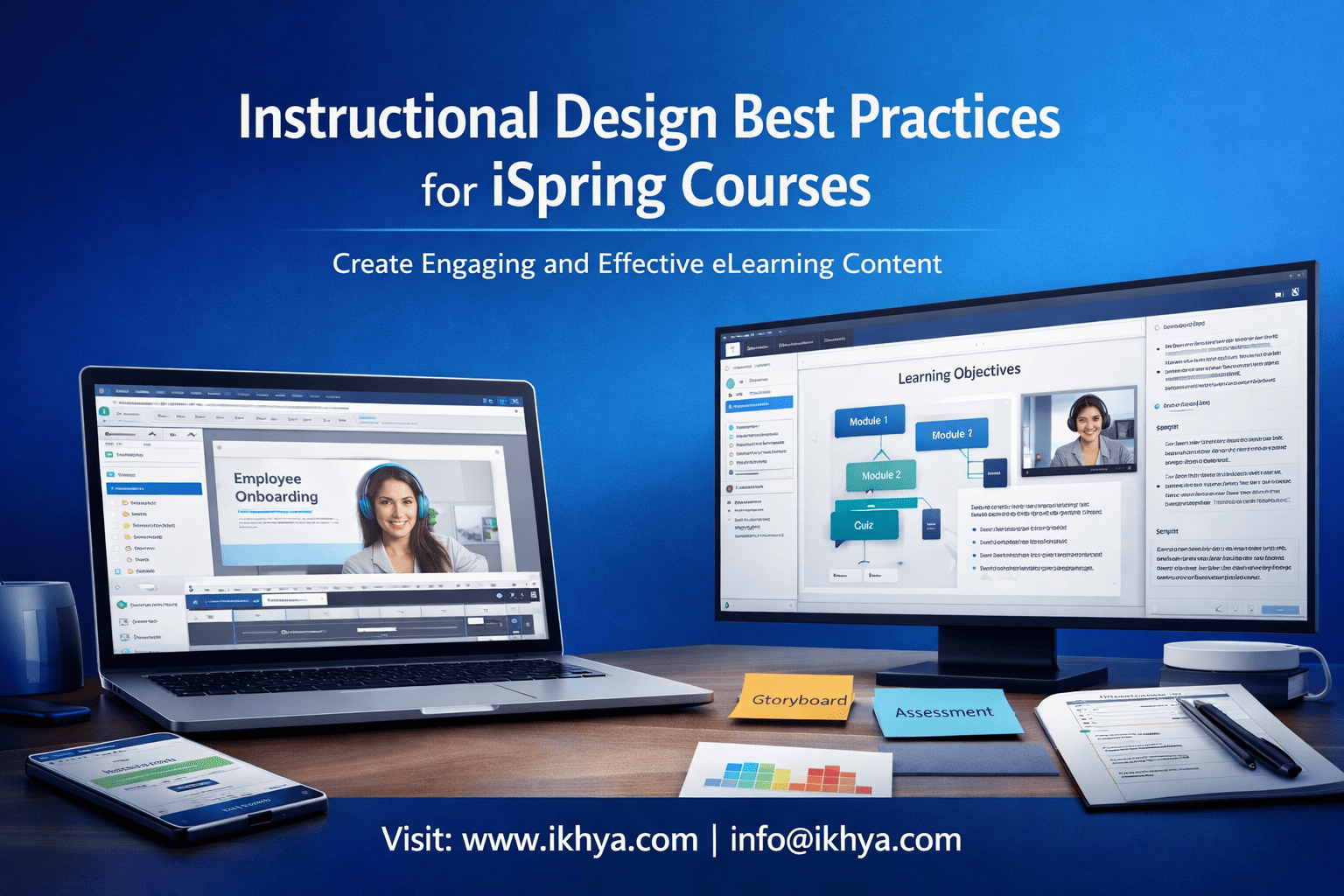
Creating effective eLearning courses is no longer just about converting slides into digital content. Organizations today need engaging, interactive, and results-driven training. This is where Instructional Design Best Practices for iSpring Courses become critical.
iSpring is widely used for rapid eLearning development, but without proper instructional design, courses can feel like static presentations. The right approach ensures better learner engagement, knowledge retention, and measurable training outcomes.
If you’re planning to build or improve your iSpring courses, working with experts can accelerate results. You can explore a free eLearning demo to see how professionally designed courses improve performance.
What Is iSpring and Why It’s Popular for Rapid eLearning
iSpring is a PowerPoint-based eLearning authoring tool that enables organizations to create interactive, SCORM-compliant, and LMS-ready courses quickly. Its simplicity and speed make it a preferred choice for corporate training teams.
Why iSpring is Widely Used
iSpring stands out because it bridges the gap between ease of use and professional output. Unlike complex tools, it allows teams to convert existing content into structured learning experiences without heavy technical expertise.
Key advantages of iSpring include:
- Seamless PowerPoint to eLearning conversion
- Built-in quiz and assessment tools
- Support for SCORM, xAPI, and LMS integration
- Faster development compared to traditional tools
- Strong support for microlearning and mobile learning
Organizations looking for quick deployment often rely on iSpring development services to scale training efficiently.
When Should You Use iSpring?
iSpring is ideal when speed and simplicity are priorities, especially in corporate environments.
Best use cases include:
| Use Case | Why iSpring Works Well |
|---|---|
| Employee onboarding | Quick rollout with structured modules |
| Compliance training | Standardized, repeatable content |
| Product training | Easy updates using PPT |
| Sales training | Fast content revisions |
When iSpring May Not Be Enough
While powerful, iSpring has limitations in advanced customization.
Consider alternatives when:
- You need highly complex simulations
- Heavy branching scenarios are required
- Custom UI/UX is a priority
Key Takeaway
iSpring is best suited for rapid, scalable, and cost-effective eLearning development, especially when paired with strong instructional design practices.
However, the real impact comes not from the tool—but from how well the course is designed.
Key Instructional Design Principles for iSpring Courses
Effective iSpring courses are not built on slides—they are built on structured learning experiences. Applying proven instructional design principles ensures your courses are engaging, outcome-driven, and aligned with business goals.
Partnering with experts offering instructional design services can significantly improve course effectiveness, especially for large-scale corporate training.
Applying the ADDIE Model in iSpring
The ADDIE model (Analyze, Design, Develop, Implement, Evaluate) provides a structured approach to building iSpring courses that deliver measurable results.
How ADDIE works in iSpring:
| Phase | Application in iSpring |
|---|---|
| Analyze | Identify learner needs, skill gaps, and business goals |
| Design | Create storyboards, define learning objectives |
| Develop | Build slides, quizzes, and interactions in iSpring |
| Implement | Publish SCORM/xAPI courses to LMS |
| Evaluate | Track learner performance and improve content |
Practical Tip:
Avoid jumping directly into PowerPoint creation. Start with a clear storyboard and learning path.
Using Bloom’s Taxonomy for Better Learning Outcomes
Bloom’s Taxonomy helps structure content based on cognitive complexity, ensuring learners move beyond basic knowledge to real understanding.
Levels and how to apply them in iSpring:
| Level | iSpring Application |
|---|---|
| Remember | Basic quizzes, recall questions |
| Understand | Concept explanations with visuals |
| Apply | Scenario-based questions |
| Analyze | Case studies, branching scenarios |
| Evaluate | Decision-making simulations |
| Create | Open-ended assignments (via LMS) |
Key Insight:
Most iSpring courses fail because they stay at the “Remember” level. High-impact training moves learners into application and decision-making.
Managing Cognitive Load for Better Retention
Cognitive Load Theory ensures learners are not overwhelmed with too much information at once.
Best practices for iSpring:
- Break content into microlearning modules
- Use one concept per slide
- Avoid cluttered visuals and excessive text
- Use narration instead of dense paragraphs
- Add interactions to reinforce learning
Instructional Design Framework Comparison
Different frameworks serve different needs. Here’s how they compare:
| Framework | Best For | iSpring Compatibility |
|---|---|---|
| ADDIE | Structured corporate training | Excellent |
| SAM (Agile) | Rapid development projects | Very high |
| Bloom’s Taxonomy | Learning depth & outcomes | Essential |
| Gagné’s 9 Events | Engagement & sequencing | High |
Real-World Example
A compliance training program redesigned using ADDIE + Bloom’s Taxonomy saw:
- 40% increase in course completion rates
- 30% improvement in assessment scores
- Reduced training time by 25%
Key Takeaways
- Instructional design is the foundation of effective iSpring courses
- Use ADDIE for structure, Bloom’s for depth, and cognitive load principles for clarity
- Focus on learning outcomes—not just content delivery
Best Practices for Designing iSpring Courses
Designing effective iSpring courses requires more than converting slides—it involves structuring content, enhancing visuals, and building meaningful interactions. The goal is to create learner-centric experiences that drive engagement and improve retention.
Organizations aiming to scale training efficiently often combine these practices with rapid eLearning development to accelerate delivery without compromising quality.
1. Structure Content for Clarity and Flow
Well-structured content ensures learners can easily follow and retain information. Poor structure leads to confusion and disengagement.
Best practices for content structuring:
- Define clear learning objectives for each module
- Organize content into logical sections and subtopics
- Use progressive disclosure (reveal information step-by-step)
- Keep modules short (5–10 minutes for microlearning)
- Include summaries at the end of each section
Example Structure:
| Section | Purpose |
|---|---|
| Introduction | Set context and expectations |
| Core Content | Deliver key concepts |
| Practice | Reinforce learning |
| Assessment | Measure understanding |
2. Use Visual Design to Enhance Learning
Visual design in iSpring should support learning—not distract from it. Since iSpring relies heavily on PowerPoint, design discipline is critical.
Effective visual design techniques:
- Use consistent templates and branding
- Limit text (follow the 6×6 rule where possible)
- Use icons, diagrams, and infographics
- Maintain proper color contrast for accessibility
- Align visuals with narration
Common Mistake:
Overloading slides with text, turning courses into “click-through presentations.”
3. Add Meaningful Interactivity
Interactivity transforms passive content into active learning experiences. iSpring provides built-in tools to create engaging interactions.
Types of interactivity to include:
- Click-and-reveal elements
- Drag-and-drop activities
- Knowledge checks after each section
- Scenario-based questions
- Role-based decision-making
Interactivity Impact Table:
| Interaction Type | Learning Benefit |
|---|---|
| Quizzes | Reinforces knowledge |
| Scenarios | Improves decision-making |
| Simulations | Builds real-world skills |
| Micro-interactions | Keeps learners engaged |
4. Optimize for Microlearning
Modern learners prefer short, focused content. iSpring supports microlearning by allowing quick module creation.
Microlearning best practices:
- Keep lessons under 7 minutes
- Focus on one objective per module
- Use standalone learning units
- Include quick assessments
5. Ensure Consistency Across Courses
Consistency improves usability and reduces cognitive effort.
Maintain consistency in:
- Navigation structure
- Button placement
- Fonts and colors
- Interaction patterns
6. Align Design with Business Goals
Every course should tie back to measurable outcomes.
Ask these questions:
- What problem is this training solving?
- How will success be measured?
- What behavior change is expected?
Key Takeaways
- Structure content logically to improve comprehension
- Use visuals to support—not overload—learning
- Add interactivity to increase engagement
- Leverage microlearning for modern learners
- Always align design with business objectives
How to Convert PowerPoint into Effective iSpring Courses
Converting PowerPoint into an iSpring course is not just a technical process—it’s a strategic instructional design task. Simply uploading slides results in passive learning. The goal is to transform static content into interactive, learner-focused experiences.
If you’re working with large volumes of legacy content, leveraging PPT to eLearning conversion services can significantly improve quality and reduce turnaround time.
Step-by-Step Process to Convert PPT to iSpring
A structured workflow ensures your courses are both engaging and effective.
Step 1: Analyze Existing Content
- Identify outdated or redundant slides
- Align content with current business goals
- Define learning objectives
Step 2: Redesign for Instructional Flow
- Break long presentations into modules
- Group related topics logically
- Add clear introductions and summaries
Step 3: Enhance Visual Design
- Simplify slide layouts
- Replace text-heavy slides with visuals
- Use consistent templates
Step 4: Add Interactivity
- Insert quizzes and knowledge checks
- Include click-based interactions
- Add scenario-based learning
Step 5: Record Narration and Media
- Add voiceovers for better engagement
- Use video demonstrations where needed
Step 6: Publish and Test
- Export as SCORM/xAPI
- Test on LMS for compatibility
- Validate tracking and reporting
PPT vs iSpring Course Transformation
| Element | Traditional PPT | iSpring Course |
|---|---|---|
| Content | Static slides | Interactive modules |
| Engagement | Low | High |
| Assessment | None or basic | Advanced quizzes |
| Tracking | Not available | LMS tracking (SCORM/xAPI) |
| Learning Experience | Passive | Active |
Common Mistakes to Avoid
Many organizations fail to unlock iSpring’s full potential due to poor conversion practices.
Avoid these mistakes:
- Converting slides without redesigning content
- Keeping excessive text on slides
- Ignoring interactivity and assessments
- Not optimizing for mobile learning
- Skipping LMS testing
Pro Tip: Think Beyond Conversion
Instead of asking “How do we convert this PPT?”, ask:
“How do we redesign this content for better learning outcomes?”
For a deeper understanding of transformation strategies, refer to this complete guide to converting PowerPoint to eLearning.
Real-World Scenario
A global organization converted 120+ PPT decks into iSpring courses:
- Reduced training time by 35%
- Increased learner engagement by 50%
- Improved compliance scores significantly
Key Takeaways
- PPT conversion should focus on learning experience, not just format
- Follow a structured process for consistency
- Add interactivity, narration, and assessments
- Always test courses in an LMS environment
Designing Interactive and Engaging iSpring Modules
Interactive iSpring modules transform passive learners into active participants by encouraging decision-making, problem-solving, and real-world application. The key is to move beyond linear slides and create experience-driven learning journeys.
For organizations aiming to scale engagement across training programs, combining interactivity with microlearning development services can significantly improve completion rates and retention.
1. Use Scenario-Based Learning
Scenario-based learning is one of the most effective ways to simulate real-world situations in iSpring.
How to implement:
- Create role-based scenarios (e.g., sales rep, manager, technician)
- Present real-life challenges
- Offer multiple decision paths
- Show consequences for each choice
Example:
A compliance training module can simulate a workplace ethics dilemma, allowing learners to choose actions and see outcomes.
2. Build Effective Quizzes and Assessments
Assessments should reinforce learning—not just test memory.
Best practices:
- Use formative quizzes after each section
- Include scenario-based questions instead of simple recall
- Provide instant feedback with explanations
- Mix question types (MCQ, drag-and-drop, hotspot)
3. Leverage Simulations for Skill-Based Training
Simulations allow learners to practice tasks in a safe environment.
Ideal for:
- Software training
- Equipment handling
- Customer service interactions
Simulation Benefits:
| Benefit | Impact |
|---|---|
| Hands-on practice | Improves skill retention |
| Risk-free learning | Reduces real-world errors |
| Realistic scenarios | Enhances confidence |
4. Use Micro-Interactions to Maintain Engagement
Small interactions throughout the course keep learners focused.
Examples:
- Click-to-reveal content
- Hover interactions
- Progress-based unlocks
- Quick knowledge checks
5. Personalize Learning Paths
Personalization improves relevance and learner satisfaction.
Ways to personalize:
- Branching scenarios based on user choices
- Role-specific content
- Adaptive learning paths (based on quiz performance)
6. Balance Interactivity with Simplicity
While interactivity is important, overloading courses can reduce effectiveness.
Avoid:
- Too many interactions per slide
- Complex navigation
- Unnecessary animations
Key Takeaways
- Use scenarios and simulations to mimic real-world situations
- Design assessments that reinforce learning
- Add micro-interactions to maintain engagement
- Personalize learning where possible
- Keep interactivity meaningful—not excessive
Mobile-Friendly and LMS-Compatible Design
Designing iSpring courses for mobile devices and LMS platforms ensures your training is accessible, trackable, and scalable across global teams. A well-optimized course delivers a seamless experience whether learners access it on desktops, tablets, or smartphones.
Organizations aiming for multi-device learning often combine this with mobile learning development solutions to maximize reach and engagement.
Why Mobile Optimization Matters
Modern learners expect flexibility. Mobile-friendly courses allow them to learn anytime, anywhere—especially critical for distributed teams across the USA, UK, UAE, and AUS.
Benefits of mobile-friendly iSpring courses:
- Higher course completion rates
- Improved learner engagement
- Better accessibility for remote teams
- Supports microlearning formats
Best Practices for Mobile-Friendly Design
iSpring supports responsive playback, but design choices still matter.
Follow these best practices:
- Use minimal text per slide
- Ensure buttons are touch-friendly
- Avoid small fonts (use at least 16px equivalent)
- Use vertical-friendly layouts
- Keep interactions simple and intuitive
LMS Compatibility: SCORM and xAPI
To track learner progress and performance, iSpring courses must be LMS-compatible.
Key standards supported:
- SCORM 1.2 / SCORM 2004 – Standard tracking (completion, scores)
- xAPI (Tin Can API) – Advanced analytics and offline tracking
SCORM vs xAPI Comparison
| Feature | SCORM | xAPI |
|---|---|---|
| Tracking | Basic (completion, score) | Advanced (behavior, interactions) |
| Offline Learning | Not supported | Supported |
| Data Insights | Limited | Detailed analytics |
| LMS Dependency | Required | Flexible (LRS support) |
LMS Integration Checklist
Before deploying your iSpring course, ensure:
- Course is published in the correct SCORM/xAPI format
- LMS supports chosen standard
- Tracking parameters are configured
- Course is tested across devices
- Reports are validated
Accessibility Considerations
Accessible eLearning ensures inclusivity and compliance.
Key accessibility practices:
- Add closed captions for audio/video
- Ensure keyboard navigation
- Maintain high color contrast
- Provide alternative text for images
For organizations with compliance requirements, integrating accessible eLearning solutions can ensure adherence to global standards like WCAG.
Key Takeaways
- Mobile-friendly design improves accessibility and engagement
- SCORM and xAPI enable tracking and analytics
- Test courses across devices and LMS platforms
- Accessibility is essential for inclusive learning
Industry Use Cases: How iSpring Courses Are Applied Across Sectors
iSpring courses are widely used across industries because they enable fast, scalable, and standardized training delivery. When combined with strong instructional design, they can address industry-specific challenges such as compliance, safety, and onboarding.
Organizations often align course design with domain needs using custom eLearning development services to ensure relevance and effectiveness.
1. Healthcare Training
In healthcare, accuracy and compliance are critical. iSpring enables rapid development of training modules for medical staff, ensuring consistency and up-to-date knowledge.
Common use cases:
- Compliance training (HIPAA, patient safety)
- Clinical procedure training
- Medical device usage
Best practices:
- Use scenario-based learning for patient interactions
- Include step-by-step simulations for procedures
- Add assessments to validate knowledge
Example Outcome:
A hospital network improved compliance training completion rates by 45% using interactive iSpring modules.
2. Manufacturing Training
Manufacturing environments require safety-focused and process-driven training. iSpring helps deliver standardized training across multiple locations.
Common use cases:
- Safety training (equipment handling, hazard prevention)
- SOP (Standard Operating Procedures) training
- Quality control processes
Best practices:
- Use video-based demonstrations
- Create interactive safety scenarios
- Include quick assessments for reinforcement
3. Compliance Training (All Industries)
Compliance training is one of the most common applications of iSpring due to its repeatable and trackable nature.
Typical compliance areas:
- Data security
- Workplace ethics
- Regulatory requirements
Best practices:
- Keep modules short and focused
- Use real-world scenarios instead of policies alone
- Track completion using SCORM/xAPI
Industry Comparison Table
| Industry | Training Focus | iSpring Advantage |
|---|---|---|
| Healthcare | Compliance, procedures | Rapid updates, standardized learning |
| Manufacturing | Safety, operations | Visual + scenario-based training |
| Compliance (General) | Regulations, policies | Scalable and trackable delivery |
Key Takeaways
- iSpring adapts well across industries due to its flexibility
- Scenario-based and interactive design is critical for effectiveness
- Compliance and safety training benefit the most from iSpring
- Industry-specific customization improves learning outcomes
iSpring vs Other Authoring Tools: Which One Should You Choose?
Choosing between iSpring and other authoring tools depends on your training complexity, timelines, and interactivity needs. While iSpring excels in rapid development and ease of use, other tools offer more advanced customization and flexibility.
If you’re unsure which tool fits your requirements, consulting experts through eLearning consultancy services can help you make the right decision.
iSpring vs Articulate Storyline
iSpring and Storyline are often compared for corporate training, but they serve slightly different purposes.
| Feature | iSpring | Storyline |
|---|---|---|
| Ease of use | Very easy (PPT-based) | Moderate learning curve |
| Development speed | Fast | Medium |
| Interactivity | Moderate | Advanced |
| Customization | Limited | High |
| Best for | Rapid eLearning | Complex simulations |
When to choose iSpring:
- Quick turnaround projects
- Converting PowerPoint content
- Standard corporate training
When to choose Storyline:
- Highly interactive simulations
- Complex branching scenarios
- Custom UI/UX requirements
iSpring vs Articulate Rise
Articulate Rise is a web-based tool focused on responsive design, while iSpring is more presentation-driven.
| Feature | iSpring | Rise |
|---|---|---|
| Design flexibility | Medium | Limited (template-based) |
| Responsiveness | Good | Excellent |
| Interactivity | Moderate | Basic |
| Development speed | Fast | Very fast |
Key Difference:
Rise is ideal for fully responsive courses, while iSpring offers more control over slide-based interactions.
iSpring vs Adobe Captivate
Adobe Captivate is known for advanced features and simulations, but it comes with complexity.
| Feature | iSpring | Captivate |
|---|---|---|
| Ease of use | High | Low |
| Learning curve | Short | Steep |
| Simulations | Basic | Advanced |
| Cost efficiency | High | Medium |
Best Use Case Comparison:
- iSpring → Rapid corporate training
- Captivate → Technical simulations and complex learning
Tool Selection Framework
Use this simple decision framework:
| Requirement | Best Tool |
|---|---|
| Fast development | iSpring |
| Advanced interactivity | Storyline |
| Mobile-first courses | Rise |
| Software simulations | Captivate |
Key Takeaways
- iSpring is best for speed, simplicity, and scalability
- Choose Storyline or Captivate for advanced interactivity
- Rise is ideal for responsive, mobile-first learning
- Tool selection should align with training goals and complexity
In-House vs Outsourced iSpring Development: Cost & Decision Guide
Choosing between in-house and outsourced iSpring development depends on your budget, timelines, internal expertise, and project complexity. While in-house teams offer control, outsourcing provides speed, scalability, and specialized expertise.
Before making a decision, many organizations evaluate options through a structured approach like a request for proposal (RFP) to compare vendors effectively.
In-House Development: Pros and Limitations
Building iSpring courses internally can work well for organizations with experienced L&D teams.
Advantages of in-house development:
- Full control over content and updates
- Better alignment with internal processes
- Faster minor revisions
Limitations:
- Requires skilled instructional designers
- Slower for large-scale projects
- Higher long-term costs (tools, resources, training)
Outsourced iSpring Development: Pros and Benefits
Outsourcing allows organizations to leverage expert teams for faster and higher-quality course development.
Benefits of outsourcing:
- Access to instructional design experts
- Faster turnaround times
- Scalable for large projects
- Better design quality and engagement
Organizations often partner with providers offering iSpring eLearning development services to ensure consistent results.
Cost Comparison: In-House vs Outsourcing
| Cost Factor | In-House | Outsourced |
|---|---|---|
| Initial setup | High | Low |
| Tool investment | Required | Included |
| Resource cost | High (salaries) | Variable (project-based) |
| Scalability | Limited | High |
| Time to launch | Slower | Faster |
When Should You Outsource?
Outsourcing is the better choice when:
- You have tight deadlines
- Large volumes of content need conversion
- Internal expertise is limited
- High-quality interactivity is required
Decision Framework
Use this quick checklist:
| Question | If YES → |
|---|---|
| Do you need fast delivery? | Outsource |
| Do you have skilled ID experts? | In-house |
| Is this a large-scale project? | Outsource |
| Do you need full control? | In-house |
Hybrid Approach (Best of Both Worlds)
Many organizations adopt a hybrid model:
- In-house team handles strategy and reviews
- External vendors handle development and scaling
This approach balances control, cost, and speed effectively.
Key Takeaways
- In-house offers control but requires resources
- Outsourcing provides speed, expertise, and scalability
- A hybrid model is often the most efficient approach
- Use structured evaluation methods (like RFPs) for vendor selection
Cost of iSpring Course Development
The cost of developing iSpring courses varies based on complexity, interactivity, content readiness, and development approach. While iSpring is considered cost-effective compared to other tools, the final investment depends on how professionally the course is designed.
Organizations planning budgets often consult eLearning consultancy services to estimate costs accurately and avoid hidden expenses.
Average Cost Range for iSpring Development
Here’s a general cost breakdown based on course complexity:
| Course Type | Cost per Hour of Content | Description |
|---|---|---|
| Basic | $500 – $1,500 | PPT conversion with minimal interactivity |
| Intermediate | $1,500 – $4,000 | Quizzes, basic interactions, voiceover |
| Advanced | $4,000 – $10,000+ | Scenarios, simulations, custom design |
Key Factors Affecting Cost
Several variables influence the overall development cost:
1. Content Readiness
- Raw content vs well-structured material
- Need for rewriting or instructional design
2. Level of Interactivity
- Basic slides vs scenario-based learning
- Simulations and branching complexity
3. Multimedia Elements
- Voiceovers
- Videos and animations
- Graphics and UI design
4. Localization and Translation
- Multi-language course development
- Cultural adaptation
5. LMS Integration
- SCORM/xAPI setup
- Testing and reporting configuration
Cost Comparison: iSpring vs Other Tools
| Tool | Cost Level | Reason |
|---|---|---|
| iSpring | Low–Medium | Faster development, PPT-based |
| Storyline | Medium–High | Custom development effort |
| Captivate | Medium–High | Advanced features and complexity |
| Rise | Low | Template-based, fast output |
Hidden Costs to Watch Out For
Even with iSpring, costs can increase if not planned properly.
Common hidden costs:
- Multiple revision cycles
- Poor initial content quality
- Lack of instructional design
- Rework due to unclear objectives
Cost Optimization Tips
To reduce development costs without compromising quality:
- Start with clear learning objectives
- Use existing content effectively
- Standardize templates
- Opt for microlearning modules
- Partner with experienced vendors
ROI Perspective
Instead of focusing only on cost, consider return on investment:
Benefits of well-designed iSpring courses:
- Reduced training time
- Improved learner performance
- Higher completion rates
- Scalable training delivery
Key Takeaways
- iSpring is a cost-effective solution for corporate training
- Costs vary based on complexity and interactivity
- Proper planning helps avoid hidden expenses
- Focus on ROI, not just development cost
Common Mistakes to Avoid in iSpring Course Design
Many iSpring courses fail not because of the tool, but due to poor instructional design decisions. Avoiding common mistakes can significantly improve learner engagement, retention, and training effectiveness.
Organizations often overcome these challenges by working with experts in instructional design services to ensure courses are strategically designed from the start.
1. Treating iSpring as Just a PPT Conversion Tool
One of the biggest mistakes is simply uploading PowerPoint slides without redesigning them for learning.
Why this fails:
- Leads to passive, slide-based learning
- Reduces engagement
- Limits knowledge retention
Better approach:
- Redesign content into interactive modules
- Add quizzes, scenarios, and narration
2. Overloading Slides with Content
Too much information on a single slide overwhelms learners and reduces comprehension.
Common issues:
- Long paragraphs
- Multiple concepts per slide
- Cluttered visuals
Best practice:
- Follow the “one idea per slide” rule
- Use visuals instead of text
- Break content into microlearning modules
3. Ignoring Interactivity
Courses without interaction quickly lose learner attention.
What goes wrong:
- Linear, click-next experiences
- No engagement or practice
- Poor learning outcomes
Solution:
- Include knowledge checks frequently
- Use scenario-based learning
- Add micro-interactions
4. Lack of Clear Learning Objectives
Without clear objectives, courses become unfocused and ineffective.
Signs of this issue:
- Content feels disconnected
- Assessments don’t align with goals
- Learners are unsure of outcomes
Fix:
- Define specific, measurable objectives
- Align content and assessments accordingly
5. Poor Visual Design
Design inconsistencies reduce professionalism and distract learners.
Common design mistakes:
- Inconsistent fonts and colors
- Low-quality images
- Poor alignment
Best practice:
- Use clean, consistent templates
- Maintain branding
- Ensure readability and accessibility
6. Not Testing LMS Compatibility
Skipping LMS testing can lead to tracking and reporting issues.
Risks:
- Course completion not recorded
- Incorrect scores
- Poor learner experience
Solution:
- Test SCORM/xAPI packages
- Validate reporting before launch
Mistakes vs Best Practices Summary
| Mistake | Best Practice |
|---|---|
| PPT-only conversion | Redesign for interactivity |
| Content overload | Microlearning approach |
| No interactivity | Scenario-based learning |
| No objectives | Outcome-driven design |
| Poor visuals | Consistent UI/UX |
| No LMS testing | Full QA before deployment |
Key Takeaways
- Avoid treating iSpring as a simple conversion tool
- Focus on learner experience and engagement
- Keep content clear, structured, and interactive
- Always align design with learning objectives
Future Trends in iSpring eLearning
The future of iSpring eLearning is focused on speed, personalization, and data-driven learning experiences. As corporate training evolves, organizations are leveraging iSpring not just for rapid development, but for delivering measurable business impact.
To stay competitive, many organizations are aligning their strategy with eLearning consultancy services to adopt modern training approaches.
1. Rise of Microlearning and Just-in-Time Training
Short, focused learning modules are becoming the standard.
Why it matters:
- Fits into busy work schedules
- Improves retention
- Enables on-demand learning
iSpring’s rapid development capabilities make it ideal for microlearning-based training ecosystems.
2. AI-Powered Personalization
AI is transforming how learners interact with content.
Emerging trends:
- Adaptive learning paths
- Personalized recommendations
- Smart assessments based on performance
3. Data-Driven Learning with xAPI
Organizations are moving beyond completion tracking to deeper analytics.
What’s changing:
- Tracking learner behavior
- Measuring engagement levels
- Linking training to business outcomes
4. Mobile-First Learning Design
Mobile learning is no longer optional—it’s expected.
Key focus areas:
- Responsive course design
- Offline access
- Mobile-friendly interactions
5. Integration with Learning Ecosystems
iSpring is increasingly integrated into broader learning environments.
Examples:
- LMS + LXP integration
- Performance management systems
- HR platforms
Key Takeaways
- Microlearning and mobile learning will dominate
- AI and analytics will drive personalization
- iSpring will continue to support rapid, scalable training
- Data-driven decision-making will shape future learning strategies
Conclusion
Designing effective iSpring courses requires more than technical expertise—it demands a strong instructional design foundation. By applying best practices such as structured frameworks, interactive design, and learner-centric approaches, organizations can transform basic content into impactful learning experiences.
From PowerPoint conversion to advanced interactivity, every step should focus on engagement, clarity, and measurable outcomes.
If you’re looking to scale your training with high-quality iSpring courses, IKHYA – eLearning Solutions Company can help you design, develop, and deploy impactful learning solutions.
Email: info@ikhya.com
You can also contact the team to discuss your project requirements.
FAQs
1. What are the best practices for iSpring course design?
Focus on clear objectives, structured content, meaningful interactivity, and mobile-friendly design to improve engagement and retention.
2. Is iSpring suitable for corporate training?
Yes, iSpring is ideal for corporate training due to its rapid development, ease of use, and LMS compatibility.
3. How do you make iSpring courses interactive?
Use quizzes, branching scenarios, simulations, and micro-interactions to actively engage learners.
4. What is the cost of iSpring course development?
Costs typically range from $500 to $10,000+ per hour of content depending on complexity and interactivity.
5. Can iSpring courses be used on mobile devices?
Yes, iSpring supports responsive playback, making courses accessible on mobile, tablet, and desktop devices.
6. What is the difference between iSpring and Storyline?
iSpring is faster and easier for development, while Storyline offers advanced interactivity and customization.
7. How do you convert PowerPoint to iSpring effectively?
Redesign content, add interactivity, include narration, and ensure LMS compatibility instead of direct conversion.
8. Should you outsource iSpring course development?
Outsourcing is ideal for large-scale projects, tight timelines, or when expert instructional design is required.
9. What instructional design models work best with iSpring?
ADDIE, SAM, and Bloom’s Taxonomy are commonly used to structure effective iSpring courses.
10. How long does it take to develop an iSpring course?
Development timelines range from a few days to several weeks depending on course complexity and content readiness.
11. What types of training are best suited for iSpring?
iSpring works well for onboarding, compliance, product training, and sales enablement programs.
12. Does iSpring support SCORM and xAPI?
Yes, iSpring supports SCORM 1.2, SCORM 2004, and xAPI for LMS tracking and analytics.
13. How can I improve learner engagement in iSpring courses?
Use storytelling, scenarios, quizzes, and multimedia elements to create engaging learning experiences.
14. Is iSpring good for microlearning?
Yes, iSpring is highly effective for creating short, focused microlearning modules quickly.
15. What are common mistakes in iSpring course design?
Common mistakes include content overload, lack of interactivity, poor visuals, and unclear learning objectives.
16. Can iSpring be used for compliance training?
Yes, iSpring is widely used for compliance training due to its scalability and tracking capabilities.
17. How do you ensure LMS compatibility for iSpring courses?
Publish courses in SCORM/xAPI format and test them thoroughly within your LMS before deployment.
18. What industries use iSpring for training?
Industries like healthcare, manufacturing, finance, retail, and IT commonly use iSpring for training.
19. How can I reduce iSpring development costs?
Use clear objectives, existing content, templates, and microlearning to reduce development time and costs.
20. Is iSpring suitable for global training programs?
Yes, iSpring supports localization, multi-language content, and LMS integration for global training delivery.
Related Resources
Explore these additional resources to expand your iSpring strategy, improve course quality, and make better development decisions.