Scenario-Based Learning Using Lectora Inspire: Complete Guide for Corporate Training

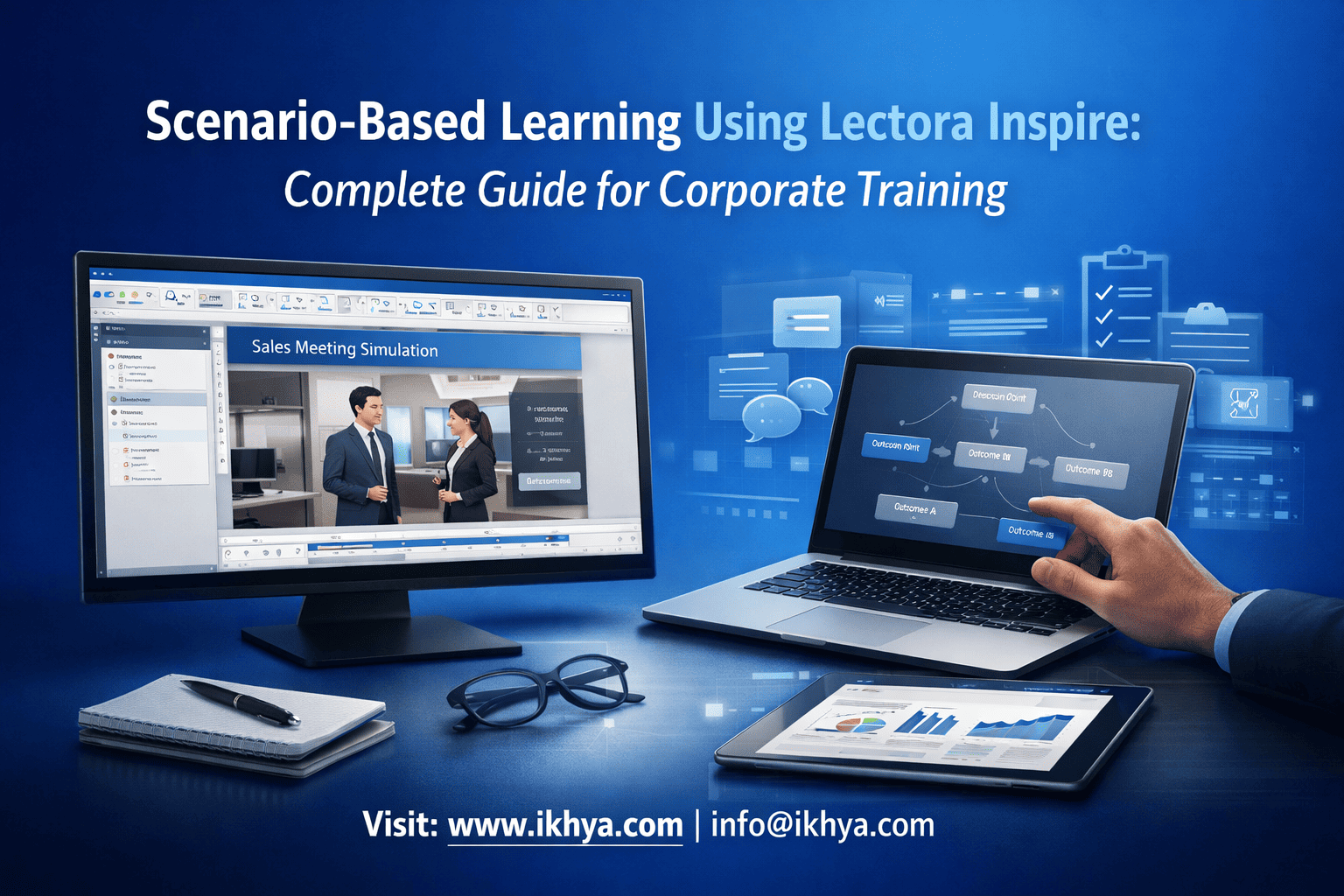
Scenario-based learning (SBL) transforms corporate training by placing learners in realistic situations where they make decisions and experience outcomes. Unlike traditional linear eLearning, SBL actively engages employees, enhances problem-solving skills, and improves knowledge retention. Using Lectora Inspire, organizations can create interactive, responsive, and measurable scenario-based courses that align with business objectives and industry compliance standards. Early adoption of SBL can help teams tackle real-world challenges while keeping training engaging and effective. To explore how your organization can implement this, you can book a free eLearning demo and see scenario-based learning in action.
What is Scenario-Based Learning?
Scenario-based learning is a learner-centric approach that uses realistic simulations to teach decision-making, problem-solving, and critical thinking. Instead of passively reading content, learners navigate through scenarios where their choices influence outcomes. This method closely mimics real-world situations, helping employees retain knowledge and apply it effectively on the job.
Definition and Core Principles
- Active Decision-Making: Learners choose actions and experience consequences.
- Contextual Learning: Scenarios are tied to actual workplace challenges.
- Branching Paths: Different decisions lead to unique outcomes, reinforcing learning.
- Immediate Feedback: Learners understand the impact of their choices in real time.
Benefits for Corporate Training
- Higher Engagement: Interactive scenarios prevent passive learning and boredom.
- Improved Retention: Experiential learning ensures long-term knowledge retention.
- Risk-Free Practice: Employees can practice complex tasks without real-world risks.
- Measurable Outcomes: Track learner performance through SCORM/xAPI data.
- Industry Compliance: Scenarios ensure adherence to regulatory standards in healthcare, finance, and manufacturing.
By integrating scenario-based learning into your corporate training, organizations can bridge the gap between knowledge and practice, turning theory into actionable skills.
Why Choose Lectora Inspire for Scenario-Based Learning
Lectora Inspire is a versatile eLearning authoring tool that enables organizations to create engaging, interactive, and responsive scenario-based courses. Its robust features support branching scenarios, multimedia integration, and mobile-ready learning experiences, making it ideal for corporate training across industries.
Key Features Supporting Scenario-Based Learning
- Branching Scenarios: Create multiple learning paths based on learner decisions, simulating real-life outcomes.
- Interactive Elements: Integrate quizzes, drag-and-drop exercises, and clickable simulations to reinforce learning.
- Responsive Design: Ensure courses work seamlessly across desktops, tablets, and smartphones without losing interactivity.
- SCORM/xAPI Compliance: Track learner choices, performance, and completion rates in your LMS.
- Multimedia Support: Incorporate audio, video, and animations to enhance scenario realism.
- Templates and Libraries: Access pre-built templates and scenario examples to accelerate development.
Branching Scenarios and Interactive Elements
Branching allows learners to experience the consequences of their decisions in a controlled, safe environment. For example:
- A healthcare compliance course can present a patient confidentiality dilemma, where learners’ choices lead to different outcomes, reinforcing best practices.
- In manufacturing, a safety scenario can guide employees through hazard recognition and proper response procedures.
- Retail employees can navigate customer service scenarios to practice handling difficult interactions.
Organizations looking to implement scenario-based learning can explore Lectora Inspire development services to create customized, high-impact courses.
Designing Scenario-Based Courses in Lectora Inspire
Creating effective scenario-based learning (SBL) courses in Lectora Inspire involves a structured process that combines instructional design principles with the tool’s interactive features. Proper planning ensures learners are engaged, decisions are meaningful, and outcomes reinforce real-world skills.
Step-by-Step Development Process
- Analyze Learning Objectives
- Identify the specific skills, knowledge, or compliance requirements the scenario aims to address.
- Align objectives with measurable outcomes to track learner performance.
- Develop Realistic Scenarios
- Base scenarios on actual workplace situations.
- Include decision points where learners’ choices lead to different consequences.
- Ensure scenarios reflect organizational policies, safety protocols, or customer expectations.
- Design Branching Paths
- Map decision points using flowcharts to visualize outcomes.
- Incorporate multiple paths to simulate realistic problem-solving experiences.
- Keep the number of branches manageable to avoid cognitive overload.
- Integrate Interactive Elements
- Use quizzes, drag-and-drop activities, and clickable media to enhance engagement.
- Provide immediate feedback to guide learners and reinforce correct decisions.
- Implement Multimedia
- Add audio, video, and animations to make scenarios immersive.
- Consider voiceover for storytelling and contextual cues.
- Test and Iterate
- Conduct pilot runs to identify gaps in logic or engagement.
- Collect feedback from SMEs and learners to refine the course.
Best Practices for Engagement and Learning Retention
- Keep decision points clear and outcomes meaningful.
- Avoid overloading learners with too many simultaneous choices.
- Use real-world consequences to reinforce learning.
- Include recap or reflection points after each scenario to consolidate knowledge.
- Ensure mobile-friendly and responsive design for multi-device access.
For organizations looking to develop scenario-based courses efficiently, partnering with a specialized provider can accelerate development and enhance instructional quality. Companies can request a free consultation to explore tailored scenario-based eLearning solutions.
Real-World Industry Applications
Scenario-based learning (SBL) is highly adaptable across industries, allowing organizations to train employees on complex tasks, compliance requirements, and decision-making skills in a safe environment. Lectora Inspire enables the creation of realistic, interactive scenarios tailored to each industry’s unique challenges.
Healthcare Compliance Training Example
- Scenario: Handling patient data while ensuring HIPAA compliance.
- Learning Objective: Reinforce privacy protocols and ethical decision-making.
- Interactive Elements: Branching scenarios where choices determine patient outcomes and compliance adherence.
- Outcome: Employees learn proper procedures, reducing errors and regulatory risk.
- Estimated Timeline & Cost: 3–4 week development cycle; $12,000–$18,000 per module, depending on interactivity level.
Manufacturing Safety Training Example
- Scenario: Responding to machinery hazards on the production floor.
- Learning Objective: Increase awareness of safety protocols and emergency response.
- Interactive Elements: Clickable hazards, decision-driven consequences, and animated simulations.
- Outcome: Lower workplace accidents and improved adherence to safety standards.
- Estimated Timeline & Cost: 2–3 weeks; $10,000–$15,000 per module.
Retail Customer Service Scenario
- Scenario: Handling difficult customers in-store or online.
- Learning Objective: Enhance problem-solving and communication skills.
- Interactive Elements: Branching dialogues, multiple resolution paths, feedback on outcomes.
- Outcome: Improved customer satisfaction and staff confidence.
- Estimated Timeline & Cost: 2 weeks; $8,000–$12,000 per module.
These examples demonstrate how scenario-based learning in Lectora Inspire can be applied practically to train employees, reduce errors, and ensure compliance. Businesses can explore healthcare and manufacturing eLearning solutions to see pre-built SBL modules in action.
Comparing Lectora Inspire with Other Authoring Tools
When selecting an authoring tool for scenario-based learning, organizations often compare Lectora Inspire with alternatives like Articulate Storyline and Adobe Captivate. Each tool has strengths and limitations depending on interactivity needs, development speed, and industry requirements.
Lectora vs Articulate Storyline
| Feature | Lectora Inspire | Articulate Storyline |
|---|---|---|
| Branching Scenarios | Robust, supports complex paths | Strong, easier for linear or simple paths |
| Mobile Responsiveness | Built-in responsive design | Requires Rise 360 for full responsiveness |
| Multimedia Support | Advanced, integrates animations & audio | Excellent, strong video and media tools |
| LMS Compatibility | SCORM/xAPI compliant | SCORM/xAPI compliant |
| Best Use Case | Compliance, safety, multi-device courses | Quick interactivity, Storyline templates |
Lectora vs Adobe Captivate
| Feature | Lectora Inspire | Adobe Captivate |
|---|---|---|
| Branching Scenarios | Easy to manage with flowcharts | Strong but can be complex for beginners |
| Mobile & Multi-device | Fully responsive | Mobile-friendly but limited flexibility |
| Interactive Elements | Quizzes, drag-drop, simulations | Simulations, VR, responsive interactions |
| Ease of Use | Moderate learning curve | Steeper learning curve |
| Best Use Case | Corporate training, compliance | Software simulations, advanced interactivity |
Pros and Cons Summary
- Lectora Inspire: Best for highly interactive, branching scenarios and responsive design.
- Articulate Storyline: Easier for rapid content creation with strong template support.
- Adobe Captivate: Powerful for software simulations and VR, but steeper learning curve.
Organizations can compare Lectora Inspire with Storyline and Captivate to determine the most suitable tool for their scenario-based training needs.
Cost, Timeline, and ROI Considerations
Investing in scenario-based learning (SBL) requires careful planning of budget, development time, and expected return on investment. Lectora Inspire allows for scalable course creation, but costs and timelines vary depending on complexity and interactivity.
Typical Scenario-Based eLearning Development Costs
| Course Complexity | Estimated Cost Range | Notes |
|---|---|---|
| Basic (linear with minor branching) | $5,000 – $8,000 | Short modules, minimal multimedia |
| Intermediate (moderate branching) | $10,000 – $15,000 | Includes quizzes, drag-drop activities |
| Advanced (complex branching + multimedia) | $18,000 – $25,000 | Highly interactive, multimedia-rich, multiple outcomes |
Project Timelines
- 2-Week Model: Basic scenario-based modules, limited branching, pre-approved assets.
- 4-Week Model: Intermediate complexity with branching, multimedia integration, and SME review.
- 6+ Weeks Model: Advanced scenarios with multiple decision points, interactive simulations, and testing iterations.
Measuring Learning Impact and ROI
- Track learner choices and completion rates via SCORM/xAPI in your LMS.
- Evaluate knowledge retention through pre- and post-assessments.
- Measure behavioral changes on the job, e.g., error reduction, improved compliance adherence.
- Estimate ROI based on reduced errors, saved training time, and enhanced employee performance.
Organizations can explore Lectora Inspire cost and development insights to plan budgets effectively for scenario-based learning initiatives.
Outsourcing Scenario-Based Learning Development
Outsourcing scenario-based learning (SBL) can help organizations leverage expert instructional design, reduce internal workload, and ensure high-quality courses. Lectora Inspire development partners provide tailored solutions, industry-specific expertise, and faster turnaround times.
Vendor Selection Framework
- Define Objectives: Identify course goals, target audience, and interactivity requirements.
- Evaluate Expertise: Look for vendors with experience in scenario-based learning, Lectora Inspire, and your industry.
- Check Portfolios: Review sample courses, branching complexity, multimedia integration, and mobile responsiveness.
- Assess Processes: Ensure vendors follow structured instructional design and QA workflows.
- Request Proposal: Compare cost, timelines, and included services before finalizing a vendor.
Risks and Benefits of Outsourcing
Benefits:
- Access to expert instructional designers and developers.
- Faster project completion with tested templates and frameworks.
- Reduced internal resource burden and skill gaps.
Risks:
- Potential misalignment with company policies or culture.
- Communication gaps may affect scenario realism.
- Cost variability depending on customization and complexity.
Key Questions to Ask Before Hiring
- Do you have experience with Lectora Inspire scenario-based courses in my industry?
- Can you provide measurable outcomes from previous projects?
- How do you handle branching, multimedia integration, and LMS compatibility?
- What are your revision and testing processes?
- Can you deliver within the required timeline and budget?
Companies can explore outsourcing Lectora Inspire development to leverage professional expertise for high-impact scenario-based learning.
Future Trends in Scenario-Based eLearning
Scenario-based learning is evolving with new technologies and instructional strategies, enhancing engagement, personalization, and effectiveness. Lectora Inspire supports modern approaches that integrate AI, microlearning, and mobile-first design for next-generation corporate training.
AI and Automation in SBL
- Adaptive Learning Paths: AI can personalize scenarios based on learner performance.
- Automated Feedback: Intelligent systems provide instant, context-specific guidance.
- Content Recommendations: Learners receive tailored modules based on skill gaps and past decisions.
Microlearning and Mobile Integration
- Break scenarios into short, focused modules for easier consumption.
- Mobile-friendly design ensures learners can access courses on smartphones and tablets anytime.
- Micro-scenarios support just-in-time training and reinforce learning in real-world contexts.
Emerging Industry Applications
- Healthcare: Virtual patient simulations for compliance and decision-making.
- Manufacturing: Interactive hazard recognition and safety drills.
- Retail: Micro-scenarios for customer service challenges and upselling techniques.
These trends demonstrate how scenario-based learning in Lectora Inspire is becoming more dynamic, data-driven, and learner-centric. Organizations can explore mobile learning development solutions to future-proof their training programs.
Conclusion
Scenario-based learning in Lectora Inspire empowers organizations to create interactive, decision-driven training that improves engagement, knowledge retention, and real-world performance. By leveraging branching scenarios, multimedia elements, and responsive design, companies can deliver effective corporate training across industries like healthcare, manufacturing, and retail.
Investing in scenario-based courses, whether developed in-house or outsourced, ensures employees gain practical experience in a safe, measurable environment. Decision-makers can evaluate vendors, compare authoring tools, and plan budgets to maximize ROI while aligning training with business goals.
To implement high-quality scenario-based learning, organizations can request an RFP for Lectora Inspire courses and start developing engaging, impactful training modules.
FAQs
1. What is scenario-based learning?
Scenario-based learning is an interactive approach where learners make decisions in realistic situations, experiencing outcomes that reinforce practical skills.
2. Why use scenario-based learning in corporate training?
It enhances engagement, knowledge retention, and decision-making skills while providing risk-free practice.
3. Can Lectora Inspire handle complex branching scenarios?
Yes, Lectora Inspire supports multiple decision paths and branching scenarios with multimedia integration.
4. Is scenario-based eLearning mobile-friendly?
Lectora Inspire ensures responsive design for desktops, tablets, and smartphones.
5. What industries benefit most from scenario-based learning?
Healthcare, manufacturing, retail, finance, and IT benefit significantly.
6. How long does it take to develop a scenario-based course in Lectora?
Depending on complexity, courses take 2–6 weeks.
7. What is the cost range for scenario-based eLearning?
Costs range from $5,000 for basic modules to $25,000+ for advanced interactive scenarios.
8. Can scenario-based learning improve compliance training?
Yes, it reinforces regulatory standards by simulating real-world compliance decisions.
9. Should I develop courses in-house or outsource?
Both are viable; outsourcing can save time and leverage expert instructional design.
10. How do I measure the effectiveness of scenario-based learning?
Track learner performance, completion rates, and behavior changes via SCORM/xAPI.
11. Does Lectora Inspire integrate with LMS platforms?
Yes, it supports SCORM, xAPI, and LMS tracking.
12. Can I reuse scenarios across multiple courses?
Yes, reusable templates and scenarios help reduce development time.
13. Are microlearning scenarios possible in Lectora?
Yes, Lectora supports microlearning modules for short, focused scenario training.
14. What kind of interactive elements can I include?
Quizzes, drag-and-drop exercises, branching decisions, and multimedia simulations.
15. How does scenario-based learning support remote teams?
It enables accessible, mobile-friendly training that employees can complete anywhere.
16. Can I combine scenario-based learning with traditional eLearning?
Yes, blending SBL with linear content improves engagement and knowledge retention.
17. How do I ensure scenarios are realistic?
Use real-world situations, consult SMEs, and test scenarios with pilot learners.
18. What are common mistakes in scenario-based course design?
Overcomplicating branches, unclear decisions, or insufficient feedback for learners.
19. Can Lectora Inspire track learner decisions?
Yes, detailed reporting on choices and outcomes is possible via LMS integration.
20. How do I start creating scenario-based courses?
Define objectives, design realistic scenarios, integrate interactivity, and leverage Lectora Inspire’s features for responsive, engaging courses.
Related Resources
Expand your knowledge of scenario-based learning and Lectora Inspire with these essential resources: