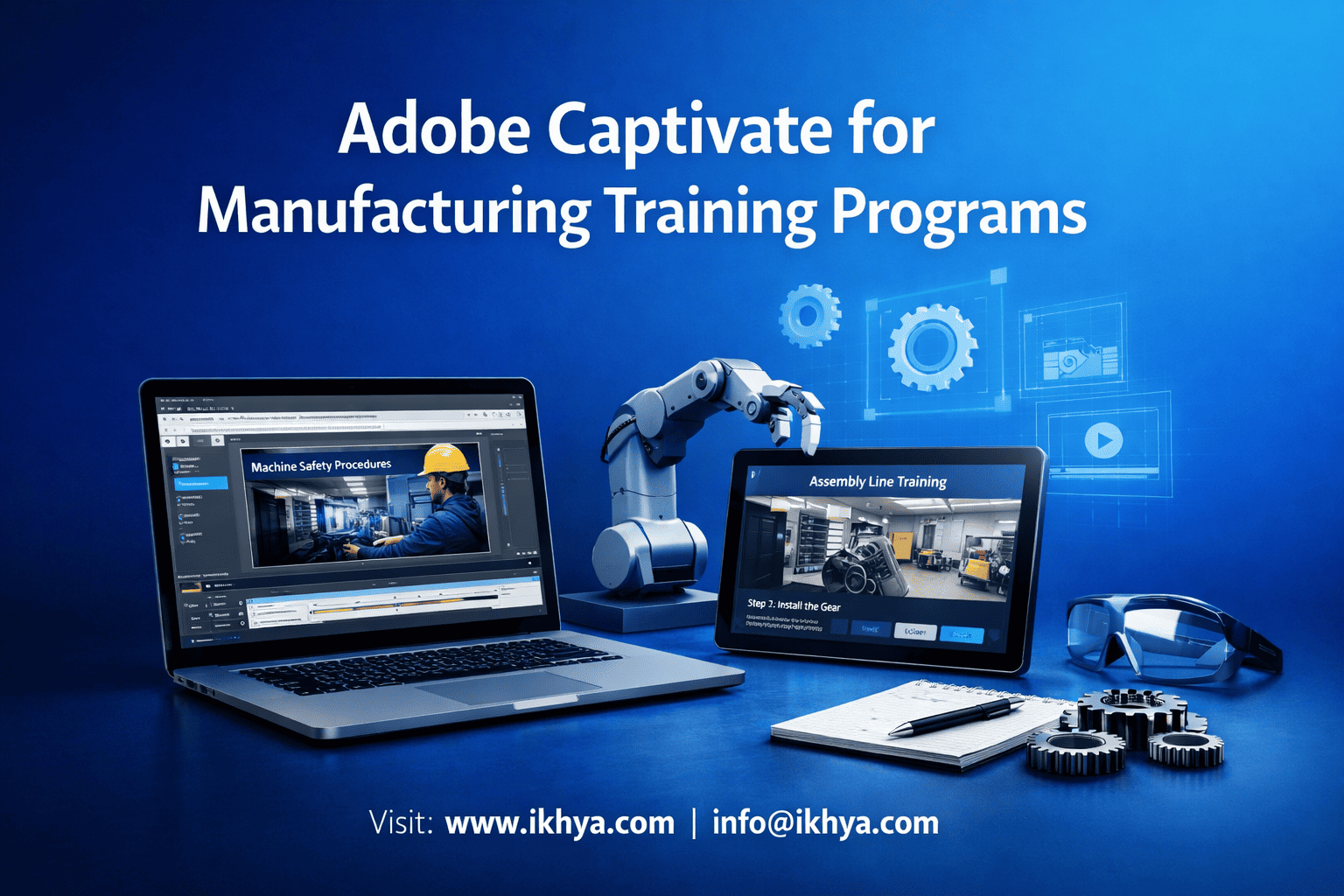
Adobe Captivate for Manufacturing Training Programs

Manufacturing training is evolving fast—and traditional classroom methods are no longer enough. Companies need scalable, interactive, and compliance-ready solutions. That’s where Adobe Captivate comes in. It enables organizations to create immersive, simulation-based training programs tailored for real factory environments.
If you’re looking to modernize training, explore our manufacturing elearning solutions or book a quick consultation to see what’s possible.
What is Adobe Captivate and Why It Matters for Manufacturing Training
Adobe Captivate is an advanced eLearning authoring tool used to create interactive, simulation-based, and mobile-friendly training content. For manufacturing, it plays a critical role in delivering safe, scalable, and standardized training across locations.
Why Manufacturing Needs Tools Like Captivate
Manufacturing environments are complex and high-risk. Training must be:
- Accurate and consistent across multiple plants
- Safe (without exposing learners to real hazards)
- Scalable for large workforces
- Trackable via LMS (SCORM/xAPI compliant)
Traditional training struggles to meet these needs.
How Adobe Captivate Solves These Challenges
Captivate enables organizations to:
- Build realistic equipment simulations
- Deliver scenario-based safety training
- Create mobile-ready microlearning modules
- Track performance using LMS analytics
Example Scenario
A factory onboarding program can include:
- Interactive walkthrough of the production floor
- Simulated machine operations
- Safety compliance quizzes
- Emergency response scenarios
This reduces onboarding time while improving retention and safety outcomes.
Key Capabilities for Manufacturing Training
| Capability | Impact on Manufacturing Training |
|---|---|
| Simulation-based learning | Safe practice of machine operations |
| Responsive design | Access training on shop-floor devices |
| SCORM/xAPI compliance | Track learner performance |
| Scenario-based modules | Improve decision-making skills |
| Video + interactive overlays | Enhance engagement |
Many organizations combine Captivate with broader digital strategies outlined in this corporate elearning development guide to ensure long-term scalability.
If you’re planning to implement such programs, consider working with experts in custom elearning development services to accelerate results.
Key Features of Adobe Captivate for Manufacturing eLearning
Adobe Captivate offers a powerful set of features specifically suited for manufacturing training, including simulations, responsive design, VR learning, and advanced assessments. These capabilities help organizations deliver safe, scalable, and highly interactive training experiences across factory environments.
1. Simulation-Based Training for Equipment Handling
Captivate allows you to create realistic software and process simulations, which are essential for manufacturing environments where hands-on practice can be risky or expensive.
What you can build:
- Machine operation walkthroughs
- SOP (Standard Operating Procedure) simulations
- Maintenance training modules
- Troubleshooting scenarios
Why it matters:
- Reduces equipment damage risks
- Enables safe practice before real-world exposure
- Improves skill retention
For advanced simulation workflows, many companies leverage simulation-based training services to build highly realistic modules.
2. Responsive Design for Shop-Floor Learning
Manufacturing workers often access training on tablets or mobile devices directly on the shop floor. Captivate supports fully responsive design, ensuring courses adapt to any screen size.
Key advantages:
- Train workers anytime, anywhere
- Enable just-in-time learning
- Improve accessibility for distributed teams
3. Virtual Reality (VR) and Immersive Learning
Captivate supports 360-degree images and VR-based learning, allowing learners to explore virtual factory environments.
Use cases in manufacturing:
- Safety hazard identification
- Emergency response training
- Facility walkthroughs
This is particularly useful in high-risk industries like oil & gas and aviation.
4. Advanced Interactions and Scenario-Based Learning
Captivate enables branching scenarios and decision-based learning, which are critical for compliance and safety training.
Examples:
- “What would you do?” safety scenarios
- Quality control decision-making
- Incident response simulations
These interactive elements improve critical thinking and real-world application.
5. SCORM and xAPI Compliance for LMS Integration
Captivate courses are fully compatible with LMS platforms using SCORM and xAPI standards.
Benefits:
- Track learner progress and completion
- Monitor compliance training
- Analyze performance data
This is essential for industries with strict regulatory requirements.
6. Microlearning and Modular Course Design
Captivate supports bite-sized learning modules, making it easier to train workers without disrupting operations.
Best used for:
- Safety refreshers
- Equipment updates
- Process changes
Feature Summary Table
| Feature | Manufacturing Benefit | Business Impact |
|---|---|---|
| Simulations | Safe equipment training | Reduced accidents |
| Responsive design | Mobile learning on shop floor | Higher accessibility |
| VR learning | Immersive safety training | Better retention |
| Scenario-based learning | Real-world decision making | Improved performance |
| LMS integration | Compliance tracking | Audit readiness |
| Microlearning | Quick training delivery | Minimal downtime |
These features make Captivate a strong choice for manufacturing organizations. However, selecting the right tool often depends on your specific needs, which is why many teams evaluate options through best elearning authoring tools for corporate training.
If you’re planning implementation, partnering with experts in Adobe Captivate development services can help you fully leverage these features.
Use Cases of Adobe Captivate in Manufacturing Training Programs
Adobe Captivate is widely used in manufacturing to create safety, equipment, and compliance training programs that are interactive, scalable, and measurable. Its strength lies in simulating real-world environments where employees can learn without risk.
1. Safety Training Programs
Captivate is highly effective for delivering safety training, which is critical in manufacturing environments with high operational risks.
Typical safety training modules include:
- Hazard identification training
- PPE (Personal Protective Equipment) usage
- Emergency response procedures
- Fire and evacuation drills
Example scenario:
A worker navigates a virtual factory floor and identifies safety violations. Immediate feedback helps reinforce correct behavior.
Why it works:
- Eliminates real-world risk during training
- Improves compliance with OSHA and global safety standards
- Increases retention through interactive learning
Many organizations enhance these programs using simulation-based training services for more realistic scenarios.
2. Equipment Operation and Technical Training
Training employees on complex machinery is one of the biggest challenges in manufacturing. Captivate enables hands-on virtual practice without using actual equipment.
Use cases:
- CNC machine operation training
- Assembly line procedures
- Maintenance and troubleshooting
- Calibration processes
Key benefits:
- Reduces machine downtime
- Prevents costly errors
- Standardizes training across locations
3. Compliance Training for Manufacturing Standards
Manufacturing companies must comply with strict regulations across regions (USA, UK, UAE, AUS). Captivate helps deliver consistent, trackable compliance training.
Common compliance topics:
- Workplace safety regulations
- Environmental compliance
- Quality standards (ISO, GMP)
- Industry-specific policies
What makes Captivate ideal:
- SCORM/xAPI tracking for audits
- Scenario-based compliance testing
- Automated reporting via LMS
4. Employee Onboarding Programs
Captivate simplifies onboarding by delivering structured, engaging training experiences for new hires.
Typical onboarding modules:
- Company policies and culture
- Factory walkthroughs
- Role-specific training
- Safety certifications
Example flow:
- Welcome module
- Virtual plant tour
- Safety training
- Equipment basics
- Assessment
This reduces onboarding time while ensuring consistency.
5. Process and SOP Training
Standard Operating Procedures (SOPs) are critical in manufacturing. Captivate helps convert static documents into interactive learning experiences.
Applications:
- Step-by-step process training
- Quality assurance procedures
- Production workflows
For organizations transitioning from static content, this aligns well with convert PowerPoint to elearning guide.
6. Multi-Language Training for Global Workforce
Manufacturing companies often operate across multiple countries. Captivate supports localization and translation, making training accessible globally.
Benefits:
- Consistent training across regions
- Improved comprehension for non-English speakers
- Faster global deployment
This is often implemented alongside elearning translation and localization services.
Use Case Summary Table
| Use Case | Training Objective | Key Outcome |
|---|---|---|
| Safety training | Risk reduction | Fewer workplace incidents |
| Equipment training | Skill development | Reduced errors |
| Compliance training | Regulatory adherence | Audit readiness |
| Onboarding | Faster ramp-up | Improved productivity |
| SOP training | Process standardization | Quality consistency |
| Multi-language training | Global scalability | Workforce alignment |
These use cases show how Adobe Captivate goes beyond basic eLearning—it becomes a core training infrastructure tool for manufacturing organizations.
Before moving forward, many organizations evaluate whether Captivate is the right fit compared to other tools. This is especially important for large-scale deployments.
Benefits of Using Adobe Captivate for Manufacturing Training
Adobe Captivate helps manufacturing organizations deliver safer, faster, and more scalable training programs. Its biggest advantage is the ability to simulate real-world environments while maintaining consistency, compliance, and measurable outcomes across global operations.
1. Improved Safety and Risk Reduction
Captivate enables risk-free training environments where employees can practice hazardous tasks without real-world consequences.
Key benefits:
- Reduces workplace accidents
- Prepares employees for emergency situations
- Reinforces safety protocols through repetition
Real impact:
Organizations often see a measurable drop in safety incidents after implementing simulation-based training.
2. Faster Training Deployment Across Locations
Manufacturing companies often operate across multiple plants and regions. Captivate allows standardized training rollout at scale.
How it helps:
- Deliver consistent training globally (USA, UK, UAE, AUS)
- Eliminate dependency on in-person trainers
- Enable rapid updates for process changes
3. Cost Efficiency Compared to Traditional Training
While initial development may require investment, Captivate significantly reduces long-term training costs.
Cost savings come from:
- Reduced travel and instructor costs
- Less machine downtime
- Lower re-training expenses
Many organizations evaluate ROI alongside Adobe Captivate benefits and cost before implementation.
4. Enhanced Learning Retention and Engagement
Captivate uses interactive and scenario-based learning, which improves knowledge retention compared to passive methods.
Why it works:
- Learners actively participate
- Immediate feedback reinforces learning
- Real-world scenarios improve application
5. Compliance Tracking and Audit Readiness
Manufacturing industries must maintain strict compliance records. Captivate ensures full tracking and reporting via LMS integration.
Capabilities:
- Track completion rates
- Monitor assessment scores
- Generate compliance reports
This is critical for audits and regulatory inspections.
6. Flexibility for Different Training Formats
Captivate supports multiple training formats, making it adaptable to various needs.
Supported formats:
- Microlearning modules
- Full-length certification courses
- Video-based training
- Interactive simulations
Benefits Summary Table
| Benefit | Operational Impact | Business Outcome |
|---|---|---|
| Safety improvement | Fewer incidents | Lower liability |
| Scalability | Global rollout | Consistent training |
| Cost efficiency | Reduced expenses | Higher ROI |
| Engagement | Better retention | Improved performance |
| Compliance tracking | Audit readiness | Regulatory compliance |
| Flexibility | Multi-format training | Adaptability |
When These Benefits Matter Most
Captivate delivers the highest value when:
- You have high-risk training environments
- You need standardized global training
- Compliance and audits are critical
- You want to replace ILT with digital learning
At this stage, many organizations start evaluating whether Captivate is the best tool compared to alternatives like Storyline or Rise. Choosing the right tool directly impacts cost, scalability, and training effectiveness.
Adobe Captivate vs Other eLearning Tools for Manufacturing
Choosing the right authoring tool is critical for manufacturing training success. Adobe Captivate is powerful for simulations and immersive learning, but tools like Articulate Storyline and Rise may be better suited for different use cases. The right choice depends on your training goals, complexity, and scalability needs.
Quick Comparison: Captivate vs Storyline vs Rise
| Feature | Adobe Captivate | Articulate Storyline | Articulate Rise |
|---|---|---|---|
| Best for | Simulations, VR, complex training | Interactive scenarios | Rapid, responsive courses |
| Ease of use | Moderate to complex | Moderate | Very easy |
| Simulation capability | Advanced | Moderate | Limited |
| Responsive design | Strong | Limited | Excellent |
| Development speed | Medium | Medium | Fast |
| Customization | High | High | Limited |
| Mobile learning | Strong | Moderate | Excellent |
When to Use Adobe Captivate in Manufacturing
Captivate is the best choice when your training requires:
- High-risk simulations (machine handling, safety drills)
- Immersive learning (VR, 360-degree environments)
- Complex workflows and branching scenarios
- Advanced compliance tracking (xAPI)
Example:
Training workers on hazardous machinery where real-life mistakes are costly or dangerous.
When Storyline Might Be a Better Fit
Articulate Storyline is ideal for:
- Scenario-based compliance training
- Moderate interactivity without heavy simulations
- Faster development with strong customization
You can explore deeper differences in this Articulate Storyline vs Adobe Captivate comparison.
When Rise Works Better
Articulate Rise is best for:
- Rapid deployment of training
- Mobile-first learning environments
- Simple, clean course structures
For example, onboarding modules or policy training that need quick rollout.
Decision Framework for Manufacturing Teams
Use this simple framework:
| Training Need | Recommended Tool |
|---|---|
| Equipment simulation | Adobe Captivate |
| Safety scenario training | Captivate / Storyline |
| Compliance modules | Storyline / Rise |
| Quick onboarding | Rise |
| Mobile-first microlearning | Rise |
Key Decision Factors
Before choosing a tool, consider:
- Complexity of training content
- Timeline for deployment
- Budget constraints
- Internal vs outsourced development
- LMS compatibility (SCORM/xAPI)
At this stage, many organizations move from tool evaluation to execution planning—how to actually build and deploy training programs using Captivate.
If you’re considering implementation, working with experts in Adobe Captivate development services can significantly reduce development time and improve quality.
Step-by-Step Process to Develop Manufacturing Training Using Captivate
Developing manufacturing training with Adobe Captivate involves a structured process—from analyzing training needs to deploying SCORM/xAPI-compliant courses in an LMS. A clear workflow ensures training is accurate, scalable, and aligned with safety and compliance requirements.
Step 1: Training Needs Analysis
Start by identifying what needs to be trained and why.
Key activities:
- Analyze job roles and skill gaps
- Identify safety risks and compliance requirements
- Define learning objectives (e.g., machine operation, SOP adherence)
Example:
A plant identifies frequent errors in machine calibration—this becomes a priority training module.
Step 2: Content Collection and Structuring
Gather all relevant materials and convert them into structured learning content.
Sources include:
- SOP documents
- Existing PowerPoint training
- Videos and manuals
- SME (Subject Matter Expert) inputs
If you’re converting legacy materials, refer to this convert PowerPoint to elearning guide.
Step 3: Instructional Design and Storyboarding
This is where raw content is transformed into an engaging learning experience.
Key elements:
- Learning flow design
- Scenario creation
- Assessment planning
- Interaction design
Organizations often rely on instructional design services to ensure effective learning outcomes.
Step 4: Development in Adobe Captivate
Now the course is built using Captivate’s features.
Development tasks:
- Create simulations and interactions
- Add multimedia (audio, video, animations)
- Build branching scenarios
- Design responsive layouts
This stage determines the quality and effectiveness of the training.
Step 5: Testing and Quality Assurance
Before deployment, the course must be tested thoroughly.
Testing checklist:
- Functionality across devices
- LMS compatibility (SCORM/xAPI)
- Content accuracy
- User experience and navigation
Step 6: LMS Integration and Deployment
Once approved, the course is deployed via an LMS.
Key steps:
- Upload SCORM/xAPI package
- Configure tracking and reporting
- Assign courses to learners
- Monitor initial performance
Step 7: Continuous Improvement and Updates
Training is not a one-time activity. Continuous updates are essential.
Ongoing activities:
- Analyze learner data
- Update content for new regulations
- Improve modules based on feedback
Process Summary Table
| Step | Objective | Outcome |
|---|---|---|
| Analysis | Identify training needs | Clear learning goals |
| Content structuring | Organize materials | Ready-to-design content |
| Instructional design | Create learning flow | Engaging storyboard |
| Development | Build course in Captivate | Interactive training |
| Testing | Ensure quality | Error-free course |
| Deployment | Launch via LMS | Accessible training |
| Optimization | Improve over time | Continuous effectiveness |
Typical Timeline for Manufacturing Training Development
| Project Type | Timeline |
|---|---|
| Microlearning module | 1–2 weeks |
| Standard course (30–45 min) | 3–6 weeks |
| Simulation-heavy training | 6–10 weeks |
A structured process ensures your training is not only effective but also scalable across multiple locations and teams.
For faster execution and better results, many organizations partner with experts in Adobe Captivate development services or explore broader strategies in the corporate elearning development guide.
Cost of Adobe Captivate eLearning Development for Manufacturing
The cost of developing manufacturing training using Adobe Captivate typically ranges from $3,000 to $25,000+ per course, depending on complexity, interactivity, and simulation requirements. High-end simulation-based training for equipment or safety can increase costs significantly but delivers strong long-term ROI.
Key Factors That Influence Cost
Several variables determine the final investment:
1. Content Complexity
- Basic PPT-to-eLearning conversion → Lower cost
- Simulation-heavy training → Higher cost
2. Level of Interactivity
- Static slides → Low cost
- Scenario-based and branching → Medium
- Full simulations and VR → High
3. Course Duration
- Microlearning (5–10 min) → Lower cost
- Full courses (30–60 min) → Higher cost
4. Multimedia Requirements
- Voiceovers, animations, and video increase cost
5. Localization Needs
- Multi-language training adds 20–50% additional cost
Cost Breakdown Table
| Course Type | Complexity Level | Estimated Cost Range |
|---|---|---|
| Basic eLearning | Low | $3,000 – $6,000 |
| Interactive course | Medium | $6,000 – $15,000 |
| Simulation-based training | High | $15,000 – $25,000+ |
| VR/immersive learning | Very high | $25,000 – $50,000+ |
Cost vs ROI in Manufacturing Training
While Captivate development may seem expensive upfront, the ROI is significant.
Where savings come from:
- Reduced instructor-led training costs
- Lower machine downtime
- Fewer workplace accidents
- Faster onboarding
Example:
A safety training module costing $12,000 can prevent incidents that would cost far more in damages or compliance penalties.
In-House vs Outsourcing Cost Comparison
| Approach | Cost Impact | Pros | Cons |
|---|---|---|---|
| In-house | Medium–High | Full control | Requires skilled team |
| Outsourcing | Flexible | Faster delivery, expertise | Vendor dependency |
Many organizations reduce costs and timelines by choosing to outsource Adobe Captivate development.
Hidden Costs to Consider
Don’t overlook these:
- LMS integration and maintenance
- Content updates and revisions
- SME involvement time
- Licensing and tools
How to Optimize Your Budget
Best practices:
- Start with high-impact training (safety, compliance)
- Use microlearning to reduce development scope
- Reuse existing content where possible
- Standardize templates for scalability
For a deeper breakdown, explore Adobe Captivate benefits and cost.
When Cost Becomes a Strategic Investment
Captivate is most cost-effective when:
- Training is repeated across large teams
- Compliance requirements are strict
- Equipment training is critical
- Global rollout is required
At this stage, many organizations face a key decision—whether to build internally or partner with experts for faster, scalable execution.
If you’re evaluating vendors, you can request an RFP or explore how to choose an Adobe Captivate development company.
When to Outsource Adobe Captivate Development
Outsourcing Adobe Captivate development is the right choice when you need faster delivery, advanced simulations, or lack in-house expertise. For manufacturing organizations, outsourcing often ensures higher-quality training, reduced timelines, and better alignment with safety and compliance requirements.
Key Signs You Should Outsource
If you’re facing any of the following, outsourcing is a strong option:
- Limited internal expertise in Captivate
- Tight project timelines
- Need for simulation-heavy training
- Large-scale rollout across multiple locations
- Requirement for multi-language training
Example:
A global manufacturing company launching safety training across 5 countries can significantly benefit from outsourcing to ensure speed and consistency.
Benefits of Outsourcing Captivate Development
1. Faster Time-to-Deployment
- Experienced teams reduce development cycles
- Parallel development for large projects
2. Access to Specialized Expertise
- Instructional designers
- Captivate developers
- Multimedia specialists
3. Higher Quality Training Output
- Better simulations and interactions
- Industry-specific best practices
4. Scalability
- Easily handle large training volumes
- Support ongoing updates and localization
Outsourcing vs In-House: Quick Comparison
| Factor | In-House Development | Outsourced Development |
|---|---|---|
| Speed | Slower | Faster |
| Expertise | Limited | High |
| Cost flexibility | Fixed overhead | Scalable |
| Quality | Depends on team | Consistent, high |
| Scalability | Limited | High |
When In-House Might Still Work
Outsourcing isn’t always necessary. In-house development works if:
- You have a dedicated eLearning team
- Training needs are simple and repetitive
- You require full control over content updates
How to Choose the Right Vendor
Selecting the right partner is critical to success.
What to evaluate:
- Experience in manufacturing training
- Portfolio of simulation-based projects
- Understanding of compliance requirements
- Ability to deliver SCORM/xAPI-ready courses
- Support for localization and scalability
You can follow this detailed guide on how to choose an Adobe Captivate development company.
Outsourcing Workflow (What to Expect)
Typical process:
- Requirement analysis
- Proposal and cost estimation
- Storyboarding and approval
- Development and iterations
- QA and deployment
Outsourcing works best when you:
- Start with high-priority training modules
- Build a long-term partnership
- Standardize templates for future courses
If you’re ready to explore outsourcing, you can request an RFP or connect with experts at IKHYA – eLearning Solutions Company (info@ikhya.com) to discuss your requirements.
Best Practices for Manufacturing Training Using Captivate
To get the best results from Adobe Captivate in manufacturing training, you need more than just good tools—you need the right strategy. Applying proven best practices ensures your training is effective, scalable, and aligned with real-world factory conditions.
1. Focus on Real-World Scenarios
Manufacturing training must reflect actual job environments. Use Captivate to create realistic, job-based scenarios.
Best practices:
- Simulate real equipment and workflows
- Include common mistakes and corrective actions
- Use decision-based branching
Example:
Instead of explaining safety rules, create a scenario where learners identify hazards on a production line.
2. Keep Training Short with Microlearning
Long training sessions don’t work well on the shop floor. Break content into bite-sized modules.
Ideal structure:
- 5–10 minute modules
- One learning objective per module
- Quick assessments at the end
This approach improves retention and reduces disruption to operations.
3. Prioritize Mobile-Friendly Design
Many workers access training on tablets or mobile devices. Ensure courses are fully responsive.
Key considerations:
- Simple navigation
- Large, clickable elements
- Minimal text with visual focus
For broader strategies, explore mobile learning development solutions.
4. Use Simulations for High-Risk Training
For hazardous tasks, simulations are essential.
Where to use simulations:
- Machine operation
- Emergency response
- Maintenance procedures
This aligns well with simulation-based training services for advanced implementations.
5. Ensure Compliance and Trackability
Manufacturing training must be audit-ready.
What to implement:
- SCORM/xAPI tracking
- Mandatory assessments
- Completion certificates
This ensures compliance with global standards and regulations.
6. Standardize Design for Scalability
Consistency is key when training large teams.
Standardization tips:
- Use templates for course design
- Maintain consistent branding
- Follow uniform navigation patterns
This reduces development time and improves user experience.
7. Incorporate Continuous Feedback and Updates
Training should evolve with your operations.
Ongoing improvements:
- Analyze LMS data
- Collect learner feedback
- Update content for new processes
Best Practices Summary Table
| Practice | Why It Matters | Outcome |
|---|---|---|
| Real-world scenarios | Improves relevance | Better application |
| Microlearning | Reduces cognitive load | Higher retention |
| Mobile design | Enables access anywhere | Increased usage |
| Simulations | Safe practice | Reduced risk |
| Compliance tracking | Audit readiness | Regulatory compliance |
| Standardization | Faster scaling | Consistency |
| Continuous updates | Keeps training relevant | Long-term effectiveness |
Common Mistakes to Avoid
- Overloading courses with too much information
- Ignoring mobile optimization
- Using passive content instead of interactive learning
- Skipping LMS tracking and analytics
- Not updating training regularly
Start with high-impact areas like safety and equipment training, then expand to onboarding and compliance modules. This ensures quick ROI and stakeholder buy-in.
At this stage, your strategy, tool selection, and execution approach are aligned. The final step is understanding where manufacturing training is heading and how to stay ahead.
Before we wrap up, if you’re planning to scale your training programs, consider working with experts in Adobe Captivate development services for faster and more effective implementation.
Future Trends in Manufacturing eLearning with Adobe Captivate
Manufacturing training is rapidly evolving with technologies like AI, immersive learning, and data-driven personalization. Adobe Captivate is increasingly being used to support these trends, helping organizations create smarter, more adaptive, and future-ready training programs.
1. Immersive Learning with VR and 360° Experiences
Manufacturing companies are adopting VR-based training for high-risk environments.
What’s changing:
- Virtual plant walkthroughs
- Hazard simulations in 360° environments
- Real-world scenario replication
Impact:
- Higher engagement
- Better preparedness for real-world tasks
2. AI-Powered Personalized Learning
AI is enabling adaptive learning paths based on learner performance.
Key capabilities:
- Personalized course recommendations
- Dynamic assessments
- Predictive learning analytics
This ensures each worker gets training tailored to their skill level.
3. Data-Driven Training with xAPI and Analytics
Organizations are moving beyond completion tracking to deep learning analytics.
What to track:
- Decision-making patterns
- Simulation performance
- Knowledge gaps
Outcome:
- Continuous improvement of training programs
- Better ROI measurement
4. Microlearning and Just-in-Time Training
Short, targeted training modules are becoming the norm in manufacturing.
Examples:
- Quick safety refreshers before shifts
- Equipment updates on-demand
- Process change alerts
5. Mobile-First Training for Frontline Workers
With increasing mobile adoption, training is shifting toward mobile-first experiences.
Benefits:
- Learn on the shop floor
- Instant access to critical information
- Reduced downtime
6. Integration with Digital Ecosystems
Training is becoming part of a larger digital ecosystem.
Integrations include:
- LMS and LXP platforms
- HR systems
- Performance management tools
This creates a seamless learning experience across the organization.
Conclusion
Adobe Captivate is a powerful solution for manufacturing training programs, especially when safety, compliance, and equipment training are critical. It enables organizations to move beyond traditional methods and adopt interactive, scalable, and data-driven learning.
From simulation-based safety training to global compliance programs, Captivate helps manufacturing companies reduce risks, improve performance, and scale training efficiently.
If you’re planning to modernize your training programs, now is the right time to take action.
- Explore tailored solutions with Adobe Captivate development services
- Get expert guidance on your training strategy
- Or simply contact us to discuss your requirements
You can also reach IKHYA – eLearning Solutions Company at info@ikhya.com for a consultation.
Frequently Asked Questions (FAQs)
1. What is Adobe Captivate used for in manufacturing training?
Adobe Captivate is used to create interactive eLearning courses for safety training, equipment simulations, compliance modules, and onboarding programs in manufacturing environments.
2. How does Adobe Captivate improve safety training in manufacturing?
It enables simulation-based learning where employees can practice hazardous tasks in a risk-free environment, improving safety awareness and reducing workplace incidents.
3. Can Adobe Captivate create equipment simulation training?
Yes, Captivate can build realistic simulations for machine operations, maintenance procedures, and troubleshooting without using actual equipment.
4. Is Adobe Captivate suitable for compliance training in manufacturing?
Yes, it supports SCORM and xAPI, allowing organizations to track learner progress and maintain compliance records for audits.
5. What types of training can be developed using Adobe Captivate?
- Safety training
- Equipment training
- Compliance training
- Onboarding programs
- SOP and process training
6. How long does it take to develop a Captivate course?
- Microlearning: 1–2 weeks
- Standard course: 3–6 weeks
- Simulation-heavy training: 6–10 weeks
7. What is the cost of Adobe Captivate eLearning development?
Costs typically range from $3,000 to $25,000+ depending on complexity, interactivity, and multimedia requirements.
8. Is Adobe Captivate better than Articulate Storyline for manufacturing training?
Captivate is better for advanced simulations and immersive learning, while Storyline is often preferred for simpler interactive courses.
9. Does Adobe Captivate support mobile learning?
Yes, Captivate offers responsive design, enabling courses to work seamlessly on mobile devices, tablets, and desktops.
10. Can Adobe Captivate courses be integrated with an LMS?
Yes, Captivate supports SCORM and xAPI standards, making it compatible with most LMS platforms.
11. What are the benefits of using Adobe Captivate for manufacturing training?
- Improved safety
- Reduced training costs
- Scalable learning programs
- Better engagement and retention
- Compliance tracking
12. Is Adobe Captivate good for onboarding manufacturing employees?
Yes, it helps create structured onboarding programs with interactive modules, simulations, and assessments.
13. Can Adobe Captivate support multi-language training?
Yes, courses can be localized into multiple languages, making it ideal for global manufacturing teams.
14. What industries benefit from Adobe Captivate training?
- Manufacturing
- Oil & Gas
- Aviation
- Healthcare
- Automotive
15. What is simulation-based training in manufacturing?
It is a training approach where employees practice real-world tasks in a virtual environment, reducing risk and improving skill development.
16. When should a company outsource Adobe Captivate development?
Outsourcing is ideal when you need faster delivery, advanced simulations, or lack in-house expertise.
17. What skills are required to develop Captivate courses?
- Instructional design
- Multimedia development
- Scenario creation
- LMS integration knowledge
18. How does Adobe Captivate support microlearning?
It allows developers to create short, focused modules that can be accessed quickly, making it ideal for just-in-time training.
19. What are the limitations of Adobe Captivate?
- Steeper learning curve
- Longer development time for complex courses
- Requires skilled developers for advanced features
20. How do you choose the right eLearning tool for manufacturing training?
Evaluate based on:
Mobile learning requirements
Training complexity
Budget
Timeline
Need for simulations
Related Resources
To help you plan, implement, and scale your manufacturing training programs using Adobe Captivate, here are some carefully selected resources. These follow a structured learning path—from understanding solutions to selecting vendors and executing projects.