
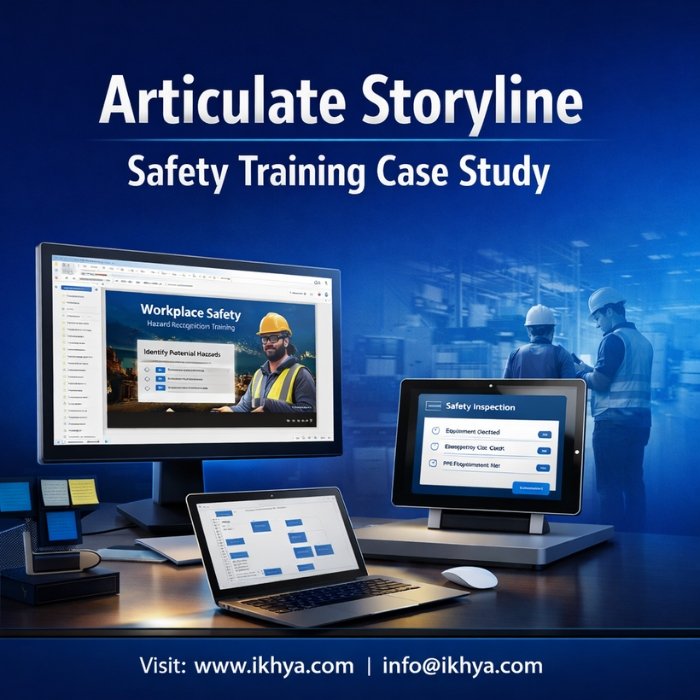


Articulate Storyline Safety Training Case Study
Workplace safety training is critical in high-risk industries. Many organizations struggle with low engagement, inconsistent procedures, and poor knowledge retention from traditional classroom training. A large enterprise needed a scalable digital training solution to standardize safety education across its workforce.
IKHYA – eLearning Solutions Company developed an interactive Articulate Storyline safety training program that improved safety awareness, training engagement, and compliance performance.
Start your corporate training transformation with IKHYA – eLearning Solutions Company.
Request a consultation or submit your RFP at info@ikhya.com.
Client Overview
The client was a large industrial equipment manufacturing company operating multiple production facilities across North America and Asia.
The organization designs and manufactures heavy mechanical components used in construction, logistics, and infrastructure projects. Because the company operates in high-risk production environments, workplace safety training is a critical operational requirement.
Organization Profile
- Industry: Industrial Manufacturing
- Employees: 6,500+ workforce
- Operational Sites: 8 manufacturing plants and 3 distribution centers
- Geographic Presence: United States, Canada, and Southeast Asia
- Workforce Composition: Machine operators, maintenance technicians, supervisors, logistics staff, and safety managers
The company’s production facilities operate 24/7 shifts, with complex machinery including:
- CNC machines
- hydraulic presses
- robotic welding equipment
- automated assembly lines
- heavy lifting equipment
These environments require strict adherence to standardized safety protocols to prevent injuries and equipment damage.
Training Environment
Before working with IKHYA – eLearning Solutions Company, the company relied heavily on instructor-led safety training.
Training was delivered through:
- classroom safety briefings
- printed operational manuals
- PowerPoint presentations
- supervisor-led demonstrations
This training approach created several challenges.
Training delivery varied across locations.
Supervisors interpreted procedures differently.
New employees received inconsistent guidance.
Additionally, the company struggled to train:
- new hires joining production teams
- temporary contractors working on projects
- experienced employees requiring annual safety recertification
Because of these challenges, leadership decided to modernize their safety training program using digital learning technology.
They needed a scalable training solution that could:
- standardize safety knowledge across locations
- improve engagement and knowledge retention
- simulate real workplace hazards
- track training performance using LMS analytics
This led the organization to partner with IKHYA to design an interactive Articulate Storyline safety training program.
Training Challenges
Before partnering with IKHYA – eLearning Solutions Company, the organization faced several operational safety training challenges. These issues affected employee safety, regulatory compliance, and production efficiency.
Inconsistent Safety Procedures Across Facilities
The company operated multiple manufacturing plants in different regions. Each facility conducted safety training in its own way.
Supervisors delivered training sessions based on personal experience rather than standardized learning materials.
This created inconsistencies such as:
- different lockout–tagout procedures
- varying machine shutdown practices
- inconsistent hazard reporting protocols
Employees transferring between facilities often noticed different safety expectations.
This inconsistency increased the risk of operational mistakes and workplace incidents.
Limited Engagement in Classroom Training
Most safety training sessions were conducted through instructor-led presentations.
These sessions included:
- long PowerPoint lectures
- printed manuals
- basic compliance tests
Employees often attended the training because it was mandatory, not because it was engaging.
As a result:
- attention levels dropped quickly
- employees retained little information
- training became a routine compliance activity rather than a learning experience
Many workers completed training but still struggled to apply procedures during real operations.
Lack of Realistic Safety Practice
Certain safety procedures are difficult to demonstrate in real environments.
For example:
- emergency equipment shutdown
- machine malfunction response
- chemical spill management
- fire evacuation procedures
Supervisors could explain these scenarios verbally, but employees rarely had the opportunity to practice them.
Without simulated practice, employees often lacked confidence when responding to unexpected incidents.
This created a serious risk because real emergencies require quick and correct decisions.
Training Scalability Problems
The organization hired hundreds of new workers each year to support expanding production.
Training had to be delivered to:
- new machine operators
- maintenance technicians
- logistics teams
- temporary contractors
Scheduling classroom sessions for every employee was difficult.
Some new hires started working on the production floor before completing full safety training.
This created potential compliance issues and operational risk.
Limited Training Performance Data
The company tracked only basic metrics such as:
- training attendance
- completion rates
- test scores
However, these metrics did not reveal whether employees could apply safety knowledge in real situations.
Leadership lacked visibility into:
- which safety topics employees struggled with
- which departments needed additional training
- how training influenced workplace safety performance
Without deeper analytics, the company could not measure the true effectiveness of their safety training program.
Compliance and Business Risks
The training challenges created several business risks.
Potential consequences included:
- workplace injuries
- OSHA compliance violations
- equipment damage
- production downtime
- increased insurance costs
Leadership realized that traditional training methods were no longer sufficient.
The organization needed a modern, scalable, and interactive training solution that could improve safety awareness and employee decision-making.
This requirement led to the development of a digital safety training program built with Articulate Storyline by IKHYA.
Training Objectives
The organization defined clear and measurable objectives before starting the training transformation project. The goal was not only to digitize safety training but also to improve real workplace safety performance.
The leadership team, safety managers, and learning and development specialists worked with IKHYA – eLearning Solutions Company to define training goals aligned with operational and compliance priorities.
Standardize Safety Procedures Across All Facilities
One of the main objectives was to ensure that every employee followed the same safety protocols regardless of location.
Before the project, safety procedures were interpreted differently at each facility.
The new training program aimed to create a single standardized safety curriculum that could be deployed globally.
This ensured employees received consistent guidance on:
- machine safety procedures
- hazard identification
- lockout–tagout processes
- emergency response protocols
- equipment maintenance safety
Standardization was essential to reduce operational errors and improve safety culture.
Reduce Workplace Safety Incidents
The organization wanted to significantly reduce accidents occurring on the production floor.
Safety managers identified common incidents such as:
- improper machine shutdown
- unsafe equipment handling
- failure to follow protective gear protocols
- incorrect response to mechanical faults
The training program aimed to improve employee decision-making in hazardous situations.
The target objective was to reduce safety incidents by at least 30 percent within 12 months of deployment.
Improve Training Engagement and Knowledge Retention
Another key objective was to increase learner engagement.
Traditional classroom training resulted in low retention because employees were passive listeners.
The new training program aimed to introduce:
- interactive learning scenarios
- simulated workplace environments
- decision-based safety situations
The objective was to improve knowledge retention and behavioral learning, ensuring employees could apply training on the job.
Increase Training Completion Rates
Scheduling classroom training across multiple locations had caused delays.
Some employees completed safety training weeks after joining production teams.
The digital training solution aimed to allow employees to access training anytime through the LMS.
The organization set a goal to increase training completion rates from 68 percent to above 90 percent within the first year.
Strengthen Regulatory Compliance
Safety compliance was another major objective.
The company needed to ensure all employees completed mandatory safety training aligned with regulatory standards.
The new training program aimed to:
- improve compliance documentation
- track certification completion automatically
- provide audit-ready training records
The target objective was to improve safety audit scores by at least 35 percent.
Enable Data-Driven Training Improvement
Leadership wanted to use analytics to continuously improve safety training.
The program needed to provide detailed insights such as:
- learner performance in safety simulations
- frequently misunderstood safety procedures
- departments requiring additional training
Using LMS reporting and learning analytics, the organization aimed to measure training effectiveness and return on investment.
By defining these measurable objectives, the company ensured that the training transformation would deliver both learning improvements and measurable business outcomes.
IKHYA designed the digital safety training program specifically to achieve these goals through interactive Articulate Storyline-based learning experiences.
Learning Solution Designed by IKHYA
To address the safety training challenges and achieve the defined objectives, IKHYA – eLearning Solutions Company designed a comprehensive interactive safety training ecosystem using Articulate Storyline.
The solution focused on three critical goals:
- improve employee engagement
- simulate real workplace safety scenarios
- enable scalable training delivery across all facilities
Instead of traditional lecture-based training, IKHYA implemented a scenario-driven digital learning program that allowed employees to actively practice safety decisions.
This approach helped transform safety training from a compliance activity into a practical skill-building experience.
Digital Learning Strategy
IKHYA developed a blended digital learning strategy that combined multiple learning methods to maximize effectiveness.
The strategy included:
- interactive scenario-based learning
- microlearning modules for quick knowledge retention
- simulation-based safety exercises
- knowledge assessments and certification tests
- mobile-compatible learning delivery
This approach ensured that employees could learn, practice, and test safety procedures in a structured learning journey.
Scenario-Based Safety Training
One of the most important elements of the solution was scenario-based learning.
Using Articulate Storyline, IKHYA created realistic workplace simulations that mirrored actual production environments.
Employees interacted with situations such as:
- identifying hazards on the production floor
- responding to machine malfunction alerts
- handling chemical exposure incidents
- choosing correct protective equipment
Each scenario required employees to make decisions.
Incorrect decisions triggered feedback explaining the risks and correct procedures.
This method allowed employees to learn from mistakes in a safe digital environment.
Simulation-Based Training
IKHYA also developed interactive equipment safety simulations.
These simulations demonstrated how employees should operate and secure machinery safely.
Examples included:
- machine start-up and shutdown procedures
- lockout–tagout implementation
- emergency equipment shutdown protocols
- hazard isolation procedures
Employees could explore these procedures step by step.
This allowed them to understand both the correct process and the consequences of unsafe actions.
Microlearning Module Design
To improve knowledge retention, the training program was divided into short microlearning modules.
Each module focused on a specific safety topic.
Examples included:
- personal protective equipment usage
- hazard identification techniques
- equipment inspection procedures
- workplace incident reporting
Most modules were 5 to 7 minutes long.
Short learning sessions helped employees complete training during work breaks without disrupting operations.
Mobile Learning Accessibility
Many employees accessed training using:
- tablets on the production floor
- mobile devices during breaks
- shared training workstations
IKHYA ensured all modules were mobile-responsive and LMS-compatible.
Employees could pause and resume training anytime.
This flexibility increased participation and improved training completion rates.
Continuous Assessment and Feedback
To ensure employees understood the material, IKHYA integrated interactive assessments throughout the training journey.
Assessment methods included:
- hazard identification quizzes
- decision-making scenarios
- equipment safety checks
- final certification tests
Immediate feedback helped learners understand mistakes and reinforce correct behavior.
The final certification test validated employee knowledge before granting safety training certification.
LMS Integration and Analytics
The training program was deployed through the company's Learning Management System (LMS).
This allowed training administrators to track:
- employee training progress
- module completion rates
- assessment scores
- knowledge gaps across departments
These analytics helped safety managers identify areas where additional training was required.
The LMS integration also created audit-ready compliance documentation, which simplified safety inspections and regulatory reporting.
By combining interactive scenarios, simulations, microlearning, and LMS analytics, IKHYA delivered a scalable safety training ecosystem that improved both employee learning outcomes and operational safety performance.
Instructional Design Strategy
To ensure the safety training program delivered measurable learning outcomes, IKHYA – eLearning Solutions Company applied a structured instructional design methodology. The design approach combined ADDIE, Bloom’s Taxonomy, and the Kirkpatrick Evaluation Model.
This framework ensured that the training was not only engaging but also aligned with operational safety behaviors and measurable performance improvements.
ADDIE Model Implementation
IKHYA used the ADDIE instructional design framework to guide the full training development lifecycle.
ADDIE includes five stages:
- Analysis
- Design
- Development
- Implementation
- Evaluation
Each stage ensured the training program addressed real workplace safety needs.
Analysis
The project began with a detailed safety training analysis.
IKHYA collaborated with:
- safety managers
- plant supervisors
- compliance officers
- learning and development teams
The goal was to identify:
- common workplace hazards
- frequent operational safety violations
- knowledge gaps among employees
- regulatory compliance requirements
This analysis helped define clear learning objectives for each training module.
Design
During the design phase, IKHYA structured the learning journey.
Key design activities included:
- defining module learning objectives
- mapping scenario-based learning paths
- designing safety simulations
- planning assessment strategies
Instructional designers created decision-based learning paths that required employees to apply safety knowledge during simulated workplace situations.
Development
During development, IKHYA built the training modules using Articulate Storyline.
The development process included:
- creating interactive safety scenarios
- building equipment operation simulations
- producing visual hazard identification exercises
- integrating multimedia such as graphics, animations, and voice narration
Each module was designed to simulate real production floor environments.
This helped learners connect training content with their daily tasks.
Implementation
Once development was completed, the training program was deployed through the organization’s Learning Management System (LMS).
Employees could access modules through:
- desktop workstations
- tablets
- mobile devices
The LMS also enabled administrators to manage:
- learner enrollment
- certification tracking
- training reminders
Evaluation
The final stage of ADDIE focused on measuring training effectiveness.
IKHYA worked with safety managers to analyze:
- assessment scores
- scenario decision accuracy
- training completion rates
These insights helped determine whether the training improved employee understanding of safety procedures.
Applying Bloom’s Taxonomy to Safety Learning
IKHYA used Bloom’s Taxonomy to design learning objectives that progressed from basic knowledge to practical application.
The training modules targeted multiple learning levels.
Remember
Employees learned key safety concepts such as:
- hazard categories
- safety equipment types
- emergency response protocols
Understand
Interactive explanations helped employees understand:
- why safety procedures exist
- how accidents occur
- the consequences of unsafe behavior
Apply
Scenario-based exercises required learners to apply knowledge.
Examples included:
- identifying hazards in simulated environments
- selecting proper protective equipment
- responding to emergency alerts
Analyze
Advanced simulations required employees to analyze complex safety situations.
For example:
- diagnosing equipment malfunction risks
- identifying multiple hazards within a production environment
By progressing through these levels, employees developed practical safety decision-making skills rather than simply memorizing procedures.
Kirkpatrick Training Evaluation Model
To measure the business impact of the training program, IKHYA applied the Kirkpatrick Four-Level Evaluation Model.
Level 1 – Learner Reaction
Employees provided feedback on training engagement and relevance.
Surveys showed strong positive responses to the interactive scenarios and simulations.
Level 2 – Learning
Assessment scores were analyzed to measure knowledge improvement.
Learners demonstrated significant improvement in:
- hazard identification accuracy
- safety procedure understanding
- emergency response decision-making
Level 3 – Behavior Change
Safety managers monitored whether employees applied training in real workplace situations.
Supervisors reported improved adherence to:
- machine safety procedures
- personal protective equipment protocols
- incident reporting processes
Level 4 – Business Results
The final evaluation focused on measurable operational outcomes such as:
- reduction in workplace incidents
- improved safety compliance scores
- increased training completion rates
These results demonstrated that the training program delivered real organizational value, not just theoretical learning improvements.
By combining ADDIE, Bloom’s Taxonomy, and the Kirkpatrick Evaluation Model, IKHYA ensured that the training program delivered structured learning design, measurable outcomes, and long-term safety performance improvements.
Technology Stack Used
To deliver a scalable and high-performance digital safety training program, IKHYA – eLearning Solutions Company implemented a carefully selected eLearning technology stack. The technology choices ensured compatibility with the client’s existing learning ecosystem, while also enabling interactive simulations and detailed learning analytics.
The stack focused on three priorities:
- interactive learning experiences
- seamless LMS deployment
- measurable training performance data
Articulate Storyline for Interactive Learning
The primary development tool used for the training program was Articulate Storyline.
Articulate Storyline is one of the most widely used enterprise eLearning authoring tools because it supports advanced interactivity and scenario-based learning.
IKHYA selected Articulate Storyline because it allowed the team to create:
- branching decision scenarios
- hazard identification simulations
- interactive equipment safety exercises
- animated safety demonstrations
- knowledge-check quizzes
Using Storyline’s triggers, layers, and variables, instructional designers built dynamic training scenarios where employee decisions affected the outcome of the learning experience.
This approach closely simulated real workplace safety situations.
SCORM Compliance for LMS Compatibility
The training modules were published using SCORM (Sharable Content Object Reference Model) standards.
SCORM ensured the training content could integrate smoothly with the company’s existing Learning Management System (LMS).
SCORM tracking enabled the organization to monitor:
- course completion
- learner progress
- assessment scores
- certification status
This made it easier for training administrators to track compliance and produce audit-ready training records.
xAPI for Advanced Learning Analytics
In addition to SCORM, the solution incorporated xAPI (Experience API) capabilities.
xAPI provides deeper insights into learner behavior.
This allowed the company to track data such as:
- learner interactions inside scenarios
- safety decision patterns
- time spent on modules
- repeated mistakes in simulations
These insights helped safety managers identify specific knowledge gaps across teams and departments.
The analytics also helped the organization continuously improve future training programs.
WCAG Accessibility Compliance
Workplace training must be accessible to all employees.
IKHYA ensured the safety training modules followed WCAG (Web Content Accessibility Guidelines).
Accessibility features included:
- keyboard navigation support
- screen reader compatibility
- high-contrast visual elements
- clear audio narration
- readable text formatting
These features ensured that employees with different learning needs could complete the training successfully.
Accessibility compliance also helped the organization meet corporate inclusion and regulatory requirements.
Multimedia Production Tools
To enhance learner engagement, IKHYA used several multimedia development tools.
These tools supported the creation of:
- safety graphics and visual diagrams
- workplace environment illustrations
- animation-based hazard demonstrations
- voice narration for safety procedures
Multimedia elements helped employees visualize complex operational risks and safety processes.
This made the training easier to understand and remember.
LMS Integration
The final training modules were integrated into the company’s existing enterprise Learning Management System.
The LMS provided capabilities such as:
- employee training enrollment
- progress tracking
- certification management
- automated training reminders
- compliance reporting dashboards
Training managers could easily monitor training status across all facilities.
The LMS integration also ensured the organization could maintain consistent safety training records for compliance audits.
By combining Articulate Storyline, SCORM standards, xAPI analytics, accessibility compliance, and LMS integration, IKHYA created a robust digital training ecosystem capable of supporting large-scale enterprise safety training.
This technology stack ensured the training program was interactive, scalable, and measurable, which are essential requirements for modern corporate learning initiatives.
Training Program Structure
IKHYA designed a structured learning program to ensure employees could progress through safety training in a clear and manageable way. The program used a microlearning-based architecture supported by simulations, assessments, and certification checkpoints.
The goal was to allow employees to learn safety concepts, practice real scenarios, and validate knowledge through assessments.
The entire training program was divided into multiple short modules so employees could complete training without disrupting production schedules.
Overall Program Architecture
The final training solution included the following structure:
- 24 microlearning safety modules
- 8 interactive scenario simulations
- 4 hazard identification exercises
- 3 knowledge assessment checkpoints
- 1 final safety certification assessment
The total training duration for the full program was approximately 2.5 to 3 hours, delivered in short sessions.
Each individual module lasted 5 to 7 minutes, making it easier for employees to complete training during short work breaks.
Core Safety Training Modules
The microlearning modules focused on essential workplace safety topics.
Examples of core modules included:
- Introduction to Workplace Safety Culture
- Hazard Identification Techniques
- Personal Protective Equipment (PPE) Usage
- Machine Operation Safety
- Lockout–Tagout Procedures
- Equipment Maintenance Safety
- Chemical Handling and Hazard Communication
- Emergency Response Procedures
- Incident Reporting and Documentation
- Workplace Fire Safety
Each module included:
- interactive visual explanations
- scenario-based questions
- quick knowledge checks
This structure ensured learners stayed engaged while absorbing critical safety information.
Scenario-Based Simulations
To reinforce learning, IKHYA created eight interactive scenario simulations using Articulate Storyline.
These simulations presented realistic workplace situations where employees had to make safety decisions.
Example scenarios included:
- identifying hazards on a production floor
- responding to equipment malfunction warnings
- selecting correct protective equipment for tasks
- handling chemical spill incidents
- performing emergency machine shutdown
Learners navigated these scenarios step by step.
Each decision triggered immediate feedback explaining:
- correct safety procedures
- potential consequences of incorrect actions
This practice helped employees build real decision-making skills.
Hazard Identification Exercises
Another key part of the training program was visual hazard identification training.
Employees were presented with images of production environments containing multiple safety hazards.
Examples included:
- exposed electrical cables
- missing protective guards on machines
- improper storage of hazardous materials
- blocked emergency exits
Learners had to identify the hazards before moving forward.
This exercise improved employee awareness and helped workers recognize risks on the job.
Knowledge Assessment Structure
The program included multiple assessments to validate learning.
Three assessment checkpoints were placed throughout the training journey.
These assessments measured understanding of:
- safety procedures
- hazard identification
- emergency response actions
Assessment formats included:
- multiple-choice questions
- scenario-based decision questions
- interactive hazard detection tasks
Employees had to achieve a minimum score of 80 percent to progress.
Final Safety Certification Assessment
At the end of the training program, employees completed a final certification assessment.
This test evaluated knowledge across all modules.
The assessment included:
- 30 scenario-based questions
- real-world operational safety decisions
- hazard analysis exercises
Employees who passed received a digital safety certification recorded in the LMS.
Those who did not pass were required to review key modules and retake the test.
Learner Journey
The training program followed a structured learning path:
- Safety Awareness Foundation Modules
- Hazard Identification Training
- Equipment Safety Procedures
- Scenario-Based Safety Simulations
- Knowledge Check Assessments
- Final Certification Exam
This structured journey ensured that employees progressed from basic safety knowledge to applied decision-making skills.
The structured training architecture allowed the organization to deliver consistent, engaging, and scalable safety training across all facilities.
Employees could complete training at their own pace while still meeting compliance requirements.
This modular approach also made it easier to update individual modules when safety procedures changed.
Development Process
IKHYA followed a structured enterprise eLearning development process to ensure the safety training program was accurate, engaging, and aligned with operational procedures.
The development workflow combined instructional design, safety subject matter expertise, and multimedia production. Each stage ensured the final program met both training effectiveness and regulatory compliance requirements.
Training Needs Analysis
The project began with a detailed training needs analysis (TNA).
IKHYA collaborated with multiple stakeholders, including:
- safety managers
- plant supervisors
- HR and L&D teams
- compliance officers
The objective was to understand the real operational safety challenges employees faced.
The analysis process included:
- reviewing workplace safety incident reports
- analyzing compliance audit findings
- interviewing supervisors and safety officers
- evaluating existing training materials
This process helped identify high-risk operational tasks and common safety violations.
The findings were used to define the core learning objectives for the new training program.
Curriculum Architecture
After completing the analysis phase, IKHYA designed the training curriculum architecture.
This step involved organizing safety topics into a logical learning sequence.
Instructional designers structured the curriculum into:
- foundational safety awareness modules
- hazard identification training
- equipment operation safety
- emergency response training
- compliance and incident reporting
The curriculum was also mapped to employee job roles.
For example:
- machine operators required detailed equipment safety modules
- maintenance technicians required advanced lockout–tagout training
- supervisors required incident investigation training
This role-based structure ensured employees received relevant safety knowledge for their specific responsibilities.
Storyboarding
Once the curriculum structure was finalized, IKHYA created detailed instructional storyboards.
Storyboards served as the blueprint for each training module.
Each storyboard included:
- screen-by-screen content flow
- learning objectives
- visual design concepts
- interactive scenario logic
- assessment questions
Safety subject matter experts reviewed these storyboards to ensure technical accuracy and regulatory compliance.
This step helped identify potential improvements before development began.
Multimedia Development
During the multimedia development phase, the design team built the training modules using Articulate Storyline.
The development process included:
- creating interactive safety scenarios
- designing production floor simulations
- producing hazard identification exercises
- adding voice narration for safety instructions
- integrating graphics and animations
Visual elements were carefully designed to reflect real production environments, including machinery, safety equipment, and facility layouts.
This realism helped learners connect training content with their daily work.
Quality Assurance
Before deployment, every module went through a multi-stage quality assurance process.
The QA team tested:
- content accuracy
- scenario logic and branching paths
- assessment scoring
- multimedia functionality
- mobile responsiveness
- LMS compatibility
Safety managers also reviewed modules to confirm that all procedures aligned with current workplace policies.
Any issues discovered during testing were corrected before final deployment.
LMS Deployment
After successful testing, the training program was packaged and uploaded to the organization’s Learning Management System.
The deployment process included:
- SCORM packaging of modules
- configuring course completion rules
- assigning training to employee groups
- enabling certification tracking
- setting automated reminders for incomplete training
Employees received training access through their LMS dashboards.
Training administrators could monitor progress across all facilities using centralized reporting tools.
By following this structured development process, IKHYA ensured that the safety training program was accurate, engaging, scalable, and aligned with real operational needs.
This disciplined workflow also allowed the organization to maintain high-quality training standards across all future learning initiatives.
Project Timeline
The safety training transformation project followed a structured enterprise development timeline to ensure accurate instructional design, stakeholder reviews, and high-quality course production.
IKHYA implemented a phased approach that allowed the organization to review each stage before moving to the next. This minimized risks and ensured the training aligned with operational safety procedures.
The total project duration was 14 weeks from initial analysis to full LMS deployment.
Phase 1: Training Needs Analysis
Duration: 2 Weeks
The project began with a comprehensive analysis of the company’s safety training requirements.
Key activities included:
- reviewing workplace incident reports
- identifying high-risk operational tasks
- evaluating existing training materials
- conducting interviews with safety managers and supervisors
- identifying compliance requirements and regulatory standards
The outcome of this phase was a detailed training requirements document outlining the learning objectives and safety topics that needed to be covered.
Phase 2: Instructional Design and Curriculum Planning
Duration: 3 Weeks
During this phase, IKHYA’s instructional design team created the learning architecture for the program.
Activities included:
- defining learning objectives for each module
- structuring the microlearning curriculum
- designing scenario-based learning activities
- planning simulation-based exercises
- mapping assessments to training objectives
Detailed instructional storyboards were developed and reviewed by subject matter experts.
This step ensured the training content accurately reflected real workplace safety procedures.
Phase 3: eLearning Development
Duration: 6 Weeks
This was the largest phase of the project.
The development team created all interactive training modules using Articulate Storyline.
Activities included:
- building interactive safety scenarios
- designing hazard identification simulations
- producing visual safety demonstrations
- integrating voice narration and graphics
- developing knowledge assessment quizzes
During development, modules were produced in batches so stakeholders could review and approve them progressively.
This helped accelerate the development cycle.
Phase 4: Quality Assurance and Testing
Duration: 2 Weeks
Before deployment, the training modules underwent extensive testing.
The QA team evaluated:
- instructional flow and clarity
- simulation accuracy
- multimedia performance
- assessment functionality
- LMS compatibility
- mobile device responsiveness
Safety managers and compliance teams also reviewed the training to verify that all procedures aligned with company safety policies.
Phase 5: LMS Deployment and Rollout
Duration: 1 Week
After final approval, the training program was deployed to the company’s Learning Management System.
Deployment activities included:
- SCORM packaging and upload
- employee enrollment setup
- certification configuration
- automated reminder settings
- reporting dashboard configuration
The training was rolled out to employees in phases to ensure smooth adoption.
Total Project Duration
| Phase | Duration |
|---|---|
| Training Needs Analysis | 2 Weeks |
| Instructional Design | 3 Weeks |
| Development | 6 Weeks |
| Quality Assurance | 2 Weeks |
| Deployment | 1 Week |
Total Duration: 14 Weeks
This structured timeline allowed the organization to launch a fully interactive digital safety training program within just over three months.
The phased approach ensured:
- strong collaboration with safety experts
- accurate training content
- high-quality learning experiences for employees
Estimated Project Cost
Enterprise eLearning development costs vary depending on the level of interactivity, number of modules, multimedia complexity, and integration requirements. The safety training program developed by IKHYA – eLearning Solutions Company included interactive scenarios, simulations, and microlearning modules built with Articulate Storyline.
Because the training involved high interactivity and realistic safety simulations, the development cost was higher than basic slide-based eLearning.
Below is a realistic cost estimate for a project of this scale.
Microlearning Module Development Cost
The program included 24 microlearning modules covering core workplace safety topics.
Typical industry pricing for interactive microlearning modules ranges between:
$1,500 – $4,000 per module
Cost depends on:
- visual design complexity
- multimedia elements
- narration
- interactions and knowledge checks
Estimated cost for 24 modules:
$36,000 – $96,000
Scenario-Based Simulation Modules
The program also included 8 interactive scenario simulations.
These modules required more development time because they included:
- branching decision paths
- multiple outcomes
- animated safety scenarios
- complex user interactions
Industry cost range for simulation-based modules:
$4,000 – $10,000 per simulation
Estimated cost for 8 simulations:
$32,000 – $80,000
Hazard Identification Exercises
The training included 4 interactive hazard detection exercises where employees analyzed workplace images and identified safety risks.
These modules involved:
- visual scene design
- interactive click-based hazard detection
- feedback explanations
Typical development cost range:
$2,000 – $5,000 per exercise
Estimated cost:
$8,000 – $20,000
Instructional Design and Project Management
Large enterprise training projects require dedicated time for:
- instructional design planning
- curriculum architecture
- SME collaboration
- storyboarding
- project coordination
Estimated cost for instructional design and project management:
$12,000 – $25,000
LMS Integration and Deployment
Deployment required technical work including:
- SCORM packaging
- LMS configuration
- reporting setup
- testing across devices
Estimated cost range:
$5,000 – $12,000
Estimated Total Project Investment
Based on the scope of the project, the total estimated investment for the training program ranged between:
$93,000 – $233,000
| Component | Estimated Cost |
|---|---|
| Microlearning Modules | $36,000 – $96,000 |
| Scenario Simulations | $32,000 – $80,000 |
| Hazard Exercises | $8,000 – $20,000 |
| Instructional Design | $12,000 – $25,000 |
| LMS Integration | $5,000 – $12,000 |
Total Estimated Investment: $93,000 – $233,000
Key Cost Drivers
Several factors influenced the final project cost.
Level of Interactivity
Scenario-based training requires more design and development time than basic slide-based courses.
Number of Modules
The more modules included in the program, the higher the overall cost.
Multimedia Production
Graphics, animations, and voice narration increase development time.
Simulations and Branching Logic
Complex decision-based scenarios require advanced programming in Articulate Storyline.
Localization
If the organization deploys training in multiple languages, translation costs increase the project scope.
LMS Integration Complexity
Advanced reporting and analytics configurations can increase deployment effort.
Despite the investment, organizations often see strong returns from safety training improvements.
Reduced workplace accidents, lower insurance costs, and improved compliance performance can deliver significant long-term financial benefits.
This is why many enterprises view digital safety training as a strategic investment rather than a compliance expense.
Results and Business Impact
After deploying the digital safety training program developed by IKHYA – eLearning Solutions Company, the organization began tracking performance metrics across multiple operational facilities. The company monitored both learning performance indicators and operational safety metrics over a 12-month period.
The results demonstrated clear improvements in safety awareness, employee engagement, and compliance performance.
Reduction in Workplace Safety Incidents
One of the most important outcomes was a measurable reduction in workplace accidents.
Before the training transformation, many incidents occurred due to:
- improper machine shutdown
- failure to follow lockout–tagout procedures
- incorrect use of personal protective equipment
- delayed response to equipment malfunction alerts
After the deployment of scenario-based safety training, employees became better at identifying hazards and responding to unsafe conditions.
Within the first 12 months, the organization recorded a 38% reduction in reportable safety incidents across production facilities.
Supervisors also reported improved adherence to safety protocols during daily operations.
Higher Training Completion Rates
The new digital learning program allowed employees to complete training through the enterprise LMS at their own pace.
Previously, classroom scheduling challenges caused delays in training completion.
After introducing the digital training system:
- completion rates increased significantly
- new employees completed safety training faster
- compliance tracking became easier
Training completion rates increased from 68% to 94% within the first year.
This improvement helped the organization maintain consistent safety knowledge across all locations.
Improved Safety Compliance Audit Scores
Regulatory compliance was a major concern for the company.
Safety inspections required documented evidence that employees completed required training programs.
The LMS-based training solution automatically tracked:
- employee certification status
- training history
- assessment scores
During the next internal safety audit cycle, the company achieved a 36% improvement in compliance audit scores.
Audit preparation also became faster because training documentation was stored in the LMS.
Faster Onboarding for New Employees
Before implementing the digital safety training program, onboarding required multiple instructor-led sessions.
New hires sometimes waited weeks before completing all required safety training.
With the new microlearning-based program:
- employees could start training immediately after joining
- modules could be completed during onboarding week
- supervisors could monitor training progress
As a result, the company achieved a 52% reduction in onboarding training time.
This allowed new employees to become productive faster while still meeting safety requirements.
Better Hazard Identification Skills
The scenario-based simulations and hazard detection exercises helped employees improve their ability to recognize workplace risks.
Assessment data showed significant improvements in hazard identification accuracy.
Employees became more effective at recognizing:
- exposed machine components
- unsafe material storage
- blocked emergency exits
- missing protective equipment
Supervisors observed that workers were more proactive in reporting safety concerns, which strengthened the company’s safety culture.
Data-Driven Training Improvement
Another major benefit of the program was access to detailed learning analytics.
Using LMS and xAPI data, training managers could identify:
- modules with lower assessment scores
- frequently misunderstood safety procedures
- departments requiring additional training
This allowed the company to continuously improve training materials and focus on areas where employees needed additional guidance.
Overall Business Value
The digital safety training initiative delivered measurable value in several areas:
| Business Metric | Improvement |
|---|---|
| Safety incidents | Reduced by 38% |
| Training completion rates | Increased to 94% |
| Compliance audit scores | Improved by 36% |
| Employee onboarding time | Reduced by 52% |
| Hazard identification accuracy | Significantly improved |
These results demonstrated that interactive scenario-based safety training can significantly improve both employee learning outcomes and operational safety performance.
For the organization, the project delivered a strong return on investment while strengthening workplace safety across all facilities.
Key Learning Outcomes
The interactive safety training program developed by IKHYA – eLearning Solutions Company significantly improved how employees understood and applied workplace safety procedures.
Instead of memorizing safety rules, employees learned how to identify risks, make correct decisions, and respond quickly in hazardous situations.
The training program produced several key learning improvements.
Stronger Safety Awareness
Employees developed a deeper understanding of workplace hazards.
Through visual simulations and hazard identification exercises, learners became better at recognizing unsafe conditions such as:
- exposed machine parts
- missing protective guards
- chemical spill risks
- blocked safety exits
- improper equipment storage
This awareness helped workers identify risks earlier and take preventive action before incidents occurred.
Improved Safety Decision-Making
Scenario-based simulations required employees to make safety decisions in realistic workplace situations.
For example, learners practiced:
- responding to equipment malfunction alerts
- choosing correct personal protective equipment
- executing emergency machine shutdown procedures
- following lockout–tagout safety protocols
Because employees practiced these situations repeatedly in training, they became more confident in responding correctly during real operational events.
Better Understanding of Safety Procedures
Interactive modules helped employees understand why safety procedures exist, not just what the procedures are.
The training explained:
- how workplace accidents occur
- how small mistakes can lead to serious incidents
- how correct safety actions prevent injuries
This deeper understanding improved compliance with safety rules.
Employees were more likely to follow procedures because they understood the consequences of unsafe behavior.
Faster Knowledge Retention Through Microlearning
The microlearning format helped employees retain information more effectively.
Short modules allowed learners to focus on one safety topic at a time.
This approach reduced cognitive overload and improved knowledge recall during daily work tasks.
Employees could also revisit specific modules whenever they needed to refresh their understanding of a safety procedure.
Increased Confidence in Emergency Situations
Emergency scenarios such as fires, equipment failure, or chemical exposure can create high-pressure situations.
The simulation exercises allowed employees to practice these situations safely.
As a result, employees reported greater confidence in handling:
- emergency shutdown procedures
- evacuation protocols
- equipment safety responses
- incident reporting processes
This confidence is critical in environments where quick decisions can prevent injuries or equipment damage.
Stronger Safety Culture Across the Organization
The training program also influenced workplace culture.
Employees became more engaged in safety discussions and proactive in reporting hazards.
Supervisors observed that teams were more willing to:
- follow safety procedures consistently
- support colleagues in maintaining safe practices
- report unsafe conditions early
This cultural shift helped strengthen the organization’s overall commitment to workplace safety.
Overall, the training program transformed safety education from a compliance requirement into a practical skill-building experience.
Employees developed the knowledge and confidence needed to protect themselves, their colleagues, and the organization’s operations.
Industries Where This Solution Applies
The Articulate Storyline safety training solution developed by IKHYA – eLearning Solutions Company can be applied across multiple industries where employees operate in high-risk environments.
Many sectors face similar safety challenges, including hazardous equipment, complex operational procedures, and strict regulatory requirements. Interactive digital safety training helps organizations standardize procedures, reduce accidents, and improve compliance.
Below are key industries where this training approach delivers strong value.
Manufacturing
Manufacturing facilities often involve complex machinery and fast-moving production lines.
Employees must follow strict safety procedures when working with:
- CNC machines
- robotic welding equipment
- conveyor systems
- hydraulic presses
- automated assembly lines
Interactive scenario-based training helps workers learn how to:
- identify machine hazards
- perform safe equipment shutdown procedures
- follow lockout–tagout protocols
- respond to mechanical faults
Digital training ensures that safety procedures remain consistent across multiple production plants.
Construction
Construction environments involve constantly changing job sites and hazardous conditions.
Workers frequently operate:
- heavy machinery
- scaffolding systems
- lifting equipment
- power tools
Scenario-based eLearning allows construction companies to simulate situations such as:
- fall prevention procedures
- equipment handling safety
- site hazard identification
- emergency response planning
Mobile-compatible training is especially useful because construction workers often access training from remote job sites.
Oil and Gas
The oil and gas industry operates in some of the most hazardous working environments.
Employees must understand strict safety procedures related to:
- drilling operations
- chemical handling
- pipeline maintenance
- confined space work
- fire and explosion prevention
Simulation-based digital training allows workers to practice responding to critical incidents such as:
- gas leaks
- equipment failure
- emergency shutdown scenarios
This type of training helps companies reduce operational risk while improving compliance with safety regulations.
Logistics and Warehousing
Logistics centers involve large-scale material handling operations.
Workers regularly interact with:
- forklifts
- pallet handling equipment
- automated storage systems
- loading docks
Interactive safety training can help employees learn:
- safe forklift operation procedures
- warehouse traffic safety
- proper material stacking techniques
- emergency response procedures
Scenario-based training helps workers make safe decisions in busy warehouse environments.
Heavy Equipment Operations
Industries such as mining, infrastructure development, and industrial maintenance rely on heavy machinery.
Operators must understand safe procedures for equipment such as:
- excavators
- cranes
- bulldozers
- drilling machines
Interactive simulations allow operators to practice:
- equipment startup and shutdown procedures
- hazard detection in work zones
- safe load handling techniques
This type of training helps reduce accidents and equipment damage.
Why Digital Safety Training Works Across Industries
The approach developed by IKHYA works effectively across many industries because it focuses on behavioral learning.
Employees learn through:
- realistic workplace simulations
- decision-based scenarios
- hazard identification exercises
- short microlearning modules
These methods improve knowledge retention and help workers apply training directly to real-world tasks.
For organizations operating in high-risk environments, this approach helps build a stronger safety culture while improving operational performance.
Related eLearning Services
The safety training program described in this case study is part of the broader enterprise learning services provided by IKHYA – eLearning Solutions Company. Many organizations require customized digital learning solutions that align with their operational workflows, compliance requirements, and workforce skill development goals.
IKHYA provides a full range of enterprise eLearning development and corporate training transformation services to help organizations modernize their training programs.
Custom eLearning Development
Many organizations require training programs that reflect their unique processes, equipment, and safety procedures.
IKHYA specializes in custom eLearning development tailored to specific operational environments.
Custom training solutions may include:
- workplace safety training
- compliance and regulatory training
- equipment operation training
- onboarding and job-role training
- leadership and management training
These programs are designed to reflect real workplace scenarios, ensuring employees can apply what they learn on the job.
Rapid eLearning Development
Organizations often need to convert existing training materials into digital learning programs quickly.
IKHYA offers rapid eLearning development services to transform legacy training content such as:
- PowerPoint presentations
- classroom training manuals
- compliance documentation
- instructor-led training materials
These materials are converted into interactive online courses that can be deployed quickly through a Learning Management System.
Rapid development helps organizations scale training programs while reducing development time.
Instructional Design Services
Effective training programs require strong instructional design.
IKHYA’s instructional design services focus on creating engaging and effective learning experiences.
The instructional design process includes:
- learning needs analysis
- curriculum architecture
- learning objective mapping
- scenario-based learning design
- assessment development
These services ensure that training programs deliver measurable learning outcomes and improved workforce performance.
Microlearning Development
Modern employees prefer short, focused learning experiences.
IKHYA develops microlearning modules designed to deliver key concepts in short learning sessions.
Microlearning is especially effective for:
- safety training
- compliance training
- product knowledge training
- sales training
Short modules allow employees to learn quickly and retain information more effectively.
Microlearning also supports just-in-time learning, where employees access training when they need it most.
Simulation-Based Training
Simulation-based learning allows employees to practice real-world decisions in a safe digital environment.
IKHYA develops interactive simulations that replicate workplace situations such as:
- equipment operation procedures
- emergency response scenarios
- customer service situations
- operational decision-making
Simulations help employees develop practical skills and decision-making confidence.
This method is highly effective in industries where mistakes in real environments could lead to serious consequences.
LMS Integration Services
For organizations using enterprise learning platforms, seamless integration with the Learning Management System (LMS) is essential.
IKHYA provides LMS integration services including:
- SCORM and xAPI course packaging
- LMS course configuration
- learner enrollment management
- reporting dashboard setup
- certification tracking
These services help organizations manage large-scale training programs while maintaining accurate training records for compliance and audits.
By combining these services, IKHYA – eLearning Solutions Company helps organizations transform traditional training programs into modern, scalable digital learning ecosystems that improve both employee performance and business outcomes.
Frequently Asked Questions
An eLearning safety training case study is a detailed documentation of how a company designed and implemented a digital training program to improve workplace safety.
It explains:
- the training challenges an organization faced
- the learning strategy used to solve the problem
- technologies used to develop the training
- the development process and timeline
- measurable business results
Enterprise buyers often review case studies to evaluate the capabilities and experience of an eLearning development company before selecting a vendor.
Articulate Storyline is one of the most popular eLearning authoring tools used in corporate training.
Organizations choose Storyline because it supports:
- scenario-based learning
- interactive simulations
- branching decision paths
- multimedia learning experiences
- SCORM and LMS compatibility
These capabilities allow companies to create realistic workplace safety scenarios that improve learner engagement and knowledge retention.
Scenario-based training places learners in realistic workplace situations where they must make decisions.
Instead of simply reading safety procedures, employees must choose the correct action during simulated situations.
For example:
- identifying a hazard on the production floor
- responding to equipment malfunction alerts
- selecting proper protective equipment
This method improves learning because employees practice applying knowledge rather than memorizing rules.
Digital safety training is valuable in industries where employees face operational hazards or regulatory compliance requirements.
Common industries include:
- manufacturing
- construction
- oil and gas
- logistics and warehousing
- heavy equipment operations
- utilities and energy
- chemical processing
These industries require consistent safety procedures and ongoing training to reduce operational risk.
Development time depends on several factors such as:
- number of modules
- level of interactivity
- multimedia production requirements
- subject matter expert reviews
- LMS integration needs
For a mid-size enterprise training program, development typically takes 10 to 16 weeks.
Large global training programs may require several months of development.
The cost of eLearning development varies based on complexity.
Typical industry cost ranges include:
- Microlearning modules: $1,500 – $4,000 each
- Scenario-based simulations: $4,000 – $10,000 each
- Full enterprise training programs: $60,000 – $200,000+
Cost depends on factors such as:
- number of modules
- level of interactivity
- multimedia production
- translations and localization
- LMS integration
Microlearning is a training approach where learning content is delivered in short, focused modules.
Each module typically lasts 3 to 7 minutes and covers a single topic.
In safety training, microlearning can focus on topics such as:
- personal protective equipment usage
- hazard identification
- machine safety procedures
- emergency response steps
Short learning sessions improve knowledge retention and learner engagement.
Simulation-based training allows employees to practice real-world tasks in a digital environment.
Examples include:
- machine operation procedures
- emergency equipment shutdown
- chemical spill response
- workplace hazard identification
Simulations allow employees to make mistakes safely and learn correct procedures before facing real operational situations.
A Learning Management System (LMS) is used to deliver, track, and manage training programs.
An LMS provides features such as:
- course enrollment
- progress tracking
- assessment results
- certification management
- compliance reporting
For safety training, an LMS helps organizations maintain audit-ready documentation of employee training completion.
SCORM and xAPI are standards used to track learning activity in digital training systems.
SCORM (Sharable Content Object Reference Model) tracks:
- course completion
- learner progress
- assessment scores
xAPI (Experience API) tracks more detailed learning data such as:
- learner interactions
- decisions made during simulations
- time spent on training modules
These standards allow organizations to measure training performance and effectiveness.
Training ROI is measured by comparing training costs with measurable improvements in business performance.
Common ROI indicators include:
- reduction in workplace accidents
- improved compliance audit scores
- faster employee onboarding
- increased training completion rates
- improved productivity
Advanced learning analytics also provide insights into knowledge improvement and behavioral change.
Instructional design ensures that training programs are structured for effective learning.
Instructional designers apply learning science principles such as:
- ADDIE development methodology
- Bloom’s Taxonomy learning objectives
- scenario-based learning design
- knowledge reinforcement techniques
This ensures training content is engaging, practical, and aligned with business goals.
Digital safety training offers several advantages over traditional instructor-led sessions.
Benefits include:
- consistent training across locations
- interactive learning experiences
- scalable training delivery
- flexible access for employees
- automated performance tracking
Employees can also revisit training modules whenever they need to refresh safety knowledge.
In many cases, digital training can replace or complement classroom instruction.
Organizations often implement blended learning approaches that combine:
- online learning modules
- instructor-led workshops
- practical demonstrations
Digital training is particularly effective for knowledge-based safety topics and scenario simulations.
Safety training should be updated regularly to reflect:
- new regulations
- updated operational procedures
- new equipment or technologies
- lessons learned from workplace incidents
Many organizations review safety training annually or after major operational changes.
Digital learning makes it easier to update individual modules without redesigning the entire training program.
Effective safety training programs typically include:
- realistic workplace scenarios
- interactive learning experiences
- short microlearning modules
- regular knowledge assessments
- certification tracking
Training should also focus on behavioral change, not just compliance.
Mobile learning allows employees to access training using smartphones or tablets.
This is especially useful for industries where employees work in:
- warehouses
- construction sites
- manufacturing plants
- remote operational locations
Mobile learning increases accessibility and improves training completion rates.
Standardization is achieved by creating centralized digital training programs delivered through an LMS.
This ensures that every employee receives the same training content regardless of location.
Standardized digital training helps organizations maintain consistent safety procedures across global operations.
When selecting an eLearning vendor, companies should evaluate:
- experience in corporate training development
- instructional design expertise
- technology capabilities
- industry experience
- ability to deliver measurable training outcomes
Case studies and client success stories are often used to evaluate vendor credibility.
IKHYA – eLearning Solutions Company helps organizations design and implement customized corporate training programs.
Services include:
- custom eLearning development
- Articulate Storyline training development
- microlearning design
- scenario-based training simulations
- LMS integration and deployment
IKHYA works closely with corporate learning teams to create scalable digital training programs that improve employee performance and operational safety.
For consultation or project inquiries, contact: info@ikhya.com.
Request Your Proposal
Start Your Corporate Training Transformation Today
Organizations operating in high-risk environments cannot rely on outdated training methods. Modern enterprises require interactive, scalable, and measurable digital learning solutions that improve employee performance and reduce operational risk.
IKHYA – eLearning Solutions Company helps organizations design and implement enterprise training programs that deliver measurable business outcomes.
Our services include:
- Custom eLearning Development
- Articulate Storyline eLearning Development
- Instructional Design Services
- Microlearning Development
- Simulation-Based Training
- LMS Integration and Deployment
Whether you need to modernize safety training, improve compliance education, or scale workforce learning globally, IKHYA can help you design a high-impact digital training solution.
Submit your RFP or request a consultation.
IKHYA – eLearning Solutions Company
Email: info@ikhya.com
At IKHYA – eLearning Solutions Company, we design impactful, compliance-driven, and performance-focused digital learning solutions tailored to your business goals.
🎯 Custom eLearning Course Development
⚡ Rapid eLearning & PPT Conversion
📊 Workplace Compliance Training
🌍 Localization & LMS-Ready Modules



Reviews
There are no reviews yet.