Convert Instructor-Led Training to iSpring eLearning: Process, Cost & Best Practices

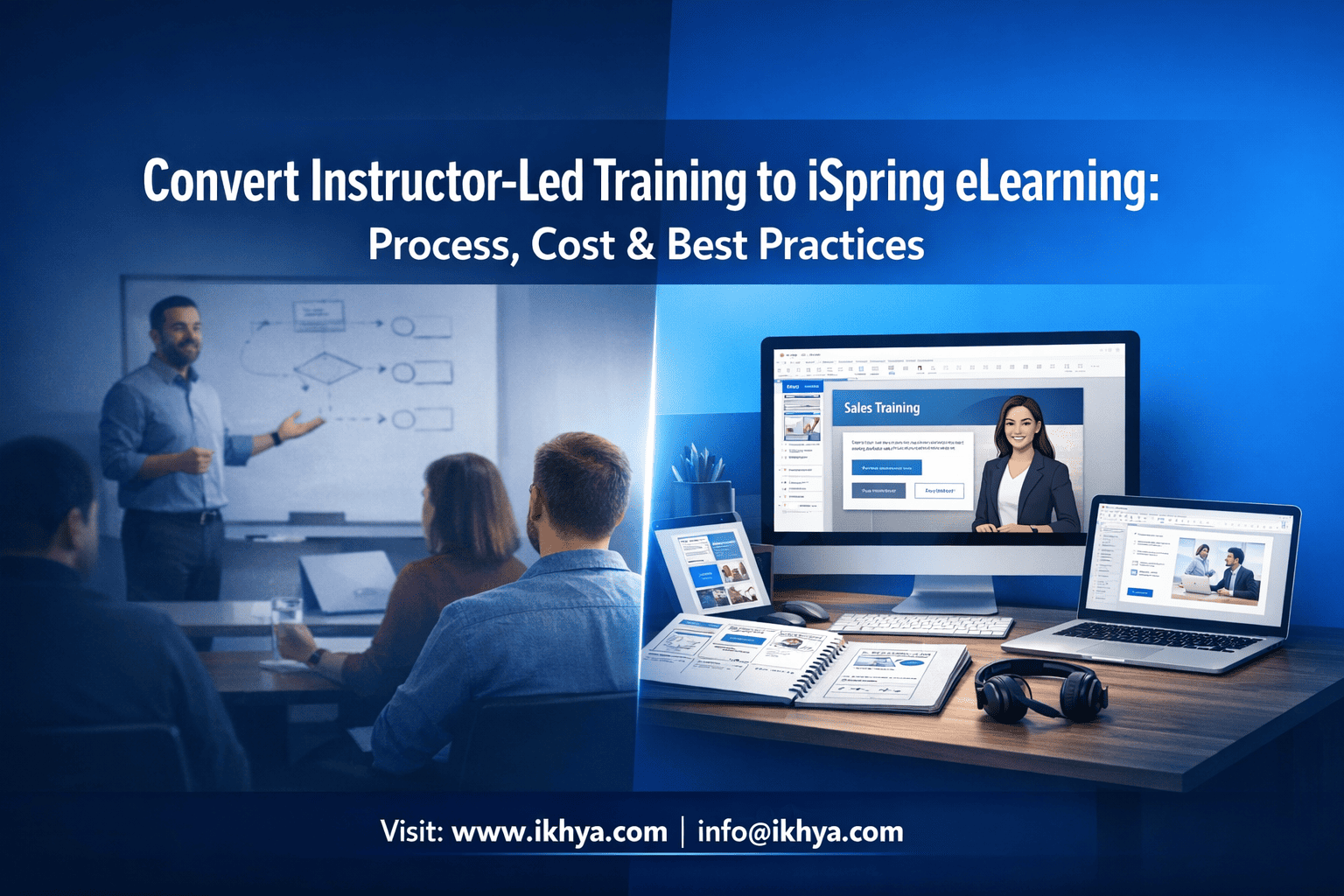
Instructor-led training (ILT) is becoming difficult to scale in today’s fast-paced, remote-first corporate environment. Organizations are increasingly shifting toward digital learning. Converting Instructor-Led Training to iSpring eLearning allows you to deliver consistent, interactive, and cost-effective training at scale.
If you’re planning this transition, the key is not just conversion—but doing it strategically with the right tools and approach.
To explore how your organization can get started, you can book a free eLearning demo and evaluate the possibilities firsthand.
What Is Instructor-Led Training (ILT) and Why Convert It?
Instructor-led training (ILT) refers to traditional classroom-based training delivered by a facilitator. Converting ILT into eLearning transforms static, in-person sessions into scalable, interactive digital courses accessible anytime, anywhere.
Limitations of ILT in Modern Corporate Training
ILT has been effective for decades, but it comes with several limitations:
- High costs: Travel, venue, instructor fees
- Limited scalability: Cannot train large, distributed teams efficiently
- Inconsistent delivery: Quality depends on instructor performance
- Scheduling challenges: Difficult to align across global teams (USA, UK, UAE, AUS)
- Low retention: One-time sessions with limited reinforcement
Benefits of Converting ILT to eLearning
Switching to eLearning—especially using iSpring—offers measurable advantages:
- Scalability: Train thousands of employees simultaneously
- Consistency: Standardized content delivery across regions
- Cost efficiency: Reduce logistics and instructor costs
- Flexibility: Learn anytime on desktop or mobile
- Tracking & analytics: SCORM/xAPI-based LMS integration for performance tracking
Additionally, organizations can integrate microlearning, simulations, and assessments to improve retention and engagement.
If you’re looking for expert support in building tailored training programs, consider exploring custom eLearning development services.
Why Use iSpring for ILT to eLearning Conversion?
iSpring is one of the most efficient tools for converting Instructor-Led Training into eLearning because it transforms existing PowerPoint content into interactive, SCORM-compliant courses quickly. It is especially ideal for organizations looking for rapid eLearning development without compromising quality or interactivity.
Key Features of iSpring
iSpring stands out because it is built for speed, simplicity, and corporate training needs:
- PowerPoint-based development
Convert existing training decks directly into eLearning courses without rebuilding from scratch - SCORM & xAPI compatibility
Seamlessly integrate with any LMS for tracking learner progress and analytics - Interactive assessments
Create quizzes, branching scenarios, and knowledge checks - Dialogue simulations
Ideal for customer service, sales, and compliance training - Mobile-ready courses
Automatically responsive across devices - Voiceovers & video integration
Add instructor narration to replicate classroom experience
If your organization already relies on PowerPoint-heavy training, iSpring provides a direct and efficient pathway. You can also explore specialized iSpring eLearning development services to accelerate implementation.
When Is iSpring the Best Choice vs Other Tools?
iSpring is not always the best tool for every scenario. Choosing the right authoring tool depends on your training complexity, timelines, and interactivity requirements.
| Criteria | iSpring | Other Tools (Storyline, Captivate, Lectora) |
|---|---|---|
| Speed of development | Very fast | Moderate to slow |
| Ease of use | Beginner-friendly | Requires expertise |
| PowerPoint conversion | Excellent | Limited or indirect |
| Advanced interactivity | Moderate | High |
| Custom animations | Limited | Advanced |
| Best for | Rapid corporate training | Complex simulations, gamification |
When You Should Choose iSpring
iSpring is the right choice when:
- You need rapid conversion of ILT content
- Your training is PowerPoint-based
- You want quick deployment across global teams
- Your focus is on compliance, onboarding, or product training
- You need cost-effective development
When You May Need Other Tools
Consider alternatives like Storyline or Captivate when:
- You require highly customized interactions
- You are building game-based learning
- You need complex branching scenarios
- Your course requires advanced animations
Practical Example
A global compliance training program in the financial services sector needed to train 5,000+ employees across the USA, UK, and UAE.
- Original format: 2-day classroom ILT
- Solution: Converted PowerPoint content into iSpring modules
- Result:
- 60% cost reduction
- 4x faster rollout
- 90% course completion rate
iSpring works best when paired with a strong instructional design strategy. If you need structured course design support, consider leveraging instructional design services to ensure your content is engaging and effective.
Step-by-Step Process to Convert ILT to iSpring eLearning
Converting Instructor-Led Training to iSpring eLearning involves a structured process that transforms classroom materials into engaging, interactive digital courses. The key is to retain learning effectiveness while improving scalability, engagement, and accessibility.
Step 1: Analyze Existing ILT Content
Start by reviewing all your existing training materials to identify what can be reused, improved, or removed.
What to analyze:
- PowerPoint presentations
- Trainer notes and scripts
- Participant manuals
- Activities and assessments
- Videos and case studies
Key goal:
Convert content, not just slides. Focus on learning outcomes, not delivery format.
Step 2: Define Clear Learning Objectives
Before converting content, align it with measurable learning goals.
Best practices:
- Use action-based objectives (e.g., “Identify safety hazards”)
- Break long sessions into smaller modules
- Align with compliance or business KPIs
This ensures your eLearning course is focused, structured, and outcome-driven.
Step 3: Convert PowerPoint to iSpring Modules
This is where iSpring becomes powerful. It allows direct conversion of slides into eLearning.
Process:
- Import PowerPoint into iSpring Suite
- Clean up slide content (remove clutter, simplify text)
- Add narration (voiceover or video)
- Sync animations with explanations
- Publish as SCORM/xAPI package
If you need a deeper understanding of this step, refer to this detailed convert PowerPoint to eLearning guide.
Step 4: Add Interactivity and Assessments
ILT relies heavily on instructor interaction. In eLearning, you must replicate that engagement digitally.
Ways to enhance interactivity:
- Quizzes and knowledge checks
- Scenario-based learning
- Drag-and-drop activities
- Dialogue simulations (iSpring TalkMaster)
- Branching decision paths
Tip:
Replace passive content with active learning wherever possible.
Step 5: Structure Content into Microlearning Modules
Long ILT sessions should be broken into shorter, focused modules.
Recommended structure:
- 5–10 minute lessons
- Single learning objective per module
- Clear progression path
This improves:
- Retention
- Engagement
- Completion rates
For organizations adopting this approach, microlearning development services can help design optimized learning journeys.
Step 6: Test and Optimize the Course
Before deployment, ensure the course works flawlessly.
Checklist:
- Content accuracy
- Navigation flow
- Mobile responsiveness
- Quiz functionality
- LMS compatibility
Run pilot testing with a small learner group and gather feedback.
Step 7: Deploy on LMS (SCORM/xAPI)
Finally, publish and upload your course to your Learning Management System.
Deployment essentials:
- SCORM or xAPI packaging
- LMS integration
- Progress tracking and analytics
- Certification setup (if required)
To ensure seamless integration, consider using LMS-compatible eLearning course development services.
Quick Summary of the Process
| Step | Action | Outcome |
|---|---|---|
| 1 | Analyze ILT content | Identify reusable material |
| 2 | Define objectives | Focused learning outcomes |
| 3 | Convert PPT to iSpring | Digital course foundation |
| 4 | Add interactivity | Increased engagement |
| 5 | Microlearning structure | Better retention |
| 6 | Test course | Quality assurance |
| 7 | LMS deployment | Scalable delivery |
Successful ILT conversion is not about digitizing slides—it’s about redesigning learning experiences.
If you’re looking for end-to-end support in this transformation, you can explore ILT to eLearning course conversion services for expert-driven execution.
ILT to iSpring Conversion Framework (Strategic Model)
A successful ILT to iSpring conversion requires more than a step-by-step process—it needs a structured framework that ensures learning effectiveness, scalability, and engagement. The most effective approach is to follow a systematic transformation model that aligns content, technology, and learner experience.
The 5D Framework for ILT to iSpring Conversion
This proven framework helps organizations convert classroom training into high-impact eLearning:
| Phase | Description | Key Outcome |
|---|---|---|
| Discover | Audit ILT materials, audience, and goals | Clear content strategy |
| Design | Define learning objectives and structure | Instructional blueprint |
| Develop | Convert content using iSpring | Interactive course |
| Deploy | Publish to LMS (SCORM/xAPI) | Scalable delivery |
| Drive | Measure performance and optimize | Continuous improvement |
1. Discover Phase: Content & Audience Analysis
Start by understanding what you’re converting and who you’re training.
Focus areas:
- Learner profiles (roles, experience levels)
- Training goals (compliance, onboarding, skills)
- Existing ILT assets (PPTs, manuals, videos)
- Delivery challenges (global teams, time constraints)
Output:
A clear roadmap of what content to convert, update, or eliminate.
2. Design Phase: Instructional Strategy
This is where most organizations fail—simply converting slides without redesigning learning.
What to define:
- Learning objectives (aligned with business goals)
- Module structure (microlearning vs full courses)
- Interactivity strategy (quizzes, scenarios)
- Assessment methods
Strong instructional planning ensures your course is engaging, not just informative. You can strengthen this phase using expert-led instructional design services.
3. Develop Phase: Build with iSpring
Now convert content into interactive modules using iSpring.
Key development actions:
- Convert PowerPoint slides into iSpring
- Add voiceovers and video explanations
- Create quizzes and simulations
- Ensure mobile responsiveness
For faster execution, organizations often leverage rapid eLearning development services to reduce turnaround time.
4. Deploy Phase: LMS Integration
Once the course is ready, deploy it across your LMS.
Deployment essentials:
- SCORM/xAPI packaging
- User enrollment and access setup
- Tracking completion and performance
- Integration with enterprise LMS platforms
This enables data-driven training decisions using analytics and reporting.
5. Drive Phase: Optimization & Continuous Improvement
Conversion is not the end—it’s the beginning of continuous improvement.
Track and optimize:
- Completion rates
- Assessment scores
- Learner feedback
- Time spent per module
Enhancement strategies:
- Update outdated content
- Introduce microlearning refreshers
- Improve weak-performing modules
Why This Framework Works
Unlike generic approaches, this model ensures:
- Strategic alignment with business goals
- Learner-centric design
- Efficient development using iSpring
- Measurable training outcomes
Real-World Scenario
A manufacturing company transitioning safety training from ILT to iSpring followed this framework:
- Reduced training time from 8 hours to 3 hours
- Improved compliance scores by 35%
- Enabled training across multiple global locations without instructors
Key Takeaway
Without a framework, ILT conversion becomes content dumping. With a framework, it becomes performance-driven learning.
If you’re planning a structured transition, working with experts can significantly improve outcomes. Explore how a dedicated team can support your strategy through ILT to eLearning course conversion services.
Cost of Converting ILT to iSpring eLearning
The cost of converting Instructor-Led Training to iSpring eLearning depends on content complexity, interactivity level, and development approach. On average, organizations can expect $500 to $3,000 per hour of eLearning content, with iSpring typically being more cost-effective due to its rapid development capabilities.
Key Factors That Influence Cost
Several variables determine the total investment:
- Content complexity
- Basic slides vs scenario-based learning
- Level of interactivity
- Static content vs simulations and branching
- Multimedia elements
- Voiceovers, videos, animations
- Instructional design effort
- Basic conversion vs full redesign
- Localization requirements
- Multi-language support (USA, UK, UAE, AUS markets)
- LMS integration
- SCORM/xAPI tracking and reporting setup
Cost Breakdown by Course Type
| Course Type | Description | Estimated Cost (Per Hour) |
|---|---|---|
| Basic Conversion | PPT to iSpring with minimal interactivity | $500 – $1,000 |
| Standard eLearning | Interactive quizzes, voiceovers | $1,000 – $2,000 |
| Advanced eLearning | Simulations, branching scenarios | $2,000 – $3,000+ |
Development Approach: In-House vs Outsourcing
| Approach | Pros | Cons | Cost Impact |
|---|---|---|---|
| In-house | Full control, internal expertise | Slower, resource-intensive | Higher long-term cost |
| Outsourcing | Faster delivery, expert quality | Vendor dependency | Cost-efficient overall |
Outsourcing is often preferred for faster turnaround and better instructional quality—especially for large-scale corporate training programs.
If you’re evaluating vendors, you can request an RFP to get tailored cost estimates based on your requirements.
Hidden Costs to Consider
Many organizations underestimate these:
- Content restructuring and redesign
- SME (Subject Matter Expert) involvement
- Review cycles and revisions
- LMS configuration and testing
- Ongoing updates and maintenance
Cost Optimization Strategies
To reduce costs without compromising quality:
- Reuse existing PowerPoint content effectively
- Adopt rapid eLearning approaches
- Prioritize microlearning modules
- Standardize templates and branding
- Outsource to experienced vendors
For faster and budget-friendly execution, consider leveraging rapid eLearning development services.
ROI of ILT to iSpring Conversion
Despite upfront costs, the return on investment is significant:
- 50–70% reduction in training costs
- Faster onboarding and upskilling
- Reduced instructor dependency
- Improved compliance tracking
- Scalable global training delivery
iSpring reduces development cost and time compared to traditional authoring tools, making it ideal for rapid corporate training deployment.
If you’re planning a cost-effective transition, exploring specialized iSpring eLearning development services can help optimize both budget and outcomes.
Timeline for ILT to eLearning Conversion
The timeline for converting Instructor-Led Training to iSpring eLearning depends on content complexity, interactivity level, and review cycles. Typically, 1 hour of eLearning content can take anywhere from 2 to 6 weeks, with iSpring enabling faster turnaround compared to other authoring tools.
Typical Development Timelines
| Course Type | Development Time (Per 1 Hour of Content) | Best Use Case |
|---|---|---|
| Basic Conversion | 2–3 weeks | Simple PPT-based training |
| Standard eLearning | 3–5 weeks | Interactive corporate training |
| Advanced eLearning | 5–6+ weeks | Simulations, branching scenarios |
Timeline Breakdown by Phase
| Phase | Activities | Duration |
|---|---|---|
| Analysis | Content audit, SME discussions | 2–5 days |
| Design | Storyboarding, instructional planning | 5–10 days |
| Development | iSpring course creation | 10–20 days |
| Review & Revisions | Feedback cycles, updates | 5–10 days |
| Deployment | LMS integration, testing | 2–5 days |
Rapid vs Custom Development
| Approach | Timeline | When to Choose |
|---|---|---|
| Rapid eLearning (iSpring) | 2–4 weeks | Tight deadlines, PPT-heavy content |
| Custom eLearning | 4–8+ weeks | Complex, highly interactive training |
iSpring is particularly effective for rapid eLearning, making it ideal for organizations that need quick rollouts across multiple regions.
To accelerate your project timeline, you can explore rapid eLearning development services.
Factors That Impact Timeline
Several variables can speed up or delay your project:
- Content readiness (organized vs scattered materials)
- SME availability for reviews
- Number of review cycles
- Level of interactivity required
- Multilingual requirements
- LMS integration complexity
Real-World Timeline Example
A global onboarding program for a retail organization:
- ILT duration: 3-day classroom training
- Conversion approach: Rapid iSpring development
- Timeline:
- Content analysis: 1 week
- Development: 3 weeks
- Deployment: 1 week
Total time: 5 weeks
Result:
- 70% faster onboarding rollout
- Consistent training across USA, UK, and AUS teams
How to Reduce Development Time
To speed up your ILT conversion:
- Start with well-structured PowerPoint content
- Use templates and reusable assets
- Limit excessive customization
- Adopt microlearning formats
- Work with experienced vendors
iSpring significantly reduces development time, making it the preferred choice for rapid corporate training transformation.
If speed is critical for your organization, working with experts can streamline execution. Consider leveraging ILT to eLearning course conversion services to ensure faster delivery without compromising quality.
Common Challenges in ILT to iSpring Conversion and How to Overcome Them
Converting Instructor-Led Training to iSpring eLearning is not just a technical task—it involves instructional, design, and organizational challenges. The most common issues include poor engagement, content overload, and lack of instructional redesign. Addressing these early ensures a successful and impactful eLearning transformation.
1. Challenge: Converting Slides Without Redesigning Learning
Many organizations simply upload PowerPoint slides into iSpring without restructuring the content.
Why this fails:
- Leads to passive learning
- Reduces engagement and retention
- Does not replicate instructor interaction
Solution:
- Redesign content using instructional design principles
- Convert long lectures into short, focused modules
- Add interactions like quizzes and scenarios
To ensure quality learning design, consider leveraging instructional design services.
2. Challenge: Lack of Learner Engagement
ILT relies heavily on human interaction, which is often missing in eLearning.
Common issues:
- Text-heavy slides
- No interactivity
- One-way content delivery
Solution:
- Use scenario-based learning and simulations
- Add quizzes and decision-making exercises
- Include voiceovers and storytelling
3. Challenge: Content Overload
ILT sessions often contain excessive information delivered over hours or days.
Problem:
- Overwhelms learners in digital format
- Reduces completion rates
Solution:
- Break content into microlearning modules
- Focus on one learning objective per module
- Use progressive learning paths
Organizations can adopt structured approaches using microlearning development services.
4. Challenge: Inconsistent SME Inputs and Delays
Subject Matter Experts (SMEs) are critical but often unavailable or inconsistent.
Impact:
- Delays in development timelines
- Multiple revisions and rework
Solution:
- Define clear review cycles upfront
- Use structured feedback templates
- Assign a single point of contact
5. Challenge: Technical and LMS Compatibility Issues
Courses must work seamlessly across LMS platforms using SCORM or xAPI standards.
Common issues:
- Tracking errors
- Compatibility problems
- Poor mobile experience
Solution:
- Use SCORM/xAPI-compliant publishing (iSpring supports both)
- Test courses across devices and LMS platforms
- Optimize for mobile learning
To avoid deployment issues, consider LMS-compatible eLearning course development services.
6. Challenge: Maintaining Training Consistency Across Regions
Global organizations struggle with delivering consistent training across different locations (USA, UK, UAE, AUS).
Solution:
- Standardize course structure and templates
- Use centralized LMS deployment
- Implement localization strategies if needed
7. Challenge: Measuring Training Effectiveness
ILT relies on instructor feedback, but eLearning requires data-driven evaluation.
Solution:
- Use LMS analytics for tracking progress
- Monitor completion rates and assessment scores
- Continuously improve based on learner data
Quick Summary: Challenges vs Solutions
| Challenge | Impact | Solution |
|---|---|---|
| No instructional redesign | Low engagement | Apply ID principles |
| Low interactivity | Poor retention | Add simulations & quizzes |
| Content overload | Drop in completion | Use microlearning |
| SME delays | Project slowdowns | Structured review process |
| LMS issues | Technical failures | SCORM/xAPI testing |
| Global inconsistency | Uneven training | Standardization |
| Poor measurement | No insights | LMS analytics |
The biggest mistake in ILT conversion is treating it as a content migration instead of a learning transformation.
With the right strategy, tools like iSpring, and expert support, these challenges can be effectively managed. If you’re facing complexity in execution, working with specialists through ILT to eLearning course conversion services can ensure smoother implementation.
When Should You Outsource ILT to iSpring Conversion?
Outsourcing ILT to iSpring eLearning conversion is the right choice when you need faster delivery, expert instructional design, and scalable execution. While in-house teams can manage small projects, outsourcing becomes essential for large, complex, or time-sensitive training programs.
Signs You Should Outsource ILT Conversion
If you notice any of the following, outsourcing is likely the better option:
- Tight deadlines for training rollout
- Large volume of ILT content to convert
- Limited in-house expertise in iSpring or instructional design
- Need for high-quality interactive learning experiences
- Global deployment requirements (multi-location training)
- Frequent updates or ongoing training needs
In-House vs Outsourced Development
| Criteria | In-House Team | Outsourced Vendor |
|---|---|---|
| Speed | Slower (limited bandwidth) | Faster (dedicated teams) |
| Expertise | Varies | Specialized (ID + tools) |
| Cost | Higher long-term | Cost-efficient |
| Scalability | Limited | High |
| Quality consistency | Variable | Standardized |
Benefits of Outsourcing ILT to iSpring Conversion
Outsourcing offers several strategic advantages:
- Faster turnaround time using rapid development workflows
- Access to instructional design experts
- High-quality interactive and engaging courses
- Scalable delivery for enterprise training
- Reduced internal workload for L&D teams
When In-House Development Still Works
You may not need outsourcing if:
- You have a skilled internal eLearning team
- The project is small or low complexity
- You only need basic PowerPoint conversion
- Timelines are flexible
What to Look for in an eLearning Vendor
Choosing the right partner is critical for success.
Key evaluation criteria:
- Experience with iSpring development
- Strong instructional design capabilities
- Portfolio of similar corporate training projects
- Ability to deliver SCORM/xAPI-compliant courses
- Clear development process and timelines
- Post-launch support and maintenance
Practical Example
A healthcare organization needed to convert compliance training for 3,000 employees:
- Internal team capacity: Limited
- Timeline: 6 weeks
- Approach: Outsourced to an iSpring development partner
Outcome:
- Completed within deadline
- Achieved 95% course completion rate
- Ensured regulatory compliance across locations
Cost vs Value Perspective
Outsourcing may seem like an added expense, but it often delivers:
- Faster ROI through quicker deployment
- Higher learner engagement
- Reduced rework and long-term costs
Key Insight
Outsourcing is not just about saving time—it’s about ensuring quality, scalability, and measurable training impact.
If you’re evaluating outsourcing options, you can explore tailored solutions through ILT to eLearning course conversion services or submit your requirements via request an RFP to get a customized proposal.
Real-World Use Cases of ILT to iSpring Conversion Across Industries
Converting Instructor-Led Training to iSpring eLearning is widely adopted across industries to improve scalability, reduce costs, and standardize training. Different sectors use this approach to address specific challenges such as compliance, safety, onboarding, and skill development.
1. Healthcare Training
Healthcare organizations require consistent, compliant, and regularly updated training.
ILT Challenges:
- Scheduling training for large medical staff
- Maintaining compliance with evolving regulations
- High cost of repeated instructor sessions
iSpring eLearning Solution:
- Convert compliance training into interactive modules
- Add scenario-based learning for patient care situations
- Enable LMS tracking for certifications
Result:
- Faster compliance training rollout
- Improved knowledge retention
- Reduced training costs
For organizations in this sector, specialized healthcare training eLearning solutions can further enhance outcomes.
2. Manufacturing & Safety Training
Manufacturing environments require hands-on safety training, often delivered through ILT.
ILT Challenges:
- Inconsistent training across locations
- Safety risks due to improper training
- Difficulty training large workforce groups
iSpring eLearning Solution:
- Use simulations and visual-based learning
- Deliver standardized safety protocols
- Provide refresher microlearning modules
Result:
- Reduced workplace incidents
- Consistent safety compliance
- Scalable training across plants
Explore tailored solutions through manufacturing training eLearning solutions.
3. Compliance Training (Finance, Legal, Corporate)
Compliance training is one of the biggest drivers for ILT conversion.
ILT Challenges:
- Frequent updates in regulations
- Difficulty tracking training completion
- Risk of non-compliance penalties
iSpring eLearning Solution:
- Rapid updates using iSpring tools
- SCORM/xAPI tracking for audits
- Interactive assessments for validation
Result:
- 100% compliance tracking
- Faster updates across global teams
- Reduced legal risks
Organizations can strengthen compliance programs using compliance training eLearning solutions.
4. Retail & Customer Service Training
Retail organizations need to train distributed teams quickly.
ILT Challenges:
- High employee turnover
- Geographically dispersed workforce
- Inconsistent customer experience
iSpring eLearning Solution:
- Create onboarding modules using iSpring
- Use dialogue simulations for customer interaction
- Provide mobile-friendly training
Result:
- Faster onboarding
- Improved customer service quality
- Reduced training costs
You can explore industry-specific strategies through retail training eLearning solutions.
5. IT & Software Training
Technology companies need continuous upskilling programs.
ILT Challenges:
- Rapidly changing technologies
- Difficulty scaling technical training
- Time constraints for employees
iSpring eLearning Solution:
- Convert technical ILT sessions into modular courses
- Add screen recordings and demos
- Enable self-paced learning
Result:
- Continuous learning culture
- Faster skill development
- Reduced dependency on instructors
Key Takeaway Across Industries
Despite differences, all industries benefit from:
- Standardized training delivery
- Scalable learning across global teams
- Improved tracking and analytics
- Cost and time efficiency
iSpring enables organizations to quickly transform industry-specific ILT programs into scalable, high-impact digital learning ecosystems.
If you’re planning industry-specific training transformation, working with experts can accelerate results. Explore tailored solutions through custom eLearning development services.
Best Practices for iSpring eLearning Development
To successfully convert Instructor-Led Training into iSpring eLearning, you need more than just tools—you need the right design, structure, and delivery strategy. Following best practices ensures your courses are engaging, effective, and aligned with business goals.
1. Focus on Learning Experience, Not Just Content
The biggest mistake is replicating classroom content without redesigning it.
Best practices:
- Convert lectures into interactive experiences
- Use storytelling and real-world scenarios
- Design for learner engagement, not slide completion
2. Keep Courses Short and Modular
Long ILT sessions should be broken into manageable learning units.
Recommended approach:
- 5–10 minute microlearning modules
- One clear objective per module
- Logical progression across lessons
This improves retention and learner completion rates. For structured implementation, consider microlearning development services.
3. Use Interactivity Strategically
Interactivity is essential to replace instructor-led engagement.
Effective techniques:
- Scenario-based learning
- Branching decision paths
- Quizzes and knowledge checks
- Dialogue simulations (iSpring TalkMaster)
Tip:
Avoid overloading with unnecessary interactions—focus on meaningful engagement.
4. Optimize PowerPoint Before Conversion
Since iSpring relies heavily on PowerPoint, optimization is critical.
Checklist:
- Remove excessive text
- Use visuals instead of paragraphs
- Simplify slide design
- Align animations with narration
A strong foundation ensures smoother conversion and better learning outcomes. You can also refer to this convert PowerPoint to eLearning guide for deeper insights.
5. Ensure Mobile-Friendly Design
Modern learners expect access across devices.
Best practices:
- Use responsive layouts
- Avoid heavy content that slows loading
- Test on multiple screen sizes
This is especially important for global workforces and remote teams.
6. Align with LMS and Tracking Standards
Your course should integrate seamlessly with your LMS.
Key considerations:
- SCORM or xAPI compatibility
- Progress tracking and reporting
- Assessment and certification setup
To ensure smooth deployment, consider LMS-compatible eLearning course development services.
7. Incorporate Continuous Feedback and Improvement
eLearning is not a one-time effort—it requires ongoing optimization.
How to improve:
- Analyze LMS data (completion rates, scores)
- Collect learner feedback
- Update content regularly
8. Maintain Branding and Consistency
Consistency builds trust and improves learning experience.
Ensure:
- Standard templates
- Consistent fonts, colors, and layouts
- Uniform navigation structure
Quick Best Practices Summary
| Area | Best Practice | Outcome |
|---|---|---|
| Content | Redesign, don’t replicate | Higher engagement |
| Structure | Use microlearning | Better retention |
| Interactivity | Add meaningful interactions | Improved learning outcomes |
| Design | Optimize PowerPoint | Cleaner courses |
| Technology | Ensure LMS compatibility | Seamless tracking |
| Optimization | Use feedback & analytics | Continuous improvement |
The success of iSpring eLearning depends more on instructional strategy than the tool itself.
If you want to ensure high-quality execution, partnering with experts can make a significant difference. You can explore tailored solutions through iSpring eLearning development services.
Before we move to the conclusion and FAQs, if you’re planning your next training initiative, you can also request an RFP to get a customized solution aligned with your business goals.
Conclusion
Converting Instructor-Led Training to iSpring eLearning is no longer optional—it’s a strategic move for organizations aiming to scale training, reduce costs, and improve learning outcomes. With the right approach, iSpring enables rapid transformation of classroom content into engaging, trackable, and accessible digital learning experiences.
The key to success lies in:
- Redesigning learning, not just converting slides
- Using structured frameworks like the 5D model
- Leveraging iSpring for rapid, cost-effective development
- Ensuring LMS integration with SCORM/xAPI for analytics
- Continuously optimizing based on learner data
Whether you’re in healthcare, manufacturing, finance, or retail, this transition can significantly enhance training efficiency and impact.
If you’re looking to implement this transformation effectively, IKHYA – eLearning Solutions Company can support your journey with end-to-end expertise. Reach out at info@ikhya.com or get started by contacting the team.
FAQs
1. What is ILT to eLearning conversion?
ILT to eLearning conversion is the process of transforming classroom-based training into digital, self-paced learning modules delivered through an LMS.
2. Why should I use iSpring for ILT conversion?
iSpring is ideal for rapid eLearning development because it converts PowerPoint into interactive courses quickly and supports SCORM/xAPI for LMS tracking.
3. How long does it take to convert ILT to iSpring eLearning?
It typically takes 2 to 6 weeks per hour of content, depending on complexity and interactivity.
4. What is the cost of ILT to iSpring conversion?
Costs usually range from $500 to $3,000 per hour of eLearning, depending on design and features.
5. Can PowerPoint training be converted into iSpring eLearning?
Yes, iSpring directly converts PowerPoint presentations into interactive eLearning courses with quizzes and multimedia.
6. What industries benefit from ILT to eLearning conversion?
Industries like healthcare, manufacturing, finance, retail, and IT benefit due to scalability and compliance needs.
7. Is iSpring suitable for mobile learning?
Yes, iSpring creates responsive courses that work across mobile, tablet, and desktop devices.
8. Should I outsource ILT to eLearning conversion?
Outsourcing is recommended for large or complex projects that require faster turnaround and expert design.
9. What is the difference between ILT and eLearning?
ILT is instructor-led and classroom-based, while eLearning is self-paced, digital, and accessible online.
10. What content can be reused during ILT conversion?
PowerPoint slides, trainer notes, videos, case studies, and assessments can all be reused and enhanced.
11. Does iSpring support SCORM and xAPI?
Yes, iSpring supports SCORM, xAPI, and other LMS standards for tracking learner performance.
12. How do you make eLearning engaging without an instructor?
You can use quizzes, simulations, storytelling, branching scenarios, and interactive elements.
13. What is microlearning in iSpring courses?
Microlearning involves breaking content into short, focused modules (5–10 minutes) to improve retention and engagement.
14. Can ILT workshops be fully replaced by eLearning?
Yes, many ILT programs can be fully converted, though some organizations use blended learning for better results.
15. What are the biggest challenges in ILT to eLearning conversion?
Common challenges include content overload, lack of interactivity, SME delays, and poor instructional design.
16. How do you ensure quality in eLearning courses?
By applying instructional design principles, testing thoroughly, and using learner feedback for improvements.
17. What is the role of instructional design in ILT conversion?
Instructional design ensures content is structured, engaging, and aligned with learning objectives.
18. Can iSpring handle compliance training?
Yes, iSpring is widely used for compliance training due to its tracking, assessments, and rapid update capabilities.
19. How do you measure eLearning effectiveness?
Through LMS analytics such as completion rates, assessment scores, learner feedback, and engagement metrics.
20. What is the ROI of converting ILT to eLearning?
Organizations typically see reduced training costs, faster rollout, improved consistency, and better learner outcomes.
Related Resources
To deepen your understanding and plan your next steps, explore: