Designing Interactive Quizzes in iSpring: A Complete Guide for Engaging eLearning

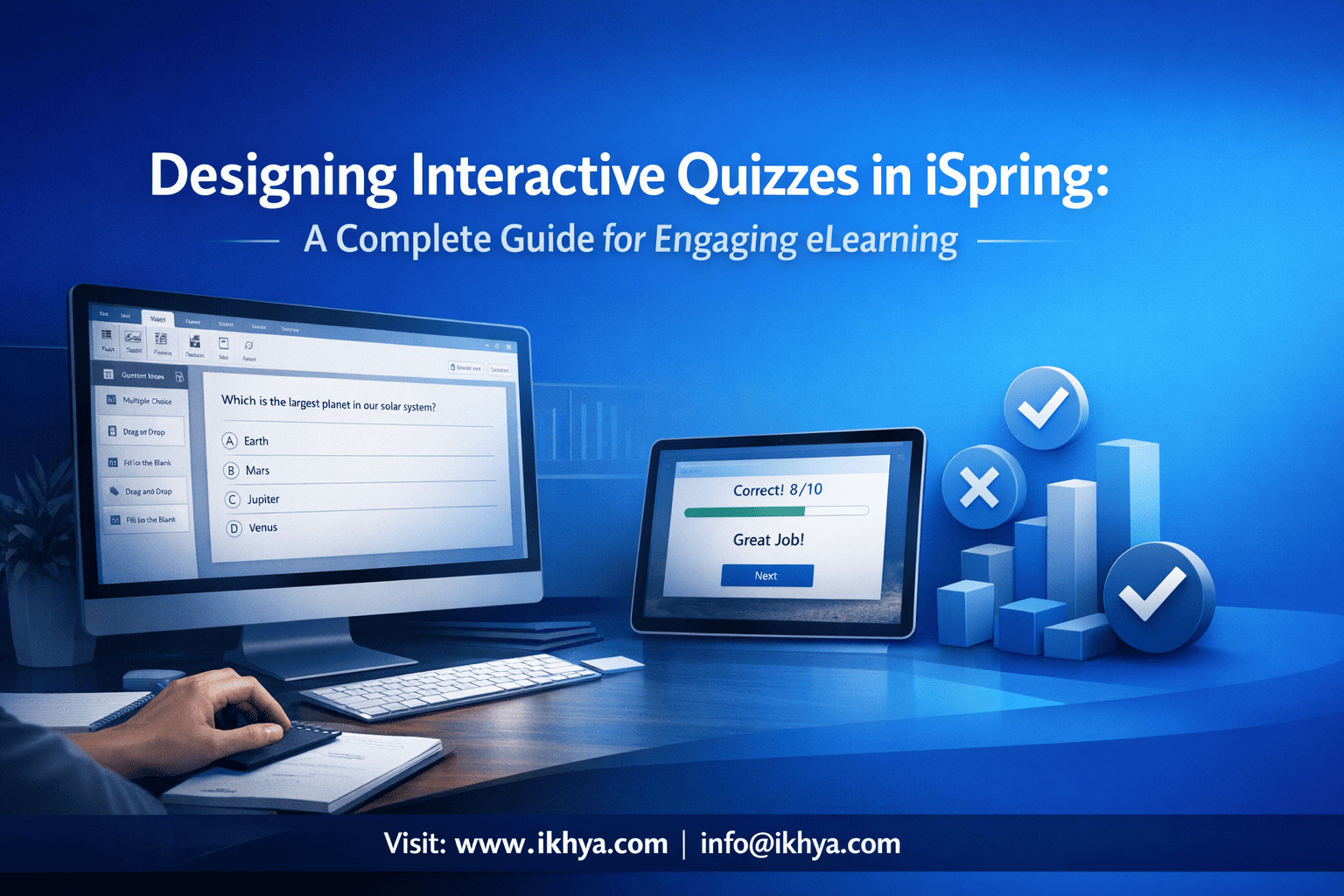
Interactive quizzes are one of the most powerful ways to improve learner engagement and knowledge retention in corporate training. When designed effectively in iSpring, they go beyond basic assessments and become immersive learning experiences that drive real business outcomes.
If you’re new to iSpring or looking to improve your quiz strategy, you can explore this helpful overview of what is iSpring Suite or even book a free eLearning demo to see how interactive quizzes work in real training environments.
What Are Interactive Quizzes in iSpring and Why Do They Matter?
Interactive quizzes in iSpring are dynamic assessments that actively engage learners through scenarios, feedback, and varied question formats rather than simple question-answer patterns. They are designed to test knowledge while reinforcing learning through interaction and immediate feedback.
Unlike static quizzes, iSpring quizzes support:
- Scenario-based learning
- Branching logic
- Instant feedback loops
- Multimedia integration
Why They Matter in Corporate Training
1. Improve Knowledge Retention
- Active participation helps learners retain up to 60% more information compared to passive learning.
2. Boost Engagement
- Interactive elements reduce drop-off rates in LMS-based courses.
3. Enable Real-Time Assessment
- Trainers can track performance instantly using LMS analytics and SCORM/xAPI data.
4. Support Compliance Training
- Essential for industries like healthcare, finance, and manufacturing where validation is critical.
Traditional vs Interactive Quizzes
| Feature | Traditional Quiz | Interactive iSpring Quiz |
|---|---|---|
| Engagement | Low | High |
| Feedback | Minimal | Instant & contextual |
| Learning impact | Surface-level | Deep learning |
| Adaptability | Static | Branching & adaptive |
| Analytics | Basic | Advanced LMS tracking |
Where Interactive Quizzes Fit in Learning Strategy
Interactive quizzes are not just end-of-course assessments. They can be used as:
- Pre-assessments to evaluate existing knowledge
- In-course knowledge checks to reinforce concepts
- Post-training evaluations to measure effectiveness
- Certification tests for compliance programs
For organizations aiming to scale learning efficiently, combining quizzes with rapid eLearning development using iSpring allows faster deployment without compromising quality.
Key Features of iSpring Quiz Maker for Interactive Assessments
iSpring Quiz Maker is a powerful tool designed to create highly interactive and customizable quizzes within eLearning courses. It integrates seamlessly with PowerPoint and LMS platforms, making it ideal for rapid corporate training development.
Core Features That Enable Interactivity
1. 14+ Question Types
- Multiple choice, drag-and-drop, matching, sequence, hotspot, and more
2. Branching Scenarios
- Customize learner paths based on responses
3. Multimedia Support
- Add audio, video, and images to enhance engagement
4. Custom Feedback
- Provide tailored responses for correct/incorrect answers
5. Attempts & Timing Controls
- Set retries, time limits, and passing scores
6. LMS Compatibility
- Fully supports SCORM, xAPI, and cmi5 standards
Feature Breakdown
| Feature | Description | Business Value |
|---|---|---|
| Question Variety | Multiple formats for different learning styles | Improves engagement |
| Branching | Personalized learning paths | Enhances learning outcomes |
| Feedback Customization | Instant corrective feedback | Reinforces knowledge |
| Reporting | LMS tracking & analytics | Data-driven decisions |
| Multimedia | Rich content integration | Better learner experience |
When Should You Use iSpring for Quiz Design?
iSpring is ideal when you need:
- Fast development cycles
- PowerPoint-based content conversion
- Scalable corporate training solutions
- LMS-ready assessments
Organizations often leverage professional iSpring eLearning development services to fully utilize these features and ensure high-quality output.
How It Compares to Other Authoring Tools (Quick View)
| Feature | iSpring | Storyline | Captivate |
|---|---|---|---|
| Ease of Use | Very High | Medium | Medium |
| Speed | Fast | Moderate | Moderate |
| PowerPoint Integration | Native | Limited | Limited |
| Quiz Features | Strong | Very Strong | Strong |
| Learning Curve | Low | Medium | High |
This makes iSpring particularly suitable for:
- L&D teams with tight timelines
- Organizations transitioning from classroom to digital
- Companies needing rapid, scalable training solutions
Types of Interactive Quiz Questions You Can Create in iSpring
iSpring Quiz Maker offers a wide variety of question types that allow you to design engaging, scenario-driven, and skill-based assessments. Choosing the right question type is critical because it directly impacts learner engagement, knowledge retention, and real-world application.
Most Common Question Types in iSpring
1. Multiple Choice (Single/Multiple Answer)
- Best for quick knowledge checks
- Ideal for compliance and theoretical concepts
2. True/False
- Simple validation of basic understanding
- Useful in early-stage learning modules
3. Matching
- Connect related items (e.g., terms and definitions)
- Great for product training and onboarding
4. Sequence (Ordering)
- Arrange steps in correct order
- Useful for process-based training like manufacturing or healthcare
5. Fill in the Blank
- Tests recall instead of recognition
- Ideal for reinforcing key concepts
Advanced Interactive Question Types
1. Drag-and-Drop
- Learners interact directly with content
- Enhances engagement and kinesthetic learning
2. Hotspot Questions
- Click on specific areas in an image
- Perfect for technical training (e.g., machinery, medical diagrams)
3. Likert Scale
- Measure opinions or confidence levels
- Useful for surveys and behavioral assessments
4. Essay Questions
- Open-ended responses
- Ideal for leadership or soft skills training
Scenario-Based Questions (Most Powerful)
Scenario-based quizzes simulate real-world situations where learners must make decisions. This is one of the most effective ways to improve critical thinking and application.
For example:
- A healthcare professional choosing the correct patient care procedure
- A retail employee handling a customer complaint
- A factory worker responding to a safety hazard
To implement this effectively, many organizations rely on scenario-based learning using iSpring to build immersive experiences.
Choosing the Right Question Type
| Learning Goal | Best Question Type |
|---|---|
| Knowledge recall | Multiple choice, True/False |
| Concept understanding | Matching, Fill in the blank |
| Process learning | Sequence |
| Skill application | Scenario-based, Drag-and-drop |
| Visual identification | Hotspot |
| Behavioral assessment | Likert scale, Essay |
Pro Tip: Mix Question Types for Maximum Engagement
Using only one type of question leads to monotony and disengagement. Instead:
- Combine recall + application questions
- Add visual interactions
- Include real-world scenarios
- Use progressive difficulty levels
For microlearning strategies, combining quizzes with short modules—like those built through microlearning development using iSpring—can significantly improve completion rates and retention.
Real-World Example
A manufacturing company redesigned its safety training by:
- Replacing static quizzes with scenario-based questions
- Adding drag-and-drop hazard identification
- Using branching paths for decision outcomes
Result:
- 40% increase in course completion
- 30% improvement in assessment scores
The key takeaway is simple: the effectiveness of your quiz depends more on design strategy than the tool itself.
Step-by-Step: How to Design Interactive Quizzes in iSpring
Designing interactive quizzes in iSpring involves more than just adding questions—it requires a structured approach that combines instructional design, learner psychology, and tool capabilities. By following a clear process, you can create quizzes that are both engaging and effective.
Step 1: Define the Learning Objective
Start by identifying what the quiz should achieve. Every question must align with a specific learning outcome.
Ask:
- What should the learner know or do after this quiz?
- Is this testing recall, understanding, or real-world application?
Example:
- Compliance training → Validate knowledge
- Sales training → Test decision-making
If you’re building structured learning journeys, aligning quizzes with instructional design services ensures measurable outcomes.
Step 2: Choose the Right Quiz Type
Select question formats based on your objective rather than convenience.
- Use multiple choice for quick checks
- Use scenario-based questions for real-life application
- Use drag-and-drop for interactive engagement
Avoid using the same format repeatedly—it reduces engagement.
Step 3: Structure the Quiz Flow
A well-structured quiz improves completion rates and learner experience.
Recommended Flow:
- Easy questions (build confidence)
- Moderate difficulty (test understanding)
- Advanced/scenario-based (apply knowledge)
You can also introduce:
- Branching paths (different outcomes based on answers)
- Adaptive progression
Step 4: Add Interactivity and Multimedia
iSpring allows you to enrich quizzes with:
- Images (diagrams, product visuals)
- Audio (instructions, feedback)
- Video (real-world scenarios)
Why this matters:
- Improves comprehension
- Increases engagement
- Supports different learning styles
Step 5: Design Feedback That Teaches
Feedback should not just say “Correct” or “Incorrect.” It should reinforce learning.
Effective Feedback Includes:
- Explanation of the correct answer
- Why the wrong option is incorrect
- Real-world context
Example:
Instead of: “Wrong answer”
Use: “Incorrect. The correct procedure requires shutting down the machine first to prevent hazards.”
Step 6: Configure Scoring and Attempts
Set rules based on training goals:
- Passing score (e.g., 80% for compliance)
- Number of attempts
- Time limits (if required)
Tip:
Use stricter rules for compliance training and flexible ones for learning modules.
Step 7: Enable LMS Tracking (SCORM/xAPI)
To measure effectiveness, integrate your quiz with an LMS.
iSpring supports:
- SCORM 1.2 / 2004
- xAPI (Tin Can)
- cmi5
This allows you to track:
- Completion rates
- Scores
- Time spent
- Question-level performance
Step 8: Test Before Publishing
Always test your quiz for:
- Functionality (buttons, navigation)
- Accuracy (answers, logic)
- User experience (flow, clarity)
Step 9: Publish and Deploy
Once finalized:
- Publish as SCORM/xAPI package
- Upload to LMS
- Monitor performance
Organizations often accelerate this entire process using rapid eLearning development using iSpring to reduce turnaround time while maintaining quality.
Quick Summary of the Process
| Step | Action | Outcome |
|---|---|---|
| 1 | Define objectives | Clear purpose |
| 2 | Select question types | Better engagement |
| 3 | Structure flow | Improved completion |
| 4 | Add multimedia | Rich experience |
| 5 | Design feedback | Strong learning |
| 6 | Configure scoring | Measurable results |
| 7 | LMS integration | Data tracking |
| 8 | Testing | Error-free delivery |
| 9 | Deployment | Scalable training |
Real-World Scenario
A financial services firm redesigned its onboarding quizzes using this process:
- Introduced scenario-based decision questions
- Added feedback explaining regulatory rules
- Enabled LMS tracking for performance insights
Results:
- 50% faster onboarding
- Higher compliance accuracy
- Reduced retraining costs
The key is simple: a structured design process turns quizzes into powerful learning tools—not just assessments.
Best Practices for Designing Engaging iSpring Quizzes
Designing engaging iSpring quizzes requires more than using advanced features—it demands a learner-first approach that combines instructional design, psychology, and real-world relevance. The most effective quizzes are those that feel interactive, meaningful, and directly applicable to the learner’s role.
1. Focus on Learning, Not Just Assessment
Quizzes should reinforce learning—not just evaluate it.
Do this:
- Use quizzes as learning checkpoints
- Add explanations for every answer
- Reinforce key concepts immediately
Avoid:
- Treating quizzes as pass/fail barriers only
- Using them only at the end of the course
Organizations that align quizzes with strong pedagogy often rely on structured instructional design services to ensure effectiveness.
2. Use Scenario-Based Learning for Real Impact
Scenario-based quizzes simulate real-world situations, helping learners apply knowledge instead of memorizing it.
Examples:
- Healthcare: Choosing correct patient procedures
- Retail: Handling customer objections
- Manufacturing: Responding to safety risks
For deeper engagement, leverage strategies like scenario-based learning using iSpring.
3. Keep Questions Clear and Concise
Clarity improves both accuracy and engagement.
Best practices:
- Use simple language
- Avoid double negatives
- Keep questions under 20 words where possible
Example:
- Poor: “Which of the following is NOT an incorrect procedure?”
- Better: “Which procedure is correct?”
4. Provide Immediate and Meaningful Feedback
Feedback is where real learning happens.
Effective feedback includes:
- Why the answer is correct
- Why other options are wrong
- Real-world implications
This transforms quizzes into learning tools rather than evaluation tools.
5. Mix Question Types to Avoid Monotony
Using only one format reduces engagement quickly.
Ideal mix:
- Multiple choice → quick checks
- Drag-and-drop → interaction
- Scenarios → application
- Hotspots → visual learning
Combining formats is especially powerful in short modules built through microlearning development using iSpring.
6. Use Gamification Elements
Gamification increases motivation and completion rates.
Add elements like:
- Scores and badges
- Progress indicators
- Timed challenges
- Leaderboards (via LMS)
Even simple gamification can significantly improve learner participation.
7. Design for Mobile Learning
Modern learners often access training on mobile devices.
Ensure:
- Questions are easy to read on small screens
- Interactions are touch-friendly
- Media loads quickly
iSpring’s responsive design capabilities support mobile-first learning strategies.
8. Control Difficulty Progression
Start simple and gradually increase complexity.
Recommended structure:
- Basic knowledge questions
- Conceptual understanding
- Scenario-based application
This keeps learners engaged without overwhelming them.
9. Align Quizzes with Business Goals
Every quiz should serve a measurable purpose.
Examples:
- Compliance → reduce legal risks
- Sales training → improve conversion rates
- Safety training → reduce workplace incidents
When aligned with business outcomes, quizzes become strategic assets—not just learning tools.
10. Keep It Short and Focused
Long quizzes reduce completion rates.
Best practice:
- 5–10 questions per module
- Break into smaller assessments
- Use microlearning formats
Quick Best Practices Summary
| Practice | Impact |
|---|---|
| Scenario-based design | Improves real-world application |
| Clear questions | Reduces confusion |
| Immediate feedback | Reinforces learning |
| Mixed formats | Increases engagement |
| Gamification | Boosts motivation |
| Mobile optimization | Enhances accessibility |
| Short quizzes | Improves completion rates |
Real-World Example
A retail company improved its customer service training by:
- Introducing scenario-based quizzes
- Adding instant feedback with real examples
- Breaking quizzes into microlearning modules
Results:
- 35% increase in learner engagement
- Improved customer satisfaction scores
- Faster onboarding time
The bottom line: engaging quizzes are designed—not just created.
Common Mistakes to Avoid in iSpring Quiz Design
Even with a powerful tool like iSpring, poorly designed quizzes can reduce engagement, frustrate learners, and fail to deliver measurable outcomes. Avoiding common mistakes is essential to ensure your quizzes are effective, scalable, and aligned with business goals.
1. Overloading Quizzes with Too Many Questions
Long quizzes lead to fatigue and drop-offs.
What goes wrong:
- Learners lose interest midway
- Completion rates drop
- Cognitive overload reduces retention
Better approach:
- Keep quizzes short (5–10 questions)
- Break content into smaller modules
- Use microlearning strategies
This is where structured approaches like microlearning development using iSpring can significantly improve engagement.
2. Using Only One Question Type
Repetition reduces engagement and limits learning effectiveness.
Problem:
- Learners get bored
- Limited assessment of skills
Fix:
- Mix formats:
- Multiple choice → recall
- Drag-and-drop → interaction
- Scenarios → decision-making
3. Writing Confusing or Ambiguous Questions
Poorly worded questions create frustration and inaccurate results.
Common issues:
- Double negatives
- Complex sentence structures
- Irrelevant answer options
Best practice:
- Keep language simple and direct
- Focus on one idea per question
4. Providing Weak or No Feedback
Feedback is critical for learning—but often ignored.
Mistake:
- Only showing “Correct” or “Incorrect”
Better approach:
- Explain why the answer is correct
- Clarify misconceptions
- Provide real-world context
5. Ignoring Real-World Application
Quizzes that only test theory fail to prepare learners for actual tasks.
Problem:
- Low knowledge transfer
- Poor job performance outcomes
Solution:
- Use scenario-based questions
- Simulate real workplace situations
For deeper implementation, consider scenario-based learning using iSpring.
6. Not Aligning with Learning Objectives
If quizzes are not tied to objectives, they become meaningless.
Example mistake:
- Teaching problem-solving but testing only definitions
Fix:
- Map each question to a learning goal
- Ensure alignment with training outcomes
7. Overcomplicating the Design
Too many animations, interactions, or instructions can overwhelm learners.
Signs of overdesign:
- Cluttered screens
- Excessive multimedia
- Confusing navigation
Best practice:
- Keep design clean and focused
- Use interactivity only where it adds value
8. Ignoring LMS Tracking and Analytics
Without tracking, you lose valuable insights.
Missed opportunities:
- Identifying weak areas
- Improving course design
- Measuring ROI
Fix:
- Enable SCORM/xAPI tracking
- Analyze:
- Completion rates
- Question-level performance
- Time spent
9. Making Quizzes Too Difficult (or Too Easy)
Improper difficulty levels reduce effectiveness.
Too easy:
- No challenge → low engagement
Too difficult:
- Frustration → drop-offs
Solution:
- Use progressive difficulty
- Balance recall and application
10. Skipping Testing Before Deployment
Un-tested quizzes can lead to technical and learning issues.
Common problems:
- Broken navigation
- Incorrect answers
- LMS tracking failures
Always:
- Test functionality
- Validate content accuracy
- Review user experience
Organizations often streamline this process using rapid eLearning development using iSpring to ensure speed without compromising quality.
Mistakes vs Solutions Summary
| Mistake | Impact | Solution |
|---|---|---|
| Too many questions | Drop-offs | Keep it short |
| Single format | Boredom | Mix question types |
| Poor wording | Confusion | Use simple language |
| No feedback | Weak learning | Add explanations |
| No real-world context | Low application | Use scenarios |
| Misaligned objectives | Ineffective training | Align with goals |
| Overdesign | Cognitive overload | Keep it simple |
| No analytics | No insights | Use LMS tracking |
| Wrong difficulty | Low engagement | Balance levels |
| No testing | Errors | Pre-launch testing |
Real-World Example
A healthcare organization initially used long, text-heavy quizzes for compliance training. After redesign:
- Reduced quiz length
- Added scenario-based questions
- Introduced instant feedback
Results:
- 45% increase in completion rates
- Improved compliance accuracy
- Better audit readiness
Avoiding these mistakes ensures your quizzes are not just functional—but truly effective learning tools.
How to Use iSpring Quizzes for Different Industries
Interactive quizzes in iSpring can be tailored to meet the specific training needs of different industries. By aligning quiz design with real-world scenarios, organizations can improve performance, reduce risks, and ensure compliance.
Healthcare Training
In healthcare, quizzes must focus on accuracy, compliance, and patient safety. Interactive quizzes help professionals make correct decisions in critical situations.
How to use quizzes effectively:
- Scenario-based questions for patient care decisions
- Hotspot questions for identifying medical equipment or body parts
- Sequence questions for procedural steps
Example:
A nurse selects the correct sequence for administering medication.
Outcome:
- Improved compliance with medical protocols
- Reduced human errors
- Better audit readiness
For organizations scaling such programs, structured healthcare training eLearning solutions ensure regulatory alignment.
Manufacturing Training
Manufacturing training focuses on safety, processes, and operational efficiency. Quizzes must simulate real-world risks and procedures.
Effective quiz strategies:
- Drag-and-drop for hazard identification
- Scenario-based safety simulations
- Sequence questions for machine operation steps
Example:
A worker identifies potential hazards on a factory floor using an interactive image.
Outcome:
- Reduced workplace incidents
- Faster onboarding of new employees
- Improved safety compliance
Many companies enhance such training through manufacturing training eLearning solutions.
Retail Training
Retail training emphasizes customer interaction, product knowledge, and sales skills.
Best quiz approaches:
- Scenario-based questions for customer handling
- Multiple choice for product knowledge
- Role-play style branching quizzes
Example:
An employee chooses how to respond to a dissatisfied customer.
Outcome:
- Improved customer satisfaction
- Higher sales conversions
- Better employee confidence
Retail organizations often leverage retail training eLearning solutions to scale training across locations.
Financial Services Training
In finance, quizzes are critical for compliance, risk management, and regulatory training.
Recommended formats:
- Case-based scenarios for fraud detection
- Multiple choice for regulatory knowledge
- Timed quizzes for certification readiness
Outcome:
- Reduced compliance risks
- Improved audit performance
- Stronger regulatory adherence
Key Takeaway Across Industries
| Industry | Focus Area | Best Quiz Type |
|---|---|---|
| Healthcare | Patient safety & compliance | Scenario, Sequence, Hotspot |
| Manufacturing | Safety & operations | Drag-and-drop, Scenario |
| Retail | Customer interaction | Scenario, Branching |
| Finance | Compliance & risk | Case-based, Timed quizzes |
Why Industry-Specific Design Matters
Generic quizzes fail because they:
- Lack real-world relevance
- Do not prepare learners for actual tasks
- Reduce engagement
Industry-aligned quizzes:
- Improve knowledge transfer
- Enhance job performance
- Deliver measurable ROI
The key is simple: the closer your quiz is to real-world situations, the more effective your training becomes.
Tracking Performance: Analytics, SCORM & LMS Integration
Tracking quiz performance in iSpring is essential to measure learning effectiveness, identify skill gaps, and improve training ROI. By integrating quizzes with an LMS using SCORM or xAPI, organizations gain detailed insights into learner behavior and outcomes.
Why Tracking Quiz Performance Matters
Without analytics, quizzes become guesswork. With tracking, they become data-driven learning tools.
Key benefits:
- Identify knowledge gaps
- Measure training effectiveness
- Improve course design
- Support compliance reporting
What Data Can You Track in iSpring?
iSpring quizzes, when published to an LMS, can track a wide range of learner data.
| Metric | What It Tells You |
|---|---|
| Completion rate | Course engagement levels |
| Quiz scores | Knowledge retention |
| Time spent | Learning difficulty |
| Attempt count | Struggle areas |
| Question-level data | Specific knowledge gaps |
SCORM vs xAPI: What Should You Use?
Both SCORM and xAPI enable tracking, but they differ in capability.
| Feature | SCORM | xAPI |
|---|---|---|
| Tracking depth | Basic | Advanced |
| Offline tracking | No | Yes |
| Data flexibility | Limited | High |
| Learning experience tracking | LMS only | Anywhere (apps, simulations) |
Recommendation:
- Use SCORM for standard corporate training
- Use xAPI for advanced analytics and complex learning environments
How to Enable LMS Tracking in iSpring (Step-by-Step)
Step 1: Create your quiz in iSpring
Step 2: Click “Publish”
Step 3: Select LMS as destination
Step 4: Choose format (SCORM 1.2 / SCORM 2004 / xAPI)
Step 5: Configure reporting settings
Step 6: Upload to your LMS
How to Use Analytics for Better Training Decisions
Tracking is only useful if you act on the data.
Use insights to:
- Improve difficult questions
- Adjust content where learners struggle
- Personalize learning paths
- Optimize course length
Example:
If 70% of learners fail one question:
- The issue may be unclear content—not learner performance
Real-World Example
A compliance training program in the UK used iSpring quizzes with LMS tracking:
- Identified frequently missed questions
- Updated content for clarity
- Introduced scenario-based reinforcement
Results:
- 25% improvement in assessment scores
- Faster certification completion
- Better audit outcomes
Best Practices for Using Analytics
- Track at both course and question level
- Review data regularly (monthly/quarterly)
- Combine analytics with learner feedback
- Use dashboards for quick insights
When to Seek Expert Support
If your organization struggles with:
- LMS integration
- Data interpretation
- SCORM/xAPI setup
It may be beneficial to work with experts offering eLearning consultancy services to ensure accurate tracking and reporting.
The key takeaway: quizzes are only as powerful as the insights you extract from them.
iSpring vs Other Authoring Tools for Quiz Design
iSpring is one of the most efficient tools for creating interactive quizzes, but it’s important to understand how it compares with other popular authoring tools. The right choice depends on your project complexity, timeline, and customization needs.
Quick Comparison of Top Authoring Tools
| Feature | iSpring | Articulate Storyline | Adobe Captivate |
|---|---|---|---|
| Ease of use | Very high | Medium | Medium–High |
| Development speed | Fast | Moderate | Moderate |
| Quiz capabilities | Strong | Very strong | Strong |
| PowerPoint integration | Native | Limited | Limited |
| Custom interactions | Moderate | Advanced | Advanced |
| Learning curve | Low | Medium | High |
When iSpring Is the Best Choice
iSpring is ideal for organizations that need speed, simplicity, and scalability.
Best for:
- Rapid eLearning development
- PowerPoint-based content conversion
- Standard corporate training programs
- Quick deployment across LMS platforms
This makes it a strong fit for teams leveraging rapid eLearning development services.
When to Consider Other Tools
While iSpring is powerful, some use cases may require more advanced customization.
Articulate Storyline
Best for:
- Complex branching scenarios
- Highly customized interactions
- Gamified learning experiences
If your project requires advanced interactivity, consider solutions like articulate storyline development services.
Adobe Captivate
Best for:
- Software simulations
- Technical training
- Responsive, device-specific designs
For such needs, organizations often explore adobe captivate development services.
Decision Framework: Which Tool Should You Choose?
| Requirement | Recommended Tool |
|---|---|
| Fast development | iSpring |
| Advanced interactivity | Storyline |
| Software simulations | Captivate |
| Low learning curve | iSpring |
| Highly customized UX | Storyline |
Key Insight
- iSpring excels in speed and simplicity
- Storyline excels in flexibility
- Captivate excels in technical simulations
Real-World Scenario
A global company with teams in the USA and UAE needed to roll out compliance training quickly.
Challenge:
- Tight deadlines
- Large workforce
- Standardized content
Solution:
- Used iSpring for rapid quiz development
- Integrated with LMS for tracking
Result:
- 60% faster course deployment
- Consistent training across regions
- Reduced development costs
When Tool Choice Impacts ROI
Choosing the wrong tool can lead to:
- Increased development time
- Higher costs
- Poor learner experience
Choosing the right one ensures:
- Faster rollout
- Better engagement
- Scalable training
Expert Tip
If you’re unsure which tool fits your needs, working with professionals offering eLearning consultancy services can help you make the right decision based on your goals, budget, and timeline.
The takeaway: iSpring is the best choice for rapid, scalable quiz development—but not always for highly complex interactions.
When to Outsource iSpring Quiz Development
Outsourcing iSpring quiz development is the right choice when you need high-quality, scalable, and strategically designed assessments without overloading your internal team. It allows organizations to focus on core business activities while experts handle instructional design, development, and deployment.
When Should You Consider Outsourcing?
Outsourcing is ideal when internal capabilities or timelines are limited.
Common scenarios:
- Tight project deadlines
- Lack of instructional design expertise
- Large-scale training rollouts
- Need for advanced interactivity (scenarios, branching)
- LMS integration challenges
If your team is struggling with execution or scale, exploring outsource eLearning development benefits, costs, and best practices can provide clarity.
Benefits of Outsourcing iSpring Quiz Development
| Benefit | Impact |
|---|---|
| Faster development | Reduced time-to-launch |
| Expert design | Higher engagement and learning effectiveness |
| Scalability | Handle large training programs |
| Cost efficiency | Avoid hiring full-time specialists |
| Quality assurance | Fewer errors and better UX |
What Do Experts Bring to the Table?
Professional eLearning vendors go beyond tool usage—they bring strategy and execution excellence.
Key capabilities include:
- Instructional design alignment
- Scenario-based quiz creation
- Gamification strategies
- LMS integration (SCORM/xAPI)
- Performance analytics setup
Organizations often partner with specialists offering iSpring eLearning development services to ensure high-quality outcomes.
In-House vs Outsourced Development
| Factor | In-House | Outsourced |
|---|---|---|
| Cost | High (fixed salaries) | Flexible (project-based) |
| Expertise | Limited | Specialized |
| Speed | Slower | Faster |
| Scalability | Limited | High |
| Quality consistency | Variable | Standardized |
When NOT to Outsource
Outsourcing may not be necessary if:
- You have a skilled internal L&D team
- Projects are small and infrequent
- No advanced interactivity is required
Real-World Example
A manufacturing company needed to roll out safety training across multiple locations in Australia.
Challenge:
- Limited internal team
- Strict compliance deadlines
Solution:
- Outsourced iSpring quiz development
- Included scenario-based safety assessments
- Integrated LMS tracking
Results:
- 50% faster deployment
- Improved safety compliance scores
- Reduced internal workload
How to Choose the Right Vendor
Before outsourcing, evaluate:
- Experience with iSpring and corporate training
- Portfolio of similar projects
- Understanding of your industry
- Ability to integrate with your LMS
- Communication and support model
Expert Tip
Outsourcing is not just about saving time—it’s about improving learning outcomes and business impact.
The bottom line: if quality, speed, and scalability matter, outsourcing is often the smarter choice.
Cost of Developing Interactive Quizzes in iSpring
The cost of developing interactive quizzes in iSpring depends on complexity, level of interactivity, content readiness, and whether you build in-house or outsource. Understanding these cost factors helps you plan budgets and choose the right development approach.
Key Factors That Influence Cost
Several variables impact the overall cost of quiz development:
1. Complexity of Quiz Design
- Basic quizzes (MCQs, True/False) → Low cost
- Scenario-based or branching quizzes → Higher cost
2. Number of Questions
- More questions = more design, testing, and feedback effort
3. Multimedia Usage
- Videos, animations, and graphics increase development time
4. Instructional Design Requirements
- Strategic design and learning alignment add value—but also cost
5. LMS Integration
- SCORM/xAPI setup and testing may require additional effort
Cost Breakdown (Estimated)
| Type of Quiz | Complexity | Estimated Cost Range |
|---|---|---|
| Basic quiz | Low | $100 – $300 |
| Intermediate quiz | Medium | $300 – $800 |
| Advanced interactive quiz | High | $800 – $2000+ |
Note: Costs vary depending on vendor, region (USA, UK, UAE, AUS), and project scope.
In-House vs Outsourcing Cost Comparison
| Cost Factor | In-House | Outsourced |
|---|---|---|
| Initial setup | High (tools + hiring) | Low |
| Per project cost | Lower (after setup) | Variable |
| Hidden costs | Training, time, errors | Minimal |
| Scalability cost | High | Flexible |
Hidden Costs to Consider
Many organizations underestimate these:
- Time spent by internal teams
- Rework due to poor design
- LMS integration issues
- Lack of analytics setup
- Delayed project timelines
How to Optimize Cost Without Compromising Quality
Best practices:
- Use templates for standard quizzes
- Focus on high-impact interactivity only
- Break content into microlearning modules
- Reuse existing content where possible
Organizations looking to balance cost and quality often explore rapid eLearning development services for faster and more efficient delivery.
When Outsourcing Becomes More Cost-Effective
Outsourcing is often more economical when:
- You have large-scale training needs
- You require advanced interactivity
- Internal teams lack expertise
- Speed is critical
In such cases, partnering with experts via outsource eLearning development benefits, costs, and best practices can reduce long-term costs.
Real-World Scenario
A financial services company initially developed quizzes in-house:
- Faced delays due to limited expertise
- Required multiple revisions
- Struggled with LMS tracking
After outsourcing:
- Reduced development time by 40%
- Improved quiz quality
- Achieved better learner outcomes
Key Takeaway
- Basic quizzes are inexpensive—but limited in impact
- Interactive, scenario-based quizzes cost more—but deliver higher ROI
Before investing, it’s always helpful to evaluate your needs and consult experts through eLearning consultancy services to make the most cost-effective decision.
Conclusion
Designing interactive quizzes in iSpring is not just about adding questions—it’s about creating meaningful learning experiences that drive engagement, improve retention, and deliver measurable business results.
When done right, iSpring quizzes can:
- Reinforce learning through real-time feedback
- Simulate real-world decision-making
- Provide actionable insights through LMS analytics
- Scale across global teams in regions like the USA, UK, UAE, and Australia
Whether you’re building compliance training, onboarding programs, or skill-based learning, the key lies in combining the right strategy, design principles, and tool capabilities.
If you’re looking to elevate your quiz design or scale training programs, partnering with experts can make a significant difference. IKHYA – eLearning Solutions Company specializes in creating high-impact, interactive eLearning solutions tailored to business goals.
You can reach out at info@ikhya.com or contact the team here to discuss your requirements.
FAQs
1. What is iSpring Quiz Maker used for?
It is used to create interactive quizzes with multiple question types, branching, and LMS tracking.
2. How do you create a quiz in iSpring?
Use iSpring Quiz Maker, add questions, set feedback, configure scoring, and publish to LMS.
3. What types of questions are available in iSpring?
Multiple choice, matching, drag-and-drop, sequence, hotspot, Likert scale, and more.
4. Can iSpring quizzes be interactive?
Yes, using scenarios, branching logic, multimedia, and feedback.
5. Does iSpring support SCORM and xAPI?
Yes, it supports SCORM 1.2, SCORM 2004, xAPI, and cmi5.
6. How long should an eLearning quiz be?
Ideally 5–10 questions per module for better engagement.
7. What is the best quiz type for engagement?
Scenario-based and drag-and-drop questions are most engaging.
8. Can iSpring quizzes include videos?
Yes, you can embed videos, audio, and images.
9. How do you make quizzes more engaging?
Use real-world scenarios, feedback, multimedia, and varied question types.
10. Is iSpring good for compliance training?
Yes, it supports certification, tracking, and structured assessments.
11. Can you track quiz performance in iSpring?
Yes, through LMS analytics like scores, completion, and time spent.
12. What is branching in iSpring quizzes?
It allows different paths based on learner responses.
13. Are iSpring quizzes mobile-friendly?
Yes, they are responsive and work on mobile devices.
14. How do you improve quiz effectiveness?
Align questions with objectives and include meaningful feedback.
15. Can iSpring quizzes be timed?
Yes, you can set time limits and attempts.
16. What industries use iSpring quizzes?
Healthcare, manufacturing, retail, finance, and more.
17. Is iSpring easy to use for beginners?
Yes, it has a simple interface and PowerPoint integration.
18. How much does it cost to develop iSpring quizzes?
Costs range from $100 to $2000+ depending on complexity.
19. Should you outsource quiz development?
Yes, if you need speed, expertise, and scalable solutions.
20. Can iSpring quizzes be used for certification?
Yes, they can be used for assessments and certification programs.
Related Resources
Explore these additional resources to expand your knowledge of iSpring, optimize quiz-based learning, and make better decisions around tools, content conversion, and scalable training solutions.