Gamification Strategies in iSpring eLearning: Complete Guide for Corporate Training

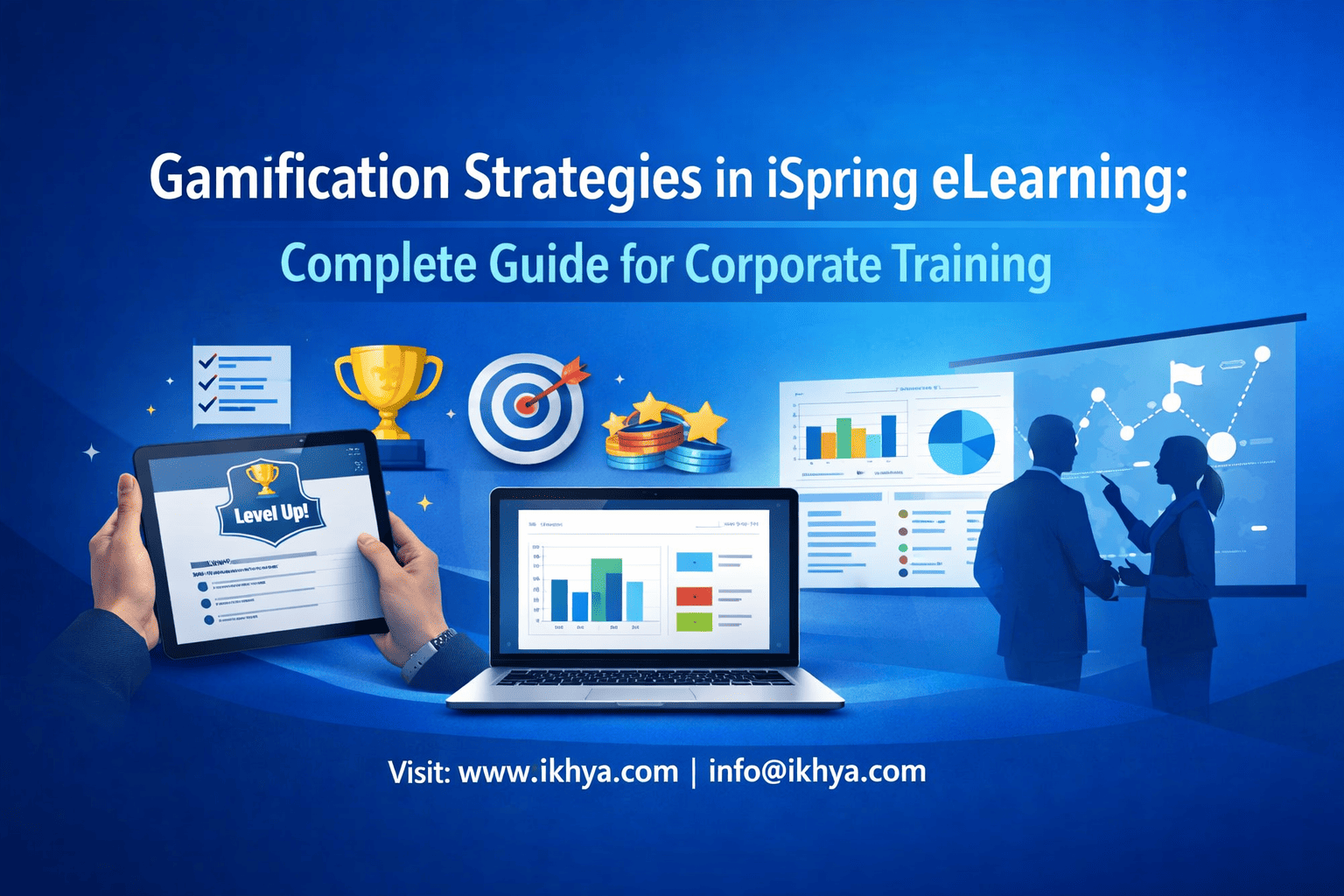
Gamification strategies in iSpring eLearning can transform dull, compliance-heavy training into engaging, interactive experiences that drive real learning outcomes. Instead of passive content, learners actively participate, compete, and progress—leading to higher retention and completion rates.
If you’re looking to build engaging, results-driven training, explore custom eLearning development services to design gamified learning experiences tailored to your organization.
What Is Gamification in eLearning?
Gamification in eLearning refers to the use of game elements—such as points, badges, leaderboards, and challenges—in training programs to increase learner engagement and motivation. It applies game mechanics to non-game contexts like corporate training.
Key Elements of Gamification
- Points: Reward learners for completing tasks or answering correctly
- Badges: Visual recognition of achievements
- Leaderboards: Encourage healthy competition
- Levels: Show progression and mastery
- Challenges: Create goals and milestones
Why It Works
Gamification taps into human psychology:
- Encourages competition and achievement
- Provides instant feedback
- Builds motivation through rewards
- Enhances knowledge retention
Gamification vs Traditional Learning
| Aspect | Traditional eLearning | Gamified eLearning |
|---|---|---|
| Engagement | Low | High |
| Motivation | Passive | Active |
| Feedback | Delayed | Instant |
| Retention | Moderate | High |
Organizations across the USA, UK, UAE, and Australia increasingly adopt gamification to improve training effectiveness, especially in compliance, onboarding, and sales training.
Why Gamification Matters in Corporate Training
Gamification matters in corporate training because it directly improves learner engagement, knowledge retention, and course completion rates. By turning passive content into interactive experiences, organizations can ensure employees not only complete training but actually apply what they learn on the job.
The Core Business Impact of Gamification
Gamification is not just about making learning “fun”—it delivers measurable business outcomes:
- Higher completion rates: Employees are more likely to finish courses
- Improved retention: Interactive learning boosts memory recall
- Better performance: Learners apply knowledge faster in real scenarios
- Reduced training fatigue: Especially in compliance-heavy industries
Key Benefits for Organizations
| Benefit | Impact on Business |
|---|---|
| Increased engagement | Reduces drop-offs in LMS courses |
| Faster learning | Cuts training time and costs |
| Behavioral change | Drives real-world application |
| Data-driven insights | Tracks performance via LMS analytics |
How Gamification Solves Common Training Challenges
Many organizations struggle with:
- Low learner participation
- Boring, slide-heavy courses
- Poor knowledge retention
- Lack of measurable outcomes
Gamification addresses these issues by:
- Turning content into interactive challenges
- Using rewards to motivate learners
- Providing real-time feedback
- Creating a sense of progression and achievement
For example, instead of a static compliance module, a gamified course can simulate real-world scenarios where employees earn points for correct decisions—making learning both practical and engaging.
When Gamification Works Best
Gamification is especially effective in:
- Employee onboarding – Making first experiences engaging
- Compliance training – Reducing monotony and increasing retention
- Sales training – Reinforcing product knowledge and competition
- Customer service training – Practicing real-world scenarios
To design impactful gamified experiences, strong pedagogy is essential. Leveraging instructional design services ensures your gamification strategy aligns with learning objectives and business goals.
Real Insight: Engagement vs Completion
Organizations that integrate gamification into LMS-based training (SCORM/xAPI-enabled) often report:
- Up to 60% higher engagement rates
- 30–50% improvement in course completion
- Significant boost in learner satisfaction scores
If you’re exploring how to implement these strategies effectively, you can book a free eLearning demo to see how gamification works in real corporate training environments.
Key Gamification Strategies in iSpring eLearning
Gamification strategies in iSpring eLearning focus on using built-in tools like QuizMaker, interactions, dialogue simulations, and LMS tracking to create engaging, reward-driven learning experiences. The goal is to combine instructional design with game mechanics to drive motivation, participation, and measurable outcomes.
1. Points, Badges, and Leaderboards (PBL)
The PBL model is the foundation of most gamification strategies. In iSpring, this is primarily implemented through quizzes, scoring systems, and LMS integrations.
How it works in iSpring:
- Assign points to quiz questions in QuizMaker
- Use passing scores as achievement thresholds
- Integrate with LMS to display leaderboards
Best use cases:
- Compliance training assessments
- Sales certification programs
- Product knowledge tests
Pro Tip: Combine PBL with timed quizzes to create urgency and competition.
2. Scenario-Based Gamification
Scenario-based learning is one of iSpring’s strongest capabilities, especially using dialogue simulations.
How it works:
- Create branching scenarios with decision points
- Assign scores based on learner choices
- Show consequences instantly
Example:
A customer service training module where learners:
- Choose responses to customer complaints
- Earn points for correct decisions
- Lose points for poor handling
This method is highly effective for behavioral training.
For advanced implementations, consider integrating rapid eLearning development services to build complex branching scenarios faster.
3. Progression & Levels
Progression mechanics keep learners motivated by showing visible advancement.
In iSpring, you can:
- Break courses into modules or levels
- Unlock content sequentially
- Use completion tracking via LMS
Gamification techniques:
- Level 1: Basics
- Level 2: Intermediate challenges
- Level 3: Advanced simulations
This creates a game-like journey, especially useful in onboarding and certification programs.
4. Rewards and Feedback Systems
Immediate feedback is critical for effective gamification.
iSpring enables:
- Instant quiz feedback
- Custom feedback messages
- Completion certificates
Reward types:
- Digital badges (via LMS)
- Certificates
- Score-based recognition
Why it matters:
- Reinforces correct behavior
- Keeps learners motivated
- Encourages continuous improvement
Strategy Comparison Table
| Strategy | iSpring Feature | Best For | Impact |
|---|---|---|---|
| PBL (Points, Badges, Leaderboards) | QuizMaker + LMS | Assessments | High engagement |
| Scenario-based learning | Dialogue simulations | Behavioral training | High retention |
| Progression & levels | Course structure + LMS | Onboarding | Sustained motivation |
| Rewards & feedback | Quiz feedback + certificates | All training | Continuous improvement |
Key Insight
The most effective gamification strategy is not a single technique—but a combination of multiple elements:
- PBL for motivation
- Scenarios for application
- Progression for engagement
- Feedback for reinforcement
When designed correctly, gamification becomes a learning experience, not just a feature.
To fully leverage these capabilities, many organizations partner with experts offering iSpring eLearning development services to design scalable, high-impact gamified training.
How iSpring Supports Gamification (Features Breakdown)
iSpring supports gamification through a combination of built-in tools like QuizMaker, role-play simulations, interactive modules, and seamless LMS integration. These features allow you to design engaging, game-like learning experiences without complex coding or advanced development skills.
Core Gamification Features in iSpring
iSpring Suite is designed for rapid development while still enabling powerful gamification elements.
| Feature | Gamification Use | Benefit |
|---|---|---|
| QuizMaker | Points, scoring, timed quizzes | Drives competition and assessment |
| Role-play simulations | Scenario-based decisions | Improves real-world skills |
| Interactions | Click-based exploration | Boosts engagement |
| Dialogue simulations | Branching conversations | Enhances behavioral training |
| LMS integration (SCORM/xAPI) | Leaderboards, tracking | Enables analytics and competition |
1. QuizMaker: The Gamification Engine
QuizMaker is the core tool for implementing gamification in iSpring.
What you can do:
- Assign points per question
- Set timers for urgency
- Provide instant feedback
- Create question pools for unpredictability
Gamification advantage:
- Turns assessments into competitive challenges
- Encourages repeated attempts to improve scores
2. Role-Play & Dialogue Simulations
These features enable immersive, scenario-based gamification.
Capabilities:
- Branching decision paths
- Character-based conversations
- Outcome-based scoring
Example use case:
- Sales training simulations where learners must close deals
- Healthcare training for patient interaction scenarios
This approach builds decision-making skills, not just theoretical knowledge.
3. Interactive Content Blocks
iSpring allows you to create visually rich, interactive learning modules.
Examples:
- Tabs and timelines
- Click-and-reveal elements
- Drag-and-drop activities
Gamification value:
- Keeps learners actively involved
- Breaks monotony of slide-based learning
4. LMS Integration for Advanced Gamification
iSpring courses integrate seamlessly with LMS platforms using SCORM and xAPI, enabling deeper gamification.
What this enables:
- Leaderboards across teams
- Progress tracking
- Performance analytics
- Certification tracking
Enterprise advantage:
- Aligns learning outcomes with business KPIs
- Provides measurable ROI
5. Certificates and Achievement Systems
iSpring allows automated certificate generation upon course completion.
Gamification role:
- Acts as a reward mechanism
- Encourages course completion
- Supports compliance tracking
Feature Comparison: iSpring vs Traditional Tools
| Capability | iSpring | Traditional eLearning Tools |
|---|---|---|
| Gamified quizzes | Advanced | Basic |
| Scenario simulations | Built-in | Limited |
| LMS integration | Strong (SCORM/xAPI) | Varies |
| Development speed | Fast | Slow |
| Ease of use | High | Medium |
iSpring’s strength lies in balancing simplicity with powerful gamification capabilities. It allows organizations to rapidly develop interactive courses while still delivering engaging, game-based learning experiences.
For organizations aiming to scale gamified training efficiently, leveraging rapid eLearning development services can significantly reduce development time while maintaining quality.
If you want to see how these features work in real training environments, you can book a free eLearning demo and explore gamified iSpring courses in action.
Step-by-Step: How to Build Gamified Courses in iSpring
Building gamified courses in iSpring involves combining instructional design with game mechanics like scoring, scenarios, and progression. By following a structured approach, you can create engaging, outcome-driven training that aligns with business goals and delivers measurable results.
Step 1: Define Learning Objectives and Gamification Goals
Start by identifying what you want learners to achieve and how gamification will support those outcomes.
Ask:
- What skills or behaviors should learners develop?
- Where can gamification improve engagement or retention?
- What metrics will define success (scores, completion rates, time spent)?
Example:
- Compliance training → Improve completion rates
- Sales training → Increase product knowledge retention
For strategic alignment, many organizations rely on instructional design services to map learning goals with gamification techniques.
Step 2: Choose the Right Gamification Strategy
Select the most suitable gamification elements based on your training type.
| Training Type | Recommended Strategy |
|---|---|
| Compliance | Points, badges, timed quizzes |
| Sales | Leaderboards, challenges |
| Customer service | Scenario-based gamification |
| Onboarding | Levels and progression |
Tip: Avoid overloading the course—focus on 2–3 core mechanics.
Step 3: Design the Learning Journey
Structure your course like a game with clear progression.
Key components:
- Levels or modules
- Milestones and checkpoints
- Unlockable content
Example flow:
- Beginner level (basic concepts)
- Intermediate challenges
- Advanced simulations
This creates a sense of achievement and continuity.
Step 4: Build Interactions Using iSpring Tools
Use iSpring features to bring your gamification strategy to life.
Tools to use:
- QuizMaker for scoring and assessments
- Dialogue simulations for scenarios
- Interactions for engagement
Best practices:
- Add timers to quizzes
- Use branching logic in simulations
- Include interactive elements every few screens
Step 5: Add Rewards and Feedback Mechanisms
Reinforce learning through immediate feedback and rewards.
Include:
- Instant quiz feedback
- Score-based messages
- Completion certificates
Why it matters:
- Encourages improvement
- Reinforces correct decisions
- Keeps learners motivated
Step 6: Integrate with LMS for Tracking and Leaderboards
Upload your course to an LMS using SCORM or xAPI to unlock advanced gamification features.
Benefits:
- Track learner performance
- Display leaderboards
- Monitor completion rates
- Generate analytics reports
This step is critical for enterprise-level training programs.
Step 7: Test, Optimize, and Scale
Before full deployment:
- Test user experience
- Analyze learner feedback
- Optimize difficulty levels
- Adjust scoring and rewards
Continuous improvement ensures long-term success.
Development Timeline Overview
| Phase | Duration | Key Activities |
|---|---|---|
| Planning | 1–2 weeks | Objectives, strategy |
| Design | 2–3 weeks | Storyboarding, structure |
| Development | 2–4 weeks | Build in iSpring |
| Testing | 1 week | QA and optimization |
| Deployment | Ongoing | LMS rollout |
Successful gamified courses are not built around tools—they are built around learner motivation and behavior. iSpring simply enables execution.
If you need to accelerate development while maintaining quality, partnering with experts offering iSpring eLearning development services can help deliver scalable gamified solutions efficiently.
Real-World Use Cases Across Industries
Gamification in iSpring eLearning is widely used across industries to improve engagement, retention, and real-world performance. By tailoring game mechanics to specific training needs, organizations can transform routine learning into impactful, results-driven experiences.
Healthcare Training
Gamification in healthcare focuses on improving decision-making, compliance, and patient interaction skills.
How it’s applied:
- Scenario-based simulations for patient care
- Timed quizzes for compliance protocols
- Score-based assessments for certification
Example:
A hospital uses iSpring simulations where nurses:
- Diagnose virtual patients
- Make treatment decisions
- Receive instant feedback on outcomes
Impact:
- Reduces errors in real-world situations
- Improves compliance training completion rates
Manufacturing Training
In manufacturing, gamification helps reinforce safety procedures and operational efficiency.
Use cases:
- Safety training simulations
- Equipment handling challenges
- Hazard identification games
Example:
Employees complete a gamified module where they:
- Identify workplace hazards
- Earn points for correct actions
- Progress through safety levels
Impact:
- Improves safety awareness
- Reduces workplace incidents
For scalable training programs in such environments, organizations often leverage microlearning development services to deliver short, gamified modules.
Retail Training
Retail organizations use gamification to enhance customer service and product knowledge.
Applications:
- Sales competitions via leaderboards
- Product knowledge quizzes
- Customer interaction simulations
Example:
A retail chain implements gamified training where employees:
- Earn badges for product mastery
- Compete on leaderboards
- Practice real customer scenarios
Impact:
- Boosts sales performance
- Improves customer satisfaction
Cross-Industry Benefits
| Industry | Key Gamification Use | Business Outcome |
|---|---|---|
| Healthcare | Scenario-based learning | Better decision-making |
| Manufacturing | Safety simulations | Reduced incidents |
| Retail | Leaderboards & quizzes | Increased sales |
While the industries differ, the core principle remains the same:
Gamification works best when it mirrors real-world challenges and rewards correct behavior.
Organizations that align gamification with job-specific tasks see significantly higher ROI compared to generic training approaches.
If you’re planning to implement gamified training tailored to your industry, you can contact us to explore customized solutions.
Gamification vs Traditional eLearning
Gamification differs from traditional eLearning by transforming passive content into interactive, reward-driven experiences. While traditional training focuses on content delivery, gamified learning emphasizes engagement, participation, and behavioral outcomes—making it far more effective for modern corporate training environments.
Core Differences Explained
| Aspect | Traditional eLearning | Gamified eLearning (iSpring) |
|---|---|---|
| Learning style | Passive (read/watch) | Interactive (do/decide) |
| Engagement level | Low to moderate | High |
| Motivation | External (mandatory) | Intrinsic + rewards |
| Feedback | Delayed or minimal | Instant and continuous |
| Retention | Moderate | High |
| Completion rates | Often low | Significantly higher |
Why Traditional eLearning Falls Short
Traditional courses often rely on:
- Slide-based presentations
- Long text-heavy modules
- Static assessments
Challenges:
- Learner fatigue
- Low engagement
- Poor knowledge retention
- Minimal real-world application
This is especially problematic in industries like compliance, healthcare, and manufacturing where retention and accuracy are critical.
How Gamification Solves These Problems
Gamified eLearning—especially when built using iSpring—introduces:
- Active participation through quizzes and scenarios
- Motivation systems like points and rewards
- Real-time feedback to reinforce learning
- Progress tracking to maintain engagement
Example:
Instead of reading policies, learners:
- Engage in scenario-based decisions
- Earn points for correct actions
- Compete with peers via LMS leaderboards
This shifts learning from “consuming content” to “experiencing learning.”
When to Use Gamification vs Traditional Learning
| Scenario | Recommended Approach |
|---|---|
| Compliance training | Gamification |
| Soft skills training | Gamification |
| Product training | Gamification |
| Simple information sharing | Traditional |
| One-time updates | Traditional |
Gamification is not a replacement for traditional eLearning—it’s an evolution. The most effective corporate training programs combine structured content with interactive, gamified elements to maximize both efficiency and engagement.
Strategic Recommendation
If your current training suffers from low engagement or completion rates, transitioning to gamified learning can deliver immediate improvements.
Organizations looking to modernize training often combine gamification with rapid eLearning development services to quickly convert legacy content into interactive experiences.
Before deciding your approach, you can book a free eLearning demo to compare gamified vs traditional learning experiences in real scenarios.
Best Practices for Gamification in iSpring
Effective gamification in iSpring eLearning requires more than adding points and badges—it must align with learning objectives, learner psychology, and business outcomes. The right approach ensures engagement without compromising instructional quality.
1. Align Gamification with Learning Objectives
Gamification should always support—not distract from—learning goals.
Best practices:
- Define clear outcomes before adding game elements
- Use gamification to reinforce key behaviors
- Avoid “gamification for the sake of fun”
Example:
- Compliance training → Use scenario-based decisions
- Sales training → Use leaderboards and performance scoring
2. Use a Balanced Gamification Framework
A proven framework combines multiple elements:
- Motivation: Points, badges, rewards
- Engagement: Scenarios, challenges
- Progression: Levels, milestones
- Feedback: Instant responses and scores
This ensures a holistic learning experience rather than isolated features.
3. Keep It Simple and Focused
Overloading courses with too many gamification elements can confuse learners.
Do:
- Use 2–3 core mechanics
- Maintain a clean interface
- Focus on user experience
Avoid:
- Excessive animations
- Complex scoring systems
- Unnecessary distractions
4. Design for Real-World Application
Gamification is most effective when it reflects real job scenarios.
Approach:
- Use dialogue simulations for decision-making
- Create realistic challenges
- Provide consequence-based feedback
This is especially important in industries like healthcare, retail, and manufacturing.
5. Provide Immediate and Meaningful Feedback
Feedback is the backbone of gamified learning.
Ensure:
- Instant responses after actions
- Clear explanations for correct/incorrect answers
- Encouragement for improvement
Result:
- Reinforces learning
- Builds confidence
- Improves retention
6. Leverage LMS Analytics for Optimization
Gamification should be continuously improved using data.
Track:
- Completion rates
- Quiz scores
- Time spent
- Drop-off points
Optimize by:
- Adjusting difficulty levels
- Refining scoring systems
- Improving weak content areas
7. Make It Mobile-Friendly
Modern learners expect training on the go.
Ensure:
- Responsive design
- Short, interactive modules
- Easy navigation
For this, integrating mobile learning development solutions can significantly enhance accessibility and engagement.
Best Practices Summary Table
| Practice | Why It Matters | Outcome |
|---|---|---|
| Align with objectives | Keeps training focused | Better learning outcomes |
| Use balanced framework | Ensures engagement + structure | Higher retention |
| Keep it simple | Improves usability | Better learner experience |
| Real-world scenarios | Enhances relevance | Behavioral change |
| Immediate feedback | Reinforces learning | Faster improvement |
| LMS analytics | Enables optimization | Continuous improvement |
| Mobile-friendly design | Increases accessibility | Higher completion rates |
The success of gamification depends less on tools and more on how strategically it is implemented. Even simple iSpring features can deliver powerful results when aligned with learner needs and business goals.
If you want expert guidance in designing effective gamified courses, explore instructional design services to ensure your training delivers measurable impact.
Common Mistakes to Avoid
Gamification in iSpring eLearning can fail if it is poorly designed or misaligned with learning goals. Avoiding common mistakes ensures your training remains effective, engaging, and aligned with business outcomes.
1. Focusing on Rewards Instead of Learning
One of the biggest mistakes is overemphasizing points, badges, and rewards while neglecting actual learning.
What goes wrong:
- Learners chase rewards without understanding content
- Training becomes superficial
What to do instead:
- Tie rewards directly to learning outcomes
- Use gamification to reinforce knowledge—not replace it
2. Overcomplicating the Experience
Adding too many game elements can overwhelm learners.
Common issues:
- Complex scoring systems
- Too many interactions
- Confusing navigation
Best approach:
- Keep gamification simple and intuitive
- Focus on 2–3 core mechanics
3. Ignoring Instructional Design Principles
Gamification without proper instructional design leads to ineffective training.
Risks:
- Poor knowledge retention
- Misaligned learning objectives
- Ineffective assessments
Solution:
Work with experts or follow structured methodologies using instructional design services to ensure learning effectiveness.
4. Lack of Real-World Relevance
Gamification that doesn’t reflect real job scenarios fails to deliver value.
Example mistake:
- Generic quizzes instead of scenario-based learning
Better approach:
- Use simulations and real-life challenges
- Provide context-driven learning experiences
5. No Feedback or Delayed Feedback
Without immediate feedback, learners don’t know if they are on the right track.
Problems:
- Reduced motivation
- Missed learning opportunities
Fix:
- Provide instant, meaningful feedback after each interaction
- Explain why answers are correct or incorrect
6. Not Using LMS Data for Improvement
Many organizations fail to optimize their gamified training using available data.
Missed opportunities:
- Identifying weak content areas
- Improving learner engagement
- Adjusting difficulty levels
Best practice:
- Use SCORM/xAPI analytics
- Continuously refine courses based on performance data
7. Ignoring Mobile Learning Experience
If gamified courses are not mobile-friendly, engagement drops significantly.
Issues:
- Poor user experience on mobile devices
- Lower completion rates
Solution:
- Design responsive courses
- Use short, interactive modules
- Leverage mobile learning development solutions
Mistakes vs Solutions Table
| Mistake | Impact | Solution |
|---|---|---|
| Over-rewarding | Superficial learning | Align rewards with objectives |
| Overcomplication | Confusion | Simplify design |
| Poor instructional design | Low effectiveness | Use structured design approach |
| Lack of realism | Low relevance | Use scenarios |
| No feedback | Poor retention | Provide instant feedback |
| No data optimization | Stagnant performance | Use LMS analytics |
| Ignoring mobile | Low engagement | Ensure responsive design |
Gamification is powerful—but only when executed thoughtfully. Poor implementation can reduce effectiveness, while a well-designed strategy can significantly enhance engagement and learning outcomes.
Before implementing or scaling gamification, it’s helpful to evaluate your current training strategy. You can contact us to assess and optimize your gamified eLearning approach.
Cost & ROI of Gamified eLearning
Gamified eLearning in iSpring requires an initial investment in design and development, but it delivers strong ROI through higher engagement, faster learning, and improved performance. When implemented correctly, organizations often see reduced training costs and better business outcomes.
What Influences the Cost of Gamified eLearning?
The cost of developing gamified courses in iSpring depends on several factors:
- Course complexity (basic quizzes vs advanced simulations)
- Level of gamification (simple points vs full scenarios)
- Content volume (number of modules/screens)
- Multimedia elements (animations, voiceovers, interactions)
- LMS integration requirements (SCORM, xAPI, analytics)
Estimated Cost Breakdown
| Course Type | Features Included | Estimated Cost Range |
|---|---|---|
| Basic Gamified Course | Quizzes, points, simple interactions | $1,000 – $3,000 |
| Intermediate | Scenarios, branching, feedback systems | $3,000 – $8,000 |
| Advanced Gamified Training | Simulations, leaderboards, LMS analytics | $8,000 – $20,000+ |
Note: Costs vary based on region (USA, UK, UAE, AUS) and vendor expertise.
ROI of Gamification in Corporate Training
Gamification delivers measurable returns across multiple dimensions:
| Metric | Improvement with Gamification |
|---|---|
| Engagement rates | +40% to 60% |
| Completion rates | +30% to 50% |
| Knowledge retention | +20% to 40% |
| Training time | Reduced by 25% to 40% |
Where ROI Comes From
Gamified training improves ROI through:
- Reduced retraining costs
- Better retention means fewer repeat sessions
- Faster onboarding
- Employees become productive quicker
- Improved employee performance
- Real-world application increases efficiency
- Lower dropout rates
- Higher engagement leads to better completion
Cost vs Value Comparison
| Factor | Traditional eLearning | Gamified eLearning |
|---|---|---|
| Development cost | Lower upfront | Higher upfront |
| Engagement | Low | High |
| Retention | Moderate | High |
| Long-term ROI | Limited | Strong |
When Gamification Is Worth the Investment
Gamification delivers the best ROI when:
- Training is repetitive or compliance-heavy
- Engagement is currently low
- Performance improvement is critical
- Training is delivered at scale
Build vs Outsource: Cost Consideration
Organizations often face a key decision—build in-house or outsource.
| Approach | Pros | Cons |
|---|---|---|
| In-house | Control, internal knowledge | Time-consuming, resource-heavy |
| Outsourcing | Faster, expert-driven | Higher upfront cost |
Partnering with experts offering iSpring eLearning development services can help optimize both cost and quality, especially for large-scale or complex projects.
Gamification is not an expense—it’s an investment in performance. While initial costs may be higher, the long-term gains in engagement, efficiency, and outcomes make it one of the most cost-effective training strategies.
If you’re evaluating the cost and potential ROI for your organization, you can request an RFP to get a tailored estimate for your gamified eLearning project.
When to Outsource Gamified eLearning Development
Outsourcing gamified eLearning development is the right choice when your organization lacks the time, expertise, or resources to build high-quality training internally. It allows you to leverage specialized skills, accelerate development, and ensure your gamification strategy delivers measurable results.
When Should You Consider Outsourcing?
You should consider outsourcing if:
- Your internal team lacks gamification or iSpring expertise
- You need to scale training quickly across regions (USA, UK, UAE, AUS)
- Your project involves complex scenarios or simulations
- You have tight deadlines for training rollout
- You want high-quality, professionally designed courses
Signs Your In-House Team May Struggle
| Challenge | Impact |
|---|---|
| Limited instructional design expertise | Poor learning outcomes |
| Lack of gamification strategy | Low engagement |
| Resource constraints | Delayed delivery |
| No LMS optimization experience | Limited analytics and ROI |
Benefits of Outsourcing Gamified Training
Outsourcing provides access to experienced teams who understand both learning science and technology.
Key advantages:
- Faster development timelines
- Access to expert instructional designers
- Advanced gamification frameworks
- Scalable solutions for enterprise training
- Better alignment with LMS and analytics systems
Organizations often combine outsourcing with custom eLearning development services to build tailored, high-impact training programs.
In-House vs Outsourcing Comparison
| Factor | In-House Development | Outsourced Development |
|---|---|---|
| Cost | Lower upfront | Higher upfront |
| Speed | Slower | Faster |
| Expertise | Limited | High |
| Scalability | Challenging | आसान and scalable |
| Quality | Varies | Consistent |
What to Look for in an eLearning Partner
Choosing the right vendor is critical for success.
Evaluate based on:
- Experience with iSpring and gamification
- Strong instructional design capabilities
- Proven corporate training case studies
- Ability to deliver SCORM/xAPI compliant courses
- Support for multi-device and LMS integration
Strategic Approach to Outsourcing
Follow this process for best results:
- Define your training goals and audience
- Identify required gamification strategies
- Share clear requirements (RFP)
- Evaluate vendors based on expertise and portfolio
- Start with a pilot project before scaling
You can simplify this process using a structured eLearning RFP template guide to ensure you select the right partner.
Why Organizations Choose IKHYA
IKHYA – eLearning Solutions Company helps organizations design and develop gamified iSpring courses that drive engagement and performance.
- Expertise in gamification strategies
- Experience across industries
- Scalable solutions for global teams
- End-to-end development support
For consultations, reach out at info@ikhya.com or contact us to discuss your requirements.
Key Insight
Outsourcing is not just about reducing workload—it’s about enhancing quality, speed, and impact. The right partner can turn your training into a strategic business asset.
Before making a decision, you can book a free eLearning demo to evaluate gamified training solutions in action.
Conclusion
Gamification strategies in iSpring eLearning offer a powerful way to transform traditional training into engaging, results-driven learning experiences. By combining game mechanics with strong instructional design, organizations can significantly improve engagement, retention, and on-the-job performance.
The key to success lies in using the right mix of:
- Points, badges, and leaderboards for motivation
- Scenario-based learning for real-world application
- Progression systems for sustained engagement
- Feedback mechanisms for continuous improvement
Whether you’re training employees in healthcare, manufacturing, retail, or any other industry, gamification can deliver measurable business impact—especially when aligned with LMS analytics and performance goals.
For organizations looking to scale high-quality gamified training, partnering with experts like IKHYA – eLearning Solutions Company ensures faster development, better design, and stronger ROI. You can reach out at info@ikhya.com to explore tailored solutions.
If you’re ready to take the next step, you can request an RFP and get a customized plan for your gamified eLearning initiative.
FAQs
1. What is gamification in iSpring eLearning?
Gamification in iSpring eLearning involves using game elements like points, badges, leaderboards, and scenarios to make training interactive and engaging, improving learner motivation and retention.
2. How does iSpring support gamification?
iSpring supports gamification through QuizMaker, dialogue simulations, interactive content, and LMS integration (SCORM/xAPI) for tracking progress, scores, and leaderboards.
3. What are the key gamification strategies in iSpring?
The most effective strategies include:
- Points, badges, and leaderboards (PBL)
- Scenario-based learning
- Progression and levels
- Instant feedback systems
4. Is gamification effective for corporate training?
Yes, gamification significantly improves engagement, completion rates, and knowledge retention, making it highly effective for corporate training programs.
5. Can gamification be used for compliance training?
Absolutely. Gamification makes compliance training more engaging through simulations, quizzes, and real-world scenarios, reducing learner fatigue.
6. What industries benefit most from gamified eLearning?
Industries like healthcare, manufacturing, retail, finance, and IT benefit greatly from gamified training due to its impact on performance and retention.
7. What is the role of QuizMaker in gamification?
QuizMaker allows you to create scored quizzes, timed assessments, and instant feedback, forming the core of gamified learning in iSpring.
8. How do leaderboards work in iSpring?
Leaderboards are typically managed through LMS integration, where learner scores and performance are tracked and ranked to encourage competition.
9. What is scenario-based gamification?
Scenario-based gamification uses real-life situations where learners make decisions and see consequences, helping improve practical skills and decision-making.
10. How long does it take to develop a gamified course in iSpring?
Development typically takes:
- 4–8 weeks for standard courses
- 8–12+ weeks for advanced gamified programs
11. What is the cost of gamified eLearning development?
Costs vary based on complexity:
- Basic: $1,000–$3,000
- Intermediate: $3,000–$8,000
- Advanced: $8,000+
12. Can iSpring courses be integrated with LMS platforms?
Yes, iSpring supports SCORM and xAPI, enabling seamless integration with LMS platforms for tracking and analytics.
13. Does gamification improve knowledge retention?
Yes, gamification improves retention by engaging learners actively and reinforcing learning through feedback and rewards.
14. What are the common mistakes in gamified eLearning?
Common mistakes include:
- Overusing rewards
- Ignoring instructional design
- Lack of real-world relevance
- Overcomplicating the course
15. Is gamification suitable for mobile learning?
Yes, when designed responsively, gamified courses work effectively on mobile devices, improving accessibility and engagement.
16. How do you measure the success of gamified training?
Success can be measured using:
- Completion rates
- Engagement metrics
- Quiz scores
- LMS analytics
17. Should gamification be used in all training programs?
No, gamification works best for interactive and behavioral training. For simple information delivery, traditional methods may be sufficient.
18. What is the difference between gamification and game-based learning?
- Gamification: Adds game elements to existing content
- Game-based learning: Uses full games to teach concepts
19. Can small organizations use gamification in iSpring?
Yes, iSpring is suitable for organizations of all sizes due to its ease of use and scalability.
20. When should you outsource gamified eLearning development?
You should outsource when you need:
- Faster development
- Expert-level design
- Scalable training solutions
You can explore professional support through iSpring eLearning development services to ensure high-quality results.
Related Resources
To explore more about eLearning development and iSpring capabilities, check out: