
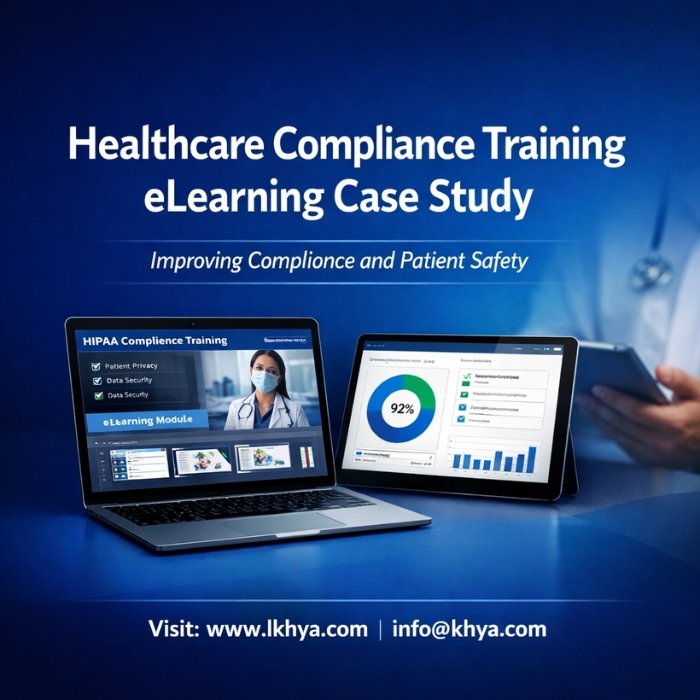



Healthcare Compliance Training eLearning Case Study
Healthcare organizations operate in highly regulated environments where compliance failures can lead to legal penalties, patient safety risks, and reputational damage. A large healthcare network needed a scalable solution to deliver consistent compliance training across its workforce.
IKHYA – eLearning Solutions Company developed a scenario-based eLearning compliance program that improved regulatory adherence, increased training completion rates, and strengthened compliance awareness among both clinical and administrative staff.
Start your training transformation with IKHYA.
Client Overview
The client is a large multi-facility healthcare provider operating a network of hospitals, outpatient clinics, and diagnostic laboratories across multiple regions. The organization serves hundreds of thousands of patients annually and employs a diverse workforce responsible for clinical care, patient administration, and healthcare operations.
Organization Profile
- Industry: Healthcare Services
- Workforce Size: 6,500+ employees
- Facilities: 8 hospitals, 20 outpatient clinics, and multiple diagnostic centers
- Geographic Presence: Multi-state healthcare network
- Patients Served Annually: 900,000+
The organization operates in a highly regulated healthcare ecosystem requiring strict compliance with regulations such as Health Insurance Portability and Accountability Act, Occupational Safety and Health Administration, and accreditation standards from The Joint Commission.
These regulations require healthcare providers to maintain consistent employee training programs covering:
- patient data privacy and security
- infection prevention procedures
- ethical medical practices
- workplace safety compliance
- regulatory reporting requirements
Workforce Demographics
The healthcare network employs professionals across multiple roles, including:
Clinical staff
- physicians and surgeons
- registered nurses
- emergency care teams
- laboratory technicians
Operational staff
- hospital administration teams
- patient support representatives
- billing and insurance specialists
- pharmacy staff
Support staff
- IT professionals
- facility management teams
- medical equipment operators
Because of these diverse roles, the organization required role-specific compliance training paths tailored to different job responsibilities.
Training Environment Before the Project
Prior to partnering with IKHYA – eLearning Solutions Company, the organization relied on a mix of traditional training approaches:
- annual classroom compliance workshops
- static PowerPoint presentations
- PDF policy manuals distributed through email
- basic LMS courses with long text-based modules
While these methods fulfilled minimum regulatory requirements, they presented major operational limitations.
Key problems included:
- inconsistent training delivery across hospital locations
- low learner engagement in compliance modules
- difficulty tracking training completion rates
- limited ability to measure training effectiveness
- minimal real-world decision-making practice
Additionally, rotating healthcare staff and shift-based work schedules made it difficult for employees to attend instructor-led training sessions.
Operational Complexity
Healthcare operations run 24 hours a day, making training logistics particularly challenging.
Employees often work:
- overnight shifts
- rotating schedules
- emergency duty assignments
As a result, traditional classroom training created operational disruptions.
Managers also struggled to ensure that temporary staff, contract workers, and new hires completed required compliance training before beginning patient-facing duties.
Compliance Pressure
Healthcare providers are regularly audited by regulatory authorities to ensure compliance with privacy laws, safety regulations, and operational procedures.
The organization faced increasing pressure to demonstrate:
- standardized compliance training across facilities
- accurate training records for audits
- measurable learning outcomes
- improved employee compliance awareness
Without a scalable digital training solution, maintaining consistent training across thousands of employees was becoming increasingly difficult.
To address these challenges, the healthcare provider partnered with IKHYA – eLearning Solutions Company to design and implement a modern digital compliance training ecosystem capable of delivering engaging, scalable, and measurable learning experiences.
Training Challenges
Before implementing the new digital learning solution, the healthcare organization faced several critical operational and compliance-related training challenges. These issues impacted regulatory compliance, employee performance, and patient safety across multiple facilities.
1. Inconsistent Compliance Training Across Facilities
Because the organization operated multiple hospitals and clinics in different regions, training delivery varied widely between locations.
Different departments often used:
- locally created PowerPoint presentations
- outdated training manuals
- trainer-led workshops with inconsistent content
As a result, employees received different interpretations of compliance policies, which increased regulatory risk.
For example:
A nurse working in Hospital A might receive a detailed training session on patient data privacy, while a nurse in Hospital B only received a brief overview.
This inconsistency created gaps in compliance knowledge across the organization.
2. Low Engagement with Compliance Training
Most compliance training modules were designed as text-heavy presentations or lecture-style sessions.
Employees often viewed these sessions as mandatory administrative tasks rather than meaningful learning experiences.
Common engagement issues included:
- employees skipping slides quickly to complete training
- minimal participation in workshops
- poor knowledge retention after training sessions
Healthcare staff frequently reported that compliance training felt disconnected from real clinical scenarios.
For example:
A nurse learning about HIPAA regulations might read policy documents but never practice identifying real patient privacy violations.
Without practical learning experiences, employees struggled to apply compliance rules during daily work activities.
3. Limited Real-World Decision-Making Practice
Healthcare professionals regularly face situations where they must apply compliance policies in real time.
Examples include:
- responding to accidental patient data exposure
- handling unauthorized access to medical records
- reporting safety violations in clinical environments
Traditional training methods rarely provided interactive scenarios that allowed employees to practice decision-making.
This gap increased the risk that employees would:
- make incorrect decisions during critical situations
- fail to recognize compliance violations
- delay reporting incidents
4. Difficulty Tracking Compliance Training Completion
The organization’s existing training management system provided limited visibility into learner progress.
Training administrators struggled to answer key compliance questions such as:
- Which employees completed required compliance training?
- Which departments had overdue training modules?
- Which topics employees struggled to understand?
Incomplete training records created challenges during regulatory audits conducted by organizations such as
The Joint Commission and regulators enforcing **Health Insurance Portability and Accountability Act requirements.
Without centralized reporting, demonstrating training compliance during audits became difficult.
5. Time Constraints for Healthcare Staff
Healthcare professionals work in fast-paced clinical environments where time is extremely limited.
Employees often work:
- 12-hour shifts
- emergency rotations
- unpredictable schedules
Long classroom sessions were difficult to attend, especially for staff working overnight or rotating shifts.
Many employees postponed or rushed through training simply to meet compliance deadlines.
This created a situation where training completion rates were technically high, but actual knowledge retention was low.
6. Increasing Regulatory and Legal Pressure
Healthcare regulators increasingly expect organizations to demonstrate active compliance training programs, not just policy documentation.
Failure to demonstrate adequate employee training can lead to:
- financial penalties
- legal investigations
- loss of accreditation
- reputational damage
For example, violations of **Health Insurance Portability and Accountability Act can result in fines reaching $1.5 million per year for severe cases of non-compliance.
The organization needed a training solution that could:
- prove compliance training completion
- track employee performance in assessments
- demonstrate learning outcomes during audits
7. Inefficient Onboarding for New Healthcare Employees
New hires were required to complete multiple compliance courses before working with patients.
However, the existing onboarding process involved:
- multiple classroom sessions
- long policy documents
- limited digital training resources
This created delays in onboarding and increased administrative workload for HR and compliance teams.
Managers wanted a training system that could accelerate onboarding while ensuring regulatory compliance.
Summary of Key Challenges
The healthcare organization needed to address several major issues:
- inconsistent compliance training delivery
- low learner engagement
- lack of real-world training scenarios
- limited training analytics and reporting
- difficulty scheduling training for shift-based staff
- growing regulatory compliance pressure
These challenges created a clear need for a modern digital learning solution capable of delivering scalable, engaging, and measurable compliance training across the entire workforce.
To solve these problems, IKHYA worked with the client to define clear training objectives aligned with compliance requirements and business goals.
Training Objectives
To address the operational and compliance challenges identified during the training needs analysis, the healthcare organization and IKHYA – eLearning Solutions Company defined a set of clear, measurable training objectives aligned with regulatory requirements, workforce performance, and patient safety standards.
The objective was not only to deliver compliance information, but to ensure that employees could apply compliance knowledge correctly in real-world healthcare situations.
1. Standardize Compliance Training Across All Facilities
One of the primary objectives was to create a consistent compliance training framework that could be delivered uniformly across hospitals, clinics, and diagnostic centers.
Key goals included:
- standardizing compliance policies across locations
- ensuring consistent training content for all employees
- reducing regional training inconsistencies
- improving knowledge alignment across departments
By creating a centralized digital learning program, the organization aimed to ensure that every employee received the same high-quality compliance training regardless of location.
2. Improve Training Completion Rates
Previously, the organization struggled with employees postponing or rushing through compliance training modules.
The new training program aimed to significantly improve participation and completion rates.
Target goals included:
- achieving 95%+ compliance training completion rates
- reducing overdue training assignments
- enabling flexible training access for shift-based workers
- providing mobile-friendly training access
Shorter digital learning modules were expected to help employees complete training more efficiently.
3. Strengthen Employee Understanding of Regulatory Requirements
Compliance training must ensure employees understand the practical implications of regulations, not just theoretical policies.
Training objectives included improving employee understanding of regulations such as:
- Health Insurance Portability and Accountability Act for patient data protection
- workplace safety standards enforced by Occupational Safety and Health Administration
- accreditation requirements defined by The Joint Commission
Employees needed to learn how to:
- protect patient data
- follow infection control protocols
- identify compliance violations
- report incidents correctly
The goal was to ensure staff could apply regulations during daily clinical operations.
4. Improve Real-World Decision-Making Skills
Healthcare employees frequently face complex compliance situations that require quick decisions.
The training program aimed to improve employees’ ability to:
- identify patient privacy risks
- respond to ethical dilemmas
- handle confidential medical information properly
- recognize unsafe clinical practices
Scenario-based training simulations were designed to help employees practice decision-making in realistic healthcare environments.
5. Reduce Compliance Risks and Violations
Another key objective was to reduce operational and legal risks associated with compliance failures.
Target outcomes included:
- reducing patient data privacy violations
- improving reporting of safety incidents
- minimizing regulatory audit findings
- strengthening documentation procedures
Improved compliance awareness would help reduce potential legal exposure and protect the organization’s reputation.
6. Accelerate Onboarding for New Employees
New healthcare employees must complete compliance training before interacting with patients.
The new digital training system aimed to streamline onboarding by:
- providing structured digital onboarding programs
- enabling self-paced training completion
- reducing reliance on classroom sessions
- allowing HR teams to track onboarding progress through the LMS
The goal was to reduce onboarding training time by at least 40% while maintaining compliance standards.
7. Enable Data-Driven Compliance Monitoring
Modern training programs must provide analytics and reporting capabilities to monitor training effectiveness.
The organization wanted the ability to track:
- employee training completion rates
- assessment performance
- knowledge gaps across departments
- compliance training deadlines
These insights would help compliance teams identify risk areas before they lead to regulatory violations.
Summary of Training Goals
The organization defined several measurable targets for the new training initiative:
- 95%+ compliance training completion rate
- 30–40% reduction in compliance violations
- 40% faster onboarding training completion
- improved regulatory audit readiness
- higher employee engagement in compliance training
To achieve these objectives, IKHYA designed a modern digital learning architecture combining microlearning, simulations, and scenario-based training experiences tailored to healthcare professionals.
Learning Solution Designed by IKHYA
To address the healthcare organization’s complex compliance training challenges, IKHYA – eLearning Solutions Company designed a comprehensive digital learning ecosystem that transformed traditional compliance training into an engaging, scalable, and measurable learning experience.
The learning architecture was designed to support:
- clinical staff working in high-pressure environments
- shift-based healthcare workers with limited time
- multiple training locations and departments
- strict regulatory compliance requirements
The solution combined microlearning, scenario-based training, and interactive simulations delivered through a centralized learning platform.
Digital Learning Strategy
IKHYA implemented a modern enterprise digital learning strategy designed to improve engagement, retention, and compliance awareness.
The strategy focused on five core principles:
1. Behavior-focused learning
Instead of simply presenting compliance policies, the training focused on behavior change and real-world decision-making.
Learners practiced applying compliance rules in realistic workplace scenarios.
2. Microlearning-based delivery
Long training sessions were replaced with short, focused microlearning modules.
Each module focused on a single compliance topic, such as:
- protecting patient data
- reporting compliance violations
- infection prevention protocols
- ethical medical practices
Modules were designed to take 5–7 minutes, making them easy to complete during busy work schedules.
3. Scenario-based learning
Compliance training included interactive scenarios that simulate real workplace situations.
Examples included:
- identifying a potential HIPAA violation when patient data is shared incorrectly
- deciding how to respond when a colleague fails to follow infection control procedures
- determining the correct action when encountering confidential patient information left unattended
Learners were required to choose actions and see the consequences of their decisions.
This approach improved critical thinking and decision-making skills.
4. Simulation-based training
For high-risk compliance topics, IKHYA designed interactive simulations that replicate real healthcare environments.
Examples included:
- patient data handling simulations
- infection control decision simulations
- ethical decision-making scenarios
These simulations allowed employees to practice responding to compliance risks without impacting real patients or operations.
5. Mobile-first learning experience
Healthcare staff often access training from different devices during shifts.
The learning solution was designed with a mobile-first approach, allowing employees to access training on:
- smartphones
- tablets
- desktop computers
Mobile accessibility enabled employees to complete training:
- during breaks
- between shifts
- during onboarding periods
Blended Learning Architecture
The final learning ecosystem combined multiple training formats to maximize effectiveness.
Components included:
Microlearning modules
Short interactive lessons covering key compliance concepts.
Scenario-based learning
Interactive decision-making exercises.
Simulation training
Practice environments for complex compliance situations.
Knowledge checks
Short quizzes after each module to reinforce learning.
Final assessments
Comprehensive evaluations measuring regulatory knowledge and decision-making ability.
This blended learning approach ensured employees developed both knowledge and practical application skills.
Personalized Learning Paths
Different healthcare roles require different compliance knowledge.
IKHYA created role-based learning paths tailored to different employee groups.
Examples include:
Clinical staff training path
- infection control procedures
- patient safety protocols
- medical documentation compliance
- ethical treatment guidelines
Administrative staff training path
- patient data privacy compliance
- billing compliance
- documentation procedures
- data security protocols
Management training path
- regulatory reporting requirements
- incident investigation procedures
- compliance monitoring responsibilities
Role-based learning ensured that employees received relevant and practical training aligned with their responsibilities.
Continuous Learning Reinforcement
To maintain long-term compliance awareness, IKHYA incorporated ongoing learning reinforcement strategies.
These included:
- periodic refresher microlearning modules
- scenario-based compliance challenges
- automated training reminders
- knowledge reinforcement quizzes
This approach helped prevent the “annual training effect,” where employees forget compliance rules after completing yearly training sessions.
Why This Solution Works
The IKHYA learning architecture addressed the organization’s original challenges by:
- improving learner engagement through interactive training
- enabling flexible training access for shift-based healthcare staff
- standardizing compliance training across facilities
- providing measurable training analytics for compliance audits
- strengthening real-world decision-making skills
By replacing passive training methods with interactive digital learning experiences, the organization created a scalable compliance training ecosystem capable of supporting thousands of healthcare employees.
Instructional Design Strategy
To ensure the compliance training program delivered measurable learning outcomes and behavioral change, IKHYA – eLearning Solutions Company implemented a structured instructional design framework grounded in established learning science models. The design combined the ADDIE Model, Bloom’s Taxonomy, and Kirkpatrick Model to guide course development, learner engagement, and training evaluation.
These methodologies ensured that the program was not simply informational but focused on real behavioral outcomes and measurable compliance improvement.
Applying the ADDIE Model
The ADDIE Model (Analysis, Design, Development, Implementation, Evaluation) served as the foundation for the overall course development lifecycle.
Analysis
During the analysis phase, the IKHYA team conducted a detailed training needs assessment. This included:
- reviewing regulatory requirements such as HIPAA and workplace safety standards
- analyzing previous compliance training materials
- interviewing healthcare managers and compliance officers
- identifying high-risk compliance areas across departments
This phase helped determine the most critical training topics and learner needs.
Design
In the design phase, the team created a structured curriculum architecture aligned with organizational compliance objectives.
Activities included:
- defining learning objectives for each compliance module
- mapping learning outcomes to job roles (clinical, administrative, leadership)
- selecting instructional strategies such as microlearning, simulations, and scenarios
- designing learner assessments and evaluation metrics
Each module was structured to deliver focused learning outcomes in short learning sessions.
Development
During the development phase, instructional designers collaborated with subject matter experts (SMEs) to create interactive course content.
Development included:
- multimedia learning modules
- animated compliance scenarios
- branching decision simulations
- interactive knowledge checks
The goal was to transform complex regulatory information into engaging, practical learning experiences.
Implementation
Courses were deployed through the organization’s Learning Management System (LMS), allowing employees to access training from any location.
Implementation activities included:
- LMS configuration and course integration
- automated training enrollment for employees
- system testing and user acceptance testing (UAT)
- instructor and administrator orientation
The implementation stage ensured smooth training rollout across all healthcare facilities.
Evaluation
After deployment, the program’s effectiveness was evaluated using learner analytics, assessment performance, and feedback surveys.
This evaluation helped identify:
- knowledge gaps among employees
- training modules needing improvement
- departments requiring additional compliance support
Using Bloom’s Taxonomy for Learning Objectives
Compliance training must ensure employees can apply knowledge in real situations, not just recall information.
To achieve this, IKHYA structured learning objectives using Bloom’s Taxonomy, which categorizes learning into six levels:
- Remember – recalling regulatory policies
- Understand – explaining compliance requirements
- Apply – following procedures during daily work
- Analyze – identifying compliance risks
- Evaluate – making ethical decisions
- Create – implementing best practices in the workplace
Most compliance modules targeted higher-order learning levels, such as application and evaluation.
Example learning objective:
Instead of simply memorizing HIPAA regulations, employees were required to:
- identify potential privacy violations in simulated scenarios
- evaluate appropriate response actions
- apply compliance protocols during decision-making exercises
This design ensured employees developed practical compliance competence.
Measuring Training Effectiveness with the Kirkpatrick Model
Training success was evaluated using the Kirkpatrick Model, which measures training effectiveness across four levels.
Level 1: Reaction
Learner feedback was collected through post-course surveys to measure:
- course engagement
- perceived relevance of training
- satisfaction with learning experience
Level 2: Learning
Assessment scores and scenario-based evaluations measured whether employees had gained compliance knowledge.
Metrics included:
- quiz scores
- scenario decision accuracy
- knowledge retention tests
Level 3: Behavior
Managers observed whether employees applied compliance practices in their daily work.
Examples included:
- improved patient data handling procedures
- better documentation practices
- increased incident reporting
Level 4: Results
Organizational metrics were analyzed to measure the broader business impact of the training.
These included:
- reduction in compliance violations
- improved regulatory audit results
- increased employee training completion rates
Mapping Learning Objectives to Real Healthcare Scenarios
Every module was designed to align learning objectives with real workplace situations.
Examples included:
Patient Data Privacy Scenario
A nurse discovers a patient chart left open on a shared computer.
Learners must decide whether to:
- ignore the issue
- report it immediately
- secure the system and notify supervisors
Infection Control Scenario
A healthcare worker notices a colleague skipping required sanitation procedures.
Learners must determine the correct compliance response.
By integrating these instructional design strategies, IKHYA ensured the training program delivered meaningful learning experiences that directly improved workplace compliance behaviors.
Technology Stack Used
To deliver a scalable and interactive compliance training ecosystem, IKHYA – eLearning Solutions Company selected a modern eLearning technology stack that supports high interactivity, LMS compatibility, mobile access, accessibility compliance, and enterprise analytics.
The technology architecture was designed to ensure:
- seamless integration with the organization’s LMS
- compatibility with healthcare IT systems
- scalable delivery across thousands of learners
- detailed learner analytics for compliance reporting
The selected tools also allowed the instructional design team to create interactive scenarios, simulations, and multimedia-rich learning experiences.
eLearning Authoring Tools
The training modules were developed using industry-leading eLearning authoring platforms to ensure flexibility, interactivity, and high-quality multimedia content.
Articulate Storyline
Articulate Storyline was used for developing highly interactive modules and scenario-based simulations.
Key capabilities included:
- branching scenario design
- drag-and-drop interactions
- decision-based learning paths
- animated storytelling elements
Storyline was particularly useful for creating realistic healthcare compliance scenarios where learners could explore multiple decision outcomes.
Adobe Captivate
Adobe Captivate was used for building responsive learning modules and software simulation content.
Key features used in the project included:
- responsive design for mobile learning
- software interface simulations
- interactive quizzes and assessments
Captivate ensured training modules could adapt seamlessly across mobile devices, tablets, and desktops.
Lectora Inspire
Lectora Inspire was used to develop compliance training modules requiring advanced accessibility support and structured course frameworks.
Its strengths included:
- strong HTML5 publishing capabilities
- flexible course navigation design
- built-in accessibility tools
This was particularly important for ensuring compliance with accessibility standards.
iSpring Suite
iSpring Suite was used to convert certain existing training materials into interactive digital courses quickly.
This tool helped accelerate development for:
- policy explanation modules
- onboarding training content
- knowledge refresher courses
Using iSpring allowed the organization to rapidly digitize legacy training content while improving interactivity.
Learning Standards and Integration
To ensure compatibility with enterprise learning systems and regulatory reporting requirements, the courses were developed using widely supported eLearning standards.
SCORM
SCORM enabled the training modules to communicate with the organization’s LMS.
This allowed administrators to track:
- learner progress
- course completion
- assessment results
SCORM compatibility ensured the courses could be deployed across multiple LMS platforms.
Experience API
xAPI (Experience API) was used to capture deeper learning analytics beyond traditional LMS reporting.
xAPI enabled tracking of:
- learner interactions within simulations
- scenario decision patterns
- engagement time across modules
These analytics helped compliance teams identify knowledge gaps and training risk areas.
Accessibility and Compliance Standards
Healthcare organizations must ensure that digital training materials are accessible to all employees.
To support inclusive learning, the courses were designed according to Web Content Accessibility Guidelines.
Accessibility features included:
- screen reader compatibility
- keyboard navigation support
- high-contrast visual design
- captioned video content
- alternative text for images
These features ensured that the training program was accessible to employees with visual, auditory, or motor impairments.
LMS Integration
The learning modules were integrated with the organization’s enterprise Learning Management System (LMS).
Integration allowed administrators to:
- automate course enrollment
- monitor training completion rates
- generate compliance reports for regulatory audits
- track learner assessment performance
This centralized LMS infrastructure enabled the organization to manage compliance training for thousands of healthcare employees across multiple facilities.
Why This Technology Stack Was Chosen
The selected technology ecosystem provided several key advantages:
- high interactivity for engaging learning experiences
- compatibility with enterprise LMS platforms
- support for mobile learning environments
- advanced learner analytics for compliance monitoring
- accessibility compliance for inclusive training
By leveraging these technologies, IKHYA created a future-ready digital training ecosystem capable of scaling across large healthcare workforces while maintaining regulatory compliance standards.
Training Program Structure
To ensure healthcare professionals could complete compliance training efficiently without disrupting their clinical responsibilities, IKHYA – eLearning Solutions Company designed a structured microlearning-based training program organized into short modules, interactive scenarios, and simulation exercises.
The training architecture focused on delivering focused learning experiences that could be completed quickly while still ensuring strong knowledge retention and practical application.
The program was structured as a multi-stage learning journey, guiding employees from foundational compliance knowledge to real-world decision-making practice.
Program Overview
The final training program included:
- 28 microlearning modules
- 7 scenario-based learning simulations
- 5 interactive assessments
- 1 final compliance certification assessment
Average module duration:
5–7 minutes per microlearning module
Total learning time:
Approximately 3–3.5 hours of structured training
This modular approach allowed healthcare employees to complete training gradually during available time windows without affecting patient care responsibilities.
Microlearning Compliance Modules
The training program consisted of 28 short compliance modules, each focusing on a specific regulatory or operational topic.
Key module topics included:
Patient Data Privacy
- protecting patient information
- identifying potential data privacy breaches
- reporting unauthorized access incidents
Infection Control Compliance
- hygiene and sanitation protocols
- preventing cross-contamination
- proper use of protective equipment
Ethical Conduct and Professional Responsibility
- handling ethical dilemmas
- reporting misconduct
- maintaining professional integrity
Workplace Safety Compliance
- identifying workplace hazards
- incident reporting procedures
- emergency response protocols
Billing and Documentation Compliance
- accurate patient record documentation
- billing transparency guidelines
- avoiding fraudulent billing practices
Each module included:
- short explainer content
- real-world healthcare examples
- interactive learning elements
- knowledge check questions
Scenario-Based Learning Simulations
To strengthen real-world decision-making skills, the program included 7 interactive scenario simulations.
Each simulation replicated realistic healthcare environments where employees had to apply compliance knowledge.
Examples of scenario simulations included:
Patient Privacy Violation Scenario
A nurse notices a colleague discussing patient information in a public hallway.
Learners must decide:
- whether to ignore the situation
- remind the colleague about privacy rules
- report the incident through compliance channels
Medical Record Access Scenario
An administrative employee receives a request from a relative asking for patient information.
Learners must determine:
- whether sharing information is permitted
- how to verify authorization
- when to escalate the request
Infection Control Scenario
A healthcare worker fails to follow required sanitation procedures before entering a patient room.
Learners must decide the correct action based on hospital infection prevention policies.
Interactive Assessments
Each training section included interactive knowledge checks designed to reinforce learning.
Assessment formats included:
- multiple-choice questions
- scenario-based decision questions
- compliance risk identification exercises
- drag-and-drop procedural sequencing
These assessments helped ensure employees understood the practical implications of compliance policies.
Final Compliance Certification Assessment
At the end of the training program, employees completed a comprehensive compliance certification exam.
The final assessment measured:
- understanding of regulatory requirements
- ability to identify compliance risks
- decision-making accuracy in simulated scenarios
Certification requirements included:
- minimum 80% passing score
- completion of all required modules
- participation in scenario simulations
Successful completion of the certification allowed the organization to demonstrate formal compliance training completion during regulatory audits.
Learner Journey
The program followed a structured learner journey designed to guide employees through progressively complex learning experiences.
Step 1: Compliance Foundations
Employees learned fundamental compliance principles and regulatory requirements.
Step 2: Role-Specific Compliance Training
Employees completed training tailored to their job responsibilities.
Step 3: Scenario-Based Practice
Learners applied compliance knowledge in realistic workplace simulations.
Step 4: Knowledge Reinforcement
Short quizzes reinforced understanding of key compliance topics.
Step 5: Final Certification Assessment
Employees demonstrated their knowledge and decision-making abilities through the final evaluation.
Continuous Learning Reinforcement
To prevent knowledge decay, the organization implemented ongoing reinforcement learning activities.
These included:
- quarterly refresher microlearning modules
- compliance awareness quizzes
- new regulation update modules
- scenario-based refresher exercises
This continuous learning approach ensured that compliance training became an ongoing process rather than a once-a-year activity.
Why This Training Structure Was Effective
The training program structure solved several key challenges faced by the organization.
It enabled:
- flexible learning for shift-based healthcare employees
- strong engagement through interactive learning methods
- practical decision-making practice through simulations
- measurable learning outcomes through assessments
- standardized training across all healthcare facilities
The modular architecture allowed the organization to scale compliance training across thousands of employees while maintaining high learning effectiveness.
Development Process
To deliver a high-quality enterprise compliance training solution, IKHYA – eLearning Solutions Company followed a structured development workflow aligned with enterprise instructional design best practices. The process ensured that training content was accurate, compliant with healthcare regulations, engaging for learners, and scalable across the organization’s workforce.
The project followed a multi-stage development lifecycle designed to maintain content quality, regulatory accuracy, and technical reliability.
Training Needs Analysis
The first stage involved a detailed training needs analysis (TNA) to identify gaps in the organization’s compliance training program.
IKHYA collaborated with:
- compliance officers
- healthcare administrators
- HR leaders
- clinical department managers
The analysis included:
- reviewing existing training materials and compliance policies
- analyzing past compliance incidents and audit reports
- identifying high-risk operational areas
- mapping regulatory requirements from entities such as
Health Insurance Portability and Accountability Act and
The Joint Commission.
This stage helped determine:
- which compliance topics required deeper training
- which employee roles required specialized learning paths
- which knowledge gaps posed the highest operational risks.
The findings guided the overall learning strategy.
Curriculum Architecture
After the analysis phase, the instructional design team created a comprehensive curriculum architecture for the compliance training program.
This step involved structuring the training into logical learning pathways based on:
- employee roles
- regulatory priorities
- risk severity
- training complexity
The curriculum framework defined:
- learning objectives for each module
- training sequence for learners
- assessment methods
- reinforcement strategies
For example, clinical staff training paths emphasized:
- infection prevention protocols
- patient privacy compliance
- medical documentation procedures
Meanwhile, administrative staff training paths focused on:
- patient data protection
- billing compliance
- documentation accuracy.
This structured architecture ensured that training remained relevant and role-specific.
Storyboarding
Before development began, each training module was carefully planned using detailed instructional storyboards.
Storyboards served as the blueprint for course development and included:
- learning objectives
- screen-by-screen content structure
- interaction designs
- scenario scripts
- visual design guidelines
For example, a compliance scenario storyboard might include:
- a simulated hospital environment
- dialogue between healthcare staff members
- branching decision points for learners
- feedback explaining the consequences of each decision
Storyboarding allowed stakeholders to review and approve content before development, ensuring regulatory accuracy and reducing revision cycles.
Multimedia Development
Once storyboards were approved, the development team began building the training modules using modern eLearning tools.
Development included:
- interactive course design
- animated healthcare scenarios
- voice-over narration
- motion graphics and visual illustrations
- simulation-based learning interactions
Modules were developed using tools such as
Articulate Storyline and
Adobe Captivate.
Special attention was given to visual realism, ensuring that learning environments resembled real healthcare settings such as:
- hospital wards
- patient record systems
- clinical workstations
This helped learners connect training scenarios with real workplace situations.
Quality Assurance
Before deployment, each module underwent a rigorous quality assurance (QA) process to ensure accuracy, usability, and technical compatibility.
QA testing included:
Content validation
- verifying compliance information with subject matter experts
- confirming regulatory references and procedures
Instructional design review
- checking learning objectives alignment
- ensuring scenario logic and assessment accuracy
Technical testing
- verifying compatibility across devices
- testing SCORM/xAPI tracking
- checking LMS reporting functionality
Accessibility testing
- validating keyboard navigation
- testing screen reader compatibility
- confirming caption availability for multimedia content
These steps ensured the training met enterprise learning standards and accessibility guidelines.
LMS Deployment
After successful QA testing, the training program was deployed through the organization’s Learning Management System (LMS).
Deployment activities included:
- uploading SCORM-compliant course packages
- configuring course enrollment rules
- assigning learning paths to employee groups
- enabling compliance reporting dashboards
The LMS allowed administrators to:
- monitor training progress
- track completion rates
- generate compliance audit reports
- identify employees who had not completed required training
Integration with the LMS ensured the organization could manage compliance training across thousands of employees efficiently.
Continuous Improvement Cycle
After launch, the training program entered a continuous improvement cycle.
Feedback and analytics were used to improve the program over time.
Sources of feedback included:
- learner surveys
- assessment performance data
- compliance audit results
- feedback from healthcare managers
These insights allowed the organization to:
- update modules when regulations changed
- improve learning content based on performance data
- introduce new training scenarios addressing emerging risks
Outcome of the Development Process
By following this structured development process, IKHYA successfully delivered a high-quality, enterprise-ready compliance training program that could be deployed consistently across the healthcare organization.
The development methodology ensured:
- regulatory accuracy
- engaging learning experiences
- scalable training deployment
- reliable compliance reporting
This structured process also helped keep the project on schedule and within the planned development timeline.
Project Timeline
Implementing an enterprise-level compliance training program for a healthcare organization requires careful coordination between instructional designers, subject matter experts, compliance officers, multimedia developers, and LMS administrators.
To ensure the project remained efficient while maintaining high quality and regulatory accuracy, IKHYA – eLearning Solutions Company followed a structured project timeline.
The entire development lifecycle—from initial analysis to LMS deployment—was completed in approximately 14 weeks.
Phase 1: Training Needs Analysis
Duration: 2 Weeks
The project began with a comprehensive analysis of the organization's training environment, compliance requirements, and workforce learning needs.
Key activities during this phase included:
- reviewing existing compliance training materials
- analyzing previous compliance audit reports
- interviewing department heads and compliance managers
- identifying regulatory requirements from organizations such as
Health Insurance Portability and Accountability Act and
The Joint Commission - identifying training gaps across clinical and administrative roles
Deliverables produced during this stage included:
- training needs assessment report
- learning objectives framework
- compliance training priority list
This phase ensured that the learning program addressed real compliance risks and operational challenges.
Phase 2: Instructional Design and Curriculum Architecture
Duration: 3 Weeks
Once the analysis was complete, the instructional design team began structuring the compliance training curriculum.
Key activities included:
- defining learning objectives aligned with regulatory standards
- designing role-based learning pathways
- outlining module structure and content flow
- designing scenario-based learning experiences
- creating assessment strategies
During this phase, the team also developed detailed instructional storyboards outlining the structure of each training module.
Stakeholders reviewed and approved these storyboards before development began, ensuring content accuracy and compliance alignment.
Deliverables produced during this stage included:
- curriculum architecture blueprint
- module storyboards
- assessment framework
Phase 3: eLearning Development
Duration: 6 Weeks
The development phase focused on transforming approved storyboards into fully interactive eLearning modules.
The development team used tools such as:
- Articulate Storyline
- Adobe Captivate
Key development activities included:
- building interactive microlearning modules
- designing branching compliance scenarios
- creating animated training content
- recording voice-over narration
- developing simulation-based training exercises
- integrating interactive assessments
During this phase, the team also ensured all modules were compatible with enterprise LMS systems and met accessibility requirements.
Phase 4: Quality Assurance and Testing
Duration: 2 Weeks
Before deployment, all training modules underwent a rigorous quality assurance process.
QA activities included:
Content validation
- verifying compliance policies with subject matter experts
- ensuring accuracy of regulatory information
Instructional design review
- confirming learning objectives alignment
- reviewing scenario decision paths
Technical testing
- validating SCORM compatibility
- testing course functionality across devices
- confirming LMS tracking and reporting
Accessibility testing
- ensuring compatibility with screen readers
- validating keyboard navigation support
- verifying captions for multimedia content
This phase ensured the training program met enterprise quality and accessibility standards.
Phase 5: LMS Deployment and Launch
Duration: 1 Week
The final stage involved deploying the training program to the organization’s Learning Management System (LMS).
Key activities included:
- uploading SCORM course packages
- configuring course enrollment rules
- assigning training modules to employee groups
- testing LMS reporting dashboards
- launching the training program across all facilities
Training administrators received guidance on:
- managing course enrollment
- monitoring learner progress
- generating compliance reports for audits
Total Project Duration
The complete project timeline was:
| Phase | Duration |
|---|---|
| Training Needs Analysis | 2 weeks |
| Instructional Design | 3 weeks |
| eLearning Development | 6 weeks |
| Quality Assurance | 2 weeks |
| LMS Deployment | 1 week |
Total Project Duration: 14 Weeks
Why This Timeline Was Effective
This structured timeline ensured that the project progressed efficiently while maintaining high quality and regulatory compliance.
The phased approach allowed the organization to:
- validate training content before development
- maintain alignment with regulatory requirements
- test course functionality thoroughly before launch
- deploy training across the workforce without operational disruption
By following this timeline, IKHYA successfully delivered a scalable compliance training program within a predictable enterprise project schedule.
Estimated Project Cost
Enterprise healthcare compliance training programs involve multiple components including instructional design, multimedia development, scenario simulations, LMS integration, and quality assurance.
The overall project cost depends on several variables such as:
- number of training modules
- complexity of interactions
- simulation design requirements
- multimedia production level
- localization or translation requirements
- LMS integration complexity
For this healthcare compliance training project, IKHYA – eLearning Solutions Company designed a scalable solution that balanced high learning quality with cost efficiency.
Microlearning Module Development Cost
Microlearning modules formed the core of the compliance training program.
Each module included:
- instructional design
- interactive content development
- voice-over narration
- animations and graphics
- knowledge check assessments
Typical industry cost range for microlearning modules:
$1,500 – $4,000 per module
Project scope:
28 microlearning modules
Estimated cost range:
$42,000 – $112,000
Scenario-Based Learning Simulations
Interactive compliance scenarios required additional development effort because they involved:
- branching decision paths
- complex learner interactions
- visual storytelling elements
- feedback based on learner choices
Typical development cost for scenario-based modules:
$4,000 – $8,000 per simulation
Project scope:
7 scenario simulations
Estimated cost range:
$28,000 – $56,000
Multimedia Production
The program included various multimedia components designed to improve engagement and knowledge retention.
Multimedia elements included:
- animated healthcare scenarios
- motion graphics
- professional voice-over narration
- visual illustrations of healthcare environments
Estimated multimedia production cost:
$8,000 – $20,000
Instructional Design and Learning Architecture
Enterprise training projects require extensive instructional design work to ensure:
- alignment with regulatory requirements
- clear learning objectives
- structured learner journeys
- assessment design
Instructional design services included:
- training needs analysis
- curriculum architecture
- storyboard development
- assessment design
Estimated instructional design cost:
$10,000 – $25,000
LMS Integration and Deployment
Integrating the training modules with the organization's Learning Management System required additional configuration and testing.
This included:
- SCORM package configuration
- course enrollment automation
- training completion tracking
- compliance reporting setup
Estimated LMS integration cost:
$5,000 – $12,000
Quality Assurance and Testing
Enterprise training projects require rigorous quality assurance to ensure technical stability and regulatory accuracy.
QA activities included:
- functional testing
- compatibility testing across devices
- accessibility compliance validation
- content accuracy verification
Estimated QA cost:
$4,000 – $10,000
Total Estimated Project Cost
Combining all development components, the total estimated project investment ranged between:
$97,000 – $235,000
This range reflects variations in:
- interactivity levels
- multimedia production quality
- simulation complexity
- revision cycles during development
Cost Drivers in Enterprise eLearning Development
Several factors can significantly influence the final project cost.
Key cost drivers include:
Level of Interactivity
Highly interactive modules with branching scenarios require more development effort than simple slide-based courses.
Simulation Complexity
Advanced simulations involving realistic healthcare environments and decision paths increase production costs.
Multimedia Quality
Professional voice-over narration, animations, and graphics enhance engagement but also increase development costs.
Localization Requirements
If the training program must support multiple languages, additional costs may arise for translation and localization.
LMS Customization
Integrating with complex enterprise LMS platforms or HR systems can increase implementation costs.
ROI Considerations
Although the upfront investment may appear substantial, organizations typically recover these costs through:
- reduced compliance violations
- fewer regulatory penalties
- faster employee onboarding
- improved operational efficiency
- reduced instructor-led training expenses
For large healthcare organizations, preventing even a single major compliance violation can offset the entire training investment.
Strategic Value for Healthcare Organizations
The investment in digital compliance training allowed the organization to create a long-term scalable training infrastructure that could be updated easily as regulations evolve.
This ensured the organization could maintain ongoing compliance readiness while improving workforce performance.
Results and Business Impact
After implementing the new digital compliance training ecosystem designed by IKHYA – eLearning Solutions Company, the healthcare organization experienced measurable improvements across several operational, compliance, and workforce performance metrics.
The results were measured over a 12-month evaluation period following the full deployment of the training program through the organization’s Learning Management System.
The impact was evaluated using performance metrics aligned with the Kirkpatrick Model, focusing on learner engagement, knowledge acquisition, behavioral change, and organizational outcomes.
1. Significant Improvement in Training Completion Rates
Before the new eLearning program was implemented, compliance training completion rates averaged 68% across the organization. Employees often delayed training due to busy schedules or limited classroom availability.
After the digital training program launch:
- compliance training completion increased to 96% within the first training cycle
- overdue training assignments dropped by over 70%
- employees completed modules faster due to the microlearning structure
Healthcare staff could now complete short modules during breaks or between shifts, significantly improving accessibility.
2. Reduction in Compliance Violations
One of the most important outcomes of the project was a measurable reduction in compliance incidents.
Within the first year after implementing the new training program:
- 35% reduction in patient data privacy violations
- 28% decrease in infection control compliance issues
- 40% increase in incident reporting accuracy
The training simulations helped employees identify potential risks earlier and respond appropriately in real-world situations.
Improved compliance awareness also strengthened adherence to regulations such as
Health Insurance Portability and Accountability Act.
3. Improved Regulatory Audit Performance
Healthcare organizations must regularly undergo regulatory and accreditation audits conducted by organizations such as
The Joint Commission.
After implementing the new training system, the organization achieved:
- 30% improvement in compliance audit scores
- better documentation of employee training records
- faster generation of audit reports through LMS analytics
Training administrators could now quickly provide verifiable records of employee training completion, significantly improving audit readiness.
4. Faster Onboarding for New Healthcare Employees
Before the digital training program, onboarding new healthcare employees required multiple in-person training sessions.
With the new digital training ecosystem:
- onboarding training time was reduced by 45%
- new employees could complete compliance modules online before starting clinical duties
- HR teams could track onboarding progress through LMS dashboards
This improvement allowed new hires to become productive more quickly while still meeting compliance requirements.
5. Improved Employee Engagement with Compliance Training
Employee feedback surveys revealed that learners found the new training program far more engaging than traditional compliance training.
Survey results showed:
- 82% of employees preferred scenario-based learning over traditional slide-based training
- 76% reported better understanding of compliance policies
- 88% said the microlearning modules were easier to complete during work schedules
Interactive scenarios helped employees connect training content with real workplace situations.
6. Better Compliance Data Visibility
One of the major advantages of the new digital learning ecosystem was the ability to collect detailed training analytics.
Using LMS reporting and Experience API analytics, the organization could track:
- employee learning progress
- scenario decision accuracy
- department-level compliance knowledge gaps
Compliance officers could now proactively identify high-risk training areas and introduce additional learning reinforcement when necessary.
7. Reduced Training Administration Effort
Previously, training administrators spent significant time coordinating classroom training sessions and manually tracking training completion.
With the new digital training platform:
- administrative workload for training coordination decreased by 50%
- automated enrollment simplified training management
- compliance reporting became faster and more accurate
Training administrators could now focus on improving training strategy rather than managing logistics.
Summary of Measurable Results
The healthcare organization achieved significant operational improvements after implementing the new training program.
Key outcomes included:
- 96% compliance training completion rate
- 35% reduction in privacy violations
- 30% improvement in audit performance
- 45% faster onboarding
- 50% reduction in training administration workload
These results demonstrated that transforming compliance training into an interactive digital learning experience can significantly improve both regulatory compliance and operational efficiency.
Key Learning Outcomes
Beyond organizational improvements in compliance metrics and operational efficiency, the training program delivered significant individual learning outcomes for healthcare employees. The new digital learning ecosystem helped employees develop stronger compliance awareness, better decision-making skills, and a deeper understanding of regulatory responsibilities.
These outcomes were measured using learner assessments, feedback surveys, and behavioral observations aligned with the Kirkpatrick Model.
1. Stronger Compliance Awareness
One of the primary outcomes of the training program was improved awareness of healthcare regulations and workplace compliance policies.
Employees developed a clearer understanding of:
- patient privacy protection requirements
- regulatory compliance responsibilities
- workplace safety procedures
- ethical conduct guidelines
Training modules covering regulations such as
Health Insurance Portability and Accountability Act helped employees understand how compliance rules apply directly to their daily work.
As a result, employees became more confident in identifying potential compliance violations and taking appropriate action.
2. Improved Decision-Making in High-Risk Situations
Healthcare professionals frequently face situations that require quick decisions while maintaining compliance with regulations and organizational policies.
The scenario-based learning modules allowed employees to practice responding to realistic workplace situations, such as:
- handling confidential patient information
- responding to privacy violations
- reporting safety incidents
- managing ethical dilemmas
By practicing these situations through interactive simulations, employees developed stronger situational awareness and decision-making confidence.
Managers reported that staff were more proactive in addressing compliance issues and escalating concerns when necessary.
3. Better Understanding of Regulatory Procedures
Healthcare compliance regulations can often be complex and difficult to interpret.
The training program simplified these regulations by presenting them through:
- real-world examples
- visual demonstrations
- interactive explanations
Employees gained a deeper understanding of how to follow procedures related to:
- patient data security
- infection prevention protocols
- medical documentation standards
- incident reporting processes
This practical understanding helped employees apply compliance procedures more consistently across different departments and facilities.
4. Increased Confidence in Reporting Compliance Issues
One of the goals of the training program was to encourage employees to report potential compliance violations without hesitation.
Scenario-based training helped employees understand:
- when an issue should be reported
- how to report incidents properly
- what documentation is required during reporting
As a result, the organization observed an increase in accurate and timely compliance incident reporting, allowing issues to be addressed earlier before escalating into larger problems.
5. Improved Patient Safety Awareness
Compliance training in healthcare directly contributes to patient safety.
Employees gained stronger awareness of safety-related topics such as:
- infection control practices
- safe handling of medical equipment
- documentation accuracy in patient records
By reinforcing these practices through interactive learning modules, the training program helped employees understand the direct connection between compliance practices and patient outcomes.
This increased awareness contributed to improved adherence to safety procedures in clinical environments.
6. Long-Term Knowledge Retention
Traditional compliance training often leads to rapid knowledge loss because information is delivered in long lectures or dense policy documents.
The new microlearning-based structure improved knowledge retention by:
- presenting information in short, focused modules
- reinforcing learning through frequent knowledge checks
- providing ongoing refresher modules throughout the year
Employees reported that the microlearning format made it easier to remember key compliance principles.
Summary of Learner-Level Improvements
The training program produced measurable improvements in employee knowledge and behavior.
Key learning outcomes included:
- stronger understanding of healthcare regulations
- improved decision-making in compliance scenarios
- increased confidence in reporting violations
- better adherence to workplace safety procedures
- improved patient safety awareness
- stronger long-term knowledge retention
These improvements helped the organization build a more compliance-aware workforce capable of maintaining regulatory standards while delivering high-quality patient care.
Industries Where This Solution Applies
Although this case study focuses on healthcare compliance training, the digital compliance training framework designed by IKHYA – eLearning Solutions Company can be applied across multiple industries where regulatory compliance, safety standards, and operational procedures are critical.
Many industries face similar training challenges, such as:
- complex regulatory requirements
- large distributed workforces
- high-risk operational environments
- the need for standardized training across locations
The microlearning, scenario-based learning, and simulation-based training approach used in this healthcare project can be adapted to various sectors.
Manufacturing
Manufacturing environments often involve high-risk equipment, hazardous materials, and strict workplace safety regulations.
Companies must ensure employees are trained in areas such as:
- workplace safety protocols
- equipment operation procedures
- hazardous material handling
- quality control standards
- incident reporting
Digital learning solutions can simulate real manufacturing environments, allowing employees to practice safety procedures before working with machinery.
For example, simulation-based training can help workers learn how to respond to machine malfunctions or emergency shutdown situations.
Construction
The construction industry has one of the highest workplace accident rates, making safety training essential.
Construction companies must comply with safety standards enforced by organizations such as
Occupational Safety and Health Administration.
Training programs in this industry typically focus on:
- fall protection procedures
- equipment safety protocols
- site hazard identification
- emergency response planning
- safe use of construction tools
Scenario-based learning can help workers identify risks on simulated construction sites and make safer decisions.
Oil and Gas
The oil and gas industry operates in extremely hazardous environments where compliance failures can lead to severe safety incidents.
Training programs must address:
- hazardous material handling
- environmental protection regulations
- equipment safety procedures
- emergency evacuation protocols
- operational risk management
Interactive simulation training allows workers to practice responding to emergencies such as equipment failures, gas leaks, or fire incidents without exposing them to real danger.
Logistics and Transportation
Logistics companies must train employees on operational procedures, safety standards, and regulatory compliance related to transportation and supply chain operations.
Training topics often include:
- warehouse safety procedures
- safe equipment operation
- inventory management compliance
- transportation regulations
- accident prevention
Digital training programs can simulate warehouse environments where employees learn to identify hazards and follow safe operational procedures.
Heavy Equipment Operations
Industries that rely on heavy machinery require specialized training to ensure operators follow safety protocols and regulatory guidelines.
Training programs typically focus on:
- safe operation of heavy equipment
- maintenance procedures
- hazard recognition
- accident prevention strategies
- emergency response procedures
Simulation-based learning environments can replicate equipment operation scenarios, allowing workers to practice handling complex situations safely.
Why This Training Model Works Across Industries
The digital learning architecture implemented by IKHYA offers several advantages that make it adaptable to many industries.
Key benefits include:
- scalable training delivery for large workforces
- standardized training across locations
- improved employee engagement through interactive learning
- measurable training outcomes through analytics
- reduced operational risk through scenario-based learning
Because regulatory requirements and workplace safety standards continue to evolve, organizations across industries are increasingly adopting digital compliance training ecosystems to maintain workforce readiness and reduce operational risks.
Related eLearning Services
Organizations implementing enterprise training programs often require a combination of specialized learning services to build a scalable and effective digital learning ecosystem.
IKHYA – eLearning Solutions Company provides a full suite of eLearning development and learning technology services designed to support corporate training transformation initiatives.
These services help organizations design, develop, deploy, and optimize modern learning solutions for workforce development and compliance training.
Custom eLearning Development
Custom eLearning development involves designing training programs tailored specifically to an organization’s operational environment, workforce roles, and learning objectives.
Key features include:
- role-based training modules
- interactive multimedia content
- scenario-based learning experiences
- customized assessments and certification programs
Custom eLearning development is particularly valuable for organizations that require training aligned with specific regulatory requirements or proprietary operational processes.
Rapid eLearning Development
Rapid eLearning development focuses on converting existing training materials into digital learning modules quickly and cost-effectively.
This approach is often used when organizations already have:
- PowerPoint training presentations
- classroom training manuals
- legacy training documentation
Using tools such as iSpring Suite and Articulate Storyline, existing content can be transformed into interactive digital courses.
Rapid eLearning allows organizations to deploy training programs faster while still improving learner engagement.
Instructional Design Services
Instructional design focuses on creating effective learning experiences based on proven learning science and educational methodologies.
IKHYA instructional design services include:
- training needs analysis
- curriculum architecture design
- learning objective mapping
- scenario-based training design
- assessment development
Instructional designers use frameworks such as the ADDIE Model and Bloom’s Taxonomy to ensure training programs deliver measurable learning outcomes.
Microlearning Development
Microlearning development involves creating short, focused learning modules designed for quick consumption.
Typical microlearning modules:
- 3–7 minutes long
- focused on a single learning objective
- accessible through mobile devices
Microlearning is highly effective for:
- compliance training
- product knowledge training
- onboarding programs
- refresher learning
This format improves knowledge retention and allows employees to complete training during short time intervals.
Simulation-Based Training
Simulation-based training allows learners to practice decision-making in realistic workplace environments without real-world risk.
Interactive simulations can replicate scenarios such as:
- compliance violations
- workplace safety incidents
- customer interactions
- operational decision-making
Simulation training modules are typically developed using platforms such as Adobe Captivate and Articulate Storyline.
This approach significantly improves behavioral learning outcomes and practical skill development.
LMS Integration Services
A Learning Management System (LMS) enables organizations to manage, track, and analyze training programs across their workforce.
IKHYA provides LMS integration services that include:
- LMS platform configuration
- course deployment and SCORM integration
- automated training enrollment
- reporting and analytics setup
Integration with standards such as
SCORM and
Experience API
ensures that training programs generate detailed learner data and compliance reporting.
End-to-End Corporate Training Solutions
By combining these services, IKHYA helps organizations implement complete enterprise learning ecosystems that support:
- employee onboarding programs
- compliance training initiatives
- leadership development programs
- technical skill training
- workforce reskilling initiatives
This end-to-end approach allows organizations to transform traditional training into modern digital learning experiences that improve workforce performance and operational efficiency.
Frequently Asked Questions
Healthcare compliance training eLearning is a digital training system designed to help healthcare employees understand and follow regulatory requirements, safety protocols, and ethical standards.
These programs typically cover regulations such as Health Insurance Portability and Accountability Act, infection control guidelines, workplace safety procedures, and patient data protection.
Modern eLearning compliance programs use:
- interactive microlearning modules
- scenario-based learning exercises
- simulation training
- mobile learning delivery
These approaches improve engagement and ensure employees can apply compliance knowledge in real clinical situations.
Healthcare organizations operate in highly regulated environments where compliance failures can lead to severe consequences.
Risks of poor compliance training include:
- patient safety incidents
- regulatory penalties
- legal lawsuits
- loss of accreditation
- reputational damage
Training ensures employees understand how to comply with regulations, protect patient data, and follow safe clinical procedures.
Effective compliance training also helps organizations prepare for regulatory audits conducted by entities such as The Joint Commission.
The timeline for developing an enterprise healthcare compliance training program typically ranges between 10 and 16 weeks, depending on project complexity.
A typical timeline includes:
- training needs analysis (2 weeks)
- instructional design and storyboarding (3 weeks)
- eLearning development (5–7 weeks)
- quality assurance testing (2 weeks)
- LMS deployment (1 week)
Complex training programs involving simulations, multilingual content, or extensive multimedia production may require longer development timelines.
Enterprise eLearning development uses specialized authoring tools and learning technology platforms.
Common tools include:
- Articulate Storyline
- Adobe Captivate
- Lectora Inspire
- iSpring Suite
Courses are typically published using learning standards such as:
- SCORM
- Experience API
These standards allow courses to integrate with enterprise Learning Management Systems.
The cost of developing healthcare compliance training depends on the complexity and scope of the training program.
Typical development costs include:
- microlearning modules: $1,500 – $4,000 per module
- scenario-based simulations: $4,000 – $8,000 per module
- multimedia production and instructional design: $10,000 – $25,000
For enterprise projects, the total investment typically ranges between:
$80,000 – $250,000
Costs may vary depending on interactivity levels, localization requirements, and LMS integration complexity.
Scenario-based learning uses realistic workplace situations to help learners practice decision-making.
In healthcare compliance training, scenarios may include:
- identifying patient data privacy violations
- responding to infection control breaches
- reporting safety incidents
- handling ethical dilemmas
This approach allows employees to practice applying compliance rules in realistic situations rather than simply memorizing policies.
Microlearning breaks complex training topics into short, focused learning modules typically lasting 3–7 minutes.
Benefits of microlearning include:
- higher learner engagement
- improved knowledge retention
- flexible learning for busy healthcare staff
- faster training completion rates
Microlearning is especially effective for shift-based healthcare environments where employees may have limited time for training.
Simulation-based training allows employees to practice responding to realistic workplace scenarios in a controlled learning environment.
For healthcare organizations, simulations may replicate:
- hospital work environments
- patient record systems
- emergency response situations
- compliance violation scenarios
Simulation training helps employees build confidence and improve decision-making skills without exposing patients or operations to risk.
Training ROI can be measured using multiple metrics, including:
- reduction in compliance violations
- improvement in audit results
- increased training completion rates
- faster onboarding for new employees
- reduced training administration costs
Many organizations use evaluation frameworks such as the Kirkpatrick Model to measure training effectiveness.
A Learning Management System (LMS) is used to deliver, manage, and track employee training programs.
An LMS enables organizations to:
- assign courses to employees
- monitor training completion rates
- track learner assessment performance
- generate compliance reports for regulatory audits
The LMS also allows training administrators to automate enrollment and manage training across large workforces.
Digital learning systems store detailed records of employee training completion and assessment performance.
These records can be used to demonstrate compliance during regulatory audits conducted by authorities such as:
- The Joint Commission
- healthcare privacy regulators enforcing Health Insurance Portability and Accountability Act
Automated reporting allows organizations to generate audit documentation quickly.
Yes. Effective compliance training programs are designed with role-based learning paths.
Examples include:
Clinical staff training
- infection control procedures
- patient safety protocols
- clinical documentation compliance
Administrative staff training
- patient data privacy protection
- billing compliance
- documentation accuracy
Role-based training ensures employees receive relevant learning aligned with their job responsibilities.
Healthcare compliance training should be reviewed at least annually or whenever major regulatory updates occur.
Updates may be required when:
- regulations change
- new healthcare technologies are introduced
- internal compliance incidents reveal training gaps
Digital training programs allow organizations to update content quickly without scheduling new classroom sessions.
Enterprise training programs should comply with Web Content Accessibility Guidelines.
Accessibility features include:
- screen reader compatibility
- keyboard navigation support
- captioned videos
- high-contrast visual design
Accessibility compliance ensures training is usable by employees with disabilities.
Traditional compliance training often suffers from low engagement because it relies on lectures and long policy documents.
Interactive eLearning improves engagement by using:
- scenario-based learning
- gamified assessments
- multimedia storytelling
- simulation environments
These techniques make training more interactive and relevant to real workplace situations.
Although this case study focuses on healthcare, compliance training eLearning solutions are widely used in industries such as:
- manufacturing
- construction
- oil and gas
- financial services
- logistics and transportation
These industries face strict regulatory requirements and benefit from standardized digital training programs.
The Experience API enables organizations to track detailed learner interactions within training modules.
xAPI can capture data such as:
- scenario decision paths
- time spent on training activities
- learner engagement patterns
These analytics help organizations identify knowledge gaps and improve training strategies.
Mobile learning allows healthcare employees to access training from smartphones and tablets.
Benefits include:
- flexible training access during shifts
- faster training completion
- improved knowledge retention through on-demand learning
Mobile learning is especially valuable for employees working in shift-based healthcare environments.
Rapid eLearning focuses on quickly converting existing training materials into digital learning modules.
Custom eLearning development involves designing fully interactive training programs tailored to organizational needs.
Rapid eLearning is ideal for:
- quick training deployment
- budget-conscious projects
Custom eLearning is best for:
- complex training programs
- simulation-based learning
- highly interactive training experiences.
Organizations can begin implementing compliance training by following these steps:
- Conduct a training needs analysis
- Identify regulatory requirements
- Define learning objectives
- select appropriate learning technologies
- develop interactive training modules
- deploy training through an LMS
- measure training effectiveness and continuously improve the program
Organizations looking to modernize compliance training can partner with experienced providers such as IKHYA – eLearning Solutions Company to design scalable enterprise learning solutions.
Request Your Proposal
Start Your Corporate Training Transformation Today
Organizations in regulated industries must ensure that employees are equipped with the knowledge and decision-making skills required to maintain compliance, protect operations, and deliver high-quality services. Modern digital learning solutions enable organizations to transform traditional training programs into scalable, engaging, and measurable workforce development ecosystems.
IKHYA – eLearning Solutions Company specializes in designing enterprise learning solutions that help organizations:
- modernize compliance training programs
- implement interactive scenario-based learning
- improve employee engagement and knowledge retention
- standardize training across global workforces
- measure training effectiveness and ROI
Whether your organization needs custom eLearning development, microlearning programs, simulation-based training, or LMS integration, IKHYA provides end-to-end expertise to support your corporate training transformation.
Work With an Enterprise eLearning Partner
IKHYA works with organizations across industries to deliver:
- Custom eLearning Development
- Rapid eLearning Conversion
- Instructional Design Services
- Microlearning Development
- Simulation-Based Training
- Learning Management System (LMS) Integration
Our solutions are designed to help organizations build future-ready learning ecosystems that improve employee performance and operational compliance.
Submit Your RFP or Request a Consultation
If your organization is planning to implement or modernize corporate training programs, our team can help you design a solution tailored to your operational and regulatory requirements.
IKHYA – eLearning Solutions Company
Email: info@ikhya.com
Start your training transformation today by submitting your Request for Proposal (RFP) or scheduling a consultation with our enterprise learning experts.
At IKHYA – eLearning Solutions Company, we design impactful, compliance-driven, and performance-focused digital learning solutions tailored to your business goals.
🎯 Custom eLearning Course Development
⚡ Rapid eLearning & PPT Conversion
📊 Workplace Compliance Training
🌍 Localization & LMS-Ready Modules


Reviews
There are no reviews yet.