Lectora Inspire vs Elucidat: A Complete Enterprise Guide to Choosing the Right eLearning Authoring Tool

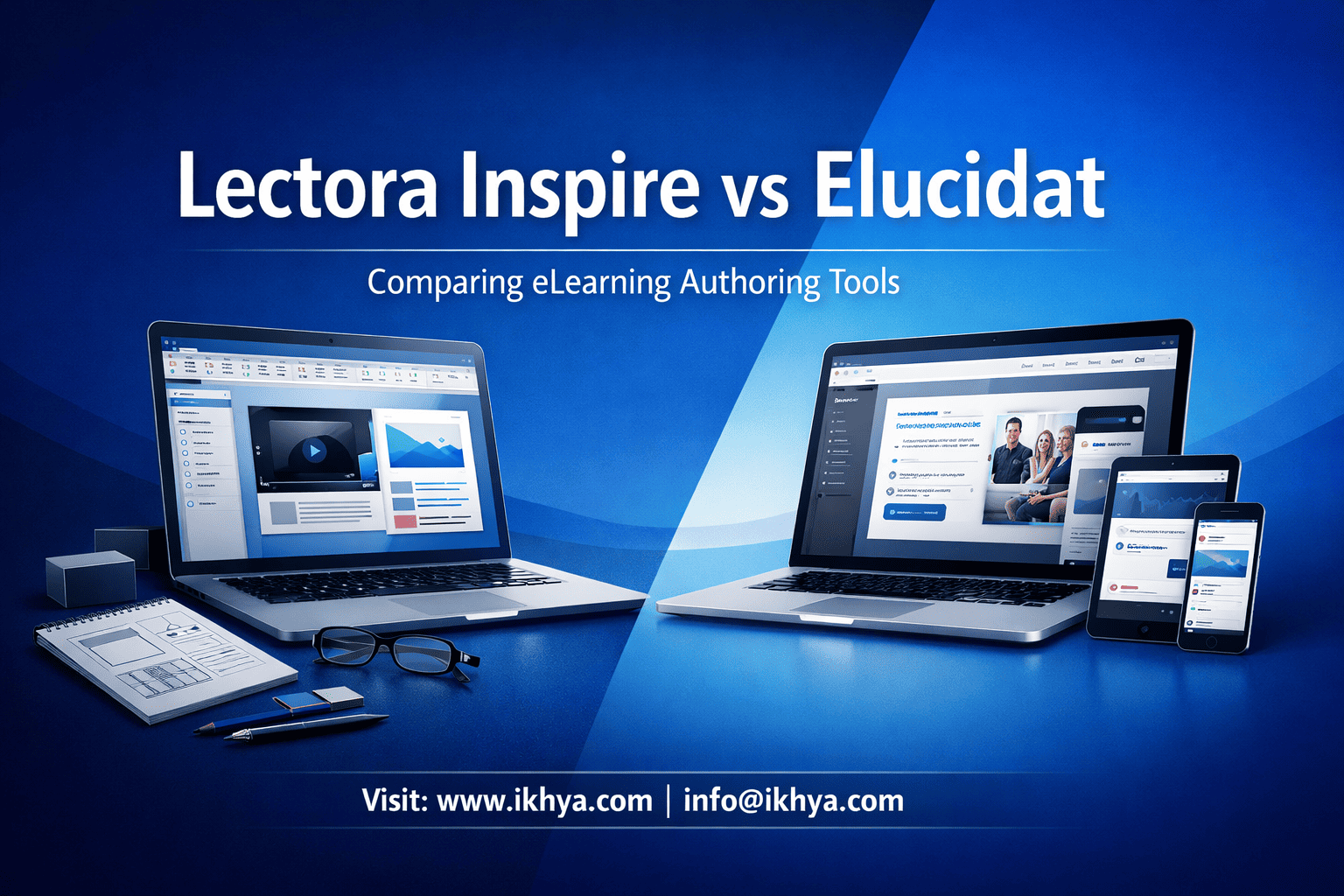
Enterprise learning teams increasingly rely on modern authoring tools to create scalable, LMS-ready training programs. Choosing between Lectora Inspire and Elucidat is a strategic decision because the platform you select affects development speed, global deployment, accessibility compliance, and long-term training governance.
Organizations in the US, UK, UAE, and Australia are shifting toward scalable digital learning ecosystems built on SCORM-compliant courses, xAPI analytics, and LMS integrations. Selecting the right authoring tool is therefore not just a technology decision—it directly impacts learning effectiveness and operational efficiency.
If your organization is evaluating enterprise eLearning development partners, you can also Book a Free eLearning Demo with IKHYA to explore how scalable course development works in real corporate environments.
Lectora Inspire vs Elucidat: Quick Comparison for Enterprise Learning Teams
Lectora Inspire and Elucidat are both enterprise-grade authoring tools used to build interactive corporate training. The key difference is that Lectora offers advanced development flexibility for complex learning, while Elucidat focuses on cloud-based collaboration and rapid course production for large organizations.
Both platforms support SCORM, xAPI, LMS integrations, and responsive learning, but their workflows, governance capabilities, and development speed differ significantly. Understanding these differences helps L&D leaders choose the right platform for their training strategy.
Quick Comparison Table
| Feature | Lectora Inspire | Elucidat |
|---|---|---|
| Deployment | Desktop authoring tool | Cloud-based platform |
| Collaboration | Limited real-time collaboration | Built for multi-author teams |
| Customization | Very high flexibility | Moderate customization |
| Development speed | Medium | Very fast |
| Accessibility support | Strong WCAG compliance | Good accessibility support |
| LMS compatibility | SCORM, AICC, xAPI | SCORM, xAPI |
| Best for | Complex simulations & compliance training | Rapid global training rollout |
| Ideal users | Instructional designers & developers | Corporate L&D teams |
When Enterprises Typically Choose Each Tool
Lectora Inspire is commonly used for:
- complex compliance training
- aviation safety simulations
- healthcare training modules
- accessibility-focused learning
- highly customized learning interactions
Elucidat is preferred for:
- global corporate training deployment
- rapid course production
- distributed L&D teams
- fast compliance training rollouts
- multi-language learning programs
Enterprise Training Context
Large organizations today must produce learning at scale while maintaining quality, compliance, and governance.
For example:
- US healthcare organizations require accessible training that meets WCAG standards.
- UK financial services firms require strict compliance training updates.
- Australian vocational training providers need scalable LMS-compatible learning.
- UAE enterprises often deploy multilingual training across global workforces.
Both Lectora and Elucidat support these needs—but through very different development approaches.
Development Approach Differences
Lectora Development Workflow
Typical enterprise development process:
- Instructional design planning
- Custom interaction design
- Advanced scripting and logic
- LMS packaging (SCORM/xAPI)
- Testing and accessibility validation
Organizations that require deeper customization often rely on specialized development teams offering Lectora eLearning Development Services to ensure high-quality course production.
Elucidat Development Workflow
Elucidat focuses on collaborative content creation.
Typical workflow:
- Content template selection
- Cloud-based author collaboration
- Rapid course assembly
- Multi-language localization
- LMS deployment
Enterprises managing large course libraries often partner with experts providing Elucidat Development Services to scale production efficiently.
Key Enterprise Decision Factors
When evaluating authoring tools, corporate learning teams typically analyze the following factors:
1. Development complexity
- Highly interactive simulations → Lectora
- Rapid course creation → Elucidat
2. Collaboration requirements
- Multiple authors across departments → Elucidat
3. Compliance and accessibility needs
- WCAG-focused training → Lectora
4. Course production scale
- Thousands of courses globally → Elucidat
5. Custom learning experiences
- advanced branching scenarios → Lectora
Enterprise Authoring Tools and LMS Ecosystems
Most corporate learning programs operate within a broader LMS environment.
Examples of common enterprise LMS platforms include:
- Cornerstone OnDemand
- Moodle Workplace
- Docebo
- SAP SuccessFactors
- TalentLMS
Both Lectora and Elucidat publish courses compatible with SCORM and xAPI, ensuring seamless integration into enterprise LMS platforms.
Organizations implementing complex learning ecosystems often rely on LMS Compatible eLearning Course Development Services to ensure interoperability and analytics compatibility.
Why Enterprises Work with eLearning Development Partners
Large enterprises rarely develop all training internally. Instead, they partner with experienced development companies to manage:
- instructional design
- authoring tool expertise
- LMS integration
- localization
- accessibility compliance
- course production at scale
IKHYA – eLearning Solutions Company supports corporate learning teams with scalable enterprise development models through Custom eLearning Development Services designed for complex training environments.
What Is Lectora Inspire? Understanding Its Enterprise eLearning Capabilities
Lectora Inspire is an advanced desktop-based eLearning authoring tool designed for organizations that need highly customized training, complex interactions, and strict accessibility compliance. Enterprises commonly use Lectora for compliance-heavy industries such as healthcare, aviation, manufacturing, and financial services because it supports deep instructional design control and flexible course development.
Key Features of Lectora Inspire
Lectora is known for its strong developer-level control and customization capabilities.
Key enterprise features include:
- Advanced interactivity
Developers can build branching scenarios, simulations, and conditional learning paths. - Accessibility compliance
Lectora has strong support for WCAG accessibility standards, making it widely used in government and regulated industries. - SCORM and xAPI support
Courses can integrate easily with enterprise LMS platforms. - Responsive course design
Training can adapt to desktop, tablet, and mobile environments. - Advanced scripting capability
Developers can implement JavaScript for complex learning logic.
These capabilities make Lectora a strong choice for organizations that require highly customized digital learning environments.
Organizations that need enterprise-scale Lectora development often work with specialists offering Lectora eLearning Development Services to ensure quality instructional design and LMS compatibility.
Accessibility and Compliance Strengths
One of Lectora’s biggest advantages is accessibility.
Many corporate training programs must meet strict compliance regulations, including:
- WCAG accessibility standards
- Section 508 compliance (United States)
- government and public sector accessibility requirements
Because Lectora provides detailed accessibility controls such as:
- keyboard navigation
- screen reader compatibility
- ARIA labels
- accessible navigation structures
it is frequently used by organizations that require highly accessible training programs.
For example:
- US healthcare providers must deliver accessible compliance training.
- UK financial services firms must ensure regulatory learning accessibility.
- government agencies require inclusive training for all employees.
LMS Compatibility and Learning Analytics
Modern enterprise learning environments rely heavily on LMS integration and learning analytics.
Lectora supports major learning standards such as:
- SCORM 1.2
- SCORM 2004
- xAPI (Tin Can API)
- AICC
This ensures courses can integrate seamlessly with enterprise LMS platforms such as:
- Cornerstone
- SAP SuccessFactors
- Moodle Workplace
- Docebo
Organizations implementing complex LMS ecosystems often leverage LMS Compatible eLearning Course Development Services to ensure smooth deployment and tracking.
Ideal Enterprise Use Cases for Lectora
Lectora Inspire works best when training requires advanced instructional design and interactive experiences.
Common enterprise applications include:
Compliance Training
Industries such as finance and healthcare require detailed regulatory training with branching scenarios and assessments.
Safety Training
Manufacturing and aviation organizations often use simulation-based safety training to replicate real-world environments.
Complex Skill Training
Programs that involve troubleshooting, operational procedures, or equipment training benefit from Lectora’s interactivity capabilities.
Accessibility-Focused Learning
Organizations with strict accessibility requirements rely on Lectora for WCAG-compliant learning content.
Global Enterprise Adoption
Many multinational companies use Lectora to develop training for complex environments.
Examples include:
- US healthcare organizations delivering HIPAA compliance training
- UK financial institutions deploying regulatory training
- Australian vocational training providers delivering accredited programs
- UAE aviation companies creating safety and operations training
These environments require highly structured training programs that Lectora can support.
What Is Elucidat? A Cloud-Based Authoring Platform for Scalable Corporate Training
Elucidat is a cloud-based eLearning authoring platform designed for large organizations that need rapid course development, team collaboration, and global training scalability. Unlike desktop-based authoring tools, Elucidat allows multiple instructional designers and subject matter experts to collaborate in real time.
This makes it particularly valuable for enterprises managing large training libraries and distributed learning teams.
Companies implementing scalable learning production workflows often rely on experts providing Elucidat Development Services to support enterprise course creation and localization.
Core Capabilities of Elucidat
Elucidat focuses on speed, collaboration, and scalability.
Key capabilities include:
- Cloud-based authoring
- multi-user collaboration
- template-driven course creation
- centralized content governance
- global localization support
These features make it easier for corporate training teams to produce courses quickly without requiring deep technical expertise.
Collaboration and Governance Features
One of Elucidat’s strongest advantages is its ability to support distributed content creation teams.
Large enterprises often involve multiple stakeholders in course development:
- instructional designers
- subject matter experts
- compliance officers
- learning administrators
Elucidat allows these teams to collaborate through:
- shared project environments
- reusable templates
- content libraries
- review and approval workflows
This governance structure helps organizations maintain consistent training quality across global teams.
Rapid eLearning Development
Speed is a critical factor for many corporate learning teams.
Elucidat enables rapid course production through:
- pre-built templates
- drag-and-drop components
- reusable design frameworks
- centralized branding control
This makes it ideal for organizations that must quickly deploy training such as:
- compliance updates
- policy changes
- product training
- onboarding programs
Enterprises scaling training production often combine Elucidat with Rapid eLearning Development Services to accelerate course rollout.
Ideal Enterprise Use Cases for Elucidat
Elucidat performs best in environments where speed and collaboration are critical.
Typical use cases include:
Global Workforce Training
Organizations with employees across multiple countries need scalable training production.
Distributed Learning Teams
Companies with multiple L&D teams can collaborate through a single cloud environment.
Rapid Compliance Updates
Elucidat enables fast updates to compliance training when regulations change.
Multi-language Learning Programs
Global enterprises frequently localize courses into multiple languages.
Global Enterprise Adoption
Elucidat is widely used by companies delivering training across large international workforces.
Examples include:
- global retail organizations training frontline staff
- technology companies onboarding distributed teams
- UAE enterprises delivering multilingual workforce training
- Australian training providers delivering scalable online programs
Its cloud-first design makes it particularly effective for organizations with large global training operations.
Lectora Inspire vs Elucidat: Detailed Feature Comparison for Corporate eLearning
Lectora Inspire and Elucidat both support enterprise eLearning development, but they differ significantly in authoring flexibility, collaboration capabilities, scalability, and governance control. Understanding these differences helps corporate training teams select the right tool based on development complexity, team size, and production scale.
For organizations building large corporate training ecosystems, the choice often depends on whether the priority is custom learning experiences or rapid scalable production.
Enterprise Feature Comparison
| Capability | Lectora Inspire | Elucidat |
|---|---|---|
| Platform Type | Desktop authoring tool | Cloud-based authoring platform |
| Development Flexibility | Very high customization | Moderate customization |
| Collaboration | Limited real-time collaboration | Designed for multi-author teams |
| Accessibility Compliance | Strong WCAG and Section 508 support | Good accessibility support |
| Course Development Speed | Moderate | Very fast |
| Localization Support | Manual workflows | Built-in localization management |
| Governance Control | Developer controlled | Enterprise content governance |
| Ideal for | Complex interactive learning | Large-scale training production |
Authoring Flexibility
One of the most important differences between the two tools is development flexibility.
Lectora Inspire
- Supports complex scripting
- Allows advanced branching logic
- Enables highly customized interactions
- Ideal for simulation-based training
This makes Lectora popular for industries where training requires deep instructional design and complex interactions.
Elucidat
- Uses structured templates
- Simplifies course creation
- Limits deep customization
- Focuses on scalability
Elucidat prioritizes consistency and speed rather than complex interaction design.
Collaboration Capabilities
Modern corporate training projects often involve multiple stakeholders.
Lectora collaboration
- Primarily single-developer workflow
- Collaboration through file sharing
- Requires structured development processes
Elucidat collaboration
- Built for multi-user teams
- Cloud-based editing
- Real-time collaboration
- Review and approval workflows
Large enterprises with distributed learning teams often prefer Elucidat for this reason.
Accessibility and Compliance
Accessibility is critical for organizations operating under regulatory requirements.
Lectora accessibility strengths
- Advanced screen reader compatibility
- WCAG compliance support
- ARIA labels and accessible navigation
- keyboard-only interaction support
This makes Lectora widely used in:
- government training
- healthcare compliance
- financial services training
Elucidat accessibility support
Elucidat also supports accessibility features, including:
- responsive design
- accessible content templates
- screen reader compatibility
However, it provides less granular control than Lectora for complex accessibility implementations.
Localization and Global Training
Many multinational organizations must deploy training across multiple languages.
Lectora localization
- Requires structured localization workflow
- Translation files must be managed externally
Elucidat localization
- Built-in language management
- easier translation workflows
- scalable global training deployment
Organizations running multilingual learning programs often rely on eLearning Translation Localization Services to manage large-scale course localization.
LMS Integration, SCORM, and xAPI Support
Modern corporate training ecosystems depend on LMS integration, standardized learning formats, and advanced analytics. Both Lectora Inspire and Elucidat support SCORM and xAPI standards, ensuring seamless compatibility with enterprise LMS platforms.
This interoperability allows organizations to track learner progress, generate training reports, and measure performance across global training programs.
SCORM Compatibility
SCORM remains one of the most widely used standards for corporate learning content.
Both tools support:
- SCORM 1.2
- SCORM 2004
This allows courses to be deployed across common LMS platforms such as:
- Cornerstone OnDemand
- Moodle Workplace
- SAP SuccessFactors
- Docebo
- TalentLMS
Enterprises integrating authoring tools with LMS platforms often use LMS Compatible eLearning Course Development Services to ensure proper course packaging and tracking.
xAPI Learning Analytics
xAPI (Tin Can API) allows organizations to collect deeper learning data beyond traditional LMS tracking.
With xAPI, companies can track:
- learner engagement
- training completion behavior
- real-world skill application
- mobile learning activity
Both Lectora and Elucidat can generate xAPI-compliant learning statements, enabling advanced analytics through Learning Record Stores (LRS).
Enterprise LMS Deployment Examples
Different regions often adopt specific LMS platforms based on industry needs.
United States
Healthcare organizations commonly use LMS platforms to manage compliance training and track certification renewal.
United Kingdom
Financial institutions deploy LMS platforms for regulatory training aligned with FCA compliance requirements.
Australia
Vocational training providers use LMS systems to support large-scale online learning programs.
United Arab Emirates
Large enterprises frequently deploy LMS systems for multilingual workforce training across global teams.
In each of these environments, SCORM/xAPI compatibility ensures training content can be deployed consistently across learning platforms.
Learning Analytics and Reporting
Enterprise learning programs increasingly rely on analytics to measure training effectiveness.
Both Lectora and Elucidat allow organizations to track:
- completion rates
- assessment scores
- learner engagement
- compliance completion
- certification status
When combined with learning analytics dashboards, these insights help L&D leaders optimize corporate training strategies.
Integration with Enterprise Learning Ecosystems
Authoring tools rarely operate in isolation.
Most corporate learning ecosystems include:
- Learning Management Systems
- Learning Experience Platforms (LXP)
- HR systems
- compliance management platforms
- analytics tools
Because of this complexity, many enterprises partner with experienced providers offering eLearning Consultancy Services to design scalable training ecosystems and integrate authoring tools effectively.
Rapid eLearning Development: Which Tool Enables Faster Course Production?
Rapid eLearning development focuses on producing training content quickly while maintaining instructional quality and LMS compatibility. In enterprise environments where organizations must launch onboarding, compliance, or product training quickly, the authoring tool’s workflow efficiency directly impacts course production speed.
While both Lectora Inspire and Elucidat support rapid development, Elucidat is generally faster for large-scale course production, whereas Lectora offers greater flexibility for complex course structures.
Template-Driven Development
One of the biggest drivers of rapid development is the availability of reusable templates.
Elucidat
Elucidat uses a template-based design system that allows learning teams to create courses quickly without starting from scratch.
Key benefits include:
- pre-built course templates
- reusable learning components
- centralized brand control
- consistent design across courses
This makes Elucidat highly effective for organizations producing large volumes of training modules.
Lectora Inspire
Lectora also supports templates, but development typically involves:
- custom layout creation
- interaction design
- scripting for advanced logic
Because of this, Lectora development often requires more time but allows greater instructional creativity.
Course Production Speed
In enterprise environments, development speed often depends on:
- number of courses required
- complexity of interactions
- number of stakeholders involved
- localization requirements
Typical enterprise development scenarios
| Scenario | Better Tool |
|---|---|
| Rapid onboarding training | Elucidat |
| Product knowledge training | Elucidat |
| Scenario-based training | Lectora |
| Simulation-based learning | Lectora |
| Global compliance rollout | Elucidat |
Organizations scaling digital training production often combine authoring tools with Rapid eLearning Development Services to accelerate course creation.
Scaling Course Production
Large organizations often need to produce hundreds or thousands of courses per year.
Examples:
- retail chains training thousands of employees
- financial institutions delivering regulatory updates
- manufacturing companies providing safety training
- global corporations rolling out leadership programs
In such environments:
- Elucidat enables scalable content production
- Lectora supports complex training experiences
Choosing the right tool therefore depends on training volume vs training complexity.
Rapid Updates for Compliance Training
Many industries must frequently update training due to regulatory changes.
Examples include:
- healthcare compliance updates
- financial regulations
- safety training requirements
- cybersecurity awareness programs
Because Elucidat enables quick edits and cloud-based updates, it is often preferred for rapidly updating compliance training across global teams.
Instructional Design Flexibility: Lectora vs Elucidat
Instructional design flexibility determines how deeply organizations can customize the learning experience. Corporate training programs often require branching scenarios, simulations, assessments, and real-world learning activities that align with organizational objectives.
Lectora Inspire offers more freedom for complex instructional design, while Elucidat focuses on structured learning experiences that prioritize scalability.
Custom Learning Experiences
Enterprise training programs often require learning experiences that go beyond simple slide-based courses.
Lectora Inspire
Lectora allows instructional designers to create:
- advanced branching scenarios
- dynamic content behavior
- simulation-based training
- multi-layered assessments
These capabilities make Lectora ideal for technical and operational training programs.
Organizations designing complex learning experiences frequently use Instructional Design Services to ensure training aligns with learning objectives and performance outcomes.
Elucidat
Elucidat supports structured instructional design through:
- interactive templates
- predefined interaction blocks
- multimedia learning elements
- structured assessments
This approach simplifies development while maintaining consistent learning design standards.
Scenario-Based Learning
Scenario-based learning is widely used in corporate training to simulate real-world decision making.
Examples include:
- customer service training
- leadership training
- compliance decision scenarios
- sales training simulations
Lectora’s advanced scripting capabilities allow instructional designers to build highly complex branching scenarios, while Elucidat provides simpler interaction frameworks.
Interactive Simulations
Some industries require immersive training experiences.
Examples:
- aviation safety simulations
- healthcare procedure training
- manufacturing equipment training
- cybersecurity incident response training
Because Lectora supports custom interaction logic, it is often preferred for simulation-heavy learning environments.
Organizations implementing these training models often deploy eLearning Simulation Based Training Services to develop realistic training scenarios.
Compliance Learning Design
Compliance training is one of the most common applications of enterprise eLearning.
Training areas include:
- anti-money laundering
- workplace safety
- data protection regulations
- workplace ethics training
Both Lectora and Elucidat support compliance training, but the development approach differs.
Lectora
- deeper interaction design
- advanced assessments
- complex learning paths
Elucidat
- rapid course production
- easy updates for regulatory changes
- scalable training rollout
Enterprise Training Use Cases: When to Choose Lectora Inspire
Lectora Inspire is best suited for enterprise training environments where complex learning experiences, strict compliance requirements, and advanced instructional design are critical.
Organizations that need deep customization, advanced logic, and simulation-based learning often prefer Lectora.
Healthcare Compliance Training
Healthcare organizations frequently require training aligned with strict regulatory frameworks.
Typical training programs include:
- HIPAA compliance training
- patient safety procedures
- clinical workflow training
- medical device training
These programs often require detailed interactions and accessibility compliance.
Companies implementing these programs may leverage Healthcare Training eLearning Solutions to ensure regulatory compliance and effective knowledge transfer.
Aviation Safety Training
The aviation industry requires highly structured safety training programs.
Common training modules include:
- aircraft maintenance procedures
- safety protocols
- emergency response training
- regulatory compliance learning
Such training programs often involve simulations and scenario-based learning.
Organizations delivering aviation training frequently use Aviation Training eLearning Solutions to develop specialized digital learning programs.
Manufacturing Safety Programs
Manufacturing environments rely heavily on safety training.
Common programs include:
- equipment safety procedures
- hazard recognition training
- operational workflow training
- safety compliance certification
Interactive simulations can help workers understand real-world risks before entering hazardous environments.
Companies often implement Manufacturing Training eLearning Solutions to develop scalable safety training for industrial teams.
Financial Services Compliance
Financial institutions operate under strict regulatory frameworks that require ongoing employee training.
Common topics include:
- anti-money laundering (AML)
- fraud prevention
- regulatory compliance
- customer protection laws
These training programs often require detailed scenario-based assessments, making Lectora a strong choice.
Enterprise Training Use Cases: When Elucidat Is the Better Choice
Elucidat is particularly effective for enterprises that need fast, scalable, and collaborative course development across large global workforces. Its cloud-based architecture enables distributed teams to create, update, and deploy learning content quickly without relying heavily on specialized developers.
Organizations that prioritize speed, governance, and global deployment often select Elucidat over traditional desktop authoring tools.
Global Workforce Training
Multinational companies must deliver training to employees across multiple countries and time zones. Managing such programs requires tools that allow rapid updates and centralized control.
Elucidat helps organizations:
- deploy training across global teams
- maintain brand consistency
- update training quickly across multiple courses
- track learning performance across regions
Enterprises managing multilingual training initiatives often combine authoring platforms with eLearning Translation Localization Services to ensure accurate global deployment.
Distributed Learning Teams
Many organizations operate with multiple L&D teams across regions.
For example:
- headquarters instructional design teams
- regional training departments
- subject matter experts from different business units
Elucidat allows these stakeholders to collaborate within a single platform through:
- shared project libraries
- reusable templates
- approval workflows
- centralized content governance
This structure helps large organizations maintain consistent training quality across departments.
Rapid Compliance Rollouts
Regulatory changes often require companies to update training quickly.
Industries such as:
- financial services
- healthcare
- oil and gas
- retail
must regularly deploy updated compliance modules.
Because Elucidat enables quick editing and immediate deployment, companies can distribute updated training across thousands of employees rapidly.
Organizations implementing regulatory training programs frequently rely on Compliance Training eLearning Solutions to design scalable compliance learning strategies.
Large-Scale Training Libraries
Some enterprises maintain hundreds or even thousands of courses.
Typical examples include:
- product knowledge training
- onboarding programs
- policy training
- leadership development
- customer service training
Elucidat’s template-driven architecture helps L&D teams manage large training libraries without increasing development complexity.
Enterprise Procurement Considerations: Cost, Licensing, and Scalability
Selecting an authoring tool is not only a technical decision—it is also a procurement and cost management decision. Large organizations must consider licensing costs, development resources, scalability requirements, and long-term maintenance.
Both Lectora Inspire and Elucidat have different cost structures that influence enterprise adoption.
Licensing Models
Lectora Inspire
- typically licensed per developer
- installed locally
- requires individual authoring licenses
This model works well for organizations with smaller instructional design teams.
Elucidat
- cloud-based licensing
- enterprise subscription model
- multiple authors within a shared platform
This structure benefits companies that require collaborative development environments.
Development Costs
The cost of eLearning development often includes more than just authoring tool licenses.
Key cost factors include:
- instructional design expertise
- multimedia development
- authoring tool specialists
- LMS integration
- course localization
Organizations comparing internal and external development approaches often review In-House vs Outsourced eLearning Development Cost Comparison to determine the most cost-effective strategy.
Scalability Considerations
Large enterprises must ensure their authoring tools support long-term training scalability.
Important scalability factors include:
- number of courses produced annually
- number of instructional designers
- global training deployment
- localization requirements
- LMS compatibility
For organizations producing large course volumes, cloud-based authoring tools like Elucidat often provide better scalability.
Should Enterprises Outsource Lectora or Elucidat Development?
Many organizations discover that developing enterprise learning internally can strain internal resources. As a result, companies increasingly outsource course development to specialized eLearning providers.
Outsourcing allows enterprises to scale training production while maintaining instructional quality and reducing development timelines.
Companies exploring outsourcing strategies can review eLearning Outsourcing Guide for Enterprises to understand different engagement models.
Advantages of Outsourcing eLearning Development
Partnering with an experienced development provider offers several benefits.
1. Access to specialized expertise
Professional vendors provide:
- instructional designers
- multimedia developers
- LMS integration specialists
- authoring tool experts
2. Faster course production
Outsourcing teams can often produce training faster because they use established development workflows and specialized authoring tool expertise.
3. Reduced operational overhead
Instead of hiring and training internal staff, organizations can scale projects through flexible outsourcing models.
4. Global training deployment
Experienced eLearning providers help companies manage:
- multi-language training
- accessibility compliance
- LMS integration
- global training governance
Vendor Selection Framework for Enterprises
When selecting an eLearning development partner, organizations should evaluate several factors.
Key evaluation criteria include:
- experience with enterprise learning ecosystems
- authoring tool expertise
- instructional design capability
- LMS integration experience
- scalability for global training
Companies evaluating vendors can also review How to Choose the eLearning Vendor for a structured selection framework.
Why Enterprises Partner with IKHYA for eLearning Development
Enterprises increasingly partner with specialized development providers to manage large-scale digital learning initiatives. IKHYA – eLearning Solutions Company supports organizations in designing and deploying scalable training programs built on modern authoring tools and enterprise LMS ecosystems.
Organizations exploring enterprise learning solutions can learn more about the company’s expertise on the About IKHYA eLearning Solutions Company page.
Enterprise eLearning Capabilities
IKHYA supports organizations with:
- custom corporate training development
- LMS-compatible course creation
- instructional design strategy
- rapid eLearning production
- global course localization
- compliance training development
Through structured development processes and enterprise governance frameworks, IKHYA helps organizations scale digital learning programs across global teams.
Strategic Support for Corporate Learning Teams
IKHYA works closely with:
- corporate training managers
- L&D leaders
- HR departments
- procurement teams
to design training solutions that align with business goals and workforce development strategies.
Organizations evaluating enterprise training partners can Contact IKHYA Experts to discuss project requirements or request strategic guidance.
Conclusion: Choosing the Right Enterprise eLearning Authoring Tool
Both Lectora Inspire and Elucidat are powerful enterprise authoring tools, but they serve different strategic purposes.
Lectora Inspire is best suited for:
- complex interactive learning
- simulation-based training
- accessibility-focused programs
- compliance-heavy industries
Elucidat is best suited for:
- rapid course production
- global workforce training
- collaborative development teams
- scalable training libraries
Enterprises selecting an authoring tool should evaluate:
- training complexity
- production scale
- team collaboration needs
- LMS ecosystem compatibility
- long-term training strategy
Organizations planning large-scale digital learning initiatives can Request an eLearning RFP to evaluate development models and explore scalable enterprise learning solutions.
FAQs
1. What is Lectora Inspire used for in corporate training?
Lectora Inspire is used to create highly interactive and customized eLearning courses, particularly for compliance training, simulations, and complex instructional design scenarios.
2. What is Elucidat best known for?
Elucidat is known for cloud-based rapid eLearning development and collaborative course creation for large corporate training teams.
3. Which tool is better for rapid course development?
Elucidat generally enables faster course production due to its template-driven development and collaborative workflows.
4. Which authoring tool is better for complex simulations?
Lectora Inspire is better suited for complex simulations because it allows advanced scripting and interaction design.
5. Can Lectora courses integrate with LMS platforms?
Yes. Lectora supports SCORM, xAPI, and AICC standards, enabling integration with most enterprise LMS platforms.
6. Does Elucidat support SCORM?
Yes. Elucidat supports SCORM and xAPI, allowing course deployment within standard LMS environments.
7. Is Elucidat suitable for global training programs?
Yes. Elucidat’s cloud-based environment and localization capabilities make it well suited for global workforce training.
8. Which tool supports better accessibility?
Lectora Inspire provides stronger accessibility control, making it widely used for WCAG-compliant training programs.
9. Can enterprises use both Lectora and Elucidat?
Yes. Some organizations use multiple authoring tools depending on the type of training they are developing.
10. What industries commonly use Lectora?
Healthcare, aviation, financial services, and government sectors frequently use Lectora for compliance training.
11. Is Elucidat beginner-friendly?
Yes. Its template-based approach allows learning teams to create courses without extensive technical skills.
12. Do enterprises outsource eLearning development?
Yes. Many companies outsource development to scale course production and access specialized expertise.
13. What does SCORM mean in eLearning?
SCORM is a standard that ensures eLearning courses can communicate with LMS platforms for tracking learner progress.
14. What is xAPI?
xAPI is an advanced learning analytics standard that tracks learner behavior beyond traditional LMS reporting.
15. Can authoring tools integrate with corporate LMS systems?
Yes. Most enterprise authoring tools support LMS integration through SCORM or xAPI standards.
16. Why is instructional design important in eLearning?
Instructional design ensures training aligns with learning objectives and improves knowledge retention.
17. What is rapid eLearning development?
Rapid eLearning focuses on producing training quickly using templates, authoring tools, and streamlined workflows.
18. How long does it take to develop an eLearning course?
Development timelines vary depending on course complexity, but typical projects range from a few weeks to several months.
19. What should companies look for in an eLearning vendor?
Organizations should evaluate vendor expertise, instructional design capability, scalability, and LMS integration experience.
20. Can eLearning courses support mobile learning?
Yes. Modern authoring tools allow courses to be accessed on mobile devices through responsive design.
Related Resources
If you want to explore enterprise eLearning development and authoring tools in greater depth, the following resources provide additional guidance.