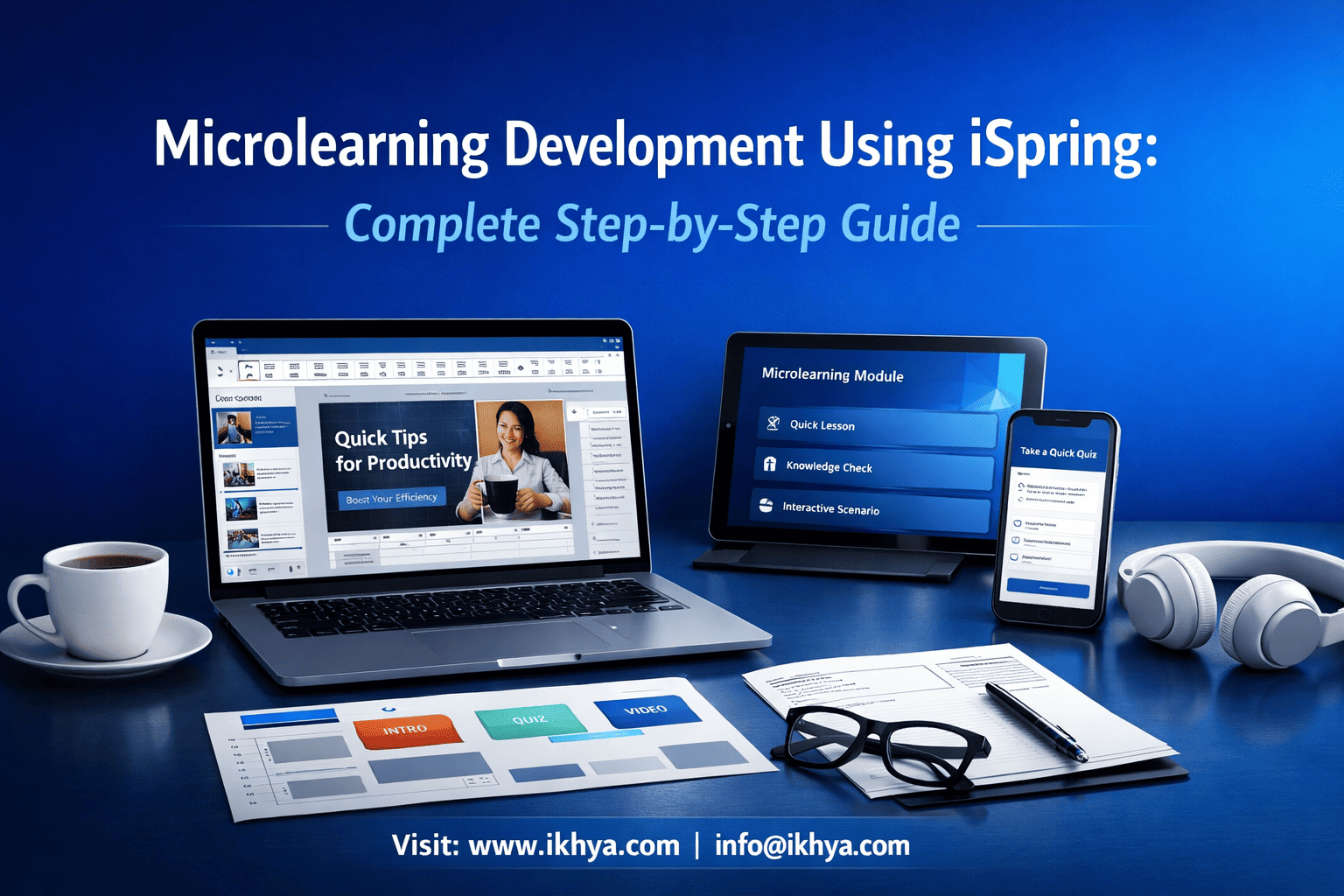
Microlearning Development Using iSpring: Complete Step-by-Step Guide

Modern corporate training is shifting fast. Employees no longer have time for long, outdated courses—they need quick, focused, and engaging learning experiences. That’s where microlearning development using iSpring becomes powerful.
If you’re looking to deliver bite-sized, mobile-friendly training quickly, iSpring offers one of the fastest ways to transform existing content into impactful learning.
If you’re planning to implement microlearning at scale, explore our microlearning development services to accelerate your training strategy.
What is Microlearning and Why It Matters in Corporate Training
Microlearning is a training approach that delivers content in short, focused modules (typically 2–7 minutes) designed to meet specific learning objectives. It improves retention, engagement, and accessibility—especially for busy professionals.
Key Characteristics of Microlearning
- Short duration: 2–7 minutes per module
- Single learning objective per module
- Mobile-friendly delivery
- Interactive formats (videos, quizzes, scenarios)
- Just-in-time learning access
Why Organizations Prefer Microlearning
- Higher retention rates compared to long-form courses
- Faster development and deployment
- Better learner engagement
- Ideal for remote and hybrid teams
- Supports continuous learning culture
Industry Use Cases
| Industry | Microlearning Use Case |
|---|---|
| Healthcare | Compliance training, patient safety modules |
| Manufacturing | Safety procedures, equipment handling |
| Retail | Product training, customer service skills |
Microlearning is especially effective when combined with rapid authoring tools like iSpring, enabling organizations to scale training globally across LMS platforms using SCORM or xAPI.
What is iSpring and Why It’s Ideal for Microlearning Development
iSpring is a powerful PowerPoint-based eLearning authoring tool that allows you to quickly convert presentations into interactive microlearning modules. It’s widely used for rapid eLearning development due to its simplicity and speed.
If you’re evaluating tools, our iSpring eLearning development services can help you build high-impact courses efficiently.
Key Features of iSpring for Microlearning
- PowerPoint to eLearning conversion
- Built-in quiz maker and assessments
- Role-play simulations for scenario-based learning
- Screen recording and video lectures
- SCORM, xAPI, and LMS compatibility
- Mobile-ready output
Why iSpring is Perfect for Microlearning
- No steep learning curve – ideal for SMEs and trainers
- Rapid development – convert existing PPTs in hours
- Cost-effective compared to complex tools
- Strong interactivity without heavy development
iSpring vs Other Authoring Tools
| Feature | iSpring | Articulate Storyline | Adobe Captivate |
|---|---|---|---|
| Ease of use | Very easy | Moderate | Advanced |
| Development speed | Fast | Medium | Slow |
| PPT conversion | Excellent | Limited | Moderate |
| Interactivity | Moderate | High | High |
| Best for | Rapid microlearning | Custom simulations | Advanced use cases |
For a deeper comparison, you can also explore the best eLearning authoring tools for corporate training.
Step-by-Step Process for Microlearning Development Using iSpring
Developing microlearning using iSpring is a structured yet fast process. It involves converting existing content into short, engaging, interactive modules that can be deployed via LMS platforms using SCORM or xAPI standards.
If you already have training materials, you can speed up development using our rapid eLearning development services.
Step 1: Analyze and Break Down Content
Start by identifying what content should be converted into microlearning. The goal is to split large topics into focused learning objectives.
What to Do
- Review existing training materials (PPTs, PDFs, ILT content)
- Identify key learning objectives
- Divide content into bite-sized modules
- Remove unnecessary or redundant information
Example
A 60-minute compliance course can be broken into:
- Module 1: Introduction to compliance
- Module 2: Key regulations
- Module 3: Real-world violations
- Module 4: Assessment quiz
If you’re starting with presentations, refer to this guide on how to convert PowerPoint to eLearning.
Step 2: Convert PowerPoint into Microlearning Modules
iSpring integrates directly with PowerPoint, making it easy to transform slides into interactive lessons.
How It Works
- Import or open your PowerPoint in iSpring
- Organize slides into logical microlearning chunks
- Add narration or voiceovers
- Use slide branching for modular navigation
Best Practices
- Keep each module under 7 minutes
- Use one concept per module
- Maintain visual consistency
- Optimize for mobile viewing
Step 3: Add Interactivity and Engagement
Microlearning works best when learners actively engage with content. iSpring provides built-in tools to enhance interactivity.
Interactive Elements You Can Add
- Quizzes and knowledge checks
- Drag-and-drop interactions
- Dialogue simulations (role-play scenarios)
- Clickable tabs and hotspots
Why This Matters
- Improves knowledge retention
- Encourages active participation
- Provides instant feedback
To ensure strong learning design, many organizations combine this with expert instructional design services.
Step 4: Incorporate Multimedia for Better Engagement
Adding multimedia transforms static slides into engaging learning experiences.
Multimedia Options in iSpring
- Video lectures
- Screen recordings
- Animations and transitions
- Voice narration
Example
A product training module can include:
- Short explainer video
- Interactive product demo
- Quick quiz at the end
This approach significantly increases learner engagement compared to text-heavy slides.
Step 5: Publish and Deploy to LMS
Once your microlearning modules are ready, iSpring allows you to publish them in LMS-compatible formats.
Supported Formats
- SCORM 1.2 / SCORM 2004
- xAPI (Tin Can API)
- HTML5 (for web/mobile access)
Deployment Process
- Export course from iSpring
- Upload to your LMS
- Assign learners and track progress
- Analyze performance using LMS analytics
Development Timeline Overview
| Stage | Estimated Time |
|---|---|
| Content analysis | 1–2 days |
| PPT conversion | 1–3 days |
| Interactivity design | 2–4 days |
| Testing & deployment | 1–2 days |
Total Time: 5–10 days (depending on complexity)
Key Takeaway
Microlearning development using iSpring is fast, scalable, and cost-effective—especially when leveraging existing PowerPoint content. The combination of rapid conversion + interactive design makes it ideal for modern corporate training.
Types of Microlearning You Can Build with iSpring
iSpring enables organizations to create a wide range of microlearning formats tailored to different training goals. From quick knowledge refreshers to scenario-based simulations, it supports multiple engaging formats that improve retention and performance.
Choosing the right format depends on your learning objective, audience, and industry requirements.
1. Video-Based Microlearning
Video-based modules are one of the most effective microlearning formats. They deliver information quickly and are ideal for demonstrations, explainers, and onboarding content.
When to Use
- Product demonstrations
- Process walkthroughs
- Software training
- Employee onboarding
Features in iSpring
- Screen recording tools
- Voice-over narration
- Webcam integration
- Slide-to-video conversion
Example
A retail company can create a 3-minute product training video explaining features, benefits, and selling points.
2. Scenario-Based Microlearning
Scenario-based learning uses real-world situations to help learners practice decision-making. iSpring’s role-play simulations make this easy to implement.
When to Use
- Compliance training
- Customer service training
- Sales training
- Leadership development
Key Benefits
- Improves critical thinking skills
- Provides real-life context
- Enhances behavioral learning
Example
A healthcare organization can simulate a patient interaction scenario, where learners choose responses and see consequences.
3. Quiz-Based Microlearning
Quiz-based modules are ideal for reinforcing knowledge and assessing understanding. They are often used as standalone microlearning units or as part of a learning path.
Types of Quizzes in iSpring
- Multiple choice
- Drag-and-drop
- Matching
- Fill-in-the-blanks
Best Use Cases
- Post-training assessments
- Compliance checks
- Knowledge refreshers
4. Interactive Slide-Based Microlearning
This is the most common format when converting PowerPoint into microlearning. It combines visual slides with interactive elements.
Features
- Clickable tabs
- Layered content
- Animations
- Navigation controls
Example
A manufacturing company can create a safety checklist module with clickable sections for each procedure.
5. Mobile-First Microlearning Modules
iSpring publishes content in HTML5, making it fully responsive for mobile devices. This is essential for on-the-go learning.
Benefits
- Accessible anytime, anywhere
- Ideal for frontline employees
- Supports just-in-time learning
Industries That Benefit Most
| Industry | Use Case |
|---|---|
| Retail | Product knowledge on mobile |
| Oil & Gas | Safety training in field environments |
| Logistics | Quick SOP refreshers |
Choosing the Right Microlearning Format
| Learning Goal | Recommended Format |
|---|---|
| Knowledge transfer | Video-based |
| Skill development | Scenario-based |
| Assessment | Quiz-based |
| Information navigation | Interactive slides |
| On-the-go learning | Mobile-first modules |
Key Takeaway
iSpring’s flexibility allows you to design microlearning that is not just short—but also highly engaging and outcome-driven. By combining formats, organizations can create a blended microlearning strategy that improves both knowledge retention and real-world performance.
Real-World Use Cases Across Industries
Microlearning development using iSpring is widely adopted across industries because it delivers fast, scalable, and role-specific training. Organizations use it to address critical training needs such as compliance, safety, onboarding, and skill development—without overwhelming learners.
Below are practical examples of how different industries apply iSpring-based microlearning.
Healthcare: Compliance and Patient Safety Training
Healthcare organizations rely on microlearning to deliver frequent, regulation-driven training in a digestible format.
Use Cases
- HIPAA and compliance training
- Patient safety protocols
- Medical device usage
- Infection control procedures
Example Scenario
A hospital deploys 5-minute modules on infection control, including:
- Short explainer video
- Scenario-based patient interaction
- Quick assessment
Why iSpring Works Well
- Rapid updates for changing regulations
- Scenario-based simulations for real-life situations
- LMS tracking for compliance audits
For specialized solutions, explore healthcare training eLearning solutions.
Manufacturing: Safety and Equipment Training
Manufacturing environments require precision, safety awareness, and quick skill reinforcement—making microlearning ideal.
Use Cases
- Machine operation training
- Workplace safety protocols
- Hazard identification
- SOP (Standard Operating Procedures) refreshers
Example Scenario
A manufacturing company creates bite-sized safety modules:
- Equipment handling video
- Interactive hazard identification exercise
- Quiz-based certification
Key Benefits
- Reduces workplace accidents
- Enables on-demand learning on the shop floor
- Supports multilingual training
You can also review a real implementation in this manufacturing safety training eLearning case study.
Retail: Product and Customer Service Training
Retail teams need fast, accessible training to stay updated on products and deliver better customer experiences.
Use Cases
- Product knowledge training
- Sales techniques
- Customer service scenarios
- Seasonal campaign updates
Example Scenario
A retail brand launches microlearning modules for new product lines:
- 3-minute product demo video
- Key selling points summary
- Scenario-based customer interaction
Why It Works
- Enables just-in-time learning on mobile
- Improves sales performance
- Reduces onboarding time
See how this works in practice through this customer service training for retail staff case study.
Financial Services: Compliance and Risk Training
Financial institutions require accurate, up-to-date compliance training delivered frequently.
Use Cases
- Anti-money laundering (AML) training
- Fraud detection
- Regulatory compliance
- Risk management awareness
Example Scenario
A bank delivers microlearning modules covering:
- Short compliance explainer
- Real-world fraud scenarios
- Quick knowledge checks
Benefits
- Ensures regulatory compliance
- Improves employee awareness
- Enables audit-ready reporting
IT & Software: Product and Process Training
Tech companies use microlearning to train employees on rapidly evolving tools and systems.
Use Cases
- Software onboarding
- Feature updates
- Internal tool training
- Cybersecurity awareness
Example Scenario
A SaaS company releases microlearning modules for new feature updates:
- Screen-recorded walkthrough
- Interactive simulation
- Quick assessment
Explore more in IT and software training eLearning solutions.
Key Takeaway
Across industries, microlearning using iSpring helps organizations:
- Deliver faster training updates
- Improve engagement and retention
- Scale training globally with LMS integration
- Reduce overall training costs
Its flexibility makes it suitable for compliance-heavy industries, frontline training, and fast-changing environments.
iSpring vs Other eLearning Authoring Tools
Choosing the right authoring tool is critical for successful microlearning development. iSpring stands out for speed and simplicity, but other tools may be better suited for advanced interactivity or custom development.
If you’re evaluating multiple tools, this guide on best eLearning authoring tools for corporate training can help you make the right decision.
Quick Comparison of Top Authoring Tools
| Feature | iSpring | Articulate Storyline | Articulate Rise | Adobe Captivate |
|---|---|---|---|---|
| Ease of use | Very easy | Moderate | Very easy | Advanced |
| Development speed | Fast | Medium | Very fast | Slow |
| PowerPoint conversion | Excellent | Limited | Not applicable | Moderate |
| Interactivity level | Moderate | Very high | Low–moderate | High |
| Mobile responsiveness | Good | Good | Excellent | Good |
| Best for | Rapid microlearning | Custom simulations | Responsive courses | Advanced use cases |
When to Choose iSpring
iSpring is the best choice when your priority is speed, cost-efficiency, and ease of development.
Ideal Scenarios
- You have existing PowerPoint training content
- You need rapid course deployment (within days)
- Your team has limited technical expertise
- You want simple but effective interactivity
- You are building compliance or onboarding modules
When to Consider Other Tools
While iSpring is powerful, there are cases where other tools may be more suitable.
Use Articulate Storyline When:
- You need complex branching scenarios
- You require high customization and animations
Explore more in articulate storyline development services.
Use Articulate Rise When:
- You need fully responsive, mobile-first courses
- You want fast development with modern layouts
Learn more about articulate rise development services.
Use Adobe Captivate When:
- You need software simulations or advanced interactions
- You require VR or immersive learning experiences
See details in adobe captivate development services.
Decision Framework: Which Tool Should You Choose?
| Requirement | Recommended Tool |
|---|---|
| Fast conversion from PPT | iSpring |
| High interactivity | Storyline |
| Mobile-first design | Rise |
| Advanced simulations | Captivate |
Key Takeaway
There is no single “best” tool—only the right tool for your use case.
- Choose iSpring for speed and simplicity
- Choose Storyline for customization
- Choose Rise for responsiveness
- Choose Captivate for advanced features
Many organizations even use a combination of tools to balance speed and flexibility.
If you’re unsure which tool fits your needs, consider consulting experts through our eLearning consultancy services to make an informed decision.
Cost of Microlearning Development Using iSpring
The cost of microlearning development using iSpring depends on factors like content complexity, interactivity level, multimedia usage, and whether you build in-house or outsource. However, compared to other tools, iSpring is generally more cost-effective due to its rapid development capabilities.
Average Cost Breakdown
| Component | Cost Range (USD) |
|---|---|
| Basic module (PPT conversion) | $300 – $800 |
| Interactive microlearning module | $800 – $2,500 |
| Scenario-based module | $2,000 – $5,000 |
| Video-based microlearning | $1,500 – $4,000 |
Note: Costs may vary across regions such as the USA, UK, UAE, and AUS depending on vendor expertise and project scope.
Key Factors Affecting Cost
1. Content Complexity
- Simple PPT-based modules cost less
- Complex branching scenarios increase cost
2. Interactivity Level
- Basic quizzes → low cost
- Simulations and role-plays → higher cost
3. Multimedia Integration
- Adding videos, animations, and voiceovers increases budget
4. Volume of Modules
- Bulk development reduces per-module cost
5. Localization Requirements
- Multi-language training adds translation and adaptation costs
For organizations converting legacy content, this guide on convert PowerPoint to eLearning provides useful insights.
In-House vs Outsourcing Cost Comparison
| Factor | In-House Development | Outsourced Development |
|---|---|---|
| Initial investment | High (tools + hiring) | Low |
| Development speed | Moderate | Fast |
| Quality consistency | Varies | High |
| Scalability | Limited | High |
| Cost per module | Lower (long-term) | Moderate |
Hidden Costs to Consider
- SME (Subject Matter Expert) time
- Instructional design effort
- LMS integration and testing
- Maintenance and updates
Many organizations underestimate these, leading to delays and budget overruns.
Cost Optimization Tips
- Reuse existing PowerPoint content
- Standardize templates
- Use rapid authoring tools like iSpring
- Outsource for large-scale projects
If speed and efficiency are priorities, consider leveraging rapid eLearning development services to reduce both time and cost.
ROI of Microlearning Using iSpring
Organizations investing in iSpring-based microlearning often see:
- 40–60% faster development time
- Higher learner engagement and completion rates
- Reduced training costs over time
- Improved knowledge retention
Key Takeaway
iSpring offers one of the most cost-efficient paths to microlearning, especially when leveraging existing content and rapid development workflows. The total investment depends on your complexity, scale, and delivery model, but the ROI is typically strong.
When Should You Choose iSpring for Microlearning?
You should choose iSpring for microlearning when your goal is to develop training quickly, cost-effectively, and using existing content like PowerPoint. It is especially useful for organizations that need rapid deployment without complex development cycles.
Ideal Scenarios for Using iSpring
iSpring works best in situations where speed and simplicity are critical.
1. You Have Existing PowerPoint Content
- Convert legacy PPT training into microlearning modules
- Avoid rebuilding courses from scratch
- Save time and development cost
If you’re planning large-scale conversions, this guide on convert PowerPoint to eLearning can help.
2. You Need Rapid Training Deployment
- Launch courses within days instead of weeks
- Quickly respond to compliance or policy changes
- Ideal for fast-moving industries
3. Your Team Has Limited Technical Expertise
- No coding or advanced design skills required
- SMEs and trainers can build courses easily
- Minimal learning curve
4. You Are Focused on Microlearning and Short Modules
- Perfect for 2–7 minute training modules
- Supports modular learning paths
- Easy to update individual modules
5. You Need Cost-Effective Training at Scale
- Lower development costs compared to advanced tools
- Faster turnaround reduces overall budget
- Ideal for large organizations with ongoing training needs
When iSpring May NOT Be the Best Choice
While iSpring is powerful, it’s not ideal for every scenario.
Consider Other Tools If You Need:
- Highly complex branching scenarios
- Advanced animations or custom UI/UX
- Game-based or immersive learning experiences
In such cases, tools like Storyline or Captivate may be more suitable. You can explore options in this best eLearning authoring tools for corporate training guide.
Decision Checklist
Use this quick checklist to decide if iSpring is right for you:
| Question | If Yes → iSpring is a Good Fit |
|---|---|
| Do you have existing PPT content? | Yes |
| Do you need fast development? | Yes |
| Is your budget limited? | Yes |
| Do you need simple interactivity? | Yes |
| Do you require advanced simulations? | No |
Key Takeaway
iSpring is the right choice when your priority is speed, simplicity, and scalability. It enables organizations to quickly transform existing content into effective microlearning experiences without heavy investment in development resources.
Before making a final decision, you can consult experts through our eLearning consultancy services to align the tool with your training goals.
Common Mistakes to Avoid in iSpring Microlearning Development
While iSpring enables rapid microlearning development, many organizations fail to achieve results due to poor design, lack of strategy, or over-reliance on PowerPoint content. Avoiding these common mistakes ensures your microlearning is both effective and engaging.
1. Simply Converting PowerPoint Without Redesigning
One of the biggest mistakes is turning slides into eLearning without adapting them for microlearning.
Why It’s a Problem
- Leads to content-heavy modules
- Reduces engagement
- Fails to meet microlearning principles
What to Do Instead
- Break content into small, focused modules
- Simplify slides and remove clutter
- Add interactivity and visuals
If you’re dealing with legacy content, consider structured approaches like PPT to eLearning conversion services.
2. Ignoring Instructional Design Principles
Microlearning is not just about short content—it must be instructionally sound.
Common Issues
- No clear learning objectives
- Lack of logical flow
- Poor alignment with business goals
Best Practice
Work with experts or follow proven frameworks through instructional design services to ensure learning effectiveness.
3. Overloading Modules with Information
Trying to include too much content in a single module defeats the purpose of microlearning.
Signs of Overload
- Modules longer than 10 minutes
- Too many concepts in one lesson
- Dense text-heavy slides
Solution
- Stick to one objective per module
- Keep duration under 5–7 minutes
- Use multiple modules instead of one long course
4. Lack of Interactivity
Static content reduces engagement and retention.
Common Mistakes
- No quizzes or knowledge checks
- Passive slide viewing
- Limited learner participation
Fix
- Add quizzes, simulations, and clickable elements
- Use scenario-based learning for real-world application
5. Not Optimizing for Mobile Learning
Microlearning is often consumed on mobile devices, but many courses are not designed for small screens.
Issues
- Poor readability on mobile
- Difficult navigation
- Large media files causing slow loading
Best Practices
- Use responsive layouts
- Keep content concise
- Optimize media for fast loading
For mobile-first strategies, explore mobile learning development solutions.
6. Skipping Testing and LMS Integration Checks
Even well-designed courses can fail if they are not properly tested.
Risks
- SCORM/xAPI tracking issues
- Broken interactions
- Poor user experience
What to Do
- Test across devices and browsers
- Validate LMS compatibility
- Review analytics tracking
7. Not Updating Content Regularly
Microlearning modules are easier to update—but many organizations neglect this advantage.
Why It Matters
- Outdated content reduces credibility
- Compliance risks increase
- Learner trust declines
Recommendation
- Schedule periodic updates
- Use modular design for easy revisions
Key Takeaway
Successful microlearning development using iSpring requires more than speed—it requires strategy, design, and continuous improvement. Avoiding these mistakes ensures your training delivers real business impact.
Why Organizations Outsource Microlearning Development
Many organizations choose to outsource microlearning development using iSpring to save time, reduce costs, and ensure high-quality output. While iSpring is easy to use, creating effective microlearning still requires instructional design expertise, technical skills, and scalable processes.
Key Reasons Companies Outsource
Outsourcing is not just about reducing workload—it’s about improving outcomes.
1. Faster Development and Deployment
- Dedicated teams accelerate project timelines
- Parallel development of multiple modules
- Faster turnaround for urgent training needs
This is especially valuable for compliance or product launch training.
2. Access to Instructional Design Expertise
Professional vendors bring structured learning strategies that go beyond basic content conversion.
What Experts Provide
- Learning objective mapping
- Storyboarding and content structuring
- Engagement strategies (scenarios, quizzes, gamification)
This aligns training with business goals and improves effectiveness.
3. Cost Efficiency at Scale
Hiring and maintaining an in-house team can be expensive.
Cost Benefits of Outsourcing
- No hiring or training costs
- Reduced infrastructure investment
- Predictable project-based pricing
For long-term programs, this often results in lower total cost of ownership.
4. Better Quality and Consistency
Outsourcing partners follow standardized processes to ensure:
- Consistent design across modules
- High-quality visuals and interactions
- Thorough testing and QA
5. Scalability for Large Training Programs
Organizations with global training needs require scalable solutions.
Outsourcing Enables
- Multi-language course development
- Rapid updates across multiple modules
- Simultaneous rollout across regions (USA, UK, UAE, AUS)
In-House vs Outsourcing: Quick Comparison
| Factor | In-House Team | Outsourced Partner |
|---|---|---|
| Speed | Moderate | Fast |
| Expertise | Limited | Specialized |
| Cost | High fixed cost | Flexible |
| Scalability | Low | High |
| Quality consistency | Varies | High |
When Outsourcing Makes the Most Sense
Outsourcing is ideal if:
- You have large volumes of training content
- You need fast turnaround
- You lack instructional design expertise
- You want to standardize training across regions
Choosing the Right eLearning Partner
Selecting the right vendor is critical for success.
What to Look For
- Experience with iSpring and microlearning
- Strong instructional design capabilities
- Proven case studies
- Ability to scale globally
- Clear communication and project management
If you’re evaluating vendors, this guide on how to choose the eLearning vendor can help.
How IKHYA Supports Microlearning Development
IKHYA – eLearning Solutions Company helps organizations design and develop high-impact microlearning using iSpring and other rapid authoring tools.
What You Get
- End-to-end development (analysis → deployment)
- Instructional design expertise
- Rapid turnaround timelines
- LMS-ready SCORM/xAPI courses
For tailored solutions, explore our custom eLearning development services or reach out directly.
Key Takeaway
Outsourcing microlearning development using iSpring allows organizations to focus on strategy while experts handle execution. It ensures faster delivery, better quality, and scalable training solutions—especially for enterprise-level programs.
Before you move forward, you can also contact us to discuss your requirements or request a tailored solution.
Conclusion
Microlearning development using iSpring offers a fast, scalable, and cost-effective way to modernize corporate training. By converting existing content into short, engaging, and mobile-friendly modules, organizations can significantly improve learner engagement and knowledge retention.
Throughout this guide, we’ve seen how iSpring enables:
- Rapid conversion from PowerPoint to interactive learning
- Flexible microlearning formats (video, scenarios, quizzes)
- Seamless LMS integration using SCORM and xAPI
- Cost-efficient development with strong ROI
Whether you’re in healthcare, manufacturing, retail, or financial services, iSpring helps deliver just-in-time learning that drives real performance outcomes.
If you’re planning to implement or scale microlearning, IKHYA – eLearning Solutions Company can support you with end-to-end development. Reach out at info@ikhya.com or explore our contact page to get started.
FAQs
1. What is microlearning development using iSpring?
Microlearning development using iSpring involves creating short, focused training modules using PowerPoint-based content enhanced with quizzes, simulations, and multimedia.
2. Why is iSpring suitable for microlearning?
iSpring is ideal because it enables rapid content creation, easy PowerPoint conversion, and mobile-friendly delivery, making it perfect for bite-sized learning.
3. How long should a microlearning module be?
A typical microlearning module should be 2 to 7 minutes long, focusing on a single learning objective.
4. Can iSpring convert PowerPoint into microlearning courses?
Yes, iSpring allows you to directly convert PowerPoint presentations into interactive microlearning modules with minimal effort.
5. What types of microlearning can be created using iSpring?
You can create:
- Video-based modules
- Scenario-based learning
- Quiz-based assessments
- Interactive slide-based modules
6. Is iSpring good for rapid eLearning development?
Yes, iSpring is widely used for rapid eLearning development because it reduces development time significantly.
7. What industries use iSpring for microlearning?
Industries include:
- Healthcare
- Manufacturing
- Retail
- Financial services
- IT and software
8. Does iSpring support mobile learning?
Yes, iSpring publishes courses in HTML5 format, ensuring compatibility across mobile devices.
9. What is the cost of microlearning development using iSpring?
Costs typically range from $300 to $5,000 per module, depending on complexity and interactivity.
10. Can iSpring courses be integrated with LMS platforms?
Yes, iSpring supports SCORM, xAPI, and LMS integration, enabling tracking and reporting.
11. What are the benefits of microlearning?
Key benefits include:
- Higher retention rates
- Faster learning
- Better engagement
- Flexibility for learners
12. How do you create microlearning in iSpring?
The process includes:
- Content analysis
- PowerPoint conversion
- Adding interactivity
- Publishing to LMS
13. Is iSpring better than Articulate Storyline?
iSpring is better for speed and simplicity, while Storyline is better for advanced interactivity and customization.
14. What are the limitations of iSpring for microlearning?
Limitations include:
- Limited advanced animations
- Less flexibility for complex branching
- Basic customization compared to advanced tools
15. Can iSpring be used for compliance training?
Yes, iSpring is widely used for compliance training, especially due to its rapid update capability and LMS tracking.
16. What file formats does iSpring support for publishing?
iSpring supports:
- SCORM 1.2 / 2004
- xAPI
- HTML5
17. How does microlearning improve employee performance?
Microlearning improves performance by delivering just-in-time knowledge, enabling employees to quickly apply what they learn.
18. Can iSpring handle multilingual microlearning?
Yes, iSpring supports multi-language content, making it suitable for global training programs.
19. Should you outsource microlearning development using iSpring?
Outsourcing is beneficial when you need:
- Faster delivery
- Expert instructional design
- Scalable solutions
20. What is the ROI of microlearning using iSpring?
Organizations often see:
Better knowledge retention1
Reduced training time
Lower development costs
Increased learner engagement
Related Resources
To explore more about eLearning development and tools, check out: