
Modernizing Corporate Training Using Articulate Storyline and Rise Development

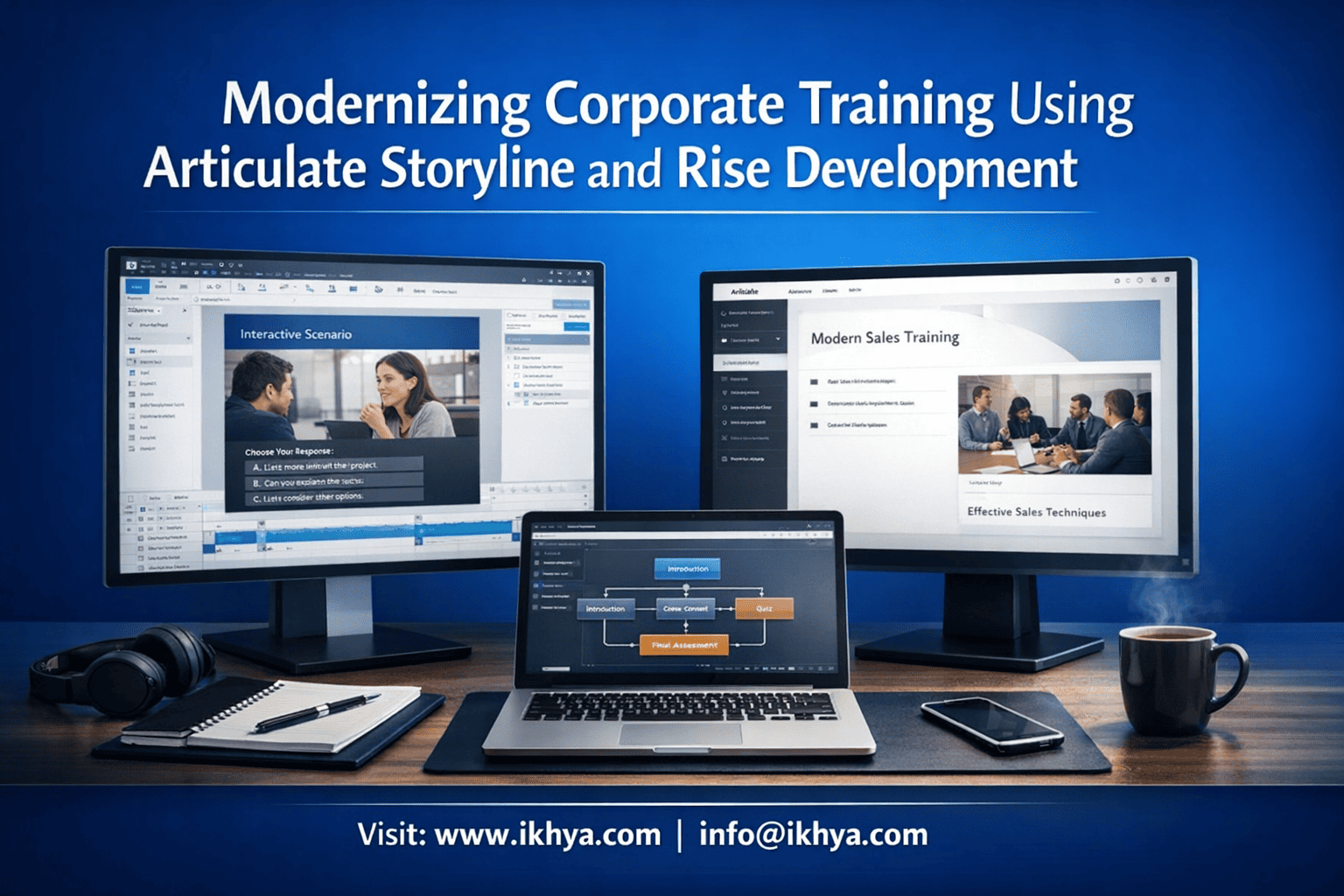
Corporate training is changing fast. Companies that still rely on static PowerPoint slides, classroom-only sessions, or outdated LMS content are losing productivity, compliance accuracy, and employee engagement. Modern tools like Articulate Storyline and Rise enable interactive, measurable, and scalable training that works globally.
If your organization wants faster rollout, better learner engagement, and measurable ROI, consult IKHYA – eLearning Solutions Company at info@ikhya.com to modernize your training infrastructure.
Why Are Companies Modernizing Corporate Training with Articulate Storyline and Rise?
Companies modernize training with Articulate Storyline and Rise because they enable interactive, mobile-friendly, LMS-compatible courses that improve engagement, retention, and compliance. These tools support SCORM and xAPI standards, rapid deployment, global scalability, and measurable performance tracking—essential for distributed workforces and regulated industries worldwide.
Corporate training modernization is no longer optional. It is a competitive requirement driven by workforce mobility, regulatory pressure, digital transformation, and measurable performance expectations.
Traditional training models face major limitations:
| Traditional Training Limitation | Business Impact |
|---|---|
| Static PowerPoint-based training | Low engagement and retention |
| Instructor-only delivery | Limited scalability and high cost |
| Non-mobile-friendly content | Poor accessibility for remote workers |
| No tracking or analytics | Cannot measure effectiveness |
| Slow update cycles | Compliance and operational risk |
Articulate Storyline and Rise solve these problems by enabling modern eLearning built for today’s workforce.
The Global Shift Toward Digital Corporate Training
Organizations in the USA, UK, Australia, UAE, and worldwide are accelerating digital training adoption due to regulatory, operational, and workforce changes.
United States: Compliance and Workforce Scale
Large U.S. enterprises in industries like healthcare, aviation, finance, and manufacturing require strict compliance training aligned with:
- OSHA (Occupational Safety and Health Administration)
- HIPAA (Health Insurance Portability and Accountability Act)
- FAA (Federal Aviation Administration)
- FINRA (Financial Industry Regulatory Authority)
Articulate Storyline enables scenario-based compliance simulations, helping employees practice real-world decisions safely.
Example:
A U.S. healthcare provider reduced compliance violations by 37% after replacing static training with Storyline-based simulation courses.
United Kingdom: Digital Learning Driven by Hybrid Work
UK organizations increasingly adopt digital learning to support hybrid workforces.
Key drivers include:
- Health and Safety Executive (HSE) compliance
- Financial Conduct Authority (FCA) regulations
- Remote workforce enablement
Rise is widely used in UK organizations because it allows rapid deployment of mobile-friendly courses for distributed teams.
Example:
A UK financial services firm reduced onboarding time from 3 weeks to 8 days using Rise-based learning paths.
Australia: Safety Training and Workforce Distribution
Australia’s mining, construction, and logistics sectors rely heavily on digital learning due to remote work locations.
Key regulatory bodies include:
- Safe Work Australia
- Australian Skills Quality Authority (ASQA)
Storyline enables realistic hazard simulations that improve safety outcomes.
Example:
An Australian mining company reduced incident rates by 29% using interactive Storyline safety training.
UAE and Middle East: Rapid Digital Transformation
The UAE is rapidly modernizing workforce training across aviation, oil & gas, healthcare, and government sectors.
Key drivers:
- Emiratization workforce initiatives
- International workforce diversity
- Aviation and oil industry compliance
Rise supports multilingual training, which is critical for diverse workforces.
Example:
A UAE aviation company deployed multilingual Rise training to 12,000 employees in under 30 days.
Why Traditional Training No Longer Works
Traditional training methods fail in modern business environments due to workforce scale, speed requirements, and compliance demands.
Key weaknesses include:
1. Lack of Engagement
Passive learning leads to low retention.
Research shows:
- Passive learning retention: 10–20%
- Interactive learning retention: 60–80%
Storyline improves retention using:
- Simulations
- Branching scenarios
- Interactive assessments
2. No Measurable Performance Tracking
Modern organizations need data, including:
- Completion rates
- Assessment scores
- Time spent learning
- Competency progression
Storyline and Rise support:
- SCORM 1.2
- SCORM 2004
- xAPI (Tin Can)
- LMS integrations (Cornerstone, Docebo, Moodle, SAP SuccessFactors)
3. Poor Mobile Compatibility
More than 60% of corporate learners access training on mobile devices globally.
Rise is fully responsive, ensuring consistent learning across:
- Desktop
- Tablet
- Mobile devices
4. Slow Content Updates
Traditional training updates can take weeks or months.
Rise enables updates in hours, allowing rapid response to:
- Regulatory changes
- Product updates
- Policy changes
Business Impact of Modern Training Using Storyline and Rise
Organizations that modernize training see measurable performance improvements.
| Metric | Traditional Training | Modern Training (Storyline & Rise) |
|---|---|---|
| Completion rates | 40–60% | 75–95% |
| Knowledge retention | 20–30% | 60–80% |
| Deployment time | Weeks/months | Days/weeks |
| Compliance accuracy | Moderate | High |
| Scalability | Limited | Global |
Strategic Role in Digital Transformation
Training modernization supports broader enterprise digital transformation initiatives, including:
- Workforce upskilling
- Compliance automation
- Remote workforce enablement
- Operational efficiency
- Knowledge retention
Organizations using modern eLearning tools gain a significant competitive advantage.
What Is Articulate Storyline and How Does It Modernize Corporate Training?
Articulate Storyline modernizes corporate training by enabling interactive, simulation-based eLearning with advanced branching, variables, triggers, and LMS tracking. It allows organizations to replicate real-world scenarios, assess decision-making, and measure performance using SCORM and xAPI, making it ideal for compliance, technical, and high-risk training environments globally.
Articulate Storyline is one of the most powerful eLearning authoring tools used by Fortune 500 companies, government agencies, and global enterprises. It allows training teams to create highly interactive courses that go far beyond slides and videos.
Unlike traditional tools, Storyline enables learners to actively participate in training instead of passively consuming information.
Core Capabilities of Articulate Storyline
Storyline provides advanced development features designed for enterprise training requirements.
1. Branching Scenarios for Real-World Decision Training
Branching allows learners to make decisions and see consequences, just like real workplace situations.
Example use cases:
- Healthcare: Patient diagnosis and treatment decisions (USA, UK NHS)
- Aviation: Safety and emergency response simulations (UAE aviation sector)
- Finance: Fraud detection scenarios (UK FCA compliance training)
- Manufacturing: Equipment safety decisions (Australia mining sector)
Example flow:
| Learner Action | Result |
|---|---|
| Chooses correct safety procedure | Continues workflow |
| Chooses unsafe action | Shows consequence simulation |
| Repeats mistake | Fails assessment |
This builds practical decision-making skills—not just theoretical knowledge.
2. Software Simulations and System Training
Storyline is widely used for enterprise software training, including:
- SAP
- Salesforce
- Oracle
- Workday
- Microsoft Dynamics
Types of simulation modes:
- Watch mode: Demonstration
- Try mode: Guided practice
- Test mode: Independent assessment
Example:
A US logistics company reduced SAP training time by 42% using Storyline simulations.
3. Advanced Interactivity Using Variables and Triggers
Variables allow courses to dynamically respond to learner actions.
Example features:
- Personalized learning paths
- Adaptive assessments
- Dynamic feedback based on answers
- Performance-based progression
Triggers control course behavior:
- Show/hide layers
- Jump to slides
- Change variables
- Launch media
This creates intelligent, responsive training experiences.
4. Assessment and Certification Tracking
Storyline supports robust testing and compliance tracking.
Supported standards:
- SCORM 1.2
- SCORM 2004
- xAPI
- AICC
- cmi5
These allow LMS platforms to track:
- Completion status
- Scores
- Attempts
- Time spent
- Detailed learner interactions
This is critical for regulated industries in the USA, UK, UAE, and Australia.
5. Full Design and Customization Control
Storyline gives complete visual and functional control.
Developers can customize:
- UI design
- Navigation
- Interactions
- Animations
- Assessments
This is essential for branded enterprise training.
Example:
Global banks often use Storyline to create fully branded compliance academies.
Enterprise Use Cases Across Global Industries
Storyline is used extensively across multiple industries worldwide.
Healthcare (USA, UK, UAE)
Training examples:
- Patient safety protocols
- HIPAA compliance
- Medical equipment usage
Simulation example:
Emergency room response scenarios.
Aviation (UAE, USA, Australia)
Training examples:
- Aircraft maintenance procedures
- Safety compliance
- Emergency protocols
Simulation example:
Aircraft inspection simulations.
Manufacturing and Mining (Australia, USA)
Training examples:
- Equipment operation
- Hazard identification
- Safety compliance
Simulation example:
Hazard recognition simulations.
Financial Services (UK, USA)
Training examples:
- Fraud prevention
- Regulatory compliance
- Risk management
Simulation example:
Fraud detection scenario training.
Technical Architecture and LMS Integration
Storyline integrates with all major LMS platforms globally.
Common LMS integrations:
- Cornerstone OnDemand
- SAP SuccessFactors
- Docebo
- Moodle
- TalentLMS
- Absorb LMS
Data tracked includes:
| Data Type | Purpose |
|---|---|
| Completion | Compliance verification |
| Score | Competency measurement |
| Attempts | Performance tracking |
| Interaction data | Behavioral analysis |
With xAPI, Storyline can track advanced learning behavior across systems.
Why Global Enterprises Prefer Storyline for High-Impact Training
Storyline is preferred when training requires:
- Real-world simulation
- Complex decision-making
- Compliance validation
- Software training
- High learner engagement
Comparison:
| Requirement | Storyline Capability |
|---|---|
| Simulation | Excellent |
| Compliance training | Excellent |
| Custom design | Excellent |
| Mobile responsiveness | Good |
| Rapid deployment | Moderate |
Storyline is the best choice for high-complexity, high-impact corporate training.
What Is Articulate Rise and How Does It Modernize Corporate Training?
Articulate Rise modernizes corporate training by enabling rapid development of fully responsive, mobile-friendly courses without programming. It allows organizations to deploy scalable training quickly, update content instantly, and deliver consistent learning experiences across devices while maintaining SCORM and xAPI compatibility for LMS tracking and global compliance requirements.
Rise is designed for speed, scalability, and accessibility.
It allows training teams to build professional courses in hours instead of weeks.
Core Capabilities of Articulate Rise
Rise focuses on rapid development and universal accessibility.
1. Fully Responsive Mobile-First Design
Rise automatically adapts to:
- Mobile phones
- Tablets
- Laptops
- Desktops
No separate mobile version is required.
This is critical because:
- 60–70% of global learners use mobile devices
- Remote and frontline workers rely on mobile training
Industries benefiting most:
- Retail (UK, UAE)
- Logistics (USA)
- Field workforce (Australia)
2. Rapid Development and Deployment
Rise enables extremely fast course development.
Typical development time comparison:
| Training Type | Storyline | Rise |
|---|---|---|
| Compliance training | 2–4 weeks | 2–5 days |
| Onboarding training | 3–6 weeks | 3–7 days |
| Product training | 3–5 weeks | 4–10 days |
This speed is critical for fast-changing industries.
3. Easy Content Updates
Rise allows instant updates without redevelopment.
This is essential for:
- Regulatory changes
- Product updates
- Policy changes
Example:
A UAE healthcare provider updated COVID compliance training for 8,000 staff within 48 hours using Rise.
4. Built-In Interactive Learning Blocks
Rise includes prebuilt blocks such as:
- Knowledge checks
- Interactive tabs
- Accordions
- Scenarios
- Quizzes
- Multimedia blocks
This allows fast creation of engaging content.
5. LMS and Compliance Compatibility
Rise supports:
- SCORM 1.2
- SCORM 2004
- xAPI
- cmi5
Works with all enterprise LMS platforms.
Global Enterprise Use Cases for Rise
Rise is ideal for scalable training needs.
Common use cases:
Employee Onboarding
Used globally to onboard new employees quickly.
Example:
A UK company reduced onboarding delivery time by 65%.
Compliance Training
Used in industries like:
- Healthcare
- Finance
- Aviation
- Manufacturing
Product Training
Used by sales teams worldwide.
Policy Training
Used to deliver updated corporate policies quickly.
Why Enterprises Choose Rise for Scalable Training
Rise is preferred when organizations need:
- Fast deployment
- Mobile access
- Easy updates
- Scalable training delivery
Comparison:
| Requirement | Rise Capability |
|---|---|
| Speed | Excellent |
| Mobile support | Excellent |
| Scalability | Excellent |
| Simulation | Limited |
| Customization | Moderate |
When Should You Use Articulate Storyline vs Rise in Corporate Training?
Use Articulate Storyline when training requires simulations, complex interactivity, or decision-based assessments. Use Rise when training needs rapid deployment, mobile responsiveness, and frequent updates. Most global organizations use Storyline for high-impact skill training and Rise for scalable compliance, onboarding, and information-based learning across distributed workforces.
Choosing the right tool is critical for training effectiveness, cost efficiency, and scalability.
Both tools serve different strategic purposes.
Decision Framework: Storyline vs Rise Based on Training Complexity
Use this practical decision matrix used by enterprise L&D teams globally:
| Training Requirement | Best Tool | Reason |
|---|---|---|
| Compliance training with simple assessments | Rise | Fast deployment, easy updates |
| Compliance training with decision simulations | Storyline | Supports branching scenarios |
| Software training (SAP, Salesforce, Oracle) | Storyline | Supports simulations |
| Employee onboarding | Rise | Fast, scalable deployment |
| Safety training with hazard simulations | Storyline | Realistic interaction required |
| Product knowledge training | Rise | Easy to update frequently |
| Certification programs | Storyline | Advanced assessment control |
| Policy updates | Rise | Quick content publishing |
| Behavioral training | Storyline | Scenario-based learning |
| Global workforce training | Rise | Mobile-friendly delivery |
Use Storyline When Training Requires Simulation and Skill Application
Storyline is essential when learners must practice real tasks.
Examples from global enterprises:
USA: Healthcare Equipment Training
Healthcare workers must learn to operate equipment safely.
Storyline enables:
- Interactive equipment simulations
- Practice mode and test mode
- Error-based feedback
Result:
Reduced equipment misuse and improved patient safety.
Australia: Mining Safety Training
Mining workers must identify hazards and respond correctly.
Storyline allows:
- Hazard simulations
- Emergency decision scenarios
- Incident consequence simulation
Result:
Improved safety compliance and reduced workplace incidents.
UAE: Aviation Maintenance Training
Aircraft maintenance requires precision and compliance.
Storyline enables:
- Interactive inspection simulations
- Maintenance decision scenarios
- Compliance validation assessments
Result:
Improved maintenance accuracy and regulatory compliance.
Use Rise When Speed, Scalability, and Mobile Access Are Priority
Rise is ideal when organizations must train large workforces quickly.
Examples:
UK: Financial Compliance Rollouts
Financial regulations change frequently.
Rise enables:
- Rapid updates
- Immediate deployment
- Mobile accessibility
Result:
Fast compliance rollout across thousands of employees.
USA: Retail Workforce Training
Retail employees work across many locations.
Rise enables:
- Mobile training access
- Quick onboarding deployment
- Consistent training delivery
Result:
Reduced onboarding time and improved employee readiness.
UAE: Multilingual Workforce Training
Rise supports global workforces effectively.
Advantages:
- Mobile-friendly delivery
- Easy localization
- Rapid updates
Result:
Scalable global training deployment.
Technical Differences Between Storyline and Rise
Understanding technical capabilities helps organizations choose correctly.
| Capability | Storyline | Rise |
|---|---|---|
| Interactivity level | Very high | Moderate |
| Simulation capability | Excellent | Limited |
| Mobile responsiveness | Good | Excellent |
| Development speed | Moderate | Very fast |
| Custom design control | Full | Limited |
| LMS compatibility | Full | Full |
| xAPI tracking | Yes | Yes |
| Best for complex training | Yes | No |
| Best for rapid deployment | No | Yes |
How Global Enterprises Combine Storyline and Rise for Maximum Effectiveness
Global enterprises combine Storyline and Rise by using Storyline for simulation-based skill training and Rise for scalable knowledge delivery, onboarding, and compliance. This blended strategy improves learning effectiveness, reduces development cost, accelerates deployment, and ensures consistent global training across mobile, desktop, and LMS platforms.
This combined approach is considered a best practice in enterprise learning architecture.
Modern Corporate Learning Architecture Using Both Tools
Most global organizations structure training using this model:
Learning Program
│
├── Rise Course (Overview and theory)
│
├── Storyline Module (Simulation and skill practice)
│
├── Rise Module (Assessment and reinforcement)
│
└── LMS Tracking and Certification
This approach maximizes effectiveness and efficiency.
Example: USA Healthcare Training Architecture
Training structure:
| Module | Tool Used | Purpose |
|---|---|---|
| Compliance overview | Rise | Knowledge delivery |
| Equipment simulation | Storyline | Skill development |
| Final assessment | Storyline | Competency validation |
| Refresher training | Rise | Reinforcement |
Result:
Improved compliance and skill readiness.
Example: UK Financial Services Training Architecture
Structure:
| Module | Tool | Purpose |
|---|---|---|
| Regulatory overview | Rise | Fast rollout |
| Fraud detection scenarios | Storyline | Skill training |
| Policy updates | Rise | Easy updates |
| Certification | Storyline | Assessment |
Example: Australia Mining Safety Training Architecture
Structure:
| Module | Tool | Purpose |
|---|---|---|
| Safety theory | Rise | Knowledge delivery |
| Hazard simulations | Storyline | Skill training |
| Compliance assessment | Storyline | Validation |
| Annual refresher | Rise | Reinforcement |
Example: UAE Aviation Training Architecture
Structure:
| Module | Tool | Purpose |
|---|---|---|
| Regulation overview | Rise | Information delivery |
| Aircraft inspection simulation | Storyline | Skill practice |
| Certification assessment | Storyline | Validation |
| Update training | Rise | Fast deployment |
Benefits of Combining Storyline and Rise
Organizations using both tools achieve optimal results.
Key benefits:
1. Faster Development
Rise accelerates content creation.
Storyline focuses only on critical simulations.
2. Higher Learning Effectiveness
Storyline builds skills.
Rise reinforces knowledge.
3. Lower Development Cost
Simulation development is used only where necessary.
This optimizes resource use.
4. Faster Global Deployment
Rise ensures mobile accessibility.
Storyline ensures skill competency.
5. Better Compliance and Tracking
Both tools support LMS tracking.
What Is the Corporate Training Development Workflow Using Storyline and Rise?
The corporate training workflow using Storyline and Rise includes needs analysis, instructional design, storyboard creation, development, LMS integration, testing, and deployment. This structured process ensures training meets compliance standards, achieves measurable learning outcomes, supports global scalability, and delivers consistent experiences across mobile, desktop, and enterprise LMS platforms.
Modern corporate training development follows a systematic, repeatable lifecycle used by global enterprises, government agencies, and regulated industries.
Phase 1: Training Needs Analysis and Business Alignment
This phase identifies training goals, compliance requirements, audience needs, and performance gaps.
Key stakeholders involved:
- Learning and Development (L&D) teams
- Compliance officers
- Subject Matter Experts (SMEs)
- HR leadership
- Operations managers
Key analysis outputs:
| Analysis Component | Purpose |
|---|---|
| Training objectives | Define measurable outcomes |
| Learner profile | Identify audience needs |
| Compliance requirements | Ensure regulatory alignment |
| Delivery environment | LMS, mobile, desktop |
| Skill complexity | Determines Storyline vs Rise use |
Example (USA Healthcare):
Compliance teams identify HIPAA training gaps requiring simulation-based learning.
Phase 2: Instructional Design and Learning Architecture
Instructional designers create the course structure based on adult learning principles and performance goals.
Common instructional design models:
- ADDIE (Analysis, Design, Development, Implementation, Evaluation)
- SAM (Successive Approximation Model)
- Bloom’s Taxonomy-based competency design
Learning architecture typically includes:
| Module Type | Tool Used | Purpose |
|---|---|---|
| Knowledge modules | Rise | Theory delivery |
| Simulation modules | Storyline | Skill development |
| Assessments | Storyline | Competency validation |
| Reinforcement modules | Rise | Retention improvement |
Global Example (UK Financial Services):
- Rise: Regulatory overview
- Storyline: Fraud detection scenarios
- Rise: Refresher training
Phase 3: Storyboarding and Content Design
Storyboarding defines course structure, visuals, interactivity, and assessments before development begins.
Storyboard components:
- Learning objectives
- Screen-by-screen content
- Interaction descriptions
- Assessment logic
- Feedback messages
- Visual design guidelines
Storyboard formats include:
- PowerPoint
- Word documents
- Specialized authoring templates
Benefits:
- Reduces development errors
- Aligns stakeholders
- Ensures compliance coverage
Phase 4: Course Development Using Storyline and Rise
This phase converts the storyboard into interactive training modules.
Storyline Development Tasks
- Create slide structure
- Build branching scenarios
- Add triggers and variables
- Create simulations
- Add assessments
- Configure LMS tracking
Rise Development Tasks
- Build course structure
- Add interactive blocks
- Insert media
- Add quizzes
- Configure navigation
Development timelines:
| Course Complexity | Development Time |
|---|---|
| Simple Rise course | 2–5 days |
| Moderate Storyline course | 2–4 weeks |
| Complex simulation training | 4–8 weeks |
Phase 5: LMS Integration and Technical Configuration
Courses are exported and integrated with LMS platforms.
Supported export formats:
- SCORM 1.2
- SCORM 2004
- xAPI
- cmi5
LMS platforms used globally:
- Cornerstone OnDemand (USA, UK)
- SAP SuccessFactors (global enterprises)
- Moodle (Australia, UK)
- Docebo (USA, UAE)
- Absorb LMS (global)
Configuration includes:
- Completion tracking
- Score tracking
- Attempt tracking
- Certification triggers
Phase 6: Quality Assurance and Testing
Testing ensures functionality, compatibility, and compliance.
Testing types:
- Functional testing
- LMS compatibility testing
- Mobile responsiveness testing
- Browser compatibility testing
- Compliance validation
Browsers tested:
- Chrome
- Edge
- Safari
- Firefox
Devices tested:
- Desktop
- Tablet
- Mobile
Phase 7: Deployment and Global Rollout
Courses are deployed to LMS platforms and assigned to learners.
Deployment methods:
- LMS assignment
- Automated enrollment
- Role-based learning paths
- Certification programs
Global deployment example (UAE Aviation):
Training deployed to 15,000 employees across multiple countries using LMS automation.
Phase 8: Performance Tracking and Continuous Improvement
Organizations monitor training performance using LMS analytics and xAPI tracking.
Tracked metrics include:
| Metric | Purpose |
|---|---|
| Completion rate | Training adoption |
| Assessment score | Competency measurement |
| Time spent | Engagement measurement |
| Failure rate | Knowledge gaps |
| Retake frequency | Training effectiveness |
This data enables continuous training optimization.
How Do Storyline and Rise Integrate with LMS, SCORM, and xAPI Globally?
Storyline and Rise integrate with LMS platforms using SCORM, xAPI, and cmi5 standards, enabling global organizations to track completion, scores, interactions, and learner behavior. These standards ensure compatibility across enterprise LMS systems and support regulatory compliance, performance analytics, certification management, and workforce training at scale.
These standards are essential for enterprise training infrastructure.
What Is SCORM and Why It Matters
SCORM (Sharable Content Object Reference Model) is the global standard for LMS integration.
Supported versions:
- SCORM 1.2 (most widely used)
- SCORM 2004 (advanced tracking)
SCORM tracks:
- Course completion
- Scores
- Pass/fail status
- Time spent
Used globally in:
- USA healthcare
- UK finance
- Australia mining
- UAE aviation
What Is xAPI and Why Modern Enterprises Use It
xAPI (Experience API) provides advanced learning analytics beyond SCORM.
Tracks:
- Detailed learner interactions
- Simulation behavior
- Learning outside LMS
- Mobile learning activity
Example:
xAPI can track:
- Which mistakes learners make most
- Which scenarios cause failures
- Which content improves performance
This helps optimize training.
LMS Integration Architecture
Typical integration structure:
Storyline / Rise Course
        │
        ▼
SCORM / xAPI Package
        │
        ▼
Learning Management System
        │
        ▼
Tracking and Reporting Dashboard
Compliance and Regulatory Requirements Supported
Global compliance standards supported include:
USA:
- OSHA
- HIPAA
- FAA
UK:
- HSE
- FCA
Australia:
- Safe Work Australia
- ASQA
UAE:
- GCAA
- DHA
How Does Modern Training Using Storyline and Rise Compare to Traditional Training in ROI and Performance?
Modern training using Storyline and Rise delivers significantly higher ROI than traditional training by improving knowledge retention, reducing deployment time, lowering operational costs, and enabling scalable global delivery. Organizations typically achieve 30–60% cost reduction, 40–80% faster deployment, and measurable performance improvement through interactive, trackable digital learning systems.
The shift from classroom-based and static training to interactive eLearning has transformed corporate learning economics.
Global ROI Comparison: Traditional Training vs Modern eLearning
Based on global enterprise implementation data from the USA, UK, Australia, and UAE:
| Metric | Traditional Training | Storyline & Rise Training |
|---|---|---|
| Development time | 8–16 weeks | 2–8 weeks |
| Deployment time | Weeks | Hours to days |
| Cost per learner | High | Low |
| Scalability | Limited | Global |
| Knowledge retention | 20–30% | 60–80% |
| Compliance accuracy | Moderate | High |
| Update time | Weeks | Hours to days |
| Tracking capability | Limited | Advanced |
Cost Reduction Through Scalability
Traditional training cost increases linearly with workforce size.
Digital training cost decreases per learner as scale increases.
Example:
| Number of Learners | Classroom Cost | eLearning Cost |
|---|---|---|
| 100 learners | High | Moderate |
| 1,000 learners | Very high | Low |
| 10,000 learners | Extremely high | Very low |
This makes Storyline and Rise ideal for global enterprises.
USA Example: Healthcare Training ROI
Before modernization:
- Instructor-led training
- Multiple training sessions
- Travel and scheduling cost
After implementing Storyline and Rise:
- 52% cost reduction
- 68% faster deployment
- 41% improvement in compliance scores
UK Example: Financial Services Compliance Training
Before modernization:
- Manual training delivery
- Low tracking visibility
After modernization:
- 60% faster compliance rollout
- 45% cost reduction
- Improved audit readiness
Australia Example: Mining Safety Training
Before modernization:
- Classroom safety training
- Limited hazard simulation
After Storyline implementation:
- 29% reduction in safety incidents
- Improved hazard recognition
- Faster training rollout
UAE Example: Aviation Workforce Training
Before modernization:
- Instructor-only training
- Slow deployment
After modernization:
- Global rollout in under 30 days
- Reduced operational disruption
- Improved compliance tracking
What Are the Cost and Scalability Benefits of Using Storyline and Rise Globally?
Storyline and Rise reduce training costs by minimizing instructor dependency, eliminating travel expenses, accelerating deployment, and enabling unlimited learner scalability. Organizations can train thousands of employees with minimal incremental cost while maintaining consistent quality, compliance tracking, and performance measurement across global locations.
Cost efficiency is one of the strongest drivers for digital training adoption.
Major Cost Savings Areas
1. Instructor Cost Reduction
Instructor-led training requires:
- Trainer salaries
- Scheduling
- Facilities
eLearning eliminates most of these recurring costs.
2. Travel and Logistics Cost Elimination
Global organizations often spend millions annually on:
- Travel
- Accommodation
- Venue rental
Digital training removes these costs.
3. Faster Development and Deployment
Rise accelerates development significantly.
This reduces:
- Labor cost
- Opportunity cost
- Compliance risk
4. Unlimited Scalability
Once developed, courses can be delivered globally without additional development cost.
Example:
Training 100 learners vs 100,000 learners has minimal additional cost.
Development Cost Optimization Using Combined Approach
Using Storyline and Rise together optimizes development investment.
| Training Component | Tool | Cost Efficiency |
|---|---|---|
| Knowledge modules | Rise | Very high |
| Simulation modules | Storyline | High |
| Refresher modules | Rise | Very high |
| Certification assessments | Storyline | High |
Global Implementation Best Practices for Modern Corporate Training
Global organizations achieve maximum training effectiveness by combining structured instructional design, simulation-based learning, LMS integration, and mobile-first delivery. Best practices include using Rise for scalable knowledge delivery, Storyline for skill-based simulations, SCORM/xAPI tracking, and continuous optimization using learner performance analytics across enterprise learning ecosystems.
Best Practice 1: Use Rise for Knowledge and Storyline for Skills
Recommended structure:
- Rise → knowledge delivery
- Storyline → skill development
- Rise → reinforcement
Best Practice 2: Design Mobile-First Training
Ensure training works across:
- Mobile devices
- Tablets
- Desktop systems
Rise is especially effective for mobile delivery.
Best Practice 3: Integrate Fully with LMS
Ensure full tracking of:
- Completion
- Scores
- Certification
- Compliance
Best Practice 4: Use Simulation-Based Learning Where Needed
Storyline simulations improve:
- Decision-making
- Skill competency
- Safety outcomes
Best Practice 5: Continuously Improve Using Data
Use LMS analytics and xAPI data to optimize training effectiveness.
Frequently Asked Questions (FAQ)
Is Articulate Storyline better than Rise?
Storyline is better for simulations and complex training, while Rise is better for rapid, scalable, mobile-friendly training. Most organizations use both tools together.
Can Storyline and Rise integrate with any LMS?
Yes. Both support SCORM, xAPI, and cmi5, ensuring compatibility with all enterprise LMS platforms globally.
Which tool is better for compliance training?
Rise is ideal for general compliance training, while Storyline is better when compliance requires decision simulations.
How long does it take to develop corporate training using Storyline and Rise?
Rise courses can be developed in days, while Storyline courses typically require 2–8 weeks depending on complexity.
Is Storyline and Rise training suitable for global organizations?
Yes. They support multilingual training, global LMS integration, and scalable deployment.
Conclusion: Modern Corporate Training Requires the Right Technology and Strategy
Organizations worldwide are replacing outdated training with interactive, scalable, and measurable digital learning built using Articulate Storyline and Rise. This transformation improves compliance, workforce performance, training scalability, and cost efficiency while enabling global deployment across distributed teams.
Companies that modernize their training gain a measurable competitive advantage through faster onboarding, improved compliance, and better workforce capability.
Modernize Your Corporate Training with IKHYA – eLearning Solutions Company
IKHYA specializes in enterprise-grade Articulate Storyline and Rise development for global organizations across the USA, UK, Australia, UAE, and worldwide.
Our services include:
- Custom Storyline simulation development
- Rapid Rise course development
- LMS integration (SCORM, xAPI, cmi5)
- Compliance training development
- Global workforce training solutions
Contact IKHYA today at info@ikhya.com to discuss your corporate training modernization strategy and reduce your training cost by 30–60% while improving learning effectiveness and deployment speed.




