
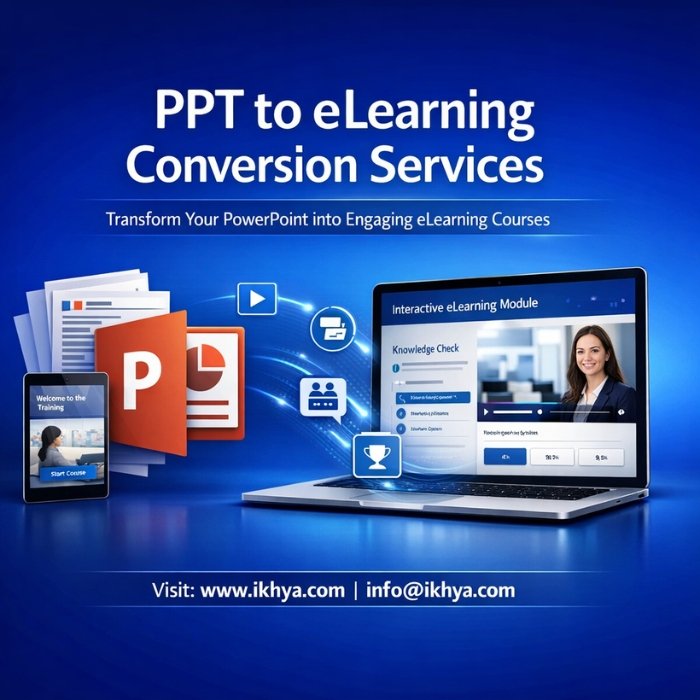


PPT to eLearning Conversion Services
PPT to eLearning Conversion Services for Modern Corporate Training.
Many organizations still rely on PowerPoint presentations for training, but static slides often fail to engage today’s digital workforce. Converting PPT content into interactive eLearning courses allows organizations to deliver scalable, engaging, and LMS-compatible training experiences.
IKHYA – eLearning Solutions Company helps global organizations transform legacy PowerPoint training into modern, interactive eLearning programs designed for performance improvement and knowledge retention.
Request a Proposal or Schedule a Consultation.
Get a Free eLearning Consultation / Proposal
Organizations often accumulate hundreds of PowerPoint training presentations over the years. These files usually contain valuable knowledge but are difficult to scale across distributed teams.
Converting these presentations into structured eLearning courses allows companies to:
- deliver consistent training across global teams
- track learner progress through an LMS
- improve engagement through interactive learning
- support remote and hybrid work environments
- update training materials quickly
IKHYA provides end-to-end PPT to eLearning conversion services, including instructional design, interactive development, multimedia production, and LMS deployment.
What We Can Convert
We transform various types of PowerPoint-based training into modern digital learning:
- Compliance training presentations
- Product training decks
- Sales enablement presentations
- Software training slides
- Safety and operational training
- HR and onboarding training
Typical Conversion Scenarios
Organizations usually approach PPT conversion in the following situations:
- Instructor-Led Training Modernization: A company has classroom training delivered through PowerPoint slides. They want to convert this into self-paced eLearning.
- Global Workforce Training: Organizations operating in multiple countries need training that can be deployed digitally and localized.
- Remote Workforce Enablement: Remote employees need access to training anytime through an LMS or learning platform.
Typical PPT to eLearning Conversion Pricing
| Conversion Level | Estimated Cost |
|---|---|
| Basic slide-to-course conversion | $1,000 – $2,500 per module |
| Interactive eLearning conversion | $2,500 – $6,000 per module |
| Scenario-based interactive courses | $6,000 – $12,000 per module |
Pricing varies depending on:
- number of slides
- level of interactivity
- multimedia development
- assessments and scenarios
- localization requirements
Typical Development Timelines
| Project Scope | Estimated Timeline |
|---|---|
| 1 module | 2–3 weeks |
| 10 modules | 6–8 weeks |
| 30 modules | 12–16 weeks |
What You Receive
A complete digital learning solution including:
- interactive eLearning modules
- narration and multimedia elements
- knowledge checks and assessments
- SCORM or xAPI packages for LMS deployment
- mobile-compatible learning modules
- accessibility support aligned with WCAG standards
Request Your Free Consultation
If you have existing PowerPoint training materials and want to convert them into engaging digital courses, our team can evaluate your content and recommend the best approach.
Contact IKHYA – eLearning Solutions Company
Email: info@ikhya.com
You can also submit an RFP, request a project estimate, or schedule a consultation with our instructional design specialists.
What is PPT to eLearning Conversion
PPT to eLearning conversion is the process of transforming PowerPoint training presentations into interactive digital learning courses that can be delivered through a Learning Management System (LMS) or other learning platforms.
Organizations exploring how to convert PowerPoint to eLearning often begin by understanding the full development process and instructional design considerations.
Many organizations use PowerPoint slides for classroom-based training or instructor-led sessions. While these presentations contain valuable knowledge, they are usually not designed for self-paced digital learning.
Through professional conversion, static slides are redesigned into structured eLearning modules that include:
- interactive learning elements
- voice narration
- scenario-based learning activities
- quizzes and assessments
- multimedia elements such as video and animations
- LMS-compatible learning packages
The goal is not simply to upload slides online but to transform them into engaging learning experiences that improve knowledge retention.
How PPT Slides Are Transformed into eLearning Courses
Professional PPT to eLearning conversion typically involves several instructional design enhancements.
Content Restructuring
Slides are reorganized to create a logical learning flow. Content is simplified to support digital learning.
Interactive Learning Elements
Interactive elements are added such as:
- clickable interactions
- branching scenarios
- drag-and-drop activities
- knowledge checks
These features increase learner engagement.
Multimedia Integration
Narration, videos, and animations are added to make the learning experience more engaging.
Assessment Design
Quizzes and assessments help measure knowledge and ensure learning objectives are achieved.
LMS Compatibility
Courses are published in formats such as:
- SCORM
- xAPI
This allows organizations to track:
- learner progress
- completion rates
- assessment scores
Example Conversion Scenario
Example: Compliance Training Conversion
You can also explore a real compliance training digital learning project delivered for a global healthcare organization.
Client: UK Financial Services Organization
Original Content: 200-slide PowerPoint compliance training
Converted Modules: 12 eLearning modules
Module Duration: 10–12 minutes each
Features included:
- scenario-based learning
- interactive decision points
- knowledge assessments
- LMS progress tracking
Timeline: 7 weeks
Estimated Cost: $30,000 – $50,000
Tools Commonly Used for PPT Conversion
Professional eLearning developers use specialized authoring tools to convert PowerPoint presentations into interactive learning modules.
Common tools include:
- Articulate Storyline
- Adobe Captivate
- Lectora Inspire
- iSpring Suite
These tools allow developers to transform static slides into fully interactive digital learning experiences.
Why Organizations Need PPT to eLearning Conversion
Many organizations have years of training content stored in PowerPoint presentations. However, traditional slide-based training is difficult to scale across large or distributed teams.
Converting PowerPoint content into eLearning enables organizations to modernize training delivery and improve learning effectiveness.
Global Workforce Training
Large organizations often operate across multiple countries. Classroom training based on PowerPoint slides can be difficult to deliver consistently across global teams.
Converting PowerPoint training into digital learning allows companies to provide consistent training experiences worldwide.
Example: USA Technology Company
A US-based software company needed to train its sales teams on new product features.
Original training format:
PowerPoint presentations delivered in instructor-led workshops
Challenges included:
- scheduling training across time zones
- inconsistent delivery by different trainers
Solution:
PowerPoint content was converted into interactive microlearning modules that sales teams could access through the company LMS.
Results:
- faster product knowledge adoption
- consistent training across global teams
Example: UK Banking Organization
A UK financial institution needed to deliver regulatory compliance training to thousands of employees.
PowerPoint presentations were converted into SCORM-compliant eLearning modules with interactive assessments.
Benefits included:
- automated LMS tracking
- faster compliance reporting
- reduced classroom training costs
Example: Australian Construction Company
This project is similar to enterprise safety training programs developed for manufacturing and industrial workforces.
A construction company in Australia needed safety training for field workers located across multiple project sites.
PowerPoint-based safety presentations were converted into mobile-friendly eLearning modules.
Workers could access training through mobile devices before entering work sites.
Results included:
- improved safety compliance
- faster onboarding of new workers
Example: UAE Aviation Organization
An aviation services company in the UAE needed standardized training for technical teams.
Existing PowerPoint training materials were redesigned into scenario-based eLearning modules with simulations and assessments.
Benefits included:
- consistent technical training across locations
- improved certification tracking
- scalable training delivery
Key Business Drivers for PPT Conversion
Organizations convert PowerPoint training to eLearning for several strategic reasons.
Scalable Training Delivery
Digital courses allow organizations to train thousands of employees simultaneously.
Consistent Learning Experience
Every learner receives the same structured training content.
LMS Tracking and Analytics
Organizations can track training metrics such as:
- course completion
- assessment performance
- learner engagement
Reduced Training Costs
Digital training reduces expenses related to:
- travel
- classroom facilities
- instructor time
Remote and Hybrid Workforce Training
Employees can access training anytime and from any location.
Modernizing Legacy Training Content
Many companies have 10–20 years of training content stored in PowerPoint presentations.
Instead of recreating courses from scratch, PPT conversion allows organizations to:
- reuse existing content
- modernize training delivery
- accelerate digital learning transformation
Benefits of PPT to eLearning Conversion
Converting PowerPoint training into interactive eLearning provides significant advantages for organizations that want to modernize corporate training programs. Instead of relying on static slides, companies can deliver engaging digital learning experiences that improve knowledge retention and scalability.
Improved Learner Engagement
Traditional PowerPoint presentations are designed for instructor-led sessions. When used alone, they often fail to keep learners engaged.
eLearning conversion introduces interactive elements such as:
- clickable content
- knowledge checks
- branching scenarios
- animations and multimedia
- simulation-based learning
These elements make training more engaging and encourage active participation.
Consistent Training Across Global Teams
When training is delivered by different instructors, the learning experience can vary. This inconsistency often leads to knowledge gaps.
eLearning courses ensure that every learner receives the same structured training experience, regardless of location.
Organizations operating in multiple regions can deliver standardized training across:
- North America
- Europe
- Middle East
- Asia-Pacific
LMS Tracking and Learning Analytics
One of the major advantages of converting PowerPoint into eLearning is the ability to track training data.
Courses can be published using standards such as:
- SCORM
- xAPI
This enables Learning Management Systems to track:
- course completion
- assessment scores
- learner progress
- training compliance
These insights help organizations measure training effectiveness.
Faster Employee Onboarding
Many organizations use PowerPoint slides during employee onboarding sessions. However, classroom training can delay onboarding when schedules are limited.
Converting these presentations into eLearning allows new employees to complete onboarding training immediately after joining.
Benefits include:
- faster employee readiness
- reduced instructor workload
- scalable onboarding programs
Mobile Learning Accessibility
Modern employees often access training through mobile devices. Static PowerPoint files are not optimized for mobile learning.
Interactive eLearning courses can be designed for:
- smartphones
- tablets
- laptops
This allows employees to access training anytime and anywhere.
Reduced Training Costs
Instructor-led training often requires:
- travel expenses
- training venues
- instructor time
- printed materials
eLearning eliminates many of these costs by delivering training digitally.
Organizations can train thousands of employees without increasing training budgets.
Many organizations also evaluate eLearning development cost when deciding whether to build courses internally or outsource development.
Faster Course Updates
PowerPoint-based training often becomes outdated quickly. Updating classroom materials and scheduling new sessions can take time.
With eLearning courses, updates can be implemented quickly and deployed through the LMS.
Organizations can ensure employees always have access to the latest training content.
Real Enterprise Project Examples
Enterprise buyers often want to understand how PPT to eLearning conversion works in real-world training projects. Below are typical examples of enterprise training initiatives.
Example 1 — Compliance Training Conversion
Client: UK Financial Services Organization
Project Scope
- Conversion of 180 PowerPoint slides
- 15 compliance training modules
- 8–10 minutes per module
Training Format
- interactive eLearning
- scenario-based decision points
- knowledge assessments
- LMS tracking using SCORM
Timeline
6–7 weeks
Estimated Cost
$30,000 – $50,000
Example 2 — Product Training for Sales Teams
Client: US Technology Company
Project Scope
- conversion of product training presentations
- 20 interactive modules
- multimedia demonstrations included
Training Features
- product simulations
- knowledge checks
- scenario-based sales conversations
Timeline
7–8 weeks
Estimated Cost
$45,000 – $70,000
Example 3 — Safety Training Conversion
Client: Australian Construction Company
Project Scope
- conversion of safety training presentations
- 12 modules
- mobile-compatible training
Learning Features
- hazard identification scenarios
- safety quizzes
- compliance certification
Timeline
5–6 weeks
Estimated Cost
$25,000 – $40,000
Example 4 — Software Training Conversion
Client: UAE Logistics Company
Project Scope
- conversion of system training presentations
- 18 modules
- interactive software walkthroughs
Learning Features
- guided system simulations
- step-by-step learning interactions
- LMS performance tracking
Timeline
8–9 weeks
Estimated Cost
$40,000 – $65,000
Example 5 — Employee Onboarding Program
Client: Global Manufacturing Organization
Project Scope
- conversion of onboarding PowerPoint materials
- 10 microlearning modules
- multimedia storytelling approach
Training Features
- onboarding journey scenarios
- knowledge assessments
- interactive company culture modules
Timeline
4–5 weeks
Estimated Cost
$18,000 – $30,000
Request a Project Estimate
If your organization has PowerPoint training presentations that need to be converted into modern digital learning, our team can assess your content and recommend the best conversion approach.
IKHYA – eLearning Solutions Company
Email: info@ikhya.com
You can request:
Organizations planning large-scale training programs often submit an RFP to evaluate potential eLearning development partners.
- a project estimate
- a sample conversion demonstration
- a consultation with our instructional design experts
IKHYA Process for PPT to eLearning Conversion
Successful PPT to eLearning conversion requires more than simply uploading slides into an authoring tool. Effective digital learning requires instructional design, structured learning objectives, and interactive experiences.
IKHYA – eLearning Solutions Company follows a structured development framework based on ADDIE, Bloom’s Taxonomy, and the Kirkpatrick Model to ensure courses are effective and measurable.
Analysis
The first step is understanding the training goals and evaluating the existing PowerPoint content.
During this stage our team analyzes:
- training objectives
- target audience
- complexity of the subject matter
- existing slide structure
- media assets such as images, videos, or animations
We also determine whether the content should be converted into:
- full-length eLearning modules
- microlearning courses
- scenario-based learning modules
This stage helps ensure the final learning experience aligns with business goals.
Instructional Design
Once the content is analyzed, our instructional designers restructure the PowerPoint material into a digital learning framework.
Instructional design is guided by proven learning principles such as:
Bloom’s Taxonomy
Learning objectives are organized into levels such as:
- knowledge
- comprehension
- application
- analysis
This ensures the training supports real-world performance improvement.
Scenario-Based Learning
Instead of simply presenting information, learners are placed in realistic situations where they must make decisions.
Microlearning Strategies
Long presentations are often divided into shorter modules of 5–10 minutes to improve retention and engagement.
During this phase we create:
- storyboards
- interaction design plans
- assessment structures
Development
Once the learning structure is finalized, the course is developed using professional eLearning authoring tools.
Typical development activities include:
- designing interactive learning screens
- recording voice narration
- creating animations and multimedia elements
- building interactive activities and quizzes
- integrating branching scenarios
The goal is to transform static slides into engaging learning experiences.
Quality Assurance
Before deployment, every course undergoes comprehensive quality checks.
Our quality assurance process evaluates:
- content accuracy
- interaction functionality
- multimedia synchronization
- navigation flow
- mobile compatibility
- LMS integration
Courses are also tested for compatibility with major LMS platforms using SCORM or xAPI standards.
Deployment
After testing, the course is packaged and delivered for deployment.
Deployment options include:
- SCORM packages for LMS platforms
- xAPI packages for advanced learning analytics
- web-based training portals
- mobile learning environments
Our team can also assist organizations with LMS configuration and course deployment if required.
Measuring Learning Effectiveness
Training effectiveness can be evaluated using the Kirkpatrick Model, which measures:
- Learner reaction
- Knowledge gained
- Behavioral change
- Business impact
These insights help organizations continuously improve training programs.
Request a Conversion Assessment
If your organization has existing PowerPoint training that needs to be modernized, our instructional design team can review your materials and recommend the best conversion strategy.
IKHYA – eLearning Solutions Company
Email: info@ikhya.com
You can request:
- a content review
- a pilot module conversion
- a full project proposal
Technologies and Tools Used
High-quality PPT to eLearning conversion requires advanced authoring tools and technology platforms. These tools allow developers to transform static slides into interactive, LMS-ready learning modules.
Authoring Tools
IKHYA uses industry-leading authoring tools to create interactive courses.
- Articulate Storyline: One of the most widely used tools for interactive eLearning development. It supports complex interactions, branching scenarios, and multimedia learning experiences. Many enterprise training teams rely on specialized Articulate Storyline development services to build advanced interactive learning experiences.
- Adobe Captivate: Ideal for software training, responsive learning design, and simulation-based learning.
- Lectora Inspire: A powerful tool used for large-scale enterprise eLearning projects that require advanced customization.
- iSpring Suite: A rapid eLearning authoring tool that integrates directly with PowerPoint and enables fast course development.
Learning Management System Compatibility
Courses developed by IKHYA are compatible with most major learning platforms, including:
- corporate LMS platforms
- Learning Experience Platforms (LXP)
- digital adoption platforms
- mobile learning systems
This ensures organizations can deploy training across existing learning ecosystems.
eLearning Standards
To ensure compatibility and tracking capabilities, courses are developed according to global eLearning standards.
- SCORM: SCORM enables LMS platforms to track learner progress, completion status, and assessment scores.
- xAPI: xAPI allows organizations to capture more detailed learning data such as interactions and behavioral insights.
- WCAG Accessibility Standards: Courses can also be developed in alignment with WCAG accessibility guidelines, ensuring learning content is accessible to all learners.
Multimedia and Learning Technologies
To enhance learner engagement, courses may include:
- animated graphics
- instructional videos
- interactive simulations
- scenario-based learning
- knowledge assessments
These technologies transform traditional presentations into engaging digital learning experiences.
Industries We Serve
Organizations across many industries rely on PowerPoint presentations for training. However, traditional slide-based training often lacks engagement and scalability. Converting these presentations into structured eLearning courses helps organizations deliver consistent and trackable training programs.
IKHYA – eLearning Solutions Company supports organizations across multiple industries by transforming legacy training materials into modern digital learning experiences.
Healthcare
Healthcare organizations use PowerPoint presentations for training related to:
- clinical procedures
- patient safety protocols
- regulatory compliance
- medical equipment usage
Converting these materials into eLearning helps hospitals and healthcare providers ensure consistent training for doctors, nurses, and administrative staff.
Interactive courses can include:
- scenario-based patient care simulations
- compliance assessments
- procedure walkthroughs
Manufacturing
Manufacturing companies often rely on slide-based training for operational and technical training programs.
Examples include:
- equipment operation training
- safety procedures
- quality control processes
- production workflows
Converting PowerPoint materials into interactive eLearning enables organizations to train large workforces efficiently across multiple production facilities.
Finance
Financial institutions must deliver training related to:
- regulatory compliance
- risk management
- financial products
- anti-money laundering policies
PowerPoint to eLearning conversion helps banks and financial services organizations deliver standardized compliance training while maintaining detailed LMS tracking for audit purposes.
Construction
Construction companies use training presentations for:
- safety regulations
- hazard identification
- equipment operation
- site procedures
Interactive eLearning modules allow workers to complete safety training before entering job sites.
Mobile-compatible learning modules are particularly useful for field workers who need quick access to training materials.
Oil and Gas
Training in the oil and gas industry often includes complex operational procedures and safety protocols.
Converting PowerPoint training into interactive learning modules allows organizations to deliver consistent training across offshore platforms, refineries, and field operations.
Modules can include:
- safety simulations
- operational walkthroughs
- emergency response scenarios
Aviation
Aviation organizations require highly standardized training for operational teams.
PowerPoint-based training materials used for aircraft operations, maintenance procedures, and regulatory compliance can be converted into interactive digital learning modules.
This ensures consistent training delivery across global aviation teams.
From Static Slides to Engaging Learning Experiences
Many organizations believe PPT to eLearning conversion simply means uploading slides to an LMS.
However, converting PowerPoint training into interactive eLearning typically requires instructional design, multimedia, and interactive learning elements.
Effective eLearning development involves transforming static presentations into engaging learning experiences that support real-world skill development.
Instructional design plays a critical role in this transformation.
Transforming Passive Content into Active Learning
Traditional PowerPoint presentations are primarily designed for instructors to explain concepts during classroom sessions. Learners often remain passive during these sessions.
eLearning courses encourage active participation by including:
- interactive decision points
- scenario-based learning
- simulations
- knowledge checks
These interactions require learners to apply knowledge rather than simply read slides.
Microlearning for Better Retention
Long PowerPoint presentations often contain dozens or even hundreds of slides. These lengthy sessions can overwhelm learners.
During conversion, content can be reorganized into microlearning modules that focus on specific learning objectives.
Typical microlearning modules include:
- 5–10 minutes of learning content
- interactive exercises
- short knowledge assessments
This structure improves learner focus and retention.
Scenario-Based Learning
Scenario-based learning allows learners to practice decision-making in realistic situations.
For example:
A sales training course converted from PowerPoint may include a scenario where learners must respond to customer objections.
A safety training module may simulate a workplace hazard where learners must identify risks and select the correct safety procedure.
These experiences help learners understand how knowledge applies to real-world situations.
Simulation Learning
Some training topics require hands-on learning. In these cases, simulations can be created to replicate real environments.
Examples include:
- software system training simulations
- operational procedure walkthroughs
- equipment usage demonstrations
Simulation learning improves learner confidence before they perform tasks in real environments.
Organizations often integrate simulation learning to help learners practice real-world tasks in a safe digital environment.
Visual and Multimedia Learning
PowerPoint slides often contain dense text. During eLearning conversion, this content can be enhanced with multimedia elements such as:
- animations
- explainer videos
- interactive diagrams
- voice narration
Multimedia learning helps simplify complex concepts and improve engagement.
Request a PPT Conversion Demo
If your organization has PowerPoint training materials that need to be modernized, IKHYA can demonstrate how these presentations can be transformed into interactive digital learning modules.
IKHYA – eLearning Solutions Company
Email: info@ikhya.com
You can request:
- a sample module conversion
- a project estimate
- a consultation with our instructional design experts
Why Choose IKHYA – eLearning Solutions Company
Selecting the right eLearning development partner is critical for successful digital training initiatives. Enterprise organizations require vendors who understand instructional design, learning technologies, and scalable course development.
IKHYA – eLearning Solutions Company provides comprehensive PPT to eLearning conversion services designed for global organizations.
Proven Experience in Corporate Training
Our team has extensive experience supporting corporate learning and development initiatives across multiple industries.
Experience Highlights
- 300+ global clients supported
- 1000+ eLearning courses developed
- 25+ years combined industry experience
- projects delivered across 20+ industries
This experience allows us to deliver learning solutions aligned with real business needs.
Enterprise-Grade eLearning Development
Enterprise organizations require training solutions that scale across large and distributed workforces.
Our solutions are designed to support:
- global workforce training programs
- multi-language course localization
- LMS and LXP integration
- large-scale learning deployments
Courses can be delivered to thousands of learners while maintaining consistent learning experiences.
Instructional Design Expertise
Simply converting slides into digital format is not enough. Effective eLearning requires instructional design expertise.
Our instructional design approach includes:
- structured learning objectives
- scenario-based learning
- microlearning strategies
- knowledge assessments
Frameworks such as ADDIE, Bloom’s Taxonomy, and the Kirkpatrick Model guide course development to ensure measurable learning outcomes.
LMS Compatibility and Integration
IKHYA develops courses that integrate seamlessly with major learning platforms.
Supported technologies include:
- Learning Management Systems (LMS)
- Learning Experience Platforms (LXP)
- Digital Adoption Platforms
Courses are published using SCORM or xAPI standards to enable learning analytics and reporting.
Scalable Development for Large Projects
Many organizations require conversion of hundreds of PowerPoint presentations into eLearning courses.
Our development process supports:
- large course libraries
- rapid eLearning development
- multi-module enterprise training programs
Dedicated project management ensures projects are delivered on schedule.
End-to-End Service Delivery
IKHYA provides a complete eLearning development lifecycle including:
- content analysis
- instructional design
- interactive development
- multimedia production
- quality assurance
- LMS deployment support
Organizations can rely on a single partner for the entire course development process.
Related eLearning Services
Organizations converting PowerPoint presentations into digital learning often require additional eLearning development services. IKHYA offers a range of services to support enterprise training transformation.
Custom eLearning Development
Custom eLearning courses are designed from the ground up to meet specific business and training objectives.
These courses often include:
- scenario-based learning
- simulations
- multimedia learning experiences
Custom development is ideal when organizations require highly tailored training solutions.
Rapid eLearning Development
Rapid eLearning development focuses on quickly converting existing training materials into structured digital courses.
This approach is particularly useful when organizations need to deploy training within tight timelines.
Rapid development often uses existing materials such as:
- PowerPoint presentations
- training manuals
- recorded webinars
Organizations that need faster training deployment often combine PPT conversion with rapid eLearning development approaches to accelerate course production timelines.
Instructional Design Services
Instructional design ensures that learning content is structured effectively to improve knowledge retention.
Our instructional design services include:
- learning objective design
- storyboard development
- assessment creation
- learning strategy planning
Microlearning Development
Microlearning modules provide short, focused learning experiences that can be completed within minutes.
These modules are ideal for:
- product training
- onboarding programs
- refresher training
Microlearning also supports mobile learning environments.
LMS Integration Services
LMS integration ensures that eLearning courses work seamlessly with enterprise learning platforms.
Our team supports:
- course packaging (SCORM or xAPI)
- LMS configuration
- learning analytics setup
- training deployment
ILT to eLearning Conversion
Instructor-led training programs often rely on PowerPoint presentations and classroom sessions.
ILT conversion transforms these programs into digital learning courses that can be accessed remotely.
This enables organizations to scale training programs globally.
Frequently Asked Questions
PPT to eLearning conversion services involve transforming PowerPoint presentations into interactive digital learning courses that can be delivered through a Learning Management System (LMS).
Instead of static slides, the content is redesigned using instructional design principles and modern authoring tools. The final course typically includes interactive elements such as quizzes, animations, multimedia, and scenario-based learning activities.
These courses are usually published in formats such as SCORM, xAPI, or HTML5, allowing organizations to track learner progress, completion rates, and assessment scores within their LMS.
Many organizations originally developed training programs using PowerPoint for classroom sessions. However, PowerPoint slides alone are not effective for self-paced digital learning.
Converting PPT content into eLearning helps organizations:
- create engaging interactive training experiences
- deliver consistent training across global teams
- track employee learning progress through LMS platforms
- reduce dependency on instructor-led sessions
- scale training programs more efficiently
eLearning also improves knowledge retention and learner engagement compared to static slide-based training.
Almost any PowerPoint-based training program can be converted into eLearning.
Common examples include:
- employee onboarding training
- compliance and regulatory training
- safety training programs
- product knowledge training
- sales training programs
- leadership and management training
- technical and software training
During the conversion process, instructional designers restructure the content to ensure it works effectively in a self-paced digital learning environment.
The development timeline depends on several factors, including:
- the number of slides in the PowerPoint presentation
- the level of interactivity required
- the amount of multimedia content (videos, animations, voiceover)
- instructional design complexity
For example:
- Simple slide-based conversion may take 1–2 weeks
- Interactive eLearning modules may take 3–6 weeks
- Large training programs with multiple modules may take several months
A detailed project timeline is usually created after reviewing the training materials.
Yes. Existing PowerPoint slides are often used as the foundation for eLearning development.
However, the slides are usually redesigned to improve the learning experience. Instructional designers may:
- simplify complex information
- add interactions and assessments
- restructure the content into learning modules
- include multimedia elements
The goal is to transform static presentation slides into engaging digital learning experiences.
Professional eLearning development companies use proven instructional design frameworks to ensure effective learning outcomes.
Common frameworks include:
- ADDIE Model– Analysis, Design, Development, Implementation, Evaluation
- Bloom’s Taxonomy– Structuring learning objectives and assessments
- Kirkpatrick Model– Evaluating training effectiveness
These frameworks help create training programs that focus on knowledge retention, learner engagement, and measurable learning outcomes.
Several professional authoring tools are used to convert PowerPoint content into interactive eLearning courses.
Common tools include:
- Articulate Storyline
- Adobe Captivate
- Lectora Inspire
- iSpring Suite
These tools allow developers to add interactions, multimedia elements, quizzes, and simulations to create engaging digital learning modules.
Yes. Most eLearning courses are designed to be compatible with corporate LMS platforms.
Courses are usually packaged using standards such as:
- SCORM 1.2
- SCORM 2004
- xAPI (Tin Can API)
- AICC
These standards allow organizations to track learner progress, completion rates, and assessment results.
Yes. Modern eLearning courses are developed using HTML5 technology, which supports responsive learning experiences across devices.
Learners can access training using:
- desktop computers
- tablets
- smartphones
This flexibility allows employees to complete training anytime and from any location.
Yes. Voiceover narration is commonly added to eLearning courses to improve learner engagement and understanding.
Professional narration can be recorded using:
- human voice actors
- studio-quality voice recordings
- AI-based voice technologies
Narration helps guide learners through the course and explains concepts that may not be fully clear through text alone.
Yes. Assessments are an important component of effective eLearning courses.
Converted courses often include:
- multiple-choice quizzes
- drag-and-drop activities
- scenario-based decision questions
- knowledge checks throughout the course
These assessments help reinforce learning and allow organizations to measure employee knowledge.
Yes. Instructor-led PowerPoint training can be redesigned into self-paced digital learning modules.
Instructional designers typically:
- add voiceover explanations
- include interactive learning elements
- restructure content into smaller learning modules
- add practice exercises and assessments
This ensures learners can complete training independently without requiring a live instructor.
Yes. Multimedia elements significantly enhance the learning experience.
During the conversion process, developers may add:
- animations and motion graphics
- instructional videos
- interactive diagrams
- audio narration
- software simulations
These elements make the training more engaging and help learners understand complex topics more easily.
The cost of PPT to eLearning conversion depends on several factors:
- number of slides
- level of interactivity
- multimedia elements
- voiceover requirements
- instructional design complexity
Basic conversions may cost less, while fully interactive courses with multimedia and simulations require a larger investment.
Organizations typically receive a custom proposal based on project requirements.
Yes. Multiple presentations can be merged into a single structured learning program.
Instructional designers often:
- organize content into modules
- remove duplicate or outdated information
- create a logical learning flow
- add assessments between modules
This helps create a comprehensive training program instead of disconnected presentations.
Yes. Existing training videos can be integrated into eLearning modules.
Developers may:
- embed videos directly into lessons
- add interactive checkpoints within videos
- include knowledge checks after video segments
Video integration helps enhance learner engagement and supports visual learning.
Yes. Many organizations require training programs for global teams.
Converted eLearning courses can be localized by:
- translating on-screen text
- adding multilingual voiceover narration
- adapting visuals for regional audiences
Localization helps organizations deliver consistent training across international workforces.
When courses are integrated with an LMS, the system tracks various learning metrics, including:
- course completion status
- time spent in training
- assessment scores
- learner progress through modules
These insights help organizations evaluate training effectiveness and compliance.
Yes. Compliance training is one of the most common use cases for PPT to eLearning conversion.
Examples include:
- workplace safety training
- regulatory compliance programs
- data security training
- ethics and conduct training
Digital courses allow organizations to track completion and maintain compliance records.
The process usually begins with a training content evaluation.
Organizations typically:
- share existing PowerPoint training materials
- define training objectives and target audience
- discuss interactivity and multimedia requirements
- review project timeline and budget
After this review, the development team prepares a conversion strategy and project proposal.
Organizations can request a consultation with:
IKHYA – eLearning Solutions Company
Email: info@ikhya.com
Request Your Proposal
If your organization has PowerPoint training presentations that need to be converted into engaging digital learning modules, IKHYA can help.
Our team of instructional designers and eLearning developers can review your existing content and recommend the best conversion strategy.
IKHYA – eLearning Solutions Company
Email: info@ikhya.com
You can request:
- a project estimate
- a sample conversion module
- a consultation with our eLearning specialists
- submission of an RFP for enterprise training projects
Transform your existing PowerPoint training into scalable digital learning experiences that support modern workforce development.
At IKHYA – eLearning Solutions Company, we design impactful, compliance-driven, and performance-focused digital learning solutions tailored to your business goals.
🎯 Custom eLearning Course Development
⚡ Rapid eLearning & PPT Conversion
📊 Workplace Compliance Training
🌍 Localization & LMS-Ready Modules



Reviews
There are no reviews yet.