
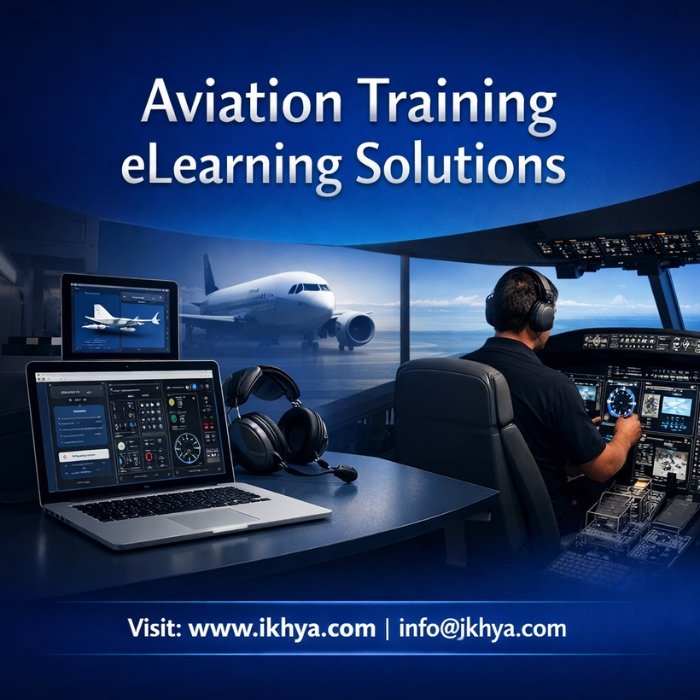



Aviation Training eLearning Solutions
Aviation organizations operate in one of the most safety-critical industries in the world. Pilots, aircraft engineers, cabin crew, and airport operations teams must receive continuous training to maintain compliance and operational excellence. Traditional classroom training alone cannot meet the growing demand for scalable aviation learning.
IKHYA – eLearning Solutions Company develops advanced aviation training eLearning programs using simulation learning, scenario-based training, and interactive digital modules. Our solutions help airlines, aviation academies, and MRO organizations deliver consistent, compliance-ready training globally.
Request a proposal or schedule a consultation today at info@ikhya.com
Get a Free eLearning Consultation / Proposal
Planning aviation training programs requires deep understanding of regulatory standards, operational workflows, and safety requirements. Our experts help organizations design scalable aviation training strategies that combine instructional design expertise with modern learning technologies.
Whether your organization needs pilot training simulations, aircraft maintenance learning modules, aviation compliance courses, or airport operations training, IKHYA provides tailored solutions aligned with global aviation regulations.
What We Discuss During the Consultation
Our aviation learning specialists evaluate your training needs and recommend the right learning strategy.
Topics covered include:
- Aviation training program objectives
- Target learner groups (pilots, engineers, cabin crew, ground staff)
- Training delivery methods
- Simulation requirements
- LMS compatibility
- Compliance requirements (FAA, ICAO, EASA)
- Project scope and timeline
What You Receive
After the consultation, your team receives a structured proposal that includes:
- Recommended aviation training approach
- Instructional design strategy
- Estimated development timeline
- Pricing estimate based on project scope
- Technology and tool recommendations
This helps procurement teams and learning leaders make informed decisions before starting development.
Ideal Use Cases for Aviation eLearning
Organizations typically request aviation training solutions for:
- Aircraft maintenance training
- Pilot procedural training
- Aviation safety compliance training
- Airport operations training
- Cabin crew service training
- Ground crew operational training
- Airline onboarding programs
Our aviation learning solutions support both initial training programs and recurrent certification training.
Start Your Aviation Training Project
If your organization is planning aviation training initiatives, our team can help design the right learning strategy.
Request a proposal or submit your RFP
IKHYA – eLearning Solutions Company
Email: info@ikhya.com
What is Aviation Training eLearning?
Aviation training eLearning refers to digital learning programs designed to train aviation professionals through interactive online courses, simulations, and scenario-based learning modules. These programs are used by airlines, aviation academies, aircraft manufacturers, Maintenance Repair and Overhaul (MRO) organizations, and airport operators to train employees efficiently while maintaining strict safety and compliance standards.
Unlike traditional classroom training, aviation eLearning allows organizations to deliver consistent, scalable, and globally accessible training across multiple locations and learner groups.
Modern aviation eLearning solutions combine:
- simulation learning
- scenario-based training
- interactive system walkthroughs
- video-based instruction
- mobile learning modules
These training formats help aviation professionals practice decision-making, operational procedures, and safety protocols in a controlled learning environment.
Types of Aviation eLearning Programs
Aviation organizations deploy different types of digital training depending on operational roles and compliance requirements.
Pilot Training eLearning
Pilots require continuous training on aircraft systems, flight procedures, and emergency response scenarios. eLearning modules help reinforce knowledge before simulator sessions or recurrent training.
Typical pilot training topics include:
- aircraft systems overview
- cockpit procedures
- emergency response training
- flight operations protocols
- safety management systems
Interactive simulations allow pilots to explore cockpit controls and decision-making scenarios.
Aircraft Maintenance Training
Aircraft maintenance engineers must understand complex aircraft systems and regulatory standards. eLearning helps train technicians on maintenance procedures and equipment handling.
Maintenance training often includes:
- aircraft component systems
- troubleshooting procedures
- maintenance safety protocols
- inspection workflows
- aviation regulatory compliance
Simulation-based learning helps technicians practice procedures without risking equipment damage.
Aviation Safety and Compliance Training
Safety is the foundation of aviation operations. Airlines and aviation authorities must ensure all staff follow strict regulatory standards.
Compliance training programs typically cover:
- aviation safety management systems
- regulatory compliance requirements
- incident reporting procedures
- risk management protocols
- operational safety guidelines
These courses ensure organizations meet standards defined by FAA, ICAO, and EASA.
Airport Operations Training
Airport operations involve multiple teams including ground staff, baggage handlers, and security personnel. Digital training programs help ensure operational efficiency across large airport ecosystems.
Common training topics include:
- ground handling procedures
- airport safety operations
- passenger service training
- baggage handling protocols
- runway and ramp safety
eLearning helps airports train thousands of staff members consistently across different terminals and locations.
Learning Methodologies Used in Aviation eLearning
Effective aviation training programs rely on proven instructional design frameworks and learning methodologies.
These include:
- simulation learning to replicate real-world aviation scenarios
- experiential learning to help learners practice operational tasks
- scenario-based training to improve decision-making under pressure
- microlearning for quick refresher training modules
Instructional design teams also use structured frameworks such as:
- ADDIE for systematic course development
- Bloom’s Taxonomy to design progressive learning objectives
- Kirkpatrick Model to evaluate training effectiveness
These methodologies ensure aviation training programs improve knowledge retention, operational performance, and safety compliance.
Technologies Used in Aviation eLearning
Modern aviation training programs leverage advanced learning technologies to deliver immersive learning experiences.
Common technologies include:
- Learning Management Systems (LMS) for course delivery and tracking
- Learning Experience Platforms (LXP) for personalized learning paths
- mobile learning platforms for on-the-go training
- digital adoption platforms for software training
Courses are typically built using tools such as:
- Articulate Storyline
- Adobe Captivate
- Lectora Inspire
- iSpring Suite
Training programs are delivered using industry standards including:
- SCORM
- xAPI
- WCAG accessibility compliance
These technologies allow aviation organizations to track training progress, measure competency development, and maintain compliance documentation.
Why Aviation Organizations Need Aviation Training eLearning
The aviation industry operates in an environment where safety, regulatory compliance, and operational efficiency are critical. Training thousands of aviation professionals across multiple locations is a complex challenge.
Traditional instructor-led training alone is no longer sufficient to meet modern aviation learning needs.
Aviation eLearning helps organizations solve several key training challenges.
Scaling Training Across Global Aviation Operations
Large airlines and aviation organizations operate across multiple countries and airports. Delivering consistent training to employees worldwide can be difficult using classroom training alone.
For example:
- USA airlines train thousands of pilots, engineers, and cabin crew each year across multiple training centers.
- UK aviation academies provide certification training to international aviation professionals.
- UAE aviation organizations support rapidly expanding airline operations and airport infrastructure.
- Australian aviation training providers train regional airline personnel across geographically dispersed locations.
eLearning allows organizations to deliver standardized training programs globally.
Reducing Training Costs
Traditional aviation training programs require:
- instructor travel
- training facilities
- printed materials
- scheduling coordination
Digital learning reduces these costs while maintaining high training quality.
Organizations can reuse training modules across multiple learner groups and locations.
Improving Aviation Safety
Human error remains one of the leading causes of aviation incidents. Training programs that use simulations and scenario-based learning help professionals practice decision-making before encountering real-world situations.
Interactive training modules allow learners to experience:
- emergency procedures
- system failures
- operational decision scenarios
This helps improve situational awareness and response capabilities.
Supporting Continuous Certification and Compliance
Aviation professionals must complete recurring training and certification programs to remain compliant with regulatory standards.
Digital training platforms allow organizations to:
- track learner progress
- automate certification updates
- monitor compliance records
- generate audit-ready training reports
This simplifies compliance management for aviation authorities and airline operators.
Accelerating Workforce Onboarding
Airlines, airports, and MRO organizations often hire large numbers of staff during expansion phases.
eLearning enables faster onboarding by providing structured digital training programs for:
- new pilots
- cabin crew
- maintenance engineers
- airport operations staff
New employees can begin learning immediately without waiting for scheduled classroom sessions.
Benefits of Aviation Training eLearning
Aviation organizations must ensure employees are trained to operate in environments where precision, safety, and regulatory compliance are critical. Digital aviation training programs allow airlines, aviation academies, and airport operators to deliver consistent learning experiences across global teams.
Aviation eLearning solutions combine simulation learning, microlearning, scenario-based training, and experiential learning to improve both knowledge retention and operational performance.
Improved Safety and Risk Reduction
Safety is the highest priority in aviation. Training programs must prepare employees to respond effectively to operational challenges and emergency scenarios.
Interactive aviation training modules help learners practice:
- emergency response procedures
- aircraft system troubleshooting
- cockpit decision-making scenarios
- maintenance safety protocols
- ground handling safety procedures
Simulation-based training allows aviation professionals to experience complex situations in a risk-free learning environment. This improves preparedness before real-world operations.
Consistent Global Training Standards
Airlines and aviation organizations operate across multiple countries and training centers. Maintaining consistent training quality across global operations is a major challenge.
Digital aviation training programs ensure that:
- pilots receive standardized system training
- maintenance engineers follow consistent procedures
- airport staff learn the same operational protocols
eLearning allows organizations to deliver the same course content to thousands of employees worldwide.
Faster Training Deployment
Traditional aviation training programs often require scheduling instructors, booking classrooms, and coordinating learners from different locations.
eLearning allows organizations to deploy training programs much faster.
For example:
- new aircraft systems training can be rolled out globally within weeks
- safety updates can be delivered instantly across multiple airports
- procedural changes can be communicated through microlearning modules
This ensures aviation professionals stay updated with the latest operational requirements.
Reduced Training Costs
Instructor-led aviation training involves significant operational expenses such as:
- travel costs
- instructor fees
- classroom infrastructure
- printed training materials
Digital aviation training reduces these costs while allowing organizations to reuse learning modules across multiple training cycles.
Once developed, training courses can be used repeatedly for:
- onboarding new employees
- refresher training
- compliance certification programs
This makes aviation eLearning a cost-effective long-term training strategy.
Improved Knowledge Retention
Research shows that learners retain information more effectively when they engage with interactive and scenario-based learning experiences.
Aviation training programs use several instructional design techniques to improve retention.
Examples include:
- simulation learning to replicate real aviation scenarios
- scenario-based training for operational decision making
- microlearning modules for quick refresher training
- interactive quizzes and assessments
Instructional designers also use frameworks such as Bloom’s Taxonomy to structure learning objectives and improve cognitive skill development.
Better Training Analytics and Reporting
Modern aviation training programs integrate with Learning Management Systems (LMS) and Learning Experience Platforms (LXP).
This allows organizations to track:
- course completion rates
- assessment performance
- certification status
- learner engagement metrics
Standards such as SCORM and xAPI allow organizations to collect detailed learning analytics and evaluate training effectiveness.
Training leaders can use this data to improve course design and measure learning impact using the Kirkpatrick Model.
Scalable Training for Growing Aviation Workforces
The aviation industry continues to grow, especially in regions such as the Middle East and Asia-Pacific. Airlines and airports frequently expand operations and hire large numbers of employees.
eLearning platforms allow organizations to train thousands of learners simultaneously without increasing instructor resources.
Training programs can be delivered through:
- desktop learning platforms
- mobile learning applications
- blended learning programs combining classroom and digital learning
This scalability makes eLearning essential for modern aviation workforce development.
Real Enterprise Aviation Training Project Examples
Enterprise aviation training projects often involve complex learning requirements. These projects may include system simulations, safety training programs, and large-scale workforce onboarding initiatives.
Below are examples of typical aviation training projects delivered by digital learning providers.
Example: Aircraft Maintenance Simulation Training
Client: Global Aircraft Maintenance Organization (MRO)
Training Objective:
Train maintenance engineers on aircraft hydraulic and electrical systems.
Project Scope
- 25 interactive simulation modules
- 5–7 minutes per module
- scenario-based troubleshooting exercises
Training Format
- simulation learning
- interactive system walkthroughs
- knowledge assessments
Timeline
10–12 weeks
Estimated Cost
$45,000 – $85,000
Example: Pilot Cockpit Procedures Training
Client: International Airline
Training Objective:
Provide pilots with digital training modules covering cockpit procedures and system operations.
Project Scope
- 18 cockpit simulation modules
- emergency procedure scenarios
- aircraft systems training
Training Format
- interactive cockpit simulations
- scenario-based decision training
- microlearning refresher modules
Timeline
8–10 weeks
Estimated Cost
$35,000 – $70,000
Example: Airport Ground Crew Training
Client: International Airport Authority
Training Objective:
Train ground handling teams on safety procedures and operational workflows.
Project Scope
- 20 operational training modules
- interactive safety scenarios
- equipment handling simulations
Training Format
- video-based instruction
- interactive simulations
- mobile learning modules
Timeline
6–8 weeks
Estimated Cost
$25,000 – $50,000
Example: Aviation Safety Compliance Training
Client: Regional Airline
Training Objective:
Deliver regulatory compliance training aligned with aviation safety management systems.
Project Scope
- 15 compliance training modules
- interactive case studies
- knowledge assessments
Training Format
- scenario-based learning
- interactive policy training
- compliance certification assessments
Timeline
5–7 weeks
Estimated Cost
$20,000 – $40,000
Pricing and Development Timeline for Aviation Training eLearning
The cost of aviation eLearning development depends on factors such as:
- complexity of simulations
- number of modules
- instructional design requirements
- multimedia development
- integration with LMS platforms
Below are typical pricing estimates for aviation training development projects.
Estimated Development Cost per Module
| Training Type | Estimated Cost |
|---|---|
| Basic Aviation eLearning Module | $1,000 – $2,500 |
| Interactive Scenario-Based Training | $2,500 – $6,000 |
| Advanced Aviation Simulation | $6,000 – $15,000 |
Typical Development Timelines
| Project Scope | Estimated Timeline |
|---|---|
| 1 training module | 2–3 weeks |
| 10 modules | 6–8 weeks |
| 30 modules | 12–16 weeks |
These estimates may vary depending on:
- simulation complexity
- number of stakeholders involved
- review cycles
- localization requirements
IKHYA Process for Aviation Training eLearning Development
Developing aviation training programs requires a structured approach that ensures accuracy, regulatory compliance, and effective learning outcomes. IKHYA follows a proven development framework based on ADDIE, supported by modern instructional design principles such as Bloom’s Taxonomy and the Kirkpatrick Model.
This process ensures aviation training programs are engaging, scalable, and aligned with operational requirements.
Analysis
The first stage focuses on understanding the aviation organization’s training objectives, operational environment, and regulatory requirements.
Key activities include:
- training needs analysis
- learner audience analysis (pilots, engineers, ground crew)
- aviation compliance requirements review
- LMS compatibility assessment
- identification of training scenarios and simulations
During this phase, we collaborate with subject matter experts such as:
- aviation instructors
- aircraft maintenance engineers
- flight operations specialists
- safety compliance officers
The goal is to identify knowledge gaps and operational training requirements.
Instructional Design
After the analysis stage, our instructional designers develop a structured learning blueprint.
Using Bloom’s Taxonomy, learning objectives are organized to help learners move from foundational knowledge to advanced decision-making skills.
Instructional design deliverables include:
- course structure and module breakdown
- scenario-based learning design
- simulation storyboards
- interactive learning activities
- assessment strategies
Aviation training programs often include:
- aircraft system simulations
- emergency response scenarios
- operational workflow training
- compliance knowledge checks
Storyboards and prototypes are shared with stakeholders for review before development begins.
Development
In this phase, the training content is converted into interactive digital learning modules.
Our development team creates engaging aviation training experiences using:
- interactive simulations
- video-based demonstrations
- animated system walkthroughs
- branching scenarios
- interactive assessments
Courses are built using industry-leading authoring tools including:
- Articulate Storyline
- Adobe Captivate
- Lectora Inspire
- iSpring Suite
Training modules are packaged according to SCORM or xAPI standards to ensure compatibility with enterprise learning platforms.
Quality Assurance
Aviation training programs require rigorous testing to ensure accuracy and reliability.
Our quality assurance process includes:
- content accuracy validation
- functional testing of simulations
- compatibility testing across devices
- accessibility validation using WCAG standards
- LMS integration testing
Multiple review cycles ensure the training meets both operational standards and regulatory expectations.
Deployment
Once the course passes quality checks, it is deployed to the organization’s learning platform.
Deployment activities include:
- LMS integration and configuration
- user enrollment setup
- reporting and analytics configuration
- training launch support
Training performance can be evaluated using the Kirkpatrick Model, which measures:
- learner satisfaction
- knowledge improvement
- behavior change
- operational performance impact
This structured deployment ensures aviation training programs deliver measurable learning outcomes.
Technologies and Tools Used
Modern aviation training programs require robust learning technologies that support interactive learning experiences and large-scale training delivery.
IKHYA uses a combination of advanced authoring tools, learning platforms, and industry standards to build scalable aviation training solutions.
Authoring Tools
Our development team uses industry-leading authoring platforms to create interactive aviation training modules.
Common tools include:
- Articulate Storyline for interactive simulations and branching scenarios
- Adobe Captivate for system demonstrations and scenario-based learning
- Lectora Inspire for complex enterprise training programs
- iSpring Suite for rapid course development and PowerPoint-based training
These tools allow us to develop highly interactive aviation training modules with multimedia elements.
Learning Technologies
Aviation organizations often integrate training programs with enterprise learning systems.
Supported platforms include:
- Learning Management Systems (LMS)
- Learning Experience Platforms (LXP)
- mobile learning platforms
- digital adoption platforms
These technologies allow organizations to deliver training programs across global teams and track learner progress efficiently.
eLearning Standards
To ensure interoperability and long-term compatibility, aviation training courses follow recognized industry standards.
These include:
- SCORM for LMS compatibility
- xAPI for advanced learning analytics
- WCAG accessibility guidelines to support inclusive learning
Compliance with these standards ensures aviation training programs can be deployed across different learning platforms.
Industries We Serve
Although this page focuses on aviation training, IKHYA supports digital learning initiatives across multiple industries where safety, compliance, and operational performance are critical.
Healthcare
Healthcare organizations use eLearning for:
- medical device training
- regulatory compliance training
- patient safety programs
- hospital staff onboarding
Manufacturing
Manufacturing companies use digital training for:
- equipment operation training
- workplace safety programs
- quality control training
- process improvement training
Financial Services
Financial institutions implement eLearning programs for:
- regulatory compliance training
- cybersecurity awareness
- risk management education
- customer service training
Construction
Construction companies use digital learning to train employees on:
- site safety procedures
- equipment handling
- regulatory compliance
- project management processes
Oil and Gas
Oil and gas organizations require training for:
- hazardous environment safety
- operational procedures
- compliance standards
- equipment operation
Aviation
Aviation training programs support:
- pilot training programs
- aircraft maintenance training
- cabin crew training
- airport operations training
- aviation safety compliance training
Digital learning helps aviation organizations deliver consistent training across global operations.
The Psychology of Simulation-Based Aviation Training
Aviation training often involves complex decision-making in high-risk environments. Traditional lecture-based learning is not sufficient to prepare aviation professionals for real-world operational scenarios.
Simulation-based learning allows learners to experience realistic operational situations while practicing critical decision-making skills.
Why Simulations Improve Learning Retention
Research in learning psychology shows that people retain information better when they actively participate in learning experiences.
Simulation-based training engages learners through:
- interactive problem-solving
- decision-based scenarios
- realistic operational environments
This approach activates cognitive processes that improve knowledge retention and skill development.
Building Operational Confidence
Pilots, engineers, and airport personnel must make fast decisions during operational events.
Simulation training allows learners to practice:
- emergency procedures
- aircraft system troubleshooting
- operational workflow management
- risk assessment scenarios
Repeated practice builds confidence and situational awareness.
Safe Practice Environment
Aviation operations involve expensive equipment and high safety risks. Training mistakes during real operations can lead to severe consequences.
Simulation-based training provides a safe environment where learners can:
- make decisions
- explore system interactions
- understand operational consequences
This allows employees to learn from mistakes without risking real-world safety.
Improving Skill Transfer
Training is only valuable when learners can apply their knowledge in real operational environments.
Simulation training improves skill transfer from training to real-world tasks.
Learners experience realistic scenarios that mirror their daily responsibilities, which helps them apply training more effectively during actual operations.
Why Choose IKHYA – eLearning Solutions Company
Selecting the right aviation training partner is critical for organizations that require scalable, high-quality learning solutions.
IKHYA combines instructional design expertise with deep knowledge of enterprise training technologies.
Proven Global Experience
Our team has delivered digital learning solutions for organizations across multiple industries and regions.
Key highlights include:
- 300+ global clients served
- 1000+ digital learning courses delivered
- 25+ years of combined industry experience
- 20+ industries supported
Enterprise-Grade Learning Solutions
IKHYA develops aviation training programs designed for large organizations with complex operational requirements.
Our solutions support:
- global training deployment
- LMS and LXP integration
- scalable training delivery
- multilingual course localization
Instructional Design Expertise
Our instructional designers use proven frameworks including:
- ADDIE methodology
- Bloom’s Taxonomy learning structure
- Kirkpatrick Model training evaluation
These frameworks ensure aviation training programs achieve measurable learning outcomes.
Simulation and Scenario Expertise
Aviation training often requires interactive simulations to replicate real-world operational scenarios.
IKHYA specializes in developing:
- aircraft system simulations
- operational workflow simulations
- safety training scenarios
- decision-based learning modules
These experiences improve engagement and knowledge retention.
Related eLearning Services
Organizations implementing aviation training programs often require additional digital learning services to support broader corporate learning initiatives.
Related services offered by IKHYA – eLearning Solutions Company include:
- Custom eLearning Development
- Rapid eLearning Development
- Instructional Design Services
- Microlearning Development
- LMS Integration Services
- PPT to eLearning Conversion
- ILT to eLearning Conversion
These services allow organizations to build comprehensive digital learning ecosystems across multiple departments and training programs.
Frequently Asked Questions
Aviation training eLearning solutions are digital learning programs designed to train aviation professionals through interactive courses, simulations, and scenario-based learning modules. These solutions help airlines, aviation academies, airports, and aircraft maintenance organizations deliver scalable training programs to employees across multiple locations.
Aviation eLearning typically includes training for:
- pilot procedures and cockpit systems
- aircraft maintenance operations
- aviation safety and compliance
- airport ground operations
- cabin crew service and safety training
Courses are usually delivered through an LMS (Learning Management System) and built using industry standards such as SCORM or xAPI.
A wide range of aviation organizations use digital training solutions, including:
- commercial airlines
- aviation training academies
- aircraft manufacturers
- airport authorities
- aviation maintenance and MRO companies
- aviation regulatory organizations
These organizations use eLearning to train pilots, aircraft engineers, cabin crew, air traffic personnel, and airport operations staff.
Aviation eLearning solutions can support many types of training programs.
Common examples include:
- pilot training modules
- aircraft systems training
- aviation safety and compliance training
- airport operations training
- cabin crew service training
- aircraft maintenance procedures training
- aviation cybersecurity awareness training
- aviation emergency response training
These programs can include interactive simulations, video demonstrations, scenario-based learning, and assessments.
Simulation-based aviation training replicates real-world operational scenarios through interactive digital environments. Learners are presented with situations where they must make decisions and perform procedures similar to real aviation operations.
Examples include:
- cockpit procedure simulations
- aircraft system troubleshooting scenarios
- emergency response simulations
- airport operational decision-making exercises
Simulation learning helps aviation professionals practice skills in a safe and controlled learning environment.
Aviation eLearning offers several benefits compared to traditional classroom training.
Key advantages include:
- consistent training across global teams
- reduced travel and instructor costs
- scalable learning for large aviation workforces
- faster training deployment
- improved knowledge retention through interactive learning
These benefits make digital learning a valuable training approach for modern aviation organizations.
Yes. Aviation training courses can integrate with most enterprise Learning Management Systems (LMS) and Learning Experience Platforms (LXP).
Courses are usually developed according to industry standards such as:
- SCORM
- xAPI
These standards ensure that training programs can track learner progress, certification completion, and compliance records.
Development timelines depend on the complexity of the course.
Typical timelines include:
- single module: 2–3 weeks
- small training program (10 modules): 6–8 weeks
- large aviation training projects (30+ modules): 12–16 weeks
Simulation-heavy courses may require additional development time.
Several factors determine the cost of aviation training development.
These include:
- number of training modules
- level of interactivity and simulations
- multimedia content requirements
- subject matter expert involvement
- LMS integration needs
Basic courses typically cost $1,000–$2,500 per module, while advanced simulation-based training modules can range from $6,000–$15,000 per module.
Yes. Interactive cockpit simulations are commonly used in pilot training programs.
These simulations allow pilots to:
- explore cockpit instruments
- practice system procedures
- respond to emergency scenarios
- understand aircraft operational workflows
Such simulations enhance learning engagement and improve operational readiness.
Instructional design ensures that aviation training programs follow structured learning methodologies.
Common frameworks used include:
- ADDIE modelfor systematic course development
- Bloom’s Taxonomyfor structured learning objectives
- Kirkpatrick Modelfor training evaluation
These frameworks help ensure training programs achieve measurable learning outcomes.
Yes. Aviation training programs can be optimized for mobile learning, allowing learners to access training through smartphones and tablets.
Mobile learning is especially useful for:
- airport ground staff
- aircraft maintenance teams
- field technicians
- remote aviation operations staff
This flexibility helps organizations deliver training anytime and anywhere.
Aviation organizations must comply with regulations defined by authorities such as:
- FAA (Federal Aviation Administration)
- ICAO (International Civil Aviation Organization)
- EASA (European Union Aviation Safety Agency)
eLearning platforms allow organizations to track training completion, maintain certification records, and generate compliance reports for regulatory audits.
Yes. One of the key advantages of digital training is the ability to update course content quickly.
If operational procedures or regulations change, organizations can update:
- safety guidelines
- compliance modules
- aircraft system procedures
Updated courses can then be deployed instantly to all learners.
Microlearning involves delivering short, focused training modules that cover specific topics.
In aviation training, microlearning can be used for:
- refresher training
- safety reminders
- operational updates
- quick system training modules
These short modules help learners quickly review critical procedures.
Yes. Aviation organizations often operate globally, requiring training programs to support multiple languages.
Courses can be localized to support:
- language translation
- regional aviation terminology
- localized regulatory guidelines
This ensures employees across different countries receive effective training.
Aviation eLearning courses are built using modern authoring tools such as:
- Articulate Storyline
- Adobe Captivate
- Lectora Inspire
- iSpring Suite
These tools allow developers to create interactive simulations, animations, and multimedia learning experiences.
Training effectiveness can be measured using the Kirkpatrick Model, which evaluates:
- learner satisfaction
- knowledge improvement
- behavior change
- operational performance results
Organizations can analyze training analytics through LMS reports and assessments.
Yes. Many aviation organizations implement blended learning programs that combine digital learning with instructor-led sessions.
For example:
- pilots complete theoretical training online
- simulator sessions are conducted in physical training facilities
This blended approach improves learning efficiency.
Aviation eLearning programs are highly scalable.
Once developed, courses can be delivered to:
- thousands of employees
- multiple airports
- international airline teams
- global aviation training academies
This scalability makes digital learning ideal for large aviation organizations.
Organizations typically begin by consulting with an experienced eLearning development partner.
The process usually includes:
- identifying training goals
- analyzing learner groups
- defining course scope
- estimating development timelines and costs
- developing course prototypes
Organizations can contact IKHYA – eLearning Solutions Company to discuss training requirements and receive a detailed project proposal.
Email: info@ikhya.com
Start Your Aviation Training eLearning Project Today
Aviation organizations must continuously train pilots, engineers, cabin crew, and airport staff to maintain the highest standards of safety, compliance, and operational performance. Scalable digital training solutions make it possible to deliver consistent learning experiences across global aviation teams.
IKHYA – eLearning Solutions Company specializes in designing aviation training programs that combine simulation learning, scenario-based training, and advanced instructional design to help organizations build highly skilled aviation workforces.
Whether you need pilot training simulations, aircraft maintenance training modules, aviation safety compliance programs, or airport operations training, our experts can design a solution tailored to your operational requirements.
Let’s Discuss Your Aviation Training Needs
Our team can help you:
- design aviation training strategies
- develop simulation-based learning modules
- convert existing training materials into interactive eLearning
- integrate training with your LMS or LXP platform
- scale training programs across global aviation teams
Request a Consultation or Submit Your RFP
If your organization is planning an aviation training initiative, we can provide a detailed proposal, estimated timeline, and project cost range based on your requirements.
Contact IKHYA – eLearning Solutions Company
Email: info@ikhya.com
- Request a Proposal
- Schedule a Consultation
- Submit Your RFP
- Get a Project Estimate
Build safer aviation operations and stronger training programs with IKHYA’s Aviation Training eLearning Solutions.
At IKHYA – eLearning Solutions Company, we design impactful, compliance-driven, and performance-focused digital learning solutions tailored to your business goals.
🎯 Custom eLearning Course Development
⚡ Rapid eLearning & PPT Conversion
📊 Workplace Compliance Training
🌍 Localization & LMS-Ready Modules




Reviews
There are no reviews yet.