
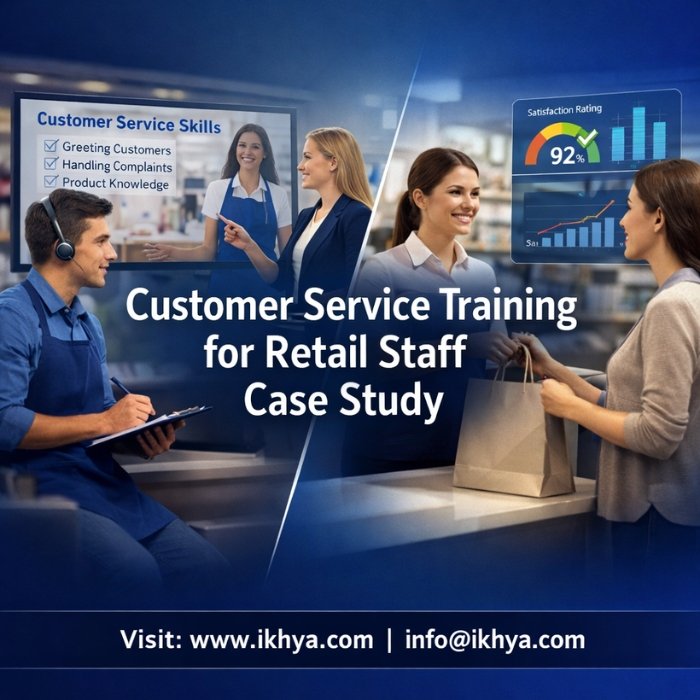



Customer Service Training for Retail Staff Case Study
Retail organizations depend heavily on frontline employees to deliver consistent customer experiences, yet many struggle to standardize service quality across stores. A large retail company faced declining customer satisfaction due to inconsistent service interactions and insufficient staff training.
IKHYA – eLearning Solutions Company designed a scalable digital training program using scenario-based learning and microlearning modules to improve retail customer service skills, boost engagement, and standardize service practices across locations.
Start your training transformation with IKHYA.
Client Overview
The client was a large omnichannel retail organization specializing in fashion and lifestyle products, operating across multiple regions with a diverse workforce responsible for delivering in-store customer experiences.
Industry: Retail (Fashion & Lifestyle)
Workforce Size: 6,500+ employees
Retail Locations: 220+ stores across North America and Asia-Pacific
Employee Roles:
- Sales associates
- Customer service representatives
- Store supervisors
- Store managers
Organizational Structure
The retailer operated a distributed store network that included:
- flagship urban retail stores
- shopping mall outlets
- outlet stores
- seasonal pop-up locations
Each store handled high daily customer footfall, particularly during peak retail periods such as:
- holiday shopping seasons
- promotional campaigns
- new product launches.
Workforce Demographics
The frontline workforce consisted largely of:
- early-career professionals
- part-time sales associates
- seasonal employees
- recently onboarded staff.
This workforce structure created frequent onboarding cycles, requiring the company to continuously train new employees on:
- customer service standards
- brand values
- product knowledge
- sales techniques
- complaint resolution procedures.
Geographic Training Complexity
Because the retailer operated across multiple regions, training delivery faced several logistical challenges:
- inconsistent training delivery across store locations
- varying store management practices
- language and cultural differences across markets
- difficulty coordinating in-person training sessions.
Store managers were responsible for delivering most employee training, but their limited time and inconsistent instructional skills led to varying training quality across locations.
Existing Training Environment
Before partnering with IKHYA – eLearning Solutions Company, the company relied primarily on:
- classroom-based onboarding sessions
- printed training manuals
- product catalog briefings
- informal peer mentoring.
These traditional training approaches resulted in several operational problems:
- inconsistent service standards across stores
- low employee engagement during training
- limited opportunities to practice customer interaction skills
- difficulty tracking training completion and knowledge retention.
The retailer’s leadership recognized that improving customer service consistency across all store locations required a scalable digital training strategy capable of reaching thousands of frontline employees efficiently.
Training Challenges
Despite having strong brand recognition and a large retail footprint, the client struggled to maintain consistent, high-quality customer service experiences across its store network. The company’s traditional training methods were unable to keep pace with workforce changes, evolving customer expectations, and the increasing complexity of retail operations.
Several operational and workforce-related challenges were identified during the training needs analysis phase.
Inconsistent Customer Service Across Store Locations
One of the most significant issues was the variation in service quality between different stores.
While flagship stores in major cities often had experienced staff and better-trained supervisors, smaller stores and newly opened locations frequently lacked structured training programs.
Customers reported inconsistent experiences such as:
- receiving detailed product recommendations in one store but minimal assistance in another
- different responses to product return requests depending on the employee handling the situation
- varying levels of greeting and engagement from sales associates.
This inconsistency weakened the brand’s reputation for delivering a premium in-store experience.
High Employee Turnover and Continuous Onboarding Needs
Retail workforce turnover created constant training pressure for store managers.
New employees were frequently hired during:
- seasonal sales periods
- promotional campaigns
- new store openings.
However, onboarding training was often rushed due to operational demands. Many new hires began interacting with customers before completing full training, which resulted in:
- incorrect product information being shared with customers
- difficulty handling complaints or returns
- missed sales opportunities.
The organization needed a training system that could rapidly onboard new employees without disrupting store operations.
Limited Training Time for Retail Staff
Retail employees spend most of their workday performing operational duties such as:
- assisting customers
- managing inventory
- processing payments
- maintaining store displays.
Because of these responsibilities, store managers found it difficult to allocate time for lengthy classroom training sessions.
Traditional training workshops lasting several hours often resulted in:
- low attendance
- reduced engagement
- information overload for learners.
Employees needed short, focused learning modules that could be completed during brief breaks or shift transitions.
Lack of Realistic Customer Interaction Training
Most existing training materials focused on theoretical information such as:
- brand values
- store policies
- product specifications.
However, employees had limited opportunities to practice handling real-world customer situations.
Common service scenarios that employees struggled with included:
- responding to dissatisfied customers requesting refunds
- assisting customers unsure about product selection
- recommending additional products during checkout
- managing high-pressure situations during peak shopping hours.
Without practice-based training, employees lacked the confidence to manage these interactions effectively.
Poor Product Knowledge Among New Employees
Retail products change frequently due to:
- seasonal collections
- promotional campaigns
- new product launches.
Traditional training manuals quickly became outdated, leaving employees with incomplete knowledge about:
- product features
- usage benefits
- product comparisons.
Customers increasingly expect sales associates to act as trusted advisors, especially in sectors like fashion, electronics, and lifestyle retail. When employees lacked product knowledge, customers often turned to online research instead of relying on store staff.
Missed Sales Opportunities
Frontline retail employees play a crucial role in increasing revenue through:
- upselling higher-value products
- cross-selling complementary items
- recommending promotions.
However, many employees were uncomfortable initiating these conversations with customers.
Without structured training in consultative selling techniques, employees often limited interactions to answering basic questions rather than proactively guiding purchasing decisions.
Lack of Training Performance Data
Another major challenge was the absence of measurable training analytics.
The company could not effectively track:
- which employees had completed training
- how well employees understood customer service principles
- whether training improved employee performance.
Without this data, leadership had difficulty evaluating the return on investment (ROI) of training programs.
Difficulty Scaling Training Across Store Networks
With over 200 retail locations and thousands of employees, delivering consistent training across the organization was extremely difficult.
The company required a solution capable of:
- delivering standardized training content globally
- supporting thousands of learners simultaneously
- allowing employees to access training on-demand
- providing centralized training management.
Summary of Core Training Challenges
The training needs analysis revealed several core problems:
- Inconsistent customer service standards across store locations
- High employee turnover requiring rapid onboarding training
- Limited time available for employee training
- Lack of realistic customer interaction practice
- Inadequate product knowledge among frontline staff
- Missed sales opportunities due to poor selling skills
- Lack of training analytics and performance measurement
- Difficulty scaling training across a distributed retail workforce
These challenges highlighted the need for a modern digital learning ecosystem capable of transforming frontline retail training into an engaging, scalable, and measurable learning experience.
Training Objectives
Following the training needs analysis, the client and IKHYA – eLearning Solutions Company defined a set of clear, measurable training objectives aligned with both customer experience improvement and business performance outcomes.
The objective was not simply to deliver training content, but to transform frontline employee behavior on the sales floor and standardize service quality across all retail locations.
Standardize Customer Service Experience Across Stores
One of the primary objectives was to create consistent service standards across all retail locations.
Because the retailer operated hundreds of stores across different regions, customers often experienced different service quality depending on where they shopped.
The training program aimed to ensure that every employee understood and applied the company’s customer service framework, including:
- professional customer greetings
- active listening techniques
- personalized product recommendations
- service recovery procedures.
Target outcome
- Standardized service protocols across all stores
- Improved brand consistency in customer interactions.
Improve Customer Satisfaction and In-Store Experience
Customer experience is a major competitive advantage in retail. The organization wanted to enhance the overall shopping experience delivered by store associates.
Training focused on improving employees’ ability to:
- understand customer needs quickly
- provide helpful product recommendations
- resolve complaints professionally
- create positive emotional interactions with customers.
Target outcome
Improve customer satisfaction scores by 25–30% within 12 months.
Increase Sales Conversion and Average Transaction Value
Frontline retail employees play a crucial role in influencing purchasing decisions.
Many employees lacked the skills required to:
- confidently recommend products
- identify upselling opportunities
- introduce complementary items.
The training program aimed to develop consultative selling skills, enabling employees to guide customers toward better purchasing decisions.
Target outcome
- Increase sales conversion rates by 15–20%
- Improve average transaction value through cross-selling and upselling techniques.
Accelerate Employee Onboarding
Due to high employee turnover, the company needed a faster onboarding process that could prepare new hires quickly without requiring long classroom sessions.
The new training program aimed to reduce the time required for new employees to become customer-ready.
Training modules were designed to help new employees quickly learn:
- brand values
- service standards
- product basics
- customer communication techniques.
Target outcome
Reduce onboarding time by 40–50%.
Improve Employee Confidence in Customer Interactions
Many employees felt uncertain when handling challenging customer situations such as:
- complaints about defective products
- requests for refunds or exchanges
- dissatisfied customers demanding immediate assistance.
Through interactive scenario-based training, the program aimed to help employees practice real-world situations before encountering them on the sales floor.
Target outcome
Improve employee confidence in handling difficult customer situations.
Strengthen Product Knowledge
Retail employees often struggle to keep up with frequently changing product catalogs.
The training program aimed to create short, focused product knowledge modules that could be easily updated when new products were introduced.
Employees would learn:
- key product features
- product comparisons
- use-case recommendations
- customer benefits.
Target outcome
Improve product knowledge assessment scores by 35–40%.
Increase Training Completion Rates
Previous classroom-based programs had low completion rates because employees could not always attend scheduled sessions.
By introducing mobile-accessible microlearning modules, the program aimed to significantly increase training participation.
Target outcome
Achieve 90%+ training completion rates across the workforce.
Enable Data-Driven Training Measurement
Retail leadership needed visibility into how training programs impacted employee performance.
The new learning system was designed to provide detailed analytics on:
- learner progress
- assessment results
- training completion rates
- engagement metrics.
These insights would allow leadership to measure training effectiveness and ROI.
Target outcome
Implement training analytics dashboards for real-time performance tracking.
Align Training with Business Growth Strategy
The retailer planned to expand into additional regions and open new store locations over the next few years.
The training solution needed to support scalable workforce development, allowing thousands of employees to be trained consistently across multiple locations.
Target outcome
Establish a scalable digital training ecosystem capable of supporting future retail expansion.
Summary of Training Objectives
The retail training initiative focused on achieving measurable improvements across both employee performance and business outcomes.
Key objectives included:
- Standardize customer service practices across stores
- Improve customer satisfaction and in-store experience
- Increase sales conversion and average transaction value
- Accelerate onboarding for new retail employees
- Improve employee confidence in handling customer interactions
- Strengthen product knowledge among sales associates
- Increase training completion rates
- Enable data-driven training evaluation.
These objectives provided a clear strategic foundation for designing the digital learning solution developed by IKHYA.
Learning Solution Designed by IKHYA
To address the retailer’s operational challenges and training objectives, IKHYA – eLearning Solutions Company designed a comprehensive digital learning ecosystem tailored specifically for frontline retail employees.
The solution focused on delivering practical, scenario-driven learning experiences that employees could easily access during their workday while ensuring training remained consistent across hundreds of store locations.
Rather than relying on a single training format, IKHYA implemented a blended digital learning architecture combining microlearning, interactive simulations, and mobile-first learning delivery.
Digital Learning Strategy
The learning strategy was designed around three key principles:
1. Short, focused learning experiences
Retail employees often have limited time available for training. To accommodate this, the program used microlearning modules lasting 5–7 minutes, allowing employees to complete training during short breaks or between shifts.
These modules delivered concise lessons focused on specific skills such as:
- greeting customers professionally
- identifying customer needs
- recommending suitable products
- handling complaints effectively.
2. Practice-based learning through real retail scenarios
Traditional retail training often focuses on theory, but frontline employees require practical decision-making skills.
IKHYA designed interactive scenario-based learning modules that simulated real customer interactions such as:
- assisting customers unsure about product selection
- handling refund requests
- responding to dissatisfied customers
- recommending complementary products.
Learners were presented with multiple response options and received immediate feedback explaining the impact of each decision.
This approach significantly improved knowledge retention and behavioral learning.
3. Mobile-first training accessibility
Retail employees frequently rely on mobile devices rather than desktop computers. Therefore, the training solution was designed with a mobile-first approach, allowing employees to access modules from:
- smartphones
- tablets
- store computers.
This ensured that employees could complete training:
- during store downtime
- while commuting
- during onboarding sessions.
Mobile learning accessibility greatly increased participation and completion rates.
Blended Digital Learning Approach
IKHYA implemented a multi-format training structure to support different learning needs and reinforce knowledge over time.
The learning program included the following components.
Microlearning Modules
Short learning modules focused on individual customer service skills.
Examples included:
- greeting customers and building rapport
- identifying customer needs through questioning
- product recommendation techniques
- managing checkout interactions.
Each module included:
- short instructional content
- interactive decision-making exercises
- quick knowledge checks.
Scenario-Based Simulations
Retail employees practiced real-world situations through branching simulations that allowed them to experience the consequences of their decisions.
Examples of simulation scenarios included:
- handling an angry customer requesting a refund
- assisting a customer choosing between multiple products
- managing long checkout queues during peak hours
- responding to customer complaints about product quality.
These simulations helped employees build confidence before encountering real customer interactions.
Product Knowledge Modules
To improve employee expertise, IKHYA developed interactive product knowledge modules covering:
- product features and specifications
- key selling points
- comparisons between similar products
- recommended customer use cases.
These modules were designed to be easily updated whenever new products were introduced, ensuring employees always had access to current information.
Interactive Assessments
Knowledge assessments were embedded throughout the program to evaluate learning progress.
Assessment types included:
- scenario-based questions
- multiple-choice knowledge checks
- product recommendation exercises.
Employees were required to complete assessments successfully before progressing to advanced modules.
Reinforcement Learning Activities
To strengthen long-term knowledge retention, the program included periodic reinforcement activities such as:
- quick refresher quizzes
- short scenario challenges
- microlearning recap modules.
These reinforcement elements ensured that training remained effective long after initial completion.
Learning Experience Design (LXD)
The program was designed using modern Learning Experience Design (LXD) principles to maximize learner engagement.
Key design elements included:
- visually rich retail store simulations
- character-based customer interactions
- conversational storytelling
- gamified progress tracking.
Instead of presenting employees with long lectures or policy documents, the training focused on immersive learning experiences that mirrored real store environments.
Personalized Learning Paths
Different employee roles required slightly different training content.
The learning system provided custom learning paths based on job roles such as:
- sales associates
- customer service specialists
- store supervisors.
This ensured employees only received training that was directly relevant to their responsibilities.
Continuous Learning Ecosystem
Rather than treating training as a one-time event, IKHYA designed the solution as a continuous learning ecosystem.
Employees could revisit modules whenever they needed to:
- refresh their knowledge
- review product information
- prepare for new promotional campaigns.
This approach transformed training from a one-time onboarding activity into an ongoing professional development resource.
Why This Learning Solution Was Effective
The solution developed by IKHYA – eLearning Solutions Company successfully addressed the client’s core training challenges because it:
- delivered consistent training across all retail locations
- provided realistic practice opportunities for customer interactions
- allowed employees to complete training quickly through microlearning
- supported mobile access for frontline retail workers
- enabled leadership to track training performance through digital analytics.
Most importantly, the program focused on behavioral skill development, enabling employees to confidently apply training during real customer interactions on the retail floor.
Instructional Design Strategy
To ensure the training program produced measurable behavioral improvements on the retail floor, IKHYA – eLearning Solutions Company applied proven instructional design frameworks used in enterprise learning projects. The goal was not only to transfer knowledge but also to change employee behavior during real customer interactions.
The instructional design strategy combined structured learning frameworks, cognitive learning principles, and performance-based assessments.
ADDIE Model Implementation
The training program was designed using the ADDIE instructional design model, a widely used framework for developing enterprise learning solutions.
The ADDIE model consists of five phases:
Analysis
During the analysis phase, IKHYA conducted a detailed training needs assessment that included:
- interviews with store managers and regional leaders
- evaluation of customer feedback and satisfaction reports
- analysis of common service failures reported in stores
- review of existing training materials and onboarding processes.
This analysis helped identify the most critical skill gaps, such as:
- handling difficult customers
- recommending products effectively
- maintaining consistent service standards.
Design
In the design phase, instructional designers mapped training content to specific performance outcomes.
Key design decisions included:
- structuring learning modules as short microlearning lessons
- integrating real-world retail scenarios into training
- designing role-based learning paths for different employees
- incorporating assessments throughout the learner journey.
This phase also included defining learning objectives for each module.
Example learning objectives included:
- demonstrate proper customer greeting techniques
- identify customer needs through effective questioning
- recommend appropriate products based on customer preferences
- resolve customer complaints professionally.
Development
During development, the IKHYA team created interactive digital learning modules that included:
- animated retail store environments
- realistic customer characters
- interactive decision-based scenarios
- multimedia elements such as audio narration and product visuals.
Content was developed in collaboration with subject matter experts to ensure accuracy and alignment with the retailer’s brand standards.
Implementation
Once development was completed, the training program was deployed through the organization’s Learning Management System (LMS).
Implementation activities included:
- uploading SCORM-compliant training modules
- configuring learning paths for different employee roles
- integrating training completion tracking
- providing onboarding support for store managers.
Employees could access the training through both desktop systems and mobile devices.
Evaluation
The final stage focused on measuring training effectiveness using learning analytics and performance data.
Metrics included:
- training completion rates
- assessment scores
- employee engagement levels
- improvements in customer satisfaction scores.
Continuous feedback allowed the learning program to be refined and improved over time.
Bloom’s Taxonomy for Learning Depth
To ensure learners progressed from basic understanding to practical application, IKHYA aligned training objectives with Bloom’s Taxonomy, which categorizes learning into progressive cognitive levels.
The training modules were structured as follows.
Remember
Employees learned key concepts such as:
- company service standards
- product categories
- store policies.
Understand
Learners developed understanding of topics such as:
- why customer service impacts brand perception
- how customer needs influence purchasing decisions.
Apply
Scenario-based exercises required employees to apply their knowledge in simulated situations, such as:
- recommending products to a customer
- responding to a complaint.
Analyze
Advanced scenarios required employees to analyze complex customer situations and choose the most appropriate response.
For example:
- resolving disputes between customers and staff
- identifying upselling opportunities.
Evaluate
Employees evaluated multiple possible solutions during branching scenarios to determine the best course of action.
Create
In final assessments, employees demonstrated their ability to design effective customer interactions by selecting the correct sequence of actions during simulated retail scenarios.
Kirkpatrick Evaluation Model for Training Effectiveness
To measure training ROI and ensure the program delivered real business impact, IKHYA applied the Kirkpatrick Model, which evaluates training across four levels.
Level 1: Reaction
Employee feedback was collected after each module to measure:
- learner engagement
- perceived usefulness of the training
- satisfaction with the learning experience.
Level 2: Learning
Knowledge assessments measured how well employees understood key concepts such as:
- service protocols
- product knowledge
- customer communication techniques.
Level 3: Behavior
Managers observed employee behavior on the sales floor to evaluate improvements in:
- customer interaction quality
- complaint resolution skills
- product recommendation confidence.
Level 4: Results
Business metrics were analyzed to determine training impact, including:
- customer satisfaction scores
- sales conversion rates
- average transaction value.
These measurements helped demonstrate the return on investment (ROI) of the training program.
Performance-Based Learning Design
A key principle in the instructional design strategy was performance-based learning.
Instead of presenting employees with long lectures or static information, the program focused on realistic workplace situations.
Learners practiced skills such as:
- assisting customers with product selection
- managing long checkout queues
- resolving complaints calmly and professionally
- recommending additional products during purchases.
This approach ensured that employees were not only learning concepts but also developing practical skills they could immediately apply in retail environments.
Microlearning Design Principles
Given the fast-paced nature of retail work, training modules were designed using microlearning principles.
Each module:
- lasted between 5 and 7 minutes
- focused on a single learning objective
- included interactive exercises
- concluded with a short assessment.
Microlearning allowed employees to complete training quickly without disrupting store operations.
Visual Learning and Realistic Environments
To increase learner engagement, the training modules incorporated visual storytelling and immersive environments.
Design features included:
- digital recreations of retail store environments
- animated customer characters
- product displays and store layouts
- conversational dialogue scenarios.
These elements helped employees connect training content to real workplace situations.
Summary of Instructional Design Approach
The instructional design strategy ensured the training program was:
- structured using proven enterprise learning frameworks
- aligned with measurable business objectives
- focused on behavioral skill development
- optimized for retail employee learning patterns.
By combining ADDIE, Bloom’s Taxonomy, and the Kirkpatrick Model, IKHYA created a learning program capable of delivering both high learner engagement and measurable business impact.
Technology Stack Used
To ensure the training program was scalable, interactive, and compatible with the client’s existing learning infrastructure, IKHYA – eLearning Solutions Company selected a technology stack commonly used in enterprise digital learning environments.
The technologies were chosen based on several critical requirements:
- ability to create highly interactive learning experiences
- compatibility with enterprise Learning Management Systems (LMS)
- support for mobile learning delivery
- compliance with accessibility standards
- capability to track learner performance and analytics.
The final technology stack combined authoring tools, learning standards, multimedia technologies, and LMS integration frameworks.
eLearning Authoring Tools
The development team used industry-standard authoring tools to build interactive and visually engaging training modules.
Articulate Storyline
Articulate Storyline was used as the primary authoring tool for creating:
- scenario-based learning modules
- branching simulations
- interactive assessments
- animated customer service interactions.
The tool allowed instructional designers to simulate real retail situations where learners could choose different responses and observe the consequences of their decisions.
Key advantages included:
- advanced interaction design
- responsive player for mobile compatibility
- support for complex branching scenarios.
Adobe Captivate
Adobe Captivate was used to create specialized learning components such as:
- product demonstration modules
- software interaction simulations (for POS training)
- responsive learning experiences.
Captivate’s responsive design capabilities allowed training modules to adapt seamlessly to different screen sizes, including smartphones and tablets.
iSpring Suite
iSpring Suite was used for rapid development of certain modules, particularly those related to:
- product knowledge training
- quick update modules for new product launches
- refresher training content.
Because retail product catalogs frequently change, iSpring enabled the client’s internal training team to update content quickly without requiring complex development.
Multimedia and Visual Design Tools
To enhance engagement and realism in training scenarios, several multimedia tools were used.
Adobe Illustrator and Photoshop
These tools were used to design:
- custom retail store environments
- product visuals
- character illustrations representing customers and employees.
Visual consistency helped create immersive learning experiences that closely resembled real retail environments.
Adobe After Effects
Motion graphics were developed using After Effects to produce:
- animated scenario introductions
- dynamic transitions
- visual storytelling elements.
These animations made training modules more engaging and improved knowledge retention.
Learning Standards and Compliance
To ensure compatibility with enterprise learning platforms and reporting systems, the training modules were developed using widely accepted eLearning standards.
SCORM (Sharable Content Object Reference Model)
All modules were packaged as SCORM-compliant content, enabling seamless integration with the company’s Learning Management System.
SCORM allowed the LMS to track:
- course completion status
- assessment scores
- learner progress
- time spent in each module.
xAPI (Experience API)
In addition to SCORM tracking, some advanced modules used xAPI to capture deeper learning analytics, including:
- user interactions within simulations
- decision patterns during branching scenarios
- learner engagement metrics.
This provided the organization with more detailed insights into how employees interacted with the training content.
WCAG Accessibility Compliance
The training modules were designed to comply with Web Content Accessibility Guidelines (WCAG) to ensure accessibility for all employees.
Accessibility features included:
- keyboard navigation support
- screen reader compatibility
- captioned audio narration
- high-contrast visual options.
This ensured the training program met enterprise accessibility standards and supported inclusive learning.
Learning Management System (LMS) Integration
The client already used a corporate Learning Management System to manage workforce training.
IKHYA ensured seamless integration with the existing LMS by configuring:
- course catalogs for retail training modules
- role-based learning paths
- automated enrollment for new hires
- progress tracking dashboards for managers.
The LMS also provided administrative capabilities such as:
- assigning mandatory training modules
- monitoring employee progress
- generating training completion reports.
Mobile Learning Compatibility
Because retail employees frequently use mobile devices, the training modules were optimized for mobile-first delivery.
Responsive design ensured modules functioned smoothly on:
- smartphones
- tablets
- desktop systems.
Employees could access training anytime through the LMS mobile interface, making it easier to complete modules during:
- shift breaks
- onboarding sessions
- remote learning periods.
Training Analytics and Reporting
Advanced reporting features allowed the organization to analyze training performance through dashboards displaying metrics such as:
- course completion rates
- learner engagement levels
- assessment performance
- training progress by store location.
These analytics helped leadership identify areas where additional training or support might be needed.
Why This Technology Stack Was Selected
The selected technology stack allowed IKHYA to deliver a solution that was:
- scalable across thousands of retail employees
- highly interactive and engaging
- compatible with existing enterprise learning systems
- optimized for mobile learning environments
- capable of generating detailed training performance analytics.
By combining advanced authoring tools, modern learning standards, and enterprise LMS integration, the solution ensured that the training program could be efficiently deployed, tracked, and continuously improved.
Training Program Structure
To ensure the training program was both efficient for frontline retail employees and comprehensive enough to improve customer service performance, IKHYA – eLearning Solutions Company designed a structured learning journey that combined microlearning modules, scenario-based simulations, and performance assessments.
The training architecture was intentionally designed to support fast onboarding, continuous skill development, and measurable learning outcomes.
Overall Program Design
The customer service training program was structured as a multi-module digital learning curriculum that employees could complete progressively.
Total Training Components
22 Microlearning Modules
6 Scenario-Based Customer Interaction Simulations
4 Product Knowledge Modules
5 Interactive Knowledge Assessments
2 Reinforcement Learning Modules
Average Module Length
5–7 minutes per microlearning module
8–10 minutes for scenario-based simulations.
This structure ensured employees could complete training without disrupting store operations.
Learner Journey
The training program followed a progressive learning journey designed to gradually build employee confidence and competence.
The typical learner pathway included:
- Retail Service Fundamentals
- Customer Communication Skills
- Product Knowledge and Recommendation Techniques
- Handling Customer Complaints and Difficult Situations
- Sales Enhancement and Upselling Skills
- Final Assessment and Certification
Each stage reinforced previously learned skills while introducing new competencies.
Module Categories
The training program included several types of modules designed to address specific learning objectives.
Customer Service Foundations
These modules introduced the retailer’s service philosophy and brand experience standards.
Example topics included:
- understanding customer expectations in modern retail
- creating positive first impressions
- greeting customers professionally
- building rapport quickly.
Learners were introduced to the company’s service framework, which guided how employees should interact with customers at every stage of the shopping journey.
Customer Communication Skills
Effective communication is critical in retail environments.
These modules focused on developing skills such as:
- active listening
- asking the right questions to understand customer needs
- explaining product features clearly
- maintaining professional body language.
Interactive exercises allowed employees to practice responding to common customer questions.
Product Knowledge and Advisory Skills
Retail employees must often act as product advisors, helping customers choose between multiple options.
These modules taught employees how to:
- identify key product features
- compare similar products
- recommend products based on customer preferences
- explain product benefits clearly.
Interactive product demonstrations and comparison exercises helped strengthen knowledge retention.
Handling Customer Complaints
Managing dissatisfied customers is one of the most challenging aspects of retail work.
This module category focused on developing skills for:
- de-escalating tense customer situations
- listening to complaints without becoming defensive
- offering appropriate solutions
- following store policies for refunds and exchanges.
Scenario-based simulations allowed learners to practice handling realistic customer complaints.
Upselling and Cross-Selling Techniques
Retail employees play an important role in increasing sales by recommending additional products.
These modules focused on teaching employees how to:
- identify opportunities to recommend complementary products
- introduce promotions or upgrades naturally
- enhance the overall shopping experience without being overly aggressive.
- Employees practiced these skills through simulated retail conversations.
Scenario-Based Simulations
The most advanced components of the training program were interactive customer service simulations.
Each simulation placed employees in a realistic retail situation where they had to choose how to respond to customers.
Examples of scenarios included:
- assisting a customer choosing between multiple products
- resolving a dispute over a defective item
- handling a long queue during peak shopping hours
- responding to a customer upset about pricing differences.
Each decision influenced the outcome of the interaction, allowing employees to learn from both correct and incorrect responses.
Assessments and Certification
Knowledge assessments were embedded throughout the training program to ensure learners understood key concepts.
Assessment types included:
- multiple-choice knowledge checks
- scenario-based decision questions
- product recommendation exercises.
- Employees were required to achieve a minimum score before progressing to advanced modules.
Upon completion of the program, employees received customer service training certification, confirming their readiness to deliver the company’s service standards.
Reinforcement Learning Modules
To support long-term retention, reinforcement modules were delivered several weeks after initial training completion.
These modules included:
- quick scenario refreshers
- short quizzes reviewing key service principles
- updates on new product lines.
This reinforcement strategy helped ensure that employees retained their training knowledge over time.
Role-Based Learning Paths
Different employee roles required slightly different learning content.
The training system created customized learning paths for:
- Sales Associates
- Focused on:
- customer engagement
- product recommendations
- upselling techniques.
Customer Service Representatives
Focused on:
- complaint handling
- return and exchange policies
- conflict resolution.
Store Supervisors
Focused on:
- coaching frontline employees
- monitoring service quality
- reinforcing service standards.
Benefits of the Structured Training Program
The structured training program delivered several key advantages:
- employees could complete training quickly through microlearning
- realistic scenarios improved decision-making skills
- standardized training content ensured consistent service across stores
- assessments provided measurable learning outcomes
- role-based learning paths ensured relevant training for each employee group.
This structure helped transform the retailer’s training program into a scalable, high-impact learning experience capable of supporting thousands of employees across multiple locations.
Development Process
To ensure the retail customer service training program was strategically aligned with business goals and operational realities, IKHYA – eLearning Solutions Company followed a structured enterprise development workflow.
The development process combined learning consulting, instructional design, multimedia production, and enterprise deployment practices to deliver a scalable training solution.
Each phase involved collaboration between:
- Learning and Development (L&D) leaders
- Retail operations managers
- Subject Matter Experts (SMEs)
- Instructional designers
- multimedia developers
- LMS administrators.
This collaborative approach ensured the final training solution accurately reflected real store operations and customer interactions.
Training Needs Analysis
The project began with a comprehensive training needs analysis (TNA) to identify skill gaps and define the scope of the learning solution.
IKHYA conducted several research activities, including:
- interviews with store managers and regional training leaders
- analysis of customer feedback and complaint reports
- review of employee performance data
- observation of real customer interactions in selected retail locations.
These activities helped identify the most critical training gaps, including:
- inconsistent greeting and engagement practices
- lack of product knowledge among new employees
- ineffective complaint handling
- missed opportunities for upselling and cross-selling.
The analysis phase also helped determine which skills could be effectively addressed through digital learning versus in-store coaching.
Deliverables from this phase included:
- training needs assessment report
- skill gap analysis
- recommended learning strategy
- high-level curriculum outline.
Curriculum Architecture
After the analysis phase, the instructional design team developed a structured learning curriculum that mapped training topics to business objectives.
This phase involved defining:
- learning pathways for different employee roles
- module categories and learning objectives
- sequencing of training content
- assessment strategy.
The curriculum architecture was designed to support progressive skill development, allowing employees to gradually build competencies.
Example curriculum structure:
- Customer Service Fundamentals
- Customer Communication Skills
- Product Knowledge and Advisory Skills
- Complaint Handling and Conflict Resolution
- Sales Enhancement and Upselling Techniques.
Each topic was divided into short microlearning modules to ensure accessibility for busy retail employees.
Storyboarding
Once the curriculum structure was finalized, the instructional design team created detailed storyboards for each module.
Storyboards served as blueprints for multimedia development and included:
- learning objectives for each module
- dialogue scripts for scenario-based interactions
- descriptions of visual elements and animations
- assessment questions and feedback messages.
For scenario-based modules, the storyboards mapped out branching decision paths, showing how learners’ choices would affect the outcome of simulated customer interactions.
Example scenario:
A customer approaches a sales associate looking for a gift but is unsure what to buy.
Possible learner responses include:
- asking questions to understand the customer’s needs
- immediately recommending the most expensive product
- directing the customer to browse independently.
- Each choice leads to different outcomes, allowing learners to understand the consequences of their decisions.
Multimedia Development
Once storyboards were approved, the development team began producing the digital learning modules.
This phase involved creating:
- interactive microlearning modules
- animated scenario simulations
- product demonstration content
- interactive assessments.
Multimedia developers produced visual assets such as:
- digital retail store environments
- animated customer characters
- product images and demonstrations
- dialogue animations for scenario interactions.
Audio narration and sound effects were also incorporated to create a more immersive learning experience.
Throughout development, the design team ensured the training content aligned with the retailer’s brand identity and store environment.
Quality Assurance
Before deployment, all training modules underwent a rigorous quality assurance (QA) process.
Quality assurance activities included:
- reviewing content accuracy with subject matter experts
- testing module functionality across devices
- verifying SCORM compatibility with the LMS
- ensuring accessibility compliance.
The QA team tested the modules on multiple platforms, including:
- desktop computers
- tablets
- smartphones.
This ensured a smooth learning experience for employees regardless of the device used.
Feedback from QA reviews was incorporated into the modules before final approval.
LMS Deployment
Once the training modules were finalized, IKHYA coordinated with the client’s IT and L&D teams to deploy the program through the company’s Learning Management System (LMS).
Deployment activities included:
- uploading SCORM-compliant modules to the LMS
- configuring learning paths for different employee roles
- setting up automated course enrollment for new hires
- enabling completion tracking and reporting dashboards.
Store managers were given access to dashboards allowing them to monitor:
- employee training progress
- assessment results
- certification status.
Employees could access the training modules directly through the LMS portal using their company login credentials.
Pilot Program and Feedback
Before launching the program across all stores, the training was first implemented through a pilot rollout in selected locations.
The pilot program allowed the organization to:
- test module usability in real retail environments
- gather employee feedback on the learning experience
- evaluate training completion rates
- identify any technical issues.
Feedback from the pilot program helped refine certain modules and improve the overall learning experience before full-scale deployment.
Continuous Improvement
After the program was fully deployed, IKHYA established a process for continuous learning improvement.
Training analytics and employee feedback were regularly reviewed to identify:
- modules requiring updates
- new product knowledge content
- additional training needs.
Because retail product lines frequently change, the program was designed to allow rapid content updates, ensuring employees always had access to the most current training materials.
Summary of Development Workflow
The development process ensured the training solution was:
- based on real operational needs
- aligned with measurable business objectives
- designed using structured instructional frameworks
- rigorously tested for quality and performance
- scalable across a large retail workforce.
By following a consulting-driven development approach, IKHYA delivered a training solution capable of improving customer service performance across the retailer’s entire store network.
Project Timeline
Developing a scalable retail customer service training program for a large distributed workforce requires a carefully planned timeline. IKHYA – eLearning Solutions Company structured the project using a phased implementation model to ensure the training solution was delivered efficiently while maintaining high quality and alignment with business objectives.
The complete project—from initial analysis to enterprise deployment—was completed in approximately 16 weeks.
Phase 1: Training Needs Analysis
Duration: 2 Weeks
The project began with a comprehensive Training Needs Analysis (TNA) to identify skill gaps and define the scope of the learning solution.
Key activities included:
- stakeholder interviews with L&D leaders and retail operations managers
- analysis of customer satisfaction reports and service complaints
- evaluation of existing training materials and onboarding processes
- identification of critical customer service skill gaps.
Deliverables produced during this phase:
- training needs assessment report
- learning strategy recommendations
- high-level curriculum framework.
This phase ensured the training program would directly address the retailer’s operational challenges.
Phase 2: Learning Experience Design
Duration: 3 Weeks
During this phase, IKHYA’s instructional design team developed the learning architecture and curriculum structure.
Key activities included:
- defining learning objectives aligned with business goals
- designing the overall learning pathway
- creating module outlines for microlearning and simulation modules
- mapping assessment strategies and learner journeys.
The design phase also involved defining role-based learning paths for different retail employee groups such as sales associates, customer service representatives, and store supervisors.
Deliverables included:
- detailed curriculum architecture
- instructional design blueprint
- module structure and interaction design plans.
Phase 3: Storyboarding
Duration: 3 Weeks
Once the learning structure was approved, instructional designers developed detailed storyboards for each module.
Storyboards provided a step-by-step description of:
- module flow and navigation
- dialogue for scenario-based interactions
- visual elements and animations
- assessment questions and feedback messages.
For scenario-based modules, branching decision paths were mapped to simulate realistic retail situations.
Example:
A customer approaches an employee looking for a product but appears unsure about their options. The learner must choose how to respond:
- ask clarifying questions
- recommend the most expensive item
- direct the customer to browse independently.
Each decision leads to different outcomes, helping learners understand the impact of their actions.
Storyboards were reviewed and approved by subject matter experts and retail managers before development began.
Phase 4: Multimedia Development
Duration: 6 Weeks
During this phase, the IKHYA development team produced the interactive digital learning modules.
Activities included:
- building microlearning modules using eLearning authoring tools
- developing scenario-based simulations with branching interactions
- designing digital retail store environments
- creating animated customer characters
- integrating audio narration and multimedia elements.
Developers also ensured the modules were mobile-responsive, allowing employees to complete training on smartphones, tablets, or desktop devices.
This phase produced the full set of learning modules and interactive assessments.
Phase 5: Quality Assurance and Testing
Duration: 1.5 Weeks
Before deployment, the training modules underwent a comprehensive quality assurance (QA) process.
Testing activities included:
- verifying functionality of interactive elements
- testing module performance on different devices
- confirming SCORM compatibility with the LMS
- validating accessibility features such as captions and keyboard navigation.
Subject matter experts also reviewed the modules to ensure the content accurately reflected real retail operations and service policies.
All issues identified during QA were resolved before final approval.
Phase 6: LMS Deployment and Pilot Launch
Duration: 0.5–1 Week
The final phase involved deploying the training modules into the company’s Learning Management System (LMS).
Deployment activities included:
- uploading SCORM-compliant modules
- configuring learning paths for different employee roles
- enabling progress tracking and reporting dashboards
- setting up automated course enrollment for new hires.
A pilot launch was conducted in a small group of retail stores to test the training experience in real working environments.
Employee feedback from the pilot phase was used to make minor refinements before the full enterprise rollout.
Total Project Duration
| Phase | Duration |
|---|---|
| Training Needs Analysis | 2 Weeks |
| Learning Experience Design | 3 Weeks |
| Storyboarding | 3 Weeks |
| Multimedia Development | 6 Weeks |
| Quality Assurance | 1.5 Weeks |
| Deployment & Pilot | 0.5–1 Week |
Total Estimated Duration:
15–16 Weeks
Why This Timeline Works for Enterprise Training Projects
This structured timeline ensures that the training program is:
- strategically aligned with business goals
- designed using proven instructional design frameworks
- thoroughly tested before deployment
- scalable for large enterprise workforces.
By following a phased enterprise development process, IKHYA ensured that the retail customer service training program was delivered efficiently while maintaining high instructional quality.
Estimated Project Cost
Enterprise retail training programs vary in cost depending on factors such as number of modules, level of interactivity, multimedia complexity, and integration requirements. For this project, IKHYA – eLearning Solutions Company provided a scalable pricing model aligned with industry standards for custom eLearning development.
The final investment depended on the scope of learning content, simulation complexity, and localization requirements.
Microlearning Module Development Cost
Microlearning modules formed the core of the training program. These short modules delivered focused learning on specific skills such as greeting customers, identifying customer needs, or recommending products.
Typical development costs for microlearning modules include:
Estimated Cost per Module:
$1,500 – $3,500
Cost factors included:
- instructional design complexity
- number of interactive elements
- multimedia assets and animations
- voice-over narration.
For this project:
22 Microlearning Modules
Estimated cost range:
$33,000 – $77,000
Scenario-Based Simulation Development Cost
Scenario-based simulations required more advanced development because they included:
- branching decision paths
- animated characters and dialogue
- multiple outcome scenarios.
These modules simulate real customer interactions and require significant design effort.
Estimated Cost per Simulation Module:
$4,000 – $9,000
For this project:
6 Scenario-Based Simulations
Estimated cost range:
$24,000 – $54,000
Product Knowledge Module Development Cost
Product knowledge modules were designed to help employees understand product features, comparisons, and customer benefits.
These modules included:
- interactive product demonstrations
- comparison tables
- short quizzes.
Estimated Cost per Module:
$1,200 – $2,500
For this project:
4 Product Knowledge Modules
Estimated cost range:
$4,800 – $10,000
Assessments and Reinforcement Modules
Assessment modules were used to measure learning outcomes and reinforce knowledge retention.
These included:
- knowledge checks
- scenario-based assessments
- refresher quizzes.
Estimated Cost Range:
$5,000 – $12,000
Instructional Design and Consulting
Enterprise learning projects also require significant consulting and instructional design work, including:
- training needs analysis
- curriculum architecture
- learning strategy development
- storyboard creation.
These services typically account for 15–20% of the total project budget.
Estimated Cost Range:
$12,000 – $25,000
LMS Integration and Deployment
Although the client already had an LMS, integration work was required to configure learning paths, upload SCORM modules, and enable reporting dashboards.
Deployment services included:
- LMS configuration
- testing SCORM compatibility
- configuring learner analytics.
Estimated Cost Range:
$5,000 – $12,000
Total Estimated Project Investment
Combining all components, the estimated cost of the project was:
| Cost Component | Estimated Range |
|---|---|
| Microlearning Modules | $33,000 – $77,000 |
| Scenario Simulations | $24,000 – $54,000 |
| Product Knowledge Modules | $4,800 – $10,000 |
| Assessments & Reinforcement | $5,000 – $12,000 |
| Instructional Design & Consulting | $12,000 – $25,000 |
| LMS Integration & Deployment | $5,000 – $12,000 |
Total Estimated Project Cost:
$83,800 – $190,000
Key Cost Drivers in Retail Training Projects
Several factors influence the final cost of enterprise training solutions:
Level of Interactivity
Highly interactive modules with simulations and branching scenarios require more design and development time.
Number of Modules
Large retail organizations often require dozens of modules to cover:
- service standards
- product knowledge
- sales techniques.
Multimedia Complexity
Training that includes animations, voice narration, and interactive graphics increases production costs but significantly improves learner engagement.
Localization and Translation
Retail organizations operating in multiple regions may require training modules translated into multiple languages.
Localization can increase costs by 20–40% depending on the number of languages required.
LMS Integration Requirements
Complex integrations with enterprise learning platforms may require additional configuration and testing.
Return on Investment (ROI)
Although enterprise training projects require significant investment, the business benefits often justify the cost.
For retail organizations, improved customer service training can lead to:
- higher sales conversion rates
- improved customer satisfaction
- reduced employee turnover
- faster onboarding of new employees.
Even small improvements in average transaction value or customer retention can generate millions of dollars in additional revenue for large retail organizations.
Why Enterprise Buyers Invest in Digital Retail Training
Retail leaders increasingly invest in digital training because it offers:
- scalable training for thousands of employees
- consistent service standards across locations
- measurable training performance data
- lower long-term training costs compared to classroom programs.
By investing in modern digital learning solutions, retailers can transform their frontline workforce into a competitive advantage in delivering superior customer experiences.
Results and Business Impact
After full deployment across the retail network, the customer service training program delivered measurable improvements in employee performance, customer satisfaction, and retail sales outcomes.
The organization monitored results for six months following the training rollout, comparing key business metrics before and after implementation.
Because the training program was integrated with the company’s Learning Management System and store performance dashboards, leadership was able to track both learning metrics and operational performance indicators.
Training Completion and Engagement Improvements
One of the first measurable improvements was a dramatic increase in training participation and completion rates.
Under the previous classroom-based training model, many employees were unable to attend scheduled sessions, leading to inconsistent training coverage.
After implementing the digital learning solution:
- Training completion rates increased from 58% to 94%
- Employees completed modules an average of 3× faster due to microlearning format
- Mobile learning accounted for 65% of total training access
The flexibility of short learning modules allowed employees to complete training without disrupting store operations.
Improved Customer Satisfaction Scores
Customer satisfaction is a key performance indicator for retail businesses.
Within six months of training implementation, the retailer observed significant improvements in customer feedback metrics.
Results included:
- Customer satisfaction scores increased by 32%
- Customer complaints related to staff interactions decreased by 28%
- Positive customer feedback about staff helpfulness increased by 41%
Store managers reported that employees demonstrated greater confidence when interacting with customers and were better equipped to resolve issues quickly.
Increase in Sales Conversion Rates
Customer service training had a direct impact on sales performance.
Employees who completed the training program demonstrated stronger consultative selling skills, including:
- identifying customer needs more effectively
- recommending appropriate products
- introducing complementary products.
Sales data showed measurable improvements:
- Sales conversion rates increased by 18%
- Average transaction value increased by 14%
- Cross-selling activity increased by 22%
These improvements generated significant additional revenue across the retailer’s store network.
Faster Employee Onboarding
Retail employee turnover often creates challenges for onboarding new hires quickly.
The new digital training program significantly accelerated onboarding timelines.
Results included:
- Onboarding time reduced by 45%
- New hires completed essential customer service training within their first week of employment
- Managers spent less time delivering manual training sessions
- The digital training platform ensured new employees were customer-ready much faster than before.
Improved Product Knowledge Among Staff
Post-training assessments showed substantial improvements in employee understanding of product features and benefits.
Knowledge assessment results showed:
- Product knowledge assessment scores improved by 38%
- Employees demonstrated stronger ability to recommend appropriate products
- Customers received more accurate and helpful product information.
- Improved product knowledge also contributed to increased sales conversion rates.
Stronger Employee Confidence and Engagement
Feedback surveys conducted after the training rollout revealed significant improvements in employee confidence when handling customer interactions.
Employees reported feeling more comfortable managing situations such as:
- handling dissatisfied customers
- explaining product differences
- recommending additional items during purchases.
Survey results indicated:
- 87% of employees felt more confident assisting customers
- 81% believed the training improved their ability to resolve customer complaints
Higher confidence levels translated into more proactive customer engagement on the sales floor.
Consistent Service Standards Across Stores
One of the retailer’s major objectives was to standardize service quality across all store locations.
Following the training rollout:
- customer service practices became more consistent across regions
- employees followed standardized service protocols
- store managers reported fewer service-related complaints.
The digital learning platform ensured that every employee received the same training content and service guidelines, eliminating inconsistencies caused by informal training methods.
Training Analytics and Leadership Visibility
For the first time, retail leadership gained access to comprehensive training analytics.
The LMS dashboards provided insights into:
- employee training completion rates
- assessment performance by store location
- engagement with specific learning modules
- areas where additional training might be required.
These insights allowed leadership to make data-driven decisions about workforce development and customer service improvement initiatives.
Business Value Generated by the Training Program
The overall impact of the training program extended beyond employee learning outcomes.
Key business benefits included:
- improved customer experience across all stores
- increased sales performance through better customer engagement
- faster onboarding of new employees
- stronger brand reputation due to consistent service quality.
For a large retail organization, even small improvements in customer experience and sales conversion can generate millions of dollars in additional annual revenue.
Long-Term Organizational Benefits
In addition to immediate performance improvements, the training program established a foundation for continuous workforce development.
The digital learning ecosystem allows the retailer to:
- update product knowledge modules quickly when new products are launched
- introduce refresher training for seasonal employees
- scale training easily as new stores are opened.
This ensures that the organization can continue improving customer experience while supporting future growth.
Summary of Measurable Results
The retail customer service training program delivered significant measurable outcomes:
- 94% training completion rate
- 32% improvement in customer satisfaction
- 18% increase in sales conversion rates
- 14% increase in average transaction value
- 45% faster employee onboarding
- 38% improvement in product knowledge assessment scores
These results demonstrate how a well-designed digital learning strategy can transform frontline retail performance and drive measurable business impact.
Key Learning Outcomes
The customer service training program developed by IKHYA – eLearning Solutions Company significantly improved the knowledge, skills, and confidence of retail employees. By combining microlearning, scenario-based simulations, and interactive assessments, the program enabled employees to apply training concepts directly during real customer interactions.
The learning outcomes focused not only on knowledge acquisition but also on behavioral skill development that influences customer experience and sales performance.
Improved Customer Communication Skills
After completing the training program, retail employees demonstrated stronger communication abilities when interacting with customers.
Key improvements included:
- greeting customers professionally and confidently
- actively listening to customer needs
- asking relevant questions to understand purchasing intent
- explaining product features in a clear and engaging way.
Employees were able to build better rapport with customers, which contributed to higher customer satisfaction and stronger brand perception.
Enhanced Customer Problem-Solving Skills
Handling difficult customer situations is a common challenge in retail environments.
Through interactive scenarios, employees learned how to:
- manage frustrated or dissatisfied customers calmly
- resolve complaints using structured service recovery techniques
- offer appropriate solutions based on company policies
- de-escalate tense situations effectively.
These skills helped employees respond to customer issues more confidently while maintaining a positive store experience.
Stronger Product Knowledge and Advisory Skills
The training program significantly strengthened employees’ ability to act as trusted product advisors.
Employees developed the ability to:
- explain key product features and benefits
- compare different product options for customers
- recommend products based on customer preferences and needs
- demonstrate product value effectively.
This improvement allowed employees to provide more helpful shopping guidance, enhancing the customer experience.
Increased Confidence in Customer Interactions
Before the training program, many employees felt uncertain when dealing with complex customer situations.
The scenario-based simulations allowed employees to practice realistic retail interactions in a safe learning environment.
As a result, employees became more confident in situations such as:
- helping indecisive customers choose products
- managing complaints and refund requests
- recommending additional products during checkout.
Higher confidence levels translated into more proactive customer engagement on the sales floor.
Improved Sales and Customer Engagement Skills
Retail employees learned how to engage customers in ways that improve both service quality and sales outcomes.
Key skills developed included:
- recognizing upselling opportunities
- suggesting complementary products through cross-selling
- presenting promotions effectively
- guiding customers through purchasing decisions.
These skills helped employees contribute directly to improving store revenue and average transaction value.
Consistent Application of Service Standards
A major outcome of the training program was the standardization of customer service practices across retail locations.
Employees consistently applied the company’s service framework when interacting with customers.
This included:
- following structured service interaction steps
- adhering to brand communication guidelines
- delivering a consistent in-store experience across all locations.
Consistency in service delivery strengthened the retailer’s brand identity and customer trust.
Faster Decision-Making in Real Customer Situations
The simulation-based learning approach improved employees’ ability to make quick, effective decisions during customer interactions.
Through repeated practice in branching scenarios, employees developed stronger judgment in situations such as:
- selecting appropriate responses to customer complaints
- determining when to escalate issues to supervisors
- identifying opportunities to recommend additional products.
This capability is particularly valuable during high-traffic retail periods when employees must manage multiple customer interactions efficiently.
Continuous Learning Mindset
Another important outcome of the training program was the development of a continuous learning culture within the retail workforce.
Employees became accustomed to using the digital learning platform to:
- review product knowledge updates
- revisit customer service scenarios
- complete refresher modules.
This encouraged ongoing skill development rather than treating training as a one-time onboarding activity.
Summary of Key Learning Outcomes
The training program helped retail employees achieve several important learning outcomes:
- improved customer communication and engagement skills
- stronger product knowledge and advisory capabilities
- increased confidence in managing customer interactions
- enhanced complaint handling and problem-solving abilities
- better upselling and cross-selling techniques
- consistent application of company service standards.
By strengthening these competencies, the training program helped transform retail employees into skilled customer experience ambassadors capable of delivering high-quality service across every store location.
Industries Where This Solution Applies
Although this case study focuses on the retail industry, the digital customer service training solution developed by IKHYA – eLearning Solutions Company can be applied across many industries that rely heavily on frontline employee interactions and customer experience management.
Organizations in several sectors face similar challenges, including:
- inconsistent service quality
- high employee turnover
- the need for rapid employee onboarding
- limited time available for staff training
- the need to standardize customer experience across multiple locations.
The training framework designed in this project can be adapted to support workforce development in the following industries.
Retail
Retail organizations rely on frontline employees to deliver a consistent and engaging shopping experience.
Training solutions like the one implemented in this case study can help retail companies:
- improve customer service skills among sales associates
- increase sales conversion through consultative selling techniques
- standardize service quality across multiple store locations
- accelerate onboarding for seasonal and part-time employees.
Retail sectors that benefit from this training approach include:
- fashion and apparel retail
- electronics retail
- home goods and furniture stores
- beauty and cosmetics retailers
- specialty retail chains.
Hospitality and Hotels
The hospitality industry places a strong emphasis on customer experience and guest satisfaction.
Frontline employees such as:
- hotel front desk staff
- guest service representatives
- concierge personnel
- restaurant hosts
- must consistently deliver exceptional service.
Customer service training programs using scenario-based simulations and microlearning can help hospitality organizations train employees to:
- handle guest complaints professionally
- deliver personalized service experiences
- manage high-pressure situations during peak service periods.
Banking and Financial Services
Banks and financial institutions require employees to manage complex customer interactions while maintaining regulatory compliance.
Customer-facing roles such as:
- bank tellers
- customer relationship managers
- branch service staff
- must demonstrate strong communication and advisory skills.
Training solutions similar to this retail program can help financial institutions improve:
- customer advisory capabilities
- complaint handling processes
- product recommendation skills for financial services.
Telecommunications
Telecommunications companies operate large customer service teams responsible for managing high volumes of customer inquiries.
Employees frequently assist customers with:
- billing inquiries
- service upgrades
- technical support requests
- account management.
Interactive scenario-based training helps employees develop the skills required to:
- resolve customer issues efficiently
- communicate complex service information clearly
- manage customer frustration during service disruptions.
Healthcare and Patient Services
Healthcare organizations increasingly recognize the importance of patient experience.
Frontline healthcare employees such as:
- patient support representatives
- hospital reception staff
- clinic administrators
- must deliver compassionate and efficient service.
Customer service training programs can help healthcare staff:
- communicate effectively with patients and families
- handle sensitive situations professionally
- improve overall patient satisfaction.
Travel and Tourism
Travel companies and airlines operate in highly customer-centric environments.
Employees working in roles such as:
- airport service agents
- travel consultants
- tour coordinators
frequently interact with customers during stressful situations such as:
- flight delays
- booking issues
- itinerary changes.
Training programs using scenario simulations allow employees to practice handling these situations before encountering them in real operations.
Quick-Service Restaurants and Food Service
Food service businesses depend heavily on frontline employees to deliver quick, friendly service.
Training programs similar to this retail solution can help restaurant employees:
- manage customer orders efficiently
- resolve service complaints quickly
- maintain a positive dining experience.
Because these industries often experience high employee turnover, microlearning-based training is particularly effective for rapid onboarding.
E-commerce Customer Support Teams
Although e-commerce businesses operate online, customer service teams still interact with customers through:
- chat support
- email communication
- phone support.
Customer service training programs can help support agents:
- respond to customer inquiries professionally
- resolve order issues efficiently
- maintain consistent brand communication across channels.
Why This Training Model Works Across Industries
The learning solution developed by IKHYA is adaptable because it focuses on universal customer experience skills, including:
- effective communication
- problem-solving
- empathy and relationship building
- product or service advisory skills.
These competencies are relevant across many industries where employee interactions directly influence customer satisfaction and brand reputation.
Scalable Workforce Development
Organizations with large, distributed workforces benefit most from this type of digital training solution.
Industries with thousands of employees across multiple locations can use similar training programs to:
- standardize employee skills
- improve service consistency
- reduce training costs
- scale training programs as the organization grows.
By leveraging microlearning, scenario-based simulations, and mobile learning delivery, companies across many sectors can develop highly skilled customer-facing teams.
Related eLearning Services
In addition to developing the retail customer service training program described in this case study, IKHYA – eLearning Solutions Company provides a comprehensive range of enterprise digital learning services designed to support organizations in transforming their workforce training strategies.
These services help companies design, develop, and deploy scalable learning ecosystems that improve employee performance, operational efficiency, and business outcomes.
Custom eLearning Development
Custom eLearning development focuses on creating tailored digital training programs aligned with an organization’s specific business goals, processes, and workforce needs.
Unlike off-the-shelf training courses, custom eLearning solutions are designed to reflect:
- real workplace scenarios
- company policies and procedures
- industry-specific regulations
- organizational culture.
Custom eLearning solutions developed by IKHYA can include:
- interactive learning modules
- scenario-based simulations
- compliance training programs
- leadership development courses
- customer service and sales training.
These programs are designed to improve employee engagement and knowledge retention while ensuring training content remains highly relevant to real operational environments.
Rapid eLearning Development
Rapid eLearning development is ideal for organizations that need to convert existing training materials into digital learning modules quickly and cost-effectively.
Companies often have large volumes of training content stored in formats such as:
- PowerPoint presentations
- PDF documents
- instructor-led training manuals.
IKHYA’s rapid eLearning approach transforms these materials into engaging digital learning experiences that include:
- interactive content
- multimedia elements
- short assessments.
Rapid development techniques allow organizations to deploy training programs much faster than traditional course development timelines.
Instructional Design Services
Effective training programs require strong instructional design strategies to ensure learning content leads to measurable performance improvements.
IKHYA’s instructional design services help organizations develop structured learning solutions using proven methodologies such as:
- ADDIE model
- Bloom’s Taxonomy
- Kirkpatrick evaluation framework.
Instructional design services include:
- training needs analysis
- curriculum architecture development
- learning objective mapping
- assessment design
- learner journey design.
This consulting-driven approach ensures training programs align with business objectives and workforce performance goals.
Microlearning Development
Microlearning is an effective training approach for modern work environments where employees have limited time available for learning.
Microlearning modules typically:
- focus on a single learning objective
- last between 3 and 7 minutes
- include interactive exercises and assessments.
Organizations use microlearning to deliver training in areas such as:
- onboarding programs
- product knowledge training
- compliance training
- sales and customer service skills.
Microlearning solutions are particularly effective for industries with large frontline workforces, such as retail, hospitality, and logistics.
Simulation-Based Training
Simulation-based training allows employees to practice real-world situations in a safe, controlled learning environment.
This training approach is highly effective for developing practical skills such as:
- decision-making
- problem-solving
- customer interaction management.
IKHYA develops advanced simulation-based training modules that include:
- branching scenario simulations
- role-playing interactions
- decision-based learning exercises.
These simulations help learners understand the consequences of their decisions, leading to better skill development and higher knowledge retention.
Learning Management System (LMS) Integration
Many organizations use Learning Management Systems (LMS) to manage training programs and track employee learning progress.
IKHYA provides LMS integration services to ensure training modules function seamlessly within enterprise learning platforms.
Services include:
- SCORM and xAPI course integration
- LMS configuration and course catalog setup
- learner progress tracking and reporting
- analytics dashboard configuration.
These services help organizations gain full visibility into training performance and learning outcomes.
Learning Analytics and Training ROI Measurement
Measuring training effectiveness is essential for organizations that want to understand the return on investment of their learning programs.
IKHYA helps organizations implement data-driven learning strategies by providing analytics frameworks that track:
- training completion rates
- learner engagement levels
- knowledge assessment results
- improvements in workforce performance.
By connecting training analytics with business metrics such as productivity, customer satisfaction, and sales performance, organizations can better understand the impact of their training investments.
End-to-End Corporate Training Transformation
Many organizations partner with IKHYA to redesign their entire learning ecosystem.
This includes:
- replacing outdated classroom training programs
- implementing digital learning strategies
- designing scalable employee development programs
- integrating modern learning technologies.
- The goal is to create a continuous learning culture that supports long-term workforce development.
Why Organizations Choose IKHYA
Organizations choose IKHYA – eLearning Solutions Company because of its ability to combine:
- enterprise learning consulting
- instructional design expertise
- advanced eLearning development technologies
- scalable training solutions.
This integrated approach allows organizations to implement training programs that are strategically aligned with business goals and capable of delivering measurable performance improvements.
Frequently Asked Questions
IKHYA – eLearning Solutions Company provides end-to-end enterprise learning services designed to help organizations modernize workforce training and improve employee performance.
Key services include:
- Custom eLearning development
- Rapid eLearning conversion
- Instructional design consulting
- Microlearning development
- Scenario-based and simulation training
- Learning Management System (LMS) integration
- corporate training transformation consulting
- learning analytics and ROI measurement.
These services allow organizations to create scalable digital learning ecosystems that support employee onboarding, compliance training, product knowledge development, leadership training, and customer service improvement.
Custom eLearning development involves designing training programs specifically tailored to an organization’s:
- business processes
- workforce roles
- industry requirements
- training objectives.
Companies typically choose custom eLearning when they need training that reflects real workplace scenarios and company policies.
For example, retail organizations may require training that teaches employees how to handle store-specific customer service situations or product recommendations.
Custom eLearning ensures the training is highly relevant, engaging, and aligned with organizational goals.
Rapid eLearning focuses on quickly converting existing training materials into digital learning modules.
Organizations often have training content in formats such as:
- PowerPoint presentations
- instructor-led training manuals
- PDF documents.
Rapid eLearning tools transform this content into interactive digital courses with features such as:
- quizzes
- animations
- multimedia elements.
While custom eLearning involves more complex design and interactive scenarios, rapid eLearning is ideal for faster deployment and lower development costs.
Many industries benefit from digital learning solutions, particularly those with large workforces and complex training requirements.
Industries that commonly use eLearning services include:
- retail and customer service
- healthcare and compliance training
- manufacturing and safety training
- financial services
- aviation and transportation
- technology and software companies.
These industries rely on digital learning to deliver consistent training across multiple locations and employee roles.
Instructional design at IKHYA follows proven learning frameworks used in enterprise training environments.
The design process typically includes:
- training needs analysis
- learning objective definition
- curriculum architecture development
- learner journey design
- assessment strategy.
Methodologies such as ADDIE, Bloom’s Taxonomy, and the Kirkpatrick Evaluation Model are used to ensure the training program supports measurable learning outcomes and behavioral change.
Microlearning is a training approach that delivers short, focused learning modules that typically last between 3 and 7 minutes.
Each microlearning module focuses on a single skill or concept, making it easier for employees to absorb information quickly.
Benefits of microlearning include:
- higher learner engagement
- improved knowledge retention
- flexibility for busy employees
- better mobile learning compatibility.
Microlearning is particularly effective for industries such as retail, hospitality, and logistics where employees have limited time available for training.
Scenario-based learning uses realistic workplace situations to help learners practice decision-making skills.
In scenario-based modules, employees are presented with simulated situations such as:
- handling customer complaints
- responding to safety incidents
- making product recommendations.
Learners choose responses and receive feedback explaining the impact of their decisions.
This approach helps employees develop practical skills that can be applied immediately in real work environments.
Simulation-based training creates interactive digital environments that replicate real workplace scenarios.
For example, in customer service training, simulations might allow employees to practice:
- assisting customers with product selection
- managing complaints
- handling complex service interactions.
Simulations help employees develop confidence and decision-making skills by allowing them to practice in a risk-free environment before encountering real situations.
Professional eLearning development typically uses industry-standard authoring tools such as:
- Articulate Storyline
- Adobe Captivate
- Lectora Inspire
- iSpring Suite.
These tools allow developers to create interactive learning modules that include:
- multimedia elements
- branching scenarios
- interactive assessments.
Courses created with these tools can be delivered through enterprise Learning Management Systems.
Learning Management System (LMS) integration ensures that training modules can be delivered, tracked, and managed through a centralized platform.
An LMS allows organizations to:
- assign courses to employees
- track training completion
- monitor assessment scores
- generate learning analytics reports.
Integrating eLearning modules with an LMS ensures organizations can manage large-scale training programs efficiently.
Corporate eLearning modules typically follow industry standards such as:
SCORM (Sharable Content Object Reference Model)
Allows learning content to communicate with LMS platforms.
xAPI (Experience API)
Tracks detailed learner interactions and learning experiences.
These standards enable organizations to track learner progress and training performance accurately.
The development timeline depends on factors such as:
- number of modules
- complexity of interactions
- availability of subject matter experts
- multimedia requirements.
Most enterprise training programs take between:
12 and 20 weeks
from analysis to final deployment.
Larger projects involving simulations and multiple languages may require longer timelines.
The cost of custom eLearning development varies depending on the complexity of the project.
Typical industry ranges include:
- Microlearning modules: $1,500 – $4,000 each
- Scenario-based simulations: $4,000 – $10,000 each
Full enterprise training programs typically range between:
$50,000 and $200,000, depending on scope.
IKHYA designs training programs with performance measurement frameworks that evaluate learning effectiveness.
Metrics commonly tracked include:
- training completion rates
- knowledge assessment scores
- employee engagement levels
- improvements in workplace performance.
Business metrics such as customer satisfaction, productivity, and sales performance can also be used to measure training return on investment (ROI).
Yes. Many organizations already have training content stored in formats such as:
- PowerPoint presentations
- training manuals
- classroom workshop materials.
IKHYA converts these materials into interactive eLearning modules by adding:
- multimedia elements
- quizzes and assessments
- interactive activities.
This process allows organizations to digitize their training programs efficiently.
Mobile learning allows employees to access training courses on smartphones or tablets.
This provides several advantages:
- flexible learning schedules
- access to training anytime and anywhere
- higher course completion rates.
Mobile learning is particularly valuable for industries with frontline or remote workers.
Learning analytics provide insights into how employees interact with training programs.
Analytics dashboards allow organizations to track:
- learner engagement
- training completion rates
- assessment performance.
These insights help companies improve training programs and make data-driven workforce development decisions.
Digital learning platforms are highly scalable and can support thousands of employees across multiple locations.
Organizations can:
- deliver standardized training globally
- update training modules quickly
- track learning progress across departments.
This scalability makes digital learning ideal for large enterprises.
Training content should be updated regularly to reflect:
- new company policies
- product updates
- regulatory changes
- evolving industry best practices.
Many organizations review training programs every 6–12 months to ensure the content remains relevant.
Organizations interested in transforming their workforce training can begin by conducting a training needs assessment with IKHYA.
The process typically includes:
- analyzing workforce training challenges
- defining business and learning objectives
- designing a customized learning strategy
- developing and deploying digital training programs.
Start your corporate training transformation today
IKHYA – eLearning Solutions Company
Email: info@ikhya.com
Submit your RFP or request a consultation to explore how digital learning solutions can improve workforce performance.
Request Your Proposal
Start Your Corporate Training Transformation Today
Modern organizations need scalable, engaging, and measurable training solutions to develop a high-performing workforce. Whether your goal is to improve customer service, accelerate employee onboarding, enhance product knowledge, or standardize training across multiple locations, IKHYA – eLearning Solutions Company delivers enterprise-grade digital learning solutions designed for real business impact.
Our team combines instructional design expertise, advanced eLearning technologies, and enterprise learning strategy consulting to create training programs that drive measurable performance improvements.
Partner with IKHYA to:
- Transform traditional training into engaging digital learning experiences
- Standardize workforce training across multiple locations
- Improve employee performance and customer experience
- Implement scalable learning solutions for growing organizations
- Measure training effectiveness with data-driven learning analytics
Whether you need custom eLearning development, microlearning modules, simulation-based training, or LMS integration, IKHYA can design a solution tailored to your organization’s needs.
Start your training transformation with
IKHYA – eLearning Solutions Company
📩 Email: info@ikhya.com
Submit your RFP or request a consultation to explore how digital learning solutions can improve your workforce training and business performance.
At IKHYA – eLearning Solutions Company, we design impactful, compliance-driven, and performance-focused digital learning solutions tailored to your business goals.
🎯 Custom eLearning Course Development
⚡ Rapid eLearning & PPT Conversion
📊 Workplace Compliance Training
🌍 Localization & LMS-Ready Modules



Reviews
There are no reviews yet.