
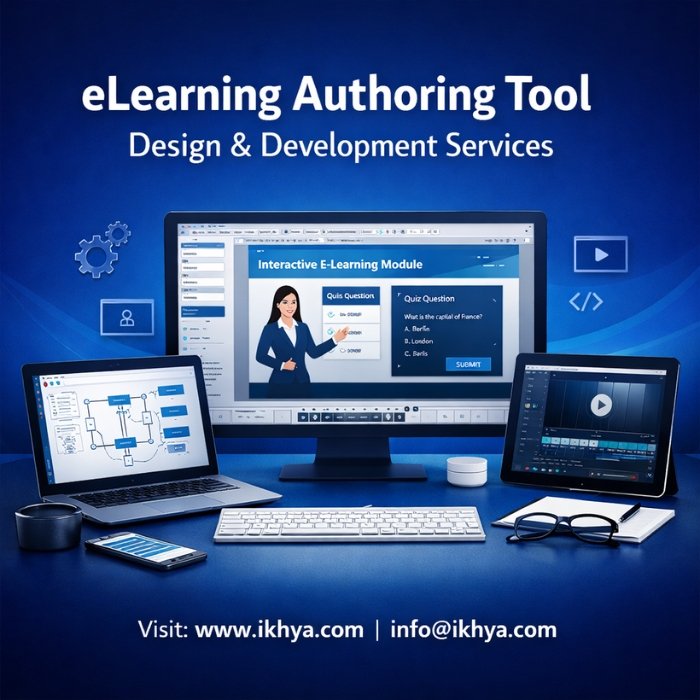



eLearning Authoring Tool Design & Development Services
Organizations today must deliver scalable digital training that works across locations, devices, and learning platforms. However, building interactive courses internally using complex authoring tools can be time-consuming and resource-intensive.
IKHYA – eLearning Solutions Company helps organizations design and develop high-quality eLearning courses using industry-leading authoring tools such as Articulate Storyline, Adobe Captivate, and Lectora Inspire. Our experts create SCORM- and xAPI-compliant courses that integrate seamlessly with your LMS.
Request a proposal or consultation at info@ikhya.com
Get a Free eLearning Consultation / Proposal
Choosing the right authoring tool strategy is critical for successful corporate training programs. Many organizations struggle with questions such as:
- Which authoring tool is best for our training needs?
- How long will course development take?
- What is the cost per module?
- Will the courses work with our LMS?
- Can our existing PowerPoint or instructor-led training be converted into eLearning?
IKHYA offers a free consultation and project proposal to help organizations evaluate the best development approach before starting a training project.
Organizations can also book a free eLearning demo to explore sample training modules and development capabilities.
During the consultation, our experts analyze:
Training Goals
We identify the purpose of the training program, such as:
- employee onboarding
- compliance training
- product training
- software system training
- leadership development
Understanding the training objective helps determine the most suitable learning methodology, such as:
- microlearning
- simulation learning
- scenario-based training
- experiential learning
Content Availability
Organizations often have existing training materials such as:
- PowerPoint presentations
- instructor-led training materials
- PDFs and manuals
- video recordings
- legacy eLearning courses
Many organizations begin their digital learning journey when they need to convert PowerPoint to eLearning to modernize classroom-based training materials.
Our team evaluates these assets to determine the best approach for authoring tool-based course development.
LMS Compatibility
Enterprise buyers frequently need courses that work within existing learning platforms.
Organizations often invest in LMS-compatible eLearning courses to ensure seamless integration with enterprise learning systems.
IKHYA develops courses compatible with:
- Learning Management Systems (LMS)
- Learning Experience Platforms (LXP)
- Digital Adoption Platforms
All courses are built to support industry standards including:
- SCORM
- xAPI
- WCAG accessibility compliance
Project Scope and Timeline
During the consultation we estimate:
- number of modules
- level of interactivity
- development timeline
- approximate project cost
This helps enterprise teams plan budgets and training rollout schedules.
When to Request a Consultation
Organizations typically request proposals when they need to:
- develop interactive digital training programs
- convert ILT to eLearning conversion into eLearning
- modernize legacy Flash-based courses
- build scenario-based or simulation training
- create scalable training programs for global employees
If your organization is planning a digital learning initiative, our specialists can help design a development roadmap.
Request a consultation or submit your RFP:
IKHYA – eLearning Solutions Company
📧 info@ikhya.com
What are eLearning Authoring Tools?
eLearning authoring tools are software platforms used to design, develop, and publish interactive digital training courses. These tools allow instructional designers and developers to transform training content into engaging learning experiences that include multimedia, simulations, quizzes, and assessments.
Organizations use authoring tools to create courses that are compatible with enterprise learning platforms such as Learning Management Systems (LMS) and Learning Experience Platforms (LXP). Courses developed with modern authoring tools typically support industry standards such as SCORM, xAPI, and WCAG accessibility.
With the right authoring tools and instructional design strategy, organizations can deliver scalable training programs for employees across multiple locations and devices.
Types of eLearning Authoring Tools
Different authoring tools offer different capabilities depending on the training requirements.
Common categories include:
Slide-Based Authoring Tools
These tools resemble PowerPoint-style development environments and are widely used for corporate training programs.
Examples include:
- Articulate Storyline
- iSpring Suite
- Adobe Captivate
They are commonly used for:
- compliance training
- product training
- onboarding programs
- software training
Responsive Authoring Tools
Responsive tools allow courses to automatically adapt to different devices such as desktops, tablets, and smartphones.
Examples include:
- Articulate Rise
- Lectora Inspire
These tools are often used for:
- mobile learning
- microlearning programs
- global workforce training
Simulation and Interactive Authoring Tools
Some authoring tools are designed to create highly interactive training experiences such as simulations and scenario-based learning.
These tools support:
- software simulations
- branching scenarios
- role-based decision training
- experiential learning
Simulation-based learning is commonly used in industries such as healthcare training eLearning solutions, aviation, and manufacturing where employees must practice real-world procedures.
Industries such as manufacturing often implement manufacturing training eLearning solutions to train employees on operational procedures and workplace safety.
Cloud vs Desktop Authoring Tools
Organizations often choose between cloud-based authoring tools and desktop-based authoring tools depending on their development workflow.
| Type | Characteristics | Typical Use |
|---|---|---|
| Cloud Authoring Tools | Web-based development with collaboration features | Distributed L&D teams |
| Desktop Authoring Tools | Installed software with advanced customization | Complex interactive courses |
| Hybrid Development | Combination of desktop and cloud tools | Large enterprise projects |
Cloud tools allow teams across multiple locations to collaborate on course development, while desktop tools provide greater flexibility for advanced interactions.
How Authoring Tools Support Corporate Training
Modern authoring tools enable organizations to build scalable digital learning programs.
Key capabilities include:
- multimedia integration (video, audio, animations)
- interactive scenarios and simulations
- quizzes and assessments
- progress tracking through LMS integration
- responsive design for mobile learning
When combined with strong instructional design frameworks such as ADDIE, Bloom’s Taxonomy, and the Kirkpatrick Model, authoring tools help organizations create training programs that improve:
- knowledge retention
- learner engagement
- skill development
- training effectiveness
Authoring tool-based development also enables organizations to update training content quickly as processes, regulations, or technologies change.
Why Organizations Use Authoring Tools for eLearning Development
Many organizations are replacing traditional classroom training with digital learning programs that can be delivered at scale. eLearning authoring tools allow companies to convert training materials into interactive courses that employees can access anytime through their LMS or mobile devices.
Many organizations implement these programs through structured custom eLearning development projects designed to support enterprise training initiatives.
Authoring tool-based development is widely used because it enables faster course creation, consistent learning experiences, and easy updates when training requirements change.
Organizations often use rapid eLearning development approaches to accelerate course production while maintaining instructional quality.
Below are examples of how organizations across different regions use authoring tools for corporate training.
Corporate Training Programs in the United States
Large organizations in the United States often use authoring tools to develop compliance and regulatory training programs.
Industries such as healthcare, finance, and pharmaceuticals must regularly train employees on regulatory standards. Authoring tools help organizations deliver standardized digital courses across thousands of employees.
Common training programs include:
- HIPAA compliance training for healthcare employees
- financial regulations training for banking staff
- cybersecurity awareness training
- workplace ethics and harassment prevention programs
Interactive eLearning modules built using tools such as Articulate Storyline or Adobe Captivate help improve engagement compared to traditional slide presentations.
Compliance and Workforce Training in the United Kingdom
Organizations in the United Kingdom frequently use authoring tools to deliver compliance training aligned with national regulations.
Examples include:
- workplace safety training
- data protection training related to GDPR
- health and safety certification programs
- leadership and management training
Because compliance content changes frequently, authoring tools allow organizations to update training modules quickly without rebuilding entire courses.
Workforce Development Programs in Australia
Companies in Australia often use authoring tools to support workforce development and employee onboarding programs.
Many organizations operate across multiple locations, making classroom training difficult to scale.
Authoring tool-based eLearning enables companies to deliver consistent onboarding experiences for new employees.
Typical programs include:
- new employee onboarding
- customer service training
- retail product training
- operational procedures training
Interactive training modules allow employees to learn at their own pace while ensuring standardized learning outcomes.
Enterprise Training Initiatives in the UAE
Organizations in the UAE often use digital learning to train employees working across international offices.
Industries such as aviation, oil and gas, and construction rely on eLearning programs to deliver technical training and safety procedures.
Authoring tools are commonly used to develop:
- safety and compliance training
- equipment operation training
- aviation safety procedures
- construction site safety programs
Scenario-based training and simulation learning are particularly valuable in these industries because employees must practice real-world decision making.
Advantages for Enterprise Learning and Development Teams
For corporate learning and development teams, authoring tools provide several operational advantages.
Scalable Training Delivery
Organizations can train thousands of employees using LMS-hosted courses without scheduling classroom sessions.
Rapid Course Updates
When policies or procedures change, training modules can be updated quickly without recreating entire programs.
Interactive Learning Experiences
Modern authoring tools support multimedia elements such as:
- video demonstrations
- branching scenarios
- interactive simulations
- knowledge assessments
These elements improve learner engagement and retention.
LMS Integration and Tracking
Courses developed using authoring tools can be integrated into LMS platforms using standards such as:
- SCORM
- xAPI
This enables organizations to track:
- course completion
- assessment scores
- learner progress
- training effectiveness
Because of these advantages, authoring tools have become a core technology in modern digital learning ecosystems.
Benefits of Authoring Tool-Based eLearning Development
Using modern eLearning authoring tools allows organizations to create structured, interactive, and scalable training programs. Compared with traditional training methods or manual course development, authoring tool-based development offers several operational and learning advantages.
These tools help corporate learning teams deliver high-quality training while maintaining consistency across global workforces.
Faster Course Development
Authoring tools significantly reduce the time required to develop training programs.
Features such as:
- reusable templates
- built-in interaction libraries
- drag-and-drop design components
- prebuilt assessment modules
allow developers to build courses faster than traditional custom development.
For organizations launching training programs across multiple departments, this speed helps reduce time-to-deployment.
Interactive Learning Experiences
Modern authoring tools support rich multimedia and interactive learning experiences.
Courses can include:
- branching scenarios
- software simulations
- role-based decision activities
- video demonstrations
- interactive quizzes
These elements help learners actively participate in the training process instead of passively consuming information.
Interactive training improves engagement and knowledge retention, especially for complex topics such as software systems or operational procedures.
LMS Compatibility and Learning Analytics
Enterprise organizations typically deliver training through Learning Management Systems (LMS) or Learning Experience Platforms (LXP).
Courses developed using professional authoring tools can be published in formats such as:
- SCORM
- xAPI
This allows organizations to track learning data such as:
- course completion rates
- learner progress
- assessment performance
- training effectiveness
Analytics help learning and development teams measure the impact of their training programs.
Mobile and Remote Learning Support
Many organizations now have distributed workforces that require training across different locations.
Authoring tools allow courses to be delivered on:
- desktop computers
- tablets
- mobile devices
Responsive design capabilities ensure that learners can access training from anywhere, making digital learning suitable for global teams.
Easy Course Updates and Maintenance
Corporate training content often changes due to:
- regulatory updates
- new product releases
- updated operational procedures
Authoring tools make it easy to update content without rebuilding entire courses.
Instructional designers can quickly modify slides, interactions, or assessments and republish the course to the LMS.
This capability helps organizations keep training materials current.
Consistent Learning Across Global Teams
For organizations operating across multiple locations, maintaining training consistency is essential.
Authoring tools help standardize learning experiences by ensuring that all employees receive the same structured training modules.
This is particularly valuable for:
- compliance training
- safety training
- customer service training
- product training
Standardized digital learning reduces variations that often occur in instructor-led training environments.
Cost Efficiency for Large Training Programs
Although initial development requires planning and design, authoring tool-based eLearning can reduce long-term training costs.
Organizations can save on:
- classroom training expenses
- instructor fees
- travel costs for employees
- training logistics
Once developed, digital courses can be reused and updated for future training cycles.
Support for Modern Learning Methodologies
Authoring tools allow organizations to implement proven learning methodologies such as:
- microlearning modules
- scenario-based training
- simulation learning
- experiential learning
Instructional designers often apply frameworks such as:
- ADDIE Model for structured course development
- Bloom’s Taxonomy to design learning objectives
- Kirkpatrick Model to evaluate training effectiveness
These methodologies help organizations ensure that training programs deliver measurable learning outcomes.
Real Enterprise Project Examples
Enterprise training programs vary widely depending on industry requirements, number of learners, and complexity of the training content. Authoring tool–based development allows organizations to create scalable learning programs ranging from simple knowledge modules to advanced interactive simulations.
Below are realistic examples of how organizations use authoring tools to develop corporate training programs.
Example: ERP Software Simulation Training
Client: Global Manufacturing Company
The organization implemented a new ERP system and needed to train employees across finance, procurement, and operations departments.
Training Scope
- 30 interactive simulation modules
- system navigation training
- scenario-based workflow practice
- assessment at the end of each module
Development Approach
Courses were developed using Articulate Storyline to create guided software simulations and interactive practice environments.
| Project Component | Details |
|---|---|
| Modules | 30 simulations |
| Duration per module | 5–7 minutes |
| Estimated timeline | 8–10 weeks |
| Estimated cost | $40,000 – $75,000 |
The training allowed employees to practice ERP workflows in a simulated environment before using the live system.
Example: Salesforce CRM Training Program
Client: US Technology Company
A growing technology firm needed structured training for sales and customer support teams using Salesforce CRM.
Training Scope
- guided CRM walkthroughs
- role-based training for sales representatives
- customer support workflows
- knowledge checks and certification
Development Approach
The courses were developed using Adobe Captivate to create interactive system simulations and task-based learning modules.
| Project Component | Details |
|---|---|
| Modules | 20 training modules |
| Duration per module | 6 minutes |
| Estimated timeline | 6 weeks |
| Estimated cost | $25,000 – $45,000 |
The program helped the organization improve CRM adoption and reduce onboarding time for new sales staff.
Example: Healthcare Compliance Training
Client: Healthcare Provider Network (USA)
Healthcare organizations must regularly train employees on compliance regulations, patient safety standards, and operational procedures.
A recent healthcare compliance training case study demonstrates how eLearning programs help healthcare organizations maintain regulatory compliance.
Training Scope
- HIPAA compliance training
- patient data protection procedures
- workplace safety training
- knowledge assessments
Development Approach
Courses were developed using Articulate Rise to create responsive microlearning modules accessible on mobile devices.
| Project Component | Details |
|---|---|
| Modules | 15 microlearning modules |
| Duration per module | 5 minutes |
| Estimated timeline | 5 weeks |
| Estimated cost | $18,000 – $30,000 |
This approach enabled healthcare staff to complete training on mobile devices during shift breaks.
Example: Manufacturing Safety Training
Client: Global Industrial Manufacturing Company
Manufacturing organizations must train employees on safety procedures to prevent workplace accidents.
You can explore a real-world manufacturing safety training case study to see how digital learning programs improve workplace safety outcomes.
Training Scope
- equipment operation procedures
- hazard identification training
- emergency response scenarios
- compliance certification
Development Approach
Interactive scenario-based training was developed using Lectora Inspire with branching decision scenarios.
| Project Component | Details |
|---|---|
| Modules | 12 safety training modules |
| Duration per module | 8 minutes |
| Estimated timeline | 6–7 weeks |
| Estimated cost | $22,000 – $40,000 |
The training allowed workers to practice decision-making in simulated safety situations.
Example: Financial Compliance Training
Client: International Banking Institution
Banks must regularly train employees on regulatory requirements and internal compliance procedures.
Many organizations implement structured financial services training eLearning solutions to ensure employees understand regulatory compliance and risk management practices.
Training Scope
- anti-money laundering (AML) training
- fraud prevention procedures
- customer data protection policies
- assessment-based certification
Development Approach
Courses were developed using iSpring Suite, which allows rapid conversion of existing PowerPoint training into interactive eLearning.
| Project Component | Details |
|---|---|
| Modules | 18 training modules |
| Duration per module | 6 minutes |
| Estimated timeline | 4–5 weeks |
| Estimated cost | $15,000 – $28,000 |
Rapid development allowed the organization to deploy updated compliance training before regulatory deadlines.
Typical Development Timeline for Authoring Tool Projects
Enterprise buyers often need a clear understanding of project timelines before initiating training programs.
| Project Scope | Estimated Timeline |
|---|---|
| 1 eLearning module | 2–3 weeks |
| 5 modules | 4–6 weeks |
| 10 modules | 6–8 weeks |
| 30 modules | 12–16 weeks |
Actual timelines depend on:
- content readiness
- level of interactivity
- review cycles
- localization requirements
Typical Cost Ranges for Authoring Tool Development
Development costs vary depending on the complexity of the training experience.
| Course Type | Estimated Cost per Module |
|---|---|
| Basic eLearning module | $1,000 – $2,500 |
| Interactive module | $2,500 – $6,000 |
| Scenario-based or simulation module | $6,000 – $15,000 |
These ranges help organizations estimate training budgets before starting a project.
IKHYA Process for eLearning Authoring Tool Design & Development
Developing effective corporate training requires more than using authoring tools. Successful programs combine instructional design expertise, learning science, and structured development processes.
At IKHYA – eLearning Solutions Company, we follow a proven development methodology based on the ADDIE model, supported by learning frameworks such as Bloom’s Taxonomy and the Kirkpatrick Model.
This structured approach ensures training programs are aligned with business goals, learner needs, and measurable outcomes.
Analysis
The first stage focuses on understanding the training requirements and business objectives.
During this stage, our team collaborates with stakeholders such as:
- learning and development teams
- subject matter experts (SMEs)
- HR leaders
- training managers
We analyze several factors including:
Training Objectives
Define what learners should know or be able to do after completing the training.
Audience Profile
Understand the learner group, including:
- job roles
- skill levels
- experience with the subject matter
- learning environment
Content Sources
Training materials may include:
- PowerPoint presentations
- policy documents
- process manuals
- instructor-led training materials
- videos and recorded sessions
Technology Environment
We also evaluate the organization’s learning technology ecosystem, including:
- Learning Management Systems (LMS)
- Learning Experience Platforms (LXP)
- mobile learning requirements
- reporting and analytics capabilities
The analysis phase ensures the training program is designed to support organizational learning goals.
Instructional Design
Once requirements are defined, our instructional designers create the learning architecture for the course.
Instructional design focuses on structuring the training to maximize engagement and knowledge retention.
Many organizations work with specialized instructional design services to ensure training content follows proven learning science principles.
Key activities include:
Learning Objectives Design
Learning objectives are developed using Bloom’s Taxonomy, which helps define cognitive levels such as:
- remembering
- understanding
- applying
- analyzing
- evaluating
Content Structuring
Content is organized into clear learning modules and lessons that follow a logical sequence.
Training programs often include:
- concept explanations
- real-world examples
- scenario-based activities
- practice exercises
- knowledge assessments
Learning Methodologies
Depending on training goals, we may incorporate methodologies such as:
- microlearning modules
- simulation learning
- scenario-based training
- experiential learning
Many modern training programs incorporate microlearning development strategies to deliver focused learning modules that employees can complete quickly.
A detailed storyboard or design document is created before development begins.
Development
During the development stage, the course is built using professional eLearning authoring tools.
Common development tools include:
- Articulate Storyline
- Adobe Captivate
- Lectora Inspire
- iSpring Suite
Our development team integrates various multimedia elements to create engaging learning experiences.
Course components may include:
- animations and visual graphics
- video demonstrations
- interactive simulations
- branching decision scenarios
- quizzes and assessments
Courses are designed to be compatible with industry standards such as:
- SCORM
- xAPI
This ensures seamless integration with corporate LMS platforms.
Quality Assurance
Before deployment, each course undergoes a detailed quality review process.
The QA stage ensures the course functions correctly across different devices and learning environments.
Quality checks include:
Content Accuracy
Reviewing content with subject matter experts to ensure information is correct and up to date.
Functional Testing
Testing all interactions including:
- navigation controls
- branching scenarios
- quizzes and assessments
- multimedia playback
LMS Compatibility Testing
Ensuring the course launches and tracks correctly in the LMS using SCORM or xAPI standards.
Accessibility Compliance
Courses are reviewed to support accessibility standards such as WCAG, ensuring content is usable for learners with disabilities.
Deployment
The final stage involves delivering the course to the organization's learning platform.
Our team supports organizations with:
- LMS upload and configuration
- course testing in the LMS environment
- learner tracking setup
- reporting configuration
Once deployed, organizations can monitor training effectiveness using learning analytics.
Evaluation methods often align with the Kirkpatrick Model, which measures:
- learner reaction
- knowledge acquisition
- behavior change
- business impact
This structured process ensures that corporate training programs are not only engaging but also aligned with measurable learning outcomes.
Technologies and Authoring Tools Used
Creating effective digital learning experiences requires the right combination of authoring tools, learning technologies, and industry standards. At IKHYA – eLearning Solutions Company, we use widely adopted enterprise tools to develop interactive training programs that integrate seamlessly with modern learning ecosystems.
Our development approach ensures that courses are compatible with Learning Management Systems (LMS), Learning Experience Platforms (LXP), and mobile learning environments.
Articulate Storyline
Articulate Storyline is one of the most widely used authoring tools for corporate training development. It provides advanced capabilities for building interactive and scenario-based learning experiences.
Many organizations work with specialists in Articulate Storyline development to create advanced interactive and scenario-based training programs.
Organizations use Storyline to create training programs such as:
- software simulations
- branching decision scenarios
- compliance training modules
- product training courses
Storyline allows developers to design complex interactions while maintaining compatibility with enterprise LMS platforms.
Key advantages include:
- interactive learning experiences
- customizable course design
- support for multimedia elements
- SCORM and xAPI compatibility
Because of its flexibility, Storyline is often used for advanced corporate training programs that require high levels of interactivity.
Adobe Captivate
Adobe Captivate is widely used for simulation-based training and technical learning programs.
Many enterprise organizations use professional Adobe Captivate development services to build system simulations and application training programs.
It is particularly useful for developing:
- software application training
- system walkthroughs
- interactive simulations
- mobile learning modules
Captivate includes features that allow developers to create responsive training courses that adapt to different screen sizes.
Organizations frequently use Captivate for:
- enterprise software training
- IT systems training
- application onboarding programs
Lectora Inspire
Lectora Inspire is a powerful authoring tool designed for enterprise-level eLearning development.
Organizations that require accessibility compliance often invest in Lectora eLearning development for enterprise training programs.
It is commonly used when organizations require:
- complex course structures
- advanced branching scenarios
- accessibility-focused development
- multilingual training programs
Lectora provides strong support for accessibility standards, making it suitable for organizations that must comply with accessibility regulations.
iSpring Suite
iSpring Suite is often used for rapid eLearning development, especially when organizations want to convert existing training materials into digital courses.
Companies frequently choose iSpring eLearning development when converting PowerPoint-based training into interactive digital courses.
It integrates directly with Microsoft PowerPoint, making it ideal for:
- converting presentations into eLearning modules
- developing quick training updates
- creating knowledge checks and quizzes
iSpring is commonly used for:
- onboarding programs
- compliance training
- internal corporate training modules
Learning Standards and Compliance
Enterprise training programs must follow industry standards to ensure compatibility and accessibility.
IKHYA develops courses that support widely recognized eLearning standards.
| Standard | Purpose |
|---|---|
| SCORM | Enables courses to communicate with LMS platforms |
| xAPI | Provides advanced tracking of learner activities |
| WCAG | Ensures accessibility for learners with disabilities |
Following these standards ensures that training programs can be delivered consistently across different learning platforms.
LMS and Learning Ecosystem Compatibility
Modern organizations use a variety of learning technologies to deliver and manage training programs.
Courses developed by IKHYA are compatible with:
- Learning Management Systems (LMS)
- Learning Experience Platforms (LXP)
- Digital Adoption Platforms
This compatibility allows organizations to track learner progress, measure training effectiveness, and scale digital learning programs globally.
Mobile Learning Support
Many corporate learners access training through mobile devices.
Authoring tools such as Storyline, Captivate, and Rise allow courses to be optimized for:
- desktops
- tablets
- smartphones
Responsive design ensures that employees can complete training regardless of device or location.
Industries We Serve
Organizations across many industries use authoring tools to deliver structured digital training programs. Each industry has unique regulatory requirements, operational procedures, and workforce training needs.
At IKHYA – eLearning Solutions Company, we develop authoring tool–based eLearning solutions tailored to the needs of different sectors.
Healthcare
Healthcare organizations must regularly train medical staff, administrative teams, and support personnel on compliance regulations and clinical procedures.
Common healthcare training programs include:
- patient data privacy training
- HIPAA and regulatory compliance
- infection control procedures
- medical equipment operation training
- hospital onboarding programs
Interactive eLearning modules help healthcare professionals learn critical procedures while maintaining compliance with regulatory requirements.
Manufacturing
Manufacturing companies use digital learning to train employees on operational procedures, workplace safety, and equipment handling.
Typical manufacturing training programs include:
- machine operation training
- workplace safety programs
- production workflow training
- quality control procedures
- supply chain operations training
Scenario-based learning and simulation training allow employees to practice decision-making in a safe learning environment.
Finance
Financial institutions operate in highly regulated environments and must regularly train employees on compliance and security policies.
Training programs often include:
- anti-money laundering (AML) training
- fraud detection procedures
- financial regulations compliance
- data security awareness
- customer service training
Authoring tools help financial institutions deliver standardized training programs to employees across multiple branches.
Construction
Construction companies must ensure that workers understand safety regulations, operational procedures, and equipment usage.
Digital learning programs for construction organizations commonly include:
- construction site safety training
- equipment operation procedures
- hazard identification training
- emergency response training
Interactive modules help workers learn safety protocols and reduce the risk of workplace accidents.
Oil and Gas
The oil and gas industry requires specialized training for employees working in high-risk environments.
Training programs typically include:
- safety compliance training
- drilling and equipment operation procedures
- emergency response planning
- environmental protection guidelines
Simulation-based learning allows workers to understand operational risks before performing real-world tasks.
Aviation
Aviation organizations rely on highly structured training programs to ensure operational safety and regulatory compliance.
Common aviation training modules include:
- aircraft maintenance procedures
- safety and emergency protocols
- airport operations training
- regulatory compliance training
Interactive simulations and scenario-based training help aviation professionals practice critical procedures in a controlled learning environment.
Supporting Global Workforce Training
Many organizations operate across multiple countries and require consistent training experiences for employees in different locations.
Authoring tool–based eLearning supports global workforce training by enabling:
- standardized training programs
- multilingual course development
- scalable digital learning delivery
- mobile access for distributed teams
This approach helps organizations maintain training consistency while supporting diverse learner groups.
Choosing the Right eLearning Authoring Tool for Your Training
Selecting the right authoring tool is an important decision for organizations planning digital learning programs. Different tools are designed for different types of training, levels of interactivity, and development speed.
Enterprise learning teams often evaluate factors such as:
- complexity of the training content
- level of interactivity required
- mobile learning support
- LMS compatibility
- development timeline
Understanding the strengths of each tool helps organizations choose the most suitable development approach.
When to Use Articulate Storyline
Articulate Storyline is commonly used for interactive and scenario-based training.
It is ideal for courses that require:
- branching scenarios
- complex interactions
- role-based simulations
- decision-making exercises
Storyline provides strong flexibility for instructional designers to create custom learning experiences.
Typical use cases include:
- leadership training
- sales training
- customer service training
- compliance programs with interactive scenarios
Because of its powerful interaction capabilities, Storyline is widely used for enterprise-level eLearning development.
When to Use Articulate Rise
Articulate Rise is a cloud-based authoring tool designed for responsive and mobile-friendly training.
Organizations often rely on Articulate Rise development to build responsive eLearning modules that work across mobile and desktop devices.
It is particularly suitable for:
- microlearning programs
- mobile-first training
- onboarding courses
- quick knowledge modules
Courses developed in Rise automatically adapt to different screen sizes, making them accessible on smartphones, tablets, and desktops.
Organizations often use Rise when they need to deliver fast, responsive training experiences.
When to Use Adobe Captivate
Adobe Captivate is commonly used for software simulations and technical training.
It is well suited for courses that involve:
- application walkthroughs
- system navigation training
- software usage demonstrations
- interactive system simulations
Captivate allows developers to create guided practice environments where learners can explore software workflows step by step.
Industries such as IT services, healthcare technology, and enterprise software companies frequently use Captivate for training.
When to Use Lectora Inspire
Lectora Inspire is often used for enterprise training programs that require advanced accessibility and complex course structures.
It is suitable for:
- accessibility-compliant training
- multilingual training programs
- large enterprise learning libraries
- complex branching learning paths
Organizations that must comply with accessibility standards such as WCAG often prefer Lectora because of its strong accessibility features.
When to Use iSpring Suite
iSpring Suite is commonly used for rapid eLearning development and PowerPoint-based training conversion.
It is ideal for situations where organizations need to quickly convert existing training materials into digital learning modules.
Common use cases include:
- onboarding programs
- compliance training
- policy training updates
- internal employee training
iSpring allows developers to transform PowerPoint presentations into interactive courses with quizzes, narration, and multimedia.
Key Factors for Choosing an Authoring Tool
Enterprise learning teams should consider several factors when selecting an authoring tool for training development.
| Decision Factor | Why It Matters |
|---|---|
| Interactivity Level | Determines whether the course needs simulations or simple modules |
| Mobile Compatibility | Important for distributed workforces |
| LMS Integration | Ensures courses work with existing learning platforms |
| Development Speed | Determines how quickly courses can be deployed |
| Accessibility Compliance | Required for WCAG or regulatory standards |
Choosing the right tool helps organizations balance learning effectiveness, development efficiency, and scalability.
Why Choose IKHYA – eLearning Solutions Company
Selecting the right eLearning development partner is an important decision for organizations investing in corporate training programs. Organizations evaluating vendors often review best practices on how to choose the right eLearning vendor before starting large-scale training initiatives.
IKHYA – eLearning Solutions Company works with organizations worldwide to design and develop high-quality digital learning solutions that align with business goals and workforce development strategies.
Extensive Industry Experience
IKHYA brings deep experience in corporate training and digital learning development.
Our team includes:
- instructional designers
- eLearning developers
- multimedia specialists
- learning technology experts
Together, they combine instructional design expertise with modern learning technologies to build effective training programs.
Experience Highlights
- 300+ global clients
- 1000+ courses delivered
- 25+ years combined industry experience
- projects across 20+ industries
This experience allows us to support both small training initiatives and large enterprise learning programs.
Enterprise-Ready Development Process
IKHYA follows a structured development methodology based on established instructional design frameworks.
Our process incorporates:
- ADDIE Model for systematic course development
- Bloom’s Taxonomy for defining learning objectives
- Kirkpatrick Model for evaluating training outcomes
This structured approach helps ensure that training programs are aligned with measurable learning outcomes and business performance goals.
Expertise in Leading Authoring Tools
Our development team has extensive experience working with industry-standard authoring tools.
These include:
- Articulate Storyline
- Articulate Rise
- Adobe Captivate
- Lectora Inspire
- iSpring Suite
This flexibility allows us to select the most suitable tool depending on the training requirements, level of interactivity, and development timeline.
LMS Integration and Learning Technology Support
Many organizations already use enterprise learning platforms to manage employee training.
IKHYA develops courses that integrate with:
- Learning Management Systems (LMS)
- Learning Experience Platforms (LXP)
- Digital Adoption Platforms
Courses are delivered using widely supported standards such as:
- SCORM
- xAPI
This ensures compatibility with existing learning ecosystems and allows organizations to track learner progress and performance.
Scalable Global Training Solutions
Organizations with global workforces require training programs that can scale across locations and languages.
IKHYA supports enterprise clients with:
- multilingual course development
- localized training content
- mobile-friendly learning programs
- scalable LMS-ready courses
This capability enables organizations to deliver consistent learning experiences to employees across multiple regions.
Post-Deployment Support
Successful training programs require continuous improvement after deployment.
IKHYA provides ongoing support services including:
- course updates and maintenance
- LMS deployment assistance
- content revisions and enhancements
- analytics and reporting support
This ensures that training programs remain current as business processes, regulations, and technologies evolve.
A Strategic Partner for Corporate Learning
Many organizations treat eLearning development as a long-term partnership rather than a one-time project.
IKHYA collaborates with corporate learning teams to:
- modernize legacy training programs
- convert instructor-led training into eLearning
- implement scalable digital learning strategies
- develop structured learning pathways for employees
By combining instructional design expertise with modern learning technologies, IKHYA helps organizations create sustainable digital learning ecosystems.
Related eLearning Services
Organizations implementing digital learning initiatives often require additional services beyond authoring tool development. IKHYA offers a range of complementary solutions that support corporate training transformation.
- Custom eLearning Development: Design and development of fully customized training programs tailored to organizational learning goals.
- Rapid eLearning Development: Fast conversion of existing training materials such as PowerPoint presentations into digital learning modules.
- Instructional Design Services: Professional instructional design to structure training programs using proven learning methodologies.
- Microlearning Development: Creation of short, focused learning modules that support just-in-time training.
- LMS Integration Services: Integration of eLearning courses with enterprise learning platforms to enable tracking and reporting.
- PPT to eLearning Conversion: Transformation of PowerPoint presentations into interactive eLearning courses.
- ILT to eLearning Conversion: Conversion of instructor-led training programs into scalable digital learning experiences.
These services help organizations build comprehensive digital learning ecosystems.
Frequently Asked Questions
eLearning authoring tools are software platforms used to design and develop digital learning courses. These tools allow organizations to convert training materials such as PowerPoint presentations, manuals, and instructor-led training content into interactive online learning modules.
Corporate training teams use authoring tools to build courses that include:
- multimedia elements such as videos and graphics
- interactive scenarios and simulations
- knowledge checks and assessments
- LMS tracking and reporting
Authoring tools enable organizations to deliver structured training programs that can be accessed by employees across locations and devices.
Several authoring tools are widely used for corporate training development. The most common tools include:
- Articulate Storyline
- Articulate Rise
- Adobe Captivate
- Lectora Inspire
- iSpring Suite
Each tool serves different purposes. For example, Storyline is often used for interactive training, while Rise is suitable for responsive microlearning modules. The choice of tool depends on the complexity of the training program and the required level of interactivity.
Development timelines vary depending on the complexity of the course and the availability of content.
Typical timelines include:
Project Scope | Estimated Timeline |
1 eLearning module | 2–3 weeks |
5 modules | 4–6 weeks |
10 modules | 6–8 weeks |
30 modules | 12–16 weeks |
Factors that influence timelines include content readiness, review cycles, multimedia development, and level of interactivity.
The cost of developing eLearning courses varies depending on course complexity.
Typical pricing ranges include:
Course Type | Estimated Cost per Module |
Basic eLearning module | $1,000 – $2,500 |
Interactive module | $2,500 – $6,000 |
Scenario-based training | $6,000 – $15,000 |
These estimates help organizations plan training budgets for large-scale learning initiatives.
Yes. Many organizations already have training materials such as:
- PowerPoint presentations
- instructor-led training manuals
- PDFs and policy documents
- recorded training sessions
These materials can be converted into interactive eLearning courses using authoring tools. This process helps organizations digitize legacy training content and deliver it through an LMS.
Yes. Most professional authoring tools allow courses to be exported using industry standards such as:
- SCORM
- xAPI
These formats allow courses to communicate with Learning Management Systems so that organizations can track learner progress, completion status, and assessment results.
Custom eLearning development involves building courses from scratch using a fully customized design approach. It may involve advanced multimedia development, animations, and custom programming.
Authoring tool development uses established eLearning tools to build courses more efficiently while still providing interactivity and multimedia capabilities.
Many organizations prefer authoring tools because they allow faster development and easier course updates.
Yes. Many modern authoring tools allow courses to be delivered on mobile devices.
Courses developed using responsive design can be accessed on:
- smartphones
- tablets
- desktop computers
Mobile compatibility is particularly important for organizations with remote or field-based employees.
Authoring tools allow developers to create interactive training experiences through features such as:
- branching scenarios
- software simulations
- drag-and-drop activities
- decision-based learning paths
- quizzes and assessments
These interactive elements encourage active participation and improve learner engagement.
Instructional design ensures that training content is structured effectively to support learning outcomes.
Instructional designers apply frameworks such as:
- ADDIE model
- Bloom’s Taxonomy
- Kirkpatrick Model
These frameworks help ensure that courses are aligned with learning objectives and organizational training goals.
Choosing the right authoring tool depends on several factors:
- level of interactivity required
- complexity of the training content
- mobile learning requirements
- LMS compatibility
- development timeline
For example, Storyline may be used for interactive scenarios, while Rise may be chosen for mobile-friendly microlearning modules.
Yes. Tools such as Adobe Captivate and Articulate Storyline can create software simulations that guide learners through application workflows.
Simulation-based learning is commonly used for training employees on:
- ERP systems
- CRM platforms
- enterprise software tools
- operational systems
These simulations allow learners to practice tasks in a safe environment before using real systems.
One advantage of authoring tools is the ability to update training content quickly.
Instructional designers can modify:
- text content
- graphics and multimedia
- interactions and quizzes
The updated course can then be republished and uploaded to the LMS.
This flexibility allows organizations to keep training materials current.
Yes. Many authoring tools support accessibility features that help organizations comply with accessibility standards such as WCAG.
Accessibility features may include:
- screen reader compatibility
- keyboard navigation support
- closed captions for video content
- alternative text for images
This ensures training programs are accessible to learners with disabilities.
Yes. Many organizations operate globally and require training programs in multiple languages.
Authoring tools allow developers to create multilingual courses through:
- translation of course content
- language switching options
- localized multimedia elements
This allows organizations to deliver consistent training across international teams.
Authoring tools are used to develop many types of corporate training programs.
Common examples include:
- employee onboarding training
- compliance and regulatory training
- leadership development programs
- product knowledge training
- customer service training
- software and systems training
These tools support both simple knowledge-based courses and advanced interactive learning experiences.
Authoring tool development is highly scalable.
Organizations can develop:
- single training modules
- department-level training programs
- enterprise-wide learning libraries
Once courses are developed, they can be reused and updated for future training cycles.
Organizations typically measure training effectiveness using learning analytics and evaluation models.
Metrics may include:
- course completion rates
- assessment scores
- learner engagement metrics
- performance improvements
Many organizations evaluate results using the Kirkpatrick Model, which measures training impact across four levels.
Multimedia elements help improve learner engagement and understanding.
Courses often include:
- instructional videos
- animations and graphics
- voice narration
- interactive diagrams
These elements help simplify complex topics and make training more engaging.
Organizations usually begin by defining their training goals and identifying available content.
The next steps typically include:
- analyzing training requirements
- selecting the appropriate authoring tools
- designing the instructional structure
- developing the course modules
- deploying courses through the LMS
Working with an experienced eLearning development partner can help organizations plan and execute digital learning initiatives effectively.
Request Your Proposal
Organizations planning to develop digital training programs can benefit from expert guidance on authoring tools, instructional design, and LMS integration.
IKHYA – eLearning Solutions Company provides professional services for designing and developing interactive eLearning courses using industry-leading authoring tools.
Our team can help organizations:
- convert existing training materials into eLearning
- design interactive learning experiences
- develop LMS-compatible courses
- implement scalable digital training programs
To discuss your training project or request a proposal:
IKHYA – eLearning Solutions Company
📧 info@ikhya.com
Schedule a consultation or submit your eLearning RFP to begin planning your next corporate learning initiative.
At IKHYA – eLearning Solutions Company, we design impactful, compliance-driven, and performance-focused digital learning solutions tailored to your business goals.
🎯 Custom eLearning Course Development
⚡ Rapid eLearning & PPT Conversion
📊 Workplace Compliance Training
🌍 Localization & LMS-Ready Modules



Reviews
There are no reviews yet.