eLearning Freelancer vs eLearning Development Company: Which Should You Choose?

You are about to invest thousands of dollars into eLearning—but choosing the wrong development partner can cost you far more in delays, compliance risks, and poor learner results. The right decision can accelerate training, improve completion rates, and protect your organization legally. If you want scalable, compliant, and future-ready eLearning, partner with a proven development team that understands global standards and enterprise needs.
Take the next step today. Contact IKHYA – eLearning Solutions Company for a free consultation and project assessment. Our experts will evaluate your requirements, recommend the best development approach, and provide a clear roadmap to launch high-impact eLearning that delivers measurable results. Email us at info@ikhya.com to start building training that performs, scales, and lasts.
What Is the Difference Between an eLearning Freelancer and an eLearning Development Company?
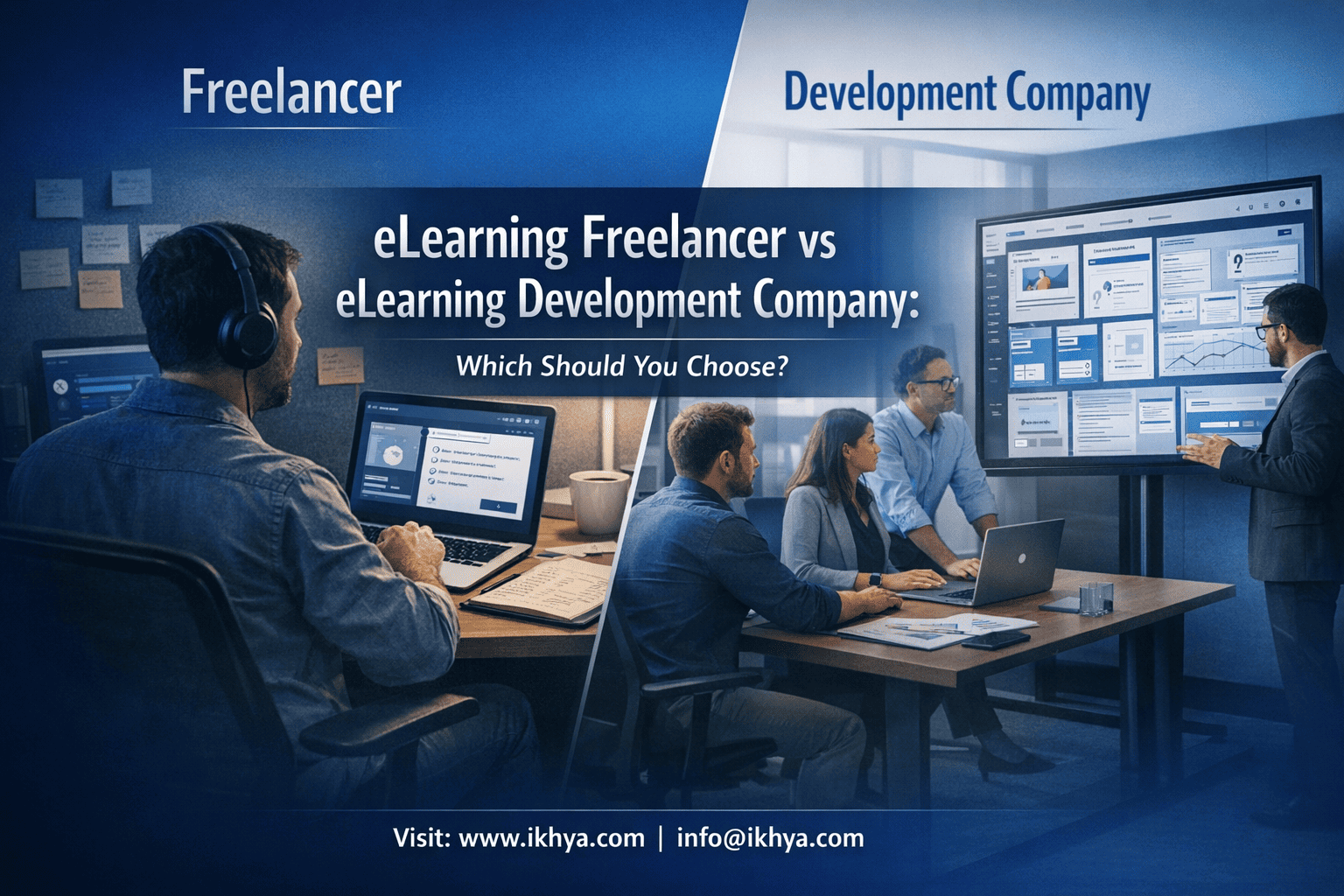
An eLearning freelancer is an independent professional who works alone and handles limited parts of the eLearning process. An eLearning development company is a structured team with specialists in instructional design, multimedia, development, and quality assurance. Companies offer scalability, reliability, and compliance expertise, while freelancers are more flexible and budget-friendly for smaller projects.
Understanding this difference is critical because eLearning development is not a single task. It is a multi-stage process that requires expertise in instructional design, learning psychology, multimedia production, technical standards, and platform compatibility.
eLearning Freelancer: Definition and Structure
An eLearning freelancer is typically a single professional who offers one or more of the following services:
- Instructional design
- Articulate Storyline or Adobe Captivate development
- Graphic design
- Voiceover coordination
- Basic LMS integration
Freelancers usually work remotely and manage projects independently. They may specialize in one tool or area.
Example: Freelancer Scenario (USA Corporate Training)
A healthcare company in Texas hires a freelance Articulate Storyline developer to convert PowerPoint slides into SCORM modules. The freelancer handles:
- Slide conversion
- Basic quiz creation
- SCORM export
However, the freelancer does not handle:
- Instructional strategy alignment with OSHA compliance
- Accessibility requirements (WCAG 2.1)
- LMS troubleshooting across multiple systems
This creates gaps in compliance and scalability.
eLearning Development Company: Definition and Structure
An eLearning development company is a structured organization with a full team of specialists.
Typical team roles include:
- Instructional Designers
- eLearning Developers
- Graphic Designers
- Animators
- Voiceover Managers
- QA Specialists
- LMS Integration Experts
- Project Managers
Each specialist handles a specific part of the development lifecycle.
Example: Development Company Scenario (UK Compliance Training)
A financial services company in London needs FCA-compliant compliance training. An eLearning company provides:
- Instructional design aligned with FCA requirements
- SCORM 2004 4th Edition compatibility
- Accessibility compliance with UK Equality Act
- LMS testing across Moodle and Cornerstone
This ensures compliance, scalability, and audit readiness.
Key Structural Comparison Table
| Factor | Freelancer | eLearning Development Company |
|---|---|---|
| Team size | Single person | Full specialist team |
| Project capacity | Limited | High scalability |
| Compliance expertise | Limited | Strong |
| Risk level | Higher | Lower |
| Cost | Lower upfront | Higher upfront, better long-term value |
| Reliability | Depends on individual | Structured and predictable |
| Delivery speed | Slower for large projects | Faster due to team structure |
Real-World Global Insight: USA, UK, Australia, UAE
Different regions have strict compliance requirements that affect development partner choice.
USA
Corporate training must often comply with:
- OSHA safety standards
- HIPAA healthcare training requirements
- Section 508 accessibility
Freelancers may lack full compliance expertise.
Development companies provide structured compliance validation.
UK
UK organizations must comply with:
- Equality Act accessibility requirements
- FCA compliance training standards
- GDPR training requirements
Companies provide audit-ready training systems.
Australia
Australian organizations follow:
- ASQA training standards
- SCORM and xAPI LMS compatibility
- Workplace safety compliance training
Development companies provide scalable national training deployment.
UAE
UAE enterprises often require:
- Multilingual training (Arabic and English)
- Government compliance standards
- Enterprise LMS integration
Companies handle localization and enterprise deployment effectively.
Why This Difference Matters More Than Most Companies Realize
eLearning is not just content creation. It is infrastructure.
A single mistake can cause:
- LMS compatibility failures
- Compliance violations
- Training audit failures
- Employee training delays
Freelancers are best suited for small, simple projects.
Development companies are best suited for enterprise, compliance, and scalable training.
Strong Call to Action
If your training affects compliance, employee safety, or large-scale deployment, choosing the right partner is critical. A structured eLearning development company ensures quality, compliance, and long-term scalability—protecting your investment and your organization.
How Do Costs Compare Between an eLearning Freelancer and an eLearning Development Company?
Freelancers typically charge $20–$80 per hour globally, while eLearning companies charge $50–$150 per hour depending on expertise and region. Freelancers cost less upfront but may increase total cost due to rework, delays, and limited scalability. Companies offer predictable pricing, structured delivery, and lower long-term risk for enterprise projects.
Cost is one of the biggest deciding factors, but the cheapest option is not always the most cost-effective. To understand the true cost, you must evaluate hourly rates, project pricing, scalability, revision cycles, and long-term maintenance.
Global Hourly Rate Comparison (USA, UK, Australia, UAE, India)
eLearning development rates vary widely based on expertise, compliance knowledge, and regional market demand.
| Region | Freelancer Hourly Rate | Development Company Hourly Rate |
|---|---|---|
| USA | $40 – $100 | $80 – $150 |
| UK | £30 – £80 | £60 – £120 |
| Australia | AUD $50 – $120 | AUD $90 – $160 |
| UAE | AED 120 – AED 350 | AED 250 – AED 550 |
| India | $15 – $40 | $25 – $70 |
These differences reflect labor costs, compliance expertise, and infrastructure.
Total Project Cost Comparison: Real-World Example
Let’s compare the cost of developing a 60-minute interactive SCORM compliance course.
| Cost Component | Freelancer | Development Company |
|---|---|---|
| Instructional design | $300 – $800 | Included with specialist |
| Visual design | $200 – $600 | Included |
| Development | $800 – $2,000 | Included |
| QA testing | Limited | Full testing included |
| LMS integration | Often extra | Included |
| Project management | None | Included |
| Total Estimated Cost | $1,300 – $3,400 | $3,000 – $7,000 |
At first glance, freelancers appear cheaper. But hidden costs can increase the total.
Hidden Costs Most Organizations Do Not Expect
Freelancer projects often require additional support and fixes that increase cost.
1. Revision Costs
Freelancers may charge per revision:
- $50 – $200 per revision cycle
- Instructional changes can require full rework
Companies include revision cycles in contracts.
2. LMS Compatibility Fixes
Common issues include:
- SCORM tracking errors
- LMS completion not recording
- Mobile compatibility problems
Companies test across multiple LMS platforms.
Freelancers often test only locally.
3. Compliance Risk Costs (USA, UK, Australia, UAE)
Compliance failures can cost far more than development.
Example: USA Healthcare Training
If training does not meet HIPAA standards:
- Legal risk increases
- Training may need full redevelopment
Companies design with compliance alignment from the start.
4. Delay Costs
Freelancers can only work limited hours.
If a freelancer becomes unavailable:
- Project delays increase
- Business deadlines may be missed
Companies assign backup team members.
Long-Term Cost Comparison: 12-Month Example
Let’s compare total cost over one year for a company needing 10 courses.
| Cost Factor | Freelancer | Development Company |
|---|---|---|
| Initial development | $15,000 | $40,000 |
| Fixes and revisions | $5,000 | Included |
| LMS troubleshooting | $3,000 | Included |
| Delays and rework | $4,000 | Minimal |
| Total | $27,000 | $40,000 |
However, the company solution includes:
- Compliance assurance
- Faster deployment
- Lower risk
When Freelancers Are More Cost-Effective
Freelancers are ideal for:
- Small projects (under 2 hours of content)
- Simple PowerPoint to eLearning conversion
- Non-compliance training
- One-time projects
- Limited budget startups
Example: Startup in Australia creating product training.
Freelancer is sufficient.
When Development Companies Provide Better ROI
Companies are more cost-effective for:
- Compliance training (USA OSHA, UK FCA, UAE regulatory training)
- Enterprise LMS deployment
- Multiple courses
- Long-term training programs
- Multilingual training
Example: UAE enterprise deploying bilingual compliance training.
Company ensures Arabic and English localization.
How Does Quality and Reliability Compare Between Freelancers and Companies?
Development companies deliver higher and more consistent quality because they use structured workflows, quality assurance processes, and multiple specialists. Freelancers may produce excellent work individually, but quality depends entirely on one person’s expertise, availability, and testing capabilities, which increases risk for complex or compliance-sensitive training projects.
Quality in eLearning is not subjective. It is measurable through instructional effectiveness, technical reliability, accessibility, and LMS compatibility.
Instructional Design Quality Comparison
Instructional design determines whether learners actually understand and retain information.
Freelancer Limitations
Many freelancers specialize in tools, not instructional design.
Common issues include:
- Slide-based learning instead of scenario-based learning
- Limited learner engagement
- Weak assessment design
Example: USA corporate safety training with basic slide navigation only.
Low engagement reduces completion rates.
Company Advantage: Dedicated Instructional Designers
Companies apply proven learning frameworks:
- ADDIE model
- Bloom’s Taxonomy
- Adult learning theory
- Scenario-based learning
Example: UK compliance course using realistic financial risk scenarios.
Improves retention and audit performance.
Technical Quality and Compatibility
Freelancers may test on limited systems.
Companies test on multiple environments:
- SCORM 1.2
- SCORM 2004
- xAPI
- Moodle
- Cornerstone
- Docebo
- SAP SuccessFactors
This ensures compatibility across enterprise systems.
Quality Assurance and Testing
Companies use structured QA processes:
- Multi-device testing
- Browser testing
- LMS tracking validation
- Accessibility validation (WCAG)
Freelancers may perform limited QA.
Reliability and Continuity
Freelancers can become unavailable due to:
- Illness
- Other projects
- Personal commitments
Companies ensure continuity with backup resources.
Real-World Global Example: UAE Government Training
Government compliance training requires:
- Arabic localization
- Accessibility compliance
- LMS deployment across ministries
Development companies provide structured delivery.
Freelancers struggle to scale.
Can Freelancers and Development Companies Handle Enterprise-Scale eLearning Projects?
Development companies are designed to handle enterprise-scale eLearning through structured teams, parallel workflows, and project management systems. Freelancers typically handle one project at a time and face capacity limits. Companies can deliver dozens of courses simultaneously, support large LMS deployments, and maintain consistent quality across global training programs.
Enterprise-scale eLearning involves far more than creating a single course. It requires coordinated production, version control, LMS integration, localization, and long-term maintenance.
What Defines an Enterprise-Scale eLearning Project?
Enterprise eLearning typically includes:
- 10 to 500+ courses
- Multi-language versions
- LMS integration across departments or regions
- Compliance tracking and reporting
- Continuous updates
Example: A US healthcare organization may deploy 120 compliance modules across 15,000 employees.
This scale requires structured production systems.
Freelancer Scalability Limitations
Freelancers work alone, which creates natural capacity limits.
Typical freelancer output capacity:
| Content Type | Average Freelancer Capacity |
|---|---|
| Basic course | 1–2 per month |
| Interactive course | 1 per month |
| Complex simulation | 1 every 4–6 weeks |
If your organization needs 50 courses, a freelancer may require 2–4 years.
This timeline is not practical for enterprise rollout.
Development Company Scalability Advantage
Development companies use parallel workflows.
Typical company output capacity:
| Team Size | Monthly Course Output |
|---|---|
| Small company (5–10 staff) | 5–15 courses |
| Mid-size company (10–30 staff) | 15–40 courses |
| Large company (50+ staff) | 50–150 courses |
Parallel production reduces deployment time dramatically.
Real-World Example: Australia National Training Deployment
An Australian Registered Training Organisation (RTO) required:
- 85 courses
- SCORM 2004 compliance
- Moodle LMS integration
- Assessment tracking aligned with ASQA
A development company delivered in 8 months.
A freelancer would require 3+ years.
Enterprise LMS Integration Requirements
Enterprise LMS platforms include:
- Cornerstone OnDemand (USA)
- Moodle (UK, Australia)
- Docebo (global)
- SAP SuccessFactors (UAE enterprise sector)
Companies provide:
- LMS testing
- SCORM troubleshooting
- Reporting validation
- Deployment support
Freelancers often lack deep LMS integration experience.
Localization and Multi-Language Scaling
Global organizations require localization.
Example: UAE corporate training often requires:
- Arabic
- English
- Sometimes Hindi or Urdu
Localization involves:
- Translation
- Voiceover recording
- Cultural adaptation
- UI adjustments
Companies provide localization teams.
Freelancers must outsource, increasing risk.
Which Option Is Better for Compliance, Security, and Global Regulatory Requirements?
Development companies are better equipped for compliance and security because they follow structured processes, documentation standards, and regulatory frameworks. Freelancers may lack formal compliance validation, accessibility testing, and secure development environments. This creates risk for regulated industries like healthcare, finance, aviation, oil and gas, and government training.
Compliance is one of the most critical factors in eLearning development.
Failure to comply can result in:
- Legal penalties
- Audit failures
- Employee safety risks
- Mandatory retraining costs
Compliance Standards Required in Major Global Markets
United States Compliance Requirements
Common standards include:
- OSHA training compliance
- HIPAA training compliance
- Section 508 accessibility compliance
- ADA accessibility requirements
Development companies ensure accessibility through:
- Screen reader compatibility
- Keyboard navigation
- Captioning and transcripts
Freelancers may not fully test accessibility.
United Kingdom Compliance Requirements
UK organizations must comply with:
- Equality Act accessibility standards
- GDPR training requirements
- FCA compliance training standards
Companies maintain documentation and audit trails.
Australia Compliance Requirements
Australian training must align with:
- ASQA requirements
- National training package standards
- Workplace safety compliance
Companies ensure assessment validity and tracking.
UAE Compliance Requirements
UAE enterprise and government training requires:
- Arabic language accessibility
- Government compliance alignment
- Secure LMS deployment
Companies handle secure hosting and deployment.
Security and Data Protection Considerations
Enterprise training often includes sensitive data.
Examples:
- Employee records
- Compliance tracking
- Internal procedures
Development companies provide:
- Secure file handling
- NDA protection
- Version control systems
- Access control
Freelancers may use unsecured file sharing methods.
Accessibility Compliance: WCAG Standards
WCAG 2.1 accessibility includes:
- Screen reader compatibility
- Keyboard navigation
- Color contrast requirements
- Closed captions
Companies use accessibility testing tools.
Freelancers often rely on manual testing only.
Documentation and Audit Readiness
Companies provide:
- Source file management
- Version tracking
- Compliance documentation
- LMS validation reports
Freelancers rarely provide full documentation systems.
What Are the Risks of Hiring an eLearning Freelancer vs a Development Company?
Freelancers carry higher delivery, compliance, and continuity risks because one person manages everything. Development companies reduce risk through structured workflows, backup resources, documented processes, and quality assurance. Risk directly affects deadlines, legal compliance, LMS compatibility, and long-term maintenance, making partner selection critical for enterprise and compliance-sensitive training.
Understanding risk is essential because training failures can disrupt operations, delay onboarding, and create regulatory exposure.
Major Risk Categories Comparison
| Risk Category | Freelancer Risk Level | Development Company Risk Level | Business Impact |
|---|---|---|---|
| Delivery delays | High | Low | Missed deadlines |
| Compliance gaps | High | Low | Legal and audit risks |
| LMS compatibility issues | Medium–High | Low | Training tracking failures |
| Availability risk | High | Very Low | Project interruption |
| Scalability risk | High | Low | Deployment delays |
| Quality consistency | Variable | Consistent | Learner experience impact |
| Knowledge continuity | High risk | Managed with teams | Long-term maintenance issues |
| Security risk | Medium | Low | Data protection concerns |
Delivery and Timeline Risk
Freelancers manage multiple clients simultaneously.
Common delivery risks include:
- Unexpected illness
- Personal emergencies
- Overbooking projects
- Limited daily working hours
Example: USA Corporate Rollout Delay
A compliance rollout scheduled for OSHA deadlines was delayed by 6 weeks because the freelancer became unavailable.
Companies mitigate this risk using:
- Backup developers
- Project managers
- Resource allocation systems
Compliance and Legal Risk
Compliance risk is one of the most serious concerns.
Example: UK Financial Services Training
If training does not meet FCA standards:
- Audit failures occur
- Retraining is required
- Legal exposure increases
Development companies implement:
- Compliance validation checklists
- Accessibility testing
- Audit-ready documentation
Freelancers may not follow formal compliance validation.
LMS and Technical Failure Risk
Common technical failures include:
- SCORM completion not tracking
- LMS reporting failures
- Mobile compatibility issues
- Browser compatibility errors
Example: UAE Enterprise LMS Deployment
A freelancer-built course failed to track completion in SAP SuccessFactors. The entire course required redevelopment.
Companies test across:
- Multiple LMS platforms
- Multiple browsers
- Multiple devices
Continuity and Long-Term Support Risk
Training requires updates over time.
Example updates include:
- Policy changes
- Compliance updates
- Software interface changes
Freelancers may no longer be available.
Companies maintain long-term support contracts.
Security and Confidentiality Risk
Sensitive training may include:
- Internal procedures
- Compliance protocols
- Employee data
Companies use:
- Secure file management systems
- Access control protocols
- Confidential development environments
Freelancers may rely on consumer tools like email or cloud storage without enterprise security.
When Should You Choose an eLearning Freelancer?
Choose a freelancer when your project is small, simple, and has minimal compliance or scalability requirements. Freelancers are ideal for startups, short courses, or basic content conversion. They provide flexibility and lower upfront cost but are not suitable for enterprise, compliance-critical, or large-scale training programs.
Freelancers can be an excellent choice in the right scenario.
Best Use Cases for Freelancers
1. Small Projects (Under 60 Minutes of Content)
Examples include:
- Product tutorials
- Internal tool training
- Informational modules
Example: Australian startup onboarding course.
2. PowerPoint to eLearning Conversion
If instructional design is already complete and you only need development, freelancers are cost-effective.
Example: UK internal HR training conversion.
3. Limited Budget Projects
Startups and small businesses benefit from lower upfront costs.
Example: UAE small business compliance introduction training.
4. Non-Compliance Training
Training without legal or regulatory implications is safer to outsource to freelancers.
Examples include:
- Soft skills training
- Product training
- Awareness modules
5. One-Time Projects
Freelancers work well when ongoing maintenance is not required.
When Freelancers Are NOT Recommended
Avoid freelancers if your project includes:
- Regulatory compliance requirements
- Enterprise LMS deployment
- Multiple courses
- Multi-language training
- Long-term training programs
When Should You Choose an eLearning Development Company?
Choose an eLearning development company when your training requires compliance, scalability, enterprise LMS integration, multilingual support, or long-term maintenance. Companies provide structured teams, quality assurance, and reliable delivery. They are essential for regulated industries, large organizations, and global training programs requiring consistency and audit readiness.
Companies are the safest choice for mission-critical training.
Best Use Cases for Development Companies
1. Compliance Training (USA, UK, Australia, UAE)
Examples include:
- OSHA safety training (USA)
- FCA compliance training (UK)
- ASQA-aligned training (Australia)
- Government compliance training (UAE)
2. Enterprise LMS Deployment
Companies support:
- SAP SuccessFactors
- Cornerstone
- Docebo
- Moodle enterprise deployments
3. Multi-Course Training Programs
Example: Global employee onboarding programs.
4. Multilingual Training
Companies handle:
- Translation
- Voiceover
- Localization
Example: UAE Arabic + English compliance training.
5. Long-Term Training Partnerships
Companies provide:
- Updates
- Maintenance
- LMS support
- Version management
6. High-Quality Interactive Training
Companies build:
- Simulations
- Scenario-based learning
- Advanced interactivity
How Do You Decide Between a Freelancer and an eLearning Development Company?
Choose a freelancer for small, simple, low-risk projects with limited scope and no compliance requirements. Choose a development company for enterprise, compliance-driven, multilingual, or scalable training. The decision depends on project size, risk tolerance, timeline, compliance needs, and long-term training strategy, not just upfront cost.
Use this decision framework to make the correct choice based on your business situation.
Decision Framework Table
| Decision Factor | Choose Freelancer | Choose Development Company |
|---|---|---|
| Project size | 1–2 courses | 5+ courses |
| Course duration | Under 60 minutes | Multiple hours or programs |
| Compliance requirements | None | OSHA, FCA, ASQA, GDPR, government |
| Budget | Limited budget | Strategic training investment |
| Timeline | Flexible | Strict deadlines |
| LMS integration | Basic or none | Enterprise LMS |
| Languages | Single language | Multiple languages |
| Maintenance needs | One-time use | Long-term updates required |
| Risk tolerance | Higher risk acceptable | Low risk required |
| Scalability | Not required | Required |
Simple Rule Most Organizations Use
Use this simple guideline followed by enterprise training managers globally:
- If your project affects compliance, safety, or regulation → Choose a company
- If your project affects large employee populations → Choose a company
- If your project is small and internal → Freelancer is acceptable
Recommendations Based on Company Size and Region
Large enterprises, regulated industries, and government organizations benefit most from development companies, while startups and small businesses can effectively use freelancers for limited projects. Regional regulations in the USA, UK, Australia, and UAE often make development companies the safer and more practical choice for compliance and scalability.
Startups (USA, UK, Australia, UAE, India)
Recommended approach: Freelancer for initial training.
Reason:
- Lower upfront cost
- Smaller workforce
- Limited compliance requirements
Example: Startup onboarding training.
Upgrade to a company when scaling.
Small and Medium Businesses (SMEs)
Recommended approach: Hybrid model.
Use freelancers for:
- Internal training
- Simple courses
Use companies for:
- Compliance training
- LMS deployment
Example: UK SME implementing GDPR training should use a company.
Large Enterprises
Recommended approach: Development company.
Reasons:
- Compliance requirements
- Multiple departments
- Large-scale deployment
- Long-term maintenance
Example: USA healthcare enterprise implementing HIPAA training.
Government and Regulated Industries
Recommended approach: Development company only.
Reasons:
- Mandatory compliance
- Accessibility requirements
- Audit requirements
- Security standards
Example: UAE government compliance training.
Global Scenario Examples
USA: Healthcare Organization
Requirement:
- HIPAA compliance
- LMS integration
- Accessibility compliance
Best choice: Development company
Reason: Compliance risk too high for freelancer-only solution.
UK: Financial Services Firm
Requirement:
- FCA compliance training
- GDPR training
- Audit readiness
Best choice: Development company
Australia: Registered Training Organisation
Requirement:
- 120 courses
- Moodle LMS integration
- ASQA compliance
Best choice: Development company
UAE: Enterprise Corporate Training
Requirement:
- Arabic and English training
- SAP SuccessFactors LMS integration
- Government compliance alignment
Best choice: Development company
Frequently Asked Questions (FAQ)
1. Is hiring an eLearning freelancer cheaper than a company?
Yes, freelancers are cheaper upfront. However, total cost may increase due to revisions, delays, compliance fixes, and scalability limitations. Companies offer higher upfront cost but lower long-term risk and better ROI for enterprise and compliance projects.
2. Can freelancers create SCORM-compliant courses?
Yes, many freelancers can create SCORM-compliant courses. However, development companies provide more reliable SCORM testing across multiple LMS platforms, reducing compatibility and tracking issues.
3. Do development companies provide better quality than freelancers?
Development companies provide more consistent quality because they use instructional designers, developers, QA specialists, and project managers. Freelancers can produce high quality, but consistency depends on one person.
4. Are freelancers suitable for compliance training?
Freelancers are generally not recommended for compliance training involving OSHA, HIPAA, FCA, ASQA, or government regulations because compliance validation requires structured review and documentation.
5. Can a freelancer handle large eLearning projects?
Freelancers have limited scalability and may struggle with large or multi-course projects. Development companies use teams and parallel workflows to deliver faster.
6. Do development companies provide LMS integration support?
Yes. Development companies test courses on LMS platforms like Moodle, Cornerstone, SAP SuccessFactors, and Docebo to ensure compatibility.
7. Which option is better for multilingual training?
Development companies are better because they provide translation, localization, and voiceover services.
8. Are development companies more reliable?
Yes. Companies provide structured delivery, backup resources, and long-term support, reducing project risk.
9. When should startups use freelancers?
Startups should use freelancers for small, non-compliance training with limited scope and budget.
10. When should enterprises use development companies?
Enterprises should use companies for compliance training, LMS deployment, large-scale programs, and multilingual training.
11. Do companies provide accessibility-compliant courses?
Yes. Companies ensure compliance with WCAG, Section 508, and accessibility regulations.
12. Can freelancers provide ongoing support?
Some freelancers provide support, but availability is not guaranteed long term.
13. Do companies provide project management?
Yes. Development companies assign project managers to ensure structured delivery.
14. Which option is faster?
Development companies are faster for large projects due to team-based workflows.
15. Which option is better for long-term training programs?
Development companies provide better long-term support and scalability.
16. Can freelancers build advanced simulations?
Some can, but companies provide more advanced simulation capabilities with specialized teams.
17. Do companies help with instructional design?
Yes. Companies use instructional designers to improve learning effectiveness.
18. Are development companies more secure?
Yes. Companies use secure systems and controlled access environments.
19. Can companies update courses later?
Yes. Companies provide maintenance and version control.
20. What is the safest choice overall?
Development companies are the safest choice for compliance, enterprise, and long-term training programs.
Final Verdict: Which Should You Choose?
If your training is simple, small, and low-risk, a freelancer is a practical and cost-effective option. But if your training affects compliance, large employee populations, or business-critical operations, an eLearning development company is the safest and most strategic choice.
Freelancers offer flexibility. Development companies offer reliability, scalability, and compliance assurance.
Organizations in the USA, UK, Australia, and UAE increasingly choose development companies because training is no longer just content—it is regulated infrastructure.
Ready to Build Reliable, Scalable eLearning?
Choosing the right partner determines the success of your training. A professional eLearning development company ensures compliance, scalability, LMS compatibility, and long-term support—protecting your investment and your organization.
If you want eLearning that meets global standards and delivers measurable results, partner with an experienced development team that understands enterprise training requirements.