How to Choose an iSpring Development Company (Complete Buyer’s Guide)

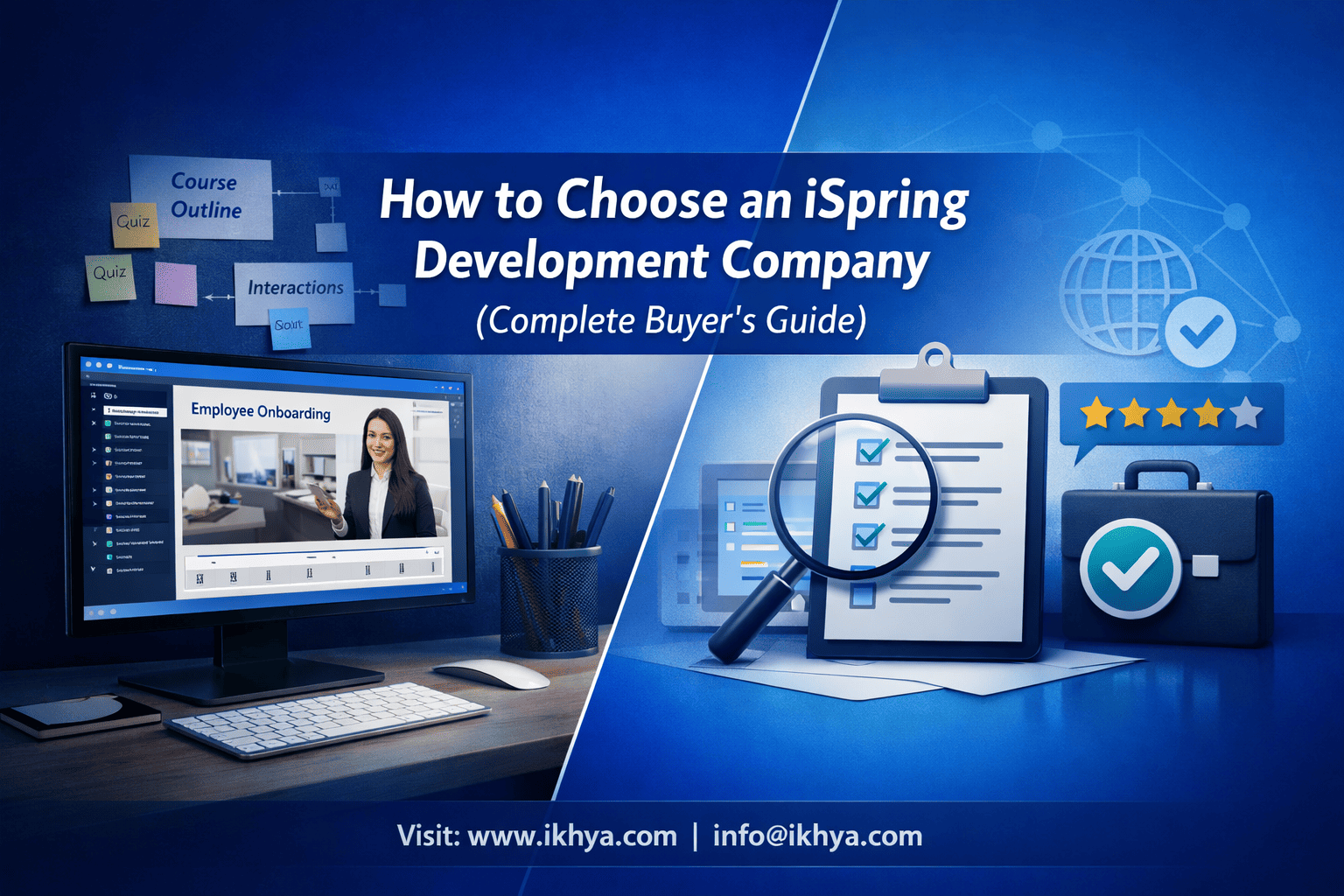
Choosing the right iSpring development company can make or break your corporate training success. With organizations increasingly relying on rapid eLearning, selecting a vendor that understands both technology and instructional design is critical.
If you’re planning to build engaging, scalable courses using iSpring, partnering with the right experts in iSpring eLearning development services ensures faster delivery, better learner engagement, and seamless LMS integration.
You can also explore how iSpring fits your training goals by requesting a free eLearning demo to evaluate real-world course quality before committing.
What is iSpring and When Should You Use It?
iSpring is a rapid eLearning authoring tool designed to convert PowerPoint presentations into interactive, SCORM-compliant courses quickly. It is best suited for organizations that need fast, cost-effective training development without compromising quality.
To understand its full capabilities, refer to this detailed guide on what is iSpring Suite.
Key Features of iSpring Suite
iSpring stands out because of its simplicity and speed. It allows teams to create professional courses without deep technical expertise.
Key features include:
- PowerPoint-based development for quick course creation
- SCORM and xAPI compatibility for LMS integration
- Built-in quiz and assessment tools
- Video-based learning and screen recording
- Mobile-responsive output
- Support for dialog simulations and role-based training
This makes iSpring especially valuable for companies that want to scale training quickly across global teams in regions like the USA, UK, UAE, and Australia.
Ideal Use Cases for iSpring
iSpring is not a one-size-fits-all tool, but it excels in specific scenarios where speed and efficiency matter most.
1. Rapid eLearning Development
When you need courses developed in weeks—not months—iSpring is ideal. It aligns perfectly with rapid eLearning development services for fast deployment.
2. PowerPoint to eLearning Conversion
Organizations with existing PPT-based training can easily transform them into interactive modules using iSpring.
3. Compliance Training
Industries like healthcare, finance, and oil & gas use iSpring for mandatory training due to its speed and consistency.
4. Microlearning Modules
Short, focused learning content can be quickly created using microlearning development services powered by iSpring.
5. Employee Onboarding and Sales Training
iSpring enables fast rollout of onboarding and product training across distributed teams.
When iSpring May Not Be the Best Choice
While iSpring is powerful, it’s not always the right fit.
You may need alternatives if:
- You require highly complex simulations
- You need advanced branching scenarios
- Your project demands custom UI-heavy interactions
In such cases, combining iSpring with broader instructional design services ensures the right tool is selected for each learning objective.
Why Choosing the Right iSpring Development Company Matters
Choosing the right iSpring development company directly impacts the effectiveness, scalability, and ROI of your training programs. A skilled partner ensures your courses are not just fast to build, but also engaging, instructionally sound, and aligned with business goals.
Many organizations underestimate this step and end up with courses that are technically correct but fail to deliver real learning outcomes.
Impact on Training ROI
A capable iSpring vendor goes beyond basic course conversion. They align content with learning objectives, user behavior, and performance outcomes.
Here’s how the right partner improves ROI:
- Higher learner engagement through interactive elements and storytelling
- Better knowledge retention using structured instructional design
- Faster deployment timelines with optimized workflows
- Seamless LMS integration using SCORM/xAPI standards
- Reduced rework costs due to quality-first development
For example, a manufacturing company rolling out safety training globally can significantly reduce incidents if courses are designed with real-world scenarios—not just slides.
This is where combining iSpring expertise with strong instructional design services becomes essential.
Risks of Choosing the Wrong Vendor
Selecting the wrong iSpring development company can lead to hidden costs, delays, and ineffective training.
Common risks include:
- Slide-to-slide conversions without interactivity
- Poor understanding of adult learning principles
- Lack of LMS compatibility testing
- Missed deadlines and inconsistent quality
- No scalability for future training needs
Comparison: Good Vendor vs Poor Vendor
| Criteria | Good iSpring Vendor | Poor iSpring Vendor |
|---|---|---|
| Instructional design | Strong learning strategy | Basic content dumping |
| Interactivity | Scenario-based, engaging | Static slides |
| Speed | Optimized rapid workflows | Delays and rework |
| LMS compatibility | SCORM/xAPI tested | Frequent integration issues |
| Scalability | Supports large rollouts | Limited capability |
| Support | Ongoing maintenance | Minimal post-delivery support |
Why Vendor Selection is a Strategic Decision
Choosing a vendor is not just an operational task—it’s a strategic investment.
Organizations in industries like healthcare, finance, and IT often rely on external partners to scale training efficiently. Instead of building large in-house teams, many prefer to outsource eLearning development to experienced providers.
This approach offers:
- Access to specialized expertise
- Faster turnaround times
- Cost efficiency
- Flexibility for scaling projects
However, outsourcing only works when you choose the right partner.
Real-World Scenario
Consider a global IT company launching product training across multiple regions.
- A poor vendor delivers static courses → low engagement → poor adoption
- A strong iSpring partner creates interactive, localized modules → higher completion rates → improved performance
The difference lies entirely in vendor capability.
5-Step Framework to Choose the Right iSpring Development Company
Choosing the right iSpring development company becomes easier when you follow a structured evaluation framework. Instead of relying on guesswork, this 5-step approach helps you assess vendors based on capability, quality, scalability, and long-term fit.
You can also complement this framework with a broader guide on how to choose the eLearning vendor for enterprise-level decision-making.
Step 1: Define Your Training Goals Clearly
Start by identifying what you want your training to achieve. Without clear goals, even the best vendor cannot deliver effective results.
Ask yourself:
- Are you focusing on compliance, onboarding, or product training?
- Do you need rapid deployment or highly interactive learning?
- What are your target audience and learning outcomes?
- Which regions (USA, UK, UAE, AUS) will the training cover?
Example:
A healthcare company may prioritize compliance accuracy, while a retail brand may focus on customer experience training.
Step 2: Evaluate Technical Expertise in iSpring
Not all eLearning companies specialize in iSpring. You need a vendor with deep expertise in the tool.
Look for:
- Experience with PowerPoint-to-iSpring conversion
- Strong understanding of SCORM and LMS integration
- Ability to create interactive quizzes and simulations
- Experience in rapid eLearning workflows
You can also evaluate their knowledge against benchmarks like rapid eLearning development services to ensure efficiency.
Step 3: Review Portfolio and Case Studies
A vendor’s past work is one of the strongest indicators of future performance.
Check for:
- Industry-specific experience (healthcare, manufacturing, IT)
- Quality of visual design and interactivity
- Real-world learning scenarios
- Measurable results (completion rates, engagement metrics)
If a vendor cannot show relevant examples, it’s a red flag.
Step 4: Assess Instructional Design Capability
iSpring is a tool—but learning effectiveness depends on instructional design.
Ensure the vendor offers:
- Structured learning journeys
- Use of microlearning, storytelling, and scenarios
- Alignment with adult learning principles
- Content optimization for knowledge retention
Strong vendors combine tool expertise with instructional design services to deliver meaningful outcomes.
Step 5: Check Scalability, Support, and Collaboration
Your training needs will grow. The vendor must be able to scale with you.
Evaluate:
- Ability to handle large volumes of courses
- Turnaround time for updates and revisions
- Availability of dedicated project managers
- Post-launch support and maintenance
Quick Evaluation Checklist
| Factor | What to Look For | Why It Matters |
|---|---|---|
| Experience | Proven iSpring projects | Reduces risk |
| Instructional design | Learning-focused approach | Improves outcomes |
| Speed | Rapid development capability | Meets deadlines |
| Technology | LMS compatibility | Avoids integration issues |
| Scalability | Team size and process | Supports growth |
| Communication | Clear workflows | Ensures smooth execution |
Pro Tip: Don’t Evaluate Based on Cost Alone
Many organizations make the mistake of choosing the cheapest vendor. This often leads to poor-quality courses and higher long-term costs.
Instead, focus on:
- Value delivered
- Quality of learning experience
- Long-term partnership potential
Key Criteria for Evaluating an iSpring Vendor
To choose the best iSpring development company, you need clear evaluation criteria that go beyond surface-level promises. The right vendor should balance technical expertise, instructional design, scalability, and business alignment.
This section gives you a practical, side-by-side comparison framework you can use during vendor selection.
Core Evaluation Criteria
Here are the most important factors to assess when comparing iSpring vendors:
- iSpring Expertise – Depth of experience with iSpring Suite and rapid development workflows
- Instructional Design Capability – Ability to create engaging, outcome-driven learning
- Content Conversion Skills – Expertise in transforming PPT, ILT, or PDFs into interactive courses
- LMS Compatibility – Strong understanding of SCORM, xAPI, and LMS environments
- Customization Level – Ability to tailor courses for branding, roles, and industries
- Turnaround Time – Speed without compromising quality
- Quality Assurance Process – Testing, feedback loops, and iteration cycles
- Post-Launch Support – Maintenance, updates, and scalability
Vendor Comparison Table
| Criteria | High-Quality iSpring Vendor | Average Vendor | Low-Quality Vendor |
|---|---|---|---|
| Tool expertise | Advanced iSpring capabilities | Basic usage | Limited knowledge |
| Instructional design | Strategy-driven learning | Moderate structure | Slide-based content |
| Interactivity | Scenario-based, engaging | Some interactivity | Static slides |
| LMS compatibility | Fully SCORM/xAPI tested | Partial testing | Frequent issues |
| Speed | Optimized rapid workflows | Moderate delays | Slow, inconsistent |
| Customization | High flexibility | Limited options | Generic output |
| QA process | Multi-level testing | Basic QA | Minimal/no QA |
| Support | Ongoing partnership | Limited support | No support |
Content Conversion Capability (Critical Factor)
Many iSpring projects involve converting existing materials into eLearning. Your vendor must handle this efficiently.
Look for expertise in:
- PowerPoint to interactive course transformation
- Instructor-led training (ILT) conversion
- PDF and document-based content restructuring
You can explore how this process works in detail through convert PowerPoint to eLearning – complete guide.
Instructional Design vs Just Development
One of the biggest differentiators between vendors is whether they design learning experiences or simply develop content.
| Approach | Outcome |
|---|---|
| Development-only | Static courses, low engagement |
| Instructional design + development | Interactive, outcome-driven training |
Vendors that integrate instructional design services deliver significantly better results, especially for compliance-heavy industries like healthcare and finance.
Scalability & Long-Term Partnership
Choosing a vendor is not a one-time decision. You need a partner who can grow with your organization.
Evaluate:
- Ability to handle multi-course programs
- Support for global rollouts
- Experience with multi-language training
- Flexibility in engagement models (project-based, dedicated team)
Red Flag Indicators
Watch out for these warning signs:
- No clear development process
- Lack of real portfolio examples
- Overpromising timelines
- No LMS testing experience
- Poor communication during early discussions
Quick Decision Framework
Use this simple scoring model when comparing vendors:
| Criteria | Weight | Vendor Score (1–5) |
|---|---|---|
| Expertise | 25% | |
| Instructional design | 20% | |
| Speed | 15% | |
| Cost-value ratio | 15% | |
| Scalability | 15% | |
| Communication | 10% |
This helps you make data-driven decisions instead of subjective judgments.
iSpring Development Cost Breakdown
The cost of hiring an iSpring development company varies based on project complexity, content type, and level of interactivity. On average, iSpring projects are more cost-effective than custom development, making them ideal for rapid corporate training.
For a deeper breakdown, you can explore the cost of iSpring course development to benchmark your budget.
Average Cost by Project Type
iSpring pricing is typically calculated per course hour or per project.
| Project Type | Estimated Cost (USD) | Timeline |
|---|---|---|
| Basic PPT to eLearning | $1,000 – $3,000 per hour | 1–2 weeks |
| Interactive course | $3,000 – $7,000 per hour | 2–4 weeks |
| Scenario-based training | $6,000 – $10,000 per hour | 3–6 weeks |
| Video-based learning | $2,000 – $5,000 per hour | 2–3 weeks |
| Microlearning modules | $500 – $2,000 per module | 3–7 days |
Key Factors That Influence Cost
Understanding what drives pricing helps you control your budget and avoid surprises.
1. Content Complexity
- Static slides cost less
- Scenario-based and branching logic increase cost
2. Level of Interactivity
- Basic quizzes vs advanced simulations
- Gamification elements
3. Content Source
- Ready PPT content vs raw documents
- Need for restructuring or rewriting
4. Instructional Design Requirements
- Strategy, storyboarding, and learning flow
- Alignment with business outcomes
5. Multimedia Elements
- Videos, voiceovers, animations
- Custom graphics and branding
6. Localization & Multi-language Support
- Translation and cultural adaptation for global teams
Cost Optimization Strategies
You don’t always need to increase budget to improve quality. Smart planning can significantly reduce costs.
Best practices:
- Start with well-structured content
- Use standard templates where possible
- Prioritize high-impact modules
- Break large courses into microlearning units using microlearning development services
- Choose vendors experienced in rapid eLearning workflows
Cost vs Value Comparison
| Approach | Cost | Value Delivered |
|---|---|---|
| Low-cost vendor | Low upfront | Poor engagement, rework costs |
| Mid-range vendor | Balanced | Good quality and efficiency |
| Premium vendor | Higher upfront | High ROI, scalable training |
Hidden Costs to Watch Out For
Many organizations overlook hidden expenses that can inflate the total project cost.
Be cautious of:
- Multiple revision cycles
- LMS compatibility fixes
- Poor-quality outputs requiring rework
- Lack of documentation or source files
Budgeting Tip for Enterprises
If you’re planning large-scale training programs, consider long-term partnerships instead of one-off projects.
Many organizations choose to outsource eLearning development to reduce costs while maintaining consistent quality across multiple courses.
Real-World Scenario
A global finance company needed compliance training for 5,000 employees:
- Low-cost vendor → basic slides → low completion rates
- Experienced iSpring partner → interactive modules → higher compliance adherence
Result: Better ROI despite slightly higher upfront investment.
In-House vs Outsourcing iSpring Development
Deciding between in-house development and outsourcing is a critical step when choosing an iSpring development company. The right choice depends on your budget, timelines, internal capabilities, and long-term training strategy.
For most organizations, especially enterprises, outsourcing provides faster scalability and access to specialized expertise.
Quick Comparison: In-House vs Outsourced Development
| Factor | In-House Team | Outsourced iSpring Vendor |
|---|---|---|
| Cost | High (salaries, tools, training) | Flexible, project-based |
| Speed | Slower due to limited bandwidth | Faster with dedicated teams |
| Expertise | Limited to internal skills | Access to specialists |
| Scalability | Difficult to scale quickly | Easily scalable |
| Technology | May lack latest practices | Up-to-date tools & standards |
| Maintenance | Internal responsibility | Often included in support |
When In-House Development Makes Sense
Building an internal team can work if your organization has consistent and long-term training needs.
Choose in-house if:
- You produce large volumes of training regularly
- You already have instructional designers and developers
- You need full control over content and processes
- Budget is not a major constraint
However, even in-house teams often struggle with speed and advanced interactivity.
When Outsourcing is the Better Option
Outsourcing is ideal when you need expertise, speed, and flexibility without building a full team.
Most companies today prefer to outsource eLearning development for the following reasons:
- Faster turnaround times
- Access to experienced iSpring specialists
- Ability to scale across multiple projects
- Reduced operational overhead
- Consistent quality across courses
Hybrid Approach (Best of Both Worlds)
Many enterprises adopt a hybrid model:
- In-house team handles strategy and content
- External vendor handles development and scaling
This approach ensures:
- Better control
- Faster execution
- Cost optimization
Cost Comparison Overview
| Cost Component | In-House | Outsourcing |
|---|---|---|
| Hiring | High | None |
| Tools & licenses | Required | Included |
| Training | Ongoing | Not required |
| Project cost | Fixed overhead | Flexible |
| Long-term ROI | Depends on utilization | High with right vendor |
Real-World Scenario
A manufacturing company needed to convert ILT training into eLearning:
- In-house team → slow development, limited interactivity
- Outsourced iSpring partner → rapid rollout across regions
Outcome: Faster deployment and improved training consistency across plants in the USA, UK, and UAE.
Key Takeaway
If your goal is speed, scalability, and expertise, outsourcing is usually the better choice.
If your goal is control and long-term internal capability, in-house may work.
For most organizations, a trusted iSpring development company delivers the best balance of cost, quality, and efficiency.
Red Flags to Avoid When Hiring an iSpring Vendor
Choosing an iSpring development company is not just about finding capability—it’s about avoiding costly mistakes. The wrong vendor can lead to delays, poor learner engagement, and wasted budget.
Before finalizing your decision, watch for these critical warning signs.
1. “Slide Conversion Only” Approach
If a vendor simply converts PowerPoint slides into eLearning without adding interactivity, it’s a major red flag.
Why this matters:
- Results in low engagement
- Poor knowledge retention
- Minimal training impact
A strong vendor enhances content with scenarios, quizzes, and storytelling—not just slides.
2. Lack of Instructional Design Expertise
iSpring is easy to use—but effective learning is not.
Avoid vendors who:
- Skip learning objectives
- Don’t provide storyboards
- Focus only on visuals, not outcomes
Quality vendors integrate instructional design services into every project.
3. No LMS or SCORM/xAPI Experience
Your courses must work seamlessly within your LMS.
Warning signs include:
- No mention of SCORM or xAPI
- No testing process for LMS compatibility
- Issues with tracking and reporting
This can lead to serious deployment problems later.
4. Unrealistic Timelines
Be cautious of vendors promising extremely fast delivery without understanding your requirements.
Common issues:
- Compromised quality
- Lack of testing
- Missed deadlines
A reliable partner balances speed with structured workflows, especially in rapid eLearning development services.
5. No Portfolio or Case Studies
If a vendor cannot show past work, it’s a strong indicator of inexperience.
You should always ask for:
- Industry-specific examples
- Before-and-after transformations
- Measurable results
6. Poor Communication and Process Clarity
Early communication reflects future collaboration.
Red flags include:
- Delayed responses
- No defined workflow
- Unclear project ownership
This often leads to confusion, delays, and rework.
7. No Post-Launch Support
eLearning is not a one-time project. Courses require updates, revisions, and scaling.
Avoid vendors who:
- Offer no maintenance
- Don’t provide source files
- Disappear after delivery
Red Flag Summary Table
| Red Flag | Risk | Impact |
|---|---|---|
| Slide-only development | Low engagement | Poor ROI |
| No instructional design | Ineffective learning | Low retention |
| No LMS expertise | Technical failures | Deployment delays |
| Unrealistic timelines | Poor quality | Rework costs |
| No portfolio | High uncertainty | Risky investment |
| Poor communication | Delays | Project misalignment |
| No support | Maintenance issues | Long-term inefficiency |
Quick Tip: Validate Before You Commit
Before signing a contract:
- Request a sample module or pilot project
- Evaluate communication responsiveness
- Review technical and instructional capabilities
- Align on timelines and expectations
If you’re unsure how to evaluate vendors, refer back to this guide on how to choose the eLearning vendor for a broader framework.
Real-World Use Cases Across Industries
iSpring is widely used across industries because of its speed, flexibility, and cost-effectiveness. The right iSpring development company can tailor solutions to meet industry-specific training needs, ensuring both compliance and performance improvement.
Below are real-world scenarios showing how organizations successfully use iSpring for corporate training.
Healthcare: Compliance and Regulatory Training
Healthcare organizations require accurate, consistent, and audit-ready training programs.
Use case:
A hospital group needed HIPAA and compliance training for staff across multiple locations.
Solution:
- Converted PPT-based content into interactive iSpring modules
- Added scenario-based learning for patient data handling
- Integrated assessments for compliance tracking
Result:
- Higher completion rates
- Improved audit readiness
- Reduced compliance risks
This approach aligns well with structured healthcare training eLearning solutions.
Manufacturing: Safety and Process Training
Manufacturing companies need scalable training for safety, equipment handling, and SOPs.
Use case:
A global manufacturing firm wanted to standardize safety training across plants in the USA, UK, and UAE.
Solution:
- Developed microlearning modules for safety procedures
- Used visuals and simulations for equipment training
- Enabled multilingual delivery
Result:
- Reduced workplace incidents
- Faster onboarding of new employees
- Consistent training across regions
These outcomes are commonly achieved through manufacturing training eLearning solutions.
IT & Software: Product and Technical Training
IT companies often need to train employees and customers on complex products.
Use case:
A SaaS company required product training for global teams and clients.
Solution:
- Created interactive walkthroughs using iSpring
- Developed video-based tutorials and quizzes
- Integrated courses into LMS for tracking
Result:
- Faster product adoption
- Reduced support queries
- Improved customer onboarding
This is a typical application of IT software training eLearning solutions.
Finance: Compliance and Risk Training
Financial institutions require strict compliance training with measurable outcomes.
Use case:
A banking organization needed anti-money laundering (AML) training for employees.
Solution:
- Built scenario-based modules with real-life case examples
- Added knowledge checks and certifications
- Ensured SCORM compliance for tracking
Result:
- Increased compliance adherence
- Better risk awareness
- Improved audit performance
Retail: Customer Experience Training
Retail companies focus on customer interaction and sales performance.
Use case:
A retail chain wanted to train frontline staff on customer service and upselling.
Solution:
- Developed role-play scenarios
- Created short mobile-friendly modules
- Used quizzes to reinforce learning
Result:
- Improved customer satisfaction
- Increased sales conversion rates
- Faster employee onboarding
Key Takeaway
Across industries, the success of iSpring projects depends less on the tool and more on the capability of the development partner.
A skilled vendor ensures:
- Industry-specific customization
- Engaging and practical learning experiences
- Measurable business outcomes
Questions to Ask Before Hiring an iSpring Development Company
Before selecting an iSpring development company, you should ask the right questions to evaluate their expertise, process, and reliability. These questions help you uncover gaps, avoid risks, and ensure the vendor aligns with your training goals.
1. What is Your Experience with iSpring Projects?
Start by understanding their depth of experience.
Ask:
- How many iSpring projects have you completed?
- Can you share industry-specific examples?
- Have you handled projects similar to ours?
What to look for:
Proven experience across industries like healthcare, manufacturing, or IT.
2. What is Your Development Process?
A structured process ensures consistency and quality.
Ask:
- Do you follow a defined workflow (analysis → design → development → QA)?
- How do you manage timelines and revisions?
- What tools do you use for collaboration?
Tip:
A mature process often aligns with broader enterprise eLearning development processes.
3. How Do You Ensure Instructional Quality?
This question separates average vendors from expert partners.
Ask:
- Do you provide storyboards before development?
- How do you ensure engagement and retention?
- Do you offer instructional design services?
What to expect:
A vendor who focuses on learning outcomes—not just content delivery.
4. How Do You Handle LMS Integration?
Technical compatibility is critical.
Ask:
- Do you support SCORM, xAPI, and LMS testing?
- Have you worked with our LMS before?
- How do you handle tracking and reporting issues?
Why it matters:
Poor integration can delay deployment and affect reporting accuracy.
5. What is Your Pricing Model?
Understanding pricing helps avoid unexpected costs.
Ask:
- Do you charge per hour, per course, or per project?
- What is included in the cost (design, development, revisions)?
- Are there additional charges for updates or localization?
You can compare responses against benchmarks like cost of iSpring course development.
6. What is Your Turnaround Time?
Speed is important—but not at the expense of quality.
Ask:
- How long will it take to deliver a typical course?
- How do you handle urgent projects?
What to look for:
Realistic timelines supported by rapid development workflows.
7. Do You Provide Post-Launch Support?
Training content evolves over time.
Ask:
- Do you offer maintenance and updates?
- Will we receive source files?
- How quickly can changes be implemented?
8. Can We Start with a Pilot Project?
A pilot helps you evaluate the vendor before committing fully.
Ask:
- Can you create a sample module?
- What will it cost and how long will it take?
Best practice:
Always test before scaling.
Quick Question Checklist
| Category | Key Focus |
|---|---|
| Experience | Proven iSpring expertise |
| Process | Structured workflow |
| Instructional design | Learning effectiveness |
| Technology | LMS compatibility |
| Cost | Transparent pricing |
| Timeline | Realistic delivery |
| Support | Long-term partnership |
Pro Tip: Document Everything
Before finalizing the vendor:
- Create a requirement document or RFP
- Define scope, timelines, and deliverables
- Align expectations early
You can simplify this process using an eLearning RFP template guide.
Final Checklist for Choosing the Right iSpring Development Company
Choosing the right iSpring development company becomes straightforward when you follow a structured checklist. This ensures you evaluate vendors objectively and avoid costly mistakes.
Use the checklist below before making your final decision.
Complete Vendor Evaluation Checklist
| Category | What to Verify | Status (✓/✗) |
|---|---|---|
| Experience | Proven iSpring project portfolio | |
| Industry expertise | Relevant domain experience (healthcare, IT, manufacturing) | |
| Instructional design | Strong learning strategy and storyboarding | |
| Interactivity | Scenario-based and engaging courses | |
| LMS compatibility | SCORM/xAPI tested | |
| Development speed | Ability to meet timelines | |
| Communication | Clear process and responsiveness | |
| Cost transparency | No hidden charges | |
| Scalability | Ability to handle large projects | |
| Support | Post-launch maintenance and updates |
Decision-Making Framework
To simplify your final decision, shortlist 2–3 vendors and compare them using these factors:
- Capability – Do they meet your technical and instructional needs?
- Compatibility – Do they understand your industry and audience?
- Cost vs Value – Are you getting long-term ROI, not just low pricing?
- Collaboration – Are they easy to work with?
When to Move Forward with a Vendor
You can confidently proceed when:
- The vendor provides relevant case studies
- Their process is clear and structured
- They demonstrate both iSpring expertise and instructional design strength
- Pricing and timelines are transparent and realistic
- A pilot project or demo meets expectations
When to Reconsider
Pause or reconsider if:
- Communication is inconsistent
- They avoid sharing detailed proposals
- Pricing is unclear or too low to be realistic
- No LMS or compliance experience is shown
Pro Tip: Use an RFP for Clarity
For enterprise-level projects, always formalize your requirements.
- Define objectives, timelines, and deliverables
- Request structured proposals from vendors
- Compare responses objectively
You can streamline this process using this eLearning RFP template guide.
Ready to Choose the Right Partner?
If you’re looking for a reliable partner, IKHYA – eLearning Solutions Company specializes in delivering high-quality iSpring-based training tailored to your business needs.
With expertise in rapid eLearning, instructional design, and global training deployment, IKHYA helps organizations build scalable and engaging learning solutions.
You can:
- Explore company expertise on the About IKHYA page
- Submit your requirements through a Request for Proposal
- Or directly contact the team to discuss your project
Email: info@ikhya.com
Conclusion
Choosing the right iSpring development company is a strategic decision that directly impacts your training success. It’s not just about technical capability—it’s about finding a partner who understands learning, business goals, and scalability.
By following a structured framework, evaluating vendors carefully, and focusing on long-term value, you can ensure your investment delivers measurable results.
FAQs
1. What is an iSpring development company?
An iSpring development company specializes in creating eLearning courses using iSpring tools, including PowerPoint-based training, quizzes, simulations, and SCORM-compliant modules.
2. How do I choose the best iSpring vendor?
Use a structured approach:
- Define training goals
- Evaluate expertise and portfolio
- Assess instructional design capability
- Compare cost and scalability
3. What is the average cost of iSpring development?
Costs typically range from:
- $1,000–$3,000 per hour for basic courses
- $3,000–$10,000 per hour for advanced interactive training
4. Is iSpring suitable for corporate training?
Yes, iSpring is ideal for compliance training, onboarding programs, product training, and microlearning modules.
5. Should I outsource iSpring development?
Outsourcing is recommended if you need faster delivery, expert teams, and scalable training solutions.
6. What industries use iSpring the most?
Healthcare, manufacturing, IT/software, finance, and retail industries commonly use iSpring.
7. How long does it take to develop an iSpring course?
Basic courses take 1–2 weeks, while interactive courses may take 2–6 weeks depending on complexity.
8. Can iSpring courses integrate with LMS platforms?
Yes, iSpring supports SCORM, xAPI, and AICC standards for seamless LMS integration.
9. What types of content can be converted into iSpring courses?
PowerPoint presentations, PDFs, Word documents, and instructor-led training materials can all be converted into iSpring-based eLearning.
10. What is the difference between iSpring and Articulate Storyline?
iSpring is ideal for rapid, PowerPoint-based development, while Storyline is better for complex interactions and custom designs.
11. Is iSpring good for microlearning?
Yes, iSpring is highly effective for creating short, focused microlearning modules quickly.
12. Do iSpring vendors provide instructional design services?
Top vendors offer both development and instructional design to ensure courses are engaging and effective.
13. How do I evaluate an iSpring vendor’s portfolio?
Look for industry relevance, interactivity, visual quality, and measurable results like completion rates.
14. What are the risks of choosing the wrong vendor?
Risks include poor engagement, delays, LMS issues, and increased long-term costs due to rework.
15. Can iSpring be used for compliance training?
Yes, it is widely used for compliance training due to its speed, consistency, and tracking capabilities.
16. Do I need technical expertise to use iSpring?
No, iSpring is designed for ease of use, especially for teams familiar with PowerPoint.
17. What is rapid eLearning in iSpring?
Rapid eLearning refers to quickly developing courses using existing content and templates within tools like iSpring.
18. How scalable is iSpring for large organizations?
iSpring is highly scalable and supports global training deployment across multiple teams and locations.
19. What should be included in an iSpring project proposal?
A proposal should include scope, timelines, cost, deliverables, instructional approach, and support details.
20. Can iSpring courses be updated easily?
Yes, courses can be quickly updated by modifying the original PowerPoint file and republishing.
Related Resources
Explore these carefully selected resources to deepen your understanding of iSpring development, compare tools, and make more informed vendor decisions: