Lectora Inspire vs Articulate Storyline: A Strategic Comparison for Enterprise eLearning Development

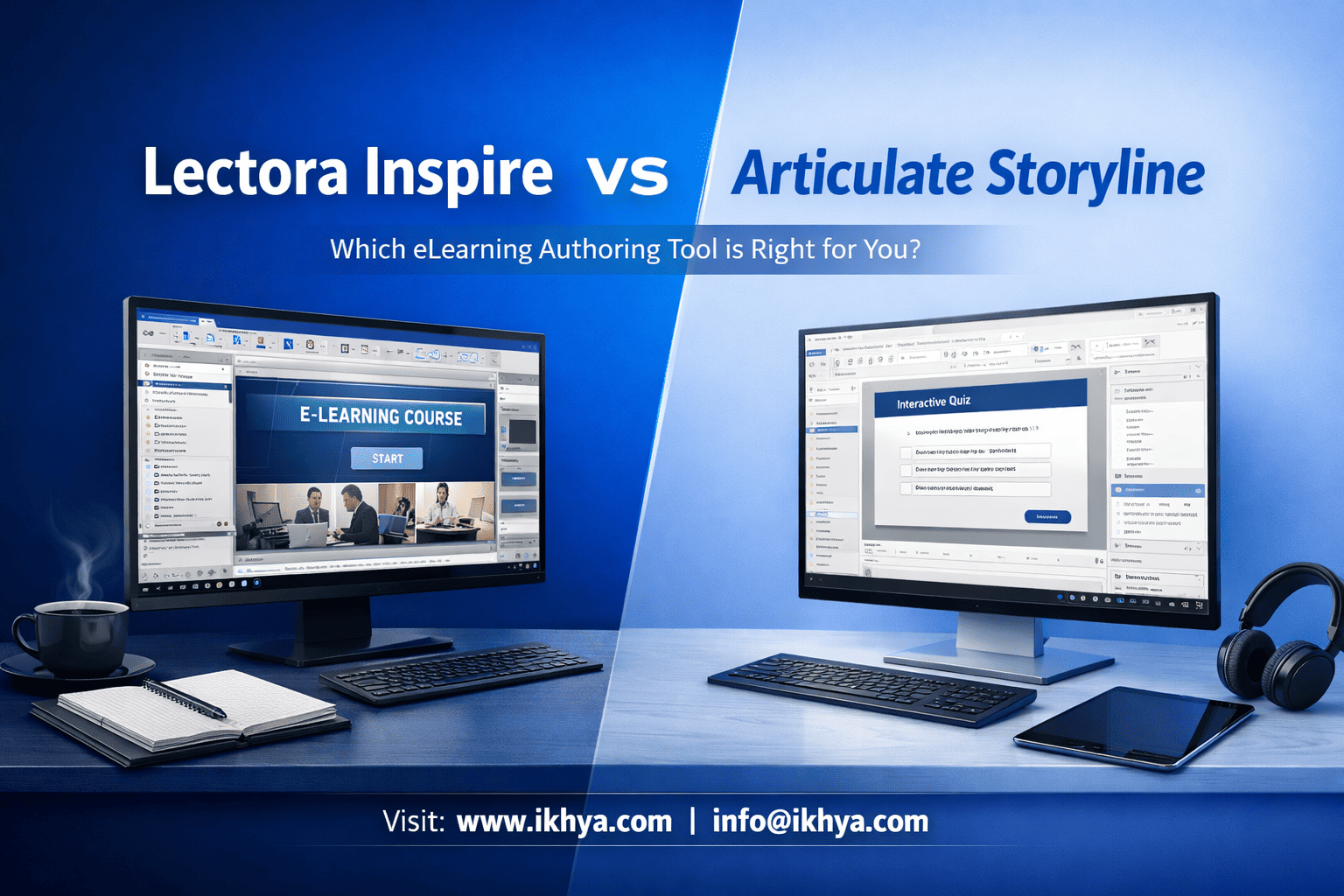
Selecting between Lectora Inspire and Articulate Storyline depends on your organization’s training goals, compliance needs, scalability expectations, and development workflows. The right choice directly impacts cost, speed, learner engagement, and LMS performance across global enterprise environments.
For L&D leaders, this is not just a tool decision—it’s a long-term strategic investment affecting training outcomes and operational efficiency.
If you’re evaluating tools for an upcoming project, you can explore a tailored solution through a Book a Free eLearning Demo to understand how enterprise teams align tool selection with business goals.
Modern enterprise learning ecosystems involve multiple variables:
- LMS compatibility (SCORM, xAPI)
- Global compliance requirements
- Rapid deployment needs
- Multi-device learning environments
- Localization at scale
Many organizations start with internal development but later shift toward scalable models using corporate eLearning development strategies to reduce cost and improve speed.
This is where choosing between Lectora Inspire and Articulate Storyline becomes critical.
What is Lectora Inspire and Articulate Storyline? (Quick Overview)
Lectora Inspire and Articulate Storyline are enterprise-grade eLearning authoring tools used to design interactive digital training. While both support SCORM and xAPI and integrate with LMS platforms, they differ significantly in accessibility, customization depth, and development workflows.
Lectora Inspire Overview
Lectora Inspire is widely used in enterprises that require strict compliance, accessibility, and scalable global deployment. It is known for its strong support for WCAG standards and Section 508 compliance.
Key capabilities:
- Built-in accessibility features (screen reader support, keyboard navigation)
- Advanced scripting and customization control
- Responsive design with device-specific optimization
- Seamless LMS integration with SCORM, xAPI, AICC
Enterprise use cases:
- Healthcare compliance training
- Financial services regulatory training
- Government and aviation learning programs
- Multi-language global workforce training
Lectora is often preferred in regions like the UK and USA where compliance standards are strict and audited.
Articulate Storyline Overview
Articulate Storyline is known for its intuitive interface and powerful interactivity capabilities. It is widely adopted by corporate training teams for rapid content development and engaging learner experiences.
Key capabilities:
- Slide-based development similar to PowerPoint
- Advanced triggers, variables, and animations
- Scenario-based and simulation training
- Strong community and asset ecosystem
Enterprise use cases:
- Employee onboarding
- Sales enablement training
- Product training modules
- Customer experience training
Storyline is especially popular in fast-paced industries like retail, IT, and SaaS, where speed and engagement are key.
Strategic Insight
At an enterprise level, the decision is rarely about which tool is “better.”
It is about:
- Which tool aligns with your compliance environment
- Which supports your LMS ecosystem
- Which fits your internal or outsourced development model
Organizations that evaluate tools in isolation often face scalability and maintenance challenges later.
If you’re unsure which tool aligns with your training strategy, a structured evaluation or pilot can help. Many enterprises begin this process by aligning tool capabilities with vendor expertise before moving to development.
Lectora vs Storyline: Feature-by-Feature Enterprise Comparison
Lectora Inspire and Articulate Storyline differ across usability, compliance, interactivity, and scalability. While Storyline excels in rapid, interactive development, Lectora stands out in accessibility and large-scale enterprise deployment, making the choice highly dependent on training type and regulatory needs.
Enterprise Comparison Table
| Feature | Lectora Inspire | Articulate Storyline |
|---|---|---|
| Ease of Use | Moderate (developer-oriented) | Easy (PowerPoint-like UI) |
| Accessibility (WCAG, 508) | Strong native support | Limited, requires manual effort |
| Interactivity | Moderate | Advanced (triggers, variables) |
| Responsive Design | True responsive (device-based) | Limited (responsive player) |
| LMS Compatibility | SCORM, xAPI, AICC | SCORM, xAPI, AICC |
| Localization | Strong multi-language support | Moderate |
| Scalability | High for enterprise rollouts | Moderate to high |
| Development Speed | Slower | Faster |
Ease of Use & Learning Curve
Articulate Storyline is easier to learn due to its familiar slide-based interface. Teams with PowerPoint experience can quickly start building courses.
Lectora, however, requires more technical understanding but offers deeper control. It is better suited for experienced instructional designers and developers.
Accessibility & Compliance (WCAG, Section 508)
Lectora is built with accessibility at its core, making it ideal for compliance-heavy industries.
Storyline can achieve accessibility, but it requires manual adjustments and careful design practices, increasing development time.
Interactivity & Customization
Storyline leads in creating highly interactive learning experiences such as:
- Simulations
- Branching scenarios
- Gamified modules
Lectora supports interactivity but is more structured and less flexible compared to Storyline.
Responsive Design Capabilities
Lectora offers true responsive design, allowing content to adapt dynamically across devices.
Storyline uses a responsive player, meaning layouts remain fixed while adjusting to screen size.
LMS Compatibility (SCORM, xAPI, AICC)
Both tools support standard LMS protocols, making them compatible with enterprise LMS platforms.
If your organization is planning scalable deployment, consider solutions like LMS-compatible eLearning development services to ensure seamless integration and tracking.
Localization & Multi-language Support
Lectora is more efficient for large-scale localization projects due to its structured content handling.
Storyline supports localization but becomes complex when managing multiple languages across large course libraries.
Performance & Scalability
For global enterprises handling thousands of learners, Lectora provides better control and scalability.
Storyline performs well for mid-scale deployments but may require optimization in large ecosystems.
At this stage, enterprises typically move from comparison to evaluation.
To structure this process effectively and align tool selection with business goals, many organizations initiate a formal requirement discussion through a Request an eLearning RFP.
When to Choose Lectora Inspire for Enterprise Training
Lectora Inspire is the right choice when compliance, accessibility, and scalability are your top priorities. It is particularly effective for regulated industries and global organizations managing complex training ecosystems.
Ideal Use Cases for Lectora
Choose Lectora Inspire if your organization requires:
- Strict compliance (WCAG, Section 508, GDPR training)
- Large-scale multilingual deployment
- Government or regulatory training programs
- Long-term content maintenance and updates
- Complex LMS integrations
Industry-Specific Applications
USA (Corporate Compliance Training)
Organizations in healthcare and finance use Lectora for HIPAA, OSHA, and regulatory training where accessibility is mandatory.
UK (Compliance & Accessibility Standards)
Public sector and enterprise companies rely on Lectora to meet strict accessibility laws and inclusive learning requirements.
Australia (Vocational Training Standards)
Training providers use Lectora for structured, compliance-driven learning aligned with national frameworks.
UAE (Enterprise Learning Initiatives)
Large enterprises implement Lectora for workforce upskilling programs with multilingual needs.
Strategic Advantage
Lectora is not just a tool—it is a long-term platform for organizations that:
- Prioritize compliance over speed
- Require centralized governance
- Manage global learning ecosystems
However, Lectora requires skilled development resources. Many enterprises overcome this challenge by leveraging specialized partners for scalable implementation.
When to Choose Articulate Storyline for Corporate Training
Articulate Storyline is best suited for enterprises that prioritize speed, interactivity, and engaging learner experiences. It enables rapid development of scenario-based training, making it ideal for dynamic business environments where training needs evolve quickly.
Ideal Use Cases for Storyline
Choose Articulate Storyline if your organization needs:
- Fast turnaround for training deployment
- Highly interactive learning (simulations, branching scenarios)
- Visually rich and engaging courses
- Frequent updates to training content
- Strong internal L&D team with limited coding expertise
Industry-Specific Applications
Retail & Customer Experience Training
Storyline is widely used to create role-play scenarios and customer interaction simulations.
IT & Software Training
Organizations use Storyline to build system simulations and product walkthroughs.
Sales Enablement Programs
Interactive modules help sales teams practice real-world scenarios and decision-making.
Employee Onboarding
Companies deploy Storyline for immersive onboarding experiences with guided workflows.
Strategic Advantage
Storyline allows enterprises to:
- Reduce development time significantly
- Improve learner engagement and retention
- Rapidly scale training programs
For organizations focused on speed and engagement rather than compliance-heavy requirements, Storyline becomes the preferred choice.
Cost Comparison: Lectora vs Storyline for Enterprises
The cost difference between Lectora Inspire and Articulate Storyline depends on licensing, development complexity, maintenance, and whether you build in-house or outsource. Storyline is generally faster to develop, while Lectora may reduce long-term compliance costs.
Cost Comparison Table
| Cost Factor | Lectora Inspire | Articulate Storyline |
|---|---|---|
| Licensing | Moderate to High | Moderate |
| Development Time | Higher | Lower |
| Development Cost | Higher initially | Lower initially |
| Maintenance | Lower (structured) | Moderate |
| Accessibility Cost | Lower (built-in) | Higher (manual effort) |
Licensing Costs
Both tools operate on subscription or licensing models.
- Lectora may involve higher upfront investment
- Storyline offers flexible pricing and is widely adopted
Development Costs
Storyline reduces development cost due to:
- Faster build time
- Easier onboarding of developers
Lectora requires experienced developers, increasing initial cost but improving long-term scalability.
Maintenance & Updates
Lectora’s structured architecture makes updates easier in large-scale deployments.
Storyline may require manual adjustments when updating complex interactions.
Outsourcing vs In-house Cost Impact
Enterprises often reduce costs by outsourcing development instead of building internal teams.
A structured approach like in-house vs outsourced eLearning development cost comparison helps organizations evaluate:
- Resource cost
- Timeline efficiency
- Quality control
At this stage, most enterprises move toward a structured evaluation process before finalizing the tool.
To align cost, scope, and implementation strategy with business goals, many organizations formalize requirements through a Request an eLearning RFP.
Enterprise Decision Framework: How to Choose the Right Tool
Choosing between Lectora and Storyline requires evaluating business goals, compliance needs, team capabilities, and long-term scalability. A structured decision framework helps enterprises avoid costly mistakes and align tool selection with strategic training objectives.
Key Evaluation Criteria
Use the following checklist:
1. Training Type
- Compliance training → Lectora
- Interactive training → Storyline
2. Compliance Requirements
- Strict accessibility → Lectora
- Standard corporate training → Storyline
3. Team Capability
- Experienced developers → Lectora
- Non-technical teams → Storyline
4. Timeline
- Urgent deployment → Storyline
- Long-term structured rollout → Lectora
5. LMS Ecosystem
- Complex LMS integrations → Lectora
- Standard LMS usage → Storyline
Decision Matrix
| Scenario | Recommended Tool |
|---|---|
| Regulatory compliance training | Lectora |
| Sales & customer training | Storyline |
| Global multilingual rollout | Lectora |
| Rapid onboarding programs | Storyline |
| Long-term enterprise training ecosystem | Lectora |
Strategic Recommendation
Instead of choosing a single tool, many enterprises adopt a hybrid strategy:
- Lectora for compliance training
- Storyline for engagement-focused modules
This approach balances compliance, speed, and learner experience.
At this decision stage, expert consultation becomes critical to avoid misalignment between tools and enterprise goals.
You can discuss your requirements with specialists via Contact IKHYA Experts to design a scalable and future-ready eLearning strategy.
LMS Integration and Technical Considerations
Lectora Inspire and Articulate Storyline both integrate with enterprise LMS platforms using standards like SCORM, xAPI, and AICC. However, Lectora offers deeper control over tracking and data handling, while Storyline focuses on ease of deployment and standard reporting.
SCORM, xAPI, and cmi5 Compatibility
Both tools support major eLearning standards:
- SCORM (1.2, 2004) for structured tracking
- xAPI (Tin Can API) for advanced learning analytics
- AICC for legacy systems
Lectora provides more granular control over tracking variables, which is useful for compliance-heavy reporting.
Storyline supports these standards effectively but with slightly less flexibility in custom tracking logic.
Integration with Enterprise LMS Platforms
In enterprise environments, LMS integration goes beyond uploading courses.
It involves:
- User role mapping
- Multi-tenant deployment
- API-based integrations
- Reporting dashboards
Organizations implementing large-scale learning ecosystems often rely on LMS-compatible eLearning course development services to ensure seamless deployment across platforms like Cornerstone, Moodle, and SuccessFactors.
Learning Analytics and Reporting
Lectora enables advanced tracking capabilities, allowing organizations to:
- Capture granular learner interactions
- Track compliance completion in detail
- Generate audit-ready reports
Storyline provides standard tracking suitable for:
- Completion rates
- Quiz scores
- Basic learner behavior
For enterprises leveraging data-driven L&D strategies, Lectora provides a stronger analytics foundation.
Data Security and Governance
Global organizations must ensure:
- GDPR compliance (EU)
- Data privacy standards (USA, UK)
- Secure LMS communication
Lectora’s structured framework makes governance easier in regulated industries.
Storyline can meet these requirements but often requires additional configuration.
Outsourcing Strategy: Lectora vs Storyline Development
Outsourcing eLearning development helps enterprises reduce costs, accelerate timelines, and access specialized expertise. The choice between Lectora and Storyline significantly influences the outsourcing model, required skill sets, and project governance.
When to Outsource
Enterprises typically outsource when they need:
- Faster project delivery
- Access to experienced instructional designers
- Scalable development teams
- Cost optimization
A structured approach like eLearning outsourcing guide for enterprises helps define the right engagement model.
Dedicated Development Teams vs Freelancers
Freelancers
- Suitable for small projects
- Limited scalability
- Higher risk in quality consistency
Dedicated Teams
- Scalable and structured
- Better governance and QA processes
- Ideal for enterprise-level projects
Quality, Speed, and Cost Trade-offs
| Factor | Lectora | Storyline |
|---|---|---|
| Development Speed | Slower | Faster |
| Quality Control | High (structured) | High (design-driven) |
| Cost Efficiency | Long-term | Short-term |
Governance and Project Management Models
Successful outsourcing requires:
- Defined workflows
- Version control systems
- Review cycles
- SME collaboration
Enterprises often combine instructional design, development, and QA into a unified delivery model for better outcomes.
At this stage, organizations typically finalize vendor selection criteria.
Before moving forward, many enterprises initiate structured discussions through a Request an eLearning RFP to align scope, timelines, and budget expectations.
Why Enterprises Partner with IKHYA for eLearning Development
Enterprises partner with IKHYA because they need more than just course development—they need a strategic eLearning partner who understands business goals, compliance requirements, and global deployment challenges.
IKHYA delivers scalable, high-quality solutions across tools like Lectora Inspire and Articulate Storyline while aligning with enterprise learning strategies.
What Makes IKHYA Different
- Tool-agnostic expertise (Lectora, Storyline, Rise, Captivate)
- Strong instructional design foundation
- Global delivery capability
- Experience across industries (healthcare, finance, retail, aviation)
- End-to-end services from consulting to deployment
Organizations can explore more about IKHYA’s capabilities through About IKHYA eLearning Solutions.
Enterprise Value Delivered
IKHYA helps organizations:
- Reduce development time and cost
- Ensure compliance and accessibility
- Scale training globally
- Improve learner engagement
Final Verdict: Which Tool is Right for Your Organization?
There is no universal winner between Lectora Inspire and Articulate Storyline. The right choice depends on your enterprise training strategy, compliance requirements, and scalability goals.
Choose Lectora Inspire if:
- You operate in regulated industries
- Accessibility and compliance are critical
- You need large-scale global deployment
- You require advanced tracking and reporting
Choose Articulate Storyline if:
- You need rapid development
- Engagement and interactivity are priorities
- Your team prefers ease of use
- Training programs evolve frequently
Strategic Recommendation
For many enterprises, a hybrid approach delivers the best results:
- Lectora for compliance-driven modules
- Storyline for interactive training
This ensures both scalability and engagement.
If you’re planning your next training initiative, aligning tool selection with business outcomes is critical. You can start by exploring a tailored approach through a Book a Free eLearning Demo or discussing requirements with specialists.
Frequently Asked Questions (FAQs)
1. What is Lectora Inspire used for?
It is used for compliance-heavy, accessible, and large-scale enterprise training.
2. Is Storyline better than Lectora?
Not necessarily—it depends on your training needs and compliance requirements.
3. Which tool is better for accessibility?
Lectora Inspire offers stronger built-in accessibility features.
4. Which tool is easier to learn?
Articulate Storyline is easier due to its PowerPoint-like interface.
5. Can both tools integrate with LMS?
Yes, both support SCORM, xAPI, and AICC standards.
6. Which tool is faster for development?
Storyline is generally faster.
7. Is Lectora suitable for global training?
Yes, especially for multilingual and compliance-driven programs.
8. Can Storyline handle complex simulations?
Yes, it excels in interactive and scenario-based learning.
9. Should enterprises outsource eLearning development?
Yes, it improves scalability, quality, and cost efficiency.
10. What is the cost difference between the tools?
Storyline is cheaper initially; Lectora may be cost-effective long-term.
11. Which tool supports better analytics?
Lectora provides more advanced tracking capabilities.
12. Can both tools support mobile learning?
Yes, but Lectora offers better responsive control.
13. What industries prefer Lectora?
Healthcare, finance, government, and aviation.
14. What industries prefer Storyline?
Retail, IT, SaaS, and sales training environments.
15. Is outsourcing better than in-house development?
For most enterprises, yes—due to scalability and expertise.
16. What is SCORM in eLearning?
A standard for tracking learner progress in LMS.
17. What is xAPI?
An advanced tracking standard for learning analytics.
18. Can one organization use both tools?
Yes, many enterprises use a hybrid approach.
19. How to choose the right eLearning vendor?
Evaluate expertise, scalability, and domain experience.
20. When should I request an eLearning RFP?
When you are ready to define scope, budget, and vendor requirements.
Related Resources
To deepen your understanding and support enterprise decision-making, explore the following resources:
- Lectora Inspire eLearning Development Services
- eLearning Outsourcing: Complete Enterprise Guide
- How to Choose the Right eLearning Vendor
- Rapid eLearning Development for Corporate Training
- LMS Integration Strategies for Enterprise Learning