Outsource eLearning Development: Benefits, Costs, and Best Practices

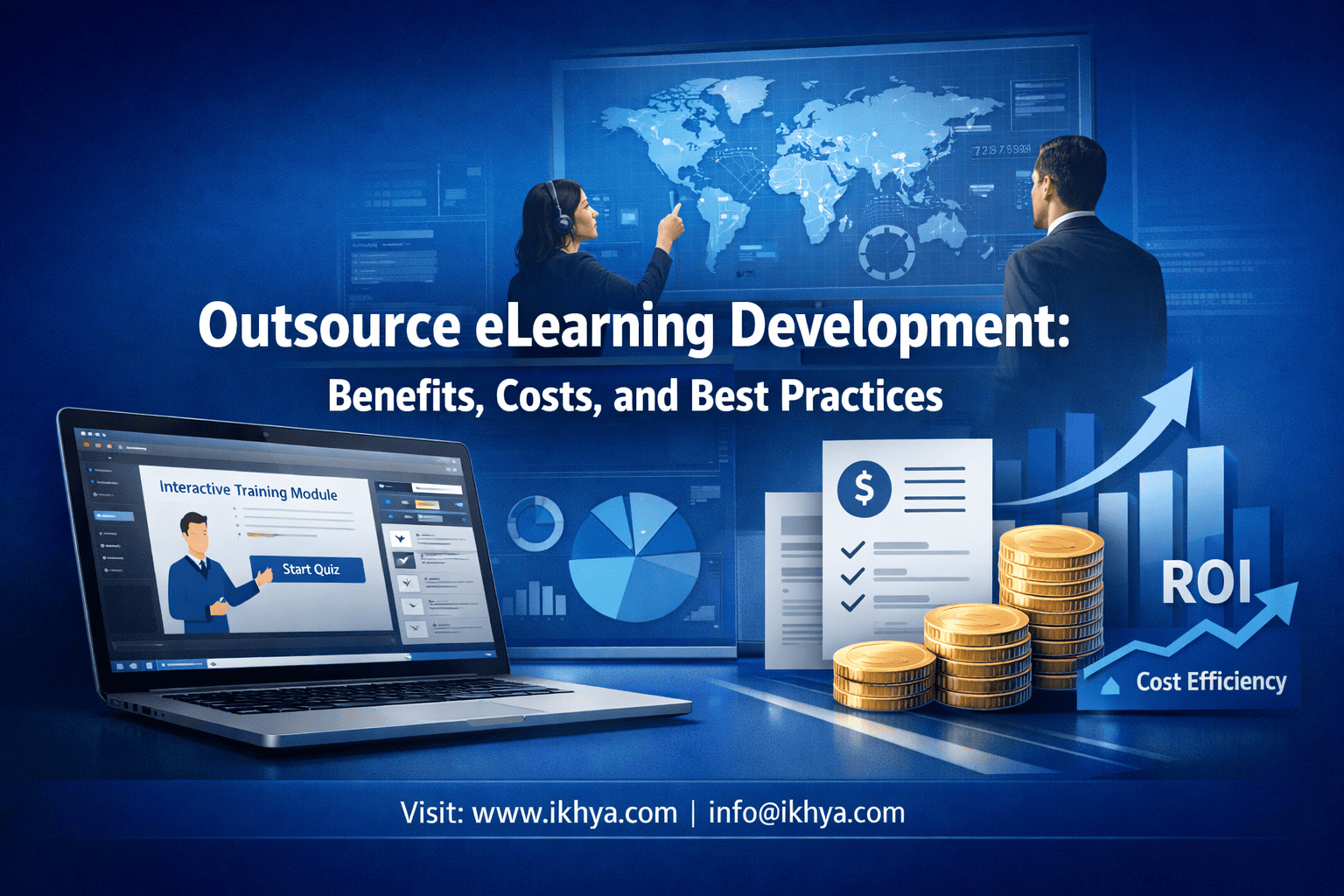
Most organizations underestimate how complex and expensive eLearning development really is—until deadlines slip, compliance risks increase, and learners disengage. Outsourcing gives you instant access to global expertise, faster production, and lower costs without sacrificing quality. If you’re planning to outsource eLearning, partner with an experienced development company that understands instructional design, compliance standards, and scalable technology. The right partner will reduce costs, accelerate timelines, and ensure measurable training results.
What Does It Mean to Outsource eLearning Development?
Outsourcing eLearning development means hiring an external company or specialized team to design, develop, and deliver digital training courses instead of using internal staff. The external partner handles instructional design, multimedia production, authoring tools, LMS compatibility, and deployment, ensuring faster delivery, professional quality, and scalability while reducing internal workload and operational costs.
Outsourcing is not simply hiring a freelancer to convert PowerPoint slides into online modules. It is a strategic partnership with specialists who manage the full lifecycle of digital learning—from analysis and instructional design to development, testing, deployment, and ongoing support.
Core Components Typically Outsourced
Organizations commonly outsource these critical eLearning functions:
1. Instructional Design
- Learning needs analysis
- Defining learning objectives
- Creating storyboards and scripts
- Designing learner journeys
2. Course Development
- Authoring using tools like Articulate Storyline, Rise, or Adobe Captivate
- Interactive scenario creation
- Quiz and assessment design
- SCORM/xAPI packaging
3. Multimedia Production
- Animation and motion graphics
- Voiceover recording and editing
- Video production
- Graphic and UI design
4. LMS Integration
- SCORM 1.2, SCORM 2004, xAPI, and AICC compatibility
- LMS deployment and testing
- Tracking and reporting configuration
5. Localization and Translation
- Multi-language course versions
- Cultural adaptation
- Regional compliance alignment
Example: Real-World Outsourcing Scenario (USA Compliance Training)
A healthcare provider in the United States needed HIPAA compliance training for 5,000 employees.
Instead of building an internal team, they outsourced development. The external vendor:
- Conducted SME interviews
- Created scenario-based training modules
- Added voiceovers and assessments
- Delivered SCORM-compliant packages
Results:
| Metric | Internal Development | Outsourced Development |
|---|---|---|
| Timeline | 9 months | 10 weeks |
| Cost | $180,000 | $52,000 |
| Completion rate | 64% | 92% |
| Compliance audit success | Moderate | Excellent |
What Types of eLearning Are Most Commonly Outsourced?
Organizations across industries outsource various types of training.
Corporate Training
- Compliance training (OSHA, HIPAA, GDPR)
- Workplace safety
- HR and onboarding
Technical Training
- Software training
- Equipment training
- IT certification preparation
Sales and Product Training
- Product knowledge courses
- Customer service training
- Sales enablement
Healthcare and Pharmaceutical Training
- Clinical training
- Regulatory training
- Medical device training
Academic and Educational Content
- Online university courses
- Certification programs
- Continuing education
What Work Stays Internal vs. Outsourced?
Most successful organizations use a hybrid model.
| Task | Internal Team | Outsourced Partner |
|---|---|---|
| Subject Matter Expertise | ✔ | |
| Learning objectives approval | ✔ | |
| Instructional design | ✔ | |
| Multimedia development | ✔ | |
| Authoring and packaging | ✔ | |
| LMS deployment | ✔ | ✔ |
| Maintenance | ✔ | ✔ |
This approach ensures accuracy while leveraging external technical expertise.
Outsourcing vs. Hiring an Internal Team: Structural Comparison
| Factor | Internal Team | Outsourcing |
|---|---|---|
| Hiring time | 3–9 months | Immediate |
| Skill availability | Limited | Full expert team |
| Cost | High fixed cost | Variable, flexible |
| Scalability | Difficult | Easy |
| Technology access | Limited | Latest tools |
| Speed | Slow | Fast |
Who Typically Outsources eLearning?
Organizations of all sizes outsource, but it is especially common among:
Large Enterprises
- Fortune 500 companies
- Healthcare networks
- Financial institutions
Mid-Sized Companies
- SaaS companies
- Manufacturing firms
- Corporate training providers
Government and Public Sector
- Defense training
- Healthcare systems
- Public safety training
Global Organizations
- Companies with multi-language training needs
- Organizations with distributed teams
Key Roles in an Outsourced eLearning Team
A professional eLearning vendor provides a full multidisciplinary team:
| Role | Responsibility |
|---|---|
| Instructional Designer | Learning strategy and structure |
| eLearning Developer | Course creation and technical build |
| Graphic Designer | Visual design and UI |
| Animator | Motion graphics and interactions |
| Voiceover Artist | Narration |
| QA Tester | Testing functionality |
| Project Manager | Timeline and coordination |
This team structure is difficult and expensive to build internally.
Why Outsourcing Has Become the Global Standard
Several global trends have accelerated outsourcing adoption:
1. Rapid Digital Transformation
Organizations must train employees faster than ever.
2. Compliance Requirements
Regulated industries require professionally built training.
3. Remote Workforce Growth
Distributed teams require scalable digital training.
4. Technology Complexity
Modern eLearning includes:
- xAPI tracking
- Interactive simulations
- Adaptive learning
- Mobile optimization
These require specialized expertise.
What Are the Benefits of Outsourcing eLearning Development?
Outsourcing eLearning development gives organizations immediate access to specialized instructional designers, developers, and multimedia experts without hiring internally. This reduces development time by 40–70%, lowers costs by 30–60%, improves learning quality, ensures compliance with standards like SCORM and xAPI, and allows organizations to scale training quickly across global teams.
Outsourcing is not just about saving money. It is about improving speed, quality, scalability, and learning effectiveness while reducing operational risk.
Access to Specialized Expertise That Is Difficult to Build Internally
Professional eLearning development requires multiple technical disciplines. Most internal teams lack all these skills.
A typical outsourced team includes:
- Instructional designers trained in adult learning theory
- Developers experienced in tools like Articulate Storyline and Rise
- UI/UX designers focused on learning usability
- Animators and video editors
- LMS integration specialists
- Quality assurance testers
Building this internally would require hiring 5–8 specialists.
Example: UK Financial Services Company
A London-based financial services firm needed FCA compliance training.
Internal team capability:
- 1 trainer
- No instructional designer
- No multimedia capability
Outsourced vendor capability:
- Instructional designer
- Developer
- Animator
- Voiceover artist
Result: Training quality improved significantly, and regulatory audit readiness increased.
Faster Development and Deployment
Outsourcing dramatically reduces course development time because vendors use established workflows, templates, and experienced teams.
Typical development timelines:
| Course Type | Internal Team | Outsourced Vendor |
|---|---|---|
| Basic course (30 min) | 6–10 weeks | 2–4 weeks |
| Interactive course (60 min) | 12–20 weeks | 4–8 weeks |
| Simulation-based training | 6–12 months | 8–16 weeks |
This speed advantage is critical for:
- Compliance deadlines
- Product launches
- Regulatory changes
- Employee onboarding
Example: Australia Workplace Safety Training
An Australian mining company needed safety training for 2,000 workers before a regulatory deadline.
Internal estimate: 6 months
Outsourced delivery: 7 weeks
This ensured regulatory compliance without operational delays.
Significant Cost Savings Compared to Internal Development
Outsourcing converts fixed staffing costs into flexible project costs.
Internal team annual cost (USA example):
| Role | Average Salary |
|---|---|
| Instructional Designer | $85,000 |
| eLearning Developer | $90,000 |
| Graphic Designer | $70,000 |
| Project Manager | $95,000 |
| Total | $340,000/year |
Outsourcing the same work:
| Project Volume | Outsourcing Cost |
|---|---|
| 10 courses/year | $80,000–$150,000 |
| Savings | 50–70% |
Organizations only pay for what they need.
Improved Learning Effectiveness and Engagement
Professionally designed eLearning improves learner outcomes significantly.
Outsourced vendors use:
- Scenario-based learning
- Interactive simulations
- Adaptive learning paths
- Microlearning modules
- Real-world case studies
These methods improve:
| Metric | Internal Basic Training | Professionally Outsourced |
|---|---|---|
| Completion rates | 50–70% | 80–95% |
| Knowledge retention | Moderate | High |
| Learner satisfaction | Low–moderate | High |
Example: UAE Aviation Training
A UAE aviation company outsourced safety training aligned with GCAA standards.
Results:
- Completion rates increased from 62% to 94%
- Training time reduced by 35%
- Compliance audit scores improved significantly
Scalability for Global and Growing Organizations
Outsourcing makes it easy to scale training across large or distributed workforces.
Vendors can handle:
- Large course volumes
- Multiple languages
- Rapid updates
- Global deployment
This is especially important for multinational companies.
Example: Global SaaS Company
Training requirements:
- 20 courses
- 5 languages
- 3 regions
Internal development timeline: 18 months
Outsourced timeline: 4 months
Access to Latest Tools and Technologies
Professional vendors already invest in expensive tools such as:
- Articulate Storyline 360
- Articulate Rise
- Adobe Captivate
- Vyond animation software
- Camtasia video tools
They also implement advanced standards:
- SCORM 1.2 and SCORM 2004
- xAPI tracking
- Mobile-responsive design
- LMS integration
- Cloud-based learning delivery
Organizations avoid purchasing expensive licenses.
Reduced Risk and Improved Compliance
Compliance training errors can lead to serious consequences, especially in regulated industries.
Outsourced vendors understand global standards such as:
USA
- OSHA
- HIPAA
- FDA regulations
UK
- FCA compliance
- Health and Safety Executive (HSE)
Australia
- Safe Work Australia standards
UAE
- GCAA aviation training standards
- DHA healthcare training compliance
Vendors ensure courses meet regulatory requirements.
Allows Internal Teams to Focus on Core Business Activities
Instead of spending months building training, internal teams can focus on:
- Strategic initiatives
- Business growth
- Operations
- Employee performance
Outsourcing removes technical development burden.
Consistent Quality Across All Courses
Outsourced vendors use standardized development processes:
- Instructional design frameworks (ADDIE, SAM)
- Quality assurance workflows
- Usability testing
- LMS compatibility testing
This ensures consistent quality across all training programs.
What Does It Cost to Outsource eLearning Development?
Outsourcing eLearning development typically costs between $1,000 and $10,000 per finished hour of training, depending on complexity, interactivity, and region. Basic courses cost less, while simulations and custom interactive training cost more. Outsourcing to India or Eastern Europe can reduce costs by 40–60% compared to the USA or UK.
Costs vary significantly based on several factors.
Cost by Course Complexity
Industry-standard pricing model is based on cost per finished hour.
| Level | Description | Cost per Hour (USA/UK) | Cost per Hour (India) |
|---|---|---|---|
| Level 1 | Basic slides, simple quizzes | $1,000–$2,500 | $500–$1,200 |
| Level 2 | Interactive elements, scenarios | $2,500–$6,000 | $1,200–$3,500 |
| Level 3 | Advanced simulations, branching | $6,000–$12,000 | $3,000–$7,000 |
Cost by Region (Global Comparison)
| Region | Average Cost per Hour |
|---|---|
| USA | $5,000–$12,000 |
| UK | $4,000–$10,000 |
| Australia | $4,500–$11,000 |
| UAE | $3,500–$9,000 |
| India | $1,200–$4,500 |
| Eastern Europe | $2,000–$6,000 |
This is why many global companies outsource to India.
Example: 1-Hour Compliance Course Cost Comparison
| Region | Estimated Cost |
|---|---|
| USA | $7,500 |
| UK | $6,500 |
| Australia | $7,000 |
| UAE | $5,000 |
| India | $2,500 |
Savings: Up to 65%
Additional Cost Factors
Costs increase based on these requirements:
Instructional design complexity
- Branching scenarios
- Decision-based simulations
Multimedia production
- Custom animation
- Professional voiceovers
- Video production
Localization
- Translation
- Voiceover in multiple languages
Technology integration
- LMS integration
- xAPI tracking
- Custom functionality
Hidden Costs in Internal Development
Internal development also includes hidden expenses:
- Hiring costs
- Training staff
- Software licenses
- Delays and inefficiencies
These often exceed outsourcing costs.
What Are the Best Practices for Outsourcing eLearning Development?
The most effective way to outsource eLearning development is to define clear learning objectives, choose vendors with proven experience, use structured development processes like ADDIE or SAM, establish communication workflows, and require compliance with standards such as SCORM and xAPI. This ensures quality, predictable timelines, and measurable learning outcomes.
Outsourcing succeeds when treated as a strategic partnership—not just a vendor transaction. Organizations that follow structured outsourcing practices consistently achieve faster delivery, higher learner engagement, and better ROI.
Define Clear Learning Objectives Before Contacting Vendors
Vendors cannot design effective training without clearly defined goals. Unclear objectives lead to delays, rework, and poor learning outcomes.
Before outsourcing, define:
- Who the learners are
- What skills or knowledge they need
- What problems the training solves
- How success will be measured
Example: Poor vs Clear Objective
| Poor Objective | Clear Objective |
|---|---|
| Train employees on safety | Reduce workplace incidents by 30% through hazard identification training |
Clear objectives allow instructional designers to build targeted, effective learning.
Choose Vendors With Proven Industry Experience
Not all eLearning vendors are equal. Industry-specific experience is critical, especially in regulated sectors.
Look for vendors with experience in your industry:
Healthcare
- HIPAA (USA)
- NHS compliance (UK)
- DHA regulations (UAE)
Manufacturing
- OSHA safety training (USA)
- Safe Work Australia standards
Finance
- FCA compliance (UK)
- Financial conduct regulations worldwide
Experienced vendors understand compliance and risk requirements.
Request Portfolio Samples and Case Studies
A vendor’s past work reveals their real capability.
Ask for examples showing:
- Interactive scenarios
- Simulation-based training
- Mobile-responsive design
- Multi-language courses
- LMS deployment experience
Evaluate:
- Visual quality
- User experience
- Interactivity
- Instructional effectiveness
Professional courses should feel modern and engaging.
Start With a Pilot Project Before Full Commitment
Always test the vendor with a small pilot project first.
Pilot project benefits:
- Evaluate quality
- Test communication
- Assess timelines
- Validate technical compatibility
Example Pilot Scope
- One 15–30 minute course
- Single language
- Moderate interactivity
This reduces risk before scaling.
Establish Clear Communication and Project Management Processes
Communication failures are the most common reason outsourcing fails.
Best practices include:
- Assign a dedicated project manager
- Weekly progress meetings
- Milestone reviews
- Structured feedback cycles
Use project tracking tools such as:
- Jira
- Trello
- Asana
- Monday.com
This ensures transparency and accountability.
Define Technical and Compliance Requirements Upfront
Specify technical standards before development begins.
Common requirements include:
LMS compatibility
- SCORM 1.2
- SCORM 2004
- xAPI
Device compatibility
- Mobile
- Tablet
- Desktop
Accessibility standards
- WCAG 2.1 compliance (required in USA, UK, Australia)
- Section 508 compliance (USA)
Example: UK Government Requirement
UK public sector training must comply with WCAG accessibility standards.
Failure to specify this early causes rework and delays.
Provide Access to Subject Matter Experts (SMEs)
Vendors need SME input to ensure accuracy.
SMEs help with:
- Content accuracy
- Real-world scenarios
- Compliance validation
- Technical details
Best practice:
- Schedule structured SME interviews
- Provide documentation and reference materials
- Review storyboards before development
Use a Structured Development Methodology
Professional vendors follow established frameworks:
ADDIE Model
- Analysis
- Design
- Development
- Implementation
- Evaluation
SAM Model (Successive Approximation Model)
- Faster iterative development
- Continuous feedback
- Faster revisions
This ensures predictable and high-quality outcomes.
Ensure LMS Testing and Quality Assurance
Always require testing before deployment.
Testing includes:
- SCORM/xAPI tracking verification
- Browser compatibility
- Mobile responsiveness
- LMS integration testing
Poor testing leads to technical failures.
Define Maintenance and Update Processes
Training content requires updates due to:
- Regulatory changes
- Process changes
- Product updates
Define:
- Update timelines
- Maintenance costs
- Support availability
Long-term support ensures sustainability.
How Do You Choose the Right eLearning Outsourcing Partner?
The right eLearning outsourcing partner should have proven instructional design expertise, strong technical capability, global compliance experience, transparent pricing, and reliable communication processes. Evaluate vendors based on portfolio quality, industry experience, development methodology, scalability, and long-term support—not just price—to ensure successful training outcomes.
Choosing the wrong vendor can result in delays, poor quality, and compliance risk.
Evaluate Instructional Design Capability First
Instructional design quality determines training effectiveness more than visual design.
Strong vendors demonstrate:
- Scenario-based learning
- Problem-solving simulations
- Real-world application
Avoid vendors that only convert slides into basic courses.
Assess Technical Expertise and Tool Capability
Professional vendors should support modern tools and standards:
Authoring tools
- Articulate Storyline
- Articulate Rise
- Adobe Captivate
Technical standards
- SCORM
- xAPI
- AICC
Learning platforms
- Moodle
- Cornerstone
- Docebo
- SAP SuccessFactors
Verify Global Compliance and Regulatory Experience
This is critical for regulated industries.
Examples
USA:
- OSHA safety training
- HIPAA compliance
UK:
- FCA compliance
- HSE standards
Australia:
- Safe Work Australia
UAE:
- Aviation and healthcare regulations
Evaluate Scalability and Team Capacity
A reliable vendor should scale based on your needs.
Ask:
- How many courses can you develop per month?
- How large is your team?
- Do you support multi-language development?
This is critical for large organizations.
Compare Pricing Transparently
Avoid vendors with unclear pricing models.
Professional vendors provide:
- Cost per finished hour
- Breakdown by complexity
- Clear revision policies
Lowest cost does not always mean best value.
Assess Communication and Support Quality
Reliable vendors provide:
- Dedicated project manager
- Regular updates
- Fast response times
Communication quality predicts project success.
Global eLearning Outsourcing Comparison: USA, UK, Australia, UAE, India, and Eastern Europe
India and Eastern Europe dominate global eLearning outsourcing due to lower costs and strong technical expertise, while the USA, UK, Australia, and UAE focus on high-end instructional design and regulatory compliance. Most global organizations use hybrid outsourcing models combining Western instructional leadership with offshore development efficiency.
Understanding regional strengths helps organizations choose the best outsourcing destination based on cost, quality, compliance, and scalability.
United States: Highest Quality, Highest Cost
The USA is a global leader in instructional design innovation and compliance-focused training.
Strengths
- Advanced instructional design expertise
- Strong compliance experience (OSHA, HIPAA, FDA)
- High-end simulation and custom development
- Mature LMS and enterprise training ecosystem
Limitations
- Highest global development cost
- Limited cost scalability
Typical Use Cases
- Healthcare compliance training
- Aviation training
- Defense and government training
- Fortune 500 enterprise training
Cost Range
| Complexity | Cost per Finished Hour |
|---|---|
| Basic | $3,000–$6,000 |
| Intermediate | $6,000–$9,000 |
| Advanced | $9,000–$15,000 |
United Kingdom: Strong Compliance and Financial Sector Expertise
The UK specializes in financial services, corporate compliance, and professional training.
Strengths
- FCA compliance training expertise
- Corporate training excellence
- Strong instructional design quality
- Excellent accessibility compliance (WCAG)
Limitations
- High development cost
- Smaller talent pool compared to India
Common Industries
- Banking and finance
- Insurance
- Corporate compliance
- Professional certification
Cost Range
| Complexity | Cost per Finished Hour |
|---|---|
| Basic | $2,500–$5,500 |
| Intermediate | $5,500–$8,500 |
| Advanced | $8,500–$12,000 |
Australia: Strong Safety and Regulatory Training
Australia excels in workplace safety and industrial training.
Strengths
- Safe Work Australia compliance expertise
- Mining and industrial safety training
- High-quality instructional design
Limitations
- High cost
- Smaller outsourcing ecosystem
Common Industries
- Mining
- Construction
- Industrial safety
- Healthcare
Cost Range
| Complexity | Cost per Finished Hour |
|---|---|
| Basic | $3,000–$6,500 |
| Intermediate | $6,500–$9,500 |
| Advanced | $9,500–$13,000 |
UAE: Regional Hub for Corporate and Aviation Training
The UAE is a major outsourcing hub for Middle East training programs.
Strengths
- Aviation training expertise
- Oil and gas training experience
- Corporate and compliance training
- Multi-language capability (Arabic and English)
Limitations
- Smaller talent pool
- Higher cost than India
Common Industries
- Aviation
- Oil and gas
- Corporate training
- Healthcare
Cost Range
| Complexity | Cost per Finished Hour |
|---|---|
| Basic | $2,000–$4,500 |
| Intermediate | $4,500–$7,500 |
| Advanced | $7,500–$10,000 |
India: Global Leader in eLearning Outsourcing
India is the largest eLearning outsourcing destination due to its cost advantage, large talent pool, and technical expertise.
Strengths
- 40–70% lower costs than Western countries
- Large number of skilled instructional designers
- Strong technical development capability
- Experience with global clients
- Fast scalability
Limitations
- Quality varies by vendor
- Requires strong vendor selection
Common Industries
- Corporate training
- IT and software training
- Healthcare and compliance
- Global enterprise training
Cost Range
| Complexity | Cost per Finished Hour |
|---|---|
| Basic | $800–$2,000 |
| Intermediate | $2,000–$4,500 |
| Advanced | $4,500–$8,000 |
India is the preferred outsourcing destination for companies in the USA, UK, and Australia.
Eastern Europe: Growing High-Quality Alternative
Eastern Europe offers strong technical capability with moderate pricing.
Strengths
- High technical expertise
- Strong software simulation capability
- Lower cost than Western Europe
Limitations
- Smaller talent pool than India
- Higher cost than Asia
Cost Range
| Complexity | Cost per Finished Hour |
|---|---|
| Basic | $1,500–$3,500 |
| Intermediate | $3,500–$6,000 |
| Advanced | $6,000–$9,000 |
Global Comparison Summary Table
| Region | Cost | Quality | Scalability | Best For |
|---|---|---|---|---|
| USA | Very High | Excellent | Medium | Compliance-heavy training |
| UK | High | Excellent | Medium | Finance and corporate |
| Australia | High | Excellent | Low–Medium | Safety training |
| UAE | Medium–High | Good | Medium | Middle East training |
| India | Low | Very Good–Excellent | Very High | Global outsourcing |
| Eastern Europe | Medium | Very Good | Medium | Technical training |
Conclusion: Is Outsourcing eLearning Development the Right Choice?
Outsourcing eLearning development is the most efficient and cost-effective way to build high-quality training at scale. It provides access to expert instructional designers, reduces costs by up to 60%, accelerates development timelines, ensures compliance with global standards, and enables organizations to deliver engaging, scalable, and effective digital learning worldwide.
Organizations that outsource successfully follow three principles:
1. Choose expertise over lowest cost
Quality instructional design determines learning effectiveness.
2. Start with pilot projects
Test vendors before large-scale engagement.
3. Build long-term partnerships
Strong vendor relationships improve efficiency over time.
Outsourcing is no longer optional—it is the global standard for scalable digital learning.
Frequently Asked Questions (FAQ)
Is outsourcing eLearning development cheaper than building internally?
Yes. Outsourcing typically reduces costs by 40–60% compared to hiring and maintaining an internal team. Internal teams require salaries, software licenses, training, and infrastructure, while outsourcing converts fixed costs into flexible project-based costs.
How long does outsourced eLearning development take?
Development timelines depend on complexity.
| Course Type | Typical Timeline |
|---|---|
| Basic course | 2–4 weeks |
| Interactive course | 4–8 weeks |
| Advanced simulation | 8–16 weeks |
Outsourcing is significantly faster than internal development.
Is outsourcing eLearning safe for compliance training?
Yes, if you choose experienced vendors. Professional eLearning companies understand compliance standards such as OSHA, HIPAA, FCA, and Safe Work Australia and ensure training meets regulatory requirements.
Which country is best for outsourcing eLearning?
India is the most popular outsourcing destination due to its strong talent pool and cost advantage. The USA and UK are preferred for highly specialized compliance training.
What should you look for in an eLearning outsourcing partner?
Key evaluation criteria include:
- Instructional design expertise
- Portfolio quality
- Compliance experience
- Technical capability
- Transparent pricing
- Strong communication
Ready to Outsource eLearning Development With Confidence?
Outsourcing eLearning is not just about reducing costs—it is about building high-quality, scalable training that improves performance, ensures compliance, and delivers measurable business results. The right partner will help you design engaging learning experiences, accelerate development timelines, and support your global training strategy.
IKHYA – eLearning Solutions Company specializes in custom eLearning development for global organizations across the USA, UK, Australia, UAE, and worldwide. Our expert instructional designers, developers, and multimedia specialists deliver SCORM/xAPI-compliant, mobile-ready, and fully interactive training tailored to your business needs.
Partner with IKHYA to:
- Convert existing training into engaging eLearning
- Develop custom compliance and corporate training
- Reduce development costs while maintaining premium quality
- Scale training across global teams and multiple languages
- Ensure full LMS compatibility and regulatory compliance
Contact IKHYA – eLearning Solutions Company today to discuss your project and receive a detailed proposal.
📧 Email: info@ikhya.com