
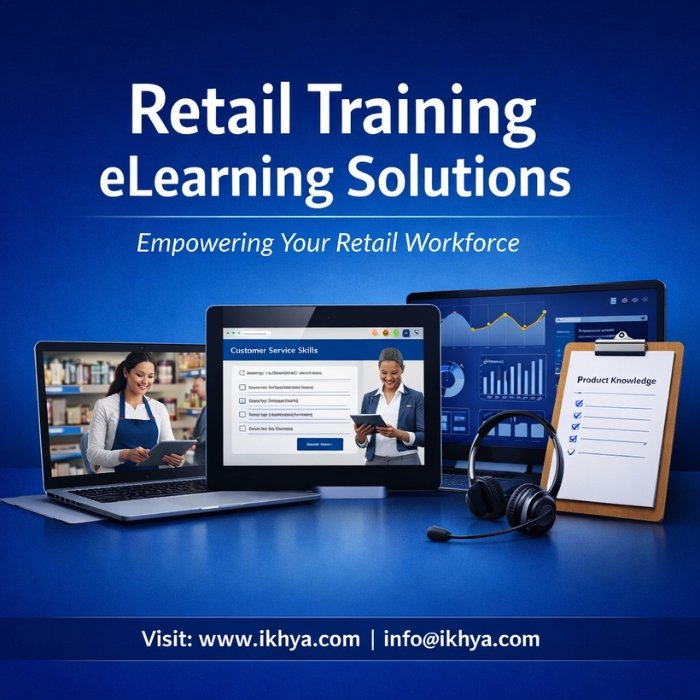


Retail Training eLearning Solutions
Retail businesses operate in a fast-paced environment where store associates must quickly learn product knowledge, customer service skills, and operational procedures. Traditional classroom training cannot scale across hundreds of locations or thousands of employees.
IKHYA – eLearning Solutions Company helps global retailers implement scalable retail training eLearning solutions that improve employee performance, customer experience, and sales outcomes.
Request a custom retail training proposal or schedule a consultation with our experts at info@ikhya.com
Get a Free eLearning Consultation / Proposal
Every retail organization has unique training challenges. Large retail chains must train store associates, sales representatives, customer service staff, and regional managers across multiple locations. Effective training programs must be scalable, mobile-friendly, and aligned with retail operations.
IKHYA provides consultative retail training development services designed for enterprise organizations.
What Our Consultation Includes
During the consultation, our learning experts analyze your retail training requirements and recommend the most effective learning strategy.
We evaluate:
- Current retail training challenges
- Workforce size and store locations
- Existing LMS or learning platforms
- Training content formats
- Skill gaps among employees
- Compliance training requirements
This analysis helps us design custom retail eLearning programs that deliver measurable performance improvements.
What You Receive in Your Proposal
After the consultation, our team provides a detailed proposal that includes:
Training Strategy
- Recommended learning formats
- Microlearning strategy for store staff
- Scenario-based customer interaction training
- Product knowledge training modules
Project Scope
- Number of courses or modules
- Estimated development timeline
- Instructional design approach
- Media elements such as videos, simulations, and interactive scenarios
Technology Recommendations
- LMS integration strategy
- SCORM or xAPI compliance
- Mobile learning compatibility
- Analytics and reporting options
Estimated Project Cost
Transparent pricing helps enterprise buyers plan budgets and procurement approvals.
When Retail Companies Request Our Consultation
Organizations typically contact IKHYA when they need to:
- Train employees across multiple store locations
- Improve sales associate performance
- Standardize customer service training
- Launch new product training programs
- Digitize store operations training
- Replace outdated classroom training
Who Should Request a Consultation
Our retail eLearning services are ideal for:
- Retail chains
- Global retail brands
- Franchise networks
- Retail distributors
- E-commerce and omnichannel retailers
Whether you manage 50 employees or 50,000 retail staff, scalable digital training can transform workforce performance.
Schedule Your Retail Training Consultation
Speak with our learning consultants to explore how digital learning can improve retail workforce performance.
Request a Proposal
Submit an RFP
Schedule a Consultation
IKHYA – eLearning Solutions Company
Email: info@ikhya.com
What Are Retail Training eLearning Solutions
Retail training eLearning solutions are digital learning programs designed to train retail employees, store associates, sales teams, and managers using interactive online courses. These programs replace or supplement traditional classroom training with scalable, mobile-friendly learning experiences.
Retail organizations use eLearning to train employees in areas such as:
- product knowledge
- customer service skills
- point-of-sale (POS) system usage
- store operations
- compliance and safety training
- retail sales techniques
Modern retail training programs combine microlearning, scenario-based learning, and simulation training to create engaging learning experiences for frontline employees.
Key Components of Retail eLearning Programs
Effective retail training solutions typically include:
1. Microlearning Modules
Short learning modules (3–7 minutes) designed for busy retail employees. These modules help staff quickly learn:
- product features
- promotional offers
- store procedures
Microlearning improves completion rates among store associates with limited time for training.
2. Scenario-Based Customer Interaction Training
Retail employees often learn best through realistic customer scenarios. These courses simulate common retail situations such as:
- handling customer complaints
- upselling products
- managing returns and exchanges
- resolving payment issues
This approach uses experiential learning techniques to improve decision-making and confidence.
3. Software Simulation Training
Retail employees must use multiple systems, including:
- POS systems
- inventory management tools
- CRM systems
- retail analytics platforms
Simulation training allows employees to practice using these systems in a safe learning environment.
4. Mobile Learning for Store Associates
Retail staff rarely sit at desks. Therefore, training must be mobile-first and accessible on smartphones or tablets.
Mobile learning allows employees to complete training:
- during shifts
- between tasks
- during onboarding periods
5. LMS and Learning Analytics Integration
Retail training programs are typically delivered through a Learning Management System (LMS) or Learning Experience Platform (LXP).
These systems enable organizations to:
- track course completion
- measure training effectiveness
- generate compliance reports
- monitor employee skill development
Courses are usually developed using SCORM or xAPI standards to ensure compatibility with enterprise LMS platforms.
Why Organizations Need Retail Training eLearning Solutions
Retail companies operate in highly competitive environments where customer experience and employee performance directly impact revenue. Poorly trained staff can lead to lost sales, negative customer experiences, and operational inefficiencies.
Digital retail training solutions help organizations standardize employee knowledge and maintain consistent service across multiple locations.
Retail Workforce Challenges
Retail organizations face several training challenges:
- high employee turnover
- seasonal hiring spikes
- geographically distributed store locations
- limited time for employee training
- rapid product launches and promotions
Traditional classroom training cannot scale effectively in these environments.
Example: Retail Training in the United States
Large retail chains in the USA often manage thousands of employees across hundreds of store locations.
For example:
A national retail brand launching a new product line must train thousands of sales associates simultaneously.
eLearning enables the organization to:
- deploy product training instantly
- ensure consistent messaging across stores
- track employee completion rates
This ensures that every store associate can confidently explain the product to customers.
Example: Retail Training in the United Kingdom
Retail companies in the UK increasingly adopt digital learning platforms to support omnichannel retail operations.
Employees must understand:
- online order processing
- click-and-collect services
- digital payment systems
eLearning programs allow employees to quickly learn these systems through interactive simulations and microlearning modules.
Example: Retail Workforce Training in Australia
Retailers in Australia often operate stores across large geographic regions. Delivering classroom training to every location is expensive and time-consuming.
eLearning helps organizations provide:
- standardized onboarding training
- safety and compliance courses
- sales training for store associates
Employees can complete training remotely through mobile devices.
Example: Retail Training in the UAE
Retail companies in the UAE frequently employ multicultural workforces across luxury retail stores, malls, and airport locations.
Training programs must support:
- multilingual learning content
- customer service excellence
- luxury retail sales techniques
Digital learning allows organizations to deliver localized training programs across diverse employee groups.
Benefits of Retail Training eLearning Solutions
Retail eLearning solutions provide several strategic advantages for enterprise organizations.
1. Scalable Training Across Store Networks
Retail companies often operate hundreds of locations. Digital training enables organizations to deliver consistent learning experiences across all stores.
Employees receive the same training regardless of location.
2. Faster Employee Onboarding
Retail organizations frequently hire new employees during peak seasons.
eLearning onboarding programs allow new hires to quickly learn:
- store procedures
- customer service standards
- product information
This helps employees become productive faster.
3. Improved Sales Performance
Training programs focused on product knowledge and sales techniques help employees confidently recommend products.
Well-trained staff can:
- upsell higher-value products
- cross-sell complementary items
- provide better customer guidance
This directly improves store revenue and conversion rates.
4. Consistent Customer Experience
Retail brands rely on consistent service quality across locations.
Standardized training ensures employees follow:
- customer interaction guidelines
- brand communication standards
- service protocols
This helps maintain a strong brand reputation.
5. Mobile Learning for Frontline Employees
Retail employees spend most of their time assisting customers on the sales floor.
Mobile-friendly training allows employees to complete courses on:
- smartphones
- tablets
- store devices
This improves accessibility and course completion.
6. Data-Driven Training Insights
Modern LMS platforms provide detailed training analytics.
Retail organizations can track:
- employee progress
- training completion rates
- assessment scores
- skill development trends
These insights help learning leaders measure the impact of training programs.
Real Enterprise Project Examples
Large retail organizations often require scalable training programs that can be deployed across hundreds of stores and thousands of employees. Below are realistic enterprise project examples that illustrate how retail training eLearning solutions are typically implemented.
Example 1: Retail Product Knowledge Training
Client: Global Consumer Electronics Retailer
Training Goal: Improve sales associate product knowledge and upselling skills.
Project Scope
- 25 interactive product training modules
- Average duration per module: 5–7 minutes
- Microlearning format for mobile learning
- Scenario-based customer interaction training
Training Topics
- product features and specifications
- comparing competing products
- upselling accessories
- customer recommendation techniques
Estimated Timeline
| Project Scope | Timeline |
|---|---|
| 1 module | 2–3 weeks |
| 10 modules | 6–8 weeks |
| 25 modules | 10–12 weeks |
Estimated Cost
| Development Type | Cost Range |
|---|---|
| Basic microlearning module | $1,200 – $2,500 |
| Interactive scenario module | $2,500 – $6,000 |
Estimated Total Project Cost
$45,000 – $85,000
Example 2: Retail POS System Simulation Training
Client: International Fashion Retail Brand
Training Goal: Train store associates to use a new POS system across global locations.
Project Scope
- 18 interactive system simulations
- Step-by-step guided practice
- Realistic POS interface simulations
- Assessments for system proficiency
Training Topics
- processing customer purchases
- issuing refunds and exchanges
- applying discounts and promotions
- managing loyalty programs
Estimated Timeline
| Project Scope | Timeline |
|---|---|
| 1 simulation module | 3 weeks |
| 10 simulations | 7–9 weeks |
| 18 simulations | 10–12 weeks |
Estimated Cost
| Simulation Type | Cost Range |
|---|---|
| Basic software simulation | $1,500 – $3,000 |
| Advanced simulation scenario | $4,000 – $8,000 |
Estimated Total Project Cost
$35,000 – $70,000
Example 3: Retail Customer Service Training
Client: UK-Based Department Store Chain
Training Goal: Improve customer service skills and complaint resolution.
Project Scope
- 15 scenario-based training modules
- Interactive role-play simulations
- Branching decision scenarios
- Knowledge assessments
Training Topics
- greeting and assisting customers
- handling complaints professionally
- managing difficult customer interactions
- cross-selling products
Estimated Timeline
| Project Scope | Timeline |
|---|---|
| 1 module | 2–3 weeks |
| 10 modules | 7–9 weeks |
| 15 modules | 9–11 weeks |
Estimated Cost
| Development Type | Cost Range |
|---|---|
| Interactive eLearning module | $2,000 – $5,000 |
| Scenario-based module | $5,000 – $10,000 |
Estimated Total Project Cost
$50,000 – $110,000
Example 4: Retail Store Operations Training
Client: UAE Retail Chain with 200+ Stores
Training Goal: Standardize store operations across all locations.
Project Scope
- 20 operational training modules
- video demonstrations of procedures
- step-by-step operational workflows
- compliance assessments
Training Topics
- store opening and closing procedures
- inventory management
- visual merchandising standards
- workplace safety protocols
Estimated Timeline
| Project Scope | Timeline |
|---|---|
| 1 module | 2–3 weeks |
| 10 modules | 6–8 weeks |
| 20 modules | 10–12 weeks |
Estimated Cost
| Development Type | Cost Range |
|---|---|
| Basic operational module | $1,500 – $3,500 |
| Video-based training module | $3,000 – $7,000 |
Estimated Total Project Cost
$40,000 – $95,000
Typical Retail eLearning Development Pricing
Enterprise buyers often request pricing estimates before initiating vendor discussions. The table below outlines typical development costs for retail training programs.
| Training Type | Typical Cost Per Module |
|---|---|
| Basic microlearning | $1,000 – $2,500 |
| Interactive eLearning | $2,500 – $6,000 |
| Scenario-based training | $5,000 – $10,000 |
| Advanced simulations | $6,000 – $15,000 |
Actual pricing depends on:
- course length
- media complexity
- number of interactions
- localization requirements
- simulation complexity
Typical Development Timelines
Retail training programs vary in complexity depending on the number of courses and multimedia elements.
| Project Scope | Estimated Timeline |
|---|---|
| 1 module | 2–3 weeks |
| 10 modules | 6–8 weeks |
| 20 modules | 10–12 weeks |
| 30+ modules | 12–16 weeks |
Enterprise retail projects often involve phased rollouts, allowing organizations to launch training quickly while additional modules are developed.
IKHYA Process for Retail Training eLearning Development
Developing effective retail training requires more than simply converting content into online courses. Successful programs must address real retail workforce challenges, such as high employee turnover, limited training time, and geographically distributed store locations.
At IKHYA – eLearning Solutions Company, we follow a structured development process based on proven instructional design frameworks including ADDIE, Bloom’s Taxonomy, and the Kirkpatrick Model. This approach ensures training programs deliver measurable learning outcomes and business impact.
Analysis
The first phase focuses on understanding the retail organization’s training goals and operational challenges.
During this stage, our learning consultants conduct a detailed training needs analysis.
Key activities include:
- identifying skill gaps among store associates
- analyzing existing training materials
- reviewing operational workflows and procedures
- understanding product knowledge requirements
- evaluating existing LMS or training platforms
We also define the learning objectives based on Bloom’s Taxonomy, ensuring each course aligns with real job tasks.
This phase helps establish a clear training strategy before course development begins.
Instructional Design
In the instructional design phase, our team develops a structured learning experience tailored for retail employees.
Retail workers typically have limited time for training, so our designers focus on short, engaging learning experiences.
Key instructional design elements include:
- microlearning modules for quick training sessions
- scenario-based customer interaction training
- interactive product knowledge lessons
- sales technique simulations
- knowledge checks and assessments
Courses are designed to support experiential learning, allowing employees to practice real retail situations in a simulated environment.
Our instructional design process also ensures content aligns with adult learning principles, improving knowledge retention and learner engagement.
Development
During the development phase, our eLearning developers transform instructional designs into fully interactive courses.
We incorporate multiple multimedia elements to create engaging learning experiences.
These include:
- interactive scenarios
- product demonstration videos
- animated explainers
- system simulations
- drag-and-drop activities
- knowledge assessments
Courses are developed using enterprise-grade authoring tools such as Articulate Storyline, Adobe Captivate, Lectora Inspire, and iSpring Suite.
All courses are built to comply with industry standards such as SCORM and xAPI, ensuring compatibility with enterprise Learning Management Systems (LMS).
Quality Assurance
Quality assurance is critical for enterprise retail training deployments.
Before delivery, each course undergoes a rigorous testing process to ensure:
- content accuracy
- functionality across devices
- LMS compatibility
- accessibility compliance
- user experience quality
Our QA team performs:
- functionality testing
- device compatibility testing
- LMS integration testing
- accessibility testing based on WCAG guidelines
This ensures courses work smoothly across desktop, tablet, and mobile devices.
Deployment
Once testing is complete, courses are deployed through the organization’s LMS or LXP platform.
During deployment, we assist organizations with:
- LMS integration
- course upload and configuration
- learner enrollment setup
- reporting and analytics configuration
We also help organizations track training effectiveness using evaluation frameworks such as the Kirkpatrick Model, which measures:
- learner reaction
- knowledge acquisition
- behavioral change
- business impact
This allows retail organizations to measure how training improves employee performance, customer experience, and sales results.
Technologies and Tools Used
Retail training eLearning solutions rely on modern learning technologies to deliver scalable, engaging training programs.
IKHYA uses enterprise-grade tools and standards to ensure training programs are compatible with existing learning ecosystems.
Authoring Tools
Our development team creates courses using industry-leading authoring tools.
These include:
- Articulate Storyline – advanced interactive eLearning development
- Adobe Captivate – software simulations and immersive learning experiences
- Lectora Inspire – enterprise-scale course development
- iSpring Suite – rapid eLearning and PowerPoint-based training conversion
These tools allow us to build interactive courses with simulations, branching scenarios, and assessments.
Learning Platforms
Retail training programs are typically delivered through:
- Learning Management Systems (LMS)
- Learning Experience Platforms (LXP)
- Digital Adoption Platforms (DAP)
These platforms allow organizations to manage training delivery, track learner progress, and analyze performance data.
eLearning Standards
To ensure compatibility with enterprise learning systems, our courses support major eLearning standards including:
- SCORM for LMS compatibility
- xAPI for advanced learning analytics
- WCAG accessibility standards for inclusive learning experiences
These standards allow organizations to deploy training across global learning environments.
Mobile Learning Compatibility
Retail employees rarely work at desks. Therefore, training programs must support mobile-first learning experiences.
All courses developed by IKHYA are optimized for:
- smartphones
- tablets
- store devices
This allows employees to complete training anytime and anywhere, even during short breaks in retail environments.
Industries We Serve
Retail training eLearning solutions are used across multiple industries where customer-facing employees must deliver consistent service, product knowledge, and operational efficiency.
At IKHYA – eLearning Solutions Company, we design scalable training programs for organizations operating in complex, high-volume environments.
Healthcare Retail
Healthcare retailers such as pharmacies and medical supply stores require employees to understand product usage, safety regulations, and compliance requirements.
Retail training programs for healthcare focus on:
- medical product knowledge
- regulatory compliance training
- patient interaction and customer support
- pharmacy retail procedures
eLearning allows healthcare retailers to ensure employees follow strict safety and compliance standards.
Manufacturing Retail Distribution
Manufacturing companies often operate retail distribution channels or product showrooms where employees must explain complex products.
Training programs typically include:
- product specification training
- installation guidance
- safety procedures
- technical product comparisons
Interactive eLearning modules help employees confidently explain product features to customers.
Financial Services Retail
Banks and financial institutions operate retail branches where employees must assist customers with financial services.
Training solutions include:
- customer service training
- regulatory compliance education
- financial product training
- fraud prevention awareness
Digital learning programs help financial institutions maintain consistent customer experience and regulatory compliance.
Construction Retail Suppliers
Construction retailers supply building materials and equipment to contractors and homeowners.
Retail employees must understand:
- product specifications
- safety guidelines
- equipment handling procedures
- material compatibility
Interactive training programs improve employee knowledge and customer service quality.
Oil & Gas Retail Operations
Fuel stations and energy retailers require employees to follow strict operational procedures.
Training programs may include:
- fuel station safety protocols
- hazardous material handling
- equipment operation training
- customer service standards
eLearning enables organizations to maintain consistent safety practices across multiple locations.
Aviation Retail Operations
Retail operations at airports involve duty-free stores, travel retail outlets, and airport service shops.
Training programs often focus on:
- luxury retail sales techniques
- international customer service standards
- product knowledge training
- compliance and security procedures
Digital learning ensures staff can deliver high-quality service to international travelers.
Retail Workforce Training Strategy
Retail employees often have limited time for training. Traditional long training sessions rarely work in retail environments. Effective retail training programs must be short, engaging, and accessible on mobile devices.
IKHYA designs retail training strategies that address the unique needs of frontline employees and store associates.
Microlearning for Store Employees
Microlearning is one of the most effective learning strategies for retail environments.
Instead of long courses, training is divided into short modules lasting 3–7 minutes.
Examples of microlearning topics include:
- new product features
- promotional campaigns
- sales techniques
- quick operational procedures
Short lessons help employees quickly learn important information during their workday.
Mobile Learning for Retail Staff
Retail employees are constantly moving around the store. Training must be accessible through mobile devices.
Mobile learning enables employees to complete training:
- on smartphones
- on tablets
- on store devices
This flexibility increases training completion rates and employee engagement.
Scenario-Based Customer Interaction Training
Customer service is one of the most critical skills in retail. Scenario-based learning allows employees to practice real-life situations.
Example scenarios include:
- assisting a customer choosing between products
- handling customer complaints
- recommending complementary products
- managing returns and exchanges
These simulations help employees develop confidence and decision-making skills.
Sales Enablement Training
Retail employees play a major role in influencing purchasing decisions. Sales training programs help employees learn how to:
- identify customer needs
- recommend suitable products
- upsell premium options
- cross-sell complementary products
Interactive learning experiences help employees apply these skills in real retail scenarios.
Why Choose IKHYA – eLearning Solutions Company
Selecting the right training partner is critical for organizations implementing enterprise learning programs. Retail training programs must be scalable, engaging, and aligned with business objectives.
IKHYA provides enterprise-grade learning solutions designed to help organizations transform workforce performance.
Extensive Industry Experience
Our team brings extensive experience in designing training solutions across multiple industries.
Key experience highlights
- 25+ years of combined industry experience
- 20+ industries served
- 300+ global clients
- 1000+ eLearning courses delivered
This experience allows us to design training programs that address real business challenges.
Enterprise-Scale Training Solutions
Retail organizations often require training programs that support large distributed workforces.
Our solutions support:
- multi-location retail operations
- multilingual training delivery
- global workforce training initiatives
Courses can be deployed through enterprise LMS and LXP platforms.
Instructional Design Expertise
Effective training programs require more than just digital content.
Our team uses proven instructional design frameworks including:
- ADDIE Model
- Bloom’s Taxonomy
- Kirkpatrick Evaluation Model
These frameworks ensure training programs deliver measurable learning outcomes.
Scalable Learning Technology
Our training programs integrate seamlessly with enterprise learning platforms.
We support:
- LMS integration
- SCORM and xAPI compatibility
- mobile learning delivery
- learning analytics and reporting
This enables organizations to track training effectiveness and employee performance.
End-to-End eLearning Development
IKHYA provides complete support throughout the training development lifecycle.
Our services include:
- training needs analysis
- instructional design
- eLearning development
- multimedia production
- LMS integration
- post-launch support
This ensures organizations receive a fully managed training solution.
Related eLearning Services
Many organizations implementing retail training programs also require additional digital learning services to support broader workforce development. IKHYA – eLearning Solutions Company provides a complete portfolio of corporate training solutions designed for enterprise learning environments.
These services can be integrated with retail training programs to create scalable and effective learning ecosystems.
Custom eLearning Development
Custom eLearning solutions allow organizations to create tailored training programs aligned with business objectives, brand guidelines, and operational requirements.
Custom programs are commonly used for:
- product knowledge training
- customer experience training
- leadership development programs
- operational process training
Organizations looking for fully tailored digital learning programs often combine retail training with custom eLearning development services.
Rapid eLearning Development
Rapid eLearning is ideal for organizations that need to quickly convert existing training materials into digital learning courses.
This approach is commonly used for:
- PowerPoint training conversion
- quick product launch training
- policy and compliance updates
- sales enablement programs
Rapid development allows organizations to deploy training programs within short timelines.
Instructional Design Services
Instructional design plays a crucial role in developing engaging and effective learning experiences.
Our instructional design services include:
- learning strategy development
- curriculum design
- course storyboard creation
- assessment design
Professional instructional design ensures training content follows proven learning methodologies.
Microlearning Development
Microlearning solutions deliver short, focused learning experiences designed for busy employees.
Microlearning is particularly effective for:
- frontline workforce training
- retail product knowledge training
- quick process training
- reinforcement learning programs
Short lessons help employees retain information and apply knowledge quickly.
LMS Integration Services
Enterprise training programs require seamless integration with learning platforms.
Our LMS integration services include:
- LMS setup and configuration
- SCORM and xAPI course deployment
- learner enrollment management
- reporting and analytics configuration
This ensures organizations can track training completion and performance.
PPT to eLearning Conversion
Many organizations already have training materials in PowerPoint format.
Our conversion services transform existing presentations into interactive eLearning courses that include:
- multimedia content
- knowledge assessments
- interactive learning activities
This approach modernizes training without rebuilding content from scratch.
ILT to eLearning Conversion
Instructor-led training programs can be converted into scalable digital learning solutions.
ILT conversion is commonly used for:
- onboarding programs
- leadership development training
- compliance training
- product training
This allows organizations to deliver training across global workforces.
Frequently Asked Questions
Retail training eLearning solutions are digital learning programs designed to train store associates, sales representatives, managers, and retail operations teams through online courses. These programs cover areas such as product knowledge, customer service, sales techniques, store procedures, and compliance training.
Retail organizations use eLearning platforms to deliver scalable training across multiple store locations while tracking employee progress and performance through Learning Management Systems (LMS).
Retail training programs usually cover a wide range of operational and customer-facing skills.
Common training topics include:
- retail employee onboarding
- product knowledge training
- point-of-sale (POS) system training
- sales and upselling techniques
- customer service and complaint handling
- store operations procedures
- workplace safety and compliance training
These programs help employees develop the skills needed to provide excellent customer experiences and improve store performance.
Retail organizations often operate across multiple store locations and employ large numbers of frontline workers. eLearning allows companies to deliver consistent training programs to employees regardless of location.
Digital learning solutions help organizations:
- standardize employee knowledge
- reduce training costs
- deliver training quickly across stores
- support mobile learning for frontline employees
- track training completion and performance
This makes eLearning an efficient solution for retail workforce development.
The development timeline depends on course complexity, multimedia requirements, and the number of modules.
Typical timelines include:
- microlearning module: 2–3 weeks
- interactive eLearning course: 4–6 weeks
- scenario-based training module: 6–10 weeks
Large enterprise projects with multiple courses may take 8–16 weeks or more, depending on scope and approval cycles.
Retail training development costs vary depending on the complexity of the course.
Typical pricing ranges include:
- basic microlearning modules: $1,000 – $2,500
- interactive eLearning modules: $2,500 – $6,000
- scenario-based training modules: $6,000 – $10,000
- advanced simulation-based training: $6,000 – $15,000
Final pricing depends on course duration, multimedia elements, localization needs, and project scale.
Yes. Retail training courses are developed using widely supported eLearning standards such as SCORM and xAPI, ensuring compatibility with most enterprise Learning Management Systems.
Integration allows organizations to:
- enroll employees automatically
- track course completion
- generate compliance reports
- analyze training performance data.
Yes. Retail employees often rely on smartphones or tablets during their workday. Modern retail training programs are designed using responsive learning design, ensuring compatibility across devices including:
- smartphones
- tablets
- desktop computers
- store devices
Mobile accessibility improves learner engagement and course completion.
Yes. Global retail companies often employ diverse workforces across multiple countries. eLearning courses can be localized to support different languages and cultural contexts.
Localization services may include:
- translation of course content
- multilingual voice-over narration
- regional cultural adaptations
This ensures training programs are effective for international retail teams.
Professional retail training programs follow structured instructional design frameworks such as:
- ADDIE modelfor course development
- Bloom’s Taxonomyfor defining learning objectives
- Kirkpatrick Modelfor training evaluation
These frameworks ensure training programs deliver measurable learning outcomes and business impact.
Retail eLearning courses are developed using industry-leading authoring tools such as:
- Articulate Storyline
- Adobe Captivate
- Lectora Inspire
- iSpring Suite
These tools allow developers to create interactive courses that include simulations, scenario-based learning activities, and assessments.
Yes. Software simulation training is commonly used to train employees on systems such as:
- point-of-sale (POS) systems
- inventory management platforms
- CRM tools
- digital ordering systems
Simulations allow employees to practice using systems in a risk-free training environment before working with real customers.
Microlearning divides training into short lessons typically lasting 3–7 minutes. This format is particularly effective for retail environments where employees have limited time for training.
Benefits of microlearning include:
- faster knowledge retention
- higher course completion rates
- easier access during work breaks
- quick updates for product launches or promotions.
Well-designed retail training programs help employees understand product features and customer needs. Training can include sales enablement techniques such as upselling, cross-selling, and consultative selling.
Employees who understand products and customer preferences are better able to recommend solutions, which can improve conversion rates and store revenue.
Training effectiveness is typically evaluated using frameworks such as the Kirkpatrick Model, which measures:
- learner satisfaction
- knowledge acquisition
- behavioral changes in the workplace
- business impact such as increased sales or improved customer satisfaction.
Learning analytics from LMS platforms also provide insights into employee performance.
Yes. Retail companies often hire large numbers of seasonal employees during peak shopping periods. eLearning programs enable organizations to quickly onboard new employees by delivering standardized training modules.
Seasonal workers can complete onboarding courses before starting their shifts, helping them become productive faster.
Retail businesses frequently launch new products or promotions. Digital learning content can be easily updated and redistributed through LMS platforms.
Rapid eLearning development tools allow organizations to quickly update courses when:
- new products are introduced
- policies change
- promotional campaigns launch.
Customer service training helps employees learn how to interact effectively with customers.
Training programs may include:
- greeting and assisting customers
- managing complaints professionally
- recommending suitable products
- handling difficult situations.
Scenario-based learning simulations allow employees to practice these skills in realistic situations.
Yes. Retail franchises often require standardized training across multiple locations. eLearning allows franchise owners to deliver consistent training programs to all stores while ensuring brand standards are followed.
Franchise training programs often include:
- operational procedures
- customer service guidelines
- brand communication standards.
Retail eLearning platforms are highly scalable and can support training for thousands of employees across global locations.
Courses can be deployed simultaneously across multiple regions, ensuring employees receive the same training regardless of location.
Developing effective retail training programs requires expertise in instructional design, learning technology, and retail operations. A specialized eLearning partner understands how to design training that engages frontline employees while aligning with business objectives.
Working with an experienced development partner ensures training programs are:
- scalable across locations
- compatible with LMS platforms
- designed for mobile learning
- aligned with real retail workflows
Organizations partnering with IKHYA – eLearning Solutions Company gain access to enterprise-level expertise in designing digital learning solutions that improve workforce performance and customer experience.
Transform Your Retail Workforce with Scalable eLearning
Retail success depends on well-trained employees who can deliver exceptional customer experiences, understand products, and follow operational standards across every store location. Scalable digital learning makes it possible to train thousands of employees consistently while reducing training costs and improving performance.
IKHYA – eLearning Solutions Company helps global retailers design and deploy high-impact retail training eLearning solutions tailored to modern retail environments. From product knowledge training and sales enablement programs to store operations and customer service training, our team delivers learning experiences that improve employee confidence and business outcomes.
If your organization is planning to modernize retail workforce training, our experts are ready to help you design the right solution.
Request Your Retail Training Proposal Today
- Schedule a consultation with our learning experts
- Get a detailed project estimate
- Submit your RFP for enterprise training development
IKHYA – eLearning Solutions Company
📧 Email: info@ikhya.com
Let’s build a retail training program that empowers your workforce and elevates your customer experience.
At IKHYA – eLearning Solutions Company, we design impactful, compliance-driven, and performance-focused digital learning solutions tailored to your business goals.
🎯 Custom eLearning Course Development
⚡ Rapid eLearning & PPT Conversion
📊 Workplace Compliance Training
🌍 Localization & LMS-Ready Modules

Reviews
There are no reviews yet.