Articulate Rise vs Storyline Features & Differences Explained

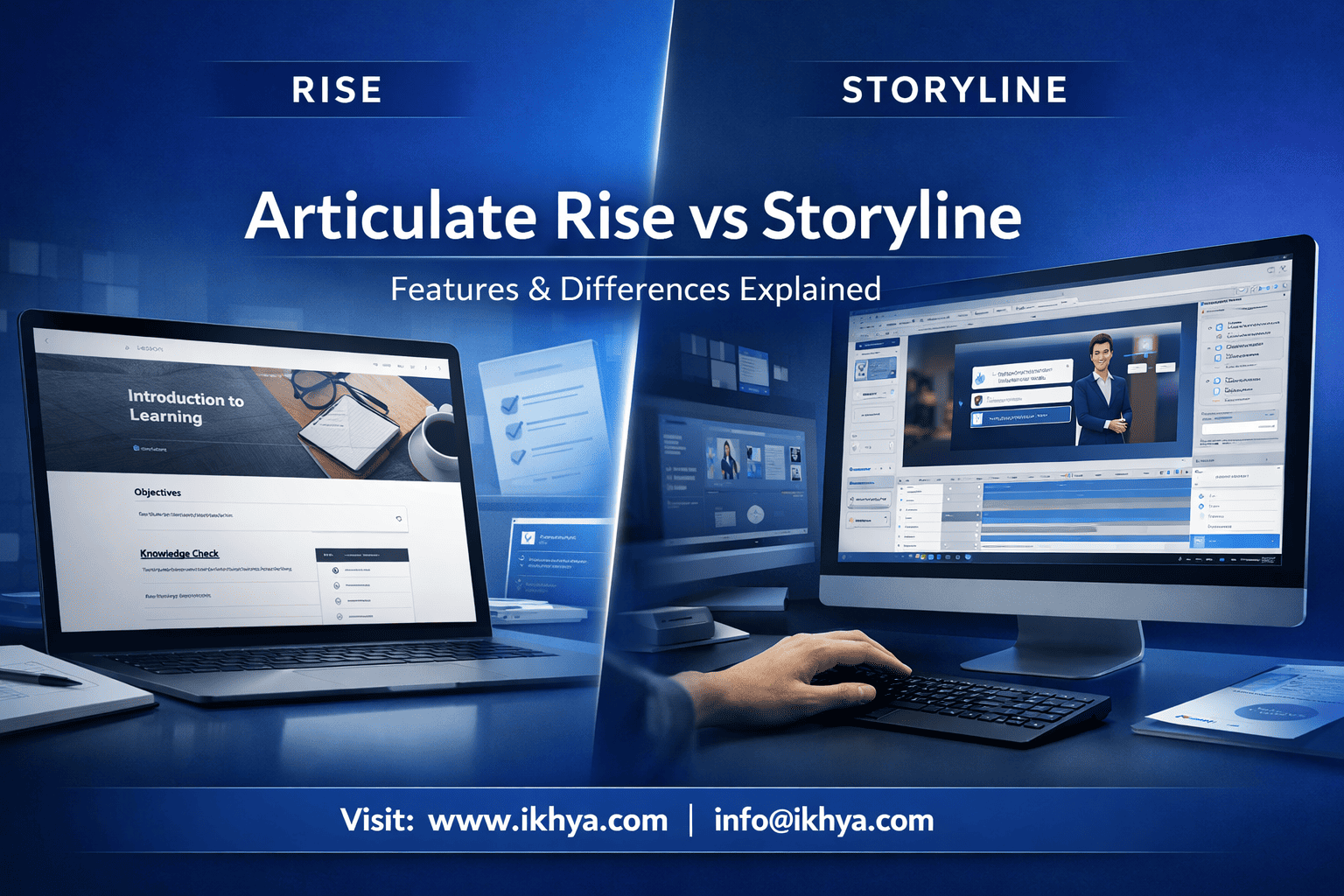
Articulate Rise vs Storyline features can be confusing to evaluate—especially when the wrong choice leads to slow development, limited interactivity, or costly rework in your eLearning projects. Many organizations struggle to decide between speed, scalability, and interactivity when comparing these tools.
At IKHYA, we help organizations design and develop effective eLearning solutions using both Rise and Storyline based on real training needs—not assumptions. This guide explains Articulate Rise vs Storyline features and differences in a clear, practical way so you can understand how each tool is used in different training scenarios.
If you’re specifically evaluating these tools for corporate training, explore our detailed guide on Rise vs Storyline for corporate training here.
Articulate Rise vs Storyline Features Overview
When comparing Articulate Rise vs Storyline features, Articulate Rise stands out as a web-based authoring tool designed for fast, responsive course creation using pre-built blocks and templates. In comparison, it stands out for speed and simplicity when evaluated alongside Storyline. Articulate Storyline is a desktop-based authoring tool built for custom interactive learning, simulations, and complex branching. While Rise prioritizes speed and responsiveness, Storyline focuses on flexibility, control, and advanced instructional design capabilities.
Understanding Articulate Rise
Articulate Rise (Rise 360) is part of the Articulate 360 suite and runs entirely in a web browser. It allows instructional designers to build courses using structured content blocks without needing programming skills.
Key Characteristics of Articulate Rise
1. Fully Responsive by Default
Rise automatically adapts content for:
- Desktop
- Tablets
- Mobile phones
This is critical for global organizations where mobile learning dominates. According to LinkedIn Workplace Learning reports, mobile learning adoption exceeds 60% in regions like the UAE, India, and Southeast Asia.
2. Block-Based Content Structure
Rise uses modular blocks such as:
- Text blocks
- Image blocks
- Interactive accordion blocks
- Tabs
- Knowledge checks
- Process interactions
This allows rapid course assembly without custom development.
3. Cloud-Based Development
Rise runs in the cloud, enabling:
- No software installation
- Access from anywhere
- Automatic updates
- Real-time collaboration
This is especially valuable for distributed teams in the USA, UK, and Australia.
4. Faster Development Speed
Typical development timelines:
| Course Type | Rise Development Time |
|---|---|
| 30-minute course | 4–8 hours |
| 60-minute course | 8–16 hours |
| Compliance refresher | 2–6 hours |
Compared to Storyline, Rise can be 40–70% faster for standard courses.
Understanding Articulate Storyline
In this articulate storyline vs rise 360 comparison, Articulate Storyline is a powerful desktop authoring tool used for creating highly interactive, custom learning experiences. It functions similarly to PowerPoint but includes advanced programming-like capabilities.
Key Characteristics of Articulate Storyline
1. Full Customization Control
Storyline allows complete control over:
- Layout
- Navigation
- Animations
- Interactions
- Triggers and variables
This makes it ideal for custom learning design.
2. Advanced Interactivity and Logic
Storyline supports:
- Conditional triggers
- Variables
- Branching scenarios
- Gamification
- Software simulations
This is essential for high-stakes training such as aviation, healthcare, and industrial safety.
Example:
US healthcare organizations use Storyline to simulate patient interactions aligned with HIPAA training requirements.
3. Software Simulation Capability
Storyline can create:
- Step-by-step software demos
- Guided practice simulations
- Assessment simulations
Widely used in SAP, Salesforce, and ERP training worldwide.
4. Complex Assessment Support
Storyline enables:
- Scenario-based assessments
- Drag-and-drop interactions
- Custom scoring logic
- Adaptive learning paths
This supports compliance-driven industries like oil & gas in the UAE and mining in Australia.
Articulate Rise vs Storyline Feature Comparison
This Articulate Rise vs Storyline comparison table highlights the key differences between both tools.
| Feature | Articulate Rise | Articulate Storyline |
|---|---|---|
| Platform | Web-based | Desktop software |
| Ease of use | Very easy | Moderate to advanced |
| Development speed | Very fast | Slower |
| Customization | Limited | Extensive |
| Interactivity | Basic to moderate | Advanced |
| Software simulations | Not supported | Fully supported |
| Responsive design | Automatic | Manual adjustments |
| Collaboration | Real-time cloud | File-based |
Real-World Global Use Cases
Rise is commonly used for:
- Compliance training (OSHA, GDPR, workplace safety)
- HR onboarding
- Policy training
- Awareness training
Storyline is commonly used for:
- Medical simulations (USA, UK NHS training)
- Aviation training (FAA, CASA Australia)
- Oil and gas safety simulations (UAE)
- Equipment training simulations
Instructional Design Capability Comparison
| Instructional Need | Rise | Storyline |
|---|---|---|
| Rapid deployment | Excellent | Moderate |
| Scenario-based learning | Limited | Excellent |
| Software training | Poor | Excellent |
| Mobile learning | Excellent | Good |
| Gamification | Limited | Excellent |
| Compliance training | Excellent | Excellent |
| Custom learning journeys | Limited | Excellent |
Common Use Cases of Articulate Rise
Rise is commonly used in scenarios where:
- Training must be deployed quickly
- Content is mostly informational
- Budget is limited
- Mobile learners are the priority
Example:
A UK retail chain rolling out new HR policy training to 20,000 employees globally can deploy Rise courses in weeks instead of months.
Common Use Cases of Articulate Storyline
Storyline is selected when:
- Training requires simulations
- Compliance risk is high
- Learning must be highly interactive
- Custom scenarios are needed
Example:
A US manufacturing company training workers on hazardous equipment must use Storyline to simulate real-world risk scenarios.
Articulate Rise vs Storyline Features: Key Differences and Capabilities
Articulate Rise is optimized for speed, consistency, and responsive delivery using structured content blocks, while Storyline is optimized for customization, interactivity, and simulation-based learning using triggers, variables, and layers. Rise is ideal for rapid deployment and mobile-first training, while Storyline supports complex logic, software simulations, and high-risk compliance training requiring realism and learner decision-making.
Development Speed vs Customization Power
One of the most important aspects of Articulate Rise vs Storyline Features is development speed versus creative control.
Articulate Rise: Built for Rapid Deployment
Rise enables instructional designers to assemble courses quickly using pre-built blocks. There is minimal need for custom design, animation, or logic programming.
Why Rise is faster:
- No timeline management
- No trigger programming
- No animation sequencing
- Pre-built interactions ready to use
- Automatic responsive behavior
Example (Global Compliance Rollout):
A UAE logistics company deploying new workplace safety training to 15,000 employees can build and launch Rise courses in under two weeks. The same project in Storyline could take 6–10 weeks depending on complexity.
Typical Development Ratios:
| Course Length | Rise Development Time | Storyline Development Time |
|---|---|---|
| 30 minutes | 4–8 hours | 20–40 hours |
| 60 minutes | 8–16 hours | 40–80 hours |
| 2 hours | 16–32 hours | 80–160 hours |
This difference directly impacts cost and scalability.
Articulate Storyline: Built for Full Creative Control
Storyline provides complete control over every visual and functional element.
Instructional designers can control:
- Object states
- Motion paths
- Conditional navigation
- Adaptive learning paths
- Custom animations
Example (Medical Training – USA and UK):
Healthcare organizations use Storyline to simulate patient diagnosis scenarios where learner decisions affect outcomes. This cannot be replicated effectively in Rise.
Interactivity Capabilities: Basic vs Advanced
Interactivity is a critical part of Articulate Rise vs Storyline Features and determines how deeply learners engage with training.
Rise Interactivity Capabilities
Rise supports structured interactions such as:
- Tabs
- Accordion blocks
- Labeled graphics
- Flashcards
- Knowledge checks
- Sorting activities
These are effective for:
- Awareness training
- Policy training
- Concept reinforcement
But Rise cannot support:
- Custom drag-and-drop logic
- Multi-layer scenarios
- Conditional simulations
Storyline Interactivity Capabilities
Storyline supports advanced logic using:
- Triggers
- Variables
- Layers
- States
This allows creation of:
- Decision-based scenarios
- Gamified learning
- Simulation-based training
- Adaptive assessments
Example (Oil & Gas – Australia and UAE):
Workers can simulate responding to equipment failure. Incorrect decisions lead to simulated consequences, reinforcing safety behavior.
This level of realism significantly improves retention.
Software Simulation Capability: Critical Difference
Software training is one of the biggest differentiators.
Rise: No True Simulation Capability
Rise can only show:
- Images
- Videos
- Step descriptions
It cannot simulate real software interaction.
This is insufficient for training on:
- SAP
- Salesforce
- Oracle systems
- Healthcare systems like Epic
Storyline: Full Software Simulation Support
Storyline allows recording and building:
- Watch mode (demonstration)
- Try mode (guided interaction)
- Test mode (assessment)
This is essential for enterprise software adoption globally.
Example (Banking Sector – UK):
Banks use Storyline to train staff on fraud detection systems where learners must perform tasks correctly inside simulated software environments.
Responsive Design and Mobile Experience
Mobile learning is critical globally.
Rise: Fully Responsive Automatically
Rise automatically adapts content to:
- Mobile phones
- Tablets
- Desktops
No manual adjustment required.
This makes it ideal for:
- Field workers
- Retail staff
- Logistics employees
Especially important in India, Southeast Asia, and the UAE where mobile-first learning dominates.
Storyline: Responsive But Requires Optimization
Storyline uses a responsive player, but content itself is fixed-layout.
Designers must manually optimize for mobile by:
- Using larger buttons
- Simplifying layouts
- Avoiding small text
Poor optimization can reduce usability.
Learning Experience Quality and Realism
Learning effectiveness depends on realism and engagement.
Rise: Structured and Consistent
Rise provides:
- Clean layouts
- Consistent navigation
- Predictable experience
Best for:
- Knowledge transfer
- Policy education
- Awareness training
But limited in immersive learning.
Storyline: Highly Immersive Learning
Storyline enables:
- Real-world simulations
- Scenario-based learning
- Gamification
- Adaptive feedback
This is essential for:
- Safety training
- Medical training
- Equipment training
Studies across US corporate training environments show scenario-based learning improves retention by 30–50% compared to passive content.
Collaboration and Team Workflow
Modern global teams require collaboration.
Rise: Built for Team Collaboration
Rise supports:
- Real-time collaboration
- Cloud access
- Shared editing
- Version control
Multiple team members in different countries can work simultaneously.
Example:
A UK-based instructional designer and an Australian SME can collaborate on the same course in real time.
Storyline: File-Based Workflow
Storyline uses local files (.story format).
Challenges include:
- Version conflicts
- File sharing delays
- No real-time collaboration
Teams often use version control systems or project management tools to manage workflow.
Maintenance and Updating Courses
Course maintenance is a major long-term cost factor.
Rise: Extremely Easy to Update
Updates can be made instantly in the browser.
Changes automatically apply across all learners.
This is ideal for:
- Compliance training updates
- Policy changes
- Regulatory updates
Storyline: Requires Republishing
Updating Storyline requires:
- Opening source file
- Making changes
- Republishing
- Uploading to LMS
This increases maintenance time and cost.
When to Choose Articulate Rise vs Storyline (Decision Framework)
When to use articulate rise vs storyline depends on your training goals—choose Articulate Rise when speed, mobile responsiveness, and scalability are priorities for informational or compliance training. Choose Storyline when training requires simulations, complex interactivity, custom logic, or high-risk skill development. The decision depends on training goals, risk level, learner environment, and instructional design complexity—not just budget or timeline.
Choose Articulate Rise When Speed and Scale Are Critical
Rise is the best choice when rapid deployment is the primary objective.
Ideal Use Cases
Compliance training
Examples:
- OSHA training (USA)
- GDPR training (UK, EU)
- Workplace safety (Australia)
- Labor law compliance (UAE)
Corporate onboarding
- HR policies
- Company introduction
- Culture training
Awareness training
- Cybersecurity awareness
- Diversity and inclusion
- Code of conduct
Why Rise Works Best Here
Because compliance training primarily focuses on information delivery, Rise’s structured format is sufficient and highly efficient.
Example:
A global company onboarding 10,000 employees can deploy Rise courses in days instead of months.
Choose Storyline When Training Requires Skill Practice
Storyline is essential when learners must perform tasks, make decisions, or practice skills.
Ideal Use Cases
Software training
- SAP training
- Salesforce training
- ERP training
Safety training
- Equipment operation
- Hazard identification
- Emergency procedures
Medical training
- Patient care simulations
- Clinical decision training
Why Storyline Is Required
Skill-based learning requires:
- Decision-making
- Practice environments
- Realistic scenarios
Rise cannot provide this level of realism.
Decision Matrix: Rise vs Storyline
| Training Requirement | Choose Rise | Choose Storyline |
|---|---|---|
| Compliance training | ✔ | ✔ |
| Software simulation | ✘ | ✔ |
| Rapid deployment | ✔ | ✘ |
| Complex scenarios | ✘ | ✔ |
| Mobile-first training | ✔ | ✔ |
| Gamification | Limited | Excellent |
| Budget constraints | ✔ | ✘ |
| High-risk safety training | ✘ | ✔ |
Cost Comparison: Articulate Rise vs Storyline (Development, Maintenance, and Total Cost)
When comparing rise vs storyline cost, Articulate Rise is significantly cheaper to develop and maintain because it requires fewer development hours and less technical expertise. Storyline costs more due to custom design, simulation development, and programming-like logic. Globally, Storyline projects typically cost 2–5 times more than Rise, depending on interactivity, compliance requirements, and instructional complexity.
Development Cost Differences by Region
Development costs vary globally based on labor rates, compliance requirements, and technical complexity. However, the relative cost difference between Rise and Storyline remains consistent worldwide.
Average Development Cost Per Finished Hour of eLearning
| Region | Rise Cost (USD) | Storyline Cost (USD) |
|---|---|---|
| USA | $1,500 – $4,000 | $5,000 – $15,000 |
| UK | $1,200 – $3,500 | $4,500 – $12,000 |
| Australia | $1,400 – $3,800 | $5,000 – $14,000 |
| UAE | $1,000 – $3,000 | $4,000 – $10,000 |
| India | $600 – $2,000 | $2,500 – $6,000 |
These ranges reflect real enterprise development costs, including:
- Instructional design
- Visual design
- Development
- Testing
- LMS packaging (SCORM/xAPI)
Why Storyline Costs More: Technical Complexity Factors
Storyline development involves significantly more manual work.
Additional Development Components in Storyline
1. Custom Interaction Development
Requires building:
- Triggers
- Variables
- Logic conditions
- Navigation rules
Each interaction can take 1–4 hours to develop.
2. Simulation Development Time
Software simulations require:
- Screen recording
- Interaction layer creation
- Feedback programming
- Testing and debugging
Typical simulation development time:
- 1 minute simulation = 2–6 development hours
3. Instructional Design Complexity
Storyline projects often include:
- Scenario mapping
- Branching logic design
- Adaptive feedback development
This adds instructional design hours significantly.
Real Enterprise Example: Compliance Training Deployment
Scenario:
A UAE oil and gas company needs a 60-minute safety course for 5,000 workers.
Rise Development
- Development time: 12–18 hours
- Cost: $1,200–$2,500
- Suitable for awareness training
Storyline Development
- Development time: 60–120 hours
- Cost: $6,000–$12,000
- Suitable for simulation-based hazard training
The higher cost delivers better risk mitigation.
Maintenance and Update Cost Comparison
Maintenance is often overlooked but represents a major long-term cost.
Rise Maintenance Cost: Very Low
Updating Rise courses requires:
- Editing directly in browser
- Republishing instantly
- No redevelopment required
Typical update cost:
- $50–$200 per update
Storyline Maintenance Cost: Moderate to High
Updating Storyline requires:
- Opening source file
- Modifying triggers/interactions
- Republishing and testing
Typical update cost:
- $300–$1,500 per update
This is especially relevant in highly regulated industries like healthcare and aviation where updates are frequent.
Total Cost of Ownership Over 3 Years
| Cost Category | Rise | Storyline |
|---|---|---|
| Initial development | Low | High |
| Maintenance | Very low | Moderate |
| Update cost | Low | Moderate |
| Scaling cost | Very low | Moderate |
| Total 3-year cost | Low | High |
When Higher Storyline Cost Is Justified
Storyline provides higher ROI when training outcomes directly affect:
- Safety
- Compliance risk
- Equipment operation
- Medical decisions
Example:
In Australia’s mining sector, simulation training significantly reduces accident rates, making higher development cost justified.
Global Industry Use Cases: When Enterprises Choose Rise vs Storyline
Organizations worldwide select Rise or Storyline based on training risk level, complexity, and learning objectives. Rise dominates compliance, onboarding, and awareness training globally, while Storyline is used for simulations, equipment training, and high-risk skill development in industries such as healthcare, aviation, oil and gas, and manufacturing.
United States: Healthcare and Corporate Compliance
Rise Usage in the USA
Commonly used for:
- HIPAA compliance training
- HR onboarding
- Workplace policy training
- Cybersecurity awareness
Example:
A US insurance company can deploy compliance updates to 50,000 employees within days using Rise.
Storyline Usage in the USA
Critical for:
- Medical simulations
- Clinical training
- Equipment training
Example:
Hospitals use Storyline to simulate patient diagnosis scenarios to train healthcare staff safely.
This reduces medical error risk.
United Kingdom: Financial Services and Regulatory Training
Rise Usage in the UK
Used for:
- GDPR compliance
- Financial compliance awareness
- Corporate onboarding
The Financial Conduct Authority (FCA) requires regular compliance training, making rapid deployment essential.
Storyline Usage in the UK
Used for:
- Fraud detection simulations
- Risk assessment training
- Banking system training
Staff must practice decision-making scenarios.
Australia: Mining, Industrial, and Safety Training
Australia has some of the strictest workplace safety regulations globally.
Rise Usage
Used for:
- Safety awareness training
- Induction training
- Compliance refreshers
Storyline Usage
Used for:
- Equipment simulations
- Hazard identification training
- Emergency procedure training
Simulation-based training reduces workplace accidents.
UAE: Oil, Gas, Aviation, and Logistics Training
The UAE relies heavily on safety-critical industries.
Rise Usage
Used for:
- Compliance awareness
- Workforce onboarding
- Logistics training
Storyline Usage
Used for:
- Equipment operation simulation
- Aviation safety training
- Emergency response training
Simulation training is essential for regulatory compliance.
India and Global Capability Centers (GCCs)
India is a major hub for global eLearning development.
Rise Usage
Common for:
- Corporate training
- IT training
- Onboarding programs
Storyline Usage
Common for:
- Software training
- Technical training
- Simulation development for global clients
Indian development teams often create Storyline courses for US, UK, and Australian organizations.
How to Use Rise and Storyline Together (Best Enterprise Strategy)
The most effective enterprise strategy is not choosing Rise or Storyline—it is using both together. Rise delivers fast, mobile-friendly core content, while Storyline provides simulations and complex interactivity. This hybrid approach reduces cost, accelerates deployment, and ensures learners get both knowledge and hands-on practice where required.
Why Enterprises Combine Rise and Storyline
Large organizations rarely rely on a single authoring tool. Instead, they match the tool to the instructional requirement.
Use Rise for:
- Policy explanations
- Compliance rules
- Concept introductions
- Knowledge reinforcement
Use Storyline for:
- Simulations
- Decision-based scenarios
- Skill practice
- Assessments requiring logic
This approach maximizes efficiency and learning effectiveness.
How Integration Works Technically
Rise allows Storyline blocks to be embedded directly inside Rise courses.
Technical workflow:
- Create simulation in Storyline
- Publish to Articulate 360 Review
- Insert Storyline block inside Rise
- Deploy as one integrated course
The learner experiences it as a single seamless course.
Example: Global Compliance Training Architecture
Example: Oil and Gas Company (UAE)
Course structure:
| Section | Tool Used | Purpose |
|---|---|---|
| Safety policies | Rise | Fast knowledge delivery |
| Hazard identification | Rise | Visual awareness |
| Equipment simulation | Storyline | Hands-on skill practice |
| Emergency scenario | Storyline | Decision-based simulation |
| Final assessment | Storyline | Skill validation |
This hybrid model reduces development cost while ensuring skill competency.
Cost Savings from Hybrid Strategy
Using both tools strategically reduces cost significantly.
Example: 1-hour course cost comparison
| Approach | Estimated Cost |
|---|---|
| Full Storyline course | $8,000 – $15,000 |
| Full Rise course | $1,500 – $4,000 |
| Hybrid approach | $3,000 – $7,000 |
Organizations achieve:
- 40–60% cost savings
- Faster deployment
- Better learning outcomes
Recommended Enterprise Workflow
Phase 1: Instructional Analysis
Identify which parts require:
- Information delivery → Rise
- Skill practice → Storyline
Phase 2: Rapid Development
Build knowledge modules in Rise first.
Phase 3: Simulation Development
Create simulations only where required.
Phase 4: Integration and Deployment
Combine into a single course and deploy via LMS.
Global Enterprise Example: Software Training (USA and UK)
Typical enterprise software training structure:
- Introduction → Rise
- Feature explanation → Rise
- Software simulation → Storyline
- Practice exercises → Storyline
- Final assessment → Storyline
This provides complete learning coverage.
Articulate Rise vs Storyline: Final Comparison Summary
When evaluating Articulate Rise vs Storyline Features, choose Articulate Rise if your training focuses on knowledge delivery, compliance, onboarding, or rapid deployment. Choose Storyline if learners must practice skills, make decisions, or interact with simulations. Most enterprise training programs use both tools together to balance speed, cost, scalability, and learning effectiveness across global audiences.
Choose Rise If Your Priority Is Speed and Scalability
Rise is the best option when:
- Training must be deployed quickly
- Content is informational
- Mobile learning is critical
- Budget is limited
- Frequent updates are expected
Best for:
- Compliance training
- HR onboarding
- Awareness training
- Corporate communications
Choose Storyline If Your Priority Is Skill Development
Storyline is the best option when:
- Learners must perform tasks
- Simulation is required
- Training involves risk
- Learning must be immersive
Best for:
- Software training
- Medical training
- Equipment training
- Safety training
Choose Both for the Best Enterprise Results
Hybrid development is ideal for:
- Complex enterprise training programs
- Safety-critical industries
- Software adoption programs
- Global workforce training
This is the strategy used by Fortune 500 companies worldwide.
Expert Recommendation
If your training involves real-world skills, simulations, or compliance risk, relying only on Rise is insufficient. If your training is purely informational, Storyline may be unnecessarily expensive. The optimal approach is selecting the right tool based on instructional goals—not convenience.
Organizations that align tool selection with learning objectives achieve better learner outcomes, faster deployment, and lower long-term costs.
Build the Right eLearning Strategy with Experts
Choosing the right authoring tool is not just a technical decision—it directly impacts training effectiveness, compliance, learner engagement, and long-term costs.
IKHYA – eLearning Solutions Company helps organizations worldwide design, develop, and deploy scalable training using Articulate Rise, Storyline, and hybrid learning architectures.
Contact: info@ikhya.com
Partner with experts who understand global compliance standards, enterprise LMS integration, and modern instructional design.
FAQs
1. What is the main difference between Articulate Rise and Storyline?
Articulate Rise is designed for fast, responsive course creation using templates, while Storyline offers advanced customization, interactivity, and simulation capabilities.
2. Which is better: Articulate Rise or Storyline?
Both tools serve different purposes. Rise is commonly used for rapid content development, while Storyline is used for complex, interactive learning experiences.
3. What are Articulate Rise vs Storyline features?
Articulate Rise focuses on speed, mobile responsiveness, and ease of use, whereas Storyline provides advanced features like triggers, variables, and branching scenarios.
4. What is the difference between Rise and Storyline in eLearning?
The difference between Rise and Storyline lies in their capabilities—Rise is best for simple, scalable courses, while Storyline supports complex simulations and interactivity.
5. What is the rise vs storyline cost difference?
When comparing rise vs storyline cost, Rise is generally more affordable due to faster development, while Storyline requires more time and expertise, increasing costs.
6. Is Articulate Rise easier to use than Storyline?
Yes, Articulate Rise is easier to use because it is template-based and requires minimal technical skills compared to Storyline.
7. Can Articulate Rise create interactive courses like Storyline?
Rise supports basic interactivity, but it cannot match Storyline’s advanced capabilities like simulations and custom logic.
8. Which tool is better for corporate training?
Both tools are used in corporate training. Rise is used for onboarding and compliance, while Storyline is used for simulation-based training.
9. Is Storyline better for software training?
Yes, Storyline is better for software training because it allows learners to interact with simulated environments.
10. Is Articulate Rise mobile-friendly?
Yes, Articulate Rise is fully responsive and automatically adapts to mobile devices without additional design effort.
11. Does Storyline support mobile learning?
Storyline supports mobile delivery, but it requires manual optimization for the best user experience.
12. Can Rise and Storyline be used together?
Yes, many organizations use both tools together by embedding Storyline interactions inside Rise courses.
13. Which tool is faster for course development?
Rise is significantly faster for course development due to its block-based structure and templates.
14. Which tool is better for compliance training?
Rise is commonly used for compliance training because it is easy to update and deploy at scale.
15. What industries use Articulate Storyline the most?
Storyline is widely used in healthcare, aviation, manufacturing, and other industries that require simulation-based training.
16. What industries prefer Articulate Rise?
Rise is commonly used in corporate environments for onboarding, HR training, and awareness programs.
17. Is Articulate Storyline difficult to learn?
Storyline has a learning curve because of its advanced features like triggers and variables, but it offers greater flexibility.
18. Does Articulate Rise support LMS integration?
Yes, Rise supports LMS integration through SCORM, xAPI, and other standard formats.
19. Which tool is better for beginners?
Rise is better for beginners due to its simplicity and ease of use.
20. How do you choose between Rise and Storyline?
The choice depends on training needs—Rise is used for fast, scalable content, while Storyline is used for interactive and simulation-based learning.
Related Resources
Explore more in-depth guides and services to help you plan, develop, and scale effective eLearning programs using Articulate Rise and Storyline.