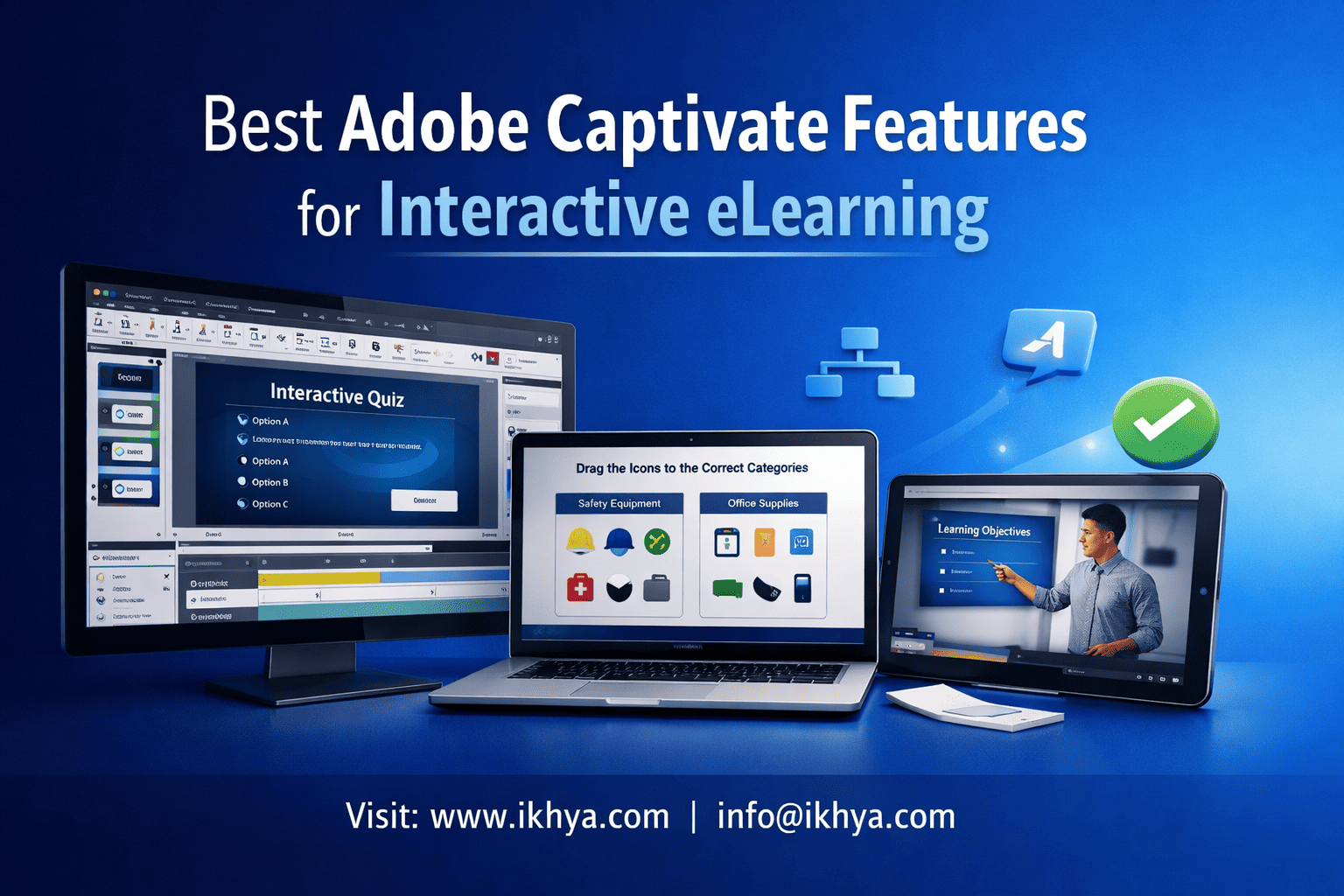
Best Adobe Captivate Features for Interactive eLearning

Modern learners expect more than static slides—they want immersive, interactive experiences. That’s where Adobe Captivate stands out. With powerful features like simulations, responsive design, and VR learning, it enables organizations to build engaging training programs at scale. If you’re evaluating tools, understanding these features is critical to making the right decision.
If you’re exploring implementation, you can also book a free eLearning demo to see how these features work in real-world corporate training.
What Makes Adobe Captivate Ideal for Interactive eLearning?
Adobe Captivate is ideal for interactive eLearning because it combines advanced interactivity, responsive design, and simulation capabilities in one platform. It enables organizations to create engaging, scalable, and LMS-compatible training experiences tailored to modern learners across devices.
Key Advantages of Adobe Captivate
- Highly interactive learning experiences with drag-and-drop, branching, and simulations
- Responsive design for mobile-first training delivery
- Advanced simulation capabilities for software and process training
- Seamless LMS integration with SCORM and xAPI support
- Support for immersive learning like VR and 360° environments
Unlike basic authoring tools, Captivate focuses heavily on experience-driven learning, making it especially valuable for industries requiring hands-on training.
To understand its broader value, explore the benefits of Adobe Captivate for corporate eLearning.
How Adobe Captivate Stands Out from Traditional Tools
| Feature Area | Traditional Tools | Adobe Captivate |
|---|---|---|
| Interactivity | Basic quizzes | Advanced branching & simulations |
| Responsiveness | Limited | Fully responsive (Fluid Boxes) |
| Learning Types | Static courses | Scenario-based, VR, video-based |
| Scalability | Moderate | Enterprise-ready |
| Automation | Minimal | AI-assisted workflows |
This makes Captivate particularly suitable for:
- Compliance-heavy industries (finance, healthcare)
- Technical training environments
- Global workforce training programs
If you’re considering implementing Captivate at scale, IKHYA – eLearning Solutions Company can help design and develop customized solutions aligned with your business goals. Reach out at info@ikhya.com or explore our expertise.
Top Adobe Captivate Features for Interactive eLearning
Adobe Captivate offers a powerful suite of features designed to create highly interactive, engaging, and scalable eLearning experiences. These features go beyond basic course creation, enabling organizations to deliver simulations, responsive learning, and immersive training.
1. Responsive Design with Fluid Boxes
Captivate’s Fluid Boxes automatically adjust content for different screen sizes, ensuring a seamless experience across desktops, tablets, and smartphones.
Why it matters:
- Eliminates the need to design multiple versions
- Supports mobile-first learning strategies
- Ensures consistent user experience across devices
Best for:
- Remote workforce training
- Global organizations with diverse device usage
2. Advanced Simulation Capabilities
Captivate excels in software simulations and scenario-based learning, making it one of the best tools for hands-on training.
Types of simulations:
- Demonstration mode (watch)
- Training mode (practice)
- Assessment mode (test)
Business impact:
- Reduces training errors
- Improves retention through experiential learning
- Ideal for onboarding and system training
For organizations looking to implement this, explore our Adobe Captivate development services for tailored solutions.
3. Virtual Reality (VR) and 360° Learning
Captivate allows you to create immersive learning experiences using 360-degree images and VR scenarios.
Use cases:
- Safety training in manufacturing
- Medical simulations in healthcare
- Site walkthroughs in construction
Key benefits:
- High engagement levels
- Real-world simulation without risk
- Better knowledge retention
4. Interactive Video-Based Learning
Captivate transforms passive video into interactive learning experiences.
Features include:
- Clickable hotspots
- In-video quizzes
- Branching scenarios within videos
Why it works:
- Keeps learners engaged
- Enables decision-based learning
- Ideal for storytelling-based training
5. Gamification and Interactions
Captivate includes built-in tools for creating gamified learning experiences.
Examples:
- Points and scoring systems
- Drag-and-drop activities
- Interactive decision paths
Outcome:
- Increased learner motivation
- Higher completion rates
- Improved knowledge retention
6. SCORM & xAPI Compliance
Captivate supports industry standards like SCORM, xAPI, and AICC, ensuring seamless integration with LMS platforms.
Advantages:
- Easy tracking of learner progress
- Compatibility with enterprise LMS systems
- Data-driven learning insights
7. Multi-Device & Offline Learning Support
Captivate enables learners to access courses anytime, anywhere.
Capabilities:
- Offline learning support
- Cross-device compatibility
- Cloud publishing options
8. AI-Based Automation & Templates
Captivate accelerates development with pre-built templates and automation features.
Benefits:
- Faster course creation
- Reduced development costs
- Consistent design standards
If you’re evaluating whether Captivate is the right tool compared to alternatives, check this detailed Adobe Captivate vs Articulate Storyline comparison.
How Adobe Captivate Enhances Learning Engagement
Adobe Captivate enhances learning engagement by combining interactivity, personalization, and immersive experiences. It transforms passive content into active learning journeys through simulations, branching scenarios, and adaptive paths—leading to better retention, higher completion rates, and measurable training outcomes.
Scenario-Based Learning for Real-World Decision Making
Scenario-based learning in Captivate allows learners to make decisions in realistic situations and experience consequences in a safe environment.
How it works:
- Learners are presented with real-life situations
- They choose actions or responses
- The course branches based on their decisions
Why it’s powerful:
- Encourages critical thinking
- Improves decision-making skills
- Mimics real-world challenges
Example:
- In healthcare training, nurses can practice patient interactions
- In financial services, employees can simulate compliance scenarios
This makes training more practical rather than theoretical.
Personalized Learning Paths with Branching Logic
Captivate enables adaptive learning paths, where content adjusts based on learner performance and choices.
Key capabilities:
- Conditional navigation based on quiz results
- Role-based learning paths
- Custom feedback loops
Business impact:
- Reduces training time by skipping irrelevant content
- Improves learner satisfaction
- Enhances knowledge retention
Microlearning for Modern Workforce Needs
Captivate supports bite-sized learning modules, ideal for busy professionals.
Microlearning benefits:
- Short, focused content (5–10 minutes)
- Easy to access on mobile devices
- Improves retention through spaced learning
Use cases:
- Sales training updates
- Compliance refreshers
- Product knowledge training
Organizations transitioning from long training formats can benefit from structured approaches like rapid eLearning development services.
Interactive Assessments and Feedback
Captivate goes beyond basic quizzes by offering interactive and dynamic assessments.
Features include:
- Drag-and-drop assessments
- Simulation-based testing
- Real-time feedback with explanations
Why it matters:
- Reinforces learning immediately
- Identifies knowledge gaps
- Improves overall training effectiveness
Immersive Learning Through VR and Simulations
Captivate’s immersive capabilities create experiential learning environments.
Key advantages:
- Safe environment for high-risk training
- Hands-on experience without physical resources
- Increased engagement compared to traditional methods
Industry examples:
- Manufacturing: Equipment safety simulations
- Healthcare: Emergency response training
- Aviation: Procedure-based simulations
Engagement Impact Summary
| Engagement Method | Feature Used | Business Outcome |
|---|---|---|
| Scenario-based learning | Branching & simulations | Better decision-making |
| Personalized learning | Adaptive paths | Faster learning |
| Microlearning | Short modules | Higher retention |
| Interactive assessments | Dynamic quizzes | Improved performance |
| Immersive learning | VR & simulations | Real-world readiness |
To implement these engagement strategies effectively, working with the right partner is critical. Learn more about how to choose an Adobe Captivate development company to ensure success.
Real-World Use Cases of Adobe Captivate
Adobe Captivate is widely used across industries to deliver interactive, scalable, and compliance-driven training. Its flexibility makes it suitable for complex learning environments where engagement and accuracy are critical.
Healthcare Training
Captivate is extensively used in healthcare for compliance, clinical training, and patient care simulations.
Applications:
- HIPAA compliance training
- Patient interaction simulations
- Medical procedure walkthroughs
Why it works:
- Enables risk-free practice
- Ensures regulatory compliance
- Improves patient safety outcomes
Manufacturing Safety Training
Manufacturing organizations use Captivate to deliver safety and operational training.
Use cases:
- Equipment handling simulations
- Hazard identification training
- Emergency response drills
Business benefits:
- Reduces workplace accidents
- Standardizes training across locations
- Improves compliance adherence
Financial Services Compliance Training
Captivate helps financial institutions deliver highly regulated compliance training.
Examples:
- Anti-money laundering (AML) training
- Data security awareness
- Regulatory compliance modules
Advantages:
- Ensures audit readiness
- Tracks learner progress via LMS
- Supports global training deployment
Retail & Customer Service Training
Retail companies use Captivate to train employees on customer interaction and product knowledge.
Applications:
- Sales scenario simulations
- Customer service training modules
- Product training courses
IT & Software Training
Captivate is particularly strong in software simulations, making it ideal for IT training.
Use cases:
- ERP/CRM system training
- Software onboarding
- Technical skill development
If you’re planning to convert existing training into interactive modules, you can follow a structured approach outlined in this step-by-step Adobe Captivate course development process.
Adobe Captivate vs Other eLearning Tools
Adobe Captivate stands out for simulations, responsive design, and immersive learning, while other tools like Storyline, Rise, and Lectora focus on ease of use, rapid development, or structured layouts. Choosing the right tool depends on your training complexity, interactivity needs, and scalability requirements.
Feature Comparison: Captivate vs Storyline vs Rise vs Lectora
| Feature | Adobe Captivate | Articulate Storyline | Articulate Rise | Lectora Inspire |
|---|---|---|---|---|
| Ease of Use | Moderate (learning curve) | Easy | Very easy | Moderate |
| Interactivity | Advanced | Advanced | Limited | Advanced |
| Responsive Design | Excellent (Fluid Boxes) | Manual | Fully responsive | Strong |
| Simulations | Best-in-class | Good | Not supported | Moderate |
| VR/360 Learning | Yes | Limited | No | No |
| Microlearning | Supported | Supported | Best suited | Supported |
| LMS Compatibility | SCORM, xAPI | SCORM, xAPI | SCORM, xAPI | SCORM, xAPI |
| Development Speed | Moderate | Fast | Very fast | Moderate |
| Customization | High | High | Limited | High |
Key Takeaways from the Comparison
- Choose Adobe Captivate if:
- You need advanced simulations or VR-based training
- Your training involves complex workflows or technical processes
- You require high interactivity with adaptive learning paths
- Choose Articulate Storyline if:
- You want strong interactivity with easier usability
- Your team prefers a PowerPoint-like interface
- You need faster development with moderate complexity
- Choose Articulate Rise if:
- You need rapid, responsive, mobile-first courses
- Your focus is on microlearning and quick deployment
- Choose Lectora if:
- You need accessibility compliance (WCAG)
- You want structured, enterprise-level content control
For a deeper breakdown, explore this detailed Adobe Captivate vs Articulate Storyline comparison.
When Should You Use Adobe Captivate?
Adobe Captivate is best used when your training requires high interactivity, simulations, or immersive learning. It is particularly effective for complex training environments where learner engagement and real-world application are critical.
Ideal Scenarios for Using Adobe Captivate
Use Captivate when you need:
- Software simulations (ERP, CRM, internal tools)
- Scenario-based compliance training
- Safety training with immersive environments
- Multi-device responsive learning
- Interactive video-based learning modules
When Adobe Captivate May Not Be the Best Choice
Captivate may not be ideal if:
- You need ultra-fast course development with minimal customization
- Your team lacks technical expertise
- You are creating simple, content-heavy courses without interactivity
In such cases, tools like Rise may be more efficient.
Decision Checklist
Use this quick checklist to decide:
| Requirement | Use Captivate? |
|---|---|
| High interactivity needed | Yes |
| Simulations required | Yes |
| VR/immersive learning | Yes |
| Rapid deployment priority | No |
| Minimal learning curve required | No |
Before making a decision, it’s important to evaluate vendors carefully. Here’s a helpful guide on how to choose an Adobe Captivate development company to ensure you partner with the right experts.
Cost & Development Considerations
Adobe Captivate development costs vary depending on course complexity, interactivity level, and whether you build in-house or outsource. Understanding these factors helps organizations plan budgets effectively and avoid unexpected expenses.
Typical Cost Breakdown
| Course Type | Cost Range (USD) |
|---|---|
| Basic eLearning (low interactivity) | $1,000 – $3,000 |
| Moderate interactivity | $3,000 – $8,000 |
| Advanced simulations/VR | $8,000 – $20,000+ |
Key Cost Factors
- Level of interactivity (simulations, branching)
- Multimedia usage (video, animations, VR)
- Instructional design complexity
- Localization and multi-language support
- LMS integration requirements
In-House vs Outsourcing
| Factor | In-House Development | Outsourcing |
|---|---|---|
| Cost | High (tools + team) | Flexible |
| Expertise | Limited | Specialized |
| Speed | Slower | Faster |
| Scalability | Limited | High |
Outsourcing is often preferred for enterprise training programs due to scalability and access to experienced developers.
If you’re considering this route, learn more about outsourcing Adobe Captivate development for corporate training teams.
How to Get Started with Adobe Captivate
Getting started with Adobe Captivate involves a structured process—from defining learning objectives to deploying courses on an LMS. Following a clear workflow ensures high-quality, engaging training outcomes.
Step-by-Step Process
- Define Learning Objectives
- Identify business goals and training outcomes
- Analyze Audience
- Understand learner needs, roles, and skill levels
- Design Instructional Strategy
- Choose between simulations, scenarios, or microlearning
- Develop Content in Captivate
- Build interactive modules using features like Fluid Boxes and simulations
- Test for Responsiveness & LMS Compatibility
- Ensure SCORM/xAPI compliance
- Deploy & Track Performance
- Upload to LMS and monitor analytics
For a deeper walkthrough, refer to this step-by-step Adobe Captivate course development process.
If you need expert support at any stage, IKHYA – eLearning Solutions Company offers end-to-end development services tailored to your training goals. You can reach out at info@ikhya.com.
Why Businesses Choose Expert Captivate Development Services
Businesses choose expert Adobe Captivate development services to ensure high-quality, scalable, and engaging eLearning solutions. Professional teams bring instructional design expertise, technical proficiency, and faster delivery—helping organizations achieve better training outcomes while reducing internal workload and costs.
Key Benefits of Working with Experts
- Instructional design expertise
Aligns content with learning objectives and business goals - Advanced feature utilization
Ensures proper use of simulations, VR, and branching scenarios - Faster turnaround time
Speeds up development with structured workflows - Scalable solutions
Supports enterprise-wide training programs across regions - Quality assurance & compliance
Ensures SCORM/xAPI compliance and LMS compatibility
When Should You Consider Outsourcing?
Outsourcing Adobe Captivate development is ideal when:
- You lack in-house expertise in advanced eLearning design
- You need to scale training across multiple regions (USA, UK, UAE, AUS)
- Your project involves complex simulations or compliance training
- You want to reduce development time and cost
Organizations often see better ROI by partnering with experienced providers rather than building internal teams from scratch.
To explore this further, read about the benefits of outsourcing Adobe Captivate development for corporate training teams.
What to Look for in a Captivate Development Partner
Choosing the right partner can significantly impact training success.
Key evaluation criteria:
- Proven experience in corporate eLearning development
- Strong portfolio in simulation-based training
- Expertise in instructional design and LMS integration
- Ability to deliver custom, scalable solutions
- Transparent pricing and timelines
If you’re evaluating vendors, this guide on how to choose an Adobe Captivate development company can help you make an informed decision.
For organizations looking for a reliable partner, IKHYA – eLearning Solutions Company delivers customized, high-impact eLearning solutions using Adobe Captivate and other leading tools. You can connect at info@ikhya.com or explore services tailored to your needs.
Conclusion
Adobe Captivate stands out as one of the most powerful tools for creating interactive eLearning experiences. From advanced simulations and responsive design to VR-based learning and interactive videos, its features are built for organizations that prioritize engagement, scalability, and real-world application.
However, the real value of Captivate lies not just in its features—but in how effectively they are used. When aligned with strong instructional design and business goals, it can transform training outcomes across industries like healthcare, manufacturing, finance, and IT.
If you’re planning to implement or upgrade your training programs, now is the right time to take action. You can contact our eLearning experts to discuss your requirements or submit a detailed project brief through this RFP request form.
FAQs
1. What are the best Adobe Captivate features for interactive eLearning?
The best features include responsive design (Fluid Boxes), simulations, VR learning, interactive videos, gamification, and SCORM/xAPI compliance.
2. Is Adobe Captivate better than Articulate Storyline?
Captivate excels in simulations and immersive learning, while Storyline is easier to use and faster for development.
3. Can Adobe Captivate be used for mobile learning?
Yes, it supports responsive design, allowing courses to work seamlessly across devices.
4. What industries benefit most from Adobe Captivate?
Healthcare, manufacturing, finance, IT, aviation, and retail benefit due to their need for compliance and simulations.
5. Does Adobe Captivate support LMS integration?
Yes, it supports SCORM, xAPI, and AICC for LMS compatibility.
6. How much does it cost to develop a Captivate course?
Typically ranges from $1,000 to $20,000+ depending on complexity and interactivity.
7. Is Adobe Captivate suitable for beginners?
It has a learning curve and is better suited for experienced developers or teams with expert support.
8. Can PowerPoint presentations be converted into Captivate courses?
Yes, PPT content can be transformed into interactive eLearning modules.
9. What makes Captivate ideal for simulation-based training?
It offers demo, practice, and assessment modes for hands-on learning.
10. Does Adobe Captivate support VR learning?
Yes, it enables 360° and VR-based immersive training experiences.
11. How does Captivate support compliance training?
It provides scenario-based learning, assessments, and LMS tracking.
12. What is Fluid Boxes in Adobe Captivate?
Fluid Boxes automatically adjust layouts for responsive design across devices.
13. Can Adobe Captivate create microlearning courses?
Yes, it supports short, focused modules ideal for microlearning.
14. How long does it take to develop a Captivate course?
Usually 2–8 weeks depending on scope and complexity.
15. What are the key advantages of Captivate over other tools?
Advanced simulations, VR support, responsive design, and deep customization.
16. Is Adobe Captivate good for onboarding training?
Yes, it’s highly effective for onboarding using simulations and interactive scenarios.
17. Can Captivate courses be multilingual?
Yes, courses can be localized for global audiences.
18. Does Captivate support interactive video learning?
Yes, it includes features like hotspots, quizzes, and branching within videos.
19. Can Captivate track learner performance?
Yes, it integrates with LMS systems to track progress and analytics.
20. Should companies outsource Adobe Captivate development?
Outsourcing is recommended for complex projects to ensure quality, scalability, and faster delivery.
Related Resources
To deepen your understanding and make informed decisions about Adobe Captivate and eLearning development, explore these carefully selected resources. These guides follow a structured learning path—from understanding services to implementation and vendor selection.