Using Adobe Captivate for Healthcare Training

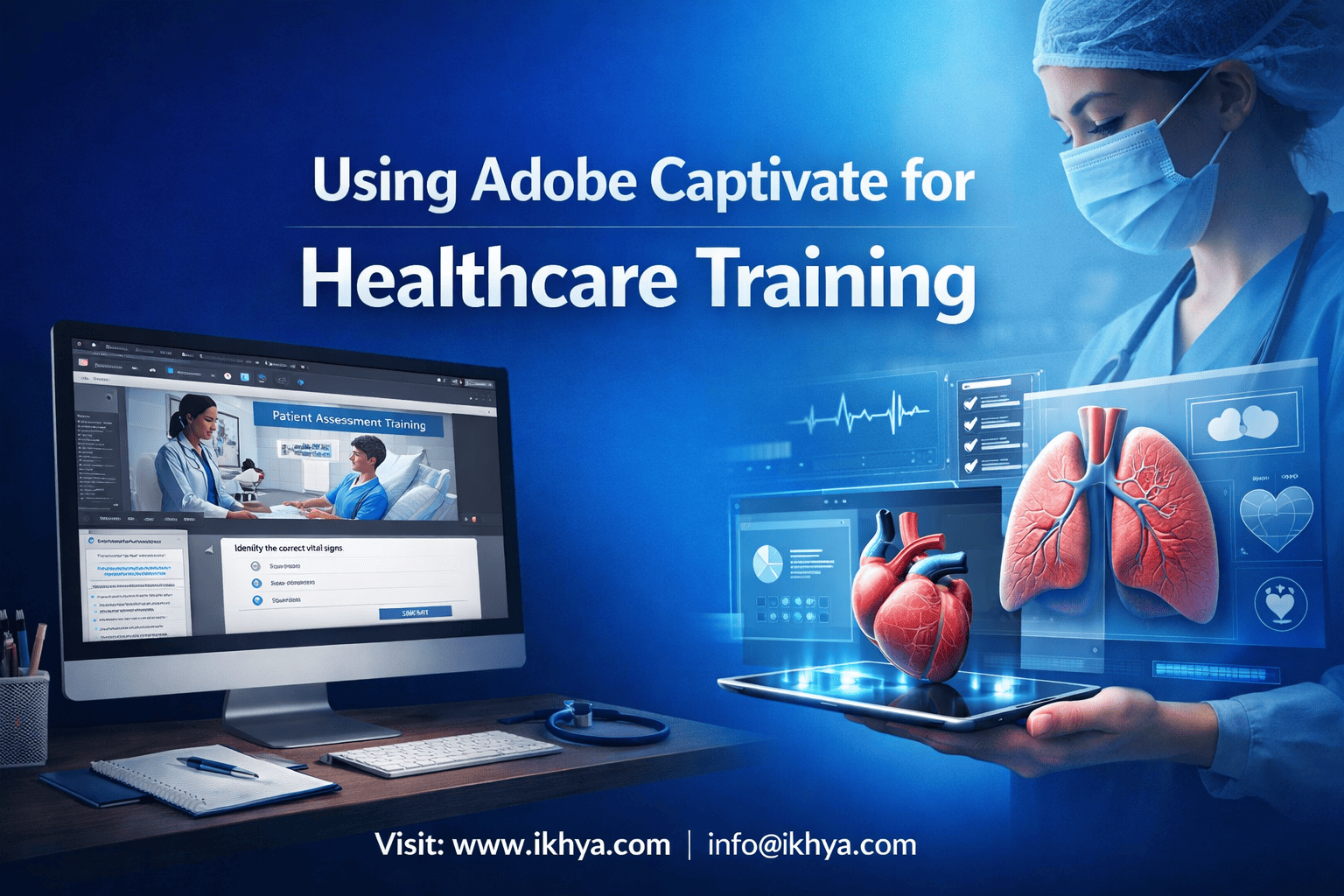
Healthcare training is no longer just about delivering information—it’s about ensuring compliance, improving patient safety, and building real-world skills. Using Adobe Captivate for healthcare training enables organizations to create interactive, simulation-driven learning experiences that go beyond traditional methods.
If you’re planning to modernize your training programs, you can also explore a free eLearning demo to see how interactive healthcare training works in practice.
What is Adobe Captivate and Why It Matters in Healthcare Training
Adobe Captivate is a powerful eLearning authoring tool designed to create interactive, responsive, and simulation-based training. In healthcare, it plays a critical role in delivering compliance training, clinical simulations, and procedural learning at scale.
Unlike basic training tools, Captivate enables hands-on practice in a risk-free environment, which is essential in medical contexts where mistakes can be costly.
Key Capabilities
- Simulation-based training for real-world scenarios
- Responsive design for mobile-friendly healthcare learning
- Advanced interactivity including branching scenarios
- SCORM and xAPI compatibility for LMS tracking
- Multimedia integration (video, audio, animations)
These capabilities make Captivate ideal for hospitals, pharmaceutical companies, and medical device manufacturers.
If you’re evaluating implementation, professional Adobe Captivate development services can help accelerate deployment and ensure compliance accuracy.
Role in Compliance and Clinical Training
Healthcare training is heavily regulated. Adobe Captivate helps organizations meet strict requirements while maintaining engagement.
Key training areas where Captivate excels:
- Compliance Training
- HIPAA regulations
- OSHA safety protocols
- Infection control procedures
- Clinical Training
- Patient handling techniques
- Emergency response simulations
- Surgical preparation workflows
- Operational Training
- Hospital onboarding
- Equipment handling
- Documentation processes
For organizations seeking structured solutions, dedicated healthcare eLearning solutions can align Captivate development with compliance standards and industry needs.
Why Healthcare Organizations Prefer Captivate
| Feature | Impact in Healthcare |
|---|---|
| Simulations | Safe practice for critical procedures |
| Scenario-based learning | Improves decision-making skills |
| LMS tracking | Ensures compliance reporting |
| Mobile learning | Enables training on-the-go |
| Accessibility support | Meets WCAG and inclusive training needs |
Real-World Example
A multi-location hospital in the US implemented Captivate-based training for infection control.
Results:
- 40% improvement in training completion rates
- Reduced compliance violations
- Faster onboarding for new staff
Key Features of Adobe Captivate for Healthcare eLearning
Adobe Captivate offers a range of advanced features that make it highly effective for healthcare training. Its strength lies in creating interactive, simulation-driven, and compliance-ready learning experiences that improve retention and real-world application.
These features are especially valuable in healthcare, where training must be accurate, engaging, and measurable.
Simulation-Based Learning
Simulation is one of the most powerful capabilities of Captivate. It allows healthcare professionals to practice procedures and decision-making in a risk-free virtual environment.
How it helps:
- Replicates real-life clinical scenarios
- Enables “learn by doing” experiences
- Reduces errors in actual patient care
Examples in healthcare:
- Emergency room response simulations
- Patient diagnosis decision trees
- Medical device operation walkthroughs
Organizations looking to build advanced simulations often use simulation-based training services to ensure realism and instructional accuracy.
Responsive Design for Mobile Learning
Healthcare professionals are constantly on the move. Captivate’s responsive design ensures training is accessible across devices—desktops, tablets, and smartphones.
Benefits:
- Learning anytime, anywhere
- Ideal for shift-based staff
- Supports microlearning modules
This is particularly useful in hospitals across the USA, UK, UAE, and AUS where mobile-first learning strategies are becoming standard.
Advanced Interactivity and Branching Scenarios
Captivate allows you to create scenario-based learning paths where learners make decisions and experience consequences.
Why this matters:
- Improves critical thinking
- Enhances retention
- Mimics real-world decision-making
Example:
A nurse chooses the wrong medication dosage in a simulation → immediate feedback → corrective learning path.
LMS Integration (SCORM & xAPI)
Captivate courses can be easily integrated with Learning Management Systems using SCORM and xAPI standards.
Key advantages:
- Tracks learner progress and completion
- Generates compliance reports
- Supports audit readiness
This is crucial for healthcare organizations that must demonstrate regulatory compliance during audits.
Accessibility and Compliance Support
Healthcare training must be inclusive and compliant with accessibility standards like WCAG.
Captivate supports:
- Screen reader compatibility
- Keyboard navigation
- Closed captions and transcripts
This ensures training is accessible to all employees, including those with disabilities.
Multimedia and Interactive Content
Captivate enables the use of rich media to make training more engaging and realistic.
Content types supported:
- Video-based demonstrations
- Audio-guided instructions
- Interactive infographics
- Animated workflows
For organizations converting legacy content into modern formats, custom eLearning development services can help transform static materials into dynamic learning experiences.
Feature Summary Table
| Feature | Healthcare Benefit | Use Case |
|---|---|---|
| Simulations | Safe practice | Clinical procedures |
| Responsive design | Mobile access | On-the-go training |
| Branching scenarios | Better decisions | Patient care training |
| LMS integration | Compliance tracking | Audit readiness |
| Accessibility | Inclusive learning | Workforce diversity |
| Multimedia | Higher engagement | Skill demonstrations |
Adobe Captivate is not just a content creation tool—it’s a performance-driven training platform that enables healthcare professionals to learn, practice, and apply skills effectively.
Use Cases of Adobe Captivate in Healthcare Training
Adobe Captivate is widely used in healthcare because it supports high-stakes, compliance-driven, and skill-based training. From regulatory programs to clinical simulations, it enables organizations to deliver training that is both engaging and measurable.
Below are the most impactful use cases where Captivate delivers real value.
Compliance Training (HIPAA, OSHA, Regulatory Programs)
Healthcare organizations must regularly train staff on strict regulations. Captivate helps create standardized, trackable, and audit-ready compliance courses.
Common compliance areas:
- HIPAA (patient data privacy)
- OSHA (workplace safety)
- Infection prevention protocols
- Clinical documentation standards
Why Captivate works well:
- Built-in quizzes and assessments
- LMS tracking for audit reports
- Scenario-based compliance training
For organizations building large-scale compliance programs, structured compliance training eLearning solutions ensure alignment with global regulatory standards.
Clinical Skills and Procedure Training
Clinical training requires hands-on practice, but real-world mistakes are not an option. Captivate bridges this gap with interactive simulations and guided learning paths.
Key applications:
- Patient examination procedures
- Emergency response training (CPR, ICU scenarios)
- Surgical preparation workflows
Example scenario:
A trainee navigates a virtual ICU emergency—making decisions on patient stabilization and receiving real-time feedback.
This type of training improves both confidence and decision-making accuracy.
Medical Device and Equipment Training
Hospitals and medical companies frequently introduce new equipment. Captivate enables step-by-step device training with interactive simulations.
Use cases:
- MRI and CT scan operation training
- Infusion pump usage
- Diagnostic equipment handling
Benefits:
- Reduces equipment misuse
- Speeds up staff onboarding
- Minimizes training costs
Healthcare Onboarding and Staff Training
New employees need to quickly understand hospital workflows, systems, and protocols. Captivate helps create structured onboarding programs that are consistent across locations.
Training modules include:
- Hospital policies and procedures
- Patient interaction guidelines
- Electronic Health Record (EHR) systems
For organizations scaling training programs, instructional design services can help structure onboarding journeys effectively.
Soft Skills and Patient Interaction Training
Healthcare isn’t just technical—it also requires strong communication and empathy. Captivate supports scenario-based soft skills training.
Examples:
- Patient communication and bedside manners
- Handling difficult conversations
- Cultural sensitivity training
Why it matters:
Better communication leads to improved patient satisfaction and outcomes.
Microlearning for Continuous Medical Education
Healthcare professionals need ongoing learning. Captivate enables bite-sized microlearning modules for continuous education.
Examples:
- Daily safety refreshers
- Short updates on new regulations
- Quick clinical skill reinforcement
For mobile-first strategies, mobile learning development solutions can enhance accessibility and adoption.
Use Case Summary Table
| Use Case | Key Benefit | Example |
|---|---|---|
| Compliance training | Audit readiness | HIPAA certification |
| Clinical simulations | Risk-free practice | ICU emergency scenario |
| Device training | Faster adoption | MRI operation training |
| Onboarding | Consistency | Hospital staff induction |
| Soft skills | Better patient care | Communication training |
| Microlearning | Continuous learning | Daily safety modules |
Real-World Scenario
A healthcare provider in the UK implemented Captivate for multi-location compliance and clinical training.
Outcomes:
- 50% reduction in training time
- Improved audit scores
- Higher learner engagement across departments
Adobe Captivate is highly versatile—it supports everything from mandatory compliance training to advanced clinical simulations, making it a strong choice for end-to-end healthcare learning ecosystems.
Step-by-Step Process to Create Healthcare Training in Captivate
Creating effective healthcare training using Adobe Captivate involves a structured process that ensures accuracy, compliance, and engagement. From planning to deployment, each step plays a critical role in delivering high-quality learning experiences.
Step 1: Define Training Goals and Compliance Requirements
Start by identifying what the training needs to achieve and which regulations must be covered.
Key considerations:
- Is the training for compliance (HIPAA, OSHA)?
- Is it skill-based (clinical procedures)?
- Who is the target audience (nurses, doctors, admin staff)?
Best practice:
Work with subject matter experts (SMEs) to ensure medical accuracy and compliance alignment.
Step 2: Instructional Design and Content Structuring
Once goals are defined, structure the content into a logical learning flow.
Typical structure:
- Introduction and objectives
- Core learning modules
- Interactive scenarios
- Assessments and quizzes
Professional instructional design services can help create structured, learner-centric content that improves retention.
Step 3: Develop Interactive Content in Captivate
This is where the actual course is built using Captivate’s features.
Development elements:
- Simulation-based scenarios
- Branching decision paths
- Multimedia (videos, animations)
- Knowledge checks
Example:
A medication administration module where learners choose dosages and receive immediate feedback.
Step 4: Add Assessments and Compliance Tracking
Healthcare training must be measurable. Captivate allows you to include quizzes and track performance.
Assessment types:
- Multiple-choice questions
- Scenario-based evaluations
- Drag-and-drop activities
Tracking standards:
- SCORM
- xAPI
These ensure integration with LMS platforms for reporting and audits.
Step 5: Ensure Accessibility and Mobile Compatibility
Before deployment, ensure the course meets accessibility and device requirements.
Checklist:
- WCAG compliance
- Mobile responsiveness
- Captioning and transcripts
This step is critical for inclusive and global healthcare training programs.
Step 6: Deploy via LMS and Monitor Performance
Finally, publish and deploy the course through your LMS.
Post-launch activities:
- Track completion rates
- Analyze learner performance
- Update content based on feedback
Organizations often use LMS-compatible eLearning course development services to ensure smooth deployment and tracking.
Process Summary Table
| Step | Action | Outcome |
|---|---|---|
| 1 | Define goals | Clear training objectives |
| 2 | Instructional design | Structured learning flow |
| 3 | Development | Interactive content |
| 4 | Assessment | Measurable learning |
| 5 | Optimization | Accessible courses |
| 6 | Deployment | LMS integration |
This structured approach ensures healthcare training is not only engaging but also compliant, scalable, and effective.
Adobe Captivate vs Other eLearning Tools for Healthcare
Choosing the right eLearning tool for healthcare training depends on your goals—whether you need simulations, rapid development, or mobile-first learning. Adobe Captivate stands out for advanced interactivity and simulations, but other tools like Storyline and Rise also have their strengths.
Quick Comparison of Top eLearning Tools
| Feature | Adobe Captivate | Articulate Storyline | Articulate Rise |
|---|---|---|---|
| Best for | Simulations & complex training | Interactive courses | Rapid, responsive courses |
| Interactivity | Advanced | High | Moderate |
| Simulations | Strong | Moderate | Limited |
| Responsive design | Yes (advanced) | Partial | Fully responsive |
| Ease of use | Moderate learning curve | Easier | Very easy |
| Healthcare use case | Clinical & compliance | Compliance & onboarding | Microlearning & awareness |
When Adobe Captivate is the Better Choice
Adobe Captivate is ideal when healthcare training requires real-world simulation and high interactivity.
Use Captivate if you need:
- Clinical procedure simulations
- Emergency response training
- Complex decision-making scenarios
- Software or device simulations
For organizations evaluating tool differences, this detailed Adobe Captivate vs Articulate Storyline comparison can help guide your decision.
When Articulate Storyline Works Better
Storyline is often preferred for interactive but less complex training.
Best suited for:
- Compliance training
- Employee onboarding
- Scenario-based learning without heavy simulations
Healthcare teams that rely on Storyline often focus on speed and ease of development rather than deep simulations.
When Articulate Rise is a Better Fit
Rise is designed for fast, mobile-first course creation.
Ideal for:
- Microlearning modules
- Policy updates
- Quick training rollouts
However, it lacks the depth needed for clinical simulations or high-stakes decision training.
Decision Framework
| If your priority is… | Choose |
|---|---|
| Simulation-heavy clinical training | Adobe Captivate |
| Balanced interactivity and speed | Storyline |
| Rapid deployment and mobile learning | Rise |
There is no one-size-fits-all solution. Many healthcare organizations actually use a combination of tools:
- Captivate for simulations
- Storyline for compliance
- Rise for microlearning
Before making a decision, it’s helpful to consult experts or evaluate your internal capabilities. A structured approach like this guide to choosing the right eLearning vendor can simplify the process.
This comparison helps you align the tool with your training needs rather than choosing based on popularity alone.
Cost of Developing Healthcare Training with Adobe Captivate
The cost of developing healthcare training with Adobe Captivate depends on complexity, level of interactivity, compliance requirements, and content volume. Simple courses may cost a few thousand dollars, while simulation-heavy clinical training can require significantly higher investment.
Key Factors That Influence Cost
Several variables impact the overall development cost:
- Content complexity (basic slides vs clinical simulations)
- Level of interactivity (quizzes vs branching scenarios)
- Multimedia usage (videos, animations, voiceovers)
- Compliance requirements (HIPAA, OSHA validation)
- Localization needs (multi-language training for global teams)
Typical Cost Breakdown
| Training Type | Complexity Level | Estimated Cost (USD) |
|---|---|---|
| Basic compliance training | Low | $1,500 – $5,000 per module |
| Interactive compliance training | Medium | $5,000 – $12,000 |
| Simulation-based clinical training | High | $12,000 – $30,000+ |
| Medical device training | High | $10,000 – $25,000 |
These costs vary depending on whether you build in-house or partner with experts.
For a deeper breakdown, you can explore this guide on Adobe Captivate eLearning development benefits, cost, and use cases.
In-House vs Outsourced Development
| Factor | In-House Team | Outsourced Vendor |
|---|---|---|
| Cost | Lower upfront, higher long-term | Higher upfront, optimized long-term |
| Expertise | Limited | Specialized healthcare experience |
| Speed | Slower | Faster turnaround |
| Scalability | Limited | Highly scalable |
Many healthcare organizations choose to outsource to reduce development time and ensure compliance accuracy. If you’re considering this route, here’s a helpful resource on outsourcing Adobe Captivate development for corporate training.
Hidden Costs to Consider
Beyond development, there are additional costs that organizations often overlook:
- LMS integration and maintenance
- Content updates due to regulatory changes
- SME (Subject Matter Expert) involvement
- Translation and localization
- Ongoing analytics and reporting
Cost Optimization Tips
To reduce costs without compromising quality:
- Use templates for repetitive training modules
- Adopt microlearning for shorter, focused content
- Repurpose existing materials (PPTs, PDFs)
- Prioritize high-impact training first
- Outsource complex modules only
Investing in Adobe Captivate for healthcare training may seem high initially, but it delivers long-term value through reduced errors, improved compliance, and better learning outcomes.
When Should You Use Adobe Captivate for Healthcare Training?
Adobe Captivate is the right choice when your healthcare training requires high interactivity, real-world simulations, and strict compliance tracking. It is especially useful in scenarios where learners must practice decision-making and procedural skills in a safe, controlled environment.
Ideal Scenarios for Using Captivate
You should consider Adobe Captivate when your training involves:
- Clinical simulations that mimic real-life situations
- High-risk procedures where practice is critical
- Complex workflows such as patient care processes
- Regulatory compliance training with audit tracking
- Medical device or software simulations
These use cases demand more than static content—they require immersive and hands-on learning experiences.
Decision Checklist
| Requirement | Captivate Fit |
|---|---|
| Need for simulation-based learning | Strong fit |
| Mobile-friendly training required | Good fit |
| Rapid development needed | Moderate fit |
| Simple content (low interactivity) | Not ideal |
| Budget constraints | Evaluate carefully |
When Captivate May Not Be the Best Option
While powerful, Captivate is not always necessary.
Consider alternatives if:
- You need quick course development with minimal interactivity
- Your training is mostly content-heavy (policies, documents)
- You have tight timelines and limited budget
In such cases, lighter tools may be more efficient.
Blended Tool Strategy in Healthcare
Many organizations combine tools instead of relying on just one.
Example approach:
- Captivate → Clinical simulations
- Storyline → Compliance and onboarding
- Rise → Microlearning and updates
This hybrid strategy helps balance cost, speed, and learning effectiveness.
Real-World Decision Scenario
A hospital group in the UAE needed to train staff on both compliance and emergency response.
Their approach:
- Used Captivate for ICU simulations
- Used simpler tools for policy training
Result:
- Faster rollout
- Better engagement in critical training areas
- Optimized development costs
Challenges and Best Practices
Using Adobe Captivate for healthcare training can deliver powerful results, but it also comes with challenges. Understanding these early helps avoid delays, cost overruns, and ineffective training.
Common Challenges
| Challenge | Impact |
|---|---|
| Steep learning curve | Slower development initially |
| High development time for simulations | Increased cost |
| Need for SME involvement | Dependency on experts |
| Frequent compliance updates | Ongoing maintenance effort |
Best Practices for Success
To overcome these challenges, follow these proven practices:
1. Start with clear learning objectives
Define exactly what learners should achieve—especially for compliance and clinical training.
2. Use scenario-based design
Focus on real-world situations rather than theoretical content.
3. Collaborate with SMEs early
Ensure accuracy from the beginning to avoid rework.
4. Keep modules concise
Break content into smaller, digestible lessons.
5. Test thoroughly before deployment
Validate simulations, assessments, and LMS tracking.
Risk Mitigation Approach
| Risk | Solution |
|---|---|
| Inaccurate medical content | SME validation |
| Low learner engagement | Use simulations and scenarios |
| Budget overruns | Prioritize high-impact modules |
| Delayed timelines | Use templates and outsourcing |
Should You Outsource Adobe Captivate Development?
Outsourcing Adobe Captivate development is often the most efficient option for healthcare organizations, especially when dealing with complex simulations, compliance requirements, and tight timelines.
When Outsourcing Makes Sense
You should consider outsourcing if:
- You lack in-house Captivate expertise
- Your project involves advanced simulations
- You need faster turnaround
- Compliance accuracy is critical
Benefits of Outsourcing
- Access to experienced instructional designers
- Faster project delivery
- Scalable development for large programs
- Reduced internal workload
You can explore the advantages in detail here: outsourcing Adobe Captivate development for corporate training teams
In-House vs Outsourcing Decision
| Criteria | In-House | Outsourcing |
|---|---|---|
| Control | High | Moderate |
| Expertise | Limited | High |
| Speed | Slower | Faster |
| Cost efficiency | Variable | Optimized |
Choosing the Right Partner
When selecting a vendor:
- Evaluate healthcare domain experience
- Check portfolio and case studies
- Assess compliance knowledge
- Ensure LMS and SCORM expertise
A structured evaluation approach like this guide to choosing the right eLearning vendor can help you make the right decision.
Future Trends in Healthcare eLearning with Captivate
Healthcare training is evolving rapidly, and Adobe Captivate continues to adapt to new learning trends and technologies.
Emerging Trends
- Simulation-driven learning expansion for high-risk training
- Microlearning adoption for continuous education
- Mobile-first training strategies for on-the-go access
- Data-driven learning using xAPI analytics
- AI-powered adaptive learning experiences
Industry Shift
Healthcare organizations across the USA, UK, UAE, and AUS are increasingly adopting digital-first training ecosystems that combine LMS platforms, analytics, and interactive content.
The future of healthcare training lies in personalized, simulation-rich, and data-driven learning, and Adobe Captivate is well-positioned to support this transformation.
If you’re planning to build or scale healthcare training programs, IKHYA – eLearning Solutions Company can help you design, develop, and deploy high-impact learning experiences.
Email: info@ikhya.com
You can also request an RFP to get a tailored solution for your organization or contact the team to discuss your requirements.
FAQs
1. Is Adobe Captivate suitable for healthcare training?
Yes, Adobe Captivate is highly suitable for healthcare training. It supports simulations, compliance tracking, and interactive learning, making it ideal for clinical, regulatory, and operational training programs.
2. Can Adobe Captivate be used for HIPAA compliance training?
Yes, Captivate is widely used for HIPAA training. It allows you to create scenario-based modules with assessments and track completion through LMS systems using SCORM or xAPI.
3. How long does it take to develop a healthcare course in Captivate?
Development time typically ranges from 2 to 8 weeks per module, depending on complexity, interactivity, and the availability of subject matter experts.
4. Is Adobe Captivate better than Articulate Storyline for healthcare training?
Captivate is better for simulation-heavy and complex clinical training, while Storyline is often preferred for simpler interactive courses like compliance and onboarding.
5. Does Adobe Captivate support mobile learning?
Yes, Captivate offers responsive design capabilities that allow courses to run smoothly on desktops, tablets, and smartphones.
6. Can Captivate courses be integrated with an LMS?
Yes, Captivate supports SCORM, xAPI, and AICC standards, making it easy to integrate with most Learning Management Systems.
7. What types of healthcare training can be created using Captivate?
You can create compliance training, clinical simulations, onboarding programs, medical device training, and soft skills training using Captivate.
8. Is Adobe Captivate good for simulation-based medical training?
Yes, Captivate is one of the best tools for simulation-based training. It allows learners to practice real-life scenarios safely and interactively.
9. What is the cost of developing healthcare training with Captivate?
Costs vary depending on complexity. Basic courses may start at $1,500, while advanced simulation-based training can exceed $30,000.
10. Can existing PowerPoint training be converted into Captivate courses?
Yes, existing PowerPoint content can be converted into interactive Captivate courses with added simulations, quizzes, and multimedia enhancements.
11. Is Adobe Captivate suitable for small healthcare organizations?
Yes, but smaller organizations should evaluate their budget and training needs. Captivate is most valuable for complex and high-impact training.
12. How does Captivate ensure compliance tracking?
Captivate integrates with LMS platforms and uses SCORM or xAPI to track learner progress, completion rates, and assessment scores.
13. Can Captivate support multi-language healthcare training?
Yes, Captivate supports localization and translation, making it suitable for global healthcare organizations.
14. What skills are required to use Adobe Captivate?
Users typically need basic instructional design knowledge, familiarity with multimedia tools, and some experience with eLearning development.
15. Is outsourcing Captivate development a good option?
Yes, outsourcing is often recommended for complex healthcare training projects to ensure accuracy, speed, and compliance.
16. Can Captivate be used for medical device training?
Yes, Captivate is widely used to create interactive simulations for training healthcare professionals on medical devices.
17. Does Captivate support accessibility standards?
Yes, Captivate supports WCAG guidelines, including screen reader compatibility, keyboard navigation, and closed captions.
18. How often should healthcare training content be updated?
Healthcare training should be updated regularly, especially when regulations change or new medical procedures are introduced.
19. What industries within healthcare use Captivate the most?
Hospitals, pharmaceutical companies, medical device manufacturers, and healthcare training institutions commonly use Captivate.
20. What is the biggest advantage of using Captivate in healthcare training?
The biggest advantage is its ability to deliver realistic, simulation-based learning that improves decision-making, reduces errors, and ensures compliance.
Related Resources
To help you go deeper into Adobe Captivate and healthcare eLearning, here are carefully selected resources. These follow a structured path—from understanding services to evaluating tools and making informed decisions—so you can move from exploration to implementation confidently.