
RFP for eLearning Providers: Ultimate Guide to Write, Evaluate & Choose the Right Partner

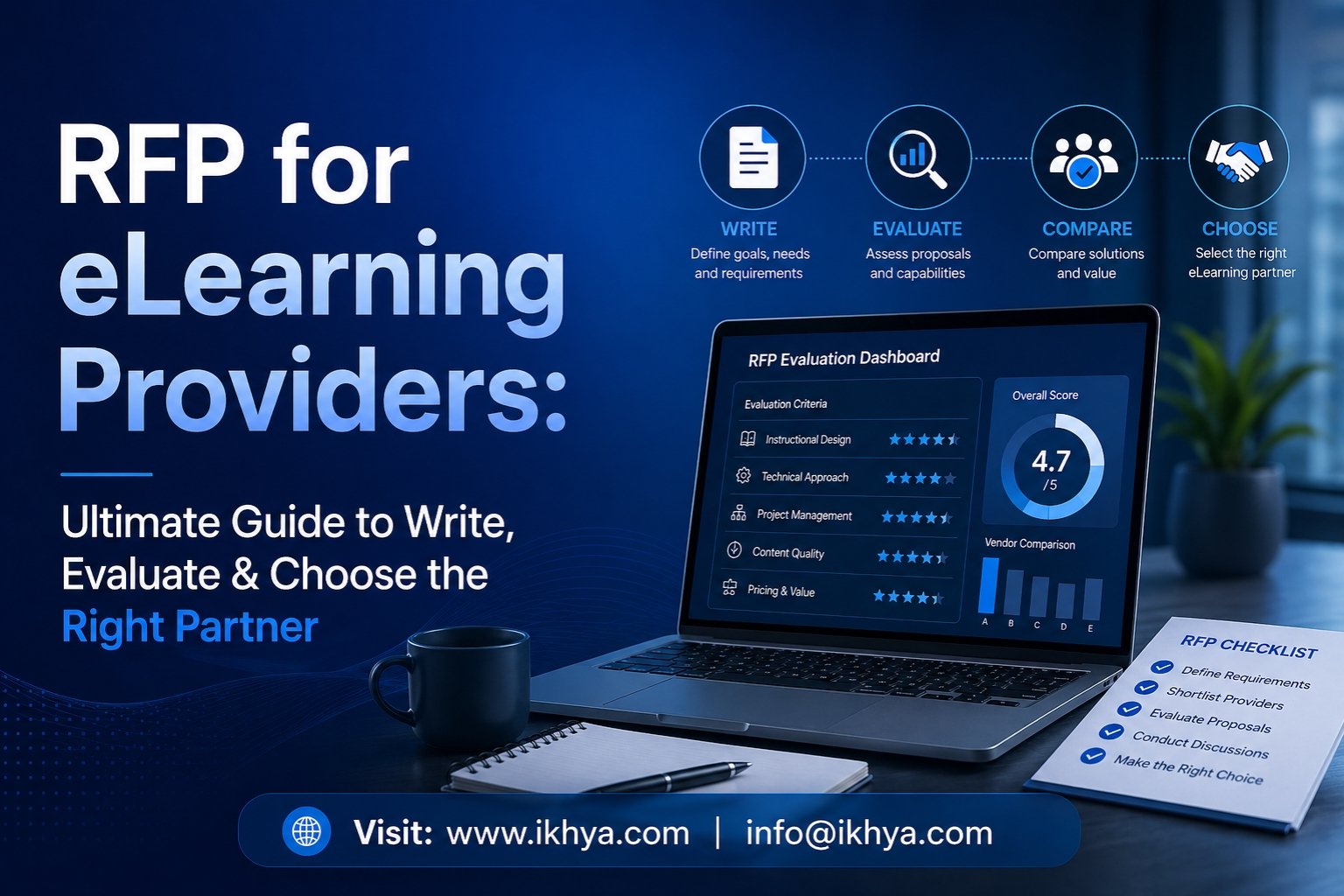
Creating an RFP for eLearning Providers can feel confusing, especially when you want to choose the right partner for your training needs. A clear and well-structured RFP helps you avoid costly mistakes, compare vendors easily, and get better results from your eLearning projects. In this guide, you will learn how to write an RFP step by step, what to include, how to evaluate vendors, and what costs to expect.
If you are planning your next eLearning project, you can request an RFP, contact us, or book a free eLearning demo with IKHYA – eLearning Solutions Company to get expert support.
What is an RFP for eLearning Providers?
An RFP (Request for Proposal) for eLearning providers is a document that organizations use to invite vendors to submit proposals for creating digital learning solutions.
It clearly explains:
- Your training goals
- Project scope
- Timeline
- Budget expectations
This allows different vendors to understand your needs and respond with suitable solutions.
A good RFP helps you:
- Compare multiple eLearning providers fairly
- Understand vendor capabilities
- Choose the best-fit partner for your business
Why You Need an RFP for eLearning Providers
Many companies skip the RFP process and directly contact vendors. This often leads to confusion, unclear expectations, and poor outcomes.
Here’s why an RFP is important:
- Clear Project Direction: It helps define what you want before starting the project.
- Better Vendor Comparison: You can evaluate different vendors based on the same criteria.
- Cost Control: It prevents unexpected expenses later.
- Reduced Risk: You avoid choosing the wrong eLearning vendor.
- Structured Decision-Making: It supports a professional and transparent selection process.
Key Elements of a Strong RFP for eLearning Providers
A well-written RFP should include all critical details. Below is a structured breakdown.
RFP Structure Table
| Section | Description | Why It Matters |
|---|---|---|
| Project Overview | Summary of your training needs | Sets context |
| Business Goals | What you want to achieve | Aligns outcomes |
| Target Audience | Who will take the training | Improves design |
| Scope of Work | What the vendor will deliver | Avoids confusion |
| Timeline | Project deadlines | Ensures planning |
| Budget | Expected cost range | Filters vendors |
| Technical Requirements | Tools, LMS, formats | Ensures compatibility |
| Evaluation Criteria | How vendors will be judged | Enables fair comparison |
Important Tip:
Include services like Custom eLearning, ID Services, or Rapid eLearning Services if your project requires them. This helps vendors tailor their proposals better.
Step-by-Step Process to Write an RFP for eLearning Providers
Writing an RFP becomes simple when you follow a clear process.
- Define Learning Objective: Start with what you want learners to achieve.
- Identify Business Challenges: Explain why the training is needed.
- Describe Scope of Work: Mention about Course development, Content creation and LMS integration
- Set Timeline and Budget: Provide realistic expectations.
- Add Evaluation Criteria: Explain how you will select vendors.
- Share Technical Requirements: Include formats, tools, or platforms.
Simple RFP Template for eLearning Providers
Below is a basic format you can follow.
| Section | Example |
|---|---|
| Introduction | Company background |
| Project Goals | Improve employee training |
| Audience | Sales team |
| Deliverables | 5 eLearning modules |
| Timeline | 8 weeks |
| Budget | $5,000 – $20,000 |
| Evaluation | Experience, cost, approach |
How to Evaluate eLearning Vendors Using Your RFP
Once you receive proposals, the next step is evaluation.
Vendor Evaluation Criteria Table
| Criteria | What to Check | Why It Matters |
|---|---|---|
| Experience | Past projects | Proven capability |
| Instructional Design | Learning approach | Quality of learning |
| Technology | Tools used | Compatibility |
| Portfolio | Sample work | Visual quality |
| Communication | Responsiveness | Smooth execution |
| Scalability | Ability to grow | Future readiness |
Key Insight:
Look for vendors who offer:
- PPT to eLearning Conversion Services
- ILT to eLearning Course Conversion
- eLearning Course Redesigning Services
These services show flexibility and expertise.
Common Mistakes to Avoid in an eLearning RFP
Even a small mistake can affect your project outcome.
Avoid these common errors:
- Vague Requirements: Unclear goals lead to poor proposals.
- Ignoring Budget Details: This wastes time for both parties.
- No Evaluation Criteria: Makes comparison difficult.
- Overcomplicated Documents: Makes comparison difficult.
- Not Asking the Right Questions: Include questions about Process, Timeline and support
Cost Expectations for eLearning Projects
Understanding pricing helps you plan better.
eLearning Pricing Table (USD)
| Project Type | Estimated Cost |
|---|---|
| Basic eLearning Course | $3,000 – $10,000 |
| Interactive Course | $10,000 – $30,000 |
| Advanced Simulation | $30,000 – $100,000+ |
| Rapid eLearning | $2,000 – $8,000 |
Factors Affecting Cost:
- Content complexity
- Level of interactivity
- Technology used
- Timeline
If you are targeting global markets like the USA, UK, UAE, or Australia, costs may vary slightly based on requirements and standards.
How IKHYA Supports Your RFP and eLearning Needs
Choosing the right partner makes a big difference. IKHYA – eLearning Solutions Company helps organizations at every stage.
What You Get:
- Expert guidance in writing RFPs
- Customized eLearning solutions
- End-to-end project support
- Scalable learning strategies
As an experienced elearning development company, IKHYA focuses on delivering results that align with your business goals.
When to Use an RFP vs Direct Vendor Engagement
Use an RFP when:
- Project scope is complex
- Multiple vendors are involved
- Budget is significant
Skip RFP when:
- You already trust a vendor
- Project is small
- Requirements are simple
Final Thoughts
Creating a strong RFP for eLearning Providers is the first step toward building effective training solutions. It helps you stay organized, compare vendors confidently, and achieve better learning outcomes.
If you are ready to move forward, you can request an RFP, contact the team, or book a free eLearning demo with IKHYA – eLearning Solutions Company to get expert advice tailored to your needs.
FAQs About RFP for eLearning providers
Q1. What is an RFP for eLearning providers?
An RFP for eLearning providers is a document used by organizations to invite vendors to submit proposals for creating digital learning solutions. It outlines project goals, scope, timeline, and budget to help compare vendors effectively.
Q2. Why is an RFP important for eLearning projects?
An RFP helps you clearly define your requirements, compare vendors on the same criteria, and reduce the risk of choosing the wrong provider. It also ensures better cost control and project clarity.
Q3. How do I write an RFP for eLearning providers?
Start by defining your learning objectives, target audience, and project scope. Then include timeline, budget, technical requirements, and evaluation criteria to guide vendors in submitting accurate proposals.
Q4. What should be included in an eLearning RFP?
A strong RFP should include project overview, business goals, audience details, scope of work, timeline, budget, technical requirements, and vendor evaluation criteria.
Q5. How long should an eLearning RFP be?
An eLearning RFP should be detailed but clear, usually between 5 to 15 pages depending on project complexity. It should provide enough information without overwhelming vendors.
Q6. What is the difference between an RFP and RFQ in eLearning?
An RFP focuses on selecting the best solution and vendor, while an RFQ (Request for Quotation) focuses mainly on pricing for a clearly defined project.
Q7. How do I evaluate eLearning vendors after sending an RFP?
You can evaluate vendors based on experience, instructional design approach, technology expertise, portfolio quality, communication, and scalability.
Q8. What are common mistakes in writing an eLearning RFP?
Common mistakes include unclear requirements, missing budget details, lack of evaluation criteria, overly complex documents, and not asking the right questions.
Q9. What is the typical cost of eLearning development?
Costs can range from $3,000 for basic courses to over $100,000 for advanced simulations. Pricing depends on complexity, interactivity, and project scope.
Q10. How long does it take to complete an eLearning project?
Project timelines usually range from 2 weeks for rapid eLearning to several months for complex interactive or simulation-based courses.
Q11. When should I use an RFP instead of directly hiring a vendor?
You should use an RFP when your project is complex, involves multiple vendors, or requires detailed comparison before making a decision.
Q12. Can small businesses use an RFP for eLearning providers?
Yes, small businesses can benefit from RFPs as they help in making informed decisions and selecting the right vendor even with limited budgets.
Q13. What questions should I ask eLearning vendors in an RFP?
You should ask about their development process, experience, tools used, timelines, support services, and past project examples.
Q14. What is an eLearning RFP template?
An eLearning RFP template is a structured format that helps you organize your requirements and ensures you include all important project details.
Q15. How do I choose the best eLearning provider?
Choose a provider based on their experience, quality of work, ability to understand your needs, communication skills, and ability to scale with your business.
Q16. What services should I mention in an eLearning RFP?
You can include services like custom eLearning development, instructional design, rapid eLearning, course conversion, and course redesign depending on your needs.
Q17. How detailed should the scope of work be in an RFP?
The scope of work should be clear and specific, covering deliverables, features, and expectations to avoid confusion later.
Q18. Can I request a demo before selecting an eLearning vendor?
Yes, requesting a demo helps you understand the eLearning vendor’s capabilities, design quality, and approach before making a final decision.
Q19. How do global companies handle eLearning RFPs?
Global companies often include localization, scalability, and compliance requirements in their RFPs to ensure solutions work across regions like the USA, UK, UAE, and Australia.
Q20. What happens after selecting an eLearning provider through an RFP?
After selection, the project moves into planning and execution stages, including content development, design, testing, and final delivery.
Choosing the right partner through a well-defined RFP for eLearning Providers can make a big difference in the success of your training programs. Instead of taking risks or working with unclear requirements, take a structured approach that ensures better results and long-term value.
If you are planning an eLearning project and want expert support, you can connect with IKHYA – eLearning Solutions Company. Their team can help you create a clear RFP, evaluate vendors, and deliver customized eLearning solutions based on your goals.
You can take the next step by requesting an RFP, booking a free eLearning demo, or reaching out to discuss your requirements. A simple conversation can help you move forward with clarity and confidence.




