Custom eLearning for Canadian Organizations, in English and French
For L&D, HR and compliance teams in Canada that need courses their people can take in English and French, and that fit the training rules they work under.
We design and build custom courses, convert classroom and PowerPoint training, and deliver English and French versions that track in your LMS.
Need a formal proposal? Submit an RFP →
- 2010Delivering eLearning since
- 500+Projects
- 40+Countries with clients
- 120+Specialists
If you are comparing eLearning companies in Canada, IKHYA builds custom courses for Canadian organizations in English and French. We plan the French version from day one, build in Storyline, Rise, Captivate or iSpring, and deliver SCORM or xAPI files for your LMS. Courses can support Quebec's French-language rules, federal harassment training and Ontario AODA training.
What Canadian Training Teams Need From an eLearning Company
English and French, released together
In Quebec, the French version of a training document must be available on terms at least as favorable as any other language. We build both versions from one source so neither one lags behind.
Training that matches the rules you work under
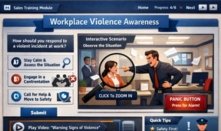
Federal harassment and violence prevention training, Ontario AODA training and your own compliance topics, written for your workplace, not a generic library course.
Courses that run in your LMS
SCORM 1.2, SCORM 2004, xAPI or HTML5 output, tested before handover. LMS platforms we have delivered courses to include Moodle, TalentLMS, Docebo and Cornerstone.
Files you own and can update
You receive the editable source files (for example Storyline or Captivate files), so your team can revise courses later.
IKHYA has delivered Canadian French courses, and we build bilingual English and Canadian French programs that can roll out across several provinces at once.
Which Canadian Training Rules Affect Your Courses?
Three rules come up most often when Canadian organizations plan employee training. Each applies only to certain employers, so check which ones cover you.
| Rule | Who it applies to | What it says about training | What it means for your course |
|---|---|---|---|
| Charter of the French Language (Quebec), section 41, as amended by Bill 96 (S.Q. 2022, c. 14) | Employers in Quebec that are subject to the Charter | Training documents produced for staff must be drawn up in French. If they are also available in another language, the French version must be available on terms at least as favorable. In force June 1, 2022 (existing English-only documents had until June 1, 2023). | Plan a French version of every course you give Quebec staff, launched at the same time and with the same features as the English one. |
| Work Place Harassment and Violence Prevention Regulations (SOR/2020-130), section 12 | Federally regulated workplaces under Part II of the Canada Labour Code, for example banks, airlines and airports, telecommunications, interprovincial trucking and rail, and the federal public service | Training must be specific to the culture, conditions and activities of the workplace, and cover the prevention policy, the link to the prohibited grounds of discrimination in the Canadian Human Rights Act, and how to recognize, minimize, prevent and respond to harassment and violence. New employees within 3 months of starting; everyone, including the employer, at least every 3 years. | A course built around your own policy, your sites and realistic scenarios from your work, with a refresh planned every 3 years. |
| Integrated Accessibility Standards, O. Reg. 191/11, section 7 (Ontario, AODA) | Organizations with at least one employee in Ontario (the Ontario government, public sector organizations, and large and small organizations) | Training on the accessibility standards and on the Ontario Human Rights Code as it relates to people with disabilities, for all employees and volunteers, people who help develop policies and others who provide goods, services or facilities for you. It must suit each person's duties and be given as soon as practicable. Large (50+ employees) and public sector organizations must keep training records. | Role-based paths (frontline, managers, policy writers) and LMS completion data that can serve as your training record. |
A few related points
- Ontario compliance reports: businesses and non-profits in Ontario with 20 or more employees file an accessibility compliance report every 3 years. The next deadline is December 31, 2026.
- Ontario websites: large and public sector organizations must make their public websites and web content conform with WCAG 2.0 Level AA (O. Reg. 191/11, section 14). We build accessible eLearning to WCAG 2.1 AA and Section 508, and WCAG 2.1 builds on WCAG 2.0 and is backwards compatible with it.
This is a plain-language summary to help you plan training, not legal advice. Please confirm what applies to your organization with your legal counsel.
For more on regulated topics, see our compliance eLearning page.
How Do We Build English and Canadian French Versions?
The cheapest French version is the one planned before the English course is built. Text that is locked inside images, tight screen layouts and English-only voice scripts are what make translation slow later.
Our eLearning translation services cover the whole route, and for Canadian projects it usually looks like this:
1. Build the English course translation-ready
Text stays editable, layouts leave room for French (French text often runs longer than English), and on-screen text is kept out of images.
2. Agree on your French terminology
We use your existing French glossary and policy wording. If you have none, we draft one with your team.
3. Translate and adapt
Examples, names, dates, currency and references are adapted for Canadian French learners, not copied from European French.
4. Record the French audio
Native Canadian French voices, human or AI, matched to the English timing.
5. Rebuild French software screens
For software training, we capture the French version of the application where it exists.
6. Review and test both versions
Your French-speaking reviewer checks the course in context, then we test both versions in your LMS.
On Canadian projects, our own Canadian French reviewer checks every screen in the built course, not only the translated script, and the English and French versions are handed over in the same batch so both can go live on the same day.
The Office québécois de la langue française (OQLF) publishes terminology resources on its Vitrine linguistique, including the Grand dictionnaire terminologique, which help when your team agrees on French terms.
Not sure which option is right for you?
Send us your course list and we will recommend a route.
Project Example: Logistics Training in English and Canadian French
 Logistics, US and Canada
35 PowerPoint training decks turned into interactive SCORM courses in 10 weeks: classroom hours down 60%
Logistics · US and Canada · 3,000 warehouse associates, drivers and supervisors · 35 decks to 35 courses of 10 to 20 minutes each · iSpring Suite · SCORM 1.2, client LMS on kiosks and tablets · English and Canadian French · 10 weeks in 5 batches
- Challenge
- A third-party logistics company with 22 warehouses and depots in the US and Canada had 6 trainers traveling between depots to deliver 35 slide decks, about 2,400 classroom hours a year. Content differed by trainer, the decks were written for a presenter, and the budget was tight.
- What we did
- Rewrote slide text for self-paced learning and cut each deck by about 40%, added knowledge checks and 1 or 2 short scenarios per course, and built in iSpring Suite inside PowerPoint, in the client's brand template, so their own team can edit. We worked in batches of 7 decks, so feedback on the first batch improved the rest. An instructional designer, 2 iSpring developers and a graphic designer ran 2 review rounds per batch with the training manager, then a handover workshop for 3 client trainers.
- Results
- Classroom hours cut by 60% (about 2,400 to 960 a year, from the training calendar, 6 months after vs 6 months before)
- An average quiz score of 86%
- Courses now updated by the client's own team; practical equipment sign-offs stay in person
"They turned thirty-five slide decks into real courses without losing our brand, in ten weeks. Our trainers spend far less time on the road, and because it is built in iSpring, our own team makes the updates now."
How a Project Works
- 01
Discovery call
We agree on audience, provinces, languages, rules that apply and your LMS.
IKHYA and you - 02
Free quote
A recommended route and a timeline for the project.
IKHYA - 03
Design and sample
A storyboard or a sample screen in English, planned for French from the start.
IKHYA drafts, you review - 04
Build in batches
Courses built and reviewed in batches, with 2 review rounds per batch.
IKHYA builds, you review - 05
French version
Translation, voiceover and French screens, checked by your French reviewer.
IKHYA drafts, you review - 06
LMS testing and handover
Both versions tested in your LMS, then delivered with editable source files.
IKHYA
Working across Canadian time zones
Your project lead schedules calls and reviews in your working hours, whether your team sits in Pacific, Eastern or Atlantic time, and answers messages within one business day. Teams in several provinces share one review link, so comments from Vancouver and Montreal land in the same place.
What Drives the Cost?
Every project is quoted, because the same request can be a small update or a large bilingual program. These are the things that change the price most:
How to Compare eLearning Companies in Canada
Directories list hundreds of companies, but they mix course builders with LMS vendors, schools and course libraries. When you shortlist, ask each company these questions:
- Do they build custom courses, or sell an off-the-shelf library? (A library may be the better fit for generic topics.)
- How do they produce the French version, who reviews it, and do they use your French terminology?
- Can they show a bilingual course they have built, with the English and French versions side by side?
- Which authoring tool will they use, and will you receive the editable source files?
- Which output (SCORM 1.2, SCORM 2004 or xAPI) will they deliver, and will they test it in your LMS?
- How many review rounds are included, and who signs off?
- Can they build to WCAG 2.1 AA if you have learners who use assistive technology?
- How do they work with your time zone and your subject matter experts?
What You Send Us, What We Prepare
You send You
- Your source content: slides, policies, procedures, videos or old courses.
- Names of subject matter experts and your French-speaking reviewer.
- Your brand guide and any French glossary or approved policy wording.
- LMS details: platform, SCORM or xAPI version, devices.
- Languages and provinces to cover, and your launch dates.
We prepare IKHYA
- A recommended route, timeline and quote.
- Storyboards or a sample course for approval.
- The English and French courses, voiceover and translated screens.
- SCORM or xAPI packages tested in your LMS.
- Editable source files for your team.
Frequently Asked Questions
Under section 41 of Quebec's Charter of the French Language, employers subject to the Charter must make training documents produced for staff available in French. If another language version exists, the French one must be available on terms at least as favorable. Check with your counsel which employees this covers.
Under section 12 of the Work Place Harassment and Violence Prevention Regulations, new employees are trained within 3 months of starting, and employees and the employer at least every 3 years. The training must be specific to your workplace's culture, conditions and activities.
Section 7 of O. Reg. 191/11 requires training for all employees and volunteers, people who help develop your policies, and others who provide goods, services or facilities for you. The training covers the accessibility standards and the Ontario Human Rights Code as it relates to people with disabilities, suited to each person's duties.
Yes, in most cases. We deliver SCORM 1.2, SCORM 2004, xAPI or HTML5 and test every course in your LMS before handover. LMS platforms we have delivered courses to include Moodle, TalentLMS, Docebo and Cornerstone. Tell us your platform and version when you ask for a quote.
Yes. You receive the editable source files, for example the Storyline or Captivate files, so your own team can update the English and French versions later without starting from scratch or coming back to us for every small change.
Yes, if French is planned from the start. We build the English course translation-ready, agree on your French terms early and hand over both versions together, so Quebec staff are not left waiting for their version of a course.
It depends on the number and length of courses, interactivity, media and review rounds. Your free quote includes a recommended route and a timeline for the project, and larger programs are built in batches so the first courses can launch while the rest are in progress.
Every IKHYA project is quoted. The price depends on course length, interactivity, media and voiceover, the number of languages, the authoring tool, review rounds and LMS testing. Send us your course list and we will return a quote with a recommended route and a timeline.
Ready to Plan Your English and French Courses?
Tell us what you need to train, where your people work and which LMS you use. We will come back with a recommended route, a timeline and a quote.