
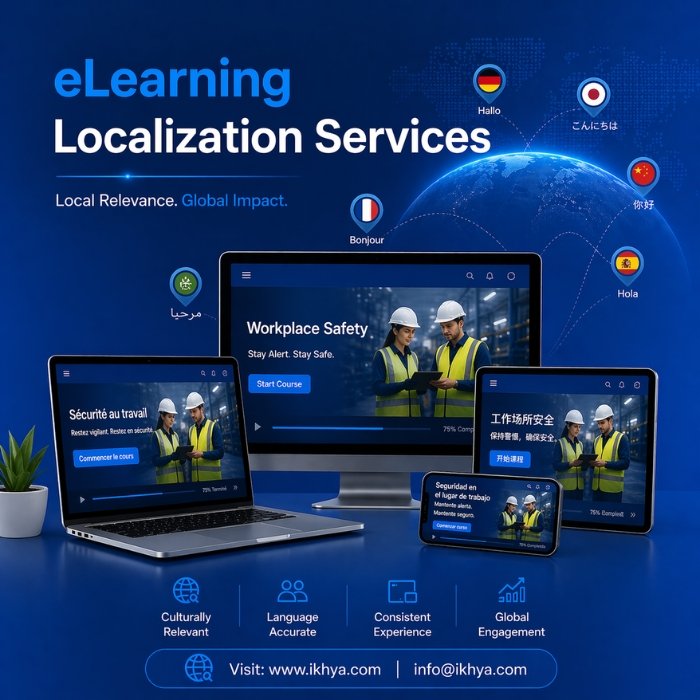


eLearning Localization Services | Multilingual Training
eLearning localization services are only as valuable as the results they produce — and translated content that doesn’t connect with learners produces nothing.
Your course works in English. But does it work in Arabic? In German? In Mandarin — for learners who’ve never been trained the same way your home team has?
Most localized eLearning fails not because of bad translation, but because the content was never truly adapted. Jokes fall flat. Visuals feel foreign. Voiceovers sound robotic. Interactions break in the LMS. And learners disengage within the first five minutes.
At IKHYA, we don’t just translate your eLearning — we rebuild it for every audience it’s meant to reach. That’s the difference between localization that checks a box and localization that actually trains people.
Table of Contents
- What eLearning Localization Actually Means
- Who This Is For
- What We Localize
- The IKHYA Localization Process
- Industries We Serve
- Supported Authoring Tools & LMS Platforms
- Translation vs. Localization: Why the Difference Matters
- What Does eLearning Localization Cost?
- Client Results
- What Our Clients Say
- Why Choose IKHYA Over a Generic LSP
- Get a Custom Localization Quote
What eLearning Localization Actually Means
eLearning localization is the end-to-end process of adapting digital training content — text, audio, video, interactions, and assessments — so it performs effectively for learners in a different language and cultural context.
It is not the same as translation.
Translation converts words. Localization converts meaning. It accounts for:
- Cultural references that don't travel across borders
- Humor, idioms, and examples that need to be rebuilt, not just rephrased
- Visual content — images, characters, icons — that may carry unintended meaning in another culture
- Reading direction — right-to-left languages like Arabic require layout restructuring
- Audio sync — translated narration must match slide timing, not just word count
- LMS functionality — SCORM, xAPI, and AICC files must be tested post-localization to confirm tracking and interactions still work
A qualified eLearning localization services partner handles all of this. A translation vendor handles words.
Who This Is For
IKHYA works with:
- L&D and HR teams rolling out global compliance, onboarding, or skills training
- Instructional designers and eLearning studios needing a localization partner for client projects
- CLOs and training directors at multinational organizations standardizing training across regions
- Corporate universities expanding training libraries into new markets
If you also need the course built before it's localized, explore our custom eLearning development services or instructional design services — we can handle both under one engagement.
What We Localize:
1. Text & Script Localization
Every word in your course — on-screen text, narration scripts, assessment questions, feedback messages, and captions — is translated by subject-matter-qualified linguists. Not machine translation with a light review. Human-first, with translation memory to keep your terminology consistent across all modules.
2. Voiceover & Audio Localization
We record localized narration with professional voice talent in your target language. We match the tone, pacing, and delivery style of your original course — so your localized version sounds intentional, not dubbed.
3. Video Localization
Options include:
- Subtitling / closed captions in target language
- On-screen text replacement
- Full dubbing with lip-sync consideration for talking-head video
- Screen recording re-narration in the target language
4. Interaction & Assessment Localization
Drag-and-drop activities, knowledge checks, branching scenarios, click-to-reveal interactions — every interactive element is reviewed for linguistic accuracy and functional integrity. We test post-localization to confirm all triggers and scoring logic still work.
5. Visual & Graphic Adaptation
Images, illustrations, and UI elements are reviewed for cultural appropriateness. We replace or modify visuals that carry unintended meaning in the target culture, and adapt any text embedded in graphics.
6. LMS Publishing & QA
We deliver SCORM 1.2, SCORM 2004, xAPI, and AICC-compatible packages ready to upload into your LMS. We test all tracking variables, completion triggers, and quiz logic in a staging environment before final delivery.
The IKHYA Localization Process
We follow a structured workflow designed specifically for eLearning content — not a generic translation pipeline.
Step 1 — Discovery & Scope We review your source files, authoring tool, LMS, target languages, and timeline. We flag potential issues (text expansion, RTL layout, audio duration mismatches) before the project begins — not after.
Step 2 — Content Extraction & Preparation We extract text from your source file while preserving all formatting, variables, and conditions. For Articulate Storyline, Rise 360, Lectora, or Adobe Captivate files, we work natively with the authoring tool — not with a plain text export that loses context.
Step 3 — Translation by Subject-Matter Linguists Your content is assigned to translators with expertise in your industry and training domain. We use translation memory (TM) and termbases to maintain consistency across modules, versions, and languages.
Step 4 — Cultural Review & Adaptation A second in-country reviewer assesses the localized content for cultural fit — not just linguistic accuracy. Scenarios, examples, humor, and idioms are adapted where needed.
Step 5 — Voiceover Recording Localized scripts are recorded in our network of professional studios. Audio is edited and synced to match your slide timing, animation cues, and video duration.
Step 6 — Desktop Publishing & Visual QA Localized text is re-integrated into your course files. We check text expansion (German can run 30% longer than English), font compatibility, RTL layout integrity, and visual balance across all slides.
Step 7 — Functional Testing We test the localized course in your LMS environment or a representative SCORM player. Every interaction, quiz trigger, completion variable, and branching condition is verified.
Step 8 — Delivery & Handoff You receive final source files (editable) and published packages (SCORM/xAPI). We document all translation memory and glossary assets so future updates are faster and cheaper.
Request a Custom Quote for Your Project
Industries We Serve
| Industry | Common Training Types Localized | Learn More |
|---|---|---|
| Manufacturing | Safety, compliance, equipment operation | Manufacturing Training Solutions |
| Healthcare & Pharma | Clinical protocols, regulatory compliance, soft skills | Healthcare Training Solutions |
| Financial Services | Regulatory training, AML/KYC compliance, product knowledge | Financial Services Training |
| Retail & Hospitality | Customer service, onboarding, brand standards | Retail Training Solutions |
| Technology & SaaS | Product training, technical certification, partner enablement | IT & Software Training Solutions |
| Oil & Gas / Energy | HSE training, permit to work, environmental compliance | Oil & Gas Training Solutions |
| Compliance-Focused Teams | Regulatory, safety, certification programs | Compliance Training Solutions |
If your industry isn't listed, it doesn't mean we haven't done it. Get in touch and we'll tell you what we've handled in your sector.
Supported Authoring Tools & LMS Platforms:
1. Authoring Tools
We work natively inside the tools your courses were built in — not around them. Need localization for a specific tool? We have dedicated teams for Articulate Storyline development, Articulate Rise development, Adobe Captivate, and Lectora — so your source files are always in the right hands.
- Articulate Storyline 360
- Articulate Rise 360
- Adobe Captivate
- Lectora Inspire / Online
- iSpring Suite
- Elucidat
- dominKnow ONE
2. LMS Platforms
- Moodle
- Cornerstone OnDemand
- SAP SuccessFactors Learning
- Docebo
- TalentLMS
- Absorb LMS
- Blackboard / Canvas
Working with a different tool or LMS? We've handled custom builds and proprietary platforms. Ask us about compatibility.
Translation vs. Localization: Why the Difference Matters
This is the most important distinction in eLearning language services — and most buyers only learn it after a painful experience.
| Translation | Localization | |
|---|---|---|
| Scope | Text only | Text + audio + video + visuals + interactions |
| Cultural adaptation | No | Yes |
| LMS testing | No | Yes |
| Voiceover | Not included | Included |
| Outcome | Words in a new language | A course that trains people |
If your training involves safety protocols, compliance requirements, certification content, or any scenario where learners must apply knowledge — localization is not optional. Mistranslated instructions or culturally misaligned scenarios create real risk.
For a real-world example of how localization fits into a global training rollout, see how we approach global training deployment using Articulate Rise and localization.
What Does eLearning Localization Cost?
Pricing depends on four variables:
- Number of languages — more languages, more economies of scale per language
- Course length and format — a 30-minute Storyline course with voiceover costs differently than a 10-module Rise program with embedded video
- Complexity — branching scenarios, multilingual quizzes, and embedded graphics require more production time
- Turnaround — standard timelines are more cost-efficient than rush delivery
Rough benchmarks (for planning purposes):
| Project Type | Approximate Range |
|---|---|
| Simple text-only localization (1 language, 30 min course) | $800–$2,500 |
| Text + voiceover (1 language, 30 min course) | $2,000–$5,000 |
| Full multimedia localization (video + audio + interactions) | $4,000–$12,000+ per language |
| Enterprise programs (multi-module, multi-language) | Custom pricing |
These are estimates only. The most accurate way to get a number is to share your source files with us — we turn around project quotes quickly.
Not sure what details to include in your localization brief? Download our eLearning RFP template guide to structure your requirements — or go straight to submitting an RFP and we'll respond with a full proposal.
Client Results
Case Study 1 — Global Manufacturing Firm: Safety Training Rollout in 6 Languages
A multinational manufacturing client needed to localize a 12-module safety training program into Arabic, Spanish, French, Polish, Mandarin, and Portuguese — targeting plants across five continents. Their previous vendor had delivered Arabic text that was technically accurate but grammatically unnatural, and voiceovers that didn't match their slide timing.
IKHYA handled the full localization workflow: text extraction from Storyline files, subject-matter linguist review, professional voiceover in all six languages, RTL layout restructuring for Arabic, and full SCORM 2004 QA testing.
The client launched on schedule with a 94% first-attempt completion rate across all regions — compared to 61% with English-only content in non-English markets.
Case Study 2 — Healthcare Technology Company: Compliance Training in 4 Languages
A healthcare SaaS company needed to localize HIPAA and clinical compliance training into German, Spanish, French, and Japanese for their EMEA and APAC expansion. The original course used highly specific regulatory terminology that required linguists familiar with healthcare compliance — not general translators.
IKHYA assembled language-specific subject-matter teams for each market, built termbases for regulatory vocabulary, and validated all translated content against the source legal references.
The compliance team reported zero localization-related incidents during their first external audit cycle. The localized modules were deployed to 1,200+ employees across four countries.
Case Study 3 — Retail Chain: Onboarding Program in 3 Languages
A regional retail chain expanding into new markets needed their onboarding program localized into Arabic, Turkish, and Hindi — with culturally adapted scenarios, local retail examples, and re-recorded voiceover for each market.
IKHYA rebuilt the customer service scenarios from scratch for each cultural context, replaced English-specific humor with equivalent cultural analogies, and recorded voiceover with local professional talent.
New-hire training time dropped by 22% in the first quarter after launch, attributed by the L&D team to higher engagement with culturally relevant content.
Start Your Localization Project Now
What Our Clients Say
"We'd worked with two other vendors before IKHYA and both times we ended up with technically translated text that felt wrong to our regional teams. IKHYA was the first partner that actually asked us about our learners before starting. The Arabic and Spanish versions of our compliance training feel like they were built for those markets from day one."
— Director of Learning & Development, Global Logistics Company
"The turnaround time was what surprised us most. We had a tight deadline for a regulatory training rollout across EMEA and IKHYA delivered five languages, including voiceover, within three weeks. The quality review from our local teams came back clean on the first pass."
— CLO, European Financial Services Firm
"We've now localized eight of our core training programs with IKHYA across 11 languages. What keeps us coming back is the consistency — same quality, same process, same account management team every time. They know our content, our LMS, and our tone of voice by now."
— Training Manager, Multinational Technology Company
Why Choose IKHYA Over a Generic LSP
Most language service providers (LSPs) treat eLearning as just another document type. They extract text, translate it, and return a Word file. What you do with the Storyline source file, the voiceover, the LMS integration — that's your problem.
IKHYA is an eLearning solutions company. Localization is not a side service — it's built into how we think about training.
| Generic LSP | IKHYA | |
|---|---|---|
| Works in authoring tools natively | Rarely | Yes |
| eLearning-specialized linguists | No | Yes |
| LMS QA testing included | No | Yes |
| Cultural adaptation (not just translation) | Rarely | Yes |
| Voiceover & multimedia handling | Limited | Yes |
| Full SCORM/xAPI delivery | No | Yes |
| Single point of contact per project | No | Yes |
Want to know more about who we are and how we work? Learn about IKHYA — our team, our approach, and why eLearning-native thinking makes a measurable difference in localization quality.
Ready to Localize Your eLearning Content?
Whether you have a single module or a library of 50 courses, IKHYA can scope, plan, and deliver your localization project — on time, in the right language, and ready to train your global teams.
What happens when you reach out:
- We review your source files and requirements (no commitment needed)
- We provide a detailed project scope and timeline within 24–48 hours
- You get a dedicated project manager from day one
There's no guesswork. No generic pricing sheets. Just a clear plan built around your content and your deadline.
FAQs
eLearning localization adapts your entire course—text, audio, visuals, and interactions—for a specific culture and language. Translation only converts words, while localization ensures the training actually works for global learners.
Without localization, learners may misunderstand content due to cultural or language gaps. Proper localization improves comprehension, engagement, and training outcomes across regions.
Localized courses use culturally relevant examples, natural language, and familiar visuals. This makes learners more comfortable and increases completion rates and knowledge retention.
Services typically include text, voiceover, video, interactions, assessments, and visuals. It also covers LMS compatibility and post-localization testing.
Timelines depend on course length, number of languages, and complexity. Standard projects can take a few weeks, while large multi-language programs may require longer.
Costs vary based on language count, course duration, multimedia elements, and complexity. Faster turnaround times can also increase pricing.
Basic text localization can start around $800, while full multimedia localization may exceed $10,000 per language. Accurate pricing requires reviewing your source files.
Yes—localized training reduces errors, improves compliance, and boosts learner performance. It also helps companies scale training globally with consistent quality.
Yes, localization can be done directly within tools like Storyline, Rise, Captivate, and others. Working natively ensures functionality and design integrity are preserved.
Quality is ensured through subject-matter linguists, cultural reviews, and functional QA testing. Courses are also tested in LMS environments before delivery.
Testing covers interactions, quiz logic, completion tracking, and LMS compatibility. It ensures the course works exactly as intended after localization.
Yes, multi-language localization is common and often more cost-efficient at scale. Translation memory tools help maintain consistency across all languages.
Professional native voice actors record localized narration. Audio is synced to match slide timing and maintain the original learning experience.
Industries like healthcare, manufacturing, finance, retail, and technology benefit greatly. Any sector with compliance or global training needs should localize content.
Challenges include text expansion, cultural differences, RTL languages, and syncing audio. A structured localization process helps prevent these issues.
If your course includes interactions, compliance content, or multimedia, localization is essential. Translation alone is not enough for effective learning outcomes.
Most existing courses can be localized without rebuilding. However, some may require minor adjustments for better cultural adaptation.
Translation memory and glossaries ensure consistent terminology across modules. Dedicated teams also help maintain tone and style.
Organizations often see higher completion rates, better engagement, and improved compliance outcomes. Localization directly impacts training effectiveness.
Start by sharing your course files and target languages. A detailed scope, timeline, and quote can typically be provided within 24–48 hours.
At IKHYA – eLearning Solutions Company, we design impactful, compliance-driven, and performance-focused digital learning solutions tailored to your business goals.
🎯 Custom eLearning Course Development
⚡ Rapid eLearning & PPT Conversion
📊 Workplace Compliance Training
🌍 Localization & LMS-Ready Modules




