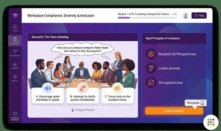
Custom eLearning for Australian Organisations
For L&D, HR, WHS and compliance teams across Australia that need training built around Australian law, Australian sites and multilingual crews.
We design and build custom eLearning that runs in your LMS, speaks to your people and can be delivered in 40+ languages.
Running a formal tender? Submit an RFP →
- 2010Delivering eLearning since
- 500+Projects
- 40+Countries with clients
- 120+Specialists
eLearning companies in Australia range from local studios and global development companies to course libraries, LMS platforms and freelance designers. Choose by need: custom courses for your own policies and sites, a library for generic topics, a platform for delivery. IKHYA is a global custom eLearning company that builds SCORM and xAPI courses for Australian teams, in 40+ languages.

What Types of eLearning Companies Work With Australian Organisations?
Most "top eLearning companies in Australia" lists mix very different businesses: course developers, LMS platforms, content libraries and even industry associations. They are not interchangeable. Start with the type of provider your problem needs, then compare companies inside that type.
| Provider type | What it is | Best for | Consider |
|---|---|---|---|
| Australian onshore agency | A local studio that designs and builds courses, usually with staff in one or two cities | Projects that need frequent face-to-face workshops, or a supplier rule that requires an onshore vendor | Team size limits how many courses and languages run at once |
| Global eLearning development company (IKHYA's model) | A larger team that builds custom courses for clients in many countries, working remotely | Custom courses at scale, many languages, several authoring tools, tight launch dates | Check how meetings fit your time zone and how reviews are run (see time zones) |
| Off-the-shelf content library | A catalogue of ready-made courses you license per learner | Generic topics where your own procedures and sites do not matter | Generic examples; content is not about your workplace, rules or equipment |
| LMS or learning platform | Software that hosts courses, enrols learners and reports completions | Delivering and tracking training you already have | A platform is not a course: you still need content built for it |
| Freelance instructional designer | One specialist, often for design or a small build | A single short course or a design review | Capacity, holidays and languages depend on one person |
Our honest view: if your topic is generic, such as basic cyber awareness, a library course is usually faster and cheaper. If the training must reflect your procedures, your sites and Australian rules, custom eLearning is the better fit. That is where we work.
What Australian Workplace Training Has to Cover
Australian training is shaped by work health and safety law, by Victoria's own OHS Act and, since December 2022, by the positive duty in the Sex Discrimination Act. Each one asks employers to give people the information and training they need. Your course content must match the law that applies in each state where you employ people.
| Law or guideline | What it says | What it means for your training |
|---|---|---|
| Model Work Health and Safety Act (implemented in every jurisdiction except Victoria) | A person conducting a business or undertaking (PCBU) must ensure, so far as is reasonably practicable, the provision of any information, training, instruction or supervision necessary to protect all persons from risks arising from the work (section 19(3)(f) of the Commonwealth Act) | Safety inductions and procedure training are part of the primary duty of care, not an extra |
| Occupational Health and Safety Act 2004 (Vic) | Employers must give employees the information, instruction, training or supervision needed to work safely (section 21), and give health and safety information in suitable languages so employees can understand it (section 22) | Victorian sites follow the Victorian Act, so terms and references differ from the model WHS law; multilingual versions matter |
| Positive duty, Sex Discrimination Act 1984 (Cth), section 47C | Employers and PCBUs must take reasonable and proportionate measures to eliminate, as far as possible, sex discrimination, sexual harassment, sex-based harassment, hostile work environments and related victimisation. The Australian Human Rights Commission has had powers to enforce compliance since 12 December 2023 | The AHRC's 7 Standards include Standard 3, Knowledge: a policy plus education for all workers, including leaders and managers |
What Standard 3 asks for. The AHRC expects education on expected standards of behaviour, on how to recognise the unlawful conduct and its consequences, and on each worker's rights and responsibilities, including their role in prevention and response. It also asks whether this information is in staff inductions and training. A short, scenario-based course for all staff, plus a deeper one for managers, is a practical way to deliver it across many sites.
Training is one control, not the whole answer. For psychosocial risks, WorkSafe Victoria's psychological health compliance code says that where controls are combined, information, instruction or training must not be the predominant control. Good eLearning supports your safer systems of work; it does not replace them.
This section explains what the laws say about training. It is not legal advice: your legal, HR or WHS team approves the content of every course we build.
See our compliance eLearning page for how we plan, build and refresh compliance courses.
Need a course for WHS, positive duty or another Australian rule?
Built for Australian Industries
Mining, energy and healthcare are three of the sectors where Australian training rules are most specific. Each has its own regulator or standard on top of the general WHS law, so a generic course rarely fits.
Mining and resources
Queensland regulates mines under its own Acts: the Coal Mining Safety and Health Act 1999 and the Mining and Quarrying Safety and Health Act 1999 for mines other than coal mines. Western Australia applies the Work Health and Safety (Mines) Regulations 2022. We build site inductions, procedure training and safety scenarios that use your sites, your equipment and your terms.
Oil, gas and energy
Offshore energy operations in Commonwealth waters are regulated for health and safety by NOPSEMA. Onshore plants and contractors fall under the WHS or OHS law of each state. We build scenario-based and simulation training for crews, contractors and supervisors.
Healthcare
All public and private hospitals, day hospitals and most public dental practices are required by health regulators to hold accreditation to the 8 National Safety and Quality Health Service (NSQHS) Standards, second edition. Staff courses often map to standards such as Preventing and Controlling Infections or Medication Safety. We build short, mobile-friendly modules that fit around shifts.
Multilingual Workforces and Asia-Pacific Sites
Many Australian employers train people who do not speak English at home, and many run sites across Asia and the Pacific. In the 2021 Census, more than 5.6 million people in Australia used a language other than English at home; the two most common were Mandarin and Arabic (ABS).
We translate and localise courses into 40+ languages, with human or AI voiceover. Our 500th project was a global onboarding program for a FTSE 100 financial services company, localised into 12 languages. For crews and contractors, localisation means more than words:
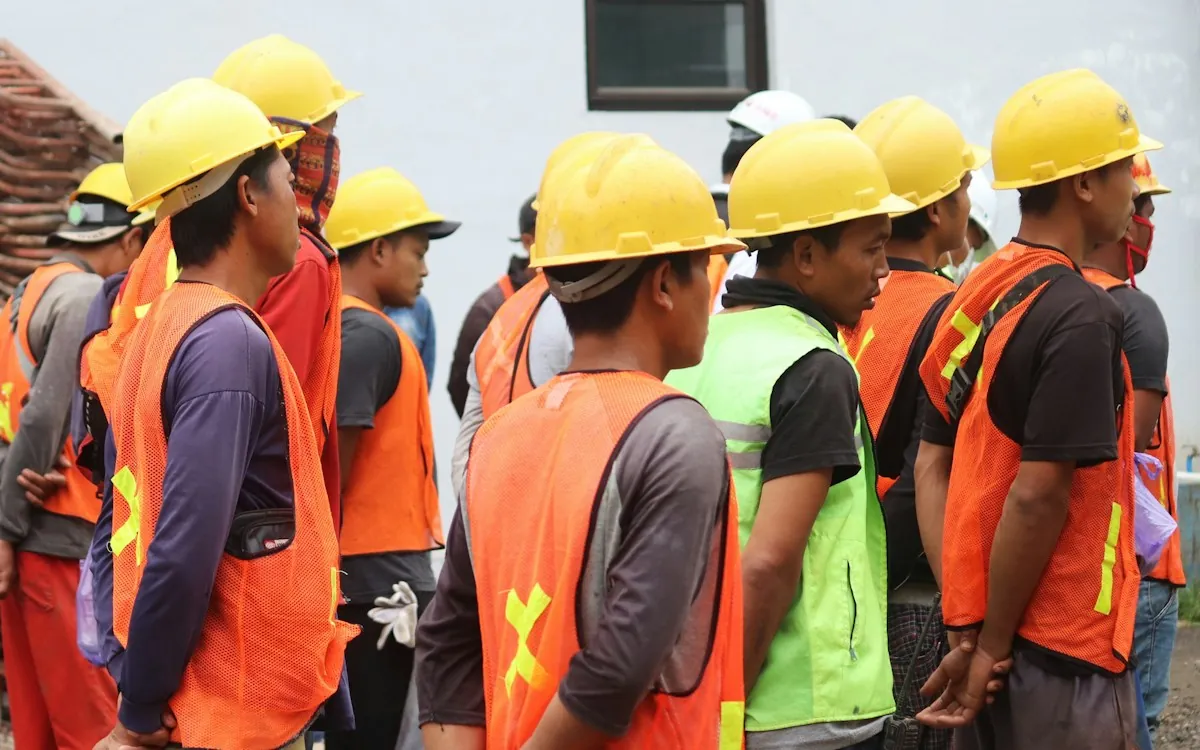
- the same approved safety terms in every language, through one glossary agreed with your WHS or HSE team;
- images, names and examples that match each site;
- audio for learners who read less easily;
- each language version tested in your LMS before launch.
Read more about our eLearning translation services.
Working Across Australian Time Zones
Australia runs on three standard time zones, and five of its states and territories use daylight saving. From the first Sunday in October to the first Sunday in April, that gives your teams five different clock times. Plan review meetings with this in mind.
| Zone | Standard time | Daylight saving | Where |
|---|---|---|---|
| Australian Eastern (AEST / AEDT) | UTC+10 | UTC+11 in NSW, the ACT, Victoria and Tasmania | Queensland, NSW, the ACT, Victoria, Tasmania (Queensland stays on UTC+10 all year) |
| Australian Central (ACST / ACDT) | UTC+9:30 | UTC+10:30 in South Australia | South Australia, Northern Territory (the NT stays on UTC+9:30) |
| Australian Western (AWST) | UTC+8 | none | Western Australia |
In 2026 to 2027, daylight saving runs from 4 October 2026 to 4 April 2027 (NSW Government). During those months, a 9am meeting in Sydney is 8am in Brisbane and 6am in Perth.
How we work with your time zone
We schedule the kick-off call, storyboard walk-throughs and review meetings inside your business hours, whether your reviewers sit in Sydney, Adelaide or Perth. Your project manager confirms the meeting times in your local time, including the daylight saving change, and replies to emails within one business day. Most review work happens in a shared online review tool, so your subject matter experts can comment when their roster allows.
What We Build for Australian Teams
IKHYA is a custom eLearning development company, delivering eLearning since 2010 with 120+ specialists and clients in 40+ countries. For Australian organisations we build the same full range of courses we build worldwide.
Custom eLearning development
Courses designed from your policies, procedures and SME knowledge, from short modules to full programs.
See custom eLearning development →Compliance and safety training
WHS inductions, positive duty and code-of-conduct courses, with knowledge checks and completion tracking.
See compliance eLearning →Translation and localisation
40+ languages, human or AI voiceover, culturally adapted images.
See eLearning translation services →Conversion, simulations and more
PowerPoint and classroom-to-eLearning conversion, course redesign, scenario-based and software simulations, microlearning, mobile learning and blended programs.
See all our eLearning services →Tools: Articulate Storyline 360, Articulate Rise 360, Adobe Captivate, Lectora, iSpring Suite, dominKnow ONE, Elucidat.
Outputs: SCORM 1.2, SCORM 2004, xAPI and HTML5, so courses run in most LMSs. Accessible courses are built to WCAG 2.1 AA.
LMS: LMS platforms we have delivered courses to include Moodle, TalentLMS, Docebo and Cornerstone. We also offer LMS selection, setup, implementation and migration.
You receive the editable source files (for example Storyline or Captivate files), so your team can update courses later.
How a Project Works
Every project starts with a free quote. The quote includes a recommended route (for example a new build or a conversion of existing material) and a timeline for your project.
- 01
Brief and quote
You share the goal, audience, source material and LMS; we send a scope, route and timeline.
You, then IKHYA - 02
Kick-off and analysis
A call in your business hours to confirm learners, sites, languages and the law each state follows.
IKHYA, with your SMEs - 03
Design and storyboard
We write the script and screen plan in Australian English.
IKHYA drafts, you review - 04
Build
We develop the course in the agreed tool, with media and voiceover.
IKHYA - 05
Review and test
Your reviewers comment online; we test function, accessibility and tracking in your LMS.
IKHYA drafts, you review - 06
Launch and languages
We hand over the SCORM or xAPI package and source files, then deliver each language version.
IKHYA
Ready to scope your course?
What Drives the Cost of eLearning in Australia?
We quote every project individually, so you pay for the course you need and not a package. The price depends on:
Course length and the number of modules;
Interactivity: simple click-and-reveal, scenarios or full simulations;
Media: custom graphics, animation, video and voiceover;
Languages: how many, and whether voiceover is human or AI;
Authoring tool and output (SCORM 1.2, SCORM 2004 or xAPI);
Review rounds and how many reviewers sign off;
LMS testing across your platform and each language version.
For an accurate quote, send: your source material, the learner audience and sites, the languages, your LMS and your launch date. Get a Free Quote.
Questions to Ask Any eLearning Company
Whether you choose an Australian studio or a global company, ask the same questions. Clear answers predict a smooth project better than a polished showreel.
- Who writes the content, and do they adapt it to the state laws that apply to us (WHS or Victoria's OHS Act)?
- How will you show the training supports our positive duty measures under the AHRC Standards?
- Which authoring tool will you use, and will we receive the editable source files?
- Which output (SCORM 1.2, SCORM 2004 or xAPI) will you test, and in which LMS?
- How many review rounds are included, and how are comments collected?
- What hours will meetings run in our time zone, and who is our day-to-day contact?
- How do you handle languages, voiceover and site-specific images?
- Which accessibility standard do you build to?
- Which currency is the quote in, and does GST apply?
- Can we see a finished course or a demo before we sign?
Proof: An Australian Mining Company's Training in 7 Languages
 Mining and resources
12 compliance courses localised into 7 Asia-Pacific languages for an Australian mining company
An Australian mining and resources company with about 9,000 employees and contractors across Australia, Indonesia, the Philippines, Mongolia and Papua New Guinea (name withheld).
- The challenge
- Courses were English only. Sites in Asia translated some locally, with mixed quality, and translated versions lagged English by 6 to 12 months. Some sites had low-literacy learners and slow connections.
- What we did
- built a glossary and style sheet with the HSE team first, so all 12 courses use the same safety terms;
- translated 8 Rise 360 and 4 Storyline 360 courses (about 5 hours) into Bahasa Indonesia, Filipino, Mongolian, Tok Pisin, Simplified Chinese, Vietnamese and Thai;
- replaced images with local site photos and local PPE;
- added human voiceover to Storyline scenarios and audio summaries for low-literacy learners;
- compressed media for site networks and tested every language in the client's LMS (SCORM 2004), with one in-country review round per language by site HSE leads.
- Results
- all 7 languages launched on the same day as English;
- 84 course versions (12 courses × 7 languages) delivered in 8 weeks;
- completion at Asian sites rose from 63% to 88% in 60 days, measured in the LMS. The company also made the courses mandatory for contractors at the same time.
"All seven languages went live on the same day as English. Our sites in Asia finally got the same safety training at the same time, with photos of our own sites, and it runs on their slow connections."
Frequently Asked Questions
An eLearning company designs and builds online training: it turns your policies, procedures and expert knowledge into interactive courses that run in a learning management system (LMS) and track completions and scores. Some also translate courses, convert classroom or PowerPoint material, and help set up the LMS.
Choose by need, not location alone. A local onshore agency suits projects that need regular in-person workshops or an onshore supplier rule. A global development company suits custom courses at scale, many languages and tight launch dates, provided meetings fit your time zone.
It depends on course length, interactivity, media, languages, the authoring tool, review rounds and LMS testing. We quote every project individually, and the free quote includes a recommended route and a timeline.
It depends on scope, how ready your source material is and how quickly your reviewers can sign off. Your free quote includes a timeline for your project, and the steps are set out in our process.
Yes, as part of your measures. The AHRC's Standard 3, Knowledge, expects education for all workers, including leaders and managers. eLearning can deliver it consistently across sites, alongside your policy, reporting and support measures.
Yes. Victoria follows its own Occupational Health and Safety Act 2004, while the other states and territories have implemented the model WHS laws. We write each course to the law your sites follow, and your WHS team approves it.
Yes. We translate and localise courses into 40+ languages, with human or AI voiceover, local images and testing of every language version in your LMS.
Our courses are built to SCORM 1.2, SCORM 2004, xAPI and HTML5, so they run in most LMSs. LMS platforms we have delivered courses to include Moodle, TalentLMS, Docebo and Cornerstone.
Yes. You receive the editable source files, for example Storyline or Captivate files, so your team can update the course later.
Planning Training for Your Australian Teams?
Tell us what you need to train, where your people work and which languages they speak. We will send a recommended route and a timeline.