


eLearning Solutions Company in Japan Built for Results, Not Just Completion Rates
Japan’s corporate learning landscape is shifting fast. Remote workforces, compliance mandates, rapid onboarding needs, and the pressure to upskill employees without disrupting operations — these aren’t future problems. They’re what your L&D team is dealing with right now.
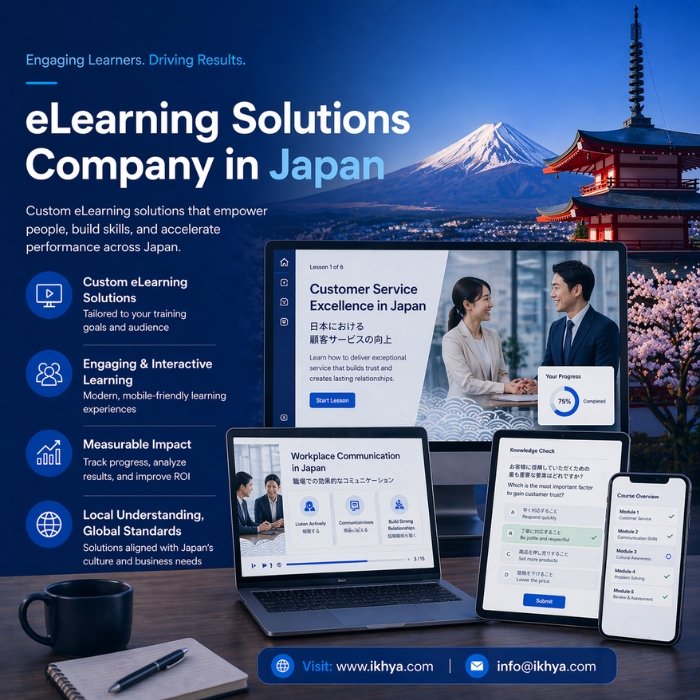
IKHYA is a dedicated eLearning solutions company in Japan serving businesses with custom course development, LMS implementation, bilingual content, and end-to-end digital training strategy. Whether you’re a multinational expanding into Japan or a Japanese enterprise moving training online, we build eLearning that actually works for your people.
What IKHYA Does as an eLearning Solutions Company
IKHYA designs, develops, and deploys custom eLearning solutions for organizations that need more than a generic course template. We work with businesses across Japan to create learning experiences that fit their workflows, culture, and technical infrastructure.
Our work spans:
- Custom eLearning course development — built from scratch, tailored to your content, brand, and learner profile
- LMS consulting and implementation — selecting, configuring, and launching the right platform for your team
- Bilingual eLearning (English + Japanese) — course content that works equally well for Japanese-speaking and English-speaking employees
- Instructional design and content strategy — not just slides, but structured learning journeys built on adult learning principles
- Rapid eLearning development — for businesses that need speed without sacrificing quality
If your training needs a real solution and not a templated course dropped into a platform, you're in the right place.
Who We Serve
IKHYA works with:
- Multinational companies with offices in Japan that need English + Japanese training content
- Japanese enterprises transitioning from classroom to digital training
- Fast-growing companies building onboarding programs at scale
- HR and L&D teams who need a reliable development partner without hiring an in-house team
- Industries including: technology, manufacturing, financial services, healthcare, retail, and professional services
If you manage employee training for 50 to 5,000+ people and need a consistent, scalable, and engaging learning experience — this is what we build.
Our eLearning Services in Japan:
1. Custom eLearning Course Development
Generic courses don't work for complex products, nuanced compliance requirements, or company-specific processes. IKHYA builds fully custom eLearning development with interactive scenarios, branching logic, assessments, and rich media — built in tools like Articulate Storyline, Rise, and Adobe Captivate. Every module is SCORM/xAPI compliant and tested across devices.
2. LMS-Compatible eLearning Course Development
Choosing and deploying the right Learning Management System is one of the most consequential decisions in corporate training. IKHYA builds LMS-compatible eLearning courses that integrate cleanly with your existing platform — configured to your organizational structure, with existing content migrated and administrators trained — so your LMS becomes an asset, not a burden.
3. Bilingual eLearning Development (English + Japanese)
One of the most under-served needs in corporate Japan. Many global companies deploy training in English only — and lose their Japanese-speaking workforce. IKHYA creates fully bilingual eLearning content with language-toggling interfaces, localized scenarios, and culturally appropriate visuals, so every employee is learning in the language they think in. Need content in multiple languages beyond English and Japanese? Explore our eLearning Translation & Localization Services.
4. Microlearning and Mobile Learning
Short-form learning designed for time-poor employees. 3–8 minute focused modules that reinforce key skills, support compliance, and integrate into daily workflows. Our microlearning development services and mobile learning solutions ensure learning happens whether your team is at a desk, on a factory floor, or commuting — on any device, without friction.
5. Instructional Design Services
Strong eLearning starts with strong instructional design. IKHYA's instructional design team structures your subject matter into a learning architecture that drives retention, changes behavior, and meets business objectives. We apply proven models — SAM, ADDIE, spaced repetition — without making the process feel academic.
6. Compliance and Regulatory Training
Compliance content needs to be accurate, current, and demonstrably completed. IKHYA builds compliance eLearning that employees don't hate — scenario-based, consequence-driven, and trackable through your LMS with certificate generation and audit-ready reporting. See how we approach compliance training eLearning solutions for regulated industries.
For teams working against tight deadlines, our Rapid eLearning Development Services offer a faster path from brief to launch without compromising quality.
Why Japan-Focused eLearning Is Different
Deploying eLearning in Japan without understanding the cultural and linguistic context is one of the most common — and costly — mistakes foreign companies make.
Here's what that looks like in practice:
- Training content translated literally from English reads awkwardly and loses nuance
- Visual design using Western stock imagery fails to resonate with Japanese learners
- Compliance training that doesn't reflect Japanese labor law specifics creates legal exposure
- Course structures that ignore Japan's group-learning and consensus culture see low completion rates
IKHYA builds for Japan from the start. That means:
- Localization, not just translation — meaning, context, and cultural tone preserved throughout
- Japan-specific compliance alignment — content built with awareness of local labor regulations and industry standards
- Visual and scenario design that reflects real Japanese workplace environments
- Bilingual delivery — simultaneous English and Japanese outputs from a single source file where needed
This is not something you retrofit after development. It has to be baked into the design process.
Our Development Process
We follow a structured but flexible development process that keeps you informed, in control, and confident at every stage.
Phase 1 — Discovery and Needs Analysis (Week 1–2) We meet with your L&D team, subject matter experts, and technical stakeholders. We map your learner profiles, existing content, LMS environment, and business objectives. No assumptions, no guesswork.
Phase 2 — Instructional Design and Storyboarding (Week 2–4) Our instructional designers create a full course blueprint — learning objectives, content structure, scenario design, assessment strategy, and interaction types. You review and approve before any development begins.
Phase 3 — Development and Review Cycles (Week 4–10) Our development team builds the course in your chosen authoring tool. You receive a working prototype at 50% and a full review build at 90%. Two rounds of revisions are included as standard.
Phase 4 — QA, Testing, and LMS Integration (Week 10–12) Every module is tested across browsers and devices, on your LMS with real user accounts. We verify SCORM/xAPI tracking, completion logic, and certificate generation before sign-off.
Phase 5 — Launch Support and Handover We support your team through go-live, provide admin training, and remain available for post-launch questions. Ongoing support contracts available for companies with continuous development needs.
Typical project timeline: 8–14 weeks for a standard custom eLearning course. Rapid development options available for urgent deadlines.
Investment and What Affects Your Pricing
eLearning development in Japan varies widely in cost depending on scope, complexity, and output format. Here's an honest breakdown of what drives pricing:
| Factor | Impact on Cost |
|---|---|
| Course length (per finished minute) | Higher minute count = higher investment |
| Interactivity level (linear vs. branching) | Complex branching scenarios cost more |
| Bilingual output (single language vs. dual) | Bilingual adds 30–50% to development time |
| Custom illustrations vs. stock assets | Custom visual design increases cost |
| LMS platform complexity | Enterprise LMS configuration adds scope |
| Subject matter expert availability | Faster SME availability = faster delivery |
| Number of review cycles | Additional rounds beyond standard add time |
Typical investment ranges:
- Rapid eLearning (template-based, shorter course): from ¥300,000–¥600,000 per module
- Mid-complexity custom development: ¥800,000–¥2,000,000+ per course
- Enterprise bilingual programs with LMS: Custom quote based on scope
Not sure whether to build in-house or outsource? Read our breakdown of in-house vs. outsourced eLearning development costs to make an informed decision before you engage any vendor.
Every project starts with a free scoping call to give you a transparent, no-obligation estimate.
Why Companies in Japan Choose IKHYA
There are dozens of eLearning vendors. Here's what makes IKHYA the right choice for businesses operating in Japan:
- Japan-specific expertise — We understand the cultural, linguistic, and regulatory context your training has to operate in
- End-to-end service — From instructional design to LMS launch, one partner owns the full process
- Bilingual capability — English and Japanese content delivered in parallel, not as an afterthought
- SCORM and xAPI expertise — Your content will track correctly in any modern LMS
- Transparent process — You're not handed off to a junior team after the sale; the people you speak to are the people building your content
- No minimum contract — Start with a single course or a full learning ecosystem; we scale with you
We don't win clients by being the cheapest option. We win them by solving a problem they couldn't solve anywhere else.
Case Studies
Case Study 1: Onboarding eLearning for a Technology Company Expanding in Japan
A US-based SaaS company expanding its Tokyo office needed onboarding training for Japanese-speaking employees — but their existing onboarding program was English-only and highly US-centric.
What we did: Rebuilt their onboarding curriculum from scratch for the Japan market. Created 6 bilingual eLearning modules covering product knowledge, company culture, compliance, and role-specific skills. All content was delivered in both English and Japanese from a single source, with culturally localized scenarios and visuals.
Result: Onboarding completion rate reached 94% in the first quarter of deployment. HR team reported a measurable reduction in first-90-day turnover among Japanese hires.
Case Study 2: Compliance Training for a Financial Services Firm in Tokyo
A regional financial services firm needed to update its anti-money laundering (AML) and data privacy compliance training to reflect updated Japanese regulatory requirements. Their previous training was a PowerPoint presented by an external consultant once per year.
What we did: Designed and developed 3 scenario-based eLearning modules in Japanese, each 12–18 minutes long, with realistic branching scenarios drawn from actual compliance cases. Integrated directly into their existing LMS with automated certificate generation and audit-ready completion reports.
Result: 100% completion across 400+ employees within the regulatory deadline. Compliance officer reported that post-training assessment scores improved by 38% compared to previous classroom format.
See the full breakdown in our Anti-Money Laundering Training eLearning Case Study.
Case Study 3: Product Training eLearning for a Manufacturing Company
A Japanese manufacturer with B2B clients across Asia needed product training materials that their distributor network could access on-demand — previously delivered as in-person sessions that were expensive, inconsistent, and impossible to scale.
What we did: Converted their in-person product training into 8 modular eLearning courses covering product specs, installation, troubleshooting, and certification. Built in both English and Japanese. Deployed on a lightweight LMS configured for external learners.
Result: Training reach expanded from ~200 attendees per year to 1,200+ active learners in the first year. Distributor certification completion time dropped from 6 weeks to under 2 weeks.
What Our Clients Say
"We'd tried two other vendors before IKHYA. Both delivered technically functional courses that nobody wanted to complete. IKHYA actually understood what our Japanese employees needed — the tone, the examples, the flow. The completion rates speak for themselves." — L&D Manager, Technology Company, Tokyo
"The bilingual development capability was the deciding factor for us. Having English and Japanese content built in parallel from a single source saved us time, cost, and a lot of headaches with inconsistent translations. The team was professional throughout." — HR Director, Financial Services, Osaka
"What impressed us most was the instructional design quality. This wasn't someone who knew how to use Storyline and called it eLearning. They understood our business, structured the content intelligently, and built something our employees actually engage with." — Training Coordinator, Manufacturing, Nagoya
Ready to Build eLearning That Actually Works in Japan?
If you're evaluating eLearning solutions companies in Japan, the next step is a conversation — not a sales pitch.
We'll spend 30 minutes understanding your training challenge, your learner profile, and your technical environment. You'll leave with a clear picture of what a solution looks like, what it costs, and how long it takes.
No commitment. No pressure. Just clarity.
FAQs
An eLearning solutions company designs, develops, and deploys digital training tailored to your business needs. This includes custom courses, LMS setup, bilingual content, and learning strategy. The goal is measurable learning outcomes, not just course completion.
Custom eLearning is built around your processes, content, and learners. Unlike generic courses, it reflects your workflows, compliance needs, and brand. This leads to higher engagement and better retention.
Japan-focused eLearning ensures cultural relevance, accurate language use, and compliance with local regulations. Without localization, training often feels disconnected and results in low completion rates.
Most custom eLearning projects take 8–14 weeks from discovery to launch. Timelines depend on complexity, interactivity, and review cycles. Faster delivery is possible with rapid eLearning options.
Bilingual eLearning includes parallel English and Japanese content built from a single source. It features language toggling, localized scenarios, and culturally appropriate visuals. This ensures consistency and reduces translation errors.
Costs typically range from ¥300,000 to ¥2,000,000+ depending on scope and complexity. Factors like course length, interactivity, and bilingual output impact pricing. Enterprise solutions are usually custom-quoted.
Yes, especially for companies with mixed-language teams in Japan. It improves comprehension, engagement, and completion rates. It also avoids costly miscommunication in training.
Industries like technology, manufacturing, finance, healthcare, and retail benefit significantly. Any organization with compliance needs or large teams can gain value. eLearning scales efficiently across departments.
Yes, modern eLearning courses are built to be LMS-compatible. They support SCORM or xAPI standards for seamless integration. This ensures accurate tracking and reporting.
Rapid eLearning focuses on speed using streamlined templates and processes. It’s ideal for urgent training needs like onboarding or compliance updates. You get faster delivery without sacrificing quality.
Instructional design structures content for better understanding and retention. It uses proven models like ADDIE and spaced repetition. This ensures learners not only complete training but apply it.
Compliance eLearning is interactive, trackable, and scalable. It includes scenario-based learning and automated reporting for audits. This leads to higher completion rates and better knowledge retention.
By designing content specifically for Japanese culture and workplace norms. This includes localized scenarios, appropriate tone, and relevant visuals. It ensures training feels natural and engaging.
Microlearning delivers short, focused lessons that fit into busy schedules. It improves retention and allows learning on-the-go. Ideal for mobile and time-constrained employees.
In many cases, yes—especially for onboarding, compliance, and product training. eLearning offers scalability and consistency. However, some organizations use a blended approach.
Timelines depend on content complexity, SME availability, and review cycles. Bilingual development and LMS integration can also extend timelines. Clear communication speeds up delivery.
Outsourcing provides access to specialized expertise and faster delivery. It avoids hiring and training internal teams. For most companies, it’s more cost-effective and scalable.
Look for Japan-specific expertise, bilingual capability, and end-to-end services. Review case studies and ensure transparent processes. The right partner focuses on outcomes, not just content.
You can expect higher completion rates, better engagement, and improved performance. Many companies also see reduced onboarding time and compliance risks. Results are measurable through LMS data.
Start with a discovery call to define your goals, audience, and technical setup. From there, you’ll receive a clear scope, timeline, and cost estimate. This ensures a structured and transparent start.
At IKHYA – eLearning Solutions Company, we design impactful, compliance-driven, and performance-focused digital learning solutions tailored to your business goals.
🎯 Custom eLearning Course Development
⚡ Rapid eLearning & PPT Conversion
📊 Workplace Compliance Training
🌍 Localization & LMS-Ready Modules