
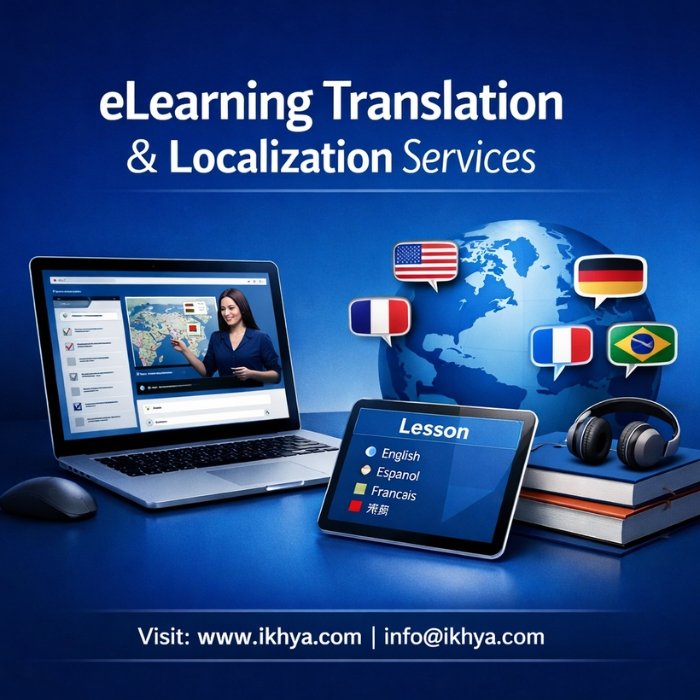



eLearning Translation & Localization Services
Global organizations often struggle to deliver consistent training across multiple languages and regions. Simply translating words is not enough. Corporate training must also reflect local culture, regulations, and learning preferences.
IKHYA – eLearning Solutions Company helps organizations translate and localize eLearning courses for global workforces while maintaining instructional quality, LMS compatibility, and learning effectiveness.
Our experts convert existing courses into multilingual learning experiences using proven instructional design and localization workflows.
Request a consultation or submit your RFP today at info@ikhya.com
Get a Free eLearning Consultation or Localization Proposal
Expanding training to multiple countries requires careful planning. Organizations must evaluate languages, learning technologies, localization complexity, and rollout timelines.
IKHYA provides enterprise consultation for eLearning translation and localization projects. Our experts help organizations plan scalable multilingual learning programs for global teams.
During the consultation we evaluate:
Training Content
- Existing eLearning courses
- Instructor-led training materials
- Video training modules
- Compliance training content
Localization Scope
- Number of languages
- Voiceover translation needs
- Subtitle and caption localization
- Graphics and interface adaptation
Technology Compatibility
- LMS compatibility
- SCORM or xAPI requirements
- Mobile learning compatibility
- LXP platform integration
Global Training Strategy
- multilingual course deployment
- regional compliance requirements
- scalable localization process
- long-term translation maintenance
This consultation helps organizations understand project scope, cost expectations, and deployment timelines before starting development.
Get a customized localization proposal for your training program.
IKHYA – eLearning Solutions Company
Email: info@ikhya.com
What are eLearning Translation & Localization Services?
eLearning translation and localization services adapt digital training content into multiple languages so global employees can learn in their native language. The process goes beyond word-for-word translation. It also adjusts cultural references, visuals, examples, and voiceovers so the training feels natural for learners in different regions.
For global organizations, localization ensures that training effectiveness remains consistent across countries while maintaining compatibility with learning technologies such as LMS platforms, mobile learning systems, and digital adoption platforms.
IKHYA helps organizations convert existing courses into multilingual eLearning experiences while preserving instructional design, learner engagement, and technical standards such as SCORM and xAPI.
Organizations typically localize:
- compliance training
- product training
- software training
- leadership development programs
- operational training courses
This allows companies to deploy a single global training strategy across multiple regions without recreating courses from scratch.
Difference Between Translation and Localization
Many organizations assume translation and localization are the same. In reality, localization is a more advanced process.
| Factor | Translation | Localization |
|---|---|---|
| Language | Converts text into another language | Adapts language and cultural context |
| Graphics | Usually unchanged | Images and visuals may be modified |
| Audio | Subtitles or translated scripts | Full voiceover adaptation |
| Cultural References | May remain unchanged | Adjusted to regional culture |
| Layout | Minimal change | Adjusted for language length and reading direction |
Example:
A safety training course created for the United States may reference OSHA regulations. When localized for the United Kingdom or UAE, the course must adapt to local safety regulations and terminology.
Localization ensures the training remains relevant, accurate, and legally compliant.
Types of eLearning Content That Can Be Localized
Organizations often localize different formats of corporate training.
Many organizations start by creating interactive eLearning courses that can later be translated and localized for global training deployment.
Interactive eLearning Courses
- interactive scenario-based training
- simulation learning modules
- microlearning courses
Authoring Tool Courses
Courses built using common tools such as:
- Articulate Storyline
- Adobe Captivate
- Lectora Inspire
- iSpring Suite
These can be translated while maintaining animations, interactions, and quizzes.
Video-Based Training
Localization may include:
- multilingual subtitles
- voiceover recording
- on-screen text translation
- graphics adaptation
LMS Training Modules
Existing LMS content can be translated while preserving:
- SCORM compatibility
- xAPI tracking
- learner progress analytics
Mobile Learning Content
Mobile training apps and responsive courses can also be localized to support global teams working in different regions.
LMS and Learning Technology Compatibility
One concern for enterprise buyers is whether translated courses will continue to work in their learning platforms.
IKHYA ensures localization maintains compatibility with:
- Learning Management Systems (LMS)
- Learning Experience Platforms (LXP)
- digital adoption platforms
- mobile learning systems
Our development process preserves learning standards including:
- SCORM compliance
- xAPI tracking
- WCAG accessibility standards
This ensures multilingual courses continue to track learner progress, assessments, and certification requirements.
Why Organizations Need eLearning Translation & Localization Services
Global companies operate across multiple countries, cultures, and languages. Training employees in a single language often limits learning effectiveness and reduces engagement. Employees learn faster and retain more knowledge when training is delivered in their native language and cultural context.
eLearning translation and localization allow organizations to deploy consistent global training programs while ensuring content remains relevant for regional teams.
For many enterprises, localization becomes essential when expanding operations internationally.
Training Global Workforces
Large organizations often manage employees across different regions. Without localized training, learners may struggle to understand complex topics such as safety procedures, technical systems, or compliance policies.
Localization helps organizations:
- deliver training in employees’ native languages
- improve learner engagement and comprehension
- reduce training errors in operational environments
- accelerate onboarding for global teams
Example:
A US-based manufacturing company expanding operations into Mexico and Germany may need to localize operational training into Spanish and German. This ensures technicians understand equipment procedures clearly and safely.
Compliance Training Across Regions
Regulatory training requirements vary across countries. Compliance courses must often reflect local laws, safety standards, and industry regulations.
Localization ensures that training content aligns with regional compliance frameworks.
Examples include:
United States
Organizations must comply with regulatory standards such as workplace safety training, data protection policies, and industry certifications.
United Kingdom
Training programs may reference UK-specific workplace regulations and employment standards.
Australia
Industries such as mining, construction, and healthcare require localized compliance training aligned with Australian regulatory frameworks.
UAE
Companies operating in the UAE often require training content adapted for regional safety laws, workforce diversity, and multilingual environments.
Localization ensures compliance training remains accurate and legally appropriate for each region.
Standardizing Corporate Training Worldwide
Global organizations often struggle with inconsistent training across regions. Different offices may create their own training materials, leading to variations in quality and messaging.
Localization allows organizations to create one master training program and adapt it for multiple languages and regions.
Benefits include:
- consistent training standards across locations
- unified corporate policies and procedures
- scalable global learning programs
- easier updates when policies change
Example:
A multinational financial services company may develop a single compliance training program in English, then localize it into:
- French
- Spanish
- Arabic
- Mandarin
This approach maintains consistency while supporting global learners.
Supporting Digital Transformation and System Adoption
Organizations often deploy enterprise software systems such as CRM platforms, ERP systems, or digital workflow tools. Training employees in multiple countries requires multilingual learning resources.
Localization helps ensure employees understand how to use these systems effectively.
Typical training programs that require localization include:
- CRM system training
- ERP software training
- cybersecurity awareness training
- digital workplace tools training
Localized training accelerates system adoption and reduces errors during technology implementation.
Improving Learning Engagement and Retention
Research in instructional design shows that learners retain information more effectively when training is delivered in a familiar language and context.
Localization improves:
- learner comprehension
- engagement in scenario-based training
- participation in interactive modules
- knowledge retention
Using instructional design principles such as Bloom’s Taxonomy and experiential learning, localized courses can provide examples and scenarios that feel relevant to regional learners.
Organizations investing in global workforce training increasingly view localization as a strategic component of corporate learning, not simply a translation task.
Benefits of eLearning Translation & Localization Services
For organizations operating in multiple countries, localized training creates a more effective learning environment for employees. Instead of developing separate training programs for each region, companies can translate and adapt a single course for multiple languages.
This approach allows organizations to scale corporate training while maintaining instructional quality and consistency.
Consistent Global Training Programs
Many organizations struggle with inconsistent training across international offices. Different locations may develop their own materials, which can lead to conflicting procedures and messaging.
Localization enables companies to build one core training program and adapt it for multiple languages.
Benefits include:
- standardized learning objectives across regions
- consistent operational procedures
- unified corporate policies and guidelines
- easier global training updates
This approach supports a centralized learning strategy while still accommodating regional language needs.
Faster Global Training Deployment
Creating separate training programs for every country can significantly delay training initiatives.
Organizations often use rapid eLearning development to convert existing training materials into scalable digital learning programs before localization.
Localization allows organizations to reuse existing content and adapt it quickly for global teams.
This helps organizations:
- launch training programs in multiple countries simultaneously
- support rapid international expansion
- train new employees faster across locations
For example, when a global company introduces a new product or software system, localized training can be deployed across multiple regions at the same time.
Improved Learner Engagement
Employees are more likely to engage with training when the content is presented in their native language and cultural context.
Localization improves learning engagement by adapting:
- examples and case studies
- visual elements and graphics
- regional terminology
- voiceover narration
These changes make training feel more relevant to learners.
Instructional design strategies such as scenario-based learning, microlearning modules, and experiential learning activities become more effective when adapted for local audiences.
Higher Knowledge Retention
Training delivered in a familiar language allows learners to understand complex topics more clearly.
Localized training improves:
- comprehension of technical procedures
- understanding of safety instructions
- retention of compliance policies
When employees fully understand the training material, they are less likely to make mistakes in real work environments.
Cost Savings Compared to Rebuilding Courses
Recreating training programs from scratch for each language can be expensive and time consuming. Localization allows organizations to reuse existing course structures and instructional design frameworks.
Typical localization costs are significantly lower than building entirely new courses.
Organizations can translate:
- course text
- voiceover narration
- subtitles and captions
- on-screen graphics
while keeping the course interactions, structure, and assessments intact.
Stronger Compliance Management
Many industries require employees to complete regulatory or safety training. Localization ensures these courses can be delivered to employees in different regions while maintaining compliance requirements.
Localized compliance training helps organizations:
- meet regional regulatory requirements
- reduce workplace safety incidents
- ensure employees understand legal policies
Industries such as healthcare, construction, finance, aviation, and oil & gas often require multilingual training programs for global workforces.
Scalable Training for Growing Organizations
As organizations expand internationally, training demands increase. Localization enables companies to scale learning programs efficiently without redesigning courses each time a new region is added.
Organizations can easily introduce new languages as they grow.
This scalability is especially valuable for companies managing:
- multinational teams
- distributed workforces
- regional compliance training requirements
- global onboarding programs
Localized eLearning helps organizations create a unified global learning ecosystem while ensuring employees in every region receive clear and culturally relevant training.
Real Enterprise Project Examples
Global organizations often localize training programs to support multilingual workforces across regions. Below are examples of typical enterprise localization projects managed for multinational companies.
These examples illustrate project scope, development timelines, and estimated costs for multilingual eLearning deployments.
Example: Manufacturing Safety Training Localization
Organizations planning multilingual industrial training programs can explore our enterprise manufacturing safety training project showing how safety courses were localized for global factory teams.
Client: Global Manufacturing Company
Industry: Manufacturing
Training Type: Workplace safety training
Project Scope
- 25 interactive eLearning modules
- 6–8 minutes per module
- scenario-based safety simulations
- multilingual voiceover narration
Languages
- Spanish
- German
- French
Timeline
10–12 weeks
Estimated Cost
$45,000 – $80,000
The project localized safety training procedures, hazard recognition scenarios, and equipment operation guidelines to ensure employees across multiple countries received consistent safety instruction.
Example: Salesforce CRM Training Localization
Client: US Technology Company
Industry: Software / Technology
Training Type: CRM system training
Project Scope
- 20 interactive system simulations
- guided walkthrough modules
- scenario-based exercises
Languages
- Japanese
- Korean
- Spanish
Timeline
6–8 weeks
Estimated Cost
$25,000 – $45,000
The project translated interface labels, system navigation instructions, and scenario-based exercises to help global sales teams adopt the CRM system more effectively.
Example: Healthcare Compliance Training Translation
Organizations looking for real-world implementations can review our enterprise healthcare compliance training project demonstrating multilingual compliance course deployment.
Client: International Healthcare Provider
Industry: Healthcare
Training Type: Compliance and regulatory training
Project Scope
- 30 compliance training modules
- interactive quizzes and assessments
- medical policy training
Languages
- Arabic
- French
- Mandarin
Timeline
12–14 weeks
Estimated Cost
$60,000 – $100,000
Localization included translation of complex medical terminology, regulatory policies, and healthcare compliance scenarios.
Example: Oil & Gas Operational Training Localization
Client: Middle East Energy Company
Industry: Oil & Gas
Training Type: operational safety and equipment training
Project Scope
- 18 interactive technical training modules
- equipment operation simulations
- scenario-based emergency response training
Languages
- Arabic
- English
- Hindi
Timeline
8–10 weeks
Estimated Cost
$35,000 – $65,000
This project required cultural adaptation of safety examples and localization of operational procedures for multinational field teams.
Example: Aviation Ground Staff Training Localization
Organizations deploying multilingual aviation programs can review our enterprise aviation safety training project showing how training was delivered to international aviation teams.
Client: International Aviation Company
Industry: Aviation
Training Type: operational procedures training
Project Scope
- 22 microlearning modules
- mobile learning format
- interactive knowledge checks
Languages
- Spanish
- Portuguese
- French
Timeline
7–9 weeks
Estimated Cost
$30,000 – $55,000
Localization ensured airport ground staff across different countries received consistent training on operational procedures and safety protocols.
Organizations planning multilingual training initiatives can request a project estimate based on course complexity, number of languages, and content format.
For enterprise localization projects:
IKHYA – eLearning Solutions Company
Email: info@ikhya.com
Submit your RFP or training requirements to receive a customized proposal.
IKHYA Process for eLearning Translation & Localization
Successful eLearning localization requires more than translating text. The process must preserve instructional design, course functionality, and learning outcomes while adapting content for different languages and cultures.
IKHYA follows a structured localization framework based on ADDIE instructional design methodology, while evaluating learning effectiveness using models such as Bloom’s Taxonomy and the Kirkpatrick Model.
This structured approach ensures multilingual courses remain engaging, technically compatible, and instructionally effective.
Analysis
The first phase focuses on understanding the training content and localization requirements.
Our team evaluates:
- source eLearning course structure
- number of modules and interactions
- languages required for translation
- voiceover and subtitle requirements
- graphics and cultural adaptation needs
- LMS compatibility
We also review technical specifications such as:
- SCORM or xAPI standards
- mobile learning compatibility
- accessibility requirements such as WCAG
At the end of the analysis stage, organizations receive a localization roadmap including timeline and cost estimates.
Instructional Design Adaptation
Simply translating text may reduce training effectiveness if instructional elements are not adapted properly.
IKHYA instructional designers review course content to ensure it remains meaningful for learners in different regions.
Adaptations may include:
- updating scenarios for regional context
- modifying examples and case studies
- adjusting cultural references
- adapting visual elements and icons
Instructional design adjustments ensure localized courses continue to support learning objectives aligned with Bloom’s Taxonomy levels such as understanding, application, and analysis.
Translation and Localization
Once the course structure is finalized, the translation and localization process begins.
This stage typically includes:
- professional language translation
- translation of on-screen text
- localization of graphics and interface elements
- subtitle translation for video content
- multilingual voiceover recording
Localization also includes adapting:
- date and time formats
- measurement units
- regulatory references
- terminology used in regional industries
For interactive courses built using tools such as Articulate Storyline, Adobe Captivate, Lectora Inspire, or iSpring Suite, translated content is integrated into the course while preserving interactions and animations.
Quality Assurance
Quality assurance is critical in multilingual training projects. Every translated course undergoes multiple testing stages before deployment.
Our QA process verifies:
- translation accuracy
- functionality of interactions and quizzes
- audio synchronization for voiceovers
- visual layout consistency
- compatibility with learning platforms
Courses are also tested to ensure they maintain:
- SCORM compliance
- xAPI tracking functionality
- accessibility standards aligned with WCAG guidelines
This ensures translated courses perform reliably across different learning environments.
Deployment
After quality validation, localized courses are prepared for deployment within the organization’s learning ecosystem.
Deployment may include:
- uploading courses to the Learning Management System (LMS)
- configuring multilingual course versions
- setting up learner tracking and analytics
- supporting mobile learning access
Organizations can deploy multilingual training across:
- global employee onboarding programs
- compliance training initiatives
- system adoption training
- operational and safety training programs
After deployment, IKHYA can also provide ongoing course updates and localization support when training content changes.
Technologies and Tools Used
Developing multilingual eLearning requires the right combination of authoring tools, translation technologies, and learning standards. These technologies ensure that translated courses maintain their interactivity, accessibility, and compatibility with enterprise learning platforms.
IKHYA uses industry-standard tools and frameworks to create scalable multilingual training programs.
Authoring Tools
Many organizations build their courses using modern eLearning authoring tools. These tools allow interactive elements, quizzes, animations, and simulations to remain intact after translation.
Many modern organizations develop interactive eLearning courses using tools like Articulate Rise to enable responsive multilingual learning experiences.
Common tools we localize include:
- Articulate Storyline
- Adobe Captivate
- Lectora Inspire
- iSpring Suite
Localization includes updating:
- course text
- interface labels
- navigation instructions
- interaction prompts
- quizzes and feedback messages
This ensures the translated course maintains the same learning structure as the original version.
Translation and Localization Technologies
Large-scale localization projects often involve multiple languages and thousands of content elements. To maintain accuracy and consistency, IKHYA uses specialized translation technologies.
These include:
- translation memory systems to maintain consistent terminology
- terminology management tools for industry-specific vocabulary
- subtitle and caption localization software for video training
- voiceover recording and synchronization tools
These technologies help reduce translation errors and ensure consistent terminology across training modules.
Multimedia Localization
Modern eLearning courses often include video, animations, and interactive media. Localization may require adapting these elements to different languages.
Typical multimedia localization tasks include:
- multilingual voiceover recording
- subtitle translation for training videos
- graphics and infographic adaptation
- animation text updates
This ensures visual and audio elements remain understandable for learners in different regions.
Learning Technology Compatibility
One major concern for enterprise organizations is ensuring that translated courses continue to function properly within learning platforms.
IKHYA ensures compatibility with modern learning ecosystems, including:
- Learning Management Systems (LMS)
- Learning Experience Platforms (LXP)
- digital adoption platforms
- mobile learning systems
Multilingual courses are tested to ensure they perform reliably across different devices and platforms.
eLearning Standards and Accessibility
All translated courses must maintain technical and accessibility standards to ensure consistent learner tracking and usability.
IKHYA ensures compliance with widely used learning standards:
- SCORM for LMS course tracking
- xAPI for advanced learning analytics
- WCAG accessibility standards to support learners with disabilities
Maintaining these standards ensures organizations can continue to track learner progress, assessments, and certification requirements across multilingual training programs.
Industries We Serve
Organizations across many industries require multilingual training programs to support international operations. Each industry has unique regulatory, operational, and technical training requirements.
IKHYA develops localized training programs tailored to industry-specific needs.
Healthcare
Healthcare organizations must train employees on medical procedures, compliance regulations, and patient safety protocols.
Localized training supports:
- hospital staff training
- medical device usage training
- regulatory compliance programs
- patient safety protocols
Multilingual training helps ensure healthcare professionals across different regions understand critical procedures clearly.
Manufacturing
Manufacturing companies often operate facilities across multiple countries. Training must be delivered consistently to workers who speak different languages.
Localization supports:
- equipment operation training
- workplace safety programs
- quality control procedures
- operational process training
This ensures factory workers understand technical instructions and safety requirements.
Finance
Financial institutions require multilingual training to ensure employees understand regulatory compliance, financial products, and data security practices.
Typical finance training programs include:
- compliance and regulatory training
- cybersecurity awareness training
- anti-money laundering training
- financial product training
Localization ensures regulatory training aligns with regional financial regulations.
Construction
Construction companies often employ multinational workforces. Safety training must be delivered clearly to workers who speak different languages.
Localized construction training supports:
- workplace safety training
- equipment operation procedures
- hazard identification training
- regulatory compliance programs
Multilingual safety training can significantly reduce workplace accidents.
Oil and Gas
Oil and gas companies operate in multiple regions with highly technical and safety-critical environments.
Training localization supports:
- operational safety training
- emergency response procedures
- equipment operation training
- environmental compliance training
Localized training helps ensure employees understand complex procedures in hazardous work environments.
Aviation
Aviation organizations require highly standardized training for pilots, ground staff, maintenance crews, and operations teams.
Localization supports:
- aviation safety training
- aircraft maintenance training
- ground operations training
- regulatory compliance programs
Multilingual training helps ensure international aviation teams follow consistent operational procedures.
Challenges of Global eLearning Localization
Many organizations assume that translating training content is a simple process. In reality, global eLearning localization involves multiple technical, cultural, and instructional challenges.
Without proper localization strategies, translated courses may lose instructional clarity, break technical functionality, or fail to engage learners in different regions.
Understanding these challenges helps organizations plan more effective multilingual training programs.
Cultural Context Differences
Learning examples that work in one country may not resonate with learners in another. Cultural context influences how people interpret workplace scenarios, leadership examples, and communication styles.
Localization ensures training scenarios feel relevant to local audiences.
This may involve adapting:
- workplace scenarios
- visual imagery and symbols
- examples used in training exercises
- communication tone and style
For example, leadership training developed in North America may emphasize open discussion and direct feedback. In other regions, workplace communication styles may be more formal, requiring adjustments to the learning scenarios.
Interface and Layout Adaptation
Languages vary significantly in length and structure. When translating courses, the text length may increase or decrease depending on the language.
This can affect:
- slide layouts
- button labels
- navigation menus
- screen spacing
Languages such as German often require longer text, while languages like Chinese may require shorter text blocks. Localization teams must adjust course layouts to maintain readability.
Multilingual Voiceover Production
Many corporate training programs include voiceover narration. Localizing audio content requires more than translating the script.
Voiceover localization includes:
- professional script translation
- native-language voice talent
- audio synchronization with animations
- subtitle and caption creation
Ensuring voiceovers align with on-screen interactions is essential to maintain the flow of the training experience.
Maintaining Learning Effectiveness Across Languages
One major risk in localization is losing the instructional impact of the original training.
Instructional designers must ensure that translated content still supports the intended learning objectives.
Localization teams must maintain:
- assessment accuracy
- scenario-based learning effectiveness
- clear instructional messaging
- alignment with learning objectives
Using frameworks such as Bloom’s Taxonomy helps ensure localized training still supports learning outcomes such as understanding, application, and analysis.
Maintaining Technical Compatibility
Another challenge in localization is ensuring translated courses continue to work correctly within enterprise learning systems.
Technical elements that must remain intact include:
- course navigation
- interactive simulations
- quiz functionality
- learning progress tracking
Localization must maintain compatibility with standards such as SCORM and xAPI, allowing organizations to track learner progress across multiple languages.
Enterprise Pricing and Development Timelines
Enterprise buyers often want to understand the expected cost and timeline before starting a localization project. The cost of eLearning translation depends on factors such as course complexity, number of languages, voiceover requirements, and multimedia content.
The following estimates provide general guidance for typical localization projects.
Typical Localization Cost Per Module
| Localization Type | Estimated Cost Per Module |
|---|---|
| Basic Text Translation | $1,000 – $2,500 |
| Interactive Course Localization | $2,500 – $6,000 |
| Advanced Multimedia Localization | $6,000 – $15,000 |
Costs may vary depending on:
- number of languages
- voiceover recording requirements
- graphics adaptation
- complexity of course interactions
Multilingual Project Cost Examples
| Project Scope | Estimated Cost |
|---|---|
| 5 modules translated into 2 languages | $10,000 – $20,000 |
| 15 modules translated into 3 languages | $35,000 – $70,000 |
| 30 modules translated into 5 languages | $80,000 – $150,000 |
These estimates help enterprise buyers understand typical project investment levels.
Development Timeline Estimates
| Project Scope | Estimated Timeline |
|---|---|
| 1 course module | 2–3 weeks |
| 10 modules | 6–8 weeks |
| 30 modules | 12–16 weeks |
Timelines depend on factors such as:
- language count
- voiceover production
- course complexity
- review and approval cycles
Organizations planning large multilingual training programs should allow additional time for stakeholder reviews and regional validation.
Why Choose IKHYA – eLearning Solutions Company
Organizations selecting a localization partner must ensure the vendor has both instructional design expertise and global training experience.
IKHYA supports global organizations with scalable multilingual learning solutions designed for enterprise environments.
Our team combines expertise in instructional design, localization workflows, and digital learning technologies.
Key strengths include:
- 300+ global clients
- 1000+ digital training courses delivered
- 25+ years of corporate learning experience
- experience across 20+ industries
IKHYA supports organizations with:
- multilingual course localization
- global compliance training programs
- LMS-compatible multilingual learning modules
- scalable global training strategies
Our approach focuses on maintaining instructional quality, technical compatibility, and cultural relevance across all languages.
Organizations can request a consultation to evaluate their multilingual training needs.
Contact:
IKHYA – eLearning Solutions Company
Email: info@ikhya.com
Related eLearning Services
Organizations that localize training content often require additional eLearning services to support global training initiatives.
Related services include:
- Custom eLearning Development: Design and development of fully customized digital training programs tailored to organizational needs.
- Rapid eLearning Development: Fast conversion of existing training materials into interactive eLearning courses.
- Instructional Design Services: Expert instructional design to improve learner engagement and training effectiveness.
- Microlearning Development: Short learning modules designed for modern learners and mobile training environments.
- LMS Integration Services: Integration of eLearning courses with enterprise Learning Management Systems.
- PPT to eLearning Conversion: Conversion of PowerPoint training presentations into interactive eLearning courses.
- ILT to eLearning Conversion: Transformation of instructor-led training programs into scalable digital learning experiences.
Frequently Asked Questions
eLearning translation and localization services adapt digital training content into multiple languages so employees in different countries can learn effectively. Translation converts the course text into another language, while localization adjusts cultural references, visuals, examples, and terminology to match the target audience.
Localization may include:
- translating course text and assessments
- adapting graphics and interface labels
- recording multilingual voiceovers
- translating subtitles for video training
- adjusting examples to match regional contexts
The goal is to ensure the training remains clear, culturally appropriate, and instructionally effective for learners worldwide.
Translation focuses only on converting text from one language to another. Localization goes further by adapting the entire learning experience to suit a specific culture or region.
Localization may involve:
- changing examples and scenarios
- updating regulatory references
- modifying images and symbols
- adjusting layouts for different languages
- adapting voiceover tone and terminology
For corporate training programs, localization ensures the training remains relevant and understandable for employees in different countries.
Many types of corporate training content can be localized, including:
- interactive eLearning courses
- scenario-based training modules
- software simulation training
- compliance training courses
- microlearning modules
- video training programs
- instructor-led training converted to eLearning
Courses built using tools such as Articulate Storyline, Adobe Captivate, Lectora Inspire, and iSpring Suite can typically be translated and localized efficiently.
eLearning courses can be translated into almost any language depending on organizational needs. Common languages requested by global organizations include:
- Spanish
- French
- German
- Arabic
- Mandarin Chinese
- Japanese
- Korean
- Portuguese
- Hindi
Organizations expanding internationally often localize courses into multiple languages simultaneously to support global workforces.
The cost of eLearning localization depends on several factors such as course complexity, number of languages, multimedia content, and voiceover requirements.
Typical pricing ranges include:
- Basic translation: $1,000 – $2,500 per module
- Interactive course localization: $2,500 – $6,000 per module
- Advanced multimedia localization: $6,000 – $15,000 per module
Large multilingual training programs may cost more depending on the number of languages and modules involved.
The timeline for localization depends on the number of modules, languages, and multimedia elements.
Typical development timelines include:
- Single module translation: 2–3 weeks
- 10 modules: 6–8 weeks
- 30 modules: 12–16 weeks
Projects involving voiceover recording or multiple languages may require additional time.
Yes. Most eLearning courses can be translated without recreating the course structure.
Localization teams typically extract the text content, translate it, and then reintegrate it into the course while maintaining:
- course interactions
- navigation
- quizzes and assessments
- animations and multimedia
This approach reduces cost and development time compared to building new courses from scratch.
Yes. During localization, the technical structure of the course is preserved so it continues to function within your Learning Management System.
Translated courses can maintain compatibility with:
- SCORM standards
- xAPI tracking
- LMS analytics systems
- mobile learning platforms
Quality testing ensures learner progress tracking and reporting continue to work correctly.
Yes. Courses built using Articulate Storyline can be localized by translating:
- slide text
- interaction prompts
- quiz questions and feedback
- navigation labels
- voiceover narration
The translated content is then reintegrated into the Storyline project while preserving animations and interactions.
Yes. Adobe Captivate courses can also be translated and localized. Localization includes translating on-screen text, captions, voiceovers, and quiz elements while maintaining the course structure.
Captivate projects often require adjustments to layout and timing to accommodate language differences.
Voiceover localization involves several steps:
- Translating the original narration script
- Selecting native-language voice talent
- Recording the audio narration
- Synchronizing audio with animations and slide timing
- Adding subtitles if required
Professional voiceovers ensure learners hear natural pronunciation and culturally appropriate tone.
Yes. Video-based training can be localized through several methods.
These include:
- multilingual subtitles
- translated voiceover narration
- on-screen text translation
- graphics adaptation
Organizations can choose subtitles or voiceovers depending on training goals and budget.
Localization teams often use translation quality processes that include:
- professional translators with subject expertise
- terminology management systems
- translation memory tools for consistent vocabulary
- multi-stage quality reviews
These processes ensure technical terminology remains accurate across all training modules.
Translation memory is a technology that stores previously translated phrases and terminology. When similar content appears in future modules, the system suggests the same translation.
Benefits include:
- consistent terminology across courses
- faster translation for large projects
- reduced translation costs for repeated content
This is especially useful for organizations with large training libraries.
Yes. Responsive eLearning courses can be localized while maintaining compatibility with mobile devices such as smartphones and tablets.
Localization teams ensure that translated text fits mobile layouts and that navigation remains easy to use on smaller screens.
Yes. Accessibility standards such as WCAG can be maintained during localization.
This includes:
- accessible navigation
- captioned videos
- screen reader compatibility
- clear visual contrast
Maintaining accessibility ensures training remains usable for all learners, including those with disabilities.
A course can be localized into as many languages as required. Some global organizations translate training programs into 10 or more languages to support international operations.
Localization teams typically create a master course version and then produce language variants.
Localization specialists review training scenarios and examples to ensure they are culturally appropriate.
This may involve:
- changing workplace examples
- updating graphics or symbols
- adjusting communication styles
- modifying regulatory references
These changes ensure learners in different countries can relate to the training content.
Yes. Compliance training is one of the most common types of content localized for global organizations.
Localization ensures regulatory training aligns with regional requirements such as:
- workplace safety regulations
- data protection laws
- financial compliance rules
- healthcare regulatory policies
This helps organizations maintain compliance across multiple countries.
Organizations typically begin by sharing existing training materials and localization requirements.
Key information includes:
- number of courses or modules
- languages required
- voiceover or subtitle requirements
- LMS compatibility needs
- project timeline expectations
A localization team can then evaluate the materials and provide a project proposal including cost estimates and timelines.
To discuss your project requirements:
IKHYA – eLearning Solutions Company
Email: info@ikhya.com
Our team can help design a scalable multilingual training strategy for your organization.
Request Your Proposal
Organizations planning multilingual training initiatives can request a consultation to evaluate localization requirements.
IKHYA supports global companies with scalable eLearning translation and localization services designed for enterprise learning environments.
To request a proposal or submit an RFP:
IKHYA – eLearning Solutions Company
Email: info@ikhya.com
Our experts will review your training materials and provide recommendations for language translation, localization strategy, project timelines, and cost estimates.
At IKHYA – eLearning Solutions Company, we design impactful, compliance-driven, and performance-focused digital learning solutions tailored to your business goals.
🎯 Custom eLearning Course Development
⚡ Rapid eLearning & PPT Conversion
📊 Workplace Compliance Training
🌍 Localization & LMS-Ready Modules



Reviews
There are no reviews yet.