Global Training Deployment Using Articulate Rise: Development and Localization

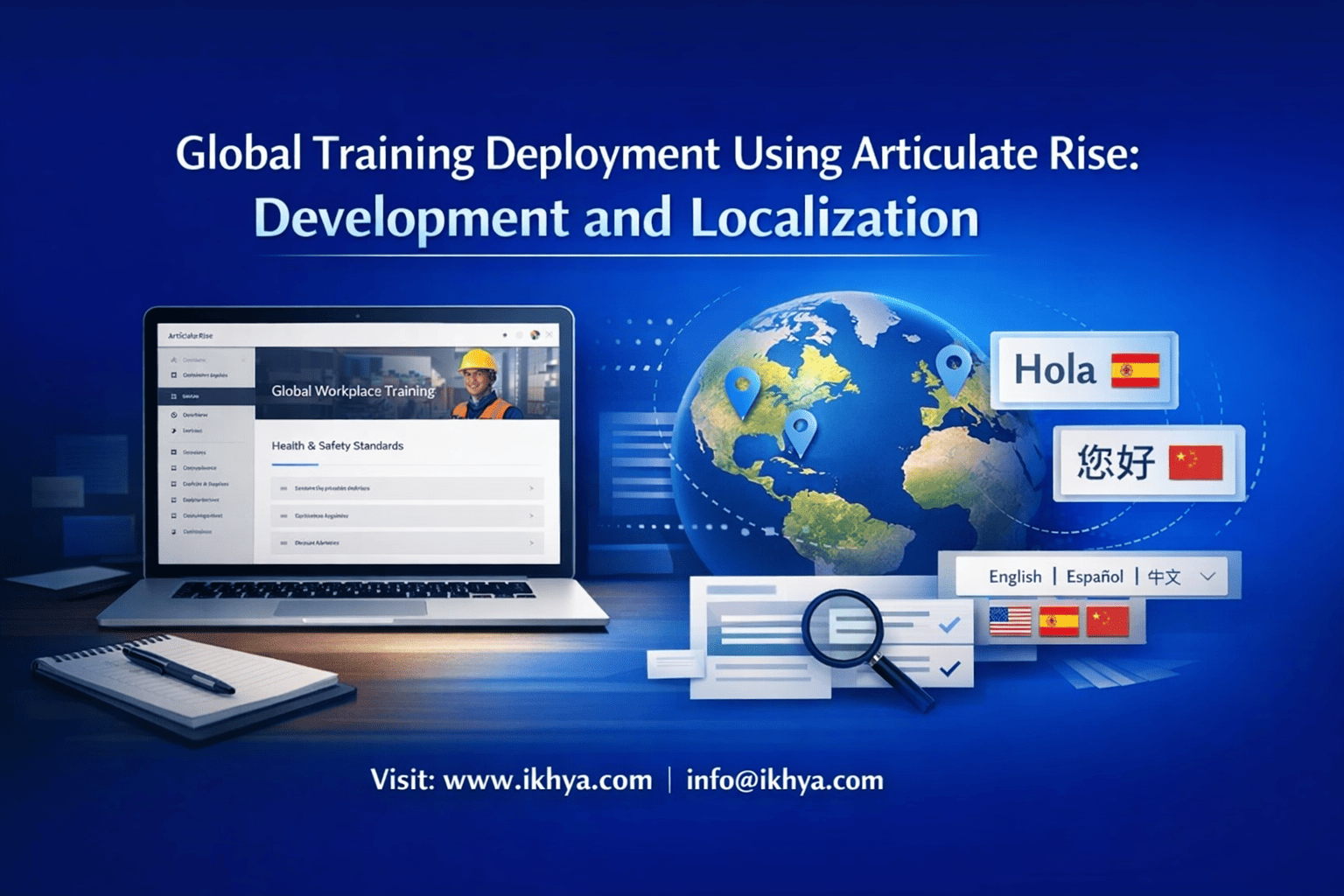
Global companies cannot afford training delays, inconsistent messaging, or compliance failures across regions. Articulate Rise enables rapid, scalable, and fully responsive course deployment worldwide—without rebuilding content for each country.
If you are planning global rollout, speak with IKHYA – eLearning Solutions Company at info@ikhya.com to design, localize, and deploy your Rise courses efficiently across all regions.
Why Articulate Rise Is Ideal for Global Training Deployment
Articulate Rise is ideal for global deployment because it creates fully responsive, cloud-based courses that automatically adapt to devices, regions, and LMS platforms without redevelopment. Its web-based architecture enables centralized updates, rapid localization, and standardized learner experiences across countries while supporting global compliance, accessibility standards, and scalable enterprise training distribution.
The Global Deployment Challenge Most Organizations Face
Multinational companies must train employees across multiple countries while maintaining consistency, compliance, and speed. However, traditional eLearning tools often create deployment bottlenecks due to:
- Device compatibility issues
- Localization complexity
- Version control problems
- LMS compatibility challenges
- Slow update cycles
For example:
- A US-based healthcare company must deploy HIPAA training across the USA, UK, and UAE.
- An Australian mining company must train workers in remote areas using mobile devices.
- A UK financial firm must ensure FCA compliance training is identical worldwide.
Legacy tools require separate versions for each region. Rise eliminates this complexity.
Cloud-Based Architecture Enables Global Scalability
Rise operates entirely in the cloud, which fundamentally changes how global training is deployed.
Traditional authoring tools:
- Require local software installation
- Need manual file management
- Create version control conflicts
- Slow down global rollout
Rise cloud-based model:
- Centralized course management
- Instant global access
- No installation required
- Automatic content updates worldwide
Example deployment scenario:
| Organization | Traditional Deployment Time | Rise Deployment Time |
|---|---|---|
| USA Healthcare Provider | 6–8 weeks | 1–2 weeks |
| UK Financial Institution | 5–7 weeks | 1–3 weeks |
| UAE Aviation Company | 8–12 weeks | 2–4 weeks |
This reduction directly impacts compliance timelines and operational readiness.
Fully Responsive Design Eliminates Device Compatibility Issues
Rise courses automatically adjust to:
- Desktop computers
- Laptops
- Tablets
- Mobile phones
This is critical in global deployment environments such as:
- Construction sites in Australia
- Oil and gas operations in the UAE
- Healthcare environments in the USA
- Logistics and transportation operations worldwide
Unlike traditional tools, Rise does not require separate mobile versions.
Technical advantage:
Rise uses responsive web design instead of fixed screen layouts, ensuring content dynamically adapts to screen size.
Standardized Global Learning Experience
One of the biggest risks in global training is inconsistent learner experience. Rise ensures identical structure and functionality worldwide.
Key consistency features:
- Uniform course structure
- Standard navigation controls
- Consistent interaction design
- Identical assessment logic
This is especially critical for compliance training in regulated industries such as:
- Healthcare (HIPAA, NHS, DHA)
- Finance (SEC, FCA, ASIC)
- Aviation (FAA, CASA, GCAA)
- Oil and gas safety (OSHA, HSE, ISO)
Rise ensures learners in New York, London, Sydney, and Dubai experience the same course quality.
Rapid Content Updates Across All Regions
One of Rise’s most powerful global deployment features is centralized updating.
Example scenario:
A global company updates its safety procedure.
Traditional tools:
- Update multiple regional files
- Re-export courses
- Re-upload to LMS
- Verify each version
This process can take weeks.
Rise workflow:
- Update once in Rise
- Republish
- LMS automatically reflects changes globally
Time required: hours instead of weeks.
Seamless LMS Integration for Global Deployment
Rise supports all major global LMS standards:
- SCORM 1.2
- SCORM 2004
- xAPI (Tin Can)
- cmi5
Compatible LMS platforms include:
- Cornerstone OnDemand
- Docebo
- SAP SuccessFactors
- Moodle
- Blackboard
This ensures compatibility across global enterprise environments.
Supports Global Accessibility Standards
Rise supports accessibility compliance required in major regions:
| Region | Accessibility Standard |
|---|---|
| USA | WCAG 2.1, Section 508 |
| UK | Equality Act accessibility requirements |
| Australia | WCAG 2.1 AA |
| UAE | Government accessibility standards |
| Europe | EN 301 549 |
Accessibility features include:
- Keyboard navigation
- Screen reader support
- Alternative text for images
- Structured headings
This ensures compliance and inclusivity worldwide.
Example: Global Compliance Training Deployment Using Rise
Scenario: US-based pharmaceutical company deploying compliance training across:
- USA
- UK
- Germany
- UAE
- Australia
Using Rise:
- Single master course created
- Exported in SCORM 2004
- Uploaded to global LMS
- Localized into 6 languages
- Deployed to 18,000 employees
Total deployment time: 4 weeks.
Traditional tools would require 12–20 weeks.
Key Advantages Summary
| Capability | Traditional Tools | Articulate Rise |
|---|---|---|
| Global deployment speed | Slow | Fast |
| Device compatibility | Limited | Full responsive |
| Localization workflow | Complex | Efficient |
| Update management | Manual | Centralized |
| LMS compatibility | Good | Excellent |
| Accessibility compliance | Variable | Strong |
Global Course Development Workflow Using Articulate Rise
The global development workflow in Articulate Rise involves centralized course creation, structured content design, standardized interaction implementation, LMS export configuration, and global deployment through cloud publishing. This process ensures scalability, consistent learner experience, compliance alignment, and efficient localization preparation across multiple countries without rebuilding or duplicating course infrastructure.
Phase 1: Global Training Needs Analysis and Standardization
Before building any Rise course, organizations must define global and regional training requirements clearly. This prevents costly redesign later.
Global training analysis identifies:
- Universal training content (used worldwide)
- Region-specific compliance requirements
- Localization needs (languages, cultural context)
- Technical deployment environments
- LMS compatibility requirements
Example: Global cybersecurity training
| Content Type | Global or Local | Example |
|---|---|---|
| Password security principles | Global | Same worldwide |
| GDPR data handling | Regional | EU, UK |
| HIPAA compliance | Regional | USA |
| Privacy Act requirements | Regional | Australia |
| UAE data protection law | Regional | UAE |
This separation allows Rise developers to create a master course structure that supports efficient localization.
Phase 2: Creating the Master Course Structure in Rise
The master course is the foundation used for all global versions. It contains standardized content, layout, and interactions.
Core structure components in Rise:
- Lessons
- Blocks
- Knowledge checks
- Assessments
- Media elements
- Navigation structure
Typical enterprise course structure example:
| Lesson | Purpose |
|---|---|
| Introduction | Training overview |
| Core Concepts | Universal global content |
| Regional Compliance | Localized lessons |
| Scenario Training | Practical application |
| Assessment | Certification validation |
Rise’s block-based architecture allows modular course design.
Key Rise block types:
- Text blocks
- Image blocks
- Video blocks
- Interactive blocks
- Scenario blocks
- Knowledge checks
This modular design allows selective localization without rebuilding entire courses.
Phase 3: Designing for Global Compatibility and Localization Readiness
Courses must be designed in a way that supports future translation and cultural adaptation.
Best practices include:
Use Neutral, Universal English
Avoid:
- Idioms (example: “hit the ground running”)
- Slang
- Culture-specific references
Use:
- Simple, clear English
- Direct instructions
- Globally understood terminology
Example:
❌ Poor: “Report incidents immediately to your supervisor on duty.”
✅ Better: “Report incidents immediately to your supervisor.”
Avoid Text Embedded in Images
Text inside images creates localization challenges because translators cannot edit it easily.
Instead:
- Use Rise text blocks
- Use caption fields
- Separate visuals and text
This reduces translation cost and effort.
Use Modular Lessons for Regional Variations
Rise allows creation of lessons that can be included or excluded based on region.
Example structure:
Global lessons:
- Safety fundamentals
- Equipment handling basics
Regional lessons:
- OSHA safety standards (USA)
- HSE safety standards (UK)
- SafeWork standards (Australia)
- UAE labor safety regulations
This allows reuse of 80–90% of content globally.
Phase 4: Implementing Assessments and Certification Logic
Global compliance training requires assessment tracking and certification validation.
Rise supports:
- Quiz scoring
- Passing score configuration
- LMS reporting
- Completion tracking
Typical enterprise settings:
| Setting | Value |
|---|---|
| Passing score | 80% |
| Attempts allowed | 2–3 |
| LMS reporting | Passed/Failed |
| Certificate requirement | Mandatory |
Rise exports this data via SCORM, xAPI, or cmi5.
Global LMS platforms use this data for compliance reporting.
Phase 5: Media Optimization for Global Performance
Global deployment must consider bandwidth limitations.
Rise automatically optimizes media delivery, but developers should still follow best practices.
Recommended video specifications:
| Parameter | Recommended Value |
|---|---|
| Resolution | 720p or 1080p |
| Format | MP4 |
| Compression | H.264 |
| Max file size per video | Under 50 MB |
This ensures smooth playback in regions with slower internet.
This is especially important in:
- Remote Australia mining sites
- UAE offshore facilities
- Rural healthcare facilities
- Global field workforce environments
Phase 6: Exporting Rise Courses for Global LMS Deployment
Rise supports multiple LMS export formats required by global enterprises.
Export options:
- SCORM 1.2
- SCORM 2004 (recommended)
- xAPI
- cmi5
Recommended enterprise export: SCORM 2004
Reason:
- Better tracking
- Detailed reporting
- Wide LMS compatibility
Export workflow:
- Publish course in Rise
- Select export format
- Download SCORM package
- Upload to LMS
- Assign to learners globally
Time required: typically under 30 minutes.
Localization Strategies for Global Rise Course Deployment
Localization in Articulate Rise involves exporting course content, translating text, adapting media and compliance elements, and reimporting localized versions for global deployment. Proper localization ensures regulatory compliance, cultural relevance, and learner comprehension while maintaining standardized training structure, functionality, and reporting across all languages and regional workforce environments.
Language Translation Workflow in Rise
Rise provides built-in export tools for translation.
Translation process:
- Export XLIFF file from Rise
- Send file to professional translators
- Translate text in XLIFF
- Import translated file into Rise
- Publish localized version
Supported languages include:
- English
- Arabic
- French
- German
- Spanish
- Hindi
- Mandarin
- Japanese
Example: UAE deployment requires Arabic and English versions.
Rise supports right-to-left languages such as Arabic.
Cultural Localization Beyond Language Translation
Localization is not just translation—it includes cultural adaptation.
Key localization elements:
- Images
- Names
- Currency
- Laws
- Symbols
Example:
USA version: OSHA compliance references
UK version: HSE compliance references
Australia version: SafeWork Australia references
UAE version: Ministry of Human Resources compliance references
This ensures legal and cultural accuracy.
Media Localization and Voiceover Adaptation
Global courses often require localized audio and visuals.
Rise supports:
- Region-specific images
- Localized videos
- Subtitles
- Voiceovers
Example:
| Region | Language | Media Adaptation |
|---|---|---|
| USA | English | US workplace visuals |
| UK | English | UK workplace visuals |
| UAE | Arabic | Arabic voiceover |
| Australia | English | Mining-specific visuals |
This improves learner engagement.
Managing Multiple Language Versions Efficiently
Best practice is to maintain one master course and create localized copies.
Typical enterprise structure:
| Version | Language | Region |
|---|---|---|
| Master | English | Global |
| Version 1 | Arabic | UAE |
| Version 2 | German | Germany |
| Version 3 | French | Canada |
| Version 4 | Spanish | Latin America |
Rise allows easy duplication and localization.
Global LMS Deployment Architecture for Articulate Rise Courses
Global LMS deployment using Articulate Rise involves exporting SCORM 2004, xAPI, or cmi5 packages and distributing them through enterprise LMS platforms configured for multi-region access. Proper architecture ensures fast delivery, reliable tracking, regional compliance reporting, and scalable access for thousands of learners across different countries, devices, and network environments simultaneously.
How Rise Integrates with Enterprise LMS Platforms Worldwide
Articulate Rise exports standards-compliant packages that work with nearly all enterprise LMS platforms.
Most common global LMS platforms include:
- Cornerstone OnDemand (USA, global enterprises)
- SAP SuccessFactors (Europe, Middle East, global corporations)
- Docebo (North America, Europe)
- Moodle (global, open-source)
- Blackboard Learn (USA, UK, universities)
- Totara LMS (UK, Australia)
Rise supports:
- SCORM 1.2
- SCORM 2004 (recommended)
- xAPI (Tin Can API)
- cmi5
These standards ensure learner progress, scores, and completion data are tracked accurately.
Recommended Global Deployment Architecture Model
Enterprise organizations typically use a centralized LMS with global access.
Standard architecture structure:
Articulate Rise (Course Development)
          ↓
SCORM 2004 Export
          ↓
Central LMS (Cloud-hosted)
          ↓
Global CDN (Content Delivery Network)
          ↓
Learners worldwide access training
This architecture ensures:
- Fast course loading worldwide
- Reliable tracking
- Minimal downtime
- Scalable performance
Role of Content Delivery Networks (CDN) in Global Training
A CDN distributes course content across global servers.
This reduces latency and improves performance.
Example:
| Region | Without CDN Load Time | With CDN Load Time |
|---|---|---|
| USA | 2 seconds | 1 second |
| UK | 5 seconds | 1.5 seconds |
| UAE | 8 seconds | 2 seconds |
| Australia | 10 seconds | 2.5 seconds |
Major LMS platforms use CDNs like:
- AWS CloudFront
- Microsoft Azure CDN
- Cloudflare
This ensures consistent performance globally.
LMS Configuration Best Practices for Global Deployment
Correct LMS settings are critical for reliable deployment.
Recommended configuration:
Tracking settings:
- Completion status: Passed/Incomplete
- Score tracking: Enabled
- Bookmarking: Enabled
- Resume support: Enabled
Security settings:
- HTTPS delivery
- User authentication required
- Access control by region
Performance settings:
- Enable caching
- Enable CDN acceleration
- Optimize media delivery
Multi-Region LMS Deployment Models
Organizations typically use one of three models.
Model 1: Single Global LMS (Most Common)
One centralized LMS serves all regions.
Advantages:
- Simplified management
- Centralized reporting
- Lower cost
Used by:
- US multinational corporations
- UK financial institutions
- UAE aviation companies
Model 2: Regional LMS Instances
Separate LMS instances for different regions.
Example:
| Region | LMS Instance |
|---|---|
| USA | LMS-US |
| UK | LMS-UK |
| UAE | LMS-UAE |
| Australia | LMS-AU |
Advantages:
- Regional compliance control
- Data residency compliance
Used in regulated industries.
Model 3: Hybrid LMS Architecture
Combination of global and regional LMS.
Example:
- Global LMS for standard training
- Regional LMS for compliance training
Common in:
- Healthcare
- Aviation
- Government
- Finance
Testing and Validation Before Global Deployment
Testing ensures proper functionality worldwide.
Required testing steps:
Technical testing
- Course launches correctly
- Tracking works correctly
- Resume works correctly
Device testing
- Desktop
- Tablet
- Mobile
Regional testing
- USA
- UK
- Australia
- UAE
Testing prevents large-scale deployment failures.
Compliance and Regulatory Requirements Across Global Regions
Articulate Rise supports compliance training deployment across global regulatory frameworks including OSHA (USA), HSE (UK), SafeWork Australia, and UAE labor regulations. Its SCORM/xAPI tracking, accessibility compliance, and standardized delivery ensure audit-ready reporting, consistent training validation, and regulatory alignment required for safety, healthcare, finance, aviation, and corporate compliance programs worldwide.
United States Compliance Requirements
The USA has strict training compliance requirements across industries.
Key regulatory bodies:
- OSHA (Occupational Safety and Health Administration)
- HIPAA (Healthcare compliance)
- FAA (Aviation)
- SEC and FINRA (Finance)
Training requirements include:
- Completion tracking
- Assessment validation
- Audit records
- Certification proof
Rise supports these through LMS reporting and tracking.
Example: OSHA safety training deployment using SCORM 2004.
United Kingdom Compliance Requirements
The UK requires structured training aligned with regulatory frameworks.
Key regulatory bodies:
- HSE (Health and Safety Executive)
- FCA (Financial Conduct Authority)
- NHS compliance standards
Requirements include:
- Training completion tracking
- Compliance reporting
- Accessibility compliance (Equality Act)
Rise courses meet these requirements.
Australia Compliance Requirements
Australia enforces strict workplace safety training standards.
Key organizations:
- SafeWork Australia
- ASIC (Finance compliance)
- CASA (Aviation safety)
Training must include:
- Certification validation
- Assessment tracking
- Completion reporting
Rise fully supports these requirements.
UAE Compliance Requirements
The UAE requires compliance training across major industries.
Key regulatory authorities:
- Ministry of Human Resources and Emiratisation
- GCAA (Aviation)
- DHA (Healthcare)
Training must support:
- Arabic and English languages
- Certification validation
- Compliance reporting
Rise supports Arabic localization and compliance tracking.
Global Accessibility Compliance Requirements
Accessibility compliance is mandatory worldwide.
Key standards:
- WCAG 2.1 (global)
- Section 508 (USA)
- EN 301 549 (Europe)
- Equality Act (UK)
Rise supports:
- Screen readers
- Keyboard navigation
- Accessible structure
This ensures inclusive global training deployment.
Global Deployment Cost Comparison: Articulate Rise vs Traditional eLearning Tools
Articulate Rise significantly reduces global deployment costs by eliminating device-specific development, reducing localization effort, and enabling centralized updates. Compared to traditional authoring tools, Rise can lower total global training deployment costs by 30–60% through faster development, reduced maintenance, and scalable LMS integration without requiring multiple course versions.
Where Traditional Global Deployment Costs Increase
Most organizations underestimate the hidden costs of global training deployment.
Major cost drivers include:
- Multi-device development (desktop, tablet, mobile)
- Multiple localized course rebuilds
- Maintenance of separate course versions
- LMS compatibility adjustments
- Developer labor costs
- Testing and validation across regions
Example scenario: Global compliance training for 10,000 employees across 5 countries.
| Cost Category | Traditional Tools | Rise |
|---|---|---|
| Development | $25,000 | $12,000 |
| Localization | $18,000 | $9,000 |
| Testing | $8,000 | $4,000 |
| Deployment | $6,000 | $2,000 |
| Maintenance (annual) | $12,000 | $4,000 |
| Total First-Year Cost | $69,000 | $31,000 |
Savings: 55% reduction
Development Speed Directly Impacts Global Deployment Cost
Faster development reduces labor costs significantly.
Typical enterprise development timelines:
| Course Type | Traditional Tools | Rise |
|---|---|---|
| 30-minute compliance course | 4–6 weeks | 1–2 weeks |
| 60-minute technical course | 6–10 weeks | 2–4 weeks |
| Global localized course (5 languages) | 12–20 weeks | 4–8 weeks |
This speed advantage allows organizations to deploy faster and reduce project overhead.
Maintenance Cost Comparison Over 3 Years
Maintenance is one of the largest hidden costs in global deployment.
| Year | Traditional Tools | Rise |
|---|---|---|
| Year 1 | $12,000 | $4,000 |
| Year 2 | $12,000 | $4,000 |
| Year 3 | $12,000 | $4,000 |
| Total | $36,000 | $12,000 |
Rise reduces maintenance workload because updates apply globally.
Infrastructure Cost Reduction
Rise reduces infrastructure requirements because:
- No software installation required
- No local development environment needed
- No multiple course file management
This lowers IT overhead.
Localization Cost Reduction Through Structured Content
Localization is cheaper because Rise uses structured content blocks.
Translation vendors can translate faster using XLIFF export.
Example:
| Languages | Traditional Tools | Rise |
|---|---|---|
| 3 languages | $9,000 | $5,000 |
| 5 languages | $18,000 | $9,000 |
| 10 languages | $35,000 | $18,000 |
Savings increase with scale.
Best Practices for Multinational Deployment Using Articulate Rise
Successful global deployment using Articulate Rise requires structured course design, localization-ready development, LMS optimization, and regional compliance alignment. Following proven enterprise deployment practices ensures faster rollout, reduced localization errors, consistent learner experience, and scalable training delivery across multiple countries, languages, and regulatory environments without costly redevelopment.
Design Courses for Localization from Day One
Avoid redesign by preparing content for localization.
Best practices:
- Use simple English
- Avoid embedded text in images
- Use modular lesson structure
- Separate global and regional content
This reduces localization effort significantly.
Use a Master Course with Localized Variants
Always create one master course.
Then duplicate and localize versions.
Example structure:
| Course | Purpose |
|---|---|
| Master course | Global content |
| UAE version | Arabic localization |
| UK version | Compliance localization |
| Australia version | Safety regulation localization |
This ensures efficient maintenance.
Standardize Global Course Templates
Create standard templates including:
- Intro structure
- Navigation design
- Assessment format
- Branding elements
This ensures consistent global deployment.
Test Courses Across Devices and Regions
Testing should include:
- Desktop testing
- Mobile testing
- LMS tracking validation
- Regional access testing
Testing prevents global deployment issues.
Optimize Media for Global Bandwidth
Recommended media strategy:
- Compress videos
- Use optimized images
- Avoid heavy animations
This ensures performance worldwide.
Use SCORM 2004 or xAPI for Global Tracking
These standards provide better reporting.
Benefits:
- Detailed completion tracking
- Certification validation
- Compliance reporting
Most global LMS platforms support these formats.
Global Comparison: Articulate Rise vs Traditional Authoring Tools for Worldwide Deployment
Articulate Rise provides superior global deployment efficiency compared to traditional tools due to responsive design, centralized updates, and simplified localization. Traditional tools require device-specific development and complex maintenance, while Rise enables scalable, standardized training delivery worldwide with lower cost, faster deployment, and improved compliance management.
| Capability | Articulate Rise | Traditional Tools |
|---|---|---|
| Mobile compatibility | Automatic responsive | Manual development required |
| Localization workflow | Efficient XLIFF export | Complex manual process |
| Update management | Centralized | Manual updates required |
| Global deployment speed | Fast | Slow |
| Maintenance effort | Low | High |
| LMS compatibility | Excellent | Good |
| Accessibility compliance | Strong | Variable |
| Development cost | Lower | Higher |
| Scalability | Excellent | Limited |
Frequently Asked Questions About Global Deployment Using Articulate Rise
Can Articulate Rise be used for multilingual global training?
Yes. Rise supports translation using XLIFF export/import, allowing deployment in dozens of languages including Arabic, French, German, Spanish, and Hindi while maintaining structure, interactions, and tracking across all localized versions within enterprise LMS platforms worldwide.
Does Articulate Rise support global LMS platforms?
Yes. Rise supports SCORM 1.2, SCORM 2004, xAPI, and cmi5, ensuring compatibility with global LMS platforms such as Cornerstone, SAP SuccessFactors, Moodle, Docebo, and Blackboard used across the USA, UK, Australia, UAE, and multinational enterprises.
Is Articulate Rise suitable for compliance training worldwide?
Yes. Rise supports compliance training requirements including assessment tracking, completion reporting, accessibility compliance, and certification validation required by OSHA, HSE, SafeWork Australia, UAE regulators, and international regulatory frameworks.
How long does global deployment take using Rise?
Most global Rise deployments take 2–6 weeks depending on course complexity, number of languages, and LMS configuration. Traditional tools often require 8–20 weeks for equivalent global deployment due to manual device optimization and localization workflows.
Can Rise courses work on mobile devices globally?
Yes. Rise courses use fully responsive design and work automatically on desktops, tablets, and mobile devices worldwide without requiring separate mobile course development.
Deploy Your Global Training Faster with IKHYA – eLearning Solutions Company
Global training deployment requires the right development architecture, localization workflow, and LMS integration expertise. IKHYA – eLearning Solutions Company helps organizations design, develop, localize, and deploy Articulate Rise courses for worldwide audiences with faster timelines, lower cost, and full compliance support.
Contact IKHYA at info@ikhya.com to discuss your global training deployment requirements and receive a deployment strategy tailored to your regions, languages, and compliance needs.