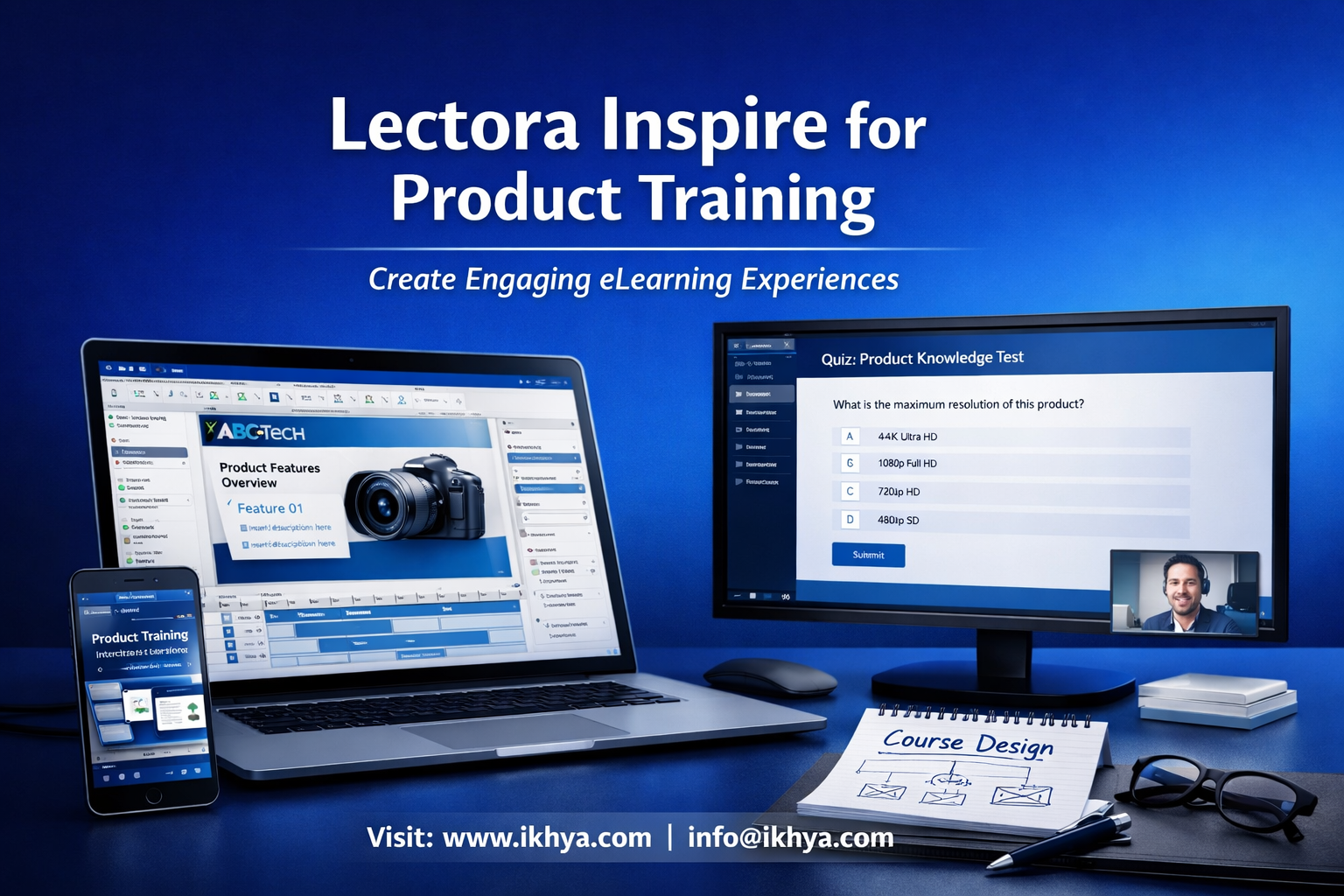
Lectora Inspire for Product Training

Product knowledge directly impacts sales performance, customer satisfaction, and operational accuracy. Yet many organizations struggle to deliver consistent product training across global teams, partners, and customers. Enterprise learning teams increasingly rely on modern eLearning authoring tools like Lectora Inspire to build scalable, interactive product training programs that can be deployed across LMS platforms worldwide.
Organizations launching new products, managing complex product lines, or training distributed sales teams need training solutions that are flexible, interactive, and easy to update. Lectora Inspire enables enterprises to develop scenario-based learning, product simulations, and structured knowledge programs that scale across regions and devices.
Companies implementing enterprise product training programs often partner with specialized development providers to accelerate course production and maintain instructional quality. Organizations evaluating external expertise can Book a Free eLearning Demo to understand how enterprise product training programs are built and deployed effectively.
In this guide, we explore how enterprises use Lectora Inspire to design product training programs, integrate them with LMS systems, and scale learning across global teams.
Why Enterprises Use Lectora Inspire for Product Training
Lectora Inspire is widely used by enterprise learning teams because it supports complex instructional design, compliance-ready delivery, and scalable LMS integration. For organizations delivering product knowledge to sales teams, distributors, and support staff, Lectora offers flexibility that many authoring tools cannot match.
Product training often requires more than basic slide-based learning. Teams must explain product features, demonstrate workflows, simulate real scenarios, and test learner understanding through interactive assessments.
Lectora Inspire enables enterprises to deliver these learning experiences while maintaining compatibility with enterprise learning systems.
The Complexity of Modern Product Training
Product training programs must support multiple audiences across the enterprise. These audiences often include:
- Sales representatives
- Customer support teams
- Technical implementation specialists
- Distribution partners
- Field service engineers
Each group requires different levels of product knowledge.
For example:
| Audience | Training Focus |
|---|---|
| Sales teams | product value, differentiation, competitive positioning |
| Customer support | troubleshooting and feature explanations |
| Technical teams | product configuration and integrations |
| Channel partners | product messaging and deployment |
Managing training across these audiences requires flexible learning design and scalable technology.
Why Traditional Product Training Often Fails
Many organizations still rely on outdated training formats such as:
- long PowerPoint presentations
- instructor-led sessions with limited scalability
- static product documentation
- fragmented training content
These approaches create several challenges:
- knowledge gaps between global teams
- inconsistent messaging across regions
- poor learner engagement
- difficulty updating training when products evolve
Modern enterprise product training requires interactive learning environments where learners can explore product features, simulate real-world scenarios, and practice decision-making.
How Lectora Inspire Supports Enterprise Product Training
Lectora Inspire provides a set of capabilities that align well with enterprise product education strategies.
Key capabilities include:
Advanced interactivity
- scenario-driven learning
- product walkthrough simulations
- interactive knowledge checks
Flexible instructional design
- support for complex learning paths
- adaptive branching scenarios
- customizable UI layouts
Enterprise learning standards
Lectora supports major learning standards used in global LMS environments:
- SCORM
- xAPI
- AICC
- HTML5 delivery
This ensures product training programs integrate easily with corporate learning systems.
Organizations implementing enterprise-scale product training often rely on specialized development expertise to maximize the potential of the tool. Enterprises exploring this approach can evaluate Lectora eLearning Development Services to accelerate course production and ensure enterprise-level quality.
Key Capabilities of Lectora Inspire for Product Training Programs
Lectora Inspire enables enterprises to create interactive product training programs that combine simulations, branching scenarios, and data-driven assessments. Its compatibility with enterprise LMS platforms and support for global learning standards make it well suited for product training that must scale across large workforces, partners, and distributed teams.
Unlike basic slide-based eLearning tools, Lectora supports advanced interaction models that help employees understand complex products, technical workflows, and real customer scenarios.
Advanced Interactivity for Product Demonstrations
Product training becomes far more effective when learners can see and practice how a product works rather than simply read about it.
Lectora Inspire supports interactive demonstrations such as:
- clickable product interfaces
- guided feature walkthroughs
- product configuration simulations
- decision-based scenarios
For example, a software company launching a new SaaS platform may build a simulation where learners:
- Configure a product feature
- Troubleshoot a customer issue
- Choose the correct solution
This approach improves retention and prepares employees for real-world customer conversations.
Many organizations combine such simulations with scenario-based training frameworks, which are often designed by instructional specialists. Enterprises looking to implement these learning experiences can explore instructional design services that help transform product documentation into structured learning journeys.
Scenario-Based Product Learning
Scenario-based learning is one of the most effective instructional design methods for product training.
Instead of presenting static product information, the course places learners in realistic product usage situations.
Example scenarios may include:
- a sales representative pitching a product to a client
- a support engineer diagnosing a product issue
- a technician configuring a system installation
Learners must make decisions that influence the outcome of the scenario.
Benefits of this approach include:
- improved product knowledge retention
- better decision-making skills
- stronger customer interaction readiness
Scenario-based learning is widely used across enterprise training programs in the USA and UK, particularly in regulated sectors such as financial services and healthcare where product knowledge must meet strict compliance standards.
SCORM, xAPI, and LMS Compatibility
Enterprise product training programs must integrate seamlessly with corporate learning systems.
Lectora Inspire supports major industry standards used in enterprise LMS deployments:
| Learning Standard | Purpose |
|---|---|
| SCORM | Standard tracking of course completion and assessment results |
| xAPI | Advanced learning analytics and learner behavior tracking |
| AICC | Legacy LMS compatibility |
| HTML5 | Cross-device learning delivery |
These standards allow organizations to:
- track learner progress
- measure product knowledge performance
- integrate training with HR systems
Global companies often use LMS platforms such as:
- Cornerstone OnDemand
- Docebo
- SAP SuccessFactors
- Moodle
- Totara
When developing product training for these platforms, compatibility becomes essential. Enterprises building LMS-ready training content frequently work with providers specializing in LMS-compatible eLearning course development services to ensure smooth deployment and tracking.
Multi-Device Learning Delivery
Product training increasingly happens outside traditional office environments.
Sales teams, field engineers, and partners often access training using:
- tablets
- mobile phones
- laptops
Lectora Inspire supports responsive design and HTML5 publishing, allowing courses to run across devices.
This capability is particularly important for industries such as:
- manufacturing
- oil and gas
- aviation
- field service operations
For example, field engineers servicing industrial equipment may access product training modules directly from a tablet while onsite.
Enterprises deploying mobile-friendly training programs often combine Lectora courses with mobile learning development solutions to ensure training remains accessible wherever employees work.
Scalable Content Reusability
One major challenge in product training is frequent product updates.
New features, product versions, and regulatory changes require training content to be updated quickly.
Lectora Inspire allows developers to:
- reuse course templates
- update modules independently
- maintain centralized content libraries
This approach reduces development time and ensures product training remains accurate as products evolve.
Organizations launching new products frequently must convert large volumes of documentation, presentations, and manuals into interactive learning. Enterprises looking to streamline this process often leverage PPT to eLearning conversion services to transform existing product content into engaging training programs.
Types of Product Training Programs Built Using Lectora Inspire
Lectora Inspire is used across industries to build multiple types of enterprise product training programs. Its flexibility allows organizations to design courses that support sales enablement, customer support training, and technical implementation guidance.
Each program type requires different instructional approaches and levels of technical detail.
Sales Product Knowledge Training
Sales teams require a deep understanding of product features, benefits, and competitive positioning.
Lectora-based sales training programs typically include:
- product value propositions
- competitor comparisons
- pricing models
- use case demonstrations
Interactive learning modules allow sales teams to practice real customer conversations and refine their product messaging.
In industries such as software and financial services, organizations in the United States often deploy structured product certification programs for sales teams to ensure consistent messaging across regions.
Customer Support Product Training
Customer support teams must understand products at a deeper operational level.
Training programs for support teams focus on:
- troubleshooting workflows
- feature explanations
- customer issue resolution
- product configuration guidance
Lectora Inspire enables developers to build interactive troubleshooting scenarios where learners diagnose product issues and choose appropriate solutions.
This type of learning approach is widely used in UK and Australian enterprise support centers where structured support training is required to maintain service quality standards.
Technical Product Training
Technical product training is common in industries that involve complex systems or equipment.
Examples include:
- medical devices
- industrial equipment
- enterprise software platforms
- aviation systems
These courses may include:
- system architecture explanations
- configuration procedures
- installation simulations
- troubleshooting exercises
Organizations operating in regulated sectors often integrate these courses with compliance frameworks to ensure employees follow approved procedures.
Many companies also enhance technical training using simulation-based learning environments, which can be developed through eLearning simulation-based training services to replicate real operational workflows.
Distributor and Partner Training
Global organizations frequently rely on external partners to sell and support their products.
These partners may include:
- distributors
- channel resellers
- franchise operators
- implementation consultants
Ensuring these partners understand the product is critical to maintaining brand reputation.
Lectora Inspire supports the creation of partner certification programs that include:
- modular learning paths
- certification assessments
- LMS tracking
This approach allows enterprises to train large partner ecosystems efficiently while maintaining consistent product messaging across global markets.
Instructional Design Strategies for Effective Product Training
Effective product training is not just about presenting features. It must help learners understand how products solve real problems, how to explain them to customers, and how to use them correctly in operational environments. Instructional design frameworks ensure that product knowledge training is structured, engaging, and measurable across enterprise learning ecosystems.
Organizations implementing enterprise training programs typically combine instructional design methodologies with scalable authoring tools like Lectora. This allows them to create product training that supports both knowledge acquisition and real-world application.
Scenario-Based Product Learning
Scenario-based learning places employees in realistic product usage situations where they must make decisions.
Instead of memorizing product features, learners apply knowledge in context.
Typical scenario formats include:
- customer consultation simulations
- product troubleshooting cases
- product configuration workflows
- sales negotiation exercises
Example:
A medical device company may design a scenario where a hospital technician must choose the correct configuration settings for equipment installation.
Benefits of scenario-based product learning:
- improves real-world application of knowledge
- strengthens decision-making skills
- increases learner engagement
This approach is widely used in enterprise learning programs across U.S. healthcare and financial services sectors, where employees must understand complex product systems before interacting with customers.
Product Simulation Training
Simulation-based training allows employees to practice using products in a controlled environment.
Simulations can include:
- software interface walkthroughs
- product setup simulations
- technical system configuration exercises
- troubleshooting workflows
For example:
A software company launching a new CRM platform might build a course where learners:
- configure customer data
- create reports
- resolve simulated system errors
Simulation-based learning significantly improves retention because learners practice tasks instead of just reading instructions.
Organizations implementing these training models frequently use eLearning simulation-based training services to design interactive product environments that replicate real workflows.
Microlearning for Product Knowledge
Modern product lines evolve quickly. Training programs must therefore deliver knowledge in short, easily updated modules.
Microlearning divides product knowledge into focused lessons such as:
- product feature overview
- product comparison
- troubleshooting steps
- configuration guidance
Advantages of microlearning include:
- faster course development
- easier updates when products change
- higher completion rates among employees
For distributed teams such as sales representatives and field engineers, microlearning modules are often deployed through mobile platforms. Enterprises adopting this strategy frequently implement microlearning development services to deliver concise product knowledge programs.
Reinforcement and Learning Analytics
Training programs are most effective when they measure learning outcomes and reinforce knowledge over time.
Enterprise product training programs often include:
- knowledge assessments
- product certification exams
- follow-up reinforcement modules
- learning analytics dashboards
Using standards such as xAPI, organizations can track detailed learning behavior including:
- learner decision paths
- time spent on product modules
- scenario outcomes
These analytics help learning teams identify knowledge gaps and training effectiveness, allowing them to refine training strategies.
Enterprise LMS Integration for Lectora Product Training
Enterprise product training programs must integrate seamlessly with corporate learning systems. LMS integration enables organizations to track training completion, measure knowledge performance, and manage large-scale global training deployments.
Lectora Inspire supports widely adopted learning standards and can integrate with most enterprise LMS platforms used by global organizations.
SCORM and xAPI Tracking
Two standards dominate enterprise LMS integrations:
| Standard | Purpose |
|---|---|
| SCORM | Tracks course completion, scores, and learning progress |
| xAPI | Tracks advanced learner behavior and performance analytics |
SCORM is still widely used in enterprise learning environments, while xAPI provides deeper insights into learner behavior.
For example, xAPI can track:
- which product simulation paths learners take
- which product features cause confusion
- how long learners spend on troubleshooting exercises
These insights help learning teams improve product training effectiveness.
LMS Deployment Models
Enterprises typically deploy product training through one of the following LMS models:
Corporate LMS
Used to train internal employees such as sales teams, support staff, and engineers.
Partner LMS
Used to train distributors, resellers, and implementation partners.
Customer education platforms
Used to train customers on product usage and onboarding.
Lectora courses can be published and deployed across these systems without significant modification.
Organizations implementing LMS-based training programs often rely on LMS-compatible eLearning course development services to ensure courses meet enterprise LMS standards.
Integration with HR and Talent Systems
Enterprise LMS platforms often connect with HR systems to automate training assignments.
Common integrations include:
- employee onboarding systems
- performance management platforms
- certification tracking tools
For example, new sales representatives may automatically receive product training courses during onboarding.
This ensures employees receive required training without manual intervention.
Learning Analytics and Performance Tracking
Learning analytics allow enterprises to measure how product training impacts performance.
Key metrics often tracked include:
- training completion rates
- assessment scores
- product certification results
- learner engagement metrics
These insights allow organizations to identify which product knowledge areas require additional reinforcement.
Many enterprises now combine LMS analytics with learning experience platforms (LXPs) and data dashboards to create advanced learning ecosystems.
Rapid Product Training Development Using Lectora Inspire
Product training must often be developed quickly, especially during product launches, software updates, or regulatory changes. Rapid development strategies allow organizations to convert existing product documentation into interactive eLearning programs without long development cycles.
Lectora Inspire supports rapid development workflows that help enterprises produce scalable training programs efficiently.
Converting Product Documentation into eLearning
Many companies already have product documentation in formats such as:
- PowerPoint presentations
- PDF manuals
- product specification documents
- internal training materials
Instead of creating training from scratch, these materials can be transformed into interactive courses.
Common conversion workflows include:
| Source Content | Converted Training Format |
|---|---|
| PowerPoint product presentations | interactive product training modules |
| PDF product manuals | microlearning knowledge modules |
| product documentation | scenario-based training |
Organizations implementing this approach often rely on convert PowerPoint to eLearning: a complete guide to streamline the transformation of existing product materials into structured learning programs.
Product Launch Training Acceleration
When companies launch new products, they must train:
- sales teams
- support teams
- partners
- implementation specialists
This training must often be deployed within weeks of the product launch.
Rapid development frameworks typically include:
- product knowledge analysis
- course storyboard development
- rapid course prototyping
- LMS deployment
By using reusable templates and modular course structures, Lectora allows organizations to deliver product training quickly while maintaining instructional quality.
Rapid Updates for Evolving Product Lines
Product training programs require frequent updates as products evolve.
For example:
- new software features
- updated compliance requirements
- new hardware configurations
Lectora supports modular course architecture, allowing developers to update individual modules instead of entire courses.
This reduces maintenance effort and ensures training remains current.
Enterprises implementing ongoing product training updates often combine Lectora development with rapid eLearning development services to maintain scalable and efficient training production.
Lectora Inspire vs Other Authoring Tools for Product Training
Choosing the right authoring tool is a critical decision for enterprise learning teams. Product training often requires complex simulations, detailed workflows, multi-language deployment, and LMS compatibility. While Lectora Inspire is widely used for enterprise training, organizations frequently evaluate it against tools like Articulate Storyline and Adobe Captivate.
Each tool has strengths depending on the complexity of the product, the level of interactivity required, and the enterprise learning ecosystem.
Lectora vs Articulate Storyline
Articulate Storyline is one of the most widely used authoring tools for corporate training. It is known for its intuitive interface and strong community support.
However, Lectora Inspire offers advantages when building large-scale enterprise training programs.
| Feature | Lectora Inspire | Articulate Storyline |
|---|---|---|
| Customization flexibility | Very high | Moderate |
| Advanced scripting | Strong | Limited |
| Large course management | Strong | Moderate |
| Responsive design | Supported | Requires additional design adjustments |
| Enterprise compliance training | Strong | Moderate |
Lectora is particularly useful when:
- courses require complex branching
- enterprise LMS environments require customization
- accessibility standards must be strictly followed
Organizations comparing these tools can explore a deeper comparison in Articulate Storyline vs Adobe Captivate: Which Tool Is Better to understand how different tools perform across enterprise training scenarios.
Lectora vs Adobe Captivate
Adobe Captivate is commonly used for software simulations and system training.
It performs well for:
- screen recordings
- application walkthroughs
- system simulation training
However, Lectora Inspire often provides greater flexibility for complex enterprise course structures and content management.
| Capability | Lectora Inspire | Adobe Captivate |
|---|---|---|
| Course architecture control | Excellent | Moderate |
| Software simulation | Moderate | Excellent |
| Complex branching scenarios | Excellent | Moderate |
| Enterprise scalability | Strong | Moderate |
| Custom interface design | Strong | Limited |
Many organizations choose tools based on training needs. For example:
- software simulation training → Captivate
- complex product training ecosystems → Lectora
Enterprises evaluating these tools sometimes consult detailed tool comparison frameworks such as Best eLearning Authoring Tools for Corporate Training.
When Lectora Inspire Is the Best Choice
Lectora Inspire is particularly suitable for enterprise product training when organizations require:
- highly customizable learning experiences
- structured training architectures for large product lines
- strict accessibility compliance
- LMS integration across global teams
- long-term course maintenance and updates
For companies building large product knowledge programs, working with specialized development partners can significantly accelerate implementation.
Organizations evaluating this option can review Lectora eLearning Development Services to understand how enterprise training teams scale course development.
Enterprise Product Training Use Cases Across Industries
Product training requirements vary significantly across industries. Some sectors focus on technical product configuration, while others emphasize sales enablement and compliance knowledge.
Lectora Inspire is used across industries because it supports complex instructional design and scalable course deployment.
Healthcare Product Training
Healthcare organizations must train professionals on medical devices, pharmaceutical products, and clinical systems.
These programs often include:
- regulatory compliance training
- equipment usage simulations
- patient safety procedures
For example, hospitals in the United States frequently deploy structured product training programs for medical device technicians to ensure proper equipment usage and compliance with safety regulations.
Manufacturing Equipment Training
Manufacturing companies must train employees on industrial machinery, production systems, and safety procedures.
Training programs often include:
- equipment configuration simulations
- troubleshooting workflows
- safety compliance procedures
Lectora-based simulations can replicate machine operation processes to prepare employees before they interact with real equipment.
Financial Product Training
Financial institutions frequently introduce new products such as:
- investment services
- insurance products
- digital banking platforms
Employees must understand both product features and regulatory guidelines.
In the United Kingdom, financial organizations often integrate product training with compliance frameworks aligned with Financial Conduct Authority (FCA) standards.
Training modules help employees explain financial products accurately while maintaining regulatory compliance.
Software Product Training
Software companies rely heavily on structured product training for:
- sales enablement
- customer onboarding
- partner certification programs
These training programs may include:
- product interface walkthroughs
- configuration exercises
- troubleshooting simulations
Many global SaaS companies deploy these programs through enterprise LMS platforms integrated with customer education portals.
Outsourcing Lectora Product Training Development
Developing enterprise product training programs internally can require significant resources. Many organizations therefore choose to outsource eLearning development to specialized partners who can provide instructional design expertise, development capacity, and technology knowledge.
Outsourcing enables enterprises to scale training programs without building large internal development teams.
Organizations evaluating outsourcing strategies can explore eLearning Outsourcing Guide for Enterprises to understand how outsourcing models work in corporate learning environments.
When Enterprises Should Outsource Product Training Development
Enterprises often outsource training development in situations such as:
- large product launches requiring rapid training deployment
- internal teams lacking instructional design expertise
- global training rollouts requiring localization
- LMS integration challenges
Outsourcing can significantly accelerate course production and reduce the burden on internal training teams.
Cost vs Internal Development
Enterprises evaluating outsourcing often compare internal development with external partnerships.
| Factor | In-House Development | Outsourced Development |
|---|---|---|
| Development cost | High staffing cost | Flexible project cost |
| Development speed | Slower for large projects | Faster with dedicated teams |
| Expertise availability | Limited to internal team | Access to specialists |
| Scalability | Difficult to scale quickly | Easily scalable |
Companies exploring cost comparisons can review In-house vs Outsourced eLearning Development Cost Comparison to evaluate the financial implications of different development models.
Benefits of Working With Specialized eLearning Vendors
Specialized eLearning vendors provide advantages such as:
- experienced instructional designers
- dedicated development teams
- LMS integration expertise
- scalable production workflows
For enterprises managing multiple training initiatives, outsourcing often provides greater flexibility and faster course deployment.
How to Choose the Right Lectora eLearning Development Partner
Selecting the right development partner is an important decision for enterprise learning teams. A capable partner ensures training programs meet technical, instructional, and organizational requirements.
Enterprises evaluating vendors should consider the following criteria.
Vendor Evaluation Framework
When assessing eLearning vendors, organizations should evaluate:
- experience with enterprise training programs
- expertise in Lectora Inspire development
- instructional design capabilities
- LMS integration experience
- global deployment capability
A structured evaluation framework helps organizations select partners capable of delivering enterprise-scale training programs.
Many procurement teams use structured evaluation methods described in How to Choose the eLearning Vendor when selecting training partners.
Technical Capability Checklist
Before selecting a vendor, enterprises should confirm that the development partner can:
- develop SCORM and xAPI compatible courses
- integrate courses with enterprise LMS platforms
- build interactive simulations and scenarios
- implement accessibility standards such as WCAG
These technical capabilities ensure training programs function correctly across enterprise learning environments.
Global Deployment Capability
Large organizations must deploy product training across multiple regions.
Key considerations include:
- multilingual course development
- localization of content
- LMS deployment across global systems
Enterprises operating internationally often require partners capable of delivering training programs for global audiences.
Organizations evaluating long-term training partners may learn more about enterprise capabilities through About IKHYA eLearning Solutions Company.
Why Enterprises Partner with IKHYA for Product Training Development
Enterprise product training programs require a combination of instructional expertise, technical development capability, and scalable delivery infrastructure.
IKHYA supports organizations in designing and deploying enterprise training solutions tailored to complex product ecosystems.
Key capabilities include:
- custom product training course development
- scenario-based learning design
- LMS-compatible course production
- global training deployment
IKHYA works with organizations across industries to transform product documentation, technical manuals, and training materials into engaging learning programs.
Enterprises evaluating training partners can Request an eLearning RFP to discuss project requirements and explore customized product training solutions.
Implementation Framework for Enterprise Product Training Programs
Successfully implementing product training requires a structured development and deployment framework.
Organizations typically follow several key phases.
Product Training Needs Assessment
The first phase involves analyzing:
- product complexity
- target audiences
- learning objectives
- delivery environments
This assessment ensures training programs align with business goals.
Development Workflow
Enterprise training development typically follows this process:
- training strategy definition
- instructional design planning
- course prototyping
- development and testing
Structured development workflows ensure training programs remain consistent and scalable.
Pilot Deployment
Before global rollout, organizations often launch pilot programs to test:
- course usability
- LMS integration
- learner engagement
Feedback from pilot programs helps refine training before large-scale deployment.
Global Rollout Strategy
Once validated, product training programs are deployed globally.
Global rollout may involve:
- multi-language course development
- regional compliance adaptation
- localized training content
Enterprises operating across regions such as the UAE, UK, and Australia often adapt training to meet local workforce and regulatory requirements.
Future of Product Training in Enterprise Learning Ecosystems
Product training continues to evolve as organizations adopt modern learning technologies.
Future trends include:
- AI-assisted learning recommendations
- adaptive learning systems
- immersive simulations
- continuous learning ecosystems
These technologies will allow organizations to deliver more personalized and data-driven product training programs.
Conclusion
Product training plays a crucial role in helping organizations ensure employees, partners, and customers understand how to use and position their products effectively.
Tools like Lectora Inspire allow enterprises to create interactive, scalable training programs that support complex product ecosystems.
However, developing enterprise product training requires expertise in instructional design, LMS integration, and scalable course development.
Organizations looking to implement high-quality training programs can Contact IKHYA Experts to explore enterprise product training solutions tailored to their needs.
Frequently Asked Questions
1. What is Lectora Inspire used for in product training?
Lectora Inspire is used to create interactive eLearning courses that help employees understand product features, workflows, and real-world usage scenarios.
2. Is Lectora Inspire suitable for enterprise training programs?
Yes. It supports enterprise standards like SCORM and xAPI and integrates with most corporate LMS platforms.
3. Can Lectora courses integrate with LMS systems?
Yes. Lectora courses can be published as SCORM or xAPI packages for deployment in enterprise LMS environments.
4. What industries use Lectora for product training?
Healthcare, manufacturing, financial services, software, aviation, and retail sectors commonly use Lectora-based training programs.
5. Can Lectora support mobile learning?
Yes. Lectora publishes HTML5 courses that run on mobile devices, tablets, and desktops.
6. Is Lectora good for simulation-based learning?
Yes. It supports interactive simulations and branching scenarios used in product training.
7. What are the benefits of outsourcing Lectora development?
Outsourcing provides access to experienced instructional designers and developers while accelerating course production.
8. How long does it take to develop a product training course?
Development timelines vary but typically range from 4 to 8 weeks depending on course complexity.
9. What learning standards does Lectora support?
Lectora supports SCORM, xAPI, AICC, and HTML5 publishing formats.
10. Can Lectora courses be updated easily?
Yes. Modular course design allows developers to update specific sections without rebuilding entire courses.
11. Does Lectora support accessibility standards?
Yes. Lectora supports accessibility guidelines such as WCAG.
12. Can Lectora be used for compliance training?
Yes. It is commonly used for compliance and regulatory training programs.
13. What skills are required to develop Lectora courses?
Instructional design, multimedia development, scripting, and LMS integration skills are typically required.
14. How do organizations choose an eLearning vendor?
Organizations evaluate vendors based on experience, technical capabilities, and LMS integration expertise.
15. Can Lectora support multilingual training programs?
Yes. Courses can be localized for multiple languages and regions.
16. What is the difference between Lectora and Storyline?
Lectora provides more customization and control for complex enterprise learning environments.
17. How can companies train global partner networks?
They can deploy LMS-based certification programs accessible to distributors and partners worldwide.
18. Is product training important for sales teams?
Yes. Strong product knowledge improves sales performance and customer engagement.
19. Can product documentation be converted into eLearning?
Yes. Existing materials such as PowerPoint and manuals can be transformed into interactive courses.
20. How can organizations start implementing product training programs?
They can begin by assessing training needs and working with experienced development partners.
Related Resources
The following resources provide deeper insights into enterprise eLearning development, outsourcing strategies, and authoring tool selection.