
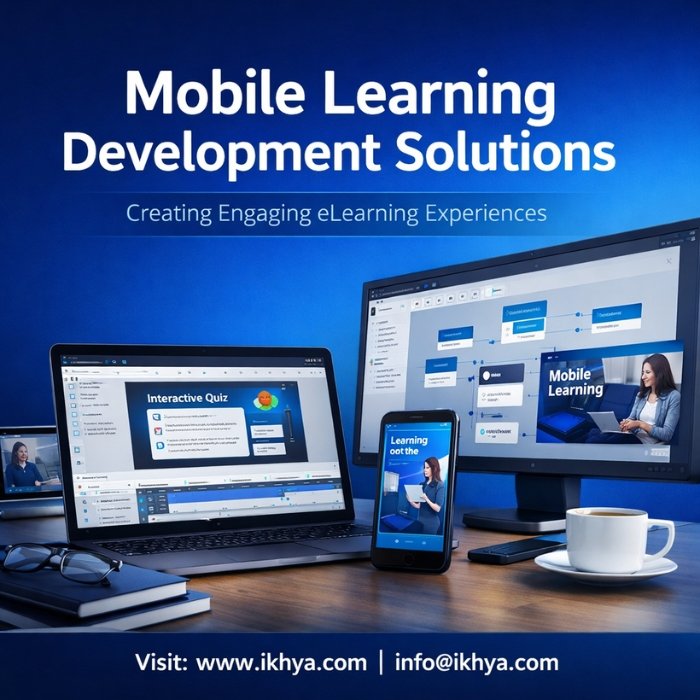


Mobile Learning Development Solutions
Modern workforces rely heavily on smartphones and tablets to access information. Traditional training programs often fail because employees cannot access learning at the moment they need it. Mobile learning solves this problem by delivering on-demand training directly to employees’ devices, improving engagement and knowledge retention.
IKHYA – eLearning Solutions Company develops enterprise-grade mobile learning solutions designed for global workforces, LMS platforms, and scalable corporate training programs.
Request a proposal or schedule a consultation at info@ikhya.com
Get a Free eLearning Consultation / Proposal
Organizations planning mobile learning initiatives often face several strategic questions:
- Should training be fully mobile or responsive across devices?
- Will courses work with an existing LMS or LXP platform?
- How should training be structured for short attention spans on mobile devices?
- What is the development cost per module?
- How long will the project take?
IKHYA provides consultation-driven mobile learning development to help enterprises design scalable and effective mobile training programs.
During the consultation, our experts evaluate:
Training Objectives
We identify the business problem your training must solve. This may include:
- employee onboarding
- sales enablement
- compliance training
- product training
- software adoption
Workforce Environment
Mobile learning strategies vary depending on the workforce.
Examples:
- Retail workforce accessing training on smartphones during shifts
- Healthcare professionals reviewing quick learning modules between procedures
- Sales teams accessing product knowledge on tablets during client meetings
Understanding the learner environment helps design mobile-first training experiences.
Existing Learning Infrastructure
We review the organization’s current learning ecosystem, including:
- Learning Management Systems (LMS)
- Learning Experience Platforms (LXP)
- Digital adoption platforms
- Internal training content
Mobile learning courses must integrate with systems that support standards such as:
- SCORM
- xAPI
- WCAG accessibility guidelines
Recommended Mobile Learning Strategy
Based on the analysis, IKHYA proposes a structured development roadmap including:
- learning format recommendations
- module length
- mobile interaction types
- technology stack
- development timeline
- estimated project cost
Organizations can then make informed decisions before launching a full development project.
If your organization is planning a mobile learning initiative, you can request a consultation or submit an RFP.
Contact:
IKHYA – eLearning Solutions Company
Email: info@ikhya.com
What is Mobile Learning Development
Mobile learning development refers to the process of designing and building training programs optimized for smartphones and tablets. These courses allow employees to access learning content anytime and anywhere, making training more flexible for modern workforces.
Mobile learning programs are typically delivered through Learning Management Systems (LMS) or Learning Experience Platforms (LXP) and are developed using responsive eLearning technologies that adapt to different screen sizes.
Organizations use mobile learning to support:
- workforce training
- sales enablement
- compliance education
- product training
- software adoption
Unlike traditional desktop-based eLearning, mobile learning focuses on short, interactive learning experiences that can be completed quickly during work breaks or while traveling.
Many organizations combine mobile learning with microlearning strategies, where training content is delivered in small, focused modules lasting 3–7 minutes.
This approach improves knowledge retention and learner engagement.
Definition of Mobile Learning
Mobile learning (mLearning) is a digital learning approach that enables employees to access training content through mobile devices such as smartphones and tablets.
Key characteristics include:
- responsive course design
- short learning modules
- touch-friendly interactions
- offline accessibility
- mobile performance tracking
Modern mobile learning programs also support analytics through xAPI and LMS reporting, allowing organizations to measure learner progress and training effectiveness.
How Mobile Learning Works in Corporate Training
In enterprise environments, mobile learning courses are integrated into a company’s digital learning ecosystem.
A typical mobile learning workflow includes:
1. Content Development
Training materials are converted into interactive mobile learning modules using tools such as:
- Articulate Storyline
- Adobe Captivate
- Lectora Inspire
- iSpring Suite
One of the most widely used tools for interactive mobile learning development is Articulate Storyline, which supports responsive course delivery across smartphones, tablets, and desktop environments.
2. LMS Integration
Courses are published in formats compatible with corporate systems, including:
- SCORM
- xAPI
3. Mobile Access
Employees can access courses through:
- LMS mobile apps
- web-based learning portals
- internal employee training platforms
4. Learning Analytics
Managers track training performance using LMS dashboards that measure:
- course completion
- learner progress
- assessment scores
- engagement metrics
This structured approach helps organizations scale mobile learning programs across global teams and distributed workforces.
Difference Between Mobile Learning and Traditional eLearning
Although both are digital learning formats, mobile learning is designed specifically for short attention spans and on-the-go access.
| Feature | Mobile Learning | Traditional eLearning |
|---|---|---|
| Device | Smartphones and tablets | Desktop computers |
| Module length | 3–7 minutes | 20–60 minutes |
| Design | Mobile-first responsive design | Desktop-focused layouts |
| Interaction | Touch gestures, swipe interactions | Mouse and keyboard |
| Accessibility | Anytime, anywhere | Typically accessed during scheduled training |
For industries with mobile workforces, mobile learning offers significant advantages.
Examples include:
- field technicians accessing troubleshooting guides
- healthcare professionals reviewing procedures
- sales teams learning about new products before client meetings
- retail employees completing training during shift breaks
These use cases explain why many organizations are investing heavily in mobile-first corporate training strategies.
Why Organizations Need Mobile Learning Development
Modern organizations operate with distributed teams, mobile employees, and fast-changing knowledge requirements. Traditional classroom training and long desktop-based eLearning courses often fail to support employees who need instant access to information while working.
Mobile learning development helps organizations deliver training that employees can access anytime, anywhere, on any device. This approach supports modern workforce behavior where employees rely heavily on smartphones for information and communication.
For enterprises, mobile learning is no longer optional. It has become an essential part of digital workforce transformation.
Mobile Workforce Training
Many industries rely on employees who work outside traditional office environments. These employees cannot always access desktop-based training systems.
Examples include:
- retail staff
- field technicians
- construction workers
- healthcare professionals
- sales teams
Mobile learning allows organizations to deliver training directly to smartphones and tablets, enabling employees to learn during work breaks or between tasks.
Example – USA Retail Training
Industry: Retail
Project Scope: Mobile onboarding training for store associates
Modules: 25 microlearning modules
Module Duration: 3–5 minutes each
Timeline: 8 weeks
Estimated Cost: $35,000 – $60,000
Employees could access training through a mobile LMS application, improving onboarding efficiency across hundreds of stores.
Just-In-Time Learning
In many industries, employees need quick answers rather than long training sessions.
Mobile learning supports just-in-time training, where employees access learning content exactly when needed.
Examples:
- A technician reviewing troubleshooting steps before repairing equipment
- A nurse checking updated safety procedures
- A salesperson reviewing product features before a meeting
Short mobile modules allow employees to quickly refresh knowledge without interrupting their workflow.
Example – UK Healthcare Compliance Training
Industry: Healthcare
Project Scope: Mobile compliance training for clinical staff
Modules: 18 mobile modules
Duration per module: 4–6 minutes
Timeline: 6 weeks
Estimated Cost: $28,000 – $50,000
Healthcare professionals accessed the modules on tablets during shift transitions.
Global Workforce Accessibility
Large organizations often operate across multiple countries and time zones. Scheduling classroom training for global teams can be expensive and difficult.
Mobile learning enables organizations to deliver training consistently across global teams.
Benefits include:
- standardized training content
- multilingual learning modules
- faster training rollout
- scalable employee development programs
Example – Australia Construction Safety Training
Industry: Construction
Project Scope: Mobile safety training for site workers
Modules: 15 scenario-based modules
Duration per module: 5 minutes
Timeline: 7 weeks
Estimated Cost: $22,000 – $40,000
Workers accessed safety training on smartphones before entering construction sites.
Supporting Remote and Hybrid Work
Many organizations now operate with remote or hybrid teams. Employees may work from home, client sites, or different regional offices.
Mobile learning ensures employees can continue training regardless of location.
Example – UAE Oil & Gas Workforce Training
Industry: Oil & Gas
Project Scope: Mobile operational training for field engineers
Modules: 20 interactive modules
Duration per module: 6 minutes
Timeline: 8–10 weeks
Estimated Cost: $40,000 – $70,000
Engineers used mobile training modules to review operational procedures before working on equipment.
Mobile learning development enables organizations to create flexible, scalable, and accessible training programs that match the needs of modern employees.
Companies investing in mobile learning often experience improvements in:
- employee engagement
- training completion rates
- knowledge retention
- workforce productivity
Benefits of Mobile Learning for Enterprises
Mobile learning offers several advantages for organizations that want to train employees efficiently across distributed teams. By delivering training through smartphones and tablets, companies can create flexible and scalable learning programs that match modern work environments.
Below are some of the key benefits enterprises experience when implementing mobile learning solutions.
Higher Learner Engagement
Traditional training programs often struggle to maintain learner attention. Long courses and complex interfaces reduce engagement.
Mobile learning improves engagement by using:
- short learning modules
- interactive scenarios
- touch-based interactions
- multimedia elements such as videos and animations
Employees can complete training in 3–7 minute sessions, making learning easier to fit into busy schedules.
Shorter learning sessions also align well with microlearning strategies, which improve knowledge retention.
Improved Knowledge Retention
Mobile learning allows employees to revisit training content whenever needed. This repeated exposure improves long-term memory retention.
Many mobile learning programs use:
- spaced learning techniques
- scenario-based exercises
- quick assessments
- knowledge reinforcement modules
Instructional design frameworks such as Bloom’s Taxonomy help structure content so learners move from basic knowledge to practical application.
Organizations often measure learning effectiveness using the Kirkpatrick Model, which evaluates:
- learner reaction
- knowledge acquisition
- behavior change
- business results
Training Accessibility Across Devices
Mobile learning courses are built using responsive design, ensuring compatibility with different screen sizes.
Employees can access courses on:
- smartphones
- tablets
- laptops
- desktop computers
Training programs can also support offline learning, allowing employees in remote environments to download content and access it without internet connectivity.
Once the device reconnects to the LMS, learning data can be synchronized automatically.
Faster Training Deployment
Mobile learning modules are typically shorter and easier to develop compared to large traditional courses.
This allows organizations to:
- deploy training faster
- update content easily
- respond quickly to regulatory changes
For example, compliance updates can be delivered as quick mobile learning modules rather than full-length training programs.
Scalable Workforce Training
Mobile learning enables organizations to deliver training across large global workforces.
Training can be rolled out simultaneously across multiple regions without requiring travel or classroom logistics.
Companies can scale training programs to support:
- employee onboarding
- product training
- safety training
- compliance education
- leadership development
Because courses are delivered through LMS platforms using standards like SCORM and xAPI, organizations can track training performance across thousands of employees.
Real Enterprise Mobile Learning Project Examples
The following examples illustrate how enterprises implement mobile learning programs to train their workforce.
Retail Sales Training Mobile Program
Industry: Retail
Client: Global Retail Chain
Project Scope
- Mobile training for store associates
- Product knowledge training modules
- Customer interaction simulations
Training Format
- 30 mobile microlearning modules
- 4–6 minutes per module
- Interactive quizzes and scenarios
Timeline
10 weeks
Estimated Cost
$45,000 – $75,000
Outcome
- Faster employee onboarding
- Improved product knowledge among sales staff
- Increased customer service consistency across retail locations
Healthcare Compliance Mobile Training
Industry: Healthcare
Client: Hospital Network
Project Scope
- Compliance training for medical staff
- Mobile modules covering patient safety protocols
Training Format
- 20 mobile learning modules
- Scenario-based learning interactions
- Knowledge check quizzes
Timeline
6–8 weeks
Estimated Cost
$30,000 – $55,000
Outcome
- Improved compliance training completion rates
- Easier access to updated regulatory information
Manufacturing Safety Training
Industry: Manufacturing
Client: Global Manufacturing Company
Project Scope
- Safety training for factory workers
- Mobile learning modules accessible on smartphones
A real-world example of manufacturing safety training using eLearning demonstrates how mobile training programs can improve worker safety and operational efficiency.
Training Format
- 15 safety training modules
- 5-minute mobile learning sessions
- Visual demonstrations and interactive simulations
Timeline
7 weeks
Estimated Cost
$25,000 – $45,000
Outcome
- Faster safety training rollout across multiple factories
- Reduced workplace incidents
Sales Enablement Mobile Training
Industry: Technology
Project Scope
- Mobile learning for global sales teams
- Product feature training and competitive positioning
Training Format
- 18 mobile modules
- Scenario-based sales conversations
- Product comparison tools
Timeline
8 weeks
Estimated Cost
$35,000 – $60,000
Outcome
- Sales representatives accessed training before client meetings
- Faster product knowledge adoption across global teams
Mobile learning development enables organizations to deliver scalable, flexible, and engaging training programs that support modern workforce needs.
IKHYA Mobile Learning Development Process
Developing effective mobile learning solutions requires more than simply converting desktop courses into smaller screens. Mobile learning must be designed specifically for mobile user behavior, shorter attention spans, and touch-based interactions.
IKHYA follows a structured development methodology based on the ADDIE instructional design framework, ensuring that mobile learning programs are aligned with business objectives and learner needs.
The process includes five key stages.
Analysis
The first step focuses on understanding the organization’s training goals, workforce environment, and technical infrastructure.
During this phase, IKHYA evaluates:
- training objectives
- target learner profiles
- device usage patterns
- LMS compatibility requirements
- existing training content
- regulatory or compliance requirements
This stage helps determine whether the mobile learning program should include:
- microlearning modules
- scenario-based training
- software simulations
- video-based training
- interactive assessments
The outcome of this stage is a mobile learning strategy document that defines the project scope and development roadmap.
Instructional Design
Once the strategy is defined, instructional designers create the learning architecture.
This phase focuses on structuring the course to maximize engagement and knowledge retention.
Instructional design includes:
- defining learning objectives
- creating storyboards and scripts
- designing mobile-friendly interactions
- structuring assessments
Designers apply proven learning frameworks such as:
Bloom’s Taxonomy
This model ensures learners progress from:
- remembering information
- understanding concepts
- applying knowledge in scenarios
Microlearning Design Principles
Courses are divided into short modules lasting 3–7 minutes, which are ideal for mobile devices.
This stage also ensures the course design is optimized for:
- vertical mobile screens
- swipe gestures
- touch interactions
- short attention spans
Development
During development, the learning content is transformed into interactive mobile learning modules.
IKHYA developers build the course using industry-standard authoring tools such as:
- Articulate Storyline
- Adobe Captivate
- Lectora Inspire
- iSpring Suite
The development stage includes:
- interface design
- interactive elements
- multimedia integration
- animation and visual storytelling
- quiz and assessment development
Courses are built using responsive design techniques so they function seamlessly across smartphones, tablets, and desktops.
Quality Assurance
Before deployment, the mobile learning modules go through a detailed testing process.
Quality assurance checks include:
- device compatibility testing
- screen resolution optimization
- LMS integration testing
- SCORM and xAPI tracking validation
- usability testing across multiple mobile devices
Accessibility is also verified to comply with WCAG accessibility standards, ensuring courses are usable by learners with disabilities.
Deployment
After final approval, courses are published and deployed through the organization’s learning systems.
Deployment includes:
- LMS or LXP integration
- SCORM or xAPI package publishing
- learner access configuration
- performance tracking setup
Organizations can track training effectiveness using learning analytics dashboards, which monitor:
- course completion rates
- learner engagement
- assessment performance
- behavioral impact
Training effectiveness can also be evaluated using the Kirkpatrick Model, which measures how training influences employee behavior and business outcomes.
This structured process ensures that mobile learning programs developed by IKHYA – eLearning Solutions Company deliver measurable results while supporting enterprise-level scalability.
Technologies and Tools Used for Mobile Learning Development
Enterprise mobile learning solutions require the right combination of authoring tools, learning platforms, and interoperability standards. These technologies ensure that mobile courses work smoothly across devices, integrate with enterprise systems, and provide accurate learner analytics.
IKHYA develops mobile learning programs using industry-standard tools and technologies that support scalable corporate training.
eLearning Authoring Tools
Mobile learning modules are developed using professional authoring tools that support responsive design and interactive learning experiences.
Common tools include:
Articulate Storyline
One of the most widely used tools for building interactive eLearning. It supports:
- responsive player design
- interactive simulations
- scenario-based learning
- mobile compatibility
Adobe Captivate
Adobe Captivate is commonly used for creating:
- software simulation training
- responsive learning modules
- video-based learning experiences
It includes advanced features such as screen recording and interactive demonstrations.
Lectora Inspire
Lectora is often used for enterprise-level training projects that require:
- advanced customization
- accessibility compliance
- complex learning interactions
iSpring Suite
iSpring is frequently used for rapid eLearning and mobile learning development. It allows organizations to convert PowerPoint training into interactive mobile courses.
Learning Platforms
Mobile learning courses are typically delivered through enterprise learning platforms.
These platforms help organizations manage learners, track progress, and generate training analytics.
Common learning systems include:
Learning Management Systems (LMS)
LMS platforms manage course delivery, learner enrollment, and reporting. Mobile learning courses can be accessed through LMS web portals or mobile applications.
Learning Experience Platforms (LXP)
LXPs focus on personalized learning experiences. They recommend training content based on learner behavior and career development goals.
Digital Adoption Platforms
These platforms provide in-app guidance and training inside enterprise software systems.
Mobile learning content can complement digital adoption initiatives by providing short training modules for software usage.
eLearning Standards and Tracking
Corporate training systems require standardized formats so that learning content works across different platforms.
IKHYA develops mobile learning modules that comply with global eLearning standards.
SCORM
SCORM ensures that training courses communicate with LMS platforms. It allows organizations to track:
- course completion
- assessment scores
- learner progress
xAPI (Experience API)
xAPI enables advanced learning analytics by tracking a wider range of learner activities.
Examples include:
- video interactions
- simulation activities
- mobile learning engagement
This data helps organizations analyze learning behavior in greater detail.
WCAG Accessibility Standards
Accessibility compliance ensures training is usable for learners with disabilities.
WCAG guidelines support:
- screen reader compatibility
- keyboard navigation
- accessible visual design
Following these standards helps organizations meet global accessibility regulations.
By combining advanced authoring tools, modern learning platforms, and global eLearning standards, IKHYA delivers mobile learning solutions that are scalable, secure, and compatible with enterprise learning ecosystems.
Industries We Serve
Mobile learning is widely adopted across industries where employees need fast access to training while working in dynamic environments. Organizations use mobile learning to deliver training that supports compliance, operational efficiency, and workforce development.
IKHYA – eLearning Solutions Company develops mobile learning programs tailored to the unique requirements of various industries.
Healthcare
Healthcare professionals often work in high-pressure environments where accessing training quickly is essential.
Mobile learning enables hospitals and healthcare organizations to deliver:
- clinical procedure training
- patient safety protocols
- compliance and regulatory training
- equipment usage training
Doctors, nurses, and medical staff can access training modules on tablets or smartphones during shift changes or before performing procedures.
Mobile learning also allows organizations to rapidly update training content when medical guidelines change.
Manufacturing
Manufacturing companies often operate multiple facilities with large numbers of workers on factory floors.
Mobile learning programs help deliver:
- safety training
- equipment operation instructions
- quality control procedures
- maintenance guidelines
Workers can access quick training modules on smartphones before operating machinery or performing maintenance tasks.
This approach improves safety awareness and reduces operational errors.
Finance
Financial institutions must regularly train employees on:
- regulatory compliance
- fraud prevention
- data security practices
- product knowledge
Mobile learning enables banks and financial organizations to deliver short compliance training modules that employees can complete without disrupting daily work.
The ability to track learning progress through LMS systems also supports regulatory audits.
Construction
Construction workers often operate in remote job sites where traditional training access is limited.
Mobile learning supports construction training programs such as:
- workplace safety training
- equipment operation procedures
- hazard identification training
- regulatory compliance education
Workers can review safety procedures on mobile devices before starting work on construction sites.
This helps organizations reinforce safety practices and reduce workplace accidents.
Oil and Gas
The oil and gas industry requires continuous training to ensure safe operations.
Mobile learning allows organizations to deliver training on:
- operational procedures
- safety protocols
- environmental compliance
- equipment handling
Field engineers and technicians can access mobile learning modules even in remote locations, making training more accessible.
Aviation
Aviation organizations must maintain strict training standards for pilots, technicians, and ground staff.
Mobile learning supports training programs such as:
- aircraft maintenance procedures
- safety compliance training
- operational protocols
- customer service training for airline staff
Short mobile learning modules help aviation professionals review procedures before performing critical tasks.
Mobile learning solutions allow organizations across industries to deliver flexible, scalable, and accessible training programs that improve workforce performance.
Mobile Learning Psychology and Engagement Science
Effective mobile learning is not just about delivering content on smartphones. It is based on learning psychology and behavioral science that explain how people absorb and retain information.
Modern mobile learning programs use principles from cognitive science, microlearning theory, and behavioral learning models to improve engagement and knowledge retention.
Understanding how people learn on mobile devices helps organizations design training that is short, focused, and easy to remember.
Cognitive Load and Short Learning Sessions
Human working memory can only process a limited amount of information at a time. When training programs contain too much information, learners experience cognitive overload, which reduces learning effectiveness.
Mobile learning solves this challenge by delivering training in short and focused modules.
Typical mobile learning modules include:
- a single concept or skill
- short explanations
- quick interactive activities
- short assessments
Most mobile modules are designed to last 3–7 minutes, allowing learners to absorb information without mental fatigue.
This approach aligns well with microlearning strategies, which are proven to improve retention.
Spaced Learning Improves Memory Retention
Learning research shows that information is retained better when it is repeated over time.
This concept is known as spaced learning.
Mobile learning platforms allow organizations to deliver training in small sessions spread over multiple days or weeks.
For example:
Day 1 – Introduction to a concept
Day 3 – Scenario-based practice
Day 7 – Knowledge reinforcement quiz
This repetition strengthens long-term memory and helps employees apply knowledge more effectively.
Scenario-Based Learning Enhances Practical Skills
Mobile learning modules often include scenario-based exercises that simulate real workplace situations.
Instead of simply reading information, learners make decisions within realistic scenarios.
Examples include:
- a sales representative responding to customer objections
- a technician diagnosing equipment problems
- a healthcare worker following patient safety procedures
Scenario-based learning helps employees practice decision-making skills in a risk-free environment.
This improves real-world performance.
Mobile Learning Matches Modern Workforce Behavior
Employees today rely heavily on smartphones for communication, information, and work tasks.
Training programs that match this behavior are more likely to be completed.
Mobile learning supports modern learning habits such as:
- quick information searches
- short learning sessions
- on-demand training access
Because training is available anytime, employees are more likely to revisit content when they need to refresh their knowledge.
Engagement Through Interactive Learning
Mobile learning programs often include interactive features that improve learner engagement.
Examples include:
- touch-based interactions
- swipe navigation
- short quizzes
- gamified elements such as badges or points
These interactive features make learning more engaging compared to static training materials.
By combining learning psychology, microlearning strategies, and interactive design, mobile learning programs can significantly improve training effectiveness.
Organizations that implement well-designed mobile learning solutions often experience:
- higher course completion rates
- improved knowledge retention
- better employee performance
Why Choose IKHYA – eLearning Solutions Company
Selecting the right eLearning development partner is critical for organizations planning large-scale mobile learning initiatives. Enterprises need a vendor that understands instructional design, learning technologies, enterprise systems, and workforce training challenges.
IKHYA – eLearning Solutions Company delivers mobile learning solutions designed for global corporate training environments.
Our team combines instructional design expertise, modern learning technologies, and enterprise project experience to create training programs that deliver measurable results.
Enterprise-Level Experience
IKHYA has extensive experience developing learning solutions for organizations across multiple industries and regions.
Our experience includes:
- 300+ global clients
- 1000+ eLearning courses delivered
- 25+ years of combined industry experience
- 20+ industries served
This experience allows us to understand the unique training challenges organizations face in different industries.
Instructional Design Expertise
Our learning solutions are built using proven instructional design frameworks.
These include:
- ADDIE Model for structured course development
- Bloom’s Taxonomy for progressive learning outcomes
- Kirkpatrick Model for training effectiveness evaluation
These frameworks ensure that training programs are designed not just to deliver information, but to improve employee performance.
Mobile-First Learning Design
IKHYA develops courses using mobile-first design principles.
This means learning experiences are optimized for:
- smartphones
- tablets
- responsive learning environments
Mobile-first design improves learner engagement and ensures courses function smoothly across different devices.
LMS and Technology Integration
Enterprise training programs must integrate with existing learning platforms.
IKHYA develops mobile learning solutions compatible with:
- Learning Management Systems (LMS)
- Learning Experience Platforms (LXP)
- Digital adoption platforms
Courses are delivered using global standards such as:
- SCORM
- xAPI
This ensures training data can be tracked and analyzed effectively.
Scalable Development Capability
Organizations often need to develop dozens or hundreds of training modules across multiple departments.
Many organizations choose to outsource eLearning development to specialized vendors in order to scale training production while maintaining instructional quality.
IKHYA supports scalable development projects by providing:
- dedicated project managers
- instructional design teams
- multimedia developers
- quality assurance specialists
This structured development approach ensures projects are delivered on time and within scope.
Post-Deployment Support
Training programs must evolve as business processes and technologies change.
IKHYA provides ongoing support services including:
- course updates and revisions
- LMS integration support
- localization for global teams
- learning analytics optimization
This helps organizations maintain effective training programs over time.
By combining instructional design expertise, enterprise technology integration, and scalable development capabilities, IKHYA helps organizations implement successful mobile learning strategies.
Related eLearning Services
Organizations implementing mobile learning solutions often require additional services to support a complete digital learning ecosystem. These services help ensure training programs are instructionally effective, scalable, and compatible with enterprise learning platforms.
IKHYA – eLearning Solutions Company provides a wide range of eLearning development services that complement mobile learning initiatives.
Custom eLearning Development
Custom eLearning development focuses on creating tailored training programs designed specifically for an organization’s learning objectives and workforce needs.
These solutions often include:
- scenario-based learning modules
- interactive simulations
- compliance training programs
- leadership and management training
Custom eLearning programs can also be optimized for mobile learning delivery, allowing employees to access training across multiple devices.
Rapid eLearning Development
Rapid eLearning development is ideal for organizations that need to convert existing training materials into digital learning modules quickly.
This approach is commonly used for:
- converting classroom training into eLearning
- updating outdated training content
- delivering training for product launches or regulatory changes
Rapid development tools help reduce project timelines while maintaining instructional quality.
Instructional Design Services
Effective training requires strong instructional design.
IKHYA provides instructional design services that focus on:
- defining learning objectives
- structuring training content
- designing learner interactions
- creating assessments and knowledge checks
Instructional designers apply frameworks such as ADDIE and Bloom’s Taxonomy to ensure training programs support real learning outcomes.
Microlearning Development
Microlearning programs deliver training in short, focused modules that are ideal for mobile devices.
These modules typically last 3–7 minutes and focus on a single learning objective.
Microlearning is commonly used for:
- performance support training
- just-in-time learning
- reinforcement of complex concepts
Mobile learning initiatives often incorporate microlearning strategies to improve learner engagement.
LMS Integration Services
LMS integration ensures that eLearning courses work smoothly with corporate learning platforms.
IKHYA supports integration with:
- Learning Management Systems
- Learning Experience Platforms
- enterprise HR systems
Courses are published using standards such as SCORM and xAPI, enabling organizations to track learner progress and training effectiveness.
PowerPoint to eLearning Conversion
Many organizations already have PowerPoint training materials developed in PowerPoint.
IKHYA converts PowerPoint presentations into interactive eLearning modules with:
- multimedia elements
- assessments and quizzes
- interactive scenarios
These courses can then be delivered through LMS platforms and optimized for mobile devices.
ILT to eLearning Conversion
Instructor-led training (ILT) programs can be converted into scalable digital learning courses.
ILT to eLearning conversion allows organizations to:
- reduce travel and classroom costs
- train larger global teams
- deliver consistent training content
Converted courses can also be designed for mobile learning environments, allowing employees to complete training on smartphones or tablets.
Organizations often combine multiple services to build a comprehensive corporate learning strategy.
IKHYA helps enterprises integrate these services into a unified learning ecosystem that supports modern workforce training and digital transformation.
Frequently Asked Questions
Mobile learning development solutions involve designing and creating training programs optimized for smartphones and tablets. These learning experiences allow employees to access training anytime and anywhere through mobile devices.
Mobile learning courses are typically delivered through:
- Learning Management Systems (LMS)
- Learning Experience Platforms (LXP)
- corporate learning portals
They are usually developed as short, interactive modules that include videos, quizzes, simulations, and scenario-based learning activities.
Organizations use mobile learning to support training such as:
- employee onboarding
- compliance training
- product training
- sales enablement
- safety training
Traditional eLearning courses are usually designed for desktop computers and often include longer training sessions.
Mobile learning focuses on short, mobile-friendly learning experiences designed for smartphones and tablets.
Key differences include:
Feature | Mobile Learning | Traditional eLearning |
Device | Smartphones & tablets | Desktop computers |
Module length | 3–7 minutes | 20–60 minutes |
Design | Mobile-first responsive design | Desktop-based layout |
Access | Anytime, anywhere | Scheduled training sessions |
Mobile learning improves accessibility and allows employees to learn during short breaks or while traveling.
Mobile learning works particularly well for training programs that require quick access to information or short learning sessions.
Examples include:
- employee onboarding training
- compliance and regulatory training
- product knowledge training
- customer service training
- safety and operational training
- sales enablement programs
Many organizations also use mobile learning for just-in-time training, where employees access learning modules immediately before performing tasks.
Most mobile learning modules are designed to last 3 to 7 minutes.
Short modules help learners stay focused and complete training without interrupting their work schedules.
These short sessions are often part of a microlearning strategy, where training content is divided into small units that focus on a single concept or skill.
This approach improves engagement and knowledge retention.
Mobile learning courses are designed using responsive design technology, allowing them to function across multiple devices.
These courses typically work on:
- smartphones
- tablets
- laptops
- desktop computers
Responsive design ensures that course layouts automatically adapt to different screen sizes.
Yes. Many mobile learning programs support offline access.
Learners can download courses onto their mobile devices and complete training without an internet connection.
Once the device reconnects to the internet, the course data is synchronized with the Learning Management System (LMS).
Offline access is especially useful for industries such as:
- construction
- manufacturing
- oil and gas
- field service operations
Professional mobile learning development companies use specialized authoring tools to create interactive training modules.
Common tools include:
- Articulate Storyline
- Adobe Captivate
- Lectora Inspire
- iSpring Suite
These tools support responsive course design and allow developers to create interactive learning experiences.
Yes. Mobile learning courses are typically designed to integrate with Learning Management Systems (LMS).
Courses are published using standard formats such as:
- SCORM
- xAPI
These standards allow LMS platforms to track:
- course completion
- learner progress
- assessment scores
- engagement metrics
Mobile learning development costs vary depending on the complexity of the course and the level of interactivity.
Typical cost ranges include:
Course Type | Estimated Cost |
Basic mobile learning module | $1,000 – $2,500 |
Interactive mobile learning module | $2,500 – $6,000 |
Advanced scenario-based module | $6,000 – $15,000 |
Large enterprise training projects often involve multiple modules, which increases the overall project cost.
The development timeline depends on the number of modules and complexity of interactions.
Typical timelines include:
Project Scope | Estimated Timeline |
1 module | 2–3 weeks |
10 modules | 6–8 weeks |
30 modules | 12–16 weeks |
Complex courses with simulations or advanced scenarios may require longer timelines.
Mobile learning courses are typically designed using established instructional design frameworks.
Common models include:
- ADDIE Modelfor structured course development
- Bloom’s Taxonomyfor defining learning objectives
- Kirkpatrick Modelfor evaluating training effectiveness
These frameworks ensure training programs support meaningful learning outcomes.
Yes. Existing training materials can often be converted into mobile learning modules.
Common conversion projects include:
- PowerPoint presentations
- instructor-led training materials
- PDF manuals
- legacy eLearning courses
These materials can be redesigned into interactive mobile learning modules optimized for smartphones and tablets.
Mobile learning is widely used across industries with distributed or mobile workforces.
Common industries include:
- healthcare
- manufacturing
- retail
- finance
- construction
- oil and gas
- aviation
These industries rely on mobile learning to provide employees with quick access to training and operational information.
Mobile learning improves engagement by delivering training in a format that aligns with modern smartphone usage behavior.
Engagement is increased through:
- short training modules
- interactive learning activities
- scenario-based exercises
- gamification elements
Employees are more likely to complete training when it is accessible and easy to consume.
Yes. Mobile learning modules can be localized into multiple languages.
Localization may include:
- translated text
- voiceover narration
- region-specific examples
- culturally adapted visuals
This allows organizations to deliver consistent training across global workforces.
Mobile-first design focuses on creating learning experiences specifically optimized for mobile devices.
Advantages include:
- better usability on smartphones
- faster loading times
- simpler navigation
- higher learner engagement
Courses designed with a mobile-first approach tend to perform better across all devices.
Yes. Mobile learning modules often include assessments to evaluate learner understanding.
Examples include:
- multiple-choice quizzes
- drag-and-drop interactions
- scenario-based decision exercises
- knowledge checks
Assessment data is typically recorded within the LMS.
Organizations measure training effectiveness using learning analytics and evaluation frameworks.
Common metrics include:
- course completion rates
- learner assessment scores
- engagement metrics
- behavioral improvements
Many organizations also use the Kirkpatrick Model to evaluate training impact on employee performance.
Yes. Mobile learning solutions are designed with enterprise security considerations.
Security measures may include:
- secure LMS authentication
- encrypted data transmission
- user access controls
- secure hosting environments
These features ensure that training content and learner data remain protected.
Organizations planning mobile learning initiatives usually begin with a training needs analysis and project consultation.
During this stage, the development team evaluates:
- training objectives
- learner profiles
- existing content
- LMS compatibility
- project scope
Based on this analysis, a development roadmap is created that outlines:
- course structure
- timeline
- estimated cost
Organizations can then proceed with full development.
Request Your Proposal
If your organization is planning a mobile learning initiative, IKHYA can help design and develop scalable mobile training programs tailored to your workforce needs.
Organizations exploring mobile training strategies can start with a free eLearning consultation to evaluate the best approach for their workforce training initiatives.
IKHYA – eLearning Solutions Company specializes in enterprise mobile learning development, instructional design, and corporate training transformation.
To discuss your project or request a proposal:
Email: info@ikhya.com
Our team can assist with:
- mobile learning strategy
- course design and development
- LMS integration
- enterprise training deployment
Contact us to start building your organization’s mobile learning ecosystem.
At IKHYA – eLearning Solutions Company, we design impactful, compliance-driven, and performance-focused digital learning solutions tailored to your business goals.
🎯 Custom eLearning Course Development
⚡ Rapid eLearning & PPT Conversion
📊 Workplace Compliance Training
🌍 Localization & LMS-Ready Modules



Reviews
There are no reviews yet.