Top Benefits of iSpring for Rapid eLearning Development

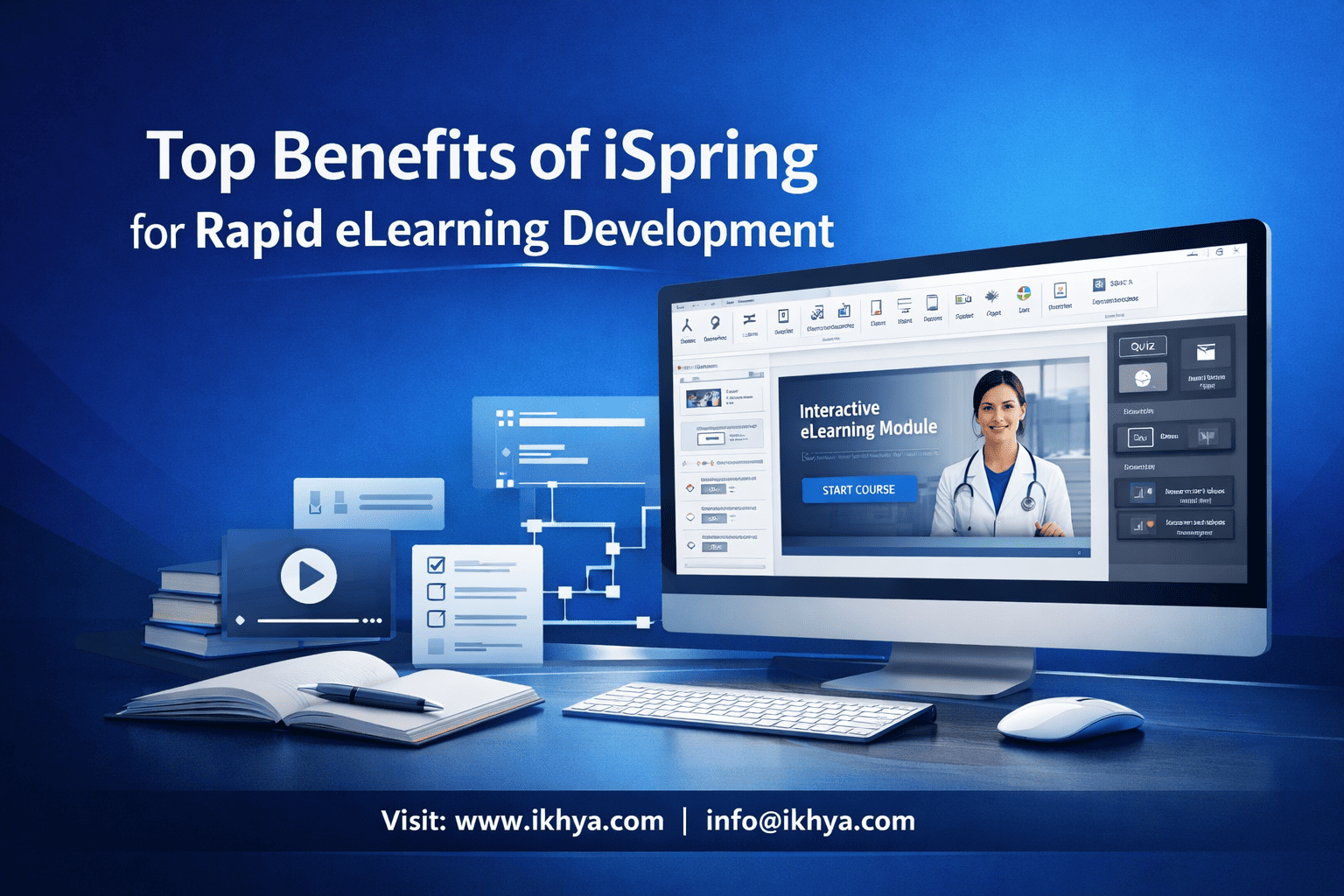
In today’s fast-paced corporate training environment, organizations need to create high-quality learning content quickly without compromising effectiveness. This is where iSpring for rapid eLearning development stands out. It enables teams to convert existing content into interactive courses efficiently, reducing development time and cost.
If you’re looking to accelerate training delivery, explore our rapid eLearning development services or book a free eLearning demo to see how it works in real scenarios.
What is iSpring and How Does it Support Rapid eLearning?
iSpring is a PowerPoint-based eLearning authoring tool that enables fast, cost-effective course development by transforming presentations into interactive, LMS-ready training modules. It simplifies the entire process, making it ideal for organizations that need speed without technical complexity.
To understand the platform in depth, check out this detailed guide on what is iSpring Suite.
Overview of iSpring Suite
iSpring Suite is designed for rapid content creation, especially for teams that already use PowerPoint. It integrates directly into PowerPoint, allowing instructional designers and subject matter experts to build courses without learning complex software.
Key characteristics:
- Works as a PowerPoint add-in
- Converts slides into interactive courses
- Supports quizzes, simulations, and video lectures
- Publishes in SCORM, xAPI, and HTML5 formats
Key Capabilities of iSpring
iSpring enables organizations to scale training quickly by offering:
- Slide-to-course conversion in minutes
- Built-in quiz and assessment tools
- Dialogue simulations for soft skills training
- Screen recording for software training
- Mobile-ready course output
For a deeper breakdown, explore the top features of iSpring for eLearning development.
Key Benefits of iSpring for Rapid eLearning Development
iSpring enables organizations to create high-quality eLearning courses faster, more affordably, and with minimal technical expertise by leveraging PowerPoint-based authoring and built-in interactive features. It is especially valuable for companies aiming to scale training across multiple locations like the USA, UK, UAE, and Australia.
1. Faster Course Development
iSpring significantly reduces development time by allowing teams to reuse existing content.
- Convert PowerPoint slides into eLearning in minutes
- Use pre-built templates and interactions
- Rapid updates without rebuilding courses
Example: A compliance training program that typically takes 4–6 weeks can be developed in 1–2 weeks using iSpring.
This makes it ideal for organizations offering rapid eLearning development services where speed is critical.
2. PowerPoint-Based Authoring (No Learning Curve)
One of the biggest advantages of iSpring is its familiarity.
- Works directly within PowerPoint
- No need for advanced technical skills
- SMEs can create content without developer support
This is particularly useful for teams converting legacy materials using PPT to eLearning conversion services.
3. Cost Efficiency Compared to Traditional Development
iSpring reduces both development and resource costs.
| Cost Factor | Traditional eLearning | iSpring-Based Development |
|---|---|---|
| Development time | High (weeks/months) | Low (days/weeks) |
| Technical expertise | Required | Minimal |
| Tool complexity | High | Low |
| Overall cost | Expensive | Cost-effective |
For organizations evaluating ROI, this makes iSpring a strong alternative to custom-heavy tools.
4. Ease of Use (No Coding Required)
iSpring eliminates technical barriers.
- Drag-and-drop interface
- Built-in interactions and assessments
- No programming or scripting needed
This allows L&D teams to focus more on instructional design rather than development complexity. If needed, you can still enhance learning outcomes with expert instructional design services.
5. Seamless LMS Compatibility (SCORM & xAPI)
iSpring ensures smooth deployment across Learning Management Systems.
- SCORM 1.2 / 2004 support
- xAPI (Tin Can) compatibility
- Easy integration with enterprise LMS platforms
This is essential for organizations delivering training at scale using LMS-compatible eLearning course development services.
6. Mobile-Ready and Responsive Learning
Modern learners expect flexibility, and iSpring delivers.
- Fully responsive HTML5 output
- Works across devices (mobile, tablet, desktop)
- Offline access options
This supports global workforce training and aligns with mobile learning development solutions.
7. Built-in Interactivity and Assessments
iSpring enhances engagement without additional tools.
- Quizzes with multiple question types
- Role-play simulations
- Interactive dialogue scenarios
These features are particularly useful for:
- Sales training
- Customer service training
- Compliance training
You can also extend this with eLearning simulation-based training services.
8. Ideal for Rapid Content Updates
In industries like healthcare, finance, and manufacturing, content changes frequently.
- Update slides quickly in PowerPoint
- Republish instantly
- No need for full redevelopment
This makes iSpring highly effective for:
- Regulatory compliance training
- Product updates
- Policy changes
9. Supports Microlearning Development
iSpring is well-suited for short, focused learning modules.
- Break content into bite-sized lessons
- Faster deployment
- Higher learner engagement
Perfect for organizations investing in microlearning development services.
10. Scalable for Enterprise Training
iSpring supports large-scale training programs across industries.
Common use cases:
- Employee onboarding
- Compliance training
- Sales enablement
- Technical training
For organizations needing tailored solutions, combining iSpring with custom eLearning development services can deliver even better results.
If you’re considering implementing iSpring for your organization, you can explore expert-led iSpring eLearning development services to accelerate your training initiatives.
How iSpring Accelerates Course Development (Step-by-Step)
iSpring accelerates eLearning development by streamlining the entire workflow—from content preparation to LMS deployment—using PowerPoint-based authoring and built-in tools. This eliminates complexity, reduces dependencies, and enables faster turnaround compared to traditional development methods.
Below is a clear step-by-step breakdown of how organizations use iSpring for rapid eLearning development:
Step-by-Step iSpring Development Process
| Step | Activity | What Happens | Time Impact |
|---|---|---|---|
| 1 | Content Collection | Gather existing PPTs, PDFs, videos | Saves time on content creation |
| 2 | PowerPoint Conversion | Import slides into iSpring | Instant course foundation |
| 3 | Add Interactivity | Insert quizzes, simulations, voiceovers | No external tools needed |
| 4 | Enhance Design | Apply templates, branding, media | Faster than custom design |
| 5 | Publish Course | Export to SCORM/xAPI/HTML5 | LMS-ready in minutes |
| 6 | LMS Deployment | Upload to LMS and track learners | Seamless integration |
Why This Process is Faster Than Traditional eLearning
iSpring removes multiple bottlenecks typically found in custom development workflows.
Traditional Development Challenges:
- Requires multiple tools (design, coding, testing)
- Heavy dependency on developers
- Long review cycles
iSpring Advantages:
- Single-tool workflow (within PowerPoint)
- SMEs can directly create content
- Faster feedback and iteration cycles
Real-World Example
A global manufacturing company needed to convert instructor-led safety training into eLearning for teams across the USA and UAE.
Using iSpring:
- Converted 120-slide training into modules in under 10 days
- Added quizzes and scenario-based learning
- Deployed via LMS with SCORM tracking
This approach aligns perfectly with ilt to eLearning course conversion services where speed and consistency are critical.
Where iSpring Fits Best in the Workflow
iSpring is most effective when:
- You already have PowerPoint-based training content
- You need fast turnaround (days/weeks, not months)
- You want minimal technical complexity
- You are scaling training across multiple regions
For organizations looking to streamline this process further, combining iSpring with expert support—like convert PowerPoint to eLearning guide—can significantly improve outcomes.
Pro Tip for Faster Development
To maximize speed and efficiency:
- Standardize templates across courses
- Use reusable quiz banks
- Maintain a centralized asset library
- Collaborate with SMEs early
Many organizations also partner with experts like IKHYA – eLearning Solutions Company to reduce timelines and ensure high-quality output. For tailored support, you can explore eLearning consultancy services.
iSpring vs Other Authoring Tools (Comparison Table)
iSpring stands out among eLearning authoring tools for its speed, simplicity, and PowerPoint-based development, while tools like Articulate Storyline and Adobe Captivate offer more advanced customization but require higher expertise and longer development time. Choosing the right tool depends on your project complexity, timeline, and team capability.
iSpring vs Storyline vs Captivate
| Feature/Criteria | iSpring Suite | Articulate Storyline | Adobe Captivate |
|---|---|---|---|
| Ease of Use | Very easy (PowerPoint-based) | Moderate | Complex |
| Development Speed | Very fast | Medium | Slower |
| Learning Curve | Low | Medium | High |
| Interactivity Level | Moderate | Advanced | Advanced |
| Customization | Limited | High | Very high |
| Coding Requirement | None | Optional | Often needed |
| Best Use Case | Rapid eLearning | Custom interactive courses | Software simulations |
| Cost Efficiency | High | Medium | Medium |
| Mobile Responsiveness | Yes | Yes | Yes |
| LMS Compatibility | SCORM, xAPI | SCORM, xAPI | SCORM, xAPI |
When iSpring is the Better Choice
Choose iSpring when speed and simplicity matter most.
Best-fit scenarios:
- Converting PowerPoint training into eLearning
- Rapid deployment of compliance training
- Onboarding programs with tight timelines
- Organizations with limited technical expertise
This aligns well with businesses leveraging rapid eLearning development using Storyline and Rise 360 but needing even faster turnaround.
When Other Tools May Be Better
Choose Storyline or Captivate when you need advanced interactivity or custom experiences.
| Scenario | Recommended Tool |
|---|---|
| Complex branching scenarios | Storyline |
| Software simulations | Captivate |
| Gamified learning experiences | Storyline |
| Highly customized UI/UX | Captivate |
For organizations evaluating tools, this comparison complements broader insights from best eLearning authoring tools for corporate training.
Decision Snapshot
| Requirement | Best Tool |
|---|---|
| Fastest development | iSpring |
| High customization | Storyline |
| Advanced simulations | Captivate |
| Beginner-friendly | iSpring |
| Enterprise-scale rapid rollout | iSpring |
Many enterprises use a hybrid approach:
- iSpring for rapid, high-volume training
- Storyline/Captivate for complex modules
This blended strategy ensures both speed and depth, especially in industries like healthcare, finance, and manufacturing.
If you’re unsure which tool fits your needs, consider consulting experts at IKHYA – eLearning Solutions Company. You can start with a tailored discussion through eLearning consultancy services.
When Should You Use iSpring? (Decision Framework)
You should use iSpring when your priority is speed, simplicity, and cost-effective course development—especially if you already have PowerPoint-based content and need to deploy training quickly across teams. It is ideal for organizations that want to scale learning without heavy technical dependencies.
Quick Decision Framework
| Scenario | Should You Use iSpring? | Reason |
|---|---|---|
| You have existing PowerPoint training | Yes | Easy conversion to eLearning |
| You need courses fast (days/weeks) | Yes | Rapid development workflow |
| Limited technical expertise in team | Yes | No coding required |
| Complex simulations needed | No | Limited advanced interactivity |
| Highly custom UI/UX required | No | Better suited for Storyline/Captivate |
| Large-scale compliance training | Yes | Fast updates and deployment |
Best-Fit Scenarios for iSpring
iSpring works best in environments where speed and scalability are critical.
1. Corporate Training & Onboarding
- Employee onboarding programs
- HR compliance training
- Policy and process training
2. Compliance & Regulatory Training
- Finance (AML, risk compliance)
- Healthcare (HIPAA, safety protocols)
- Manufacturing (safety and operational training)
These use cases align with solutions like compliance training eLearning solutions.
3. PowerPoint-Based Training Conversion
If your organization has large volumes of PPT content:
- Convert slides into interactive modules
- Add quizzes and voiceovers
- Publish instantly to LMS
This is where convert PowerPoint to eLearning guide becomes highly relevant.
4. Rapid Global Training Deployment
For companies operating in regions like the USA, UK, UAE, and Australia:
- Deliver consistent training globally
- Ensure LMS compatibility
- Enable multilingual rollout
You can enhance this further with eLearning translation localization services.
When NOT to Use iSpring
iSpring may not be the best choice for highly complex or custom learning experiences.
Avoid iSpring if you need:
- Advanced branching scenarios with deep logic
- Gamified learning with complex mechanics
- Highly interactive simulations (e.g., software training)
- Fully custom UI/UX design
In such cases, tools supported by articulate storyline development services or Captivate may be more suitable.
Hybrid Strategy: Best of Both Worlds
Many enterprises adopt a dual-tool strategy:
- Use iSpring for:
- Compliance training
- Onboarding modules
- Microlearning
- Use advanced tools for:
- Simulations
- Gamified learning
- High-interaction modules
This approach ensures:
- Faster development cycles
- Better resource allocation
- Optimized learning outcomes
Expert Tip
Before choosing a tool, evaluate:
- Content complexity
- Timeline constraints
- Budget
- Internal skillset
If you’re unsure, working with experts like IKHYA – eLearning Solutions Company can help you make the right decision. You can start by exploring eLearning consultancy services.
Industry Use Cases of iSpring
iSpring is widely used across industries to deliver fast, scalable, and cost-effective training programs—especially where frequent updates, compliance requirements, and large learner bases are involved. Its rapid development capability makes it ideal for organizations operating across global markets like the USA, UK, UAE, and Australia.
1. Healthcare Training
Healthcare organizations use iSpring to deliver compliance, safety, and clinical training quickly while ensuring accuracy and consistency.
Common Use Cases:
- HIPAA and regulatory compliance training
- Patient safety and infection control
- Medical device training
Why iSpring Works Here:
- Rapid updates for changing regulations
- Easy conversion of SOPs into eLearning
- Mobile-friendly learning for frontline staff
This aligns with specialized solutions like healthcare training eLearning solutions.
2. Manufacturing Training
Manufacturing companies leverage iSpring to train employees on safety protocols, equipment handling, and operational processes.
Common Use Cases:
- Workplace safety training
- Machine operation training
- Quality control processes
Why iSpring Works Here:
- Quick updates for safety regulations
- Scalable training across multiple plants
- Simulation-based learning for real scenarios
You can further enhance outcomes using manufacturing training eLearning solutions.
3. Financial Services & Compliance Training
Financial institutions rely on iSpring for fast deployment of compliance and regulatory training programs.
Common Use Cases:
- Anti-money laundering (AML) training
- Risk and compliance programs
- Data security awareness
Why iSpring Works Here:
- Frequent content updates
- LMS tracking for audit compliance
- Consistent delivery across regions
Relevant solutions include financial services training eLearning solutions.
4. Retail & Customer Service Training
Retail organizations use iSpring to train employees on customer service, product knowledge, and sales techniques.
Common Use Cases:
- Customer interaction training
- Product knowledge modules
- Sales enablement programs
Why iSpring Works Here:
- Rapid rollout across store networks
- Microlearning for frontline staff
- Mobile-first delivery
Explore related solutions like retail training eLearning solutions.
5. Corporate Onboarding & HR Training
Organizations across industries use iSpring to streamline onboarding and internal training programs.
Common Use Cases:
- Employee onboarding
- HR policy training
- Soft skills development
Why iSpring Works Here:
- Fast content creation for new hires
- Standardized training experience
- Easy updates for policy changes
Industry-Wise Summary
| Industry | Primary Use Case | Key Benefit of iSpring |
|---|---|---|
| Healthcare | Compliance & safety | Fast updates, accuracy |
| Manufacturing | Safety & operations | Scalable training |
| Finance | Regulatory training | Audit-ready LMS tracking |
| Retail | Sales & service | Mobile-friendly learning |
| Corporate HR | Onboarding | Standardization & speed |
Real-World Insight
A retail organization with operations across the UK and UAE used iSpring to:
- Convert classroom training into microlearning modules
- Deploy training to 500+ employees within 2 weeks
- Improve training completion rates by 35%
This demonstrates how iSpring supports rapid, scalable learning transformation.
iSpring is best suited for industries where:
- Training needs frequent updates
- Speed of deployment is critical
- Large audiences must be trained consistently
For organizations looking to implement industry-specific solutions, partnering with experts like IKHYA – eLearning Solutions Company ensures faster execution and better outcomes. You can explore tailored custom eLearning development services.
Cost vs Value of iSpring Development
iSpring offers a strong return on investment by significantly reducing development time, resource dependency, and overall training costs—making it one of the most cost-effective solutions for rapid eLearning development. However, the true value depends on how you implement it: in-house vs outsourced.
Cost Breakdown: Traditional vs iSpring Development
| Cost Component | Traditional eLearning | iSpring-Based Development |
|---|---|---|
| Development Time | 4–12 weeks | 1–3 weeks |
| Tool Complexity | High | Low |
| Resource Requirement | Developers + designers | SMEs + instructional designers |
| Cost per Course | High ($3,000–$10,000+) | Moderate ($800–$3,000) |
| Update Cost | Expensive | Minimal |
Key Insight: iSpring reduces costs primarily by eliminating complex development layers and enabling faster updates.
In-House vs Outsourced iSpring Development
| Factor | In-House Development | Outsourced Development |
|---|---|---|
| Control | High | Medium |
| Speed | Moderate | High |
| Expertise | Limited to team skills | Access to specialists |
| Cost Efficiency | Lower upfront, higher long-term | Optimized overall |
| Scalability | Limited | High |
When In-House Makes Sense
Choose in-house development if:
- You have a skilled L&D team
- Training requirements are ongoing but predictable
- You want full control over content
When Outsourcing is Better
Outsourcing iSpring development is ideal when speed, scale, and quality are critical.
Best scenarios:
- Large-scale training rollouts
- Tight deadlines
- Lack of internal expertise
- Need for instructional design excellence
This is where partnering with providers offering iSpring eLearning development services can significantly improve outcomes.
Hidden Cost Advantages of iSpring
Beyond direct savings, iSpring delivers additional value:
- Reduced rework costs due to easy updates
- Faster time-to-market for training programs
- Lower training downtime for employees
- Improved learner engagement, reducing retraining needs
ROI Perspective
Organizations using iSpring typically achieve:
- 30–50% reduction in development time
- 40–60% cost savings compared to traditional methods
- Faster global training deployment
These benefits are especially important for enterprises scaling training across multiple regions.
Strategic Recommendation
To maximize ROI:
- Start with a pilot project
- Standardize templates and workflows
- Combine internal SMEs with external experts
- Use analytics (LMS, xAPI) to track effectiveness
If you’re evaluating outsourcing, this guide on outsource eLearning development benefits, costs, and best practices can help you make informed decisions.
Expert Support
For organizations aiming to balance cost and quality, working with IKHYA – eLearning Solutions Company can help:
- Reduce development timelines
- Ensure high-quality instructional design
- Scale training efficiently
You can start by discussing your requirements through eLearning consultancy services.
Should You Outsource iSpring Development?
Outsourcing iSpring development is the fastest and most efficient way to create high-quality eLearning courses when you lack internal expertise, face tight deadlines, or need to scale training quickly. It allows organizations to focus on strategy while experts handle design, development, and deployment.
Key Benefits of Outsourcing iSpring Development
1. Faster Turnaround Time
- Dedicated teams accelerate development cycles
- Parallel workflows (design + development)
- Reduced internal bottlenecks
Result: Courses delivered in weeks instead of months.
2. Access to Specialized Expertise
Outsourcing gives you access to:
- Instructional designers
- eLearning developers
- Multimedia specialists
This ensures your courses are not just fast—but also pedagogically effective.
3. Better Instructional Design Quality
Professional vendors bring structured methodologies:
- Scenario-based learning
- Microlearning strategies
- Assessment-driven design
This aligns with best practices from instructional design services.
4. Scalability for Large Training Programs
Outsourcing enables you to:
- Develop multiple courses simultaneously
- Deploy training globally
- Maintain consistency across modules
Ideal for enterprises operating in multiple regions.
5. Cost Optimization
While outsourcing may seem like an added expense, it often reduces total cost by:
- Avoiding hiring and training internal teams
- Reducing rework and delays
- Delivering higher quality in less time
In-House vs Outsourcing: Quick Comparison
| Criteria | In-House | Outsourcing |
|---|---|---|
| Speed | Moderate | High |
| Expertise | Limited | Advanced |
| Cost | Variable | Optimized |
| Scalability | Low | High |
| Quality | Depends on team | Consistent |
When You Should Definitely Outsource
Outsourcing is the best option if:
- You need rapid course development at scale
- Your team lacks experience with iSpring
- You are converting large volumes of content
- You require high-quality interactive learning
For example, organizations converting legacy content often rely on PPT to eLearning conversion services to accelerate delivery.
How to Choose the Right iSpring Development Partner
Follow this simple evaluation framework:
Step 1: Check Experience
- Portfolio of iSpring projects
- Industry-specific expertise
Step 2: Evaluate Capabilities
- Instructional design strength
- Multimedia development skills
- LMS integration experience
Step 3: Review Process
- Development methodology
- Communication model
- Timeline commitments
Step 4: Assess Scalability
- Ability to handle large projects
- Dedicated team availability
You can also refer to this detailed guide on how to choose the eLearning vendor.
Real-World Scenario
A financial services company needed to roll out compliance training across 3 regions within 30 days.
By outsourcing iSpring development:
- Developed 10+ modules simultaneously
- Ensured SCORM compliance for LMS tracking
- Reduced internal workload by 60%
Strategic Insight
Outsourcing is not just about saving time—it’s about ensuring quality at scale.
Many organizations adopt a hybrid model:
- Internal team handles content
- External experts handle development
Get Expert Support
If you’re planning to outsource, working with experienced providers like IKHYA – eLearning Solutions Company ensures:
- Faster delivery
- High-quality course design
- Scalable training solutions
You can get started by reaching out via contact us or exploring tailored custom eLearning development services.
Email: info@ikhya.com
How to Get Started with iSpring for Your Organization
Getting started with iSpring is straightforward: assess your training needs, prepare existing content, design interactive modules, and deploy them via your LMS. The simplicity of iSpring makes it ideal for organizations looking to launch training quickly without complex setup.
Step-by-Step Guide to Implement iSpring
Step 1: Define Training Objectives
Start by identifying:
- Target audience (employees, customers, partners)
- Learning goals (compliance, onboarding, skills training)
- Delivery format (microlearning, full courses, blended learning)
Clear objectives ensure your courses are aligned with business outcomes.
Step 2: Audit Existing Content
Review available materials such as:
- PowerPoint presentations
- PDFs and documents
- Videos and recorded sessions
This step helps you reuse existing assets, which is key to rapid development. If needed, you can streamline this process using convert PowerPoint to eLearning guide.
Step 3: Choose the Right Development Approach
Decide whether to:
| Approach | When to Choose |
|---|---|
| In-house | You have a skilled L&D team |
| Outsourced | You need speed and expertise |
| Hybrid | You want balance between control and efficiency |
For faster results, many organizations opt for expert-led iSpring eLearning development services.
Step 4: Design and Develop Courses
Using iSpring, you can:
- Convert slides into interactive modules
- Add quizzes, voiceovers, and simulations
- Apply branding and visual design
For best results, combine this with professional instructional design services to enhance learner engagement.
Step 5: Publish and Deploy to LMS
Export your course in formats like:
- SCORM 1.2 / SCORM 2004
- xAPI (Tin Can)
- HTML5
Then upload it to your LMS for:
- Learner tracking
- Performance analytics
- Reporting
This ensures your training is measurable and scalable.
Step 6: Monitor, Improve, and Scale
After deployment:
- Track learner progress and completion rates
- Analyze assessment results
- Update content regularly
iSpring makes updates easy, allowing you to continuously improve training effectiveness.
Implementation Timeline (Typical)
| Phase | Duration |
|---|---|
| Planning & content audit | 2–5 days |
| Development | 5–15 days |
| Review & revisions | 3–7 days |
| Deployment | 1–2 days |
Total Time: 2–4 weeks (significantly faster than traditional eLearning)
Common Mistakes to Avoid
- Skipping instructional design planning
- Overloading slides with content
- Ignoring mobile responsiveness
- Not testing LMS compatibility
- Delaying stakeholder feedback
Avoiding these ensures smoother implementation and better outcomes.
Pro Tip for Enterprises
For organizations scaling training across regions like the USA, UK, UAE, and Australia:
- Standardize templates
- Use centralized content libraries
- Enable multilingual training
You can support this with eLearning translation localization services.
Ready to Get Started?
If you want to accelerate your training initiatives with expert support, IKHYA – eLearning Solutions Company can help you:
- Plan and execute rapid eLearning strategies
- Develop high-quality iSpring courses
- Scale training across your organization
Start with a consultation via book a free eLearning demo or reach out through contact us.
Email: info@ikhya.com
Conclusion: Why iSpring is a Smart Choice for Rapid eLearning
iSpring stands out as one of the most efficient tools for rapid eLearning development, offering speed, simplicity, and cost-effectiveness without compromising quality. It enables organizations to quickly transform existing training materials into engaging, LMS-ready courses.
Key Takeaways
- Faster course development using PowerPoint-based authoring
- Lower cost compared to traditional eLearning
- Easy to use with no coding required
- Scalable for global training programs
- Ideal for compliance, onboarding, and corporate training
Final Recommendation
If your organization needs to:
- Launch training quickly
- Convert existing content into eLearning
- Scale learning across teams
iSpring is a highly practical and strategic choice.
For best results, combining the tool with expert support ensures higher quality and faster execution.
Take the Next Step
If you’re ready to implement iSpring for your organization, IKHYA – eLearning Solutions Company can help you:
- Design and develop high-impact eLearning courses
- Convert legacy training into modern formats
- Scale training across global teams
Get started today:
- Book a free eLearning demo
- Explore iSpring eLearning development services
- Reach out via contact us
Email: info@ikhya.com
FAQs
1. What is iSpring used for in eLearning?
iSpring is used to convert PowerPoint presentations into interactive eLearning courses quickly, with built-in quizzes, simulations, and LMS compatibility. It is widely used for corporate training, onboarding, and compliance programs.
2. Why is iSpring considered a rapid eLearning tool?
iSpring enables rapid eLearning because it works directly within PowerPoint, eliminating complex development processes and reducing course creation time from weeks to days.
3. Is iSpring better than Articulate Storyline?
iSpring is better for speed and ease of use, while Storyline is better for advanced interactivity and customization. The right choice depends on your training complexity and timeline.
4. Can iSpring convert PowerPoint into eLearning?
Yes, iSpring converts PowerPoint slides into interactive, LMS-ready courses while preserving animations, transitions, and layouts.
5. Is iSpring suitable for corporate training?
Yes, iSpring is ideal for corporate training, especially onboarding, compliance, and product training programs that require quick deployment.
6. Does iSpring support LMS integration?
Yes, iSpring supports SCORM, xAPI, and HTML5 formats, making it compatible with most LMS platforms for tracking and reporting.
7. What industries benefit most from iSpring?
Industries like healthcare, manufacturing, finance, retail, and IT benefit the most due to frequent training updates and large learner bases.
8. Is iSpring cost-effective?
Yes, iSpring reduces development costs by minimizing technical complexity, speeding up production, and enabling easy content updates.
9. Should I outsource iSpring development?
Outsourcing is recommended when you need faster delivery, expert instructional design, or large-scale course development.
10. How long does it take to develop a course using iSpring?
Most iSpring courses can be developed within 1–3 weeks depending on complexity and content readiness.
11. What are the key features of iSpring Suite?
Key features include PowerPoint integration, quiz builder, dialogue simulations, screen recording, and LMS-ready publishing formats.
12. Is iSpring easy to learn for beginners?
Yes, iSpring is beginner-friendly because it works within PowerPoint, making it accessible to non-technical users.
13. Can iSpring create mobile-friendly courses?
Yes, iSpring publishes responsive HTML5 courses that work seamlessly across mobile, tablet, and desktop devices.
14. Does iSpring support microlearning?
Yes, iSpring is ideal for microlearning as it allows quick creation of short, focused learning modules.
15. Can iSpring be used for compliance training?
Yes, iSpring is widely used for compliance training because it supports quick updates, LMS tracking, and standardized content delivery.
16. How does iSpring improve learner engagement?
iSpring improves engagement through interactive quizzes, role-play simulations, multimedia integration, and scenario-based learning.
17. Can iSpring be used for software training?
Yes, iSpring supports screen recording and simulations, making it suitable for basic software training, though advanced simulations may require other tools.
18. What is the difference between iSpring and Adobe Captivate?
iSpring is simpler and faster for rapid development, while Adobe Captivate offers more advanced features for simulations and complex interactions.
19. Is iSpring suitable for global training programs?
Yes, iSpring supports multilingual content, LMS integration, and scalable deployment, making it ideal for global organizations.
20. How can I get started with iSpring development?
You can start by defining training goals, converting existing content, and deploying courses via LMS—or partner with experts for faster implementation.
Related Resources
Explore these resources to deepen your understanding of iSpring and rapid eLearning development: