Articulate Storyline Course Development Services: Complete Guide

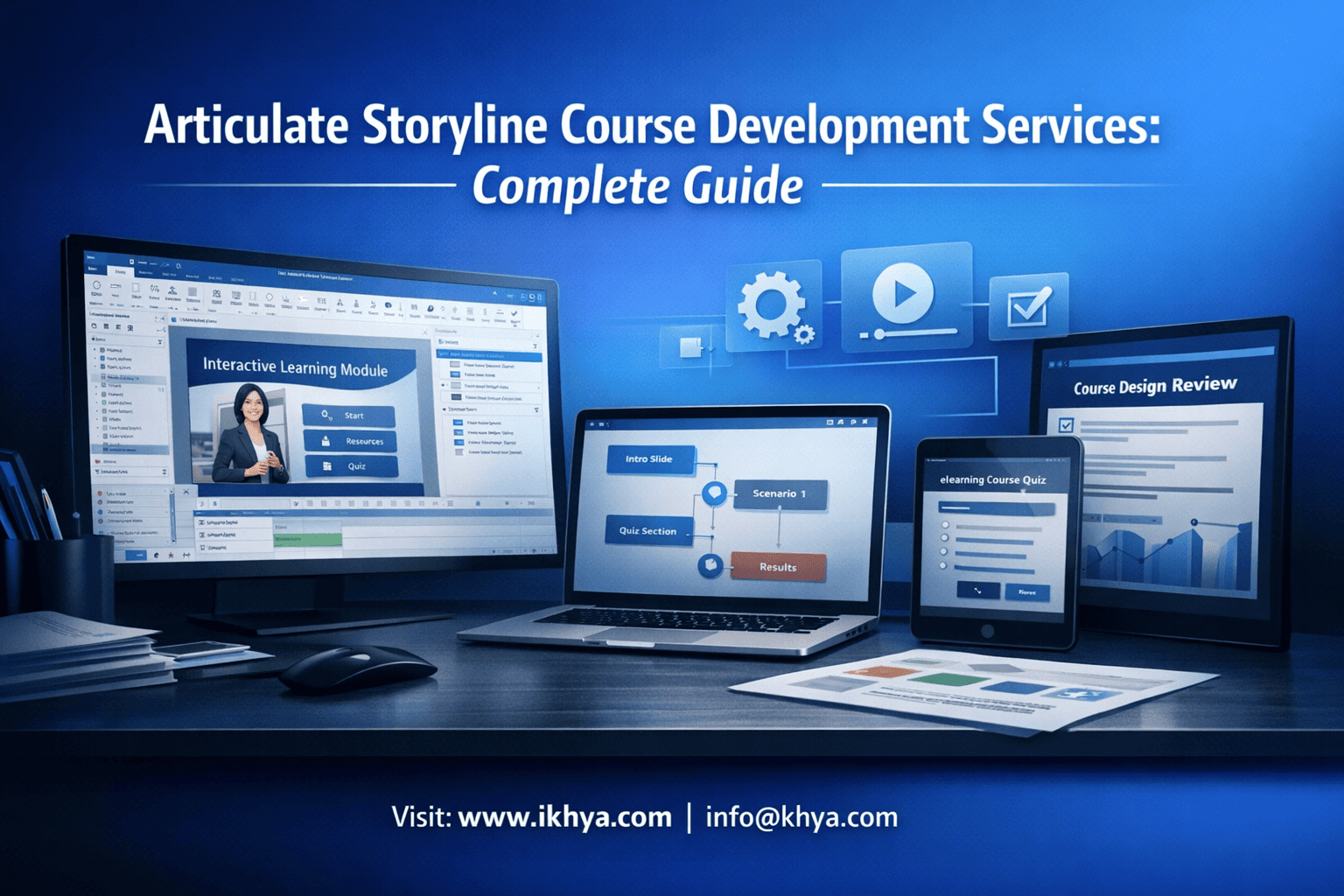
Articulate Storyline course development services are widely used by organizations moving away from outdated training—but poor design and execution still lead to compliance failures, low completion rates, and wasted budgets. Many teams invest in eLearning that looks interactive on the surface but fails to deliver meaningful learning outcomes.
The right development approach combines strong instructional design, thoughtful interactivity, and seamless LMS integration. When done correctly, Storyline-based training can improve engagement, ensure compliance, and drive measurable performance improvements across teams.
If you’re planning to scale training or improve existing programs, working with an experienced partner can make the difference. Contact IKHYA – eLearning Solutions Company (info@ikhya.com) to build high-impact Articulate Storyline courses tailored to your organization.
What Are Articulate Storyline Course Development Services?
Articulate Storyline course development services involve designing, building, and deploying interactive eLearning courses using the Storyline authoring tool. These services include instructional design, eLearning content development, multimedia production, assessments, LMS integration, accessibility compliance, and testing. Organizations use these services to convert training content into SCORM-compliant, mobile-friendly, engaging custom eLearning courses globally.
Understanding Articulate Storyline in the Modern eLearning Ecosystem
Articulate Storyline is one of the most widely used eLearning authoring tools globally. It enables developers to create highly interactive courses without advanced programming knowledge while still supporting complex logic and enterprise-level functionality.
It is used extensively across:
- Corporate training programs
- Healthcare compliance training
- Aviation safety training
- Manufacturing SOP training
- Government and defense training
- Financial services regulatory training
Global enterprises in the USA, UK, UAE, and Australia rely on Storyline because it balances powerful features with deployment flexibility.
Why organizations choose Articulate Storyline for course development
Articulate Storyline offers a unique combination of flexibility, compatibility, and advanced interaction capability.
Key advantages include:
| Feature | Business Impact |
|---|---|
| SCORM, xAPI, AICC support | Works with all major LMS platforms |
| Advanced triggers and variables | Enables complex interactive scenarios |
| Responsive player | Works across desktop, tablet, and mobile |
| Accessibility support | Helps meet WCAG 2.1 and ADA compliance |
| No coding required | Faster development timelines |
| Localization support | Easy translation for global teams |
What Services Are Included in Storyline Course Development?
Professional Storyline development services cover the full lifecycle of course creation.
1. Instructional Design and Learning Strategy
Instructional designers and instructional design services transform raw content into structured learning experiences using proven frameworks such as:
- ADDIE model (Analysis, Design, Development, Implementation, Evaluation)
- Bloom’s Taxonomy
- Gagne’s Nine Events of Instruction
This ensures training improves knowledge retention and performance.
2. Storyboarding and Content Structuring
Storyboards define:
- Screen layouts
- Interactions
- Narration scripts
- Visual elements
- Assessment logic
This stage prevents costly revisions later.
3. Custom Visual and Multimedia Design
Includes:
- Custom graphics
- Motion animations
- Voiceover integration
- Character-based scenarios
- Software simulations
High-quality visuals improve engagement and completion rates.
4. Interactive Development in Articulate Storyline
Developers use Storyline to build custom Storyline eLearning development solutions such as:
- Click-based interactions
- Drag-and-drop exercises
- Branching scenarios
- Simulation environments
- Gamified learning experiences
5. LMS Integration and SCORM Packaging
As part of LMS integration services, courses are exported in formats such as:
- SCORM 1.2
- SCORM 2004
- xAPI (Tin Can)
- cmi5
These formats allow tracking of learner progress and performance.
6. Accessibility and Compliance Implementation
Global organizations must comply with accessibility standards such as:
- WCAG 2.1 (Worldwide)
- Section 508 (USA)
- Equality Act (UK)
- EN 301 549 (EU)
Storyline supports screen readers, keyboard navigation, and accessible design.
7. Testing and Quality Assurance
QA ensures:
- LMS compatibility
- Proper scoring and tracking
- Mobile responsiveness
- Browser compatibility
- Error-free interactions
Real-World Example: Corporate Compliance Training (USA Financial Sector)
This real-world example demonstrates how structured eLearning development improves compliance outcomes and training effectiveness.
A US-based financial institution needed to convert 120 hours of classroom compliance training into eLearning.
Using Articulate Storyline, the development team created:
- Scenario-based compliance simulations
- Real-world ethical decision branching
- Automated LMS reporting
Results:
- Training completion increased from 54% to 92%
- Compliance violations reduced by 37%
- Training cost reduced by 48%
Real-World Example: Healthcare Training (UK NHS Vendor)
A healthcare training provider required infection control training aligned with NHS and UK regulatory standards.
The Storyline solution included:
- Interactive medical simulations
- Real clinical scenarios
- Mobile-compatible learning
Results:
- Faster onboarding of medical staff
- Reduced training time by 42%
- Improved audit compliance scores
Who Needs Articulate Storyline Course Development Services?
These services are essential for organizations that require structured, scalable, trackable corporate training solutions.
Industries that benefit most include:
- Healthcare
- Banking and financial services
- Aviation
- Oil and gas
- Manufacturing
- Government and defense
- Corporate HR training
- IT and cybersecurity training
Internal Team vs Professional Storyline Development Services
| Factor | Internal Team | Professional Vendor |
|---|---|---|
| Development speed | Slow | Fast |
| Instructional design expertise | Limited | Expert level |
| Multimedia quality | Basic | Professional |
| Compliance knowledge | Limited | Global compliance ready |
| Scalability | Limited | High |
| Long-term cost | Higher | Lower overall |
Professional vendors deliver better quality, faster timelines, and lower long-term cost.
Organizations evaluating cost, quality, and scalability should also explore a detailed comparison of Internal Team vs Professional Storyline Development Services to make informed decisions.
Why Global Enterprises Outsource Storyline Development
Organizations outsource because working with an experienced Articulate Storyline development company requires multiple specialized roles:
- Instructional designers
- Visual designers
- Storyline developers
- Voice artists
- QA testers
- LMS specialists
Outsourcing ensures enterprise-grade quality without hiring a large internal team.
How do Articulate Storyline course development services work? (Step-by-step process)
Articulate Storyline course development follows a structured workflow that transforms raw training content into interactive, SCORM-compliant eLearning. The standard process includes analysis, instructional design, storyboarding, visual design, Storyline development, LMS integration, testing, and deployment. This approach ensures training meets learning goals, compliance standards, and technical compatibility across global LMS platforms.
Phase 1: Training Needs Analysis and Learning Strategy
This phase defines what learners must know, why training is required, and how success will be measured. Without proper analysis, courses may look good but fail to improve performance or compliance.
Key Activities
- Identify business goals (compliance, onboarding, performance improvement)
- Define learner profiles and skill levels
- Determine delivery format (self-paced, blended, scenario-based)
- Define measurable learning objectives
Example: Manufacturing Safety Training (Australia)
This example highlights how manufacturing safety training can be effectively delivered using interactive eLearning aligned with industry regulations.
An Australian mining company needed safety training aligned with Safe Work Australia regulations. The analysis revealed workers needed decision-based hazard identification training—not passive slides.
Solution:
- Scenario-based simulations in Storyline
- Real hazard identification exercises
- Mobile-accessible training for field workers
Result:
- 41% reduction in safety incidents within 12 months
Phase 2: Instructional Design and Course Architecture
Instructional designers convert raw content into structured learning experiences using scientifically proven learning frameworks.
Common Instructional Design Models
| Model | Purpose | Where Used |
|---|---|---|
| ADDIE | Structured course development | Corporate and government training |
| SAM | Faster iterative development | Technology companies |
| Bloom’s Taxonomy | Cognitive skill development | Academic and technical training |
| Gagne’s Nine Events | Behavior-based learning | Healthcare and compliance |
Output of this Phase
- Learning objectives
- Course outline
- Assessment strategy
- Interaction plan
Phase 3: Storyboarding (Blueprint for Development)
Storyboarding defines every screen before development begins. This prevents rework and ensures stakeholder approval early.
Storyboard Includes
- Screen text
- Narration script
- Visual references
- Interaction descriptions
- Assessment logic
- Navigation flow
Why This Phase Is Critical
Without storyboards:
- Development time increases by 30–50%
- Revision costs increase significantly
- Stakeholder expectations may not align
Phase 4: Visual Design and Multimedia Production
This phase creates the visual identity and multimedia elements used in the course.
Includes
- Custom graphics
- UI layout design
- Animations
- Character-based scenarios
- Professional voiceover recording
- Video integration
Global Example: UAE Corporate Training
A UAE aviation company required multilingual training (English and Arabic).
The development included:
- Culturally appropriate visuals
- Arabic voiceovers
- RTL (right-to-left) language layout support
Storyline supports multilingual course duplication efficiently.
Phase 5: Articulate Storyline Development (Core Production Phase)
This is where the course is built using Storyline’s interactive features.
Key Storyline Features Used
Triggers and Variables
Enable dynamic course behavior such as:
- Personalized learning paths
- Decision-based branching
- Adaptive feedback
Layers and States
Allow interactive visual behavior such as:
- Hover effects
- Interactive menus
- Simulation feedback
Motion Paths and Animations
Used for:
- Software simulations
- Process training
- Equipment training
Phase 6: Assessment and Knowledge Checks
Assessments validate whether learners achieved learning objectives.
Types of Assessments
- Multiple choice questions
- Scenario-based assessments
- Drag-and-drop interactions
- Simulation-based testing
Global Compliance Example: USA Healthcare
Healthcare compliance training must demonstrate measurable knowledge improvement.
The platform allows tracking of:
- Pass/fail status
- Score percentage
- Completion time
- Attempts
This supports regulatory audits.
Phase 7: LMS Integration and SCORM/xAPI Packaging
Courses are exported and integrated into LMS platforms such as:
- Cornerstone
- Docebo
- Moodle
- SAP SuccessFactors
- TalentLMS
Supported Standards
| Standard | Purpose |
|---|---|
| SCORM 1.2 | Basic tracking |
| SCORM 2004 | Advanced tracking |
| xAPI | Detailed learner behavior tracking |
| cmi5 | Modern LMS compatibility |
Phase 8: Testing and Quality Assurance
Testing ensures courses function correctly across systems and devices.
Testing Includes
- LMS compatibility testing
- Mobile testing
- Browser testing
- Accessibility testing
- Score tracking validation
Example: UK Government Training
UK government training requires accessibility compliance.
Testing ensures:
- Screen reader compatibility
- Keyboard navigation support
- WCAG 2.1 compliance
Phase 9: Deployment and Launch
Once approved, courses are deployed to the LMS.
Final Deliverables
- SCORM/xAPI package
- Source files (.story)
- Media assets
- Documentation
What Types of Courses Can Be Built Using Articulate Storyline?
Articulate Storyline course development services can support almost any type of corporate, technical, or compliance training. It supports simulations, scenario-based learning, onboarding programs, certification courses, product training, and software training. Its flexibility allows developers to create simple courses or highly complex interactive learning environments used globally.
Compliance Training Courses
Used in regulated industries worldwide.
Examples:
- HIPAA training (USA healthcare)
- GDPR compliance (UK and EU)
- Workplace safety training (Australia)
- Anti-money laundering training (UAE banking)
Storyline supports audit-ready tracking required by regulators.
Software Simulation Training
Storyline is widely used for custom Storyline eLearning development, especially for software training simulations.
Examples:
- SAP training
- Salesforce training
- Microsoft Office training
- Internal system training
Simulation types include:
- Watch mode
- Try mode
- Test mode
Scenario-Based Training
Simulates real workplace decisions.
Examples:
- Customer service training
- Leadership training
- Sales training
- Healthcare decision training
Improves decision-making skills significantly.
Employee Onboarding Training
Storyline helps standardize onboarding through structured Storyline training course development globally.
Includes:
- Company policies
- Process training
- Culture training
- Compliance training
Technical Skills Training
Organizations implementing safety training programs can leverage interactive Storyline-based simulations to improve real-world performance and compliance outcomes.
Used in engineering, manufacturing, and IT training.
Examples:
- Equipment training
- Safety procedures
- IT security training
- Technical certification
Certification and Assessment Programs
Supports certification with score tracking and LMS integration.
Used for:
- Professional certification
- Compliance certification
- Partner certification programs
What Features Make Articulate Storyline Ideal for Enterprise Training?
Articulate Storyline provides advanced interactivity, full LMS compatibility, accessibility support, and flexible course logic without requiring programming. Its triggers, variables, responsive player, simulation capability, and SCORM/xAPI support enable organizations to build highly interactive, trackable, and scalable training programs used across global enterprises, regulated industries, and multilingual workforce environments.
Advanced Triggers and Variables for Adaptive Learning
Triggers and variables allow courses to respond dynamically to learner actions. This enables personalized learning paths, branching scenarios, and intelligent feedback.
What Triggers Do
Triggers control actions such as:
- Jumping to specific slides
- Showing or hiding objects
- Playing media
- Changing states
- Recording learner decisions
What Variables Enable
Variables store learner data such as:
- User choices
- Quiz scores
- Completion progress
- Scenario outcomes
Enterprise Example: Banking Compliance Training (UK)
A UK financial institution uses variables to simulate fraud detection scenarios.
If a learner selects incorrect actions:
- The course redirects to corrective training
- Additional explanations appear
- The learner must retry until correct
This ensures real understanding—not just completion.
Branching Scenarios for Real-World Decision Training
Branching allows learners to experience realistic consequences of their decisions.
Common Branching Use Cases
- Customer service training
- Leadership training
- Medical decision training
- Safety training
- Sales negotiation training
Global Example: Healthcare Training (USA)
Nurses complete patient care scenarios where decisions affect outcomes.
Correct choices:
- Continue to next case
Incorrect choices:
- Trigger corrective feedback
- Show patient risk consequences
This improves real-world decision readiness.
Software Simulation Capability (Watch, Try, Test Modes)
Storyline can record software workflows and convert them into simulations.
Simulation Modes
| Mode | Purpose |
|---|---|
| Watch Mode | Learner observes software workflow |
| Try Mode | Learner practices with guidance |
| Test Mode | Learner completes tasks independently |
Example: ERP Training (UAE Enterprise)
Employees learn SAP workflows using simulations instead of live systems.
Benefits:
- No risk to real data
- Faster onboarding
- Reduced support requests
Responsive Player for Mobile Learning
Storyline’s responsive player adapts courses to different devices automatically.
Supported Devices
- Desktop computers
- Tablets
- Mobile phones
- LMS mobile apps
This is critical for industries with mobile workforces such as:
- Construction (Australia)
- Oil and gas (UAE)
- Logistics (USA)
- Field healthcare (UK)
Multimedia Integration for High Engagement
Storyline supports multiple media formats to improve learner engagement.
Supported Media
- Video (MP4)
- Audio narration
- Animations
- Screen recordings
- Interactive graphics
Engagement Impact
Studies across global corporate training programs show:
- Interactive multimedia improves completion rates by 40–60%
- Scenario-based learning improves retention by up to 75%
Built-In Assessment and Certification Features
Storyline includes robust assessment tools.
Supported Assessment Types
- Multiple choice
- Drag and drop
- Fill in the blanks
- Hotspots
- Simulation assessments
Certification Tracking
LMS can track:
- Scores
- Pass/fail status
- Completion time
- Attempts
This supports compliance audits globally.
Reusable Templates and Scalable Development
Storyline allows reusable templates, which reduce development time and cost.
Templates Include
- Slide layouts
- Interaction templates
- Assessment templates
- Scenario templates
Enterprise Benefit
Organizations with 100+ courses can reuse templates to maintain consistency and reduce cost by 30–50%.
What Global Standards and Compliance Requirements Does Storyline Support?
Articulate Storyline supports SCORM, xAPI, cmi5, WCAG 2.1, Section 508, and other international standards required for enterprise and government training. These standards ensure courses are trackable, accessible, secure, and compatible with LMS platforms worldwide. Compliance is mandatory in regulated industries including healthcare, aviation, finance, and government training.
SCORM Compliance for LMS Tracking
SCORM (Sharable Content Object Reference Model) is the most widely used eLearning standard globally.
What SCORM Tracks
- Course completion
- Quiz scores
- Pass/fail status
- Time spent
- Progress
Supported SCORM Versions
| Version | Capability |
|---|---|
| SCORM 1.2 | Basic tracking |
| SCORM 2004 | Advanced sequencing and tracking |
Global Use Case
Used by:
- US corporate LMS platforms
- UK government training systems
- Australian enterprise LMS
- UAE aviation and oil sector LMS
xAPI (Tin Can API) for Advanced Learning Analytics
xAPI allows tracking beyond LMS environments.
What xAPI Tracks
- Offline learning
- Mobile learning
- Real-world activities
- Detailed learner behavior
Example: Aviation Training (UAE)
Pilots complete simulator training tracked using xAPI.
Training records include:
- Simulation performance
- Errors made
- Response time
This provides deeper performance analysis.
Accessibility Compliance (WCAG 2.1, Section 508, EN 301 549)
Accessibility compliance ensures training is usable by people with disabilities.
Supported Accessibility Features
- Screen reader compatibility
- Keyboard navigation
- Alternative text for images
- Accessible navigation
Legal Requirements
| Region | Standard |
|---|---|
| USA | Section 508 |
| UK | Equality Act and WCAG |
| EU | EN 301 549 |
| Australia | WCAG 2.1 |
| UAE | Government accessibility standards |
Non-compliance can lead to legal risk.
GDPR and Data Privacy Compliance
Storyline courses deployed via LMS can comply with GDPR and global privacy laws.
Privacy Protection Includes
- Secure LMS hosting
- Controlled learner data tracking
- User consent management
Regions with Strict Privacy Laws
- European Union (GDPR)
- UK (UK GDPR)
- California (CCPA)
- UAE data protection laws
LMS Compatibility with Global Platforms
Storyline integrates with all major LMS platforms.
Common LMS Platforms
- Cornerstone OnDemand
- SAP SuccessFactors
- Moodle
- Docebo
- TalentLMS
This ensures global deployment compatibility for enterprise training programs.
How Much Do Articulate Storyline Course Development Services Cost Globally?
Articulate Storyline course development cost typically ranges between $1,000 and $10,000 per finished hour depending on complexity, interactivity, multimedia, and compliance requirements. Basic courses cost less, while simulation-heavy or scenario-based courses cost more. Prices also vary by region, vendor expertise, and regulatory requirements such as WCAG accessibility or multilingual localization.
Understanding “Cost Per Finished Hour” (CFH)
Organizations calculating training investment often need to convert training into eLearning to reduce delivery costs and improve scalability across global teams.
The global eLearning industry uses Cost Per Finished Hour (CFH) as the standard pricing model.
One finished hour includes:
- 50–70 interactive screens
- Instructional design
- Visual design
- Storyline development
- Voiceover integration
- Assessments
- Testing and LMS packaging
Development time required:
| Course Complexity | Development Time Required |
|---|---|
| Basic | 40–80 hours |
| Intermediate | 80–160 hours |
| Advanced | 160–300+ hours |
This explains why advanced courses cost significantly more.
Global Cost Comparison by Region
Costs vary widely depending on labor costs, expertise, and compliance requirements.
| Region | Cost Per Finished Hour | Typical Quality Level |
|---|---|---|
| USA | $6,000 – $10,000 | Premium enterprise |
| UK | $5,000 – $9,000 | Enterprise and government |
| Australia | $5,000 – $8,500 | Compliance-heavy industries |
| UAE | $4,000 – $8,000 | Aviation, oil, corporate |
| Western Europe | $5,000 – $9,000 | High compliance |
| India | $1,000 – $4,000 | High quality, cost-efficient |
| Southeast Asia | $1,200 – $3,500 | Cost-effective |
India has become a major global hub for Storyline development due to high-quality output at lower cost.
Cost Based on Course Complexity
Level 1: Basic Storyline Course ($1,000–$3,000 per hour)
Includes:
- Simple slides and navigation
- Basic quizzes
- Minimal interactivity
- Stock templates
- Basic voiceover
Used for:
- Policy training
- Compliance training
- Information-based courses
Level 2: Interactive Storyline Course ($3,000–$6,000 per hour)
Includes:
- Custom interactions
- Scenario-based learning
- Custom visual design
- Professional voiceover
- Intermediate branching
Used for:
- Corporate training
- Employee onboarding
- Technical training
Level 3: Advanced Storyline Course ($6,000–$10,000 per hour)
Includes:
- Complex branching scenarios
- Software simulations
- Gamification
- Custom animations
- Full accessibility compliance
- Multilingual support
Used for:
- Aviation training
- Healthcare training
- Military training
- High-risk compliance training
Real-World Cost Example: USA Healthcare Compliance Training
A US healthcare company developed a 3-hour HIPAA compliance course.
Project scope included:
- Scenario-based training
- Voiceover narration
- WCAG accessibility compliance
- LMS integration
Total cost breakdown:
| Component | Cost |
|---|---|
| Instructional design | $6,000 |
| Storyline development | $12,000 |
| Voiceover | $2,500 |
| QA and testing | $2,000 |
| Total | $22,500 |
What Factors Affect Storyline Development Cost?
Several technical and business factors influence pricing.
Major Cost Drivers
1. Course Length
Longer courses cost more but cost per hour may decrease with volume.
2. Interactivity Level
More interactions increase development time.
Examples:
- Basic click navigation → Low cost
- Scenario branching → Medium cost
- Simulations → High cost
3. Visual Design Quality
- Stock templates → Lower cost
- Custom graphics → Higher cost
4. Voiceover and Multimedia
Professional narration increases cost but improves engagement.
5. Accessibility Compliance
WCAG compliance adds development and testing time.
6. Localization and Translation
Multilingual courses increase cost by 30–70%.
Why Global Companies Outsource Storyline Development to India
Companies in the USA, UK, and Australia frequently outsource to India.
Reasons include:
- 40–70% lower development cost
- Highly skilled Storyline developers
- Strong instructional design expertise
- Fast turnaround time
- English-language proficiency
Example: UK Corporate Training
A UK company outsourced 20 hours of training.
Cost comparison:
| Region | Estimated Cost |
|---|---|
| UK vendor | $140,000 |
| India vendor | $52,000 |
Savings: $88,000
How to choose the right Articulate Storyline course development services company
To make an informed decision, organizations should follow a structured approach to choose the right Articulate Storyline course development company based on expertise, process, and scalability.
The right Storyline development company should demonstrate instructional design expertise, technical Storyline skills, global compliance knowledge, and proven experience delivering enterprise training. Evaluate vendors based on portfolio quality, development process, LMS expertise, accessibility compliance capability, scalability, and post-development support—not just price—to ensure long-term training success and ROI.
Evaluate Their Instructional Design Expertise
Storyline is a tool—but instructional design determines learning effectiveness.
Ask these questions:
- Do they follow ADDIE or SAM methodology?
- Do they create custom storyboards?
- Do they design scenario-based learning?
A technically skilled developer without instructional design expertise may produce ineffective training.
Review Their Storyline Portfolio
Examine previous Storyline projects carefully.
Look for:
- Real interactivity (not just slides)
- Scenario-based training
- Simulations
- Professional visual design
- Clean user interface
Low-quality portfolios indicate limited expertise.
Check LMS and Technical Expertise
Ensure the vendor understands LMS integration.
Required technical knowledge includes:
- SCORM packaging
- xAPI integration
- LMS testing
- Mobile compatibility
Without this expertise, courses may fail after deployment.
Verify Accessibility Compliance Capability
This is critical for global organizations.
Ensure the vendor supports:
- WCAG 2.1
- Section 508
- Screen reader compatibility
- Keyboard navigation
This is mandatory in the USA, UK, and government sectors.
Assess Their Development Process
Professional companies follow structured workflows.
Look for:
- Needs analysis
- Storyboarding
- Prototype development
- Review cycles
- QA testing
Avoid vendors who skip structured processes.
Evaluate Scalability and Long-Term Support
Large organizations need scalable partners.
Ensure the vendor can:
- Develop multiple courses simultaneously
- Update courses in future
- Provide source files (.story)
Warning Signs of Poor Storyline Vendors
Avoid vendors who:
- Offer unrealistically low pricing
- Do not provide storyboards
- Lack real portfolio examples
- Cannot explain SCORM or xAPI
- Do not provide source files
These vendors increase long-term risk.
Why Do Organizations Choose Professional Articulate Storyline Development Services?
Organizations choose professional Articulate Storyline development services to ensure training is effective, compliant, scalable, and technically reliable. Expert vendors provide instructional design, advanced interactivity, accessibility compliance, and LMS integration that internal teams often lack. This improves learner engagement, reduces compliance risk, and delivers measurable business results across global training programs.
Access to Specialized Expertise Across Multiple Roles
Effective Storyline course development requires a multidisciplinary team.
Professional development teams include:
- Instructional designers
- Storyline developers
- Visual designers
- Voiceover specialists
- LMS integration experts
- Quality assurance testers
Most organizations do not have all these specialists internally.
Example: UAE Aviation Training Provider
An aviation training organization needed ICAO-aligned digital training.
A professional Storyline vendor delivered:
- Interactive aircraft safety simulations
- Multilingual courses (English and Arabic)
- xAPI performance tracking
Result:
- Faster pilot certification
- Reduced instructor workload by 45%
Faster Development and Deployment Timelines
Experienced vendors use proven workflows and reusable templates to accelerate development.
Typical development timelines:
| Course Length | Internal Team | Professional Vendor |
|---|---|---|
| 1 hour | 6–10 weeks | 3–5 weeks |
| 5 hours | 4–6 months | 6–10 weeks |
| 20 hours | 9–15 months | 4–6 months |
This speed advantage is critical for compliance-driven industries.
Higher Quality and Better Learning Outcomes
Professional vendors use evidence-based instructional design principles.
This improves:
- Learner engagement
- Knowledge retention
- Completion rates
- Assessment performance
Example: USA Corporate Sales Training
A company replaced slide-based training with Storyline scenario training.
Results:
- Completion rates increased from 61% to 94%
- Sales performance improved by 23%
- Training time reduced by 35%
Compliance and Accessibility Risk Reduction
Compliance failures can lead to legal and financial consequences.
Professional vendors ensure compliance with:
- WCAG 2.1 accessibility standards
- Section 508 requirements (USA)
- GDPR privacy regulations (EU and UK)
- Aviation, healthcare, and financial regulations
This protects organizations legally.
Scalability for Global Workforce Training
Professional Storyline development enables large-scale training deployment.
Supports:
- Thousands of learners globally
- Multilingual training
- LMS deployment across regions
- Standardized training quality
Example: Australian Mining Company
Training deployed to 12,000+ workers across remote locations using mobile-compatible Storyline courses.
Long-Term Cost Efficiency and ROI
Professional development reduces long-term costs.
Cost savings come from:
- Fewer errors
- Reduced rework
- Faster updates
- Higher training effectiveness
Poor-quality courses often require complete redevelopment later.
How Does Articulate Storyline Compare to Other eLearning Authoring Tools Globally?
Articulate Storyline is considered the global standard for interactive eLearning due to its advanced interactivity, flexibility, and LMS compatibility. Compared to tools like Adobe Captivate, Lectora, and Rise, Storyline offers superior ease of use, stronger community support, and powerful scenario-building capabilities, making it the preferred choice for enterprise training worldwide.
Comparison Table: Storyline vs Other Authoring Tools
| Feature | Articulate Storyline | Adobe Captivate | Lectora | Rise |
|---|---|---|---|---|
| Ease of use | Excellent | Moderate | Moderate | Very easy |
| Interactivity | Excellent | Excellent | Good | Limited |
| Software simulations | Excellent | Excellent | Limited | No |
| Scenario branching | Excellent | Good | Good | Limited |
| Accessibility support | Strong | Strong | Excellent | Moderate |
| LMS compatibility | Excellent | Excellent | Excellent | Excellent |
| Customization | Very high | High | High | Limited |
| Mobile responsiveness | Responsive player | Fully responsive | Responsive | Fully responsive |
| Development speed | Fast | Moderate | Moderate | Very fast |
Why Enterprises Prefer Storyline
Storyline provides the best balance between power and usability.
Key advantages:
- Faster development compared to Captivate
- More intuitive interface than Lectora
- More powerful interactions than Rise
- Strong global developer community
Global Adoption Across Industries
Storyline is widely used across regulated and high-risk industries.
USA
- Healthcare compliance training
- Corporate leadership training
- Financial compliance training
UK and Europe
- Government compliance training
- GDPR and regulatory training
Australia
- Mining safety training
- Construction safety training
UAE
- Aviation training
- Oil and gas compliance training
Frequently Asked Questions (FAQ)
Is Articulate Storyline the best tool for corporate training?
Yes. Articulate Storyline is widely considered the best tool for corporate training because it supports advanced interactivity, LMS tracking, accessibility compliance, and simulation-based learning. It is used globally across industries including healthcare, aviation, finance, and government training.
How long does it take to develop a Storyline course?
Development typically takes 3 to 10 weeks per finished hour depending on complexity, interactivity, and review cycles. Simple courses develop faster, while simulation-heavy or multilingual compliance training requires more time due to design, testing, and accessibility requirements.
Can Storyline courses work on mobile devices?
Yes. Storyline courses work on desktops, tablets, and mobile devices using its responsive player. Courses automatically adapt to different screen sizes and work within LMS mobile apps and browsers globally.
Is Articulate Storyline SCORM compliant?
Yes. Storyline fully supports SCORM 1.2, SCORM 2004, xAPI, and cmi5 standards. This allows tracking learner progress, completion, scores, and performance across all major LMS platforms used globally.
Can existing PowerPoint training be converted into Storyline?
Yes. PowerPoint training can be converted into fully interactive Storyline courses with added assessments, branching scenarios, multimedia, and LMS tracking. This improves engagement, compliance, and learning effectiveness significantly.
Do Storyline courses support multilingual training?
Yes. Storyline supports translation and localization for global deployment. Courses can include multiple languages such as English, Arabic, French, Spanish, and others while maintaining functionality and tracking.
Conclusion: Build high-impact training with Articulate Storyline course development services
Articulate Storyline has become the global standard for building interactive, scalable, and compliant eLearning. From healthcare and aviation in the USA and UAE to mining and corporate training in Australia and the UK, organizations rely on Storyline to deliver measurable training outcomes.
However, the effectiveness of Storyline training depends heavily on instructional design expertise, technical development quality, and compliance implementation.
Choosing the right development partner ensures your training delivers real business results—not just digital content.
IKHYA – eLearning Solutions Company specializes in professional Articulate Storyline course development services for global organizations.
Our services as an Articulate Storyline development company include:
- Custom Storyline course development
- PowerPoint to Storyline conversion
- Scenario-based training development
- Software simulations
- SCORM and xAPI LMS integration
- WCAG and accessibility compliance
- Multilingual course development
Contact IKHYA today at info@ikhya.com to discuss your Articulate Storyline course development requirements and build training that drives measurable results worldwide.
Frequently Asked Questions
1. What are Articulate Storyline course development services?
Articulate Storyline course development services involve designing and developing interactive eLearning courses using Storyline with instructional design, multimedia integration, and LMS compatibility.
2. Why should organizations use Articulate Storyline course development services?
Organizations use Articulate Storyline course development services to create scalable, engaging, and trackable training programs that improve learner performance and compliance outcomes.
3. What does an Articulate Storyline development company do?
An Articulate Storyline development company designs, develops, and deploys custom eLearning courses, including instructional design, multimedia production, and LMS integration.
4. How much does Storyline course development cost?
Storyline course development cost typically ranges from $1,000 to $10,000 per finished hour depending on course complexity, interactivity, and compliance requirements.
5. What factors affect Storyline course development cost?
Storyline course development cost depends on course length, level of interactivity, multimedia usage, accessibility requirements, and localization needs.
6. What is custom Storyline eLearning development?
Custom Storyline eLearning development refers to creating tailored courses with unique scenarios, simulations, and branding aligned with organizational training goals.
7. How long does Storyline training course development take?
Storyline training course development typically takes 3–10 weeks per finished hour depending on complexity, stakeholder reviews, and development scope.
8. Can existing PowerPoint training be converted into Storyline?
Yes, PowerPoint training can be converted into interactive Storyline courses with enhanced assessments, branching scenarios, and multimedia elements.
9. Are Articulate Storyline courses mobile-friendly?
Yes, Articulate Storyline courses are mobile-friendly and adapt to desktops, tablets, and smartphones using a responsive player.
10. Do Storyline courses support LMS integration?
Yes, Articulate Storyline course development services include LMS integration using SCORM, xAPI, and cmi5 standards for tracking learner progress.
11. What industries benefit from Storyline training course development?
Industries such as healthcare, finance, aviation, manufacturing, and IT benefit from Storyline training course development due to compliance and scalability needs.
12. What is included in Articulate Storyline course development services?
These services include instructional design, storyboarding, visual design, development, LMS integration, testing, and deployment.
13. What is the difference between internal teams and a Storyline development company?
An Articulate Storyline development company offers specialized expertise, faster delivery, and scalable solutions compared to internal teams.
14. Do Storyline courses support accessibility compliance?
Yes, Articulate Storyline course development services support WCAG 2.1, Section 508, and other accessibility standards required for global training.
15. Can Storyline be used for simulation-based training?
Yes, custom Storyline eLearning development supports simulation-based training, scenario learning, and interactive environments.
16. What is SCORM in Storyline course development?
SCORM is a standard used in Storyline training course development to track course completion, scores, and learner progress in LMS platforms.
17. Is Storyline suitable for global training programs?
Yes, Articulate Storyline course development services support multilingual training and global LMS deployment.
18. Why do companies outsource Storyline course development?
Companies outsource to an Articulate Storyline development company to reduce cost, access specialized expertise, and accelerate development timelines.
19. What types of courses can be built using Storyline?
Storyline training course development supports compliance training, onboarding programs, simulations, certification courses, and technical training.
20. How do you choose the right Articulate Storyline development company?
Choose an Articulate Storyline development company based on experience, portfolio quality, instructional design expertise, and LMS integration capability.
Related Resources
Explore more on Articulate Storyline course development services, cost, and vendor selection:
• Articulate Storyline development services
• How to choose the best Articulate Storyline development company
• In-house vs outsourced Storyline course development cost comparison
• Convert PowerPoint into Storyline course development services