Struggling with Articulate Storyline Development? Here’s When to Hire Experts

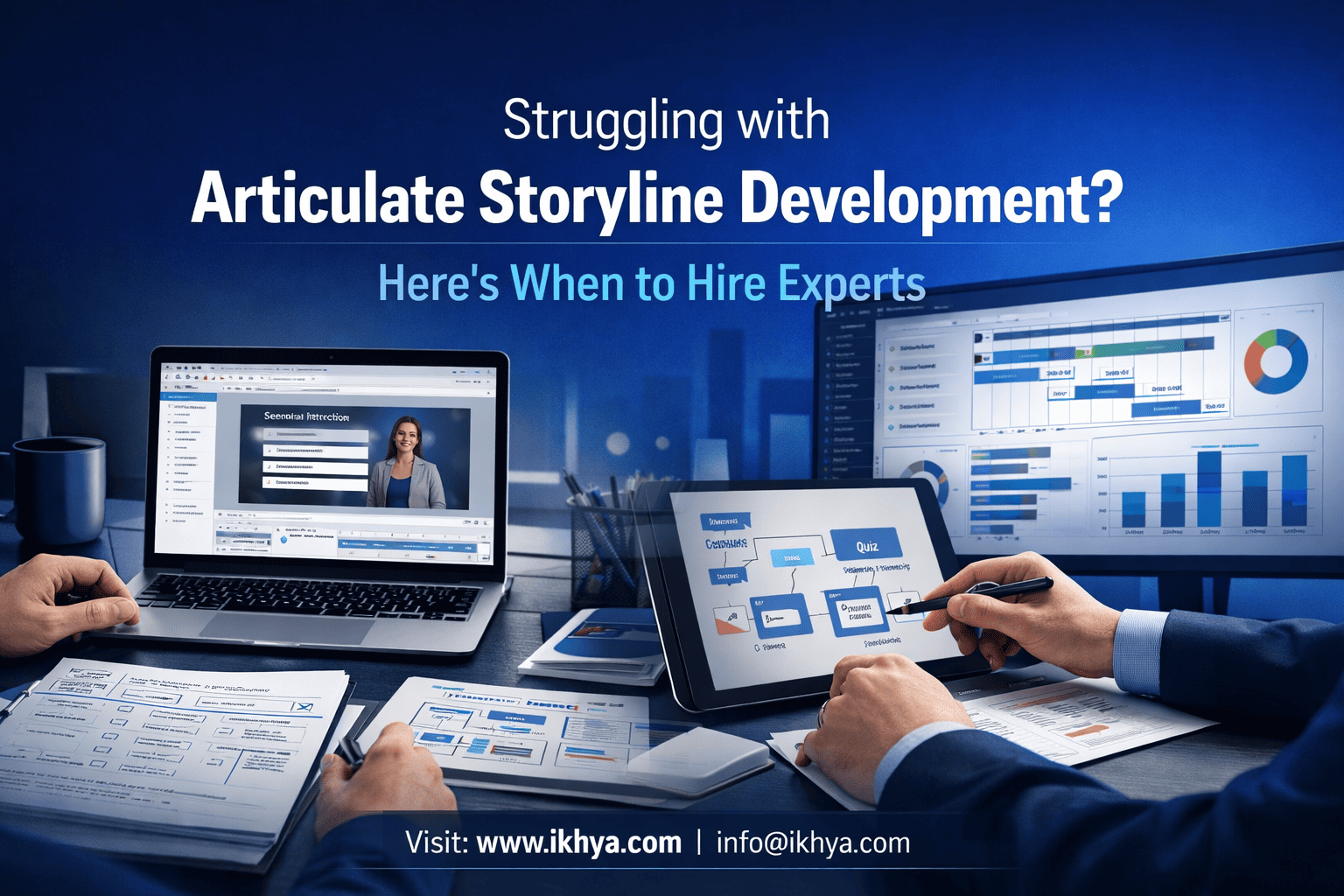
Articulate Storyline is one of the most powerful tools for interactive eLearning—but it is also one of the easiest tools to misuse. Poor structure, broken triggers, and LMS failures can turn expensive training into a frustrating experience.
If your team is struggling, don’t wait until delays and rework increase costs. Speak with experienced Articulate Storyline specialists at IKHYA – eLearning Solutions Company (info@ikhya.com) to assess your project and prevent costly mistakes before they escalate.
What Makes Articulate Storyline Development Challenging?
Articulate Storyline development is challenging because it requires instructional design expertise, technical trigger logic, LMS compatibility knowledge, accessibility compliance, and performance optimization. Without these skills, courses may break, fail tracking, load slowly, or deliver poor learning outcomes. Storyline is powerful—but its flexibility makes it easy to create inefficient or unstable courses.
Many organizations assume that Articulate Storyline is simply a “PowerPoint-like tool.” Organizations transitioning from slides often benefit from structured PPT to eLearning conversion to ensure interactive and LMS-ready course design.
While its interface looks familiar, the underlying functionality is significantly more complex. Storyline combines programming logic, multimedia integration, and LMS communication protocols. This creates a steep learning curve, especially for teams without specialized eLearning development experience.
The Hidden Technical Complexity Behind Storyline
Articulate Storyline operates more like a visual programming platform than a presentation tool. Developers must manage multiple layers of logic and technical systems simultaneously.
Core technical components include:
- Triggers and conditional logic
- Variables and state management
- Timeline synchronization
- Slide layers and branching scenarios
- JavaScript integration (for advanced functions)
- SCORM, xAPI, and cmi5 tracking configuration
- Multimedia optimization and compression
For example, a compliance course used by a healthcare provider in the United States may include:
- Branching scenarios based on learner decisions
- Variable-based scoring logic
- LMS tracking with SCORM 2004 4th Edition
- Accessibility features compliant with WCAG 2.1 AA
Each of these requires precise configuration. A single incorrect trigger can break the entire learning flow.
Example: How Trigger Misconfiguration Breaks Courses
Consider a safety training course created for a manufacturing company in Australia.
Expected behavior:
- Learner must complete all sections
- Final assessment unlocks only after completion
- LMS records completion and score
Common misconfiguration:
| Component | Incorrect Setup | Result |
|---|---|---|
| Trigger condition | Based on slide view, not completion variable | Assessment unlocks early |
| LMS tracking | Completion based on quiz result only | LMS shows incomplete |
| Variable logic | Not reset on retry | Incorrect scores reported |
| Slide layers | Timeline auto-progress enabled | Learners skip required content |
This leads to compliance risk. In regulated industries, such failures can result in audit violations.
Why Organizations Underestimate Storyline Development
Many teams underestimate the expertise required because Storyline allows basic course creation quickly. However, enterprise-level courses require advanced technical and instructional design capabilities.
Basic vs Professional Storyline Development Comparison:
| Capability | Beginner Developer | Expert Developer |
|---|---|---|
| Simple slides | Yes | Yes |
| Branching scenarios | Limited | Advanced |
| Variable-based logic | Rare | Standard |
| LMS troubleshooting | No | Yes |
| Accessibility compliance | Often missing | Fully implemented |
| Performance optimization | Poor | Optimized |
| Global deployment readiness | No | Yes |
This gap becomes critical when courses are deployed across large organizations.
Global Example: LMS Tracking Failures in Corporate Training
A UK financial services company deployed Storyline compliance training to 12,000 employees. The internal team created the course but lacked SCORM expertise.
Result:
- 37% of completion records failed to report correctly
- LMS showed incomplete training
- Regulatory audit flagged compliance gaps
The company had to rebuild the course using expert developers. This cost more than hiring specialists initially.
The Instructional Design + Technical Skill Combination
Storyline development requires two distinct skill sets:
Instructional Design Skills
- Learning objectives alignment
- Cognitive load management
- Scenario design
- Assessment strategy
Technical Development Skills
- Trigger logic implementation
- Variable programming
- LMS integration
- Accessibility compliance
Most internal teams have only one of these skill sets—not both.
Accessibility Compliance Requirements (Global Standards)
Organizations in the USA, UK, Australia, and UAE must meet accessibility standards.
Key requirements include:
- WCAG 2.1 AA compliance
- Keyboard navigation support
- Screen reader compatibility
- Focus order control
- Alternative text for media
Improper implementation can make training unusable for employees with disabilities and create legal risk.
Performance Optimization Challenges
Storyline courses often fail due to performance issues, especially on mobile devices.
Common performance problems:
- Large image sizes
- Uncompressed video
- Too many layers and triggers
- Poor slide structure
This leads to:
- Slow loading times
- LMS crashes
- Learner frustration
- Increased dropout rates
Experts optimize courses for fast performance while maintaining quality.
Why This Problem Is Increasing Globally
Organizations worldwide are rapidly converting classroom training into eLearning.
Countries with the highest Storyline adoption include:
- United States
- United Kingdom
- Australia
- Canada
- UAE
- Singapore
This demand has exposed the skill gap between basic users and expert developers.
What Are the Warning Signs You Should Hire Articulate Storyline Experts?
You should hire Articulate Storyline experts when your course has LMS tracking failures, broken triggers, slow performance, accessibility gaps, or complex branching requirements your team cannot implement correctly. Delays, repeated rework, and learner complaints also indicate technical and instructional design limitations that require specialist development expertise to resolve effectively.
Many organizations wait too long before involving experts. By the time problems are visible, the course may already be deployed to hundreds or thousands of learners. Fixing a broken course after deployment is far more expensive than building it correctly from the beginning.
Warning Sign #1: LMS Tracking Is Not Working Correctly
LMS tracking failures are one of the most serious and common Storyline problems, especially in regulated industries such as healthcare, finance, aviation, and construction.
Typical LMS tracking issues include:
- Course shows “Incomplete” after learner finishes
- Scores are not recorded correctly
- Completion status is inconsistent across learners
- LMS shows blank or missing data
- Course works locally but fails in LMS
These issues usually result from incorrect SCORM, xAPI, or completion trigger configuration.
Example: UAE Aviation Compliance Training Failure
An aviation training provider in Dubai deployed a Storyline course using SCORM 1.2. However, the course relied on completion triggers tied to slide views instead of quiz completion.
Result:
- LMS marked learners complete before assessment
- Compliance audit rejected training records
- Course required full rebuild using SCORM 2004 and proper completion triggers
Expert developers understand LMS communication models and prevent these failures.
Warning Sign #2: Your Course Uses Complex Branching or Variables
Storyline’s true power comes from its ability to create decision-based learning. However, branching scenarios require advanced logic design.
Complex scenarios that require experts include:
- Multi-path decision simulations
- Role-based learning paths
- Adaptive learning based on learner performance
- Scenario-based compliance training
- Personalized feedback based on user choices
Example: Healthcare Scenario in the United States
A hospital created infection control training with 12 decision points and 48 possible learning paths.
Such complex healthcare training programs require specialized eLearning solutions to ensure accuracy and compliance.
Internal team issue:
- Variables were not managed correctly
- Learners got stuck in loops
- Incorrect feedback displayed
Experts rebuilt the logic using structured variable mapping and state control.
Warning Sign #3: Course Performance Is Slow or Crashes
Performance issues increase dramatically when courses include high-resolution media, video, and complex interactions.
Common performance symptoms:
- Course takes more than 10 seconds to load
- Slides freeze during interaction
- Mobile version fails or crashes
- LMS times out
- Audio/video is out of sync
These issues are caused by poor media optimization and inefficient slide structure.
Performance comparison example:
| Course Version | Load Time | Completion Rate |
|---|---|---|
| Internal team version | 18 seconds | 62% |
| Expert-optimized version | 4 seconds | 91% |
This example comes from an Australian mining safety training program where mobile optimization was critical for remote workers.
Warning Sign #4: Accessibility Compliance Is Missing or Incomplete
Many organizations only discover accessibility issues after deployment, when users with disabilities cannot complete the course.
Critical accessibility requirements experts implement:
- Proper focus order
- Keyboard navigation
- Screen reader support
- Closed captions
- Accessible navigation controls
Example: UK Public Sector Compliance Issue
A government training course failed accessibility audit because:
- Buttons were not keyboard accessible
- Screen reader labels were missing
- Navigation order was incorrect
Expert developers corrected focus order, labels, and navigation logic.
This ensured compliance with WCAG 2.1 AA standards.
Warning Sign #5: Development Is Taking Too Long
Slow development is a major indicator that your team lacks Storyline expertise.
Optimizing development timelines is critical to reduce delays and improve delivery efficiency in Storyline projects.
Typical development timelines:
| Course Complexity | Internal Team | Expert Team |
|---|---|---|
| Basic course | 4–6 weeks | 2–3 weeks |
| Interactive course | 8–12 weeks | 3–6 weeks |
| Advanced simulation | 12–20 weeks | 6–10 weeks |
Experts work faster because they follow proven development frameworks.
Warning Sign #6: Your Team Is Constantly Fixing Bugs
Repeated bug fixing is one of the clearest signs expert help is needed.
Common recurring bugs include:
- Triggers not firing correctly
- Layers showing incorrectly
- Variables not resetting
- Navigation locking incorrectly
This usually results from improper course architecture.
Experts design scalable and stable course structures from the start.
What Happens When Organizations Delay Hiring Experts?
Delaying expert involvement often leads to higher costs, missed deadlines, and compliance risks. Problems compound because Storyline course architecture becomes harder to fix after development. Organizations frequently rebuild entire courses, doubling costs and delaying deployment. Early expert involvement prevents rework and ensures stable, compliant, scalable training delivery across global LMS environments.
Many organizations attempt to fix issues internally, but Storyline problems often stem from foundational architecture mistakes. These mistakes cannot be solved with small fixes.
Real Case Study: US Healthcare Compliance Course Rebuild
Initial internal development:
You can explore a real-world healthcare compliance training case study to understand how organizations overcome LMS and accessibility challenges.
- Duration: 14 weeks
- Result: LMS tracking failure, accessibility issues
Expert rebuild:
- Duration: 6 weeks
- Result: Fully compliant, stable, accessible course
Total cost comparison:
| Scenario | Total Cost |
|---|---|
| Internal attempt + rebuild | $48,000 |
| Expert development from start | $26,000 |
Hiring experts initially would have saved $22,000 and 14 weeks.
Technical Debt in Storyline Development
Poor initial development creates technical debt.
This includes:
- Broken variable logic
- Unstructured triggers
- Inconsistent navigation systems
- LMS tracking instability
Technical debt increases future maintenance cost and risk.
How Do Expert Articulate Storyline Developers Fix and Optimize Courses?
Expert Storyline developers fix courses by restructuring triggers, rebuilding variable logic, correcting LMS tracking configuration, optimizing media performance, and implementing accessibility standards. They also redesign instructional flow to improve engagement and completion rates. This ensures courses are stable, compliant, fast, and ready for global LMS deployment without failures.
Expert developers do not just “fix bugs.” They rebuild the course using scalable architecture that prevents future problems. This involves technical restructuring, instructional redesign, and system-level optimization.
Step 1: LMS Tracking and Completion Logic Reconstruction
LMS tracking failures often originate from incorrect completion triggers, wrong reporting settings, or SCORM/xAPI misconfiguration.
Experts correct these core tracking components:
- Completion trigger logic
- Pass/fail score configuration
- SCORM version selection
- LMS reporting settings
- Resume and bookmarking behavior
Example: SCORM Completion Logic Fix
| Component | Incorrect Setup | Expert Fix |
|---|---|---|
| Completion trigger | Based on slide view | Based on quiz result or completion variable |
| SCORM version | SCORM 1.2 (limited tracking) | SCORM 2004 or xAPI |
| Resume behavior | Disabled | Enabled with bookmarking |
| Reporting status | Completion only | Completion + score |
This ensures LMS systems like Cornerstone, Docebo, Moodle, and SAP SuccessFactors track correctly.
Step 2: Trigger and Variable Architecture Redesign
Triggers and variables control course logic. Poor structure leads to bugs, loops, and incorrect behavior.
Experts redesign trigger logic using structured variable frameworks.
Expert trigger architecture includes:
- Master variable mapping
- Consistent naming conventions
- Modular trigger logic
- Reset and retry logic
- Layer-based state control
Example variable structure used by experts:
| Variable Name | Purpose |
|---|---|
| Module1_Complete | Tracks module completion |
| Quiz_Passed | Determines completion |
| Attempt_Count | Controls retry attempts |
| User_Score | Stores learner score |
This ensures predictable and stable course behavior.
Step 3: Media and Performance Optimization
Performance optimization is essential, especially for mobile users and large organizations.
Experts optimize media using compression, restructuring, and resource management.
Optimization techniques include:
- Image compression without quality loss
- Video encoding using optimal bitrate
- Removing unused assets
- Reducing timeline complexity
- Splitting heavy slides
Before vs After optimization example (Australia mining training):
| Metric | Before | After |
|---|---|---|
| Course size | 480 MB | 92 MB |
| Load time | 18 seconds | 4 seconds |
| Crash rate | 12% | <1% |
This dramatically improves learner experience.
Step 4: Accessibility Compliance Implementation
Experts ensure courses meet global accessibility standards like WCAG 2.1 AA.
Accessibility features implemented:
- Keyboard navigation support
- Focus order control
- Screen reader labels
- Closed captions
- Accessible navigation
Accessibility structure example:
| Element | Expert Implementation |
|---|---|
| Buttons | Accessible labels |
| Navigation | Keyboard enabled |
| Media | Captioned |
| Focus order | Logical sequence |
This ensures compliance in USA, UK, Australia, UAE, and Europe.
Step 5: Instructional Design Optimization
Experts improve learning effectiveness, not just technical functionality.
They restructure courses using proven instructional design models:
- ADDIE
- Bloom’s Taxonomy
- Scenario-based learning
- Microlearning design
Instructional improvements include:
- Clear learning objectives
- Interactive scenarios
- Meaningful assessments
- Reduced cognitive overload
This increases completion and retention rates.
Internal Team vs Expert vs Offshore Storyline Development: Global Comparison
Choosing between internal teams, freelancers, or expert offshore providers significantly affects cost, quality, scalability, and long-term stability. Expert providers deliver faster, compliant, scalable development with lower total cost. Internal teams often lack specialized expertise, while offshore specialists combine technical depth, instructional design, and cost efficiency for global enterprise deployment.
Organizations in the USA, UK, Australia, and UAE increasingly use offshore Storyline specialists to improve quality while reducing cost.
Development Quality Comparison
| Capability | Internal Team | Freelancer | Expert Offshore Provider |
|---|---|---|---|
| Instructional design | Limited | Moderate | Advanced |
| LMS expertise | Limited | Moderate | Expert |
| Accessibility compliance | Often missing | Inconsistent | Fully compliant |
| Scalability | Low | Moderate | High |
| Reliability | Moderate | Moderate | High |
Cost Comparison by Region
| Region | Average Cost per Hour |
|---|---|
| USA | $80–$150 |
| UK | $70–$130 |
| Australia | $75–$140 |
| UAE | $60–$120 |
| Offshore expert providers | $25–$60 |
This creates cost savings of 40–70% without sacrificing quality.
Development Speed Comparison
| Project Type | Internal Team | Freelancer | Expert Provider |
|---|---|---|---|
| Basic course | 4–6 weeks | 3–5 weeks | 2–3 weeks |
| Interactive course | 8–12 weeks | 6–10 weeks | 3–6 weeks |
| Advanced simulation | 12–20 weeks | 10–16 weeks | 6–10 weeks |
Expert providers use established workflows and dedicated teams.
Real Example: UAE Corporate Training Cost Savings
A UAE corporate training provider compared internal vs expert offshore development.
Internal estimate:
$42,000 and 16 weeks
Expert offshore provider:
$18,500 and 7 weeks
Savings:
56% cost reduction and 9 weeks faster delivery
When Should You NOT Hire Articulate Storyline Experts?
You do not need Storyline experts when courses are simple, linear, non-interactive, and used internally with minimal compliance, accessibility, or LMS tracking requirements. Basic slide-based training without branching, scoring logic, or multimedia can be created by internal teams using Storyline templates without risking technical or compliance failures.
Hiring experts is most valuable for complex, high-impact, or large-scale projects. For very simple use cases, internal teams can manage development efficiently.
Scenario #1: Simple Informational Courses
If your course is purely informational and does not require advanced interactivity, internal teams can develop it successfully.
Examples of simple courses:
- Company introduction training
- HR policy overview
- Basic onboarding presentations
- Internal announcements
Typical characteristics:
| Feature | Requirement |
|---|---|
| Branching scenarios | Not required |
| Variables | Not required |
| LMS tracking | Basic completion |
| Accessibility | Minimal |
| Interactivity | Low |
These courses involve minimal technical complexity.
Scenario #2: Small Learner Groups with No Compliance Risk
If the course is used by a small internal audience and has no regulatory impact, expert involvement may not be necessary.
Example:
A small UK startup with 20 employees creates internal tool training.
Even if minor technical issues occur, the risk is manageable.
Scenario #3: Using Pre-Built Templates Without Custom Logic
Articulate Storyline templates simplify development significantly.
If your course uses:
- Default navigation
- Standard quiz templates
- No custom variables
- No branching
Internal teams can manage development effectively.
Scenario #4: Rapid Prototyping and Draft Development
Internal teams often build prototypes before hiring experts.
Experts can later refine and optimize the course.
This hybrid approach is common in large organizations.
How Do You Choose the Right Articulate Storyline Development Partner?
Choose a Storyline development partner with proven LMS expertise, accessibility compliance experience, instructional design capability, and global deployment experience. Review technical portfolio samples, verify SCORM/xAPI knowledge, assess accessibility implementation, and evaluate development process maturity. The right partner ensures scalable, compliant, and high-performance course delivery across enterprise LMS platforms worldwide.
Selecting the wrong partner can create long-term technical and compliance risks.
Critical Capability #1: LMS and Technical Expertise
Your partner must understand LMS standards deeply.
Required technical competencies:
- SCORM 1.2 and SCORM 2004
- xAPI and cmi5
- LMS testing and troubleshooting
- Resume and bookmarking logic
Ask this question:
“Which LMS platforms have you integrated with?”
Expert partners should have experience with:
- Cornerstone
- Docebo
- Moodle
- SAP SuccessFactors
- Absorb LMS
Critical Capability #2: Accessibility Compliance Experience
Accessibility compliance is mandatory in many countries.
Ask for proof of WCAG 2.1 AA implementation.
Verify they implement:
- Screen reader compatibility
- Keyboard navigation
- Proper focus order
- Accessible navigation
This is especially critical in the USA, UK, Australia, and government sectors worldwide.
Critical Capability #3: Instructional Design Expertise
Technical development alone is not enough.
Your partner must understand learning science.
Look for expertise in:
- Scenario-based learning
- Assessment design
- Microlearning
- Cognitive load optimization
This improves learning effectiveness.
Critical Capability #4: Performance Optimization Expertise
Ask partners how they optimize performance.
Key optimization areas:
- Media compression
- Mobile optimization
- Load speed optimization
- Cross-browser compatibility
Critical Capability #5: Structured Development Process
Expert providers follow structured workflows.
Typical expert development process:
| Phase | Description |
|---|---|
| Analysis | Define objectives |
| Design | Create storyboard |
| Development | Build Storyline course |
| Testing | LMS and QA testing |
| Deployment | LMS implementation |
This ensures predictable quality.
Critical Capability #6: Global Experience
Global experience ensures your partner understands:
- Regulatory requirements
- LMS compatibility
- Accessibility standards
- Localization requirements
This is critical for multinational organizations.
Global Best Practices for Successful Storyline Development
Successful Storyline development requires structured architecture, proper LMS configuration, accessibility compliance, performance optimization, and instructional design alignment. Global organizations follow defined development frameworks, testing protocols, and quality standards to ensure stable, scalable, and compliant eLearning deployment across multiple countries, LMS platforms, and learner environments.
Organizations in the USA, UK, Australia, UAE, and Europe follow these best practices.
Best Practice #1: Use Structured Variable Architecture
Always use consistent naming and structured logic.
Example naming convention:
- Module1_Complete
- Quiz_Passed
- User_Score
This improves maintainability.
Best Practice #2: Test Courses in LMS Early
Never test only in Storyline preview.
Always test in real LMS environments.
This prevents deployment failures.
Best Practice #3: Optimize for Mobile First
Over 60% of global learners access training on mobile devices.
Mobile optimization is essential.
Best Practice #4: Follow Accessibility Standards from Start
Accessibility should not be added later.
It must be built into course architecture.
Best Practice #5: Use Modular Course Structure
Modular courses improve scalability and maintenance.
Frequently Asked Questions (FAQ)
Is Articulate Storyline difficult to learn?
Articulate Storyline is easy to learn at a basic level but difficult to master. Advanced development requires expertise in triggers, variables, LMS integration, accessibility, and instructional design. Most professionals require months or years of experience to build complex, stable, and scalable enterprise-level courses.
How long does it take to develop a Storyline course?
Development time ranges from 2 weeks for simple courses to 10+ weeks for complex simulations. Expert developers work faster because they use structured workflows, templates, and proven architecture, reducing errors and rework.
Can Storyline courses work on mobile devices?
Yes. Storyline supports responsive playback via the Storyline player. However, proper design and optimization are required to ensure performance, usability, and compatibility across devices.
Is SCORM or xAPI better?
SCORM is widely supported and suitable for most LMS platforms. xAPI provides more advanced tracking and analytics. Experts select the appropriate standard based on LMS capability and training requirements.
What is the cost of hiring Storyline experts?
Costs vary globally:
- USA: $80–$150/hour
- UK: $70–$130/hour
- Australia: $75–$140/hour
- Offshore experts: $25–$60/hour
Offshore providers offer significant cost savings.
Conclusion: When Expert Storyline Development Becomes Essential
Articulate Storyline is a powerful but technically demanding platform. When courses involve LMS tracking, compliance requirements, accessibility, or advanced interactivity, expert developers become essential. Hiring specialists early prevents costly rebuilds, ensures compliance, and delivers high-quality learning experiences that scale globally.
If your team is facing Storyline delays, tracking failures, or performance issues, consult experienced specialists before problems escalate. IKHYA – eLearning Solutions Company helps organizations worldwide design, fix, and optimize Articulate Storyline courses for stability, compliance, and performance. Contact info@ikhya.com to evaluate your project and ensure successful deployment.