In-House vs Outsourced Articulate Storyline Development: Cost and Quality Comparison

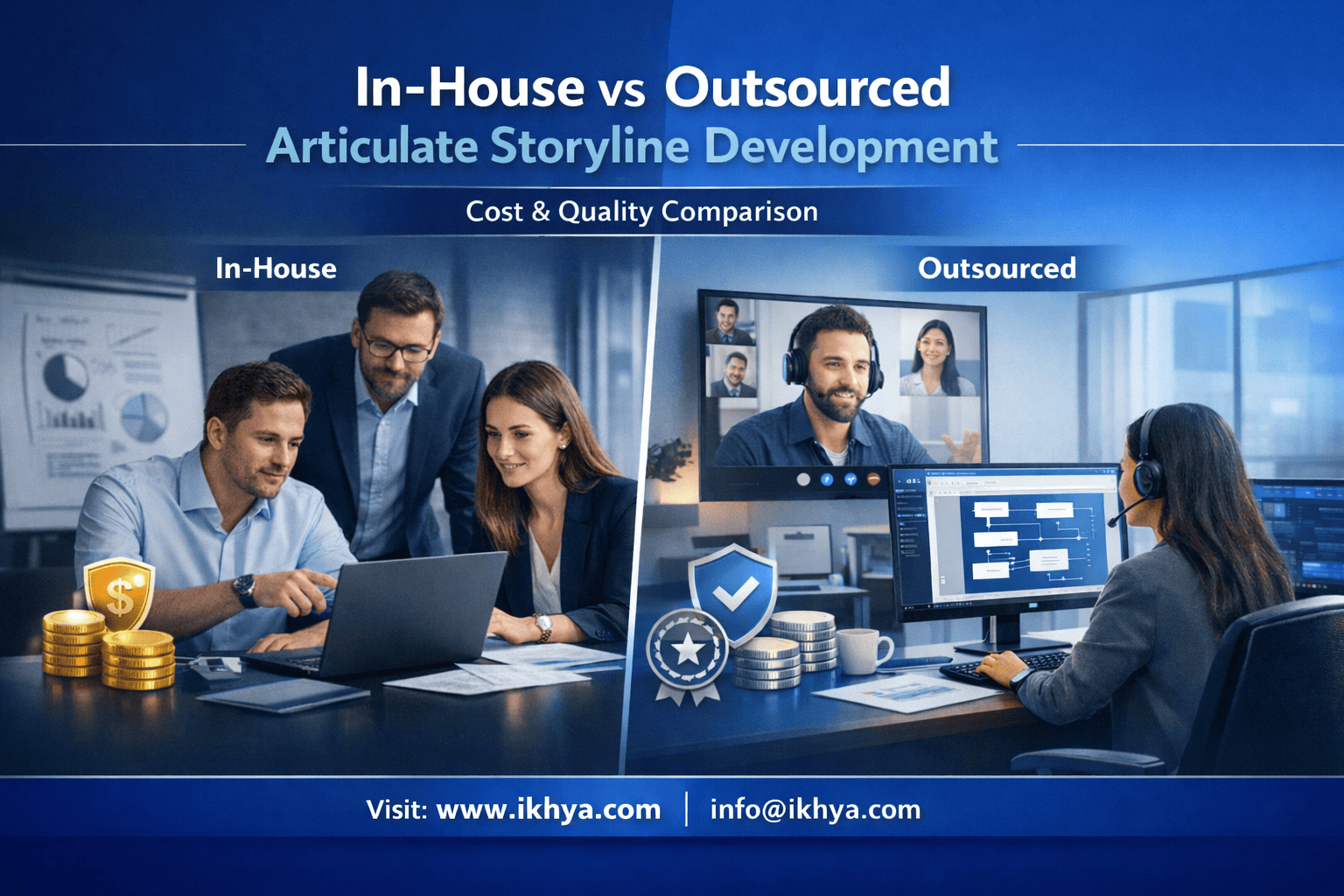
In-house vs outsourced Articulate Storyline development is a key decision for organizations evaluating cost, quality, and scalability of their eLearning programs. Many teams struggle to accurately estimate Articulate Storyline development cost when comparing internal production with Storyline outsourcing, as differences in expertise, timelines, and resources make it difficult to determine the most efficient approach.
Understanding how in-house and outsourced Storyline development compare across cost, speed, and quality helps organizations make informed decisions. While in-house teams offer control, outsourced Storyline development provides specialized expertise, faster execution, and greater flexibility.
IKHYA – eLearning Solutions Company supports organizations in evaluating in-house vs outsourced Articulate Storyline development, estimating accurate development costs, and identifying the most efficient approach. Contact IKHYA or email info@ikhya.com to discuss your requirements.
What Is In-House vs Outsourced Articulate Storyline Development?
In-house Storyline development means your internal employees design and build courses using Articulate Storyline. Outsourced development means hiring external specialists or vendors to create courses. The key differences involve cost structure, speed, scalability, technical expertise, and quality assurance. Each model affects project timelines, compliance risk, and long-term training efficiency differently.
Articulate Storyline is one of the most powerful rapid authoring tools used globally for corporate training, compliance, and technical simulations. Organizations must decide whether to build internal capability or rely on external experts.
In-House Storyline Development: Definition
In-house development means your organization manages everything internally:
- Instructional design
- Storyboarding
- Storyline development
- Graphic design
- Audio production
- Quality assurance
- LMS testing and deployment
Typical in-house team structure:
| Role | Responsibility |
|---|---|
| Instructional Designer | Learning strategy and structure |
| Storyline Developer | Builds interactive modules |
| Graphic Designer | Visual assets and UI |
| SME (Subject Matter Expert) | Provides technical knowledge |
| QA Tester | Tests functionality and LMS compatibility |
| Training Manager | Oversees project delivery |
Outsourced Storyline Development: Definition
Outsourced development means hiring external specialists such as:
- eLearning agencies
- Storyline freelancers
- Offshore development companies
- Specialized Storyline vendors
The vendor handles the full development lifecycle:
- Instructional design
- Storyline programming
- Media production
- QA and testing
- LMS integration support
Real-World Example: USA Corporate Compliance Training
A US healthcare company needed HIPAA compliance training for 5,000 employees.
In-house approach challenges:
- Internal designers lacked Storyline advanced interaction skills
- Development took 7 months
- Compliance errors required rework
Outsourced approach outcome:
- Delivered in 9 weeks
- Fully compliant with HIPAA and Section 508
- Included software simulations and assessments
Result: Faster deployment and reduced compliance risk.
Core Technical Capabilities Required for Storyline Development
Storyline development requires specialized technical skills beyond basic authoring.
Key technical competencies include:
Advanced Storyline Features
- Variables and conditional triggers
- Branching scenarios
- Software simulations
- Knowledge checks and adaptive learning paths
Compliance and Accessibility
- SCORM 1.2 / SCORM 2004 / xAPI / cmi5 packaging
- Section 508 compliance (USA)
- WCAG 2.1 accessibility (UK, Australia, EU)
Integration Requirements
- LMS integration (Cornerstone, Docebo, Moodle, SAP SuccessFactors)
- Multi-device responsive design
- Localization and translation support
Media and Interaction Development
- Custom graphics and animation
- Voiceover integration
- Video editing
- Interactive scenario development
Why This Decision Matters More Than Most Companies Realize
Choosing between in-house and outsourced Storyline development affects:
- Training quality
- Compliance risk
- Development speed
- Total cost of ownership
- Scalability
This decision becomes critical for:
- Compliance-driven industries (Healthcare, Oil & Gas, Finance)
- Fast-growing companies
- Organizations with frequent training updates
- Global companies with multilingual training needs
In-House vs Outsourced Articulate Storyline Development Cost Comparison
In-house Storyline development may appear cheaper initially, but the actual Articulate Storyline development cost includes hidden expenses such as salaries, benefits, software licenses, idle capacity, and management overhead. Outsourcing has higher upfront per-course cost but lower total ownership cost for most companies due to faster delivery, specialized expertise, and zero long-term staffing or infrastructure expense.
Many organizations compare only hourly rates, but the real cost includes the entire development ecosystem, especially when evaluating storyline course development pricing across in-house and outsourced models.
Full Cost Breakdown: In-House Storyline Development
In-house cost includes fixed and variable expenses.
1. Salary Costs (Global Benchmarks)
Average annual salaries for Storyline professionals:
| Role | USA | UK | Australia | UAE | India |
|---|---|---|---|---|---|
| Instructional Designer | $75,000 | £45,000 | AUD 95,000 | AED 220,000 | $12,000 |
| Storyline Developer | $85,000 | £50,000 | AUD 105,000 | AED 240,000 | $15,000 |
| Graphic Designer | $65,000 | £38,000 | AUD 80,000 | AED 180,000 | $10,000 |
| QA Tester | $60,000 | £35,000 | AUD 75,000 | AED 160,000 | $9,000 |
Typical minimum team cost annually:
- USA: $285,000+
- UK: £168,000+
- Australia: AUD 355,000+
- UAE: AED 800,000+
- India: $46,000+
This cost exists even when no courses are being developed.
2. Software and Tool Costs
Required tools include:
| Tool | Annual Cost |
|---|---|
| Articulate 360 license | $1,399 per user |
| Adobe Creative Cloud | $720 per user |
| Stock asset subscriptions | $500–$2,000 |
| Audio editing tools | $200–$600 |
| Review tools | $500–$1,500 |
For a small team of 3–5 developers:
Total annual software cost: $5,000–$12,000+
3. Infrastructure and Operational Costs
Hidden operational costs include:
- Recruitment costs
- Training and upskilling
- Employee benefits (20–40% of salary in USA, UK, Australia)
- Office space and IT equipment
- Project management overhead
Example (USA):
Base salary team: $285,000
Benefits (30%): $85,000
Software/tools: $10,000
Total annual cost: $380,000
4. Cost Per Course (In-House)
Typical productivity:
- 1 developer produces 20–35 hours of Storyline per year
Cost per course hour:
USA: $10,000–$18,000
UK: £6,000–£12,000
Australia: AUD 12,000–AUD 20,000
UAE: AED 30,000–AED 55,000
Full Cost Breakdown: Outsourced Storyline Development
Outsourcing converts fixed costs into variable costs, which is why many organizations prefer professional storyline development services to manage cost and efficiency.
You pay only per project.
Global Outsourcing Cost Comparison
| Region | Cost per Finished Hour |
|---|---|
| USA vendor | $8,000–$15,000 |
| UK vendor | £6,000–£12,000 |
| Australia vendor | AUD 10,000–AUD 18,000 |
| UAE vendor | AED 20,000–AED 40,000 |
| India offshore vendor | $2,000–$5,000 |
| Eastern Europe | $3,000–$6,000 |
Real Example: UK Financial Compliance Training
A London financial firm needed 12 Storyline courses.
In-house estimated cost:
- Team salary allocation: £120,000
- Software/tools: £8,000
- Timeline: 10 months
Cost per course: £10,600
Outsourced to offshore Storyline vendor:
- Cost per course: £3,800
- Timeline: 16 weeks total
Savings: £81,600 (64%)
Hidden Costs Most Companies Ignore
Hidden in-house costs include:
Idle Resource Cost
Internal developers are not utilized 100% year-round.
Typical utilization rate: 50–70%
Meaning 30–50% salary cost is wasted.
Learning Curve Cost
New Storyline developers require:
- 3–6 months training
- Reduced productivity during ramp-up
Rework and Quality Correction Cost
Poor initial development leads to:
- Rebuilding interactions
- Accessibility fixes
- LMS compatibility fixes
This can increase cost by 20–40%.
Total Cost of Ownership Comparison (3-Year Example)
Example: US company producing 30 hours of Storyline training.
| Cost Category | In-House | Outsourced Offshore |
|---|---|---|
| Salaries | $855,000 | $0 |
| Software/tools | $30,000 | $0 |
| Benefits | $255,000 | $0 |
| Development cost | Included | $120,000 |
| Total cost | $1,140,000 | $120,000 |
Savings: $1,020,000
In-House vs Outsourced Articulate Storyline Development Quality Comparison
Quality depends primarily on developer specialization, experience, and production volume. Outsourced Storyline specialists typically deliver higher quality because they build courses daily across industries. In-house teams often lack exposure to advanced interaction design, accessibility standards, and complex simulations unless the organization invests heavily in senior-level talent and continuous training.
Quality differences appear in multiple technical areas.
Interaction Design Quality
High-quality Storyline courses include:
- Branching scenarios
- Real-world simulations
- Adaptive learning paths
- Decision-based interactions
Outsourced specialists build these regularly.
In-house teams often rely on:
- Linear slides
- Basic quizzes
- Limited interactivity
Visual and UI Quality
Professional Storyline courses include:
- Custom UI layouts
- Consistent branding
- Advanced animations
- Modern UX design
Outsourced vendors usually include dedicated graphic designers.
In-house teams often reuse templates.
Compliance and Accessibility Quality
Critical for USA, UK, Australia, UAE.
Standards include:
- WCAG 2.1
- Section 508
- SCORM / xAPI
- Keyboard navigation
- Screen reader compatibility
Specialized vendors have dedicated accessibility workflows.
LMS Compatibility and Technical Stability
Common LMS platforms:
- Cornerstone
- SAP SuccessFactors
- Moodle
- Docebo
- Absorb LMS
Outsourced vendors test across multiple LMS platforms regularly.
In-house teams often test on only one system.
Real Example: Australian Mining Safety Training
Mining company required high-risk safety simulation training.
In-house result:
- Basic slides
- Limited scenario realism
Outsourced result:
- Fully interactive hazard simulations
- Real equipment environments
- Decision-based consequences
Training effectiveness improved significantly.
In-House vs Outsourced Storyline Development Speed Comparison
Outsourced Storyline development is typically 2–4 times faster than in-house because vendors use dedicated teams, established workflows, and parallel production. In-house teams face competing priorities, limited specialization, and resource constraints. Faster delivery is critical for compliance deadlines, product launches, and global training rollouts where delays increase operational and regulatory risk.
Speed directly impacts business outcomes, especially in regulated industries.
Typical Development Timeline Comparison
Development speed depends on team size, experience, and workflow maturity.
| Project Size | In-House Timeline | Outsourced Timeline |
|---|---|---|
| 1-hour course | 6–10 weeks | 2–4 weeks |
| 5-hour curriculum | 4–7 months | 6–10 weeks |
| 10-hour training program | 8–14 months | 3–5 months |
| 30-hour enterprise academy | 18–30 months | 6–12 months |
The main reason: outsourced vendors use parallel teams instead of a single internal developer.
Why Outsourced Teams Work Faster
Professional Storyline vendors use production pipelines similar to software companies.
Typical outsourced workflow:
Phase 1: Instructional Design (Parallel)
- SME analysis
- Storyboard creation
- Learning objectives mapping
Phase 2: Media Production (Parallel)
- Graphic design
- Voiceover recording
- Animation production
Phase 3: Storyline Development (Parallel)
- Multiple developers work simultaneously
- Interactions and simulations built concurrently
Phase 4: QA and LMS Testing
- Dedicated QA team
- SCORM/xAPI testing
- Multi-device testing
In-house teams often perform these sequentially.
Resource Allocation Comparison
In-house team example:
- 1 Storyline developer
- 1 Instructional designer (shared across projects)
- Limited graphic design support
Outsourced vendor example:
- 1 Project manager
- 2–4 Storyline developers
- 1 Instructional designer
- 1 Graphic designer
- 1 QA specialist
This parallel structure dramatically reduces timelines.
Real Example: UAE Aviation Compliance Training
A Dubai aviation company required Storyline training aligned with GCAA regulations.
In-house estimate:
- Timeline: 9 months
- Internal resource constraints
Outsourced vendor delivery:
- Timeline: 12 weeks
- Fully compliant and deployed globally
Result: 66% faster deployment.
Impact of Delays on Business Operations
Slow development affects:
- Compliance deadlines (OSHA, HIPAA, FCA, GCAA)
- Employee onboarding timelines
- Product launch readiness
- Regulatory audit readiness
Example: US financial services firms face fines exceeding $50,000 per compliance failure.
Speed is not just convenience—it directly affects business risk.
In-House vs Outsourced Storyline Development Scalability Comparison
Outsourced Storyline development scales significantly better because vendors can increase team size quickly. In-house teams scale slowly due to hiring delays, training requirements, and fixed staffing limits. Outsourcing enables rapid expansion for large training rollouts, multilingual projects, and global compliance programs without long-term staffing commitments.
Scalability becomes critical for growing organizations.
Scaling Challenges with In-House Teams
Scaling internal teams requires:
- Recruiting specialized Storyline developers
- Training new hires
- Purchasing additional licenses
- Expanding management capacity
Hiring timelines globally:
| Region | Average Hiring Time |
|---|---|
| USA | 2–5 months |
| UK | 2–4 months |
| Australia | 2–5 months |
| UAE | 1–3 months |
This slows scaling.
How Outsourced Vendors Scale Quickly
Outsourced vendors already maintain large teams.
They can increase production capacity immediately by adding:
- Additional developers
- Graphic designers
- QA testers
- Localization specialists
Scaling can occur within days instead of months.
Multilingual and Localization Scalability
Global organizations require training in multiple languages.
Example languages:
- English
- Arabic
- Spanish
- French
- German
- Hindi
- Mandarin
Outsourced vendors typically offer:
- Translation integration
- Multilingual voiceovers
- Regional compliance adaptation
In-house teams rarely have multilingual capability.
Real Example: Global Pharmaceutical Training (USA + EU + UAE)
A pharmaceutical company required:
- 25 Storyline courses
- 7 languages
- Deployment in 14 countries
In-house estimate:
- Timeline: 2–3 years
Outsourced vendor delivery:
- Timeline: 8 months
- Fully localized and deployed globally
Enterprise Scaling Cost Comparison
Scaling production from 5 courses/year to 50 courses/year:
| Cost Factor | In-House | Outsourced |
|---|---|---|
| Hiring cost | Very high | None |
| Time to scale | 6–18 months | Immediate |
| Infrastructure cost | High | None |
| Management overhead | High | Low |
| Flexibility | Low | High |
When to Choose In-House vs Outsourced Articulate Storyline Development
Outsourcing is the best choice for most organizations needing high-quality, scalable, and fast Storyline development without long-term staffing costs. In-house development makes sense only when course volume is extremely high, content changes weekly, and the organization can justify full-time specialist teams. The decision depends on course volume, complexity, compliance risk, and scalability needs.
Both models have valid use cases depending on organizational maturity.
Choose In-House Storyline Development If:
In-house works best when training is a continuous, core operational function.
Best scenarios include:
1. Very High Continuous Course Volume
Example:
- Large US banks producing 100–200 courses annually
- Global technology companies with dedicated learning departments
Reason: Full-time team utilization remains high.
2. Highly Confidential or Classified Training
Common in:
- Defense organizations
- Government agencies
- Military training
- Proprietary technology companies
Example: UK Ministry of Defence internal simulation training.
Security requirements prevent outsourcing.
3. Frequent Daily or Weekly Updates
Example industries:
- Software product companies
- SaaS platforms with weekly feature releases
- Internal product training teams
Constant updates justify internal teams.
4. Existing Mature Learning Infrastructure
Organizations that already have:
- Instructional design team
- Storyline developers
- Graphic designers
- Learning operations team
Adding outsourcing may not provide major advantages.
Choose Outsourced Storyline Development If:
Outsourcing is ideal for most organizations globally.
Best scenarios include:
1. Limited Internal Storyline Expertise
Common in:
- Healthcare organizations
- Manufacturing companies
- Financial institutions
- Oil and gas companies
These organizations are not training production specialists.
2. Need Faster Deployment
Critical for:
- Compliance deadlines
- Product launches
- Regulatory rollout
Example: UAE aviation regulatory training deadlines.
3. Need Advanced Interactive Simulations
High-complexity training includes:
- Software simulations
- Equipment training
- Scenario-based learning
- Safety simulations
Outsourced specialists have more experience.
4. Need Cost Efficiency
Outsourcing avoids:
- Full-time salaries
- Software licenses
- Hiring costs
- Idle resource costs
This significantly reduces total ownership cost.
5. Multilingual or Global Training Requirements
Example:
- US company deploying training in Europe, Middle East, Asia
- Australian mining company training global workforce
Outsourced vendors handle localization efficiently.
Global Enterprise Comparison: USA, UK, Australia, UAE Decision Patterns
Organizations in different regions follow distinct outsourcing patterns based on labor cost, regulation, and training volume. High-cost labor markets like the USA, UK, and Australia outsource heavily for cost efficiency. UAE companies outsource for speed and expertise. Offshore development hubs support global demand with specialized Storyline capabilities.
Below is how global enterprises typically decide.
United States
Common industries outsourcing Storyline:
- Healthcare (HIPAA training)
- Finance (SEC, FINRA compliance)
- Manufacturing (OSHA safety)
- Technology (software training)
Reason:
- High salary costs ($80,000–$120,000 per developer)
- Strong compliance requirements
Typical outsourcing rate: Very high
United Kingdom
Common outsourcing sectors:
- Financial services (FCA compliance)
- Healthcare (NHS training)
- Energy sector
Reason:
- Limited availability of senior Storyline specialists
- High internal staffing cost
Typical outsourcing rate: High
Australia
Common outsourcing sectors:
- Mining safety training
- Government compliance training
- Corporate onboarding
Reason:
- High labor costs
- Geographic isolation limits hiring pool
Typical outsourcing rate: Very high
UAE and Middle East
Common outsourcing sectors:
- Aviation training
- Oil and gas safety
- Corporate compliance
Reason:
- Limited local Storyline specialists
- Fast training deployment requirements
Typical outsourcing rate: Extremely high
Offshore Development Hubs (India, Eastern Europe)
These regions provide:
- Specialized Storyline developers
- High production capacity
- Lower cost
- Strong global experience
Many Fortune 500 companies use offshore Storyline vendors.
Hybrid Model: The Most Effective Strategy for Many Enterprises
The hybrid model combines internal strategy with outsourced production. Internal teams manage learning strategy, SMEs, and approvals, while external specialists handle Storyline development, media production, and technical implementation. This approach delivers the best balance of cost, quality, speed, and scalability for growing global organizations managing complex training programs.
Hybrid model structure:
Internal team handles:
- Learning strategy
- SME coordination
- Content approval
- LMS management
Outsourced team handles:
- Storyline development
- Interaction programming
- Graphic design
- QA and technical testing
This approach is widely used by global enterprises.
Final Cost and Quality Comparison Summary
| Factor | In-House | Outsourced |
|---|---|---|
| Upfront cost | High | Low |
| Long-term cost | Very high | Low |
| Speed | Slow | Fast |
| Scalability | Limited | High |
| Quality consistency | Variable | High |
| Compliance expertise | Limited | Strong |
| Global deployment capability | Limited | Excellent |
| Best for | Very large training departments | Most organizations |
Reduce Storyline Development Cost and Improve Training Quality
Choosing between in-house and outsourced Articulate Storyline development has long-term cost, quality, and scalability implications. Making the wrong decision can lead to unnecessary staffing costs, delayed compliance training, and lower learner engagement. The right development strategy can reduce costs by 30–60% while delivering faster, higher-quality training aligned with global standards.
IKHYA – eLearning Solutions Company provides high-quality storyline development services for global organizations across the USA, UK, Australia, UAE, and worldwide.
Whether you need a single course or a full training curriculum, our Storyline experts can help you:
- Reduce development costs without sacrificing quality
- Deliver interactive, simulation-based learning experiences
- Meet SCORM, xAPI, WCAG, and compliance requirements
- Scale training efficiently across global teams
- Accelerate deployment timelines
Contact IKHYA today to get a free consultation and accurate cost estimate for your Storyline project.
📧 Email: info@ikhya.com
🌐 Company: IKHYA – eLearning Solutions Company
Speak with our Storyline experts and discover the fastest, most cost-effective way to build world-class eLearning.
FAQS
1. What is in-house vs outsourced Articulate Storyline development?
In-house development means creating Storyline courses using internal teams, while outsourced Articulate Storyline development involves hiring external specialists or agencies to build courses.
2. Which is more cost-effective: in-house or outsourced Storyline development?
Outsourced Storyline development is typically more cost-effective due to lower overhead, faster delivery, and no long-term staffing costs.
3. What is the average Articulate Storyline development cost?
Articulate Storyline development cost ranges from $2,000 to $15,000 per hour of finished content depending on complexity, location, and expertise.
4. Why do companies outsource eLearning development?
Companies choose outsourced eLearning development to access specialized skills, reduce costs, improve quality, and accelerate project timelines.
5. What are storyline development services?
Storyline development services include instructional design, course development, interaction design, media production, and LMS integration using Articulate Storyline.
6. How does storyline course development pricing work?
Storyline course development pricing depends on factors like course length, interactivity level, media complexity, and compliance requirements.
7. Is outsourcing Storyline development better than in-house?
Outsourcing is often better for scalability, speed, and cost efficiency, while in-house development is suitable for continuous and high-volume training needs.
8. How long does it take to develop a Storyline course?
Development timelines vary, but a 1-hour course typically takes 2–10 weeks depending on complexity and team structure.
9. What factors affect Articulate Storyline development cost?
Key factors include course complexity, interactivity, media elements, compliance requirements, localization, and development team expertise.
10. What are the hidden costs of in-house Storyline development?
Hidden costs include salaries, training, software licenses, idle resources, and project management overhead.
11. What are the benefits of outsourced Storyline development?
Benefits include faster turnaround, access to experts, lower costs, scalability, and higher quality output.
12. Can outsourced Storyline developers meet compliance requirements?
Yes, experienced vendors ensure compliance with standards like SCORM, xAPI, WCAG, and Section 508.
13. What is the difference between Storyline outsourcing cost and in-house cost?
Storyline outsourcing cost is variable and project-based, while in-house cost includes fixed expenses like salaries, tools, and infrastructure.
14. How do I choose between in-house and outsourced eLearning development?
Evaluate factors like budget, timeline, complexity, internal expertise, and scalability requirements.
15. What industries benefit most from outsourced Storyline development?
Industries like healthcare, finance, manufacturing, aviation, and oil & gas benefit due to compliance and scalability needs.
16. Is outsourced Storyline development secure?
Yes, professional vendors follow strict data security protocols, NDAs, and compliance standards.
17. Can outsourced vendors match branding requirements?
Yes, vendors design fully customized courses aligned with company branding and guidelines.
18. What is the ROI of outsourced Storyline development?
Outsourcing can reduce costs by 30–60% while improving speed, quality, and training effectiveness.
19. What is included in outsourced eLearning development services?
Services include instructional design, Storyline development, multimedia production, QA testing, and LMS integration.
20. When should a company build an in-house Storyline team?
An in-house team is ideal when training demand is continuous, high-volume, and requires frequent updates.
Related Resources
Explore these related resources to better understand Articulate Storyline development, outsourcing strategies, and cost optimization. These guides will help you make informed decisions and choose the right development approach for your organization.
- Articulate Storyline Development Services
- Outsource Articulate Storyline Development to Reduce Cost and Timeline
- Hire Articulate Storyline Developers: Skills, Cost and Models
- Articulate Storyline Course Development Services – Complete Guide
- How to Choose the Best Articulate Storyline Development Company