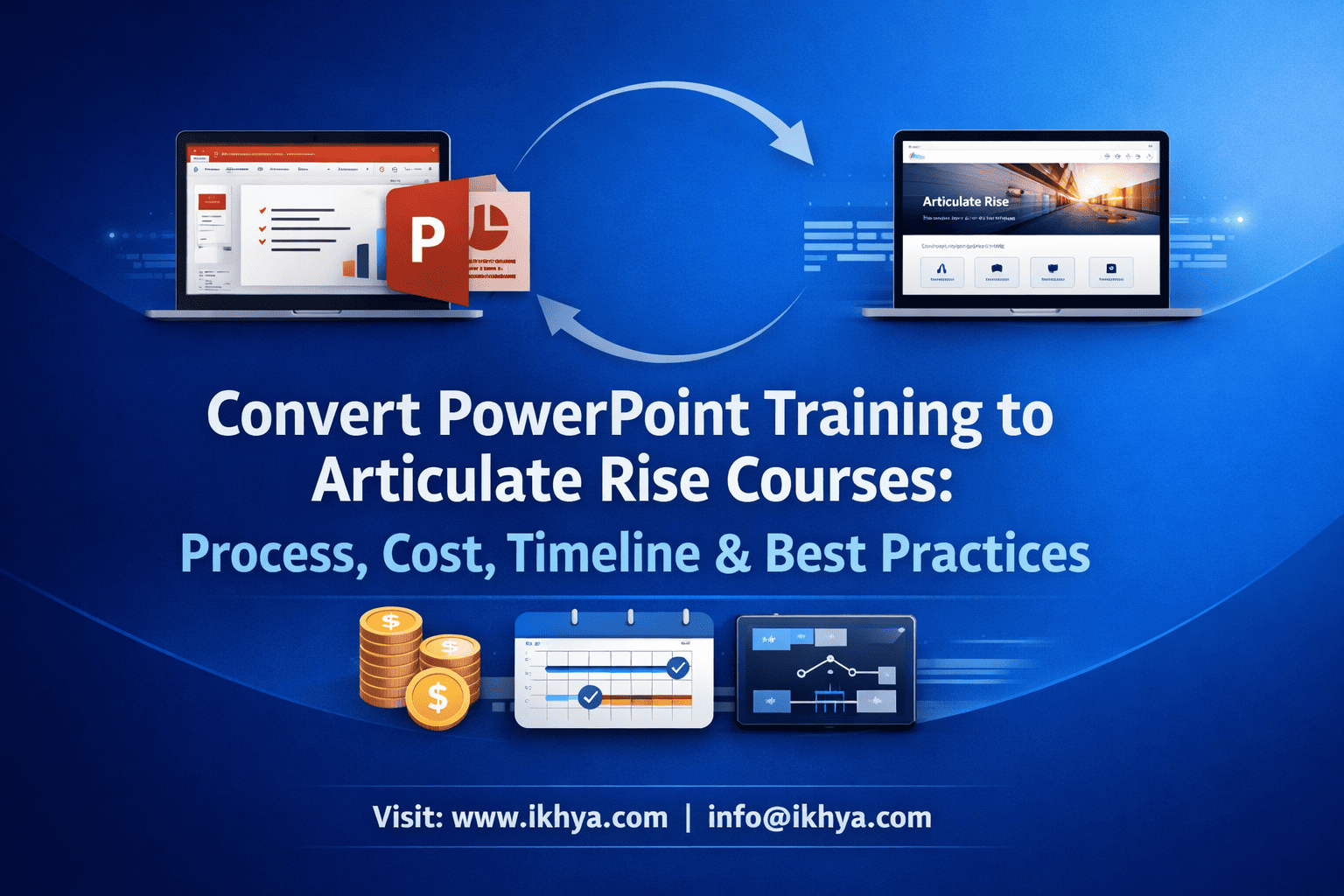
Convert PowerPoint Training to Articulate Rise Courses: Process, Cost, Timeline & Best Practices

Converting PowerPoint training to Articulate Rise courses is one of the fastest ways to modernize outdated corporate training and make it mobile-friendly, interactive, and LMS-ready. Many organizations still rely on static PPTs that fail to engage learners or meet today’s compliance and accessibility standards.
If you’re struggling with low engagement, poor retention, or training that doesn’t scale globally, converting your PowerPoint into responsive eLearning can solve all three at once. You’ll learn the exact process, cost, timelines, and best practices to do it right.
If you’re exploring how this transformation could work for your organization, you can book a free eLearning demo to see real examples in action.
What Does It Mean to Convert PowerPoint Training into Articulate Rise Courses
Converting PowerPoint to Articulate Rise means transforming static slides into interactive, responsive, and LMS-compatible eLearning modules using Rise 360, a modern authoring tool designed for rapid development.
Instead of simply uploading slides, the content is restructured, redesigned, and enhanced to improve learning outcomes.
What Actually Changes During Conversion
- Slides → structured lessons and blocks
- Bullet points → interactive content
- Static visuals → engaging multimedia
- Linear flow → modular learning paths
Key Elements of a Converted Rise Course
- Mobile-first responsive design
- Interactive elements (tabs, accordions, quizzes)
- Microlearning-friendly structure
- SCORM / xAPI compatibility for LMS tracking
Example Transformation
| PowerPoint Training | Articulate Rise Course |
|---|---|
| 50-slide compliance PPT | 5 microlearning modules |
| Static bullet content | Interactive blocks & scenarios |
| No tracking | LMS tracking (SCORM/xAPI) |
| Desktop-only | Fully responsive (mobile/tablet) |
Why Simple Conversion is Not Enough
Many organizations assume conversion is just copying content. In reality, effective conversion involves:
- Instructional redesign
- Content restructuring
- Engagement enhancement
- Learning objective alignment
If you want a deeper understanding of how this transformation works, explore this complete guide to convert PowerPoint to eLearning.
Where Most Organizations Go Wrong
- Treating PPT as final content instead of raw material
- Ignoring instructional design principles
- Overloading Rise with text-heavy content
- Not optimizing for mobile learning
These mistakes reduce engagement and ROI significantly.
How Modern Conversion Aligns with Business Goals
Today’s enterprises in the USA, UK, UAE, and Australia are shifting toward:
- Rapid eLearning development
- Scalable global training deployment
- Data-driven learning via LMS analytics
A well-converted Rise course supports:
- Faster onboarding
- Better compliance tracking
- Consistent global training delivery
If your current PPT-based training is limiting performance, it may be time to explore structured PPT to eLearning conversion services that ensure quality and scalability.
Why Convert PowerPoint to Articulate Rise (Key Benefits)
Converting PowerPoint training into Articulate Rise courses improves engagement, accessibility, scalability, and tracking. Unlike static slides, Rise delivers a structured learning experience that works seamlessly across devices and integrates with LMS platforms using SCORM or xAPI.
1. Mobile-First, Responsive Learning
PowerPoint slides are not designed for mobile devices. Rise courses automatically adapt to:
- Smartphones
- Tablets
- Laptops
This is critical for global teams, especially in industries like manufacturing and retail where employees rely on mobile learning.
2. Higher Learner Engagement
Rise replaces passive content with interactive formats:
- Click-to-reveal blocks
- Knowledge checks
- Scenario-based interactions
- Multimedia integration (video, audio)
This shift improves retention and reduces course drop-off rates.
3. Faster Development with Rapid eLearning
Rise is built for speed. Compared to traditional development:
- Courses can be developed 40–60% faster
- Updates can be made quickly without rebuilding modules
- Ideal for compliance and frequently changing content
To understand how speed impacts training ROI, explore rapid eLearning development services.
4. LMS Compatibility and Tracking
Rise courses support:
- SCORM 1.2 / 2004
- xAPI (Tin Can API)
- LMS analytics and reporting
This enables organizations to track:
- Course completion rates
- Learner performance
- Compliance status
5. Microlearning-Ready Structure
Instead of long presentations, Rise enables:
- Short, focused modules
- Just-in-time learning
- Better knowledge retention
This is especially useful for onboarding and performance support.
If your strategy includes breaking down large training into smaller modules, consider microlearning development approaches.
6. Easy Global Deployment
Rise simplifies multi-region training:
- Supports localization
- Works across devices and geographies
- Ideal for distributed teams
Organizations operating in regions like the US, UK, UAE, and Australia benefit from consistent training delivery without redesigning content for each region.
For global rollout strategies, explore mobile learning solutions that align with modern workforce needs.
7. Consistent Learning Experience Across Teams
PowerPoint-based training often varies by presenter. Rise ensures:
- Standardized content delivery
- Uniform learning outcomes
- Reduced dependency on instructors
Real-World Impact Example
| Scenario | Before (PPT Training) | After (Rise Conversion) |
|---|---|---|
| Compliance Training (Finance) | 2-hour slide deck | 20-min microlearning modules |
| Completion Rate | 45% | 85% |
| Engagement | Low | High |
| Tracking | None | LMS analytics |
When These Benefits Matter Most
You should strongly consider conversion if:
- Your training is still PPT-based
- Learners access content on mobile devices
- You need compliance tracking
- Training must scale across locations
If you’re evaluating how Rise fits into your broader learning strategy, reviewing Articulate Rise development services can give you clarity on implementation approaches.
When Should You Convert PPT vs Redesign Training
Not every PowerPoint should be directly converted into an Articulate Rise course. In many cases, the right decision is to redesign the training instead of simply converting it. The choice depends on content quality, learning goals, and business impact.
Quick Decision Rule
- Convert PPT → when content is accurate, structured, and still relevant
- Redesign → when content is outdated, text-heavy, or lacks engagement
When PPT to Rise Conversion Works Best
Direct conversion is effective when:
- Content is up-to-date and accurate
- Slides follow a logical structure
- Training is primarily informational (not skill-based)
- Minimal interactivity is required
Example Scenario
A finance company in the UK has a regulatory compliance PPT updated annually.
- Content is already validated
- No need for complex simulations
- Goal is knowledge reinforcement
Best approach: Convert into microlearning-based Rise modules for faster deployment and LMS tracking.
When You Should Redesign Instead of Convert
Redesign is necessary when:
- Slides are text-heavy or cluttered
- No clear learning objectives exist
- Training requires decision-making or simulations
- Content is outdated or inconsistent
Example Scenario
A manufacturing company uses a safety training PPT with:
- Dense text
- No visuals or scenarios
- No learner interaction
Best approach: Redesign into scenario-based learning using structured instructional design.
In such cases, leveraging instructional design services ensures the content is aligned with real-world performance goals.
Conversion vs Redesign Comparison
| Factor | Convert PPT | Redesign Training |
|---|---|---|
| Content Quality | High | Low or inconsistent |
| Development Time | Faster (1–3 weeks) | Longer (3–6 weeks) |
| Cost | Lower | Higher |
| Interactivity | Basic to moderate | Advanced |
| Learning Impact | Moderate | High |
Hybrid Approach (Most Effective Strategy)
In real-world corporate training, the best approach is often a hybrid model:
- Convert simple informational slides
- Redesign complex or critical sections
Example
A US-based healthcare organization converting onboarding training:
- Policies → converted into Rise modules
- Patient interaction scenarios → redesigned with interactive elements
This balances cost, speed, and learning effectiveness.
Decision Framework You Can Use
Before starting, evaluate your PPT using these criteria:
- Is the content still relevant?
- Does it support clear learning objectives?
- Does it require interaction or just information delivery?
- Is engagement critical for outcomes?
If most answers lean toward “no,” redesign is the better investment.
Business Impact of Choosing the Right Approach
Making the wrong choice can lead to:
- Low learner engagement
- Poor knowledge retention
- Wasted development budget
Choosing correctly ensures:
- Faster rollout
- Better ROI
- Higher training effectiveness
If you’re unsure whether to convert or redesign your training, reviewing a structured rapid conversion of instructor-led training to Articulate Rise eLearning approach can help you make the right call based on your content type.
Step-by-Step Process to Convert PPT to Rise 360
Converting PowerPoint to Rise 360 involves a structured process that includes content analysis, instructional redesign, development, and deployment. Skipping steps often leads to poor-quality courses and low engagement.
Step 1: Content Audit and Analysis
Start by reviewing your PowerPoint content:
- Identify outdated or redundant slides
- Group content into logical topics
- Define learning objectives
This step ensures you don’t carry forward ineffective content.
Step 2: Content Restructuring for Microlearning
Break long presentations into smaller modules:
- 30–50 slides → 5–7 lessons
- Each lesson → 5–7 minutes
This improves retention and makes learning more flexible.
Step 3: Instructional Design Mapping
Convert slide content into:
- Learning objectives
- Storyboards
- Interaction plans
This is where content becomes learning-focused instead of presentation-focused.
Step 4: Build Course in Articulate Rise
Using Rise 360, content is added in blocks:
- Text blocks
- Image and multimedia blocks
- Interactive elements (tabs, accordion, quizzes)
This transforms static slides into engaging modules.
Step 5: Add Assessments and Knowledge Checks
Include:
- Quiz questions
- Scenario-based checks
- Reinforcement activities
This ensures learners actively engage with the content.
Step 6: Review and Quality Assurance
Check for:
- Content accuracy
- Mobile responsiveness
- Navigation flow
- Accessibility compliance
Step 7: LMS Deployment (SCORM/xAPI)
Export the course and upload to your LMS:
- SCORM 1.2 / 2004
- xAPI for advanced tracking
This enables performance tracking and reporting.
Typical Workflow Summary
| Stage | Key Activity | Output |
|---|---|---|
| Analysis | Content audit | Cleaned PPT |
| Design | Storyboarding | Learning structure |
| Development | Build in Rise | Interactive course |
| QA | Testing | Final course |
| Deployment | LMS upload | Live training |
Example Timeline
Basic Conversion (2 Weeks)
- Simple content
- Minimal interactivity
Enhanced Conversion (4–6 Weeks)
- Instructional redesign
- Interactive elements
- Assessments
Where Most Projects Fail
- Skipping instructional design
- Direct copy-paste from PPT
- Ignoring mobile optimization
- No testing before LMS deployment
If you’re looking for a structured and scalable way to execute this process, exploring rapid eLearning development using Storyline and Rise 360 can help streamline both speed and quality.
If your organization needs a tailored conversion strategy aligned with business goals, you can request an RFP to evaluate scope, cost, and timelines with experts.
Instructional Design Best Practices for PPT to Rise Conversion
Converting PowerPoint to Articulate Rise is not just a technical task—it requires strong instructional design to ensure the course actually improves learning outcomes. The goal is to transform information into engaging, outcome-driven learning experiences.
Focus on Learning Objectives First
Before building anything in Rise:
- Define what learners should know or do after the course
- Align each module with a clear objective
- Remove content that does not support outcomes
This prevents content overload and keeps courses focused.
Apply Microlearning Principles
Instead of long lessons, structure content into:
- Short modules (5–7 minutes)
- One concept per lesson
- Clear progression
This approach works especially well for compliance, onboarding, and product training.
Replace Bullet Points with Interactions
PowerPoint often relies heavily on text. In Rise, convert this into:
- Tabs for categorized information
- Accordions for layered content
- Labeled graphics for visual explanation
This reduces cognitive overload and improves retention.
Use Real-World Scenarios
Learners retain more when content is contextual. Add:
- Decision-based scenarios
- Practical examples
- Role-based situations
For example, in finance training, instead of listing AML rules, present a scenario where a learner identifies suspicious transactions.
For more immersive learning approaches, consider integrating eLearning simulation-based training services into critical modules.
Design for Mobile-First Learning
Rise is responsive by default, but design still matters:
- Keep text concise
- Use vertical scrolling logic
- Avoid large paragraphs
- Optimize images for smaller screens
Add Frequent Knowledge Checks
Reinforcement improves retention. Include:
- Quick quizzes after each lesson
- Reflection questions
- Scenario-based assessments
Ensure Accessibility and Inclusivity
Modern training must be accessible:
- Add alt text for images
- Use readable fonts and contrast
- Provide captions for videos
Organizations operating globally should align with accessibility standards. You can explore accessible eLearning solutions to meet compliance requirements.
Maintain Visual Consistency
Consistency improves usability:
- Standard fonts and colors
- Uniform navigation patterns
- Consistent layout across modules
Common Instructional Design Mistakes to Avoid
- Converting slides without simplifying content
- Overloading learners with too much information
- Ignoring learner context and job roles
- Using interactions without purpose
How Long Does PPT to Rise Conversion Take (Timeline Models)
The time required to convert PowerPoint training into Articulate Rise courses depends on content complexity, interactivity level, and instructional design depth. Most corporate projects fall into predictable timeline models.
Typical Conversion Timelines
- Basic Conversion: 1–2 weeks
- Moderate Interactivity: 3–4 weeks
- Advanced Redesign: 4–6+ weeks
Timeline Breakdown by Project Type
| Project Type | Duration | Use Case |
|---|---|---|
| Basic PPT Conversion | 1–2 weeks | Informational training |
| Enhanced Conversion | 3–4 weeks | Interactive modules |
| Full Redesign | 4–6 weeks | Scenario-based training |
Example Timeline 1: Rapid Conversion (2 Weeks)
Industry: Retail onboarding (UAE)
- Week 1:
- Content audit
- Structuring modules
- Week 2:
- Development in Rise
- QA and LMS deployment
Outcome:
Converted 40-slide PPT into 6 microlearning modules with quizzes.
Example Timeline 2: Enhanced Conversion (5 Weeks)
Industry: Healthcare compliance (USA)
- Week 1–2:
- Instructional design + storyboarding
- Week 3–4:
- Development with interactions
- Week 5:
- QA, accessibility checks, LMS upload
Outcome:
Interactive compliance course with scenarios and assessments.
Factors That Affect Timeline
- Number of slides
- Content complexity
- Level of interactivity
- Multimedia requirements
- Review cycles and approvals
How to Speed Up Conversion
- Use standardized templates
- Limit unnecessary animations
- Pre-define learning objectives
- Work with experienced teams
Organizations looking to accelerate timelines often rely on rapid eLearning development services to meet tight deadlines without compromising quality.
Hidden Delays to Watch For
- Frequent stakeholder revisions
- Unclear content ownership
- Lack of defined learning goals
- Last-minute scope changes
Realistic Planning Tip
For enterprise-level projects across regions like the US, UK, and Australia:
- Plan buffer time for reviews
- Align with compliance requirements
- Include LMS testing cycles
Cost of Converting PowerPoint Training to Articulate Rise Courses
The cost of PPT to Rise conversion varies widely based on content quality, interactivity level, and project scope. Understanding pricing helps you plan budgets and avoid unexpected expenses.
Average Cost Range
- Basic Conversion: $1,000 – $3,000 per course
- Moderate Interactivity: $3,000 – $8,000
- Advanced Redesign: $8,000 – $15,000+
Cost Breakdown by Components
| Component | Cost Impact |
|---|---|
| Content cleanup | Low |
| Instructional design | Medium |
| Interactivity | High |
| Multimedia (video/audio) | High |
| Localization | Medium–High |
Example Cost Scenario 1
Industry: Finance (UK)
Training Type: Compliance PPT
- 50 slides
- Basic interactivity
- Minimal redesign
Estimated Cost: $2,500
Example Cost Scenario 2
Industry: Manufacturing (Australia)
Training Type: Safety training
- 70 slides
- Scenario-based learning
- Multimedia integration
Estimated Cost: $10,000+
What Increases Cost the Most
- Scenario-based interactions
- Custom graphics and animations
- Multi-language localization
- LMS integration complexity
For organizations planning global rollout, eLearning translation and localization services play a major role in cost planning.
Cost Optimization Strategies
- Convert only relevant content
- Use templates for consistency
- Avoid unnecessary complexity
- Adopt a hybrid conversion approach
ROI Perspective
While conversion requires investment, it delivers:
- Reduced training time
- Improved completion rates
- Better compliance tracking
- Scalable training delivery
In-House vs Outsourcing Cost Consideration
- In-house: Lower direct cost but slower and resource-heavy
- Outsourcing: Higher upfront cost but faster and scalable
If you are evaluating external expertise, exploring custom eLearning development services can help balance cost and quality.
If you want a precise estimate tailored to your training needs, you can contact the team to get clarity on scope, pricing, and delivery timelines.
PPT to Rise vs Storyline: Which Should You Choose
Choosing between Articulate Rise and Storyline depends on interactivity needs, complexity, and learning objectives. Both tools are powerful, but they serve different purposes in corporate training.
Quick Answer
- Choose Rise → for fast, responsive, content-driven training
- Choose Storyline → for complex, simulation-based, or highly interactive learning
Key Differences Between Rise and Storyline
| Factor | Articulate Rise | Articulate Storyline |
|---|---|---|
| Development Speed | Very fast | Moderate |
| Responsiveness | Fully responsive | Requires adjustments |
| Interactivity | Limited to moderate | Advanced |
| Use Case | Informational & microlearning | Simulations & complex scenarios |
| Mobile Compatibility | Built-in | Needs optimization |
When Rise is the Better Choice
- Compliance training
- Onboarding programs
- Product knowledge modules
- Policy-based training
Rise is ideal when you need:
- Fast deployment
- Mobile-friendly learning
- Standardized training across teams
Organizations prioritizing speed often rely on rapid eLearning development using Articulate Rise to meet tight deadlines.
When Storyline is the Better Choice
- Safety simulations
- Technical training
- Decision-based learning
- Gamified experiences
Storyline allows:
- Custom interactions
- Complex branching scenarios
- Advanced animations
For deeper insight, reviewing Articulate Storyline vs Rise comparison helps clarify tool selection based on project needs.
Hybrid Approach (Most Recommended)
In real-world enterprise training:
- Use Rise for content-heavy modules
- Use Storyline for interactive scenarios
- Combine both within one LMS
Example
A global oil & gas company:
- Compliance modules → built in Rise
- Safety simulations → built in Storyline
This ensures both speed and depth.
Decision Framework
Ask these questions:
- Does the training require complex decision-making?
- Is mobile-first delivery critical?
- Do you need rapid deployment?
- What level of interactivity is required?
Industry Use Cases: Real Examples Across Sectors
PowerPoint to Rise conversion is used across industries to solve specific training challenges. Each sector benefits differently based on its requirements.
Healthcare Training (USA)
Use Case: Compliance and patient safety training
- Convert PPT policies into microlearning modules
- Add scenario-based decision points
- Ensure accessibility compliance
Result:
- Faster onboarding for healthcare staff
- Improved compliance tracking
Organizations can align with healthcare training eLearning solutions to meet regulatory standards.
Manufacturing Training (Australia)
Use Case: Safety and equipment training
- Convert static slides into visual learning modules
- Add step-by-step process explanations
- Include quick assessments
Result:
- Reduced workplace incidents
- Better knowledge retention
A deeper look at manufacturing training eLearning solutions shows how training improves operational safety.
Finance Training (UK)
Use Case: Regulatory compliance and AML training
- Convert PPT into structured modules
- Add quizzes for compliance validation
- Enable LMS tracking
Result:
- Higher compliance completion rates
- Audit-ready training records
Retail Training (UAE)
Use Case: Customer service and onboarding
- Convert onboarding decks into mobile-first modules
- Use microlearning for quick training
- Provide just-in-time learning
Result:
- Faster employee readiness
- Consistent service standards
Explore how this works in real scenarios through retail training eLearning solutions.
IT & Software Training (Global)
Use Case: Product and software onboarding
- Convert training decks into structured lessons
- Add video demos and walkthroughs
- Provide modular learning paths
Result:
- Reduced onboarding time
- Improved product adoption
Key Insight Across Industries
Regardless of industry, successful conversion focuses on:
- Relevance of content
- Learner engagement
- Accessibility and compliance
- Scalability across regions
Common Challenges in PPT to Rise Conversion
While conversion offers many benefits, organizations often face challenges that can impact quality and timelines if not handled properly.
1. Content Overload
PowerPoint slides often contain:
- Too much text
- Redundant information
- Poor structure
This makes direct conversion ineffective.
Solution:
- Simplify content
- Break into microlearning modules
- Focus on key learning points
2. Lack of Instructional Design
Many teams:
- Copy-paste content into Rise
- Ignore learning objectives
- Skip interaction planning
Result: Low engagement and poor retention
Solution:
- Apply structured instructional design
- Use storyboards
- Align with learning outcomes
3. Limited Interactivity in Rise
Rise has limitations compared to Storyline.
Challenge:
- Cannot handle complex simulations
Solution:
- Use hybrid approach (Rise + Storyline)
- Integrate advanced modules where needed
4. Inconsistent Visual Design
PPT slides often lack design consistency.
Solution:
- Standardize templates
- Maintain brand guidelines
- Use consistent layouts
5. LMS Compatibility Issues
Common issues include:
- Incorrect SCORM settings
- Tracking failures
- Integration errors
Solution:
- Test courses before deployment
- Validate LMS compatibility
For organizations facing legacy issues, reviewing converting legacy courses to Articulate Storyline and Rise services guide can help streamline migration.
6. Stakeholder Misalignment
Delays often happen due to:
- Multiple reviewers
- Unclear expectations
- Frequent changes
Solution:
- Define scope early
- Align stakeholders
- Set clear review cycles
7. Underestimating Effort
Many assume conversion is quick and simple.
Reality:
- Requires planning, design, and testing
Risk Summary
| Challenge | Impact | Solution |
|---|---|---|
| Content overload | Low engagement | Simplify & restructure |
| Poor design | Confusion | Apply ID principles |
| LMS issues | Tracking failure | Test thoroughly |
| Delays | Timeline impact | Clear planning |
If your organization is dealing with outdated or ineffective training, exploring eLearning course redesigning services can help transform content beyond basic conversion.
In-House vs Outsourced PPT to Rise Conversion
Choosing between in-house development and outsourcing depends on your team capability, timeline, and project complexity. Both approaches work, but they produce very different outcomes in terms of speed, scalability, and quality.
Quick Comparison
- In-house → more control, slower execution
- Outsourced → faster delivery, expert-driven quality
In-House Conversion: When It Makes Sense
In-house development works well when:
- You have a skilled instructional design team
- Training volume is low to moderate
- Timelines are flexible
- Budget constraints limit outsourcing
Advantages
- Full control over content
- Easier internal collaboration
- Lower direct vendor cost
Limitations
- Slower turnaround time
- Limited scalability
- Skill gaps in advanced design or tools
Outsourced Conversion: When It Works Best
Outsourcing is ideal when:
- You need fast turnaround (2–6 weeks)
- Projects involve large volumes of PPTs
- Advanced instructional design is required
- Training needs to scale globally
Advantages
- Faster development cycles
- Access to expert instructional designers
- Scalable production
- Better quality assurance
Organizations aiming for efficiency often explore outsource eLearning development benefits, costs and best practices to streamline execution.
Cost vs Value Perspective
| Factor | In-House | Outsourced |
|---|---|---|
| Initial Cost | Lower | Higher |
| Time to Deliver | Slow | Fast |
| Quality | Depends on team | Consistent |
| Scalability | Limited | High |
| ROI | Moderate | High |
Hybrid Model (Most Practical Approach)
Many enterprises across the US, UK, and UAE adopt a hybrid approach:
- Internal team → content ownership and reviews
- External partner → development and scaling
This balances control and efficiency.
Real-World Scenario
Industry: IT / Software (Global company)
- 100+ PPT modules to convert
- Tight 3-month timeline
- Multi-language requirement
Approach:
- Internal SMEs → content validation
- External vendor → development
Outcome:
- 80% faster delivery
- Consistent course quality across regions
When Outsourcing Becomes Necessary
- Large-scale digital transformation
- Compliance deadlines
- Lack of internal expertise
- Need for rapid deployment
If your organization is scaling training globally, working with a specialized eLearning consultancy services provider can help define the right strategy.
How to Choose the Right eLearning Vendor
Selecting the right vendor is critical for successful PPT to Rise conversion. A poor choice can lead to delays, cost overruns, and low-quality training.
What to Look For in a Vendor
A strong vendor should offer:
- Instructional design expertise
- Experience with Rise 360
- Proven case studies
- LMS integration knowledge
- Ability to scale projects
Vendor Evaluation Checklist
Use this checklist before making a decision:
- Do they understand your industry?
- Can they handle large-scale projects?
- Do they follow instructional design standards?
- Can they meet your timeline?
- Do they provide post-deployment support?
Questions You Should Ask
- What is your typical project timeline?
- How do you ensure course quality?
- Can you provide sample Rise courses?
- What is your pricing model?
- How do you handle revisions?
Red Flags to Watch For
- No clear development process
- Lack of instructional design expertise
- Unrealistically low pricing
- No LMS experience
- Limited communication
Vendor Selection Framework
| Criteria | Weight | Evaluation Focus |
|---|---|---|
| Experience | High | Past projects |
| Quality | High | Sample courses |
| Cost | Medium | Budget fit |
| Scalability | High | Team size |
| Support | Medium | Post-launch help |
Real Example
Industry: Oil & Gas (UAE)
- Needed safety training conversion
- Short timeline
- High compliance requirements
Vendor Selection Approach:
- Evaluated 3 vendors
- Selected based on safety training experience
Result:
- Delivered within 4 weeks
- Improved compliance completion by 60%
If you’re unsure how to evaluate vendors effectively, this how to choose the eLearning vendor guide can help you make a confident decision.
Why Vendor Choice Impacts ROI
The right vendor ensures:
- Faster delivery
- Better learner engagement
- Higher completion rates
- Stronger compliance outcomes
Tools & Technologies Used in PPT to Rise Conversion
Converting PowerPoint into Rise courses involves multiple tools beyond just Rise 360. These tools support design, media creation, and LMS integration.
Core Authoring Tool
- Articulate Rise 360
- Block-based course creation
- Responsive design
- Built-in interactivity
To understand its capabilities in depth, explore what is Articulate Rise 360.
Supporting Tools
Content & Design
- PowerPoint (source content)
- Adobe Illustrator / Photoshop (graphics)
- Canva (quick visual design)
Multimedia Creation
- Video tools (Camtasia, Vyond)
- Audio recording tools
- Screen capture software
LMS Integration Technologies
- SCORM 1.2 / 2004
- xAPI (Tin Can API)
- Learning Record Stores (LRS)
These enable tracking of:
- Completion rates
- Learner progress
- Assessment scores
Accessibility & Compliance Tools
- WCAG compliance tools
- Captioning tools
- Screen reader testing
Localization Tools
For global training:
- Translation management systems
- Subtitling tools
- Multi-language publishing workflows
Why Technology Matters
Using the right tools ensures:
- Faster development
- Better quality output
- Seamless LMS integration
- Global scalability
Trends: AI, Automation, and Modern eLearning
The way organizations convert PowerPoint to eLearning is evolving rapidly with AI and automation.
1. AI-Assisted Content Conversion
AI tools now help:
- Convert slides into structured content
- Suggest learning objectives
- Generate quiz questions
This reduces development time significantly.
2. Automated Content Structuring
Modern tools can:
- Break PPT into modules automatically
- Recommend microlearning formats
- Optimize content flow
3. Personalized Learning Experiences
With data from LMS and xAPI:
- Courses adapt to learner performance
- Content becomes role-specific
- Learning paths are customized
4. Faster Global Deployment
Automation enables:
- Multi-language course generation
- Rapid updates across regions
- Consistent training delivery worldwide
Organizations expanding globally often leverage global training deployment using Articulate Rise development and localization for scalability.
5. Data-Driven Learning
Modern eLearning focuses on:
- Analytics-based improvements
- Performance tracking
- Continuous optimization
Key Insight
The future of PPT to Rise conversion is not just about speed—it’s about:
- smarter design
- adaptive learning
- measurable outcomes
If you’re planning to modernize your training strategy, working with an experienced partner like IKHYA – eLearning Solutions Company (info@ikhya.com) can help you align conversion with long-term business goals.
Final Thoughts: How to Get Started with PPT to Rise Conversion
Converting PowerPoint training into Articulate Rise courses is not just a content upgrade—it’s a strategic move toward scalable, engaging, and measurable learning. Organizations that approach this transformation with the right strategy see faster adoption, better retention, and improved compliance outcomes.
Key Takeaways
- PowerPoint is a starting point, not the final learning format
- Rise enables mobile-first, interactive, and LMS-ready training
- Instructional design is critical for effective conversion
- Cost and timelines vary based on complexity and interactivity
- A hybrid approach (conversion + redesign) delivers the best results
Recommended Next Steps
If you’re planning to convert PPT training:
- Audit your existing content
- Decide between conversion vs redesign
- Define learning objectives clearly
- Choose the right tools and approach
- Evaluate whether to outsource or build in-house
When You Should Act Now
You should prioritize conversion if:
- Your training is still PPT-based
- Learner engagement is low
- You need mobile-friendly training
- Compliance tracking is required
- You are scaling training globally
Moving from Planning to Execution
The difference between average and high-impact training lies in execution. Organizations that succeed:
- Use structured frameworks
- Invest in instructional design
- Focus on learner experience
- Measure outcomes through LMS analytics
If you want to explore how your existing training can be transformed into high-impact eLearning, consider tailored custom eLearning solutions aligned with your business needs.
For organizations ready to move forward with clarity and confidence, you can connect with experts to discuss your project scope, timelines, and budget.
FAQs
1. How do you convert PowerPoint training into Articulate Rise courses?
By restructuring content, applying instructional design, and rebuilding it in Rise using interactive blocks and assessments.
2. Can I directly import PowerPoint into Rise 360?
No, Rise does not support direct PPT import. Content must be manually recreated and redesigned.
3. How long does PPT to Rise conversion take?
Typically 1–6 weeks depending on content complexity and interactivity level.
4. What is the cost of converting PPT to Rise?
Costs range from $1,000 to $15,000+ depending on scope, design, and features.
5. Is Articulate Rise better than PowerPoint for training?
Yes, Rise offers interactivity, responsiveness, and LMS tracking, which PPT lacks.
6. When should I redesign instead of convert PPT?
When content is outdated, poorly structured, or requires high interactivity.
7. Can Rise courses be used on mobile devices?
Yes, Rise courses are fully responsive and optimized for mobile learning.
8. What is SCORM and why is it important?
SCORM is a standard that allows courses to communicate with LMS systems for tracking and reporting.
9. Does Rise support xAPI?
Yes, Rise supports xAPI for advanced tracking and analytics.
10. Can I add quizzes in Rise courses?
Yes, Rise includes built-in quiz and assessment features.
11. Is Rise suitable for compliance training?
Yes, it is widely used for compliance and regulatory training.
12. Can PPT animations be used in Rise?
No, animations must be recreated using Rise-compatible interactions.
13. What industries benefit from PPT to Rise conversion?
Healthcare, manufacturing, finance, retail, IT, and more.
14. Should I outsource PPT to Rise conversion?
Outsourcing is ideal for large-scale, fast, and high-quality projects.
15. What tools are used along with Rise?
Tools like PowerPoint, graphic design software, and video tools support development.
16. Can I update Rise courses easily?
Yes, Rise allows quick updates without rebuilding the entire course.
17. Is Rise suitable for simulation-based training?
Not fully—Storyline is better for complex simulations.
18. How do I ensure course quality?
By applying instructional design, testing thoroughly, and using expert review.
19. Can Rise courses be translated into multiple languages?
Yes, with proper localization processes.
20. What is the biggest mistake in PPT to Rise conversion?
Copy-pasting slides without redesigning for learning effectiveness.
Related Resources
Explore these resources to deepen your understanding and plan your conversion strategy effectively: