
iSpring for Employee Onboarding Training

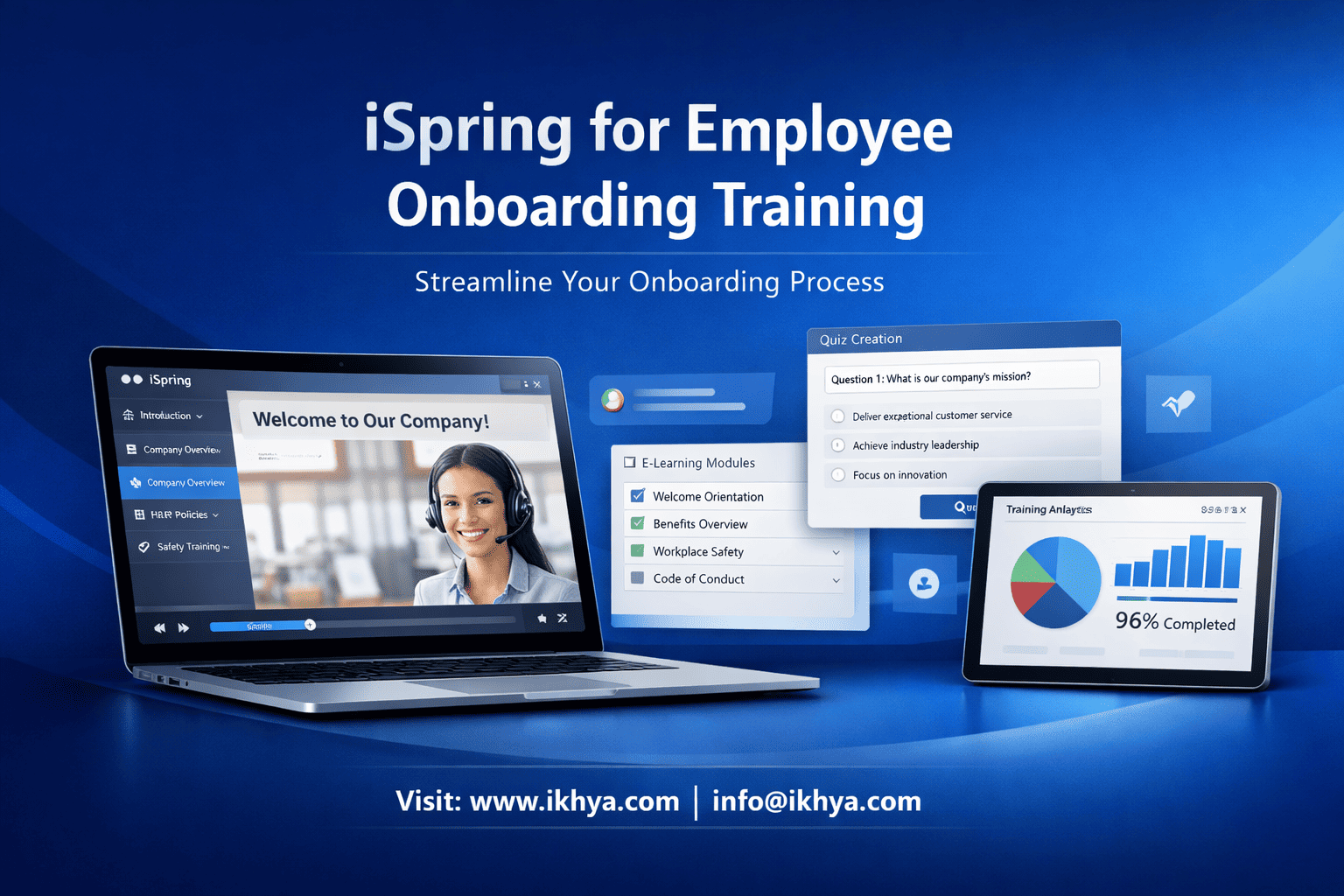
Employee onboarding often determines how quickly new hires become productive—and how long they stay. Yet many organizations still rely on static PDFs, long presentations, or inconsistent classroom sessions. This is where iSpring for employee onboarding training becomes a powerful solution, enabling fast, interactive, and scalable learning experiences.
If you’re looking to streamline onboarding, reduce training time, and improve engagement, tools like iSpring can help you convert existing materials into structured eLearning programs. You can also explore professional iSpring eLearning development services or even book a free eLearning demo to see how it works in practice.
What is iSpring and Why It’s Used for Employee Onboarding Training
iSpring is a rapid eLearning authoring tool that converts PowerPoint presentations into interactive, LMS-ready courses. It is widely used for onboarding because it enables quick content creation, supports multimedia learning, and integrates seamlessly with LMS platforms using standards like SCORM and xAPI.
Overview of iSpring Suite
iSpring Suite is designed for simplicity and speed. It works directly within PowerPoint, making it ideal for teams that already rely on presentations for training.
Key components include:
- iSpring Suite Max – Full authoring toolkit
- QuizMaker – For assessments and evaluations
- iSpring Learn LMS – For deployment and tracking
Why it matters for onboarding:
- HR teams can reuse existing onboarding decks
- No steep learning curve for content creators
- Faster course development compared to traditional tools
Key Features for Onboarding Training
iSpring stands out for onboarding due to its practical, business-focused features:
1. PowerPoint-Based Development
- Convert slides into interactive modules
- Add voiceovers, animations, and transitions
- Ideal for companies transitioning from classroom training
If you already have onboarding presentations, this aligns well with guides like convert PowerPoint to eLearning.
2. Interactive Quizzes and Assessments
- Knowledge checks after each module
- Scenario-based questions for real-world application
- Instant feedback for learners
3. Role-Based Learning Paths
- Customize onboarding for different departments
- Assign courses based on job roles
- Track individual progress
4. LMS Compatibility (SCORM, xAPI)
- Seamless integration with enterprise LMS platforms
- Track completion, scores, and engagement
- Generate compliance reports
5. Multimedia and Video Learning
- Embed videos, screen recordings, and simulations
- Create engaging onboarding journeys
- Support microlearning formats
Why Organizations Prefer iSpring for Onboarding
Companies across industries—including IT, retail, and healthcare—prefer iSpring because it balances speed, cost, and usability.
Key advantages:
- Rapid course development (days instead of weeks)
- Cost-effective compared to custom-built courses
- Minimal technical expertise required
- Scalable across global teams
For organizations aiming to accelerate onboarding rollout, combining iSpring with rapid eLearning development services can significantly reduce timelines.
Benefits of Using iSpring for Employee Onboarding Training
iSpring helps organizations deliver onboarding training faster, more consistently, and at a lower cost. Its biggest advantage lies in enabling teams to convert existing content into engaging eLearning while maintaining quality, scalability, and LMS compatibility.
1. Rapid Development and Faster Onboarding Rollout
iSpring is built for speed. Since it integrates with PowerPoint, training teams can quickly convert existing onboarding materials into interactive courses without starting from scratch.
Key advantages:
- Reduce development time from weeks to days
- Launch onboarding programs quickly across locations
- Update content instantly when policies change
This is especially useful for companies with high hiring volumes, such as retail or IT firms.
2. Seamless PowerPoint to eLearning Conversion
One of iSpring’s strongest capabilities is transforming static presentations into dynamic onboarding experiences.
What you can do:
- Add voiceovers and narration to slides
- Embed videos and screen recordings
- Convert bullet points into interactive content
This eliminates the need to rebuild training from scratch.
3. Consistent Training Across Teams and Locations
Inconsistent onboarding is a common problem—especially for global companies. iSpring ensures every employee receives the same training experience.
Benefits:
- Standardized onboarding content
- Reduced dependency on instructors
- Uniform compliance training delivery
This is critical in industries like healthcare, finance, and manufacturing, where compliance and accuracy matter.
4. LMS Integration and Performance Tracking
iSpring courses are fully compatible with LMS platforms using standards like SCORM and xAPI, enabling organizations to track onboarding performance in real time.
What you can track:
- Course completion rates
- Quiz scores and assessments
- Learner engagement and time spent
This data helps HR and L&D teams continuously improve onboarding effectiveness and identify knowledge gaps.
5. Cost-Effective Compared to Traditional Training
Traditional onboarding—especially instructor-led training—can be expensive and difficult to scale. iSpring offers a more cost-efficient alternative.
| Training Method | Cost Level | Scalability | Consistency |
|---|---|---|---|
| Instructor-led | High | Low | Medium |
| Custom eLearning | High | High | High |
| iSpring-based eLearning | Medium | High | High |
Cost benefits include:
- Reduced trainer costs
- Lower travel and logistics expenses
- Reusable training modules
6. Improved Engagement Through Interactive Learning
Unlike static onboarding materials, iSpring enables interactive and engaging learning experiences.
Engagement features:
- Scenario-based learning
- Interactive quizzes
- Video-based modules
- Simulations
To maximize engagement, many organizations integrate strategies like microlearning using microlearning development services, which break onboarding into shorter, digestible modules.
7. Mobile-Friendly and Flexible Learning
Modern employees expect to learn anytime, anywhere. iSpring supports responsive learning experiences that work across devices.
Key advantages:
- Mobile-compatible courses
- Self-paced learning
- Accessible for remote and hybrid teams
For organizations with distributed workforces, leveraging mobile learning development solutions ensures onboarding is accessible across devices and geographies.
8. Easy Updates and Content Maintenance
Onboarding content often needs updates—whether due to policy changes, product updates, or compliance requirements.
With iSpring:
- Edit original PowerPoint files
- Republish instantly
- Avoid full course redevelopment
This flexibility makes it ideal for fast-changing industries like IT and finance.
Overall, iSpring provides a practical balance between speed, cost, and effectiveness, making it one of the most preferred tools for onboarding training.
How to Use iSpring for Employee Onboarding Training (Step-by-Step)
Creating onboarding training with iSpring involves converting existing materials into structured, interactive eLearning modules and deploying them via an LMS. The process is fast, scalable, and ideal for organizations looking to standardize onboarding while reducing manual effort.
Step 1: Prepare and Structure Your Onboarding Content
Start by organizing all existing onboarding materials into a clear learning structure. This includes PowerPoint presentations, PDFs, SOPs, videos, and policy documents.
Key actions:
- Define onboarding goals (compliance, culture, role-specific skills)
- Break content into modules (company overview, policies, job training)
- Identify gaps in existing materials
Best practice:
- Keep modules short and focused (5–10 minutes each)
- Use a logical learning path (general → role-specific)
If your content is scattered across formats, consider structured approaches like instructional design services to align training with learning objectives.
Step 2: Convert PowerPoint into Interactive eLearning
Once your content is ready, use iSpring to transform PowerPoint slides into interactive courses.
What to do:
- Import your PPT into iSpring
- Add narration and voiceovers
- Enhance slides with animations and transitions
Enhancements to include:
- Video introductions for company culture
- Screen recordings for tools/software training
- Visual storytelling instead of text-heavy slides
For organizations heavily reliant on presentations, following a proven workflow like convert PowerPoint to eLearning ensures better engagement and structure.
Step 3: Add Interactivity and Assessments
Interactivity is what turns passive onboarding into engaging learning. iSpring provides built-in tools for quizzes and simulations.
Include:
- Knowledge checks after each module
- Scenario-based learning (real workplace situations)
- Role-based branching scenarios
Examples:
- Customer service scenarios for retail onboarding
- Compliance decision-making for finance teams
- Safety simulations for manufacturing
Tip:
- Use quizzes not just for testing, but for reinforcing learning
Step 4: Design for Engagement and Retention
Effective onboarding is not just about information delivery—it’s about retention and application.
Strategies:
- Break content into microlearning modules
- Use storytelling and real-life examples
- Include videos and interactive elements
You can enhance learning effectiveness further by integrating approaches like microlearning development services to improve retention and completion rates.
Step 5: Publish and Deploy to LMS
Once your course is ready, publish it in LMS-compatible formats like SCORM or xAPI.
Deployment steps:
- Export course from iSpring
- Upload to your LMS
- Assign courses to new hires
- Track progress and completion
What to monitor:
- Completion rates
- Assessment scores
- Time spent on modules
Step 6: Track, Analyze, and Improve
Onboarding should be continuously optimized based on learner data.
Track:
- Drop-off points in courses
- Quiz performance trends
- Feedback from employees
Improve by:
- Updating outdated content
- Simplifying complex modules
- Adding more interactivity
Typical Timeline for iSpring Onboarding Development
| Phase | Timeline |
|---|---|
| Content preparation | 2–5 days |
| Development (iSpring) | 5–10 days |
| Review & revisions | 3–5 days |
| LMS deployment | 1–2 days |
Total: ~2–3 weeks (can be faster with expert support)
By following this structured approach, organizations can build onboarding programs that are fast to deploy, engaging for employees, and easy to scale globally.
Real-World Use Cases of iSpring for Employee Onboarding Training
iSpring is widely used across industries to streamline onboarding, reduce training time, and ensure consistency. Its flexibility makes it suitable for both general onboarding and role-specific training, especially in organizations with distributed teams or high hiring volumes.
IT & Software Company Onboarding
In IT and software organizations, onboarding often involves a mix of company orientation, technical training, and tool familiarization. iSpring helps convert complex technical content into structured, easy-to-follow learning modules.
Typical onboarding structure:
- Company culture and policies
- Product and service training
- Software tools walkthrough (CRM, internal systems)
- Security and compliance training
How iSpring helps:
- Screen recordings for software tutorials
- Interactive quizzes for knowledge validation
- Modular learning paths for different roles (developers, sales, support)
Example scenario:
A SaaS company onboarding 50+ employees monthly can deploy standardized training globally using iSpring, ensuring every employee receives the same learning experience.
Retail Industry Onboarding
Retail onboarding focuses on customer service, product knowledge, and store operations. Speed is critical due to high employee turnover.
Key onboarding areas:
- Customer interaction training
- Product knowledge
- POS system training
- Store policies and procedures
How iSpring helps:
- Scenario-based learning for customer interactions
- Video-based product demonstrations
- Quick microlearning modules for fast onboarding
Example scenario:
Retail chains can onboard seasonal staff within days by delivering mobile-friendly courses, reducing dependency on in-store trainers.
Healthcare Onboarding Training
Healthcare onboarding requires strict compliance, accuracy, and role-specific training. Errors can have serious consequences, making standardized training essential.
Core onboarding components:
- Compliance and regulatory training
- Patient safety protocols
- Medical systems training
- Role-specific procedures
How iSpring helps:
- Interactive compliance modules with assessments
- Scenario-based simulations for real-life situations
- Tracking and reporting for audits
Example scenario:
Hospitals can ensure all new staff complete mandatory compliance training and achieve required scores before starting their roles.
Manufacturing & Safety Training
Manufacturing onboarding focuses heavily on safety, operational procedures, and equipment handling.
Training areas:
- Workplace safety protocols
- Equipment usage training
- Emergency procedures
- Compliance training
How iSpring helps:
- Simulation-based learning for safety scenarios
- Video demonstrations for machinery operation
- Assessments to ensure understanding
Example scenario:
Manufacturing companies can reduce workplace accidents by ensuring employees complete standardized safety training before entering production areas.
Financial Services & Compliance Onboarding
In financial services, onboarding must address regulatory requirements, risk management, and compliance training.
Key areas:
- Anti-money laundering (AML) training
- Data security and privacy policies
- Customer onboarding procedures
- Regulatory compliance
How iSpring helps:
- Structured compliance modules
- Scenario-based decision-making exercises
- LMS tracking for audit readiness
Why These Use Cases Matter
Across all industries, the common challenges in onboarding include:
- Inconsistent training delivery
- Long onboarding timelines
- Low engagement
- Lack of performance tracking
iSpring addresses these challenges by enabling:
- Standardized, scalable training
- Faster onboarding cycles
- Data-driven improvements
- Engaging, interactive learning experiences
These real-world applications show that iSpring is not just a tool—it’s a practical solution for building efficient, scalable, and high-impact onboarding programs.
iSpring vs Other Authoring Tools for Onboarding Training
Choosing the right authoring tool depends on your onboarding complexity, budget, and development speed requirements. iSpring is ideal for rapid, PowerPoint-based onboarding, while tools like Storyline and Captivate offer more advanced customization but require more time and expertise.
Quick Comparison of Popular Authoring Tools
| Feature | iSpring | Articulate Storyline | Adobe Captivate | Articulate Rise |
|---|---|---|---|---|
| Ease of Use | Very easy (PowerPoint-based) | Moderate (learning curve) | Complex | Very easy |
| Development Speed | Fast | Medium | Medium–Slow | Very fast |
| Interactivity Level | Moderate | Very high | High | Moderate |
| Customization | Limited–Moderate | Very high | High | Limited |
| Mobile Responsiveness | Good | Good | Good | Excellent |
| Best For | Rapid onboarding | Complex simulations | Software training | Microlearning |
When iSpring is the Best Choice
iSpring is the best fit when speed, simplicity, and cost-efficiency are your top priorities.
Choose iSpring if:
- You already have PowerPoint-based onboarding content
- You need to launch training quickly
- Your team has limited technical expertise
- You want a cost-effective solution
It works especially well for:
- HR onboarding programs
- Compliance training
- Product and process training
When to Choose Articulate Storyline
Articulate Storyline is better suited for highly interactive and customized onboarding experiences.
Choose Storyline if:
- You need advanced simulations and branching scenarios
- You require complex interactivity
- You have access to experienced developers
For organizations needing advanced customization, working with experts offering Articulate Storyline development services can help deliver high-end onboarding experiences.
When Adobe Captivate Makes Sense
Adobe Captivate is often used for technical and software-based training.
Choose Captivate if:
- You need detailed software simulations
- You require advanced screen recording features
- Your team is familiar with Adobe tools
When Articulate Rise is a Better Fit
Articulate Rise is ideal for responsive, mobile-first onboarding programs.
Choose Rise if:
- You want fully responsive courses
- You prefer clean, modern layouts
- You focus on microlearning
Organizations often leverage Articulate Rise development services for scalable, mobile-friendly onboarding programs.
Decision Framework: Which Tool Should You Choose?
| Requirement | Recommended Tool |
|---|---|
| Fast onboarding rollout | iSpring |
| High interactivity & simulations | Storyline |
| Software/system training | Captivate |
| Mobile-first microlearning | Rise |
Key Takeaway
There is no single “best” tool—only the right tool for your needs.
- iSpring → Speed, simplicity, cost-efficiency
- Storyline → Advanced customization
- Captivate → Technical training
- Rise → Responsive, modern learning
In many cases, organizations combine tools depending on training needs. However, for most onboarding scenarios, iSpring offers the fastest path to creating effective, scalable training programs.
Cost of Developing Onboarding Training with iSpring
The cost of developing employee onboarding training with iSpring depends on content complexity, level of interactivity, and whether you build in-house or outsource. In general, iSpring is more cost-effective than fully custom eLearning tools because it reduces development time and leverages existing PowerPoint content.
Typical Cost Breakdown
| Component | Cost Range (USD) |
|---|---|
| iSpring license | $770 – $970/year |
| Content development (basic) | $1,000 – $3,000 per course |
| Interactive course development | $3,000 – $8,000 per course |
| Advanced (scenarios/simulations) | $8,000 – $15,000+ |
| LMS integration & deployment | $500 – $2,000 |
Note: Costs vary based on region (USA, UK, UAE, AUS) and project scope.
In-House vs Outsourced Development
| Factor | In-House Development | Outsourced Development |
|---|---|---|
| Initial cost | Lower | Medium |
| Long-term cost | Higher (resources) | Lower (efficiency) |
| Expertise required | High | Low |
| Development speed | Slower | Faster |
| Quality consistency | Variable | High |
When In-House Development Works
Building onboarding training internally makes sense when:
- You have a skilled L&D team
- Your onboarding content is simple
- You don’t require advanced interactivity
However, internal teams often face bandwidth limitations, especially during large-scale hiring.
When Outsourcing is More Cost-Effective
Outsourcing becomes the better option when speed, quality, and scalability are critical.
Outsource if:
- You need to launch onboarding quickly
- Your content requires instructional design expertise
- You want consistent, professional-quality courses
Many organizations choose to outsource eLearning development to reduce timelines and improve outcomes.
Hidden Costs to Consider
Even with iSpring, there are indirect costs that organizations often overlook:
- SME (Subject Matter Expert) time
- Content updates and maintenance
- LMS administration
- Localization for global teams
Planning for these ensures accurate budgeting and avoids delays.
Cost Optimization Strategies
To reduce onboarding development costs without compromising quality:
- Reuse existing content (PowerPoint, PDFs, videos)
- Adopt microlearning for modular training
- Standardize templates across courses
- Outsource strategically for complex modules
For organizations planning large-scale onboarding, submitting a structured requirement through a request for proposal helps vendors provide accurate cost estimates.
Key Takeaway
iSpring offers one of the most cost-efficient ways to develop onboarding training because it combines:
- Rapid development
- Lower technical complexity
- Reusability of existing content
However, the real cost advantage comes from how efficiently you execute the project—whether in-house or with the right partner.
When to Outsource iSpring Onboarding Development
Outsourcing iSpring onboarding development is the right choice when your internal team lacks bandwidth, expertise, or speed to deliver high-quality training at scale. It helps organizations accelerate deployment, improve course quality, and ensure consistent learning experiences across teams and regions.
Signs You Should Outsource Onboarding Development
If your onboarding program is facing delays or quality issues, outsourcing can solve these challenges quickly.
Common indicators:
- Your team is overloaded with multiple training projects
- Onboarding rollout timelines are tight
- Courses lack engagement or interactivity
- You need multi-location or global deployment
- Internal expertise in instructional design is limited
Example scenario:
A fast-growing IT company hiring 100+ employees monthly may struggle to build onboarding internally. Outsourcing ensures consistent, scalable delivery without overburdening internal teams.
Benefits of Outsourcing iSpring Development
Outsourcing is not just about saving time—it’s about improving outcomes.
Key benefits:
- Faster turnaround times
Experienced vendors can develop onboarding courses in weeks instead of months - Access to expert instructional design
Align content with adult learning principles and business goals - High-quality interactive content
Better use of scenarios, quizzes, and multimedia - Scalability for global teams
Easily roll out training across regions (USA, UK, UAE, AUS) - Cost efficiency in the long run
Avoid hiring, training, and retaining full-time specialists
Organizations often combine outsourcing with custom eLearning development services to build tailored onboarding programs aligned with business needs.
Outsourcing vs In-House: Decision Snapshot
| Criteria | In-House | Outsourced |
|---|---|---|
| Speed | Slow | Fast |
| Expertise | Limited | High |
| Scalability | Low | High |
| Cost (long-term) | Higher | Optimized |
| Quality consistency | Variable | Consistent |
What to Look for in an eLearning Vendor
Choosing the right vendor is critical to the success of your onboarding program.
Key factors:
- Experience with iSpring development
- Strong instructional design capabilities
- Portfolio of onboarding projects
- Ability to meet timelines
- LMS integration expertise
To make an informed decision, follow a structured approach like how to choose the eLearning vendor, which outlines evaluation criteria and best practices.
Common Outsourcing Models
| Model | Best For |
|---|---|
| Project-based | One-time onboarding program |
| Dedicated team | Ongoing training development |
| Staff augmentation | Supporting internal teams |
Red Flags to Avoid
Not all vendors deliver the same quality. Watch out for:
- Lack of onboarding-specific experience
- No clear development process
- Poor communication or delayed timelines
- Limited understanding of LMS standards (SCORM/xAPI)
When Outsourcing Delivers Maximum Value
Outsourcing provides the highest ROI when:
- You need rapid onboarding deployment
- You want high engagement and retention
- You are scaling training across multiple locations
- You require consistent quality across programs
Before finalizing a vendor, many organizations share detailed requirements using an RFP. You can streamline this process by submitting your needs through a request for proposal, ensuring clarity on scope, timelines, and cost.
Outsourcing iSpring onboarding development is ultimately about speed, quality, and scalability—helping organizations deliver impactful training without internal bottlenecks.
Best Practices for Effective Onboarding Training Using iSpring
To get the best results from iSpring for employee onboarding training, organizations must focus on structured design, engagement, and learner experience. Simply converting slides into eLearning is not enough—effective onboarding requires thoughtful instructional design, interactivity, and continuous improvement.
1. Use Microlearning for Better Retention
Breaking onboarding into short, focused modules improves completion rates and knowledge retention. Employees can learn at their own pace without feeling overwhelmed.
Best practices:
- Keep modules under 5–10 minutes
- Focus on one topic per module
- Use short videos and quick quizzes
This approach is especially effective for remote and mobile learners.
2. Incorporate Scenario-Based Learning
Scenario-based learning helps employees apply knowledge in real-world situations rather than just memorizing information.
Examples:
- Customer interaction scenarios for retail staff
- Compliance decision-making for finance teams
- Safety situations for manufacturing employees
Why it works:
- Improves decision-making skills
- Increases engagement
- Enhances knowledge retention
3. Design for Mobile-First Learning
Modern onboarding must support mobile and remote work environments. iSpring enables responsive learning, but design decisions matter.
Key strategies:
- Use clean layouts and minimal text
- Optimize media for smaller screens
- Ensure easy navigation
4. Keep Content Visual and Interactive
Text-heavy onboarding courses lead to disengagement. Instead, focus on visual storytelling and interactivity.
Use:
- Videos and animations
- Infographics and visuals
- Interactive elements like click-and-reveal
Avoid:
- Long paragraphs on slides
- Static, lecture-style content
5. Align Training with Business Goals
Onboarding should directly support organizational objectives such as productivity, compliance, and employee retention.
Steps to align:
- Define clear learning outcomes
- Map training to job roles
- Measure performance impact
6. Personalize Learning Paths
Not all employees need the same onboarding experience. Role-based learning improves relevance and efficiency.
How to personalize:
- Create role-specific modules
- Use branching scenarios
- Assign courses based on job functions
7. Ensure Continuous Updates and Improvement
Onboarding is not a one-time effort—it should evolve with your organization.
Improve continuously by:
- Analyzing LMS data
- Collecting employee feedback
- Updating outdated content
iSpring makes updates easy by allowing quick edits to original PowerPoint files.
8. Maintain Consistency Across Global Teams
For organizations operating in multiple regions (USA, UK, UAE, AUS), consistency is critical.
Ensure:
- Standardized training modules
- Consistent messaging and branding
- Localization where required
Key Takeaway
Effective onboarding with iSpring is not just about speed—it’s about designing meaningful learning experiences that drive engagement, retention, and performance.
By applying these best practices, organizations can transform onboarding from a routine process into a strategic advantage.
How to Choose the Right eLearning Vendor for iSpring Development
Choosing the right eLearning vendor for iSpring development directly impacts the quality, speed, and effectiveness of your onboarding program. A good vendor brings instructional design expertise, technical capability, and a structured development process to ensure your training delivers measurable results.
Step-by-Step Vendor Selection Process
Selecting a vendor should follow a structured evaluation process to minimize risk and ensure alignment with your business goals.
Step 1: Define Your Requirements
- Identify onboarding goals and target audience
- Determine content types (PPT, video, simulations)
- Define timelines and budget
Step 2: Evaluate Vendor Experience
- Check experience with iSpring development
- Review onboarding-specific projects
- Assess industry expertise (IT, healthcare, retail, etc.)
Step 3: Review Portfolio and Samples
- Look for interactive and engaging courses
- Evaluate design quality and user experience
- Check for scenario-based and microlearning examples
Step 4: Assess Instructional Design Capability
- Ensure the vendor follows learning frameworks
- Evaluate how they structure content
- Check alignment with adult learning principles
Step 5: Validate Technical Expertise
- LMS integration (SCORM, xAPI)
- Multimedia and interactivity capabilities
- Mobile compatibility
Step 6: Compare Cost and Delivery Models
- Fixed pricing vs hourly
- Project-based vs dedicated team
- Timeline commitments
Vendor Evaluation Checklist
| Criteria | What to Look For |
|---|---|
| iSpring expertise | Proven experience with the tool |
| Instructional design | Strong learning strategy |
| Industry experience | Relevant onboarding use cases |
| Technical capability | LMS, SCORM, xAPI knowledge |
| Communication | Clear, responsive process |
| Scalability | Ability to handle large projects |
Questions to Ask Before Hiring a Vendor
Before finalizing a vendor, ask these critical questions:
- Can you share onboarding training case studies?
- What is your development process and timeline?
- How do you ensure engagement and interactivity?
- Do you provide post-launch support and updates?
- How do you handle LMS integration and testing?
Common Mistakes to Avoid
Choosing the wrong vendor can lead to delays, poor quality, and increased costs.
Avoid:
- Selecting based only on lowest cost
- Ignoring instructional design capabilities
- Not reviewing past work
- Overlooking communication and project management
When to Use an RFP (Request for Proposal)
For larger onboarding projects, using an RFP helps standardize vendor evaluation and ensures clarity in requirements.
Benefits of an RFP:
- Clear scope definition
- Accurate cost estimates
- Easier vendor comparison
- Reduced project risks
You can simplify the process by submitting your requirements through a structured request for proposal to receive detailed vendor responses.
Expert Support for Better Outcomes
Working with an experienced partner like IKHYA – eLearning Solutions Company ensures your onboarding training is:
- Strategically designed
- Technically sound
- Delivered on time
For tailored solutions or consultation, you can reach out at info@ikhya.com or explore their services based on your requirements.
Key Takeaway
The right vendor is not just a service provider—they are a strategic partner in building effective onboarding programs.
A structured selection process ensures:
- Better training outcomes
- Faster deployment
- Higher ROI on your eLearning investment
Conclusion
iSpring for employee onboarding training offers a practical, scalable, and cost-effective way to transform traditional onboarding into engaging digital learning experiences. Its PowerPoint-based approach, rapid development capabilities, and LMS compatibility make it an ideal choice for organizations looking to streamline onboarding without compromising quality.
From creating interactive modules to deploying training globally, iSpring enables companies to reduce onboarding time, improve consistency, and enhance employee engagement. Whether you are onboarding teams in IT, retail, healthcare, or finance, the tool adapts easily to different training needs.
However, the real impact comes from how well the onboarding program is designed and executed. Organizations that combine iSpring with strong instructional design, microlearning strategies, and the right development partner achieve significantly better results.
If you’re planning to build or scale your onboarding training, consider working with experts who can guide you through the process. You can contact us to discuss your requirements or explore tailored solutions for your organization.
FAQs
1. What is iSpring used for in employee onboarding training?
iSpring is used to convert onboarding materials like PowerPoint presentations into interactive eLearning courses. It helps deliver consistent, scalable, and engaging onboarding through LMS platforms.
2. Is iSpring suitable for large organizations?
Yes, iSpring is scalable and supports enterprise onboarding needs, including LMS integration, role-based learning paths, and global deployment.
3. How long does it take to create onboarding training using iSpring?
Typically, onboarding courses can be developed in 2–3 weeks, depending on content complexity and review cycles.
4. Can iSpring courses be integrated with an LMS?
Yes, iSpring supports SCORM and xAPI standards, enabling seamless LMS integration and tracking.
5. What types of content can be used in iSpring onboarding training?
iSpring supports:
- PowerPoint presentations
- Videos and screen recordings
- Quizzes and assessments
- Scenario-based learning
6. Is iSpring better than Articulate Storyline for onboarding?
iSpring is better for rapid development and ease of use, while Storyline is better for advanced interactivity and customization.
7. Can iSpring be used for compliance training?
Yes, iSpring is widely used for compliance training in industries like healthcare, finance, and manufacturing.
8. Should onboarding training be developed in-house or outsourced?
In-house works for simple training, while outsourcing is better for speed, quality, and scalability. Many companies choose to outsource eLearning development.
9. Does iSpring require technical expertise to use?
No, iSpring is user-friendly and works within PowerPoint, making it accessible even for non-technical users.
10. Can iSpring convert PowerPoint into interactive courses?
Yes, iSpring specializes in converting PowerPoint slides into interactive eLearning with multimedia and quizzes.
11. Is iSpring suitable for remote onboarding?
Yes, iSpring supports mobile-friendly and self-paced learning, making it ideal for remote and hybrid teams.
12. What industries benefit most from iSpring onboarding?
Industries like IT, retail, healthcare, manufacturing, and finance benefit greatly from iSpring onboarding solutions.
13. Can iSpring support microlearning?
Yes, iSpring allows you to create short, focused modules that align with microlearning strategies. You can also enhance this with microlearning development services.
14. How does iSpring improve employee engagement?
It improves engagement through interactive elements such as quizzes, scenarios, videos, and simulations.
15. What is the cost of iSpring onboarding development?
Costs vary but typically range from $1,000 to $10,000+ per course, depending on complexity and interactivity.
16. Can iSpring courses be updated easily?
Yes, courses can be updated quickly by editing the original PowerPoint and republishing.
17. Does iSpring support multilingual onboarding?
Yes, iSpring supports localization and can be used for global onboarding programs across multiple languages.
18. What are the limitations of iSpring?
- Limited advanced customization compared to Storyline
- Not ideal for highly complex simulations
- Design flexibility is moderate
19. How do you measure onboarding effectiveness with iSpring?
You can track:
- Completion rates
- Assessment scores
- Learner engagement
- Time spent on courses
20. How do I get started with iSpring onboarding training?
Start by organizing your onboarding content, converting it into eLearning using iSpring, and deploying it via an LMS. For expert support, you can contact us to discuss your requirements.
Related Resources
To help you go deeper into iSpring development, onboarding strategies, and tool selection, explore these carefully selected resources that align with your learning and decision-making journey:




