Machine Translation vs Professional eLearning Translation Services: Ultimate Guide to Choose the Right Approach

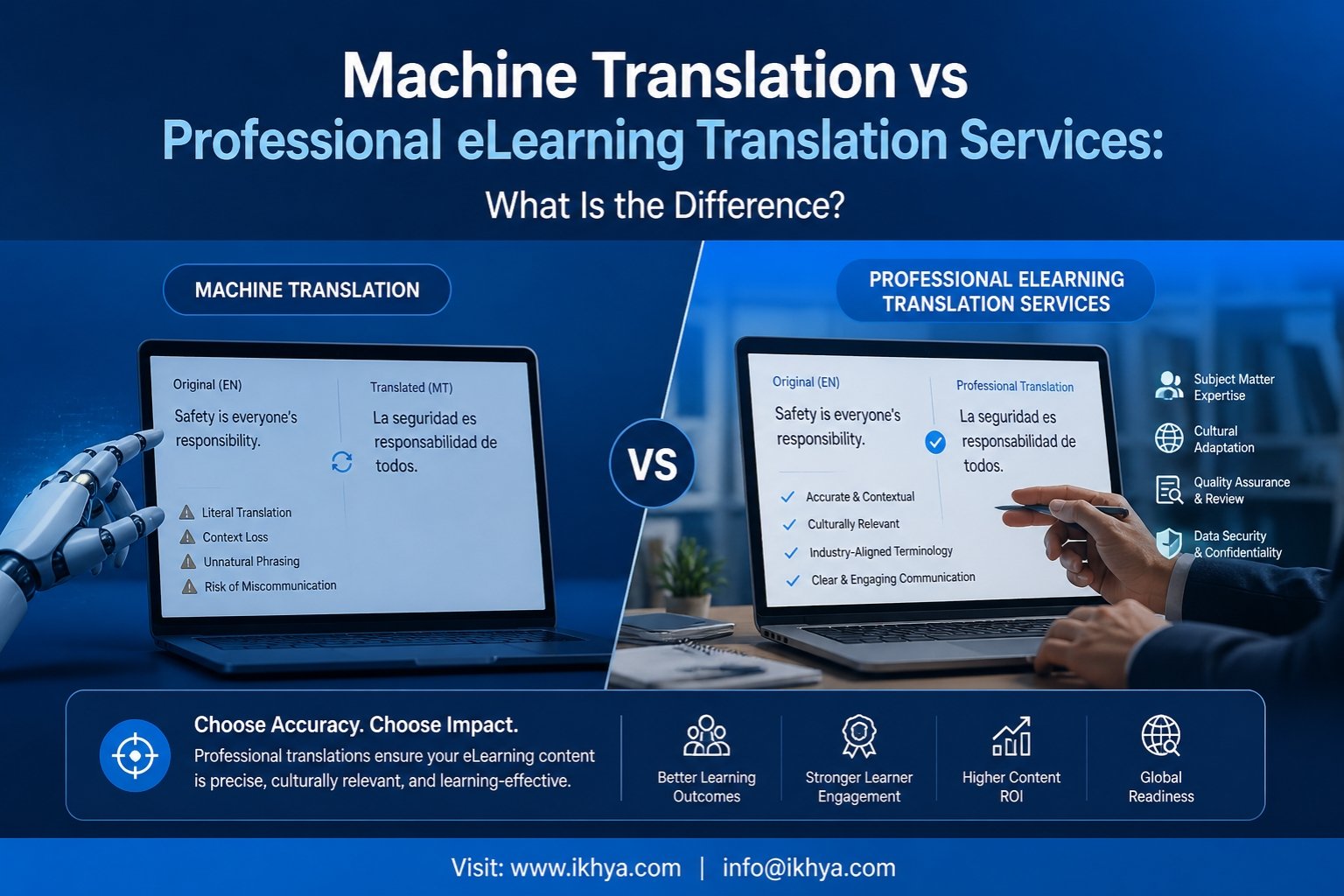
Machine Translation vs Professional eLearning Translation Services is a key decision for any business delivering training across different countries. If you choose the wrong method, your learners may misunderstand content, lose interest, or fail important training like compliance or safety programs.
This guide explains the difference in very simple terms so you can make the right choice. You will learn about cost, accuracy, and real business impact.
What Is Machine Translation in eLearning?
Machine translation uses AI tools to convert text from one language to another automatically. It is fast and can handle large volumes of content in seconds.
In eLearning, it is commonly used for:
- Translating course text quickly
- Converting subtitles
- Supporting fast global rollout
However, machine translation does not fully understand:
- Context
- Tone
- Cultural meaning
Because of this, the output may sound unnatural or even incorrect.
What Are Professional eLearning Translation Services?
Professional eLearning translation services involve human experts who translate and adapt content carefully. These experts include linguists, subject matter experts, and instructional designers.
This approach focuses on:
- Accuracy
- Cultural relevance
- Learning effectiveness
It often includes services like eLearning Translation & Localization, Instructional Design Services, and eLearning Translation Services.
Unlike machines, humans understand meaning, intent, and learner needs. This makes training more effective and engaging.
Machine Translation vs Professional eLearning Translation Services (Detailed Comparison)
Key Differences Overview
| Factor | Machine Translation | Professional eLearning Translation Services |
|---|---|---|
| Accuracy | Medium to Low | Very High |
| Speed | Very Fast | Moderate |
| Cost | Low | Higher but valuable |
| Cultural Adaptation | Poor | Excellent |
| Learning Effectiveness | Limited | High |
| Quality Assurance | None | Strong QA process |
Accuracy and Quality
Machine translation often gives word-to-word results. This can lead to:
- Wrong meaning
- Confusing sentences
- Poor clarity
Professional translation ensures:
- Correct meaning
- Proper terminology
- Clear and simple language
This is very important for training content.
Speed and Scalability
Machine translation is extremely fast and useful when:
- You need quick drafts
- Content is simple
Professional translation takes more time but delivers better results. It is ideal for long-term training programs.
Cost Comparison
| Cost Type | Machine Translation | Professional Translation |
|---|---|---|
| Initial Cost | $0 – $50/month tools | $0.08 – $0.25 per word |
| Hidden Cost | High (errors, rework) | Low (accurate first time) |
| ROI | Low for training | High for business impact |
Machine translation may look cheaper, but errors can increase costs later.
Cultural Relevance and Localization
Machine translation cannot adjust content for different cultures.
Professional services include eLearning Localization Services that:
- Adapt content for regions
- Use local examples
- Improve understanding
This is very important for global training, especially when eLearning translation and localization determine how effectively content is understood across different regions.
Learning Effectiveness
Training is not just about words. It is about how well learners understand the content.
Professional translation improves:
- Engagement
- Knowledge retention
- Completion rates
Machine translation often reduces learning quality.
When Should You Use Machine Translation in eLearning?
Machine translation works best for:
- Internal documents
- Quick drafts
- Low-risk content
- Large volumes of simple text
If accuracy is not critical, it can save time.
When to Choose Professional eLearning Translation Services?
Choose professional services when:
- Training is critical (compliance, safety)
- Content is complex
- Audience is global
- Brand reputation matters
Many companies also combine this with Custom eLearning Development Services to create better learning experiences.
Risks of Using Machine Translation for Training Content
Using machine translation in training can create serious problems:
- Incorrect information
- Compliance risks
- Poor learner experience
- Loss of trust
For example, wrong translation in safety training can lead to real risks.
Cost Breakdown: Machine vs Professional Translation in eLearning
| Scenario | Machine Translation | Professional Translation |
|---|---|---|
| Compliance Training | Risky, low accuracy | Safe and reliable |
| Sales Training | Low engagement | High impact |
| Employee Onboarding | Confusing | Clear and effective |
Professional translation provides better long-term value.
Decision Framework: Which Translation Method Is Right for You?
| Situation | Best Choice |
|---|---|
| Low budget + low risk | Machine Translation |
| High accuracy needed | Professional Translation |
| Global audience | Professional Translation |
| Quick draft required | Machine Translation |
| Long-term training | Professional Translation |
If you are unsure, you can Book a Free eLearning Demo to explore the best option.
Why Businesses Choose IKHYA for eLearning Translation
IKHYA – eLearning Solutions Company is trusted by global organizations because of:
- Strong expertise in eLearning Translation Services
- Deep Instructional Design Services knowledge
- Focus on learner experience
- Global delivery capability
They also offer:
- Custom eLearning Development Services
- eLearning Localization Services
This ensures your training works well across all regions.
Final Thoughts: Choosing the Right Translation Strategy for Global Training
Choosing between machine translation and professional eLearning translation services depends on your goals.
- Choose machine translation for speed and basic needs
- Choose professional services for accuracy and impact
For most businesses, investing in quality translation is the best decision.
If you need expert support, you can Contact Us or Request RFP to get started with the right solution.
FAQs Related to Machine Translation vs Professional eLearning Translation
Q1. What is the main difference between machine translation and professional eLearning translation services?
Machine translation uses AI tools to translate content quickly but may miss context and accuracy. Professional eLearning translation services use human experts to ensure correct meaning, cultural relevance, and better learning outcomes.
Q2. Is machine translation reliable for eLearning content?
Machine translation can work for simple or internal content, but it is not fully reliable for training programs where accuracy and clarity are important.
Q3. When should I use professional eLearning translation services instead of machine translation?
You should use professional services when your training involves compliance, safety, global learners, or complex topics that require accuracy and cultural adaptation.
Q4. Which is more cost-effective: machine translation or professional translation?
Machine translation is cheaper upfront, but professional translation provides better long-term value by avoiding errors, rework, and poor learning outcomes.
Q5. Can machine translation handle cultural differences in training content?
No, machine translation cannot fully understand cultural context. Professional services adapt content to match local culture and improve learner understanding.
Q6. Does machine translation affect learning effectiveness?
Yes, machine translation can reduce engagement and understanding because it may produce unclear or incorrect content.
Q7. How do professional eLearning translation services improve training results?
They ensure accurate language, proper tone, and cultural relevance, which helps learners understand content better and improves completion rates.
Q8. Is machine translation suitable for compliance training?
No, compliance training requires high accuracy. Errors in translation can lead to serious legal or safety issues.
Q9. What role does localization play in eLearning translation?
Localization adapts content to specific regions, including language, examples, and cultural references, making training more effective for global audiences.
Q10. Can I combine machine translation and professional translation?
Yes, many companies use machine translation for drafts and then refine the content using professional services for accuracy.
Q11. How long does professional eLearning translation take?
It depends on the content size and complexity, but it usually takes longer than machine translation because of quality checks and human involvement.
Q12. What types of content are best for machine translation?
Machine translation works best for low-risk content such as internal documents, rough drafts, or simple text with minimal complexity.
Q13. Why is instructional design important in translation?
Instructional design ensures that translated content is easy to understand and supports learning goals, not just language conversion.
Q14. Does professional translation include quality checks?
Yes, professional services include multiple quality checks to ensure accuracy, consistency, and clarity in the final content.
Q15. How does translation impact global training programs?
Good translation improves understanding and engagement, while poor translation can confuse learners and reduce training effectiveness.
Q16. Is machine translation good for large-scale eLearning projects?
It can help with speed, but it is not ideal for final content in large-scale projects where quality and consistency are important.
Q17. What industries benefit most from professional eLearning translation services?
Industries like healthcare, finance, manufacturing, and corporate training benefit the most because accuracy is critical.
Q18. How can I choose the right translation method for my business?
You should consider your budget, content complexity, audience, and risk level before choosing between machine and professional translation.
Q19. What are the risks of poor translation in eLearning?
Poor translation can lead to misunderstanding, compliance issues, reduced learner trust, and ineffective training programs.
Q20. How can IKHYA help with eLearning translation services?
IKHYA provides expert eLearning translation, localization, and instructional design services to ensure your training content works effectively across different regions.
Ready to Transform Your Global eLearning Strategy?
Choosing between machine translation and professional eLearning translation services is not just a technical decision—it directly impacts how well your learners understand, engage, and apply training.
If your goal is to deliver training that is clear, accurate, and effective across global teams, then investing in the right approach is essential. Poor translation can lead to confusion, low completion rates, and even compliance risks. On the other hand, high-quality translation ensures better learning outcomes and stronger business results.
With IKHYA – eLearning Solutions Company, you get more than just translation. You get a complete solution that combines expertise in eLearning, localization, and instructional design to create training that truly works for your audience.
If you are planning to expand your training globally or improve your existing courses, now is the right time to take action.
- Request RFP to get a tailored solution for your training needs
- Book a Free eLearning Demo to see how your courses can be transformed
- Contact Us to speak directly with experts and get guidance
Make the right choice today and ensure your eLearning content delivers real impact across every region.