Articulate Rise for Product Training: Strategy, Use Cases, Cost & Best Practices

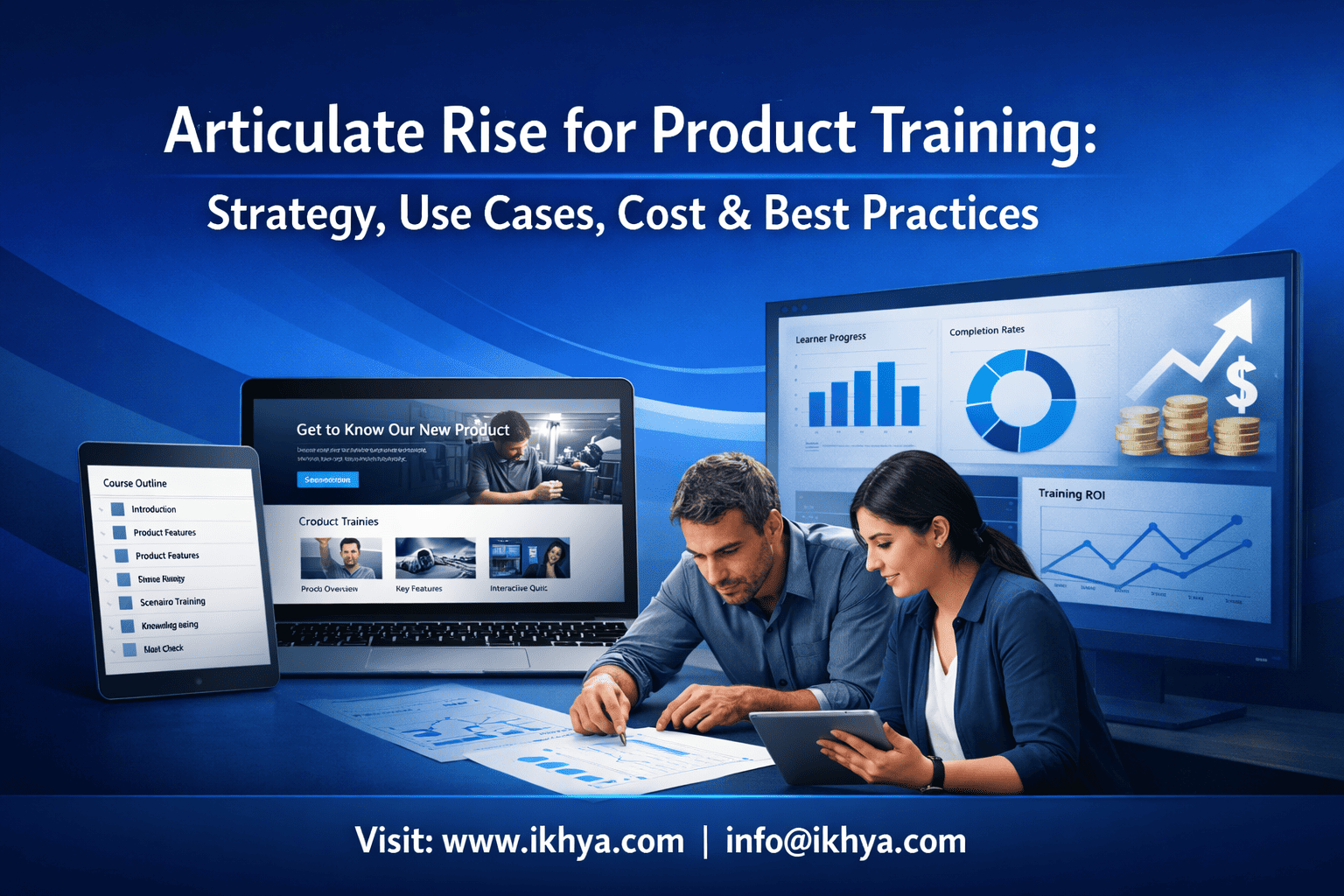
Product training often fails not because the content is wrong, but because the format is outdated. Long PDFs, static PowerPoints, and classroom-heavy sessions don’t scale across global teams or fast-changing products. This is why many organizations are turning to Articulate Rise for product training to create fast, engaging, and scalable learning experiences.
Modern product teams need training that is:
- Easy to update
- Accessible on any device
- Quick to roll out globally
- Measurable through LMS analytics
If you’re looking to modernize your training and see how it works in real scenarios, you can explore a free elearning demo to understand how interactive product training looks in practice.
This guide will help you understand how to use Articulate Rise effectively—from strategy to execution, including cost, timelines, and real-world use cases.
What is Articulate Rise for Product Training
Articulate Rise is a cloud-based eLearning authoring tool that allows organizations to create responsive, mobile-friendly product training courses quickly. It uses a block-based structure to build interactive learning modules that can be easily updated, scaled globally, and delivered through LMS platforms using SCORM or xAPI standards.
Why it works well for product training
Articulate Rise is designed for speed, consistency, and accessibility—three critical factors in product training.
It helps organizations:
- Deliver training across devices (mobile, tablet, desktop)
- Update content instantly when products change
- Maintain consistency across global teams
- Track learner progress using LMS analytics
To understand the tool in more detail, refer to what is Articulate Rise 360.
Key capabilities that make Rise effective
The effectiveness of Articulate Rise comes from its built-in features:
- Pre-built lesson blocks for faster course creation
- Interactive elements like quizzes and knowledge checks
- Responsive design without additional development effort
- Easy collaboration for distributed teams
- SCORM/xAPI compatibility for LMS tracking
Organizations often combine these capabilities with rapid elearning development services to speed up training delivery.
Real-world example: SaaS product training rollout
A SaaS company operating across the USA, UK, and UAE needed to train 500+ employees on a new product release within a tight timeline.
Challenges:
- Frequent product updates
- Distributed workforce
- Limited time for training rollout
Solution approach:
- Converted product documentation into structured modules
- Designed microlearning lessons for each feature
- Added interactive quizzes for reinforcement
- Delivered via LMS with tracking
This approach is similar to how teams convert legacy content using convert powerpoint training to articulate rise courses.
Results:
- Training deployed in under 2 weeks
- 40% increase in completion rates
- Reduced development costs significantly
When Articulate Rise may not be enough
While Rise is powerful, it is not ideal for every scenario.
It may fall short when:
- Advanced simulations are required
- Complex branching scenarios are needed
- High interactivity or custom animations are essential
In such cases, organizations evaluate alternatives using guides like Articulate Rise vs Storyline which should you choose.
Step-by-step workflow for product training using Rise
Most organizations follow a structured workflow to build product training courses:
- Analyze product content (manuals, PDFs, PPTs)
- Break content into modules (features, use cases, workflows)
- Design microlearning lessons for better retention
- Add quizzes and interactions for engagement
- Publish to LMS using SCORM/xAPI standards
- Track performance and update content regularly
For organizations scaling training, working with Articulate Rise development services can streamline this process.
Where Articulate Rise fits best
Articulate Rise is most effective for:
- Product onboarding programs
- Feature update training
- Sales enablement training
- Customer education programs
It works best when speed, scalability, and consistency are more important than complex interactivity.
Key takeaway
Articulate Rise is a practical solution for organizations that want to:
- Deliver product training quickly
- Ensure consistent learning across regions
- Provide mobile-friendly training experiences
- Continuously update content without redevelopment
It acts as a strategic tool for modern product training, especially in fast-paced industries like SaaS, healthcare, finance, and manufacturing.
Why Use Articulate Rise for Product Training
Articulate Rise is widely used for product training because it enables fast course development, consistent delivery, and mobile-friendly learning experiences. It is ideal for organizations that need to train global teams quickly while keeping content easy to update and track through LMS systems.
Key reasons organizations choose Rise for product training
Product training often needs to balance speed, scale, and clarity. Articulate Rise helps achieve this by offering:
- Rapid development – Courses can be built in days instead of weeks
- Mobile-first design – Works seamlessly across devices without extra effort
- Consistent structure – Ensures uniform training across regions (USA, UK, UAE, AUS)
- Easy updates – Modify content instantly when products change
- LMS compatibility – Supports SCORM and xAPI for tracking and analytics
Organizations looking to scale training quickly often combine this approach with custom elearning development services to ensure both speed and quality.
When Articulate Rise is the best choice
Articulate Rise is the right choice when:
- You need fast turnaround for product launches
- Your training is primarily information-driven (not simulation-heavy)
- Learners access training on mobile devices
- Content needs frequent updates
- You want microlearning-based product training
For example, a retail company launching a new POS system can train thousands of employees within days using short Rise modules instead of long classroom sessions.
Decision framework: Should you use Rise for product training?
Use this simple framework to decide:
| Requirement | Choose Rise | Consider Alternatives |
|---|---|---|
| Speed of development | High priority | Moderate priority |
| Content complexity | Low to medium | High (simulations) |
| Mobile learning | Required | Optional |
| Interactivity level | Basic to moderate | Advanced |
| Update frequency | Frequent | Rare |
If your training falls mostly in the left column, Rise is the right tool.
For deeper evaluation, you can explore Articulate Rise vs Storyline which should you use.
Real-world scenario: Manufacturing product training
A manufacturing company needed to train plant workers in the UK and UAE on new machinery features.
Challenges:
- Workers accessed training on tablets
- Content needed frequent updates
- Limited time for development
Solution using Rise:
- Created short modules for each machine function
- Used image-based instructions and quick assessments
- Deployed via LMS for tracking
Outcome:
- Training completed 3x faster
- Reduced onboarding errors
- Improved knowledge retention
This type of implementation is common in manufacturing training elearning solutions where speed and clarity are critical.
Key Features of Articulate Rise for Product Training
Articulate Rise offers built-in features that make it highly effective for creating structured and engaging product training courses without complex development.
Block-based course design
Rise uses a block-based system that allows you to quickly build lessons using pre-designed components.
These include:
- Text blocks
- Image and video blocks
- Interactive elements
- Knowledge checks
This approach significantly reduces development time compared to traditional tools.
Built-in interactivity and assessments
Engagement is critical for product training. Rise provides:
- Quizzes (multiple choice, matching, fill-in-the-blanks)
- Knowledge checks within lessons
- Immediate feedback for learners
For organizations focusing on structured learning experiences, this works well alongside instructional design services.
Responsive design without extra effort
One of the biggest advantages of Rise is its automatic responsiveness.
Courses:
- Adapt to any screen size
- Require no additional mobile design
- Provide consistent experience across devices
This makes it ideal for teams with distributed workforces.
LMS compatibility and tracking
Articulate Rise supports:
- SCORM 1.2 / SCORM 2004
- xAPI (Tin Can API)
- LMS integration
This allows organizations to:
- Track completion rates
- Monitor learner progress
- Generate analytics reports
If your organization relies heavily on LMS systems, consider LMS compatible elearning course development services for seamless integration.
Collaboration and scalability
Rise is cloud-based, which means:
- Multiple stakeholders can collaborate
- SMEs can review content easily
- Updates can be pushed instantly
This is especially useful for global product training teams working across time zones.
Microlearning support
Rise is ideal for breaking product training into smaller modules:
- Feature-based lessons
- Short learning durations (5–10 minutes)
- Better retention and engagement
Organizations often align this with microlearning development services to improve learner outcomes.
Key takeaway
Articulate Rise stands out for product training because it combines:
- Speed of development
- Ease of use
- Mobile-first delivery
- Built-in interactivity
- Scalability for global teams
It is best suited for organizations that need to deliver high-quality product training quickly without investing in complex development processes.
When to Use Articulate Rise vs Storyline for Product Training
Choosing between Articulate Rise and Storyline depends on the complexity of your product training, the level of interactivity required, and how quickly you need to deploy courses. Rise is best for speed and scalability, while Storyline is better for advanced simulations and custom interactions.
Quick comparison: Rise vs Storyline
| Criteria | Articulate Rise | Articulate Storyline |
|---|---|---|
| Development speed | Very fast | Moderate |
| Interactivity | Basic to moderate | Advanced |
| Mobile responsiveness | Built-in | Requires design effort |
| Best for | Product knowledge, onboarding | Simulations, technical training |
| Updates | Easy and quick | Requires rework |
| Collaboration | Cloud-based | File-based |
For a deeper breakdown, explore Articulate Rise vs Storyline which should you choose.
When to choose Articulate Rise
Articulate Rise is the right choice when:
- You need rapid product training rollout
- Content is informational or process-driven
- Training must be mobile-friendly
- You expect frequent product updates
- You want microlearning-based delivery
Example:
A fintech company launching a new feature across the UK and AUS can use Rise to quickly train customer support teams within days.
When to choose Articulate Storyline
Storyline is more suitable when:
- Training requires software simulations
- You need complex branching scenarios
- Interactions must be highly customized
- Training involves hands-on practice environments
Organizations handling advanced training often rely on Articulate Storyline development services to build these experiences.
Hybrid approach: Best of both worlds
Many global organizations use a hybrid model:
- Use Rise for:
- Product overviews
- Feature updates
- Quick learning modules
- Use Storyline for:
- Simulations
- Scenario-based learning
- Advanced assessments
This blended strategy is commonly adopted in modernizing corporate training using articulate storyline and rise development.
Decision snapshot
If your priority is:
- Speed + scalability → Choose Rise
- Depth + interactivity → Choose Storyline
- Both → Use a hybrid approach
How to Create Product Training Using Articulate Rise (Step-by-Step)
Creating effective product training in Articulate Rise involves a structured approach that ensures clarity, engagement, and scalability. The process focuses on breaking down complex product information into simple, digestible modules.
Step 1: Analyze product content
Start by gathering all available materials:
- Product manuals
- PPT presentations
- Feature documentation
- Videos or demos
Identify:
- Key features
- Use cases
- User workflows
If your content exists in slides, it can be efficiently transformed using PPT to elearning conversion services.
Step 2: Structure the training into modules
Break the content into logical sections:
- Product overview
- Feature-based lessons
- Use-case scenarios
- Troubleshooting guides
Each module should focus on one clear objective to avoid overwhelming learners.
Step 3: Design microlearning lessons
Instead of long courses, create short lessons:
- 5–10 minutes per module
- One concept per lesson
- Use visuals and examples
This approach improves retention and aligns with modern learning behavior.
Step 4: Build the course in Rise
Use Rise blocks to create content:
- Text + image blocks for explanations
- Process blocks for workflows
- Tabs and accordion blocks for structured information
- Video blocks for demonstrations
For organizations looking to scale quickly, this aligns well with Articulate Rise course development services.
Step 5: Add assessments and interactions
Reinforce learning with:
- Knowledge checks after each lesson
- Final assessments
- Scenario-based questions
For more advanced interaction layers, some teams integrate elearning simulation based training services.
Step 6: Publish and deploy via LMS
Export the course in:
- SCORM format
- xAPI format
Upload to your LMS to:
- Track completion
- Measure performance
- Analyze learner engagement
Step 7: Monitor and update regularly
Product training is never static.
You should:
- Update modules with new features
- Track learner performance
- Improve content based on feedback
For organizations scaling globally, this process often aligns with global training deployment using articulate rise development and localization.
Example timeline: Product training development
| Project Type | Timeline |
|---|---|
| Rapid rollout (basic modules) | 1–2 weeks |
| Standard structured training | 3–4 weeks |
| Advanced multi-module program | 5–6 weeks |
Key takeaway
Building product training with Articulate Rise is not just about creating content—it’s about structuring information in a way that learners can quickly understand, retain, and apply.
A well-planned approach ensures:
- Faster development
- Better learner engagement
- Easier scalability across teams
Cost of Product Training Development Using Articulate Rise
The cost of developing product training using Articulate Rise depends on content complexity, course length, interactivity level, and whether you build in-house or outsource. On average, organizations prefer Rise because it reduces development time and overall cost compared to traditional eLearning tools.
Typical cost ranges
Here’s a realistic breakdown based on industry standards:
| Project Type | Cost Range (USD) | Use Case |
|---|---|---|
| Basic product training (5–10 modules) | $2,000 – $5,000 | Simple feature training |
| Standard training (10–20 modules) | $5,000 – $10,000 | Structured product onboarding |
| Advanced training (20+ modules) | $10,000 – $15,000+ | Multi-role or global training programs |
These costs can vary depending on design quality, multimedia usage, and localization needs.
If you’re planning a structured engagement, using an elearning rfp template guide can help define scope and get accurate pricing.
Cost factors you should consider
The final cost is influenced by several key elements:
- Content readiness
(Existing PPTs/PDFs reduce cost significantly) - Level of interactivity
(Basic quizzes vs scenario-based learning) - Multimedia elements
(Videos, animations, voiceovers) - Number of modules
(More modules = higher cost) - Localization requirements
(Multi-language training increases cost)
For organizations handling global teams, elearning translation localization services play a major role in scaling training across regions.
Cost comparison: In-house vs outsourced
| Approach | Cost | Pros | Cons |
|---|---|---|---|
| In-house | Lower upfront | Full control | Slower, requires expertise |
| Outsourced | Higher upfront | Faster, expert-driven | Vendor dependency |
Many companies prefer outsourcing because it reduces time-to-market and ensures professional quality. This approach is widely discussed in outsource elearning development benefits costs and best practices.
Cost-saving strategies
To optimize your budget:
- Reuse existing content (PPTs, manuals)
- Use microlearning instead of long courses
- Limit unnecessary multimedia
- Standardize templates
- Focus on essential interactivity
Organizations often reduce costs further by leveraging rapid elearning development services for faster turnaround.
Development Timeline for Product Training Courses
The timeline for developing product training using Articulate Rise is significantly shorter compared to traditional tools. Most projects can be completed within 2 to 6 weeks depending on complexity and scale.
Typical timelines
| Project Type | Timeline |
|---|---|
| Rapid development (basic modules) | 1–2 weeks |
| Standard product training | 3–4 weeks |
| Large-scale enterprise training | 5–6 weeks |
Timeline breakdown (step-by-step)
- Content analysis (2–3 days)
Review product materials and define learning objectives - Course structuring (2–4 days)
Break content into modules and lessons - Development in Rise (5–15 days)
Build modules using blocks and templates - Review and feedback (3–5 days)
Stakeholder review and revisions - Final deployment (2–3 days)
Publish and upload to LMS
Factors that impact timelines
- Content quality and readiness
- Number of stakeholders involved
- Feedback cycles and approvals
- Multimedia requirements
- Localization needs
For faster execution, many organizations adopt rapid elearning development using storyline and rise 360 strategies.
Converting Existing Product Content into Articulate Rise Courses
Most organizations already have product training materials in formats like PowerPoint, PDFs, or instructor-led training. Converting these into Articulate Rise courses is one of the fastest ways to modernize training.
What content can be converted
You can convert:
- PowerPoint presentations
- Product manuals
- Instructor-led training (ILT) materials
- PDFs and documentation
- Videos and demos
Conversion approach
A structured conversion process typically includes:
- Content audit
Identify relevant and outdated information - Instructional redesign
Break content into microlearning modules - Visual enhancement
Add images, icons, and media - Interactivity integration
Include quizzes and knowledge checks - Publishing and testing
Deploy via LMS and test performance
For organizations transitioning from classroom training, this aligns with ilt to elearning course conversion services.
Example: Converting product manuals into eLearning
A healthcare company needed to train staff on a new medical device.
Before:
- 120-page PDF manual
- Classroom-based training
After conversion:
- 12 microlearning modules in Rise
- Visual step-by-step instructions
- Interactive assessments
Results:
- 50% reduction in training time
- Higher knowledge retention
- Easier compliance tracking
This type of transformation is common when organizations modernize training using modernizing legacy elearning using articulate rise.
Key takeaway
Cost and timelines for Articulate Rise product training are significantly lower and faster compared to traditional methods. By leveraging existing content and structured processes, organizations can quickly scale training while maintaining quality and consistency.
Industry Use Cases of Articulate Rise for Product Training
Articulate Rise is widely used across industries because it enables fast, scalable, and mobile-friendly product training. Its flexibility allows organizations to adapt training for different audiences, compliance needs, and product complexities while maintaining consistency.
Healthcare: Medical product and compliance training
Healthcare organizations use Rise to train staff on:
- Medical devices
- New treatment procedures
- Compliance protocols
Use case example:
A hospital group in the UAE deployed product training for a new diagnostic device using short modules with visual instructions and assessments.
Challenges solved:
- Complex information simplified into microlearning
- Compliance tracking through LMS
- Faster onboarding of medical staff
This approach aligns with healthcare training elearning solutions where accuracy and compliance are critical.
Manufacturing: Equipment and safety product training
Manufacturing companies use Rise for:
- Machinery operation training
- Product assembly instructions
- Safety procedures
Use case example:
A manufacturing firm in the UK trained workers on new equipment features using tablet-friendly Rise modules.
Benefits:
- Reduced training time
- Improved safety compliance
- Easy updates for new machine versions
This is commonly implemented in manufacturing training elearning solutions.
Finance: Product knowledge and regulatory training
Financial institutions use Rise for:
- Product knowledge (loans, insurance, investment products)
- Regulatory compliance training
- Customer-facing product education
Use case example:
A banking organization trained employees on new financial products using structured modules and quizzes.
Outcomes:
- Improved product understanding
- Better customer interactions
- Consistent training across branches
This aligns with financial services training elearning solutions.
Retail: Product and sales enablement training
Retail companies use Rise for:
- Product knowledge training
- Sales techniques
- Customer service training
Use case example:
A retail chain trained store staff on a new product line using short, mobile-friendly lessons.
Results:
- Faster onboarding of employees
- Improved sales performance
- Better product recall
This approach is widely used in retail training elearning solutions.
IT & Software: SaaS product onboarding
Tech companies rely heavily on Rise for:
- SaaS product onboarding
- Feature updates
- Customer training
Use case example:
A software company rolled out product training globally within 2 weeks using microlearning modules.
Benefits:
- Quick feature adoption
- Reduced support tickets
- Scalable training delivery
This aligns with IT software training elearning solutions.
Key takeaway
Articulate Rise adapts easily across industries because it focuses on:
- Speed of deployment
- Simplicity of content delivery
- Scalability for global teams
It is particularly effective in industries where product knowledge changes frequently and needs continuous updates.
Best Practices for Product Training Using Articulate Rise
To get the best results from Articulate Rise, organizations must focus on how content is structured and delivered—not just the tool itself.
Focus on microlearning design
Break content into small, focused lessons:
- 5–10 minutes per module
- One concept per lesson
- Clear learning objectives
This improves retention and reduces cognitive overload.
For structured design approaches, organizations often rely on instructional design services.
Use visuals instead of heavy text
Product training becomes more effective when:
- Images explain processes
- Videos demonstrate features
- Icons guide navigation
Avoid long paragraphs—focus on visual clarity.
Add frequent knowledge checks
Reinforce learning with:
- Short quizzes after each module
- Scenario-based questions
- Immediate feedback
This ensures learners retain and apply knowledge.
Design for mobile-first learning
Most learners access training on mobile devices.
Ensure:
- Short lessons
- Easy navigation
- Minimal scrolling fatigue
For global teams, this is critical for adoption.
Keep content easy to update
Product training evolves constantly.
Best practices:
- Use modular content structure
- Avoid hardcoded information
- Plan for updates from the beginning
This is especially important in fast-moving industries like SaaS and finance.
Align training with business goals
Training should not just deliver information—it should drive outcomes:
- Faster product adoption
- Reduced errors
- Improved sales performance
Organizations often align this with elearning consultancy services to ensure strategic impact.
Common Mistakes to Avoid
Even with the right tool, product training can fail if not designed properly. Avoid these common mistakes:
Overloading content
Trying to include too much information in one module leads to:
- Poor engagement
- Low retention
- Learner fatigue
Fix: Break content into smaller modules.
Ignoring interactivity
Static content reduces engagement.
Fix:
- Add quizzes
- Use interactive blocks
- Include real-world scenarios
Not updating training regularly
Outdated product training creates confusion.
Fix:
- Schedule regular updates
- Align training with product releases
Lack of real-world context
Learners need to understand how to apply knowledge.
Fix:
- Use examples
- Include use cases
- Add scenario-based learning
Choosing the wrong tool
Using Rise for highly complex training can limit effectiveness.
Fix:
- Evaluate needs properly
- Combine tools if required
Key takeaway
Effective product training is not just about creating content—it’s about delivering the right information in the right format. By following best practices and avoiding common mistakes, organizations can maximize the impact of Articulate Rise.
In-House vs Outsourcing Articulate Rise Development
Choosing between in-house development and outsourcing depends on your team’s expertise, project timeline, and training goals. While in-house teams offer control, outsourcing provides speed, scalability, and access to specialized expertise.
Quick comparison: In-house vs outsourcing
| Factor | In-house Development | Outsourced Development |
|---|---|---|
| Cost | Lower upfront | Higher upfront, better ROI |
| Speed | Slower | Faster delivery |
| Expertise | Limited to internal team | Access to specialists |
| Scalability | Limited | Highly scalable |
| Quality | Varies | Consistent and professional |
When to choose in-house development
In-house development works best when:
- You have a skilled instructional design team
- Training needs are ongoing but not urgent
- You want full control over content
- Budget constraints limit outsourcing
When outsourcing is the better option
Outsourcing is ideal when:
- You need fast turnaround for product launches
- Internal teams lack technical expertise
- You require high-quality design and interactivity
- Training needs to scale across regions
Many organizations choose outsourcing to reduce delays and ensure quality, especially when working with Articulate Rise development services.
Cost vs value perspective
While outsourcing may seem expensive initially, it often delivers better value:
- Faster deployment reduces time-to-market
- Professional design improves learner engagement
- Reduced internal workload allows teams to focus on core tasks
To understand broader implications, explore in house vs outsourced elearning development cost comparison.
Real-world example: Hybrid approach
A global IT company adopted a hybrid model:
- Internal team handled content and reviews
- External vendor managed development and design
Result:
- Reduced development time by 40%
- Maintained internal control
- Improved training quality
How to Choose the Right Articulate Rise Development Partner
Selecting the right vendor is critical to the success of your product training. A good partner not only develops courses but also helps design effective learning experiences.
Key factors to evaluate
When choosing a vendor, consider:
- Experience with product training
- Expertise in Articulate Rise
- Instructional design capabilities
- Ability to scale globally
- Understanding of LMS and compliance standards
You can start your evaluation process with this guide on how to choose the elearning vendor.
Questions to ask before hiring
Use these questions to assess vendors:
- Have you worked on similar product training projects?
- Can you handle rapid development timelines?
- Do you provide end-to-end services (design, development, deployment)?
- How do you ensure quality and consistency?
- Can you support localization for global teams?
Red flags to watch out for
Avoid vendors who:
- Lack clear project processes
- Cannot provide sample work
- Offer unrealistic timelines or pricing
- Do not understand your industry
What a good vendor should offer
A reliable partner should provide:
- End-to-end development support
- Instructional design expertise
- Scalable solutions for global deployment
- Ongoing support and updates
Organizations often prefer working with experienced teams offering custom elearning development services for long-term success.
Conclusion: Is Articulate Rise Right for Your Product Training?
Articulate Rise is one of the most effective tools for modern product training, especially when speed, scalability, and ease of updates are critical. It allows organizations to transform traditional training into engaging, mobile-friendly learning experiences.
Final decision checklist
Articulate Rise is the right choice if you need:
- Fast training development and deployment
- Consistent learning across global teams
- Mobile-friendly and accessible courses
- Easy content updates
- Cost-effective training solutions
When to reconsider
You may need alternative tools if:
- Training requires complex simulations
- Advanced interactivity is essential
- Highly customized learning experiences are needed
Final thoughts
Product training is no longer just about delivering information—it’s about enabling teams to understand, apply, and retain knowledge quickly. Articulate Rise helps organizations achieve this by simplifying development and enhancing learner engagement.
If you’re planning to implement or scale product training, taking the next step with expert guidance can make a significant difference. You can start by submitting your requirements through a request RFP to get a clear roadmap and cost estimate tailored to your needs.
FAQs
1. What is Articulate Rise used for in product training?
It is used to create responsive, interactive product training courses that can be delivered quickly across devices.
2. Is Articulate Rise suitable for complex product training?
It works best for simple to moderately complex training. For advanced simulations, other tools may be needed.
3. How long does it take to develop product training in Rise?
Typically between 2 to 6 weeks depending on complexity.
4. What is the cost of Rise-based product training?
Costs usually range from $2,000 to $15,000+ depending on scope and features.
5. Can I convert PowerPoint into Rise courses?
Yes, existing PPTs can be converted into structured eLearning modules.
6. Is Articulate Rise mobile-friendly?
Yes, it automatically adapts to all devices.
7. Does Rise support LMS integration?
Yes, it supports SCORM and xAPI for LMS compatibility.
8. Can multiple people collaborate in Rise?
Yes, it is cloud-based and supports team collaboration.
9. Is Rise good for microlearning?
Yes, it is ideal for short, focused learning modules.
10. Can Rise be used for global training?
Yes, it supports scalable deployment across regions.
11. What industries use Articulate Rise?
Healthcare, manufacturing, finance, retail, and IT industries commonly use it.
12. How often should product training be updated?
Regularly, especially when product features change.
13. Is outsourcing Rise development a good option?
Yes, it helps reduce time and ensures quality.
14. What is the difference between Rise and Storyline?
Rise is faster and simpler, while Storyline offers advanced interactivity.
15. Can Rise courses include assessments?
Yes, quizzes and knowledge checks are built-in.
16. Is coding required to use Rise?
No, it is a no-code authoring tool.
17. Can Rise handle compliance training?
Yes, especially when combined with LMS tracking.
18. What file formats does Rise support?
It supports SCORM, xAPI, and web export formats.
19. How scalable is Rise for large organizations?
Highly scalable for global teams.
20. Where can I get help with Rise development?
You can consult experts or service providers specializing in eLearning development.
Related Resources
If you’re planning to scale or improve your product training strategy, these resources will help you explore the next steps in detail:
- Articulate Rise elearning development for manufacturing training
- How to convert classroom training to Articulate Rise elearning
- Instructional design best practices for Articulate Rise
- Global training deployment using Articulate Rise development and localization
- Articulate Rise course development services for corporate training teams