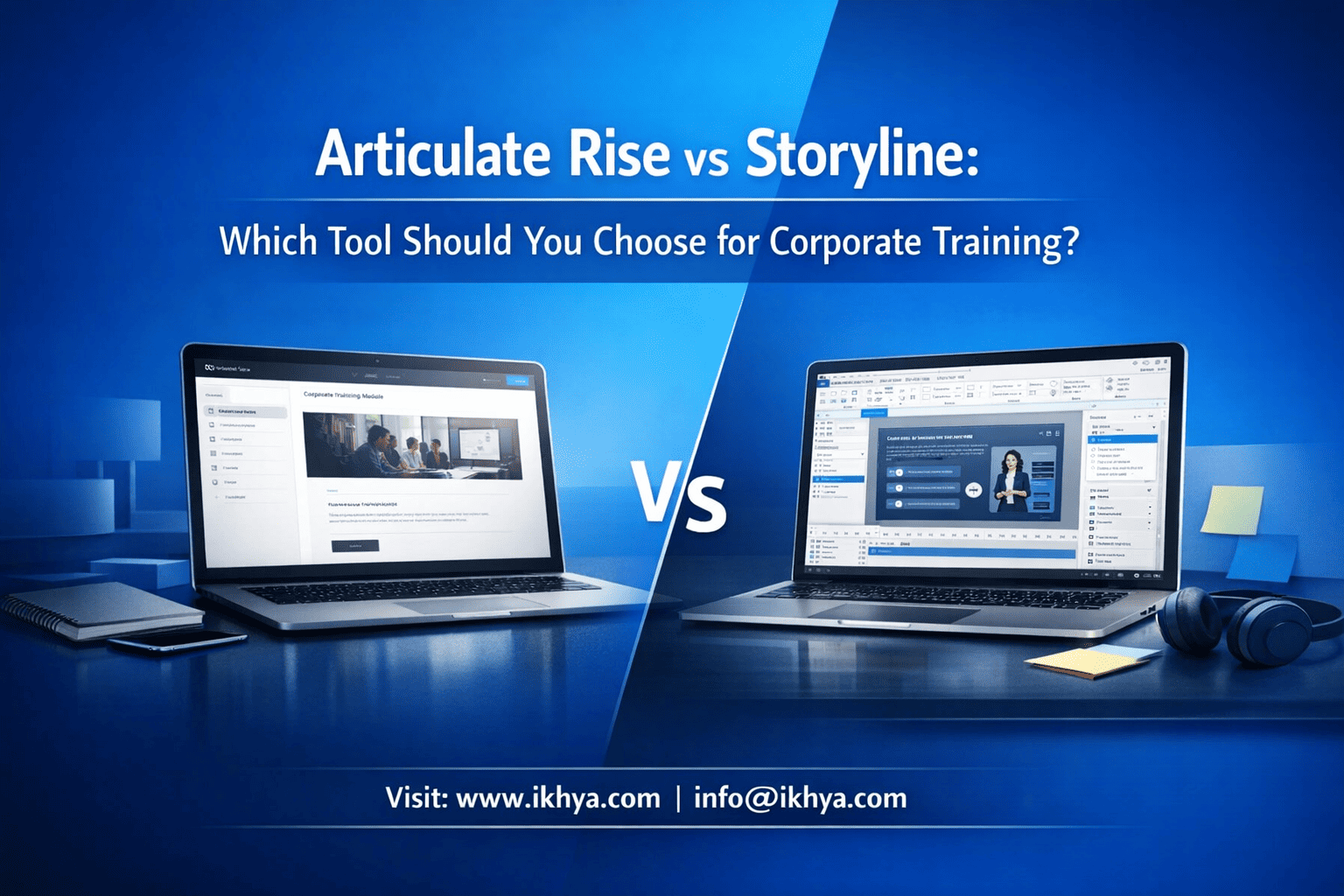
Articulate Rise vs Storyline: Which Tool Should You Choose for Corporate Training?

Choosing the right eLearning authoring tool is one of the most important decisions for corporate training teams. The tool you choose affects development speed, learning engagement, scalability, and how well courses integrate with your Learning Management System (LMS).
Many organizations today rely on two powerful tools from Articulate: Rise 360 and Storyline 360. Both tools are widely used in enterprise training programs across industries such as healthcare, manufacturing, finance, aviation, and retail.
However, these tools serve very different learning design needs.
Corporate training leaders often ask:
- Should we use Rise or Storyline for compliance training?
- Which tool is better for mobile learning?
- Which tool supports complex simulations?
- Can both tools work together in one course?
Understanding these differences is critical when designing scalable learning programs.
If your organization is planning a new training initiative, it can also help to consult experienced development partners who work with both tools. You can explore the expertise of IKHYA – eLearning Solutions Company to see how enterprise teams implement scalable learning solutions.
For organizations evaluating interactive training tools, reviewing the best eLearning authoring tools for corporate training can also provide valuable insights.
In this guide, we will explore:
- What Articulate Rise is
- What Articulate Storyline is
- Key differences between the tools
- When to use each tool
- Enterprise implementation strategies
- How organizations combine both tools effectively
What Is Articulate Rise 360?
Articulate Rise 360 is a web-based eLearning authoring tool designed for rapid course development and fully responsive learning experiences. It allows corporate training teams to create modern, mobile-friendly courses quickly without needing advanced programming or design skills.
Rise is widely used by organizations that need to deploy training at scale, especially for onboarding, compliance programs, product education, and global workforce training.
Key Features of Rise
Rise focuses on speed, simplicity, and responsiveness. Courses automatically adjust to desktops, tablets, and smartphones without requiring separate design layouts.
Key capabilities include:
- Fully responsive course design
- Block-based course structure
- Built-in interactive learning blocks
- Collaborative cloud-based development
- Rapid publishing for LMS deployment
- Support for SCORM and xAPI
This makes Rise ideal for companies that need to deploy training quickly across distributed teams.
Organizations looking for scalable course development often work with specialists offering Articulate Rise development services to accelerate course production.
When Organizations Use Rise
Rise is commonly used for rapid corporate training programs where speed and accessibility are critical.
Typical use cases include:
- Compliance training
- Employee onboarding programs
- Product training
- Policy and regulatory education
- Sales enablement learning
- Mobile learning initiatives
Many global companies use Rise to deliver standardized training across multiple regions, especially when courses must be translated or localized.
For example:
- US enterprises use Rise for compliance training rollouts.
- UK organizations deploy Rise for regulatory education programs.
- Australian companies use Rise for workforce upskilling initiatives.
- UAE enterprises leverage Rise for large-scale employee onboarding.
Rise is particularly effective when training must reach thousands of employees across multiple devices.
Strengths and Limitations of Rise
While Rise is powerful for rapid development, it is designed with simplicity rather than deep customization in mind.
Strengths
- Fast course development
- Mobile-friendly learning design
- Easy collaboration for distributed teams
- Consistent course layout and structure
- Minimal technical learning curve
Limitations
- Limited custom animation control
- Restricted interaction design compared to advanced tools
- Less flexibility for simulations and complex branching scenarios
When organizations require highly interactive learning experiences, they often rely on Storyline instead.
If your organization is planning a training initiative and wants expert guidance on tool selection, you can book a free eLearning demo to explore how enterprise courses are designed using both Rise and Storyline.
What Is Articulate Storyline 360?
Articulate Storyline 360 is a powerful desktop-based eLearning authoring tool designed to create highly interactive and customized learning experiences. It is widely used by organizations that need advanced interactions, simulations, and scenario-based learning for complex corporate training programs.
Unlike Rise, Storyline provides complete design flexibility, allowing instructional designers to control animations, triggers, variables, and branching scenarios.
This makes it a preferred tool for enterprise training programs that require deeper learner engagement and decision-based learning experiences.
Organizations that need highly customized interactive training often rely on specialized partners offering Articulate Storyline development services to design complex learning modules efficiently.
Key Features of Storyline
Storyline offers powerful capabilities that enable the creation of sophisticated eLearning experiences.
Important features include:
- Trigger-based interactivity
- Variables for personalized learning paths
- Complex branching scenarios
- Software simulations and walkthroughs
- Advanced animation control
- Interactive assessments and gamification
These features allow learning designers to build real-world training simulations, which are often required in industries such as aviation, healthcare, manufacturing, and financial services.
Storyline courses also support SCORM, xAPI, and LMS integrations, enabling organizations to track learning progress through enterprise LMS platforms.
When Organizations Use Storyline
Storyline is typically used when training requires complex learning interactions or decision-making scenarios.
Common use cases include:
- Scenario-based leadership training
- Software system simulations
- Safety training simulations
- Customer service role-play training
- Sales negotiation training
- Technical skill development
For example:
- US healthcare organizations use Storyline for clinical scenario training.
- UK financial institutions deploy Storyline for anti-money laundering simulations.
- Australian aviation companies use Storyline for safety procedure training.
- UAE enterprises implement Storyline for operational risk management training.
Because of its flexibility, Storyline is widely considered the most powerful rapid eLearning development tool for corporate training.
Organizations planning large-scale interactive training often review the Articulate Storyline course development services complete guide to understand development strategies and implementation models.
Strengths and Limitations of Storyline
Storyline is extremely powerful, but it also requires more development expertise than Rise.
Strengths
- Highly customizable course design
- Advanced interactive learning experiences
- Support for simulations and branching scenarios
- Full control over course layout and animation
- Ideal for complex learning objectives
Limitations
- Longer development time
- Requires skilled instructional designers
- Less inherently responsive compared to Rise
- Higher production effort for large-scale content
Because of these factors, many enterprises choose to outsource Storyline development to specialized teams. If your organization is exploring outsourcing options, reviewing this guide on outsourcing Articulate Storyline development to reduce cost and timeline can help evaluate the approach.
Articulate Rise vs Storyline: Key Differences Explained
Articulate Rise and Storyline are both powerful tools within the Articulate ecosystem, but they serve different instructional design purposes. Understanding their differences helps corporate training teams choose the right tool for their learning strategy.
Below is a practical comparison used by many enterprise learning teams.
| Feature | Articulate Rise | Articulate Storyline |
|---|---|---|
| Development approach | Block-based rapid development | Slide-based custom development |
| Responsiveness | Fully responsive by default | Requires responsive design setup |
| Interactivity | Limited built-in interactions | Highly customizable interactions |
| Development speed | Very fast | Moderate to slow depending on complexity |
| Custom animations | Limited | Full animation control |
| Scenario-based training | Basic | Advanced branching scenarios |
| Software simulations | Not supported | Fully supported |
| Ideal for | Rapid corporate training | Complex interactive learning |
Development Speed
Rise is designed for rapid course creation, enabling teams to build complete courses quickly using pre-designed blocks.
Storyline development takes longer because designers often create custom interactions, branching scenarios, and animations.
Organizations that need to convert large volumes of existing content often use rapid eLearning development services to accelerate the process.
Course Responsiveness
Rise courses are automatically responsive, meaning they adapt to different devices without additional development work.
Storyline courses can be viewed on mobile devices, but they may require additional design adjustments to ensure optimal mobile usability.
For organizations implementing mobile learning strategies, Rise often provides a faster deployment option.
Customization and Design Flexibility
Storyline offers far greater flexibility for custom learning experiences.
Instructional designers can build:
- branching scenarios
- role-play simulations
- gamified learning modules
- interactive system walkthroughs
Rise, on the other hand, focuses on consistent course layouts and fast content creation, which helps organizations maintain standardized training formats.
Interactivity and Simulations
Storyline excels at high-interaction learning environments.
It supports:
- scenario-based learning
- drag-and-drop interactions
- branching decision trees
- software simulations
- gamified assessments
Rise includes interactive blocks such as quizzes and knowledge checks, but it cannot create complex simulations or advanced branching experiences.
LMS Compatibility and SCORM/xAPI Support
Both Rise and Storyline support standard eLearning formats used in enterprise LMS platforms.
Supported standards include:
- SCORM 1.2
- SCORM 2004
- xAPI (Tin Can API)
This ensures that organizations can track:
- learner progress
- course completion
- assessment scores
- training compliance
Companies deploying LMS-compatible training often rely on LMS compatible eLearning course development services to ensure seamless integration.
When Should You Use Articulate Rise for Corporate Training?
Articulate Rise is best used when organizations need fast, scalable, and mobile-friendly training deployment. Its responsive design and simple development workflow make it ideal for programs where content must be distributed quickly across large employee populations.
For many corporate learning teams, Rise becomes the preferred tool for rapid enterprise training rollouts.
Organizations implementing scalable training programs often rely on Articulate Rise course development services for corporate training teams to accelerate course production while maintaining instructional quality.
Compliance Training
Compliance training is one of the most common use cases for Rise.
Industries such as healthcare, finance, aviation, and manufacturing frequently need to deliver regulatory training across thousands of employees.
Rise works well for compliance programs because it supports:
- structured learning modules
- knowledge checks and quizzes
- policy documentation
- consistent course layouts
Organizations building large compliance programs often explore compliance training eLearning solutions to ensure courses meet regulatory standards and reporting requirements.
Product Training
Companies launching new products frequently need to train:
- sales teams
- customer support teams
- channel partners
- distributors
Rise allows organizations to create quick product knowledge modules that employees can access on any device.
These courses typically include:
- product feature explanations
- visual demonstrations
- short quizzes
- quick reference materials
Because Rise supports rapid updates, product training content can be refreshed easily when product features change.
Global Training Deployment
Large enterprises often deploy training programs across multiple countries and languages.
Rise simplifies global learning initiatives because its structure makes courses easier to translate and localize.
Organizations running international training programs frequently combine Rise with eLearning translation localization services to adapt courses for regional audiences.
For example:
- US corporations deliver onboarding training to global teams.
- UK companies deploy regulatory training across European offices.
- Australian organizations use Rise for workforce certification programs.
- UAE enterprises implement multilingual employee training initiatives.
Mobile-First Learning Programs
Modern workforces increasingly access training through smartphones and tablets.
Rise was specifically designed for mobile-first learning environments.
This makes it ideal for:
- frontline workforce training
- retail staff education
- field service technician training
- distributed workforce learning
Organizations implementing mobile training strategies often combine Rise with mobile learning development solutions to deliver seamless training experiences across devices.
When Should You Use Articulate Storyline for Corporate Training?
Articulate Storyline is the better choice when organizations require complex, highly interactive learning experiences that simulate real-world decision making.
Because Storyline allows full control over course design, it is commonly used for high-impact corporate training programs.
Many enterprises partner with experts offering custom Articulate Storyline development for compliance and safety training when building advanced learning modules.
Scenario-Based Training
Scenario-based learning helps employees practice decision-making in realistic situations.
Storyline enables instructional designers to build branching scenarios, where learners make choices that lead to different outcomes.
Examples include:
- leadership decision training
- customer conflict management
- ethical decision-making programs
- compliance scenario simulations
These types of training experiences improve knowledge retention and practical application.
Software Simulations
Organizations frequently need to train employees on complex enterprise systems.
Storyline allows developers to create detailed software walkthroughs and system simulations, including:
- step-by-step process training
- system navigation simulations
- interactive task practice
- system troubleshooting scenarios
Industries such as banking, healthcare, and logistics rely heavily on these types of training modules.
Complex Decision Training
Many roles require employees to evaluate multiple variables before making decisions.
Storyline supports this through:
- branching decision trees
- variable-driven interactions
- dynamic feedback systems
Examples include:
- financial risk analysis training
- safety incident management simulations
- operations decision training
- crisis response training
These experiences help employees develop critical thinking skills in safe training environments.
High-Interaction Learning Experiences
Storyline enables a wide range of interactive learning experiences, including:
- gamified learning modules
- drag-and-drop interactions
- animated process simulations
- multi-path learning journeys
Organizations building highly engaging learning experiences often work with teams that provide eLearning simulation-based training services to design advanced learning interactions.
Can You Use Articulate Rise and Storyline Together?
Yes, many organizations combine Articulate Rise and Storyline to create hybrid eLearning courses that balance rapid development with advanced interactivity. Rise can deliver the main course structure, while Storyline modules can be embedded to provide deeper interactive learning experiences.
This hybrid approach allows corporate training teams to scale training quickly while still delivering engaging learning simulations where needed.
Enterprises that want to modernize legacy training programs often explore modernizing corporate training using Articulate Storyline and Rise development to redesign older courses into modern interactive learning experiences.
Hybrid Course Architecture
A common enterprise approach is to build the core training structure in Rise while embedding Storyline interactions within specific sections.
Example structure:
| Course Section | Tool Used |
|---|---|
| Course introduction | Rise |
| Policy or theory content | Rise |
| Scenario simulation | Storyline |
| Interactive assessment | Storyline |
| Summary and certification | Rise |
This approach helps organizations maintain consistent course design while still delivering interactive learning experiences.
Embedding Storyline Interactions in Rise
Rise allows Storyline blocks to be embedded directly into the course.
This enables developers to include:
- scenario simulations
- software walkthroughs
- advanced assessments
- branching decision exercises
By combining both tools, training teams can build courses that are both responsive and interactive.
Organizations converting instructor-led programs into digital learning often adopt this hybrid strategy using transform instructor-led training into Articulate Storyline and Rise eLearning.
Enterprise Learning Design Strategies
Large enterprises often use a structured strategy when combining both tools.
Typical design approach:
- Rise for rapid learning modules
- Storyline for high-impact learning interactions
- LMS analytics for tracking learning performance
- Instructional design frameworks for course structure
Organizations designing structured learning programs frequently work with teams offering instructional design services to ensure learning experiences align with business objectives.
Enterprise Considerations When Choosing Between Rise and Storyline
Choosing the right authoring tool is not only about course design. Enterprise organizations must also consider LMS integration, scalability, accessibility, and global deployment requirements.
Understanding these factors helps learning leaders make long-term technology decisions for corporate training programs.
Companies planning enterprise training ecosystems often review the corporate eLearning development complete enterprise guide to understand how tools, LMS platforms, and instructional design strategies work together.
LMS Integration
Most organizations deploy training through a Learning Management System (LMS).
Both Rise and Storyline integrate with major LMS platforms used by enterprises worldwide.
Typical LMS platforms include:
- Cornerstone
- Docebo
- Moodle
- SAP SuccessFactors
- TalentLMS
Organizations deploying LMS-compatible training content frequently use LMS compatible eLearning course development services to ensure courses work seamlessly across different learning systems.
SCORM and xAPI Deployment
Corporate training programs rely on standardized formats for tracking learning activity.
Both Rise and Storyline support:
- SCORM 1.2
- SCORM 2004
- xAPI (Tin Can API)
These standards allow organizations to track:
- course completion
- learner engagement
- quiz performance
- training compliance
This data is essential for industries that require regulatory compliance reporting, such as healthcare, aviation, and financial services.
Localization and Multi-Language Training
Global companies often deploy training programs across multiple regions.
Rise and Storyline both support localization workflows that allow training to be translated into multiple languages.
Organizations running international training initiatives often combine authoring tools with multi-language eLearning development using Articulate Storyline and Rise to reach global audiences.
Accessibility Standards
Modern corporate training programs must also comply with accessibility standards such as WCAG guidelines.
Accessible eLearning ensures that training can be used by employees with different learning needs and disabilities.
Organizations that prioritize inclusive learning environments often implement accessible eLearning solutions to ensure courses meet global accessibility requirements.
In-House vs Outsourced Rise and Storyline Development
Many organizations struggle to decide whether to develop eLearning courses internally or outsource development to specialized providers.
While in-house teams offer control and internal expertise, outsourcing often provides faster development timelines and access to experienced instructional designers.
Organizations evaluating outsourcing options frequently review in-house vs outsourced eLearning development cost comparison to understand the cost and quality trade-offs.
Internal Development Challenges
Corporate training teams often face several challenges when building courses internally.
Common challenges include:
- limited instructional design expertise
- lack of advanced Storyline development skills
- tight training rollout timelines
- limited multimedia production capabilities
These challenges can slow down large training initiatives.
Cost Considerations
While in-house development may appear cost-effective initially, organizations must consider hidden costs such as:
- hiring instructional designers
- purchasing authoring tool licenses
- training internal teams
- managing project timelines
Outsourcing allows companies to scale development without building large internal teams.
Organizations exploring outsourcing strategies often review outsource eLearning development benefits costs and best practices.
Scaling Enterprise Learning Development
For large enterprises delivering training to thousands of employees, scalability becomes a major factor.
Outsourcing allows organizations to:
- accelerate course production
- maintain consistent course quality
- expand development capacity quickly
Companies that need scalable development capacity frequently partner with providers offering custom eLearning development services for long-term training programs.
How to Choose the Right eLearning Development Partner
Selecting the right development partner is a critical step for organizations planning large-scale corporate training programs. The right vendor can help accelerate course development, ensure instructional quality, and integrate training with enterprise learning systems.
Companies evaluating potential partners often review how to choose the eLearning vendor to understand vendor evaluation frameworks used by enterprise procurement teams.
Vendor Evaluation Framework
Corporate training teams should evaluate vendors based on several factors:
- instructional design expertise
- experience with Rise and Storyline
- ability to support LMS integrations
- scalability for large training projects
- experience in industry-specific training
These factors help ensure the vendor can support long-term enterprise learning initiatives.
Questions to Ask eLearning Vendors
Before selecting a development partner, organizations should ask key questions such as:
- Do you have experience developing courses with Rise and Storyline?
- Can you integrate courses with our LMS?
- How do you manage large-scale training development projects?
- Do you support localization and accessibility requirements?
- What is your development process?
These questions help training leaders assess vendor capability and project fit.
Why Many Enterprises Partner with IKHYA for Articulate Rise and Storyline Development
Many organizations choose to work with IKHYA – eLearning Solutions Company when developing corporate training programs using Rise and Storyline.
IKHYA helps enterprises design scalable learning experiences that align with corporate training goals.
Organizations looking to collaborate with experts can contact IKHYA experts to discuss their training requirements.
Key capabilities include:
- custom Rise and Storyline development
- instructional design expertise
- LMS integration support
- scalable enterprise training production
- global training localization
These capabilities help organizations deliver high-quality learning programs while maintaining development efficiency.
Conclusion: Selecting the Right Tool for Your Learning Strategy
Both Articulate Rise and Storyline are powerful tools used by organizations worldwide to deliver effective corporate training.
The best choice depends on training goals, content complexity, and development resources.
In general:
Rise works best for
- rapid training deployment
- mobile learning programs
- compliance and onboarding training
- large-scale corporate training initiatives
Storyline works best for
- simulations and branching scenarios
- complex interactive training
- software system training
- high-engagement learning experiences
Many enterprises ultimately adopt a hybrid strategy, combining both tools to create scalable and engaging learning ecosystems.
Organizations planning new training programs can also request an eLearning RFP to evaluate development options and identify the right implementation strategy.
Frequently Asked Questions
1. What is the main difference between Articulate Rise and Storyline?
Rise is designed for rapid, responsive course development, while Storyline enables highly interactive and customizable learning experiences.
2. Which tool is better for corporate compliance training?
Rise is often preferred for compliance training because it supports fast deployment and mobile-friendly course delivery.
3. Is Storyline better for interactive learning?
Yes. Storyline supports advanced interactions such as branching scenarios, simulations, and gamified learning.
4. Can Rise and Storyline be used together?
Yes. Storyline interactions can be embedded within Rise courses to create hybrid learning experiences.
5. Are Rise and Storyline compatible with LMS platforms?
Yes. Both tools support SCORM and xAPI standards used by most corporate LMS systems.
6. Which tool is faster for course development?
Rise is generally faster because it uses a block-based course creation approach.
7. Does Storyline support mobile learning?
Yes, but Rise is inherently more responsive across devices.
8. Is Rise suitable for large enterprises?
Yes. Many enterprises use Rise for global training programs and large-scale compliance initiatives.
9. Can Storyline create software simulations?
Yes. Storyline is widely used for system training simulations.
10. Which tool is better for onboarding training?
Rise is typically used for onboarding because of its rapid development capabilities.
11. Do both tools support accessibility standards?
Yes. Both tools can support accessibility guidelines when courses are designed properly.
12. Can Rise courses include quizzes?
Yes. Rise includes built-in knowledge checks and assessments.
13. Is Storyline difficult to learn?
Storyline requires more technical knowledge compared to Rise but offers greater flexibility.
14. Which industries commonly use these tools?
Healthcare, finance, aviation, retail, manufacturing, and IT companies commonly use both tools.
15. Is outsourcing eLearning development common?
Yes. Many organizations outsource development to accelerate course production.
16. Can Storyline courses be translated?
Yes. Storyline courses can be localized for multilingual training programs.
17. Is Rise suitable for microlearning?
Yes. Rise is commonly used for short microlearning modules.
18. What authoring tools compete with Rise and Storyline?
Other tools include Captivate, Lectora, Elucidat, and iSpring.
19. How long does it take to develop a Storyline course?
Development time depends on complexity but usually takes longer than Rise.
20. How do companies choose the right authoring tool?
Organizations typically evaluate learning objectives, development timelines, and training complexity before choosing a tool.
Related Resources
If you are exploring tools and strategies for corporate eLearning development, the following resources provide deeper insights into implementation and vendor selection.
- Articulate Rise vs Storyline: Which Should You Use for Corporate Training?
- Enterprise eLearning Development Process Step-by-Step Guide
- eLearning Outsourcing Guide for Enterprises
- Rapid eLearning Development Using Storyline and Rise 360
- Reliable Articulate Rise Development Partner for Long-Term Projects