Corporate eLearning Development – The Complete Enterprise Guide

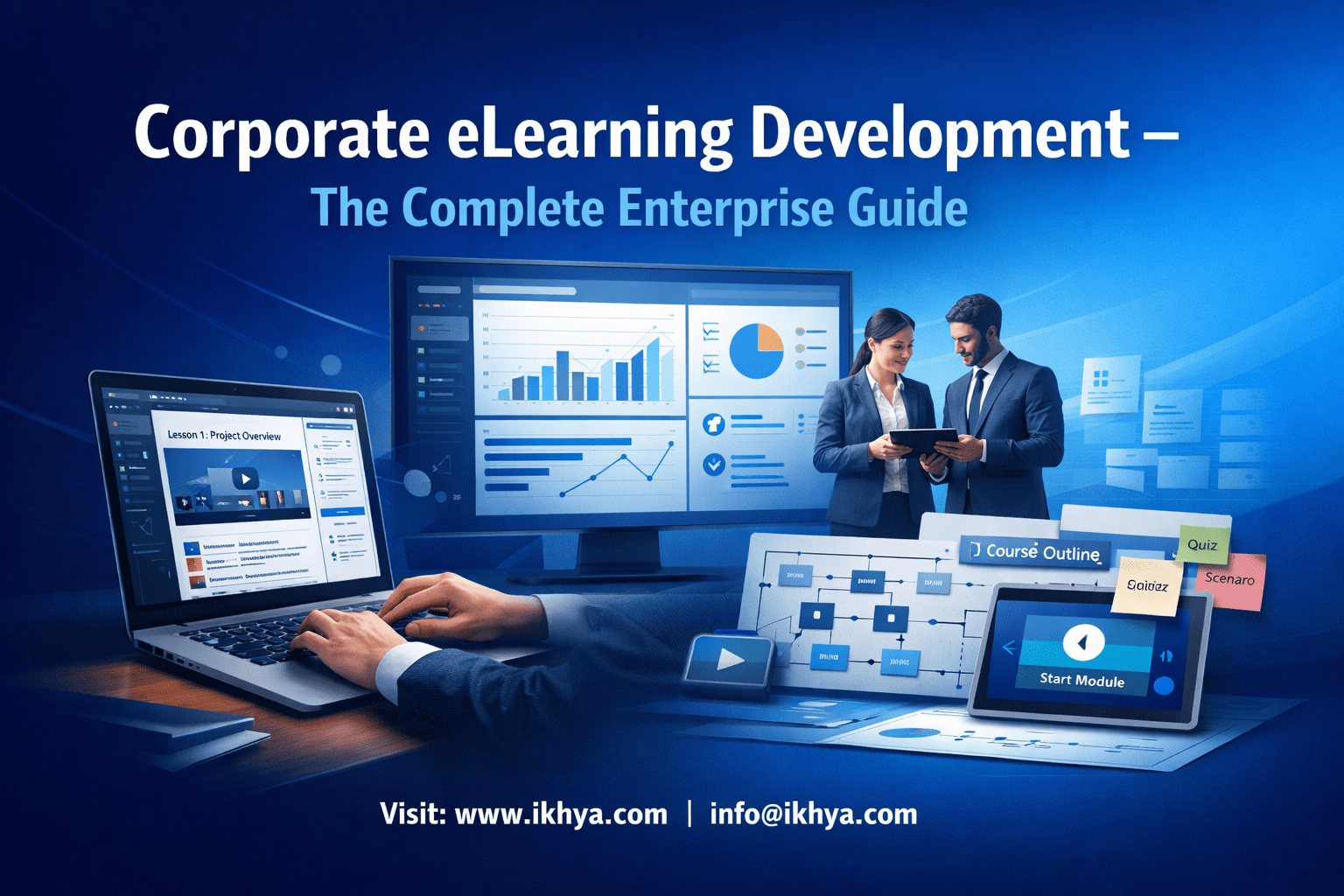
Corporate training is undergoing a massive transformation as organizations move from classroom training to digital learning ecosystems. Companies today must train distributed workforces, maintain regulatory compliance, and upskill employees quickly. IKHYA – eLearning Solutions Company helps organizations design scalable digital learning programs that improve knowledge retention, engagement, and performance.
Corporate eLearning development enables enterprises to convert traditional training into structured digital learning experiences that are interactive, measurable, and accessible across global teams. With the right development strategy, organizations can deliver consistent training while reducing costs and improving learning outcomes.
What Is Corporate eLearning Development?
Corporate eLearning development is the process of designing, developing, and deploying digital training programs for employees using structured instructional design, interactive multimedia, and learning technology platforms.
Organizations use corporate eLearning to deliver training across departments, locations, and time zones while ensuring consistent learning outcomes.
Unlike static training materials or traditional classroom sessions, modern corporate eLearning courses include:
- Interactive learning modules
- Scenario-based simulations
- Knowledge checks and assessments
- Video-based training
- Mobile learning experiences
These digital courses are typically delivered through a Learning Management System (LMS) and built using advanced authoring tools.
Companies working with experienced providers like custom eLearning development services can build scalable training ecosystems tailored to their workforce needs.
Key Characteristics of Corporate eLearning
Corporate eLearning programs typically include:
| Feature | Description |
|---|---|
| Interactive learning | Courses include simulations, branching scenarios, and assessments |
| LMS integration | Training content integrates with enterprise LMS platforms |
| SCORM/xAPI compatibility | Courses track learner progress and performance |
| Mobile accessibility | Employees can learn on smartphones and tablets |
| Global scalability | Training can be deployed across international teams |
These characteristics make corporate eLearning a powerful tool for enterprise training programs.
Why Companies Are Adopting Corporate eLearning Development
Corporate eLearning development allows organizations to train employees faster, scale learning globally, and maintain consistent training standards across departments. Digital learning solutions reduce training costs, improve knowledge retention, and provide measurable learning outcomes through analytics and reporting.
Modern enterprises are replacing traditional classroom training with scalable digital programs built through eLearning consultancy services and strategic instructional design frameworks.
Key Drivers Behind Corporate eLearning Adoption
Organizations worldwide are rapidly investing in digital learning programs for several reasons.
1. Distributed and Remote Workforces
Companies operating across multiple locations require training that can reach employees regardless of geography.
For example:
- US technology companies train distributed software teams through digital onboarding programs.
- UK organizations deploy compliance training using standardized learning frameworks.
- Australian enterprises use online safety training to maintain workplace compliance.
- UAE corporations deliver multilingual employee training across global teams.
Corporate eLearning allows companies to deploy training consistently across all these environments.
2. Faster Employee Onboarding
Traditional onboarding programs can take weeks and require extensive instructor involvement.
Corporate eLearning accelerates onboarding through:
- structured learning paths
- role-based training modules
- interactive learning scenarios
- digital assessments
Organizations converting traditional materials using ILT to eLearning course conversion services can transform instructor-led onboarding sessions into scalable digital programs.
3. Compliance and Regulatory Training
Many industries must provide mandatory training on safety, ethics, and regulatory compliance.
Examples include:
- Healthcare compliance training
- Financial regulatory training
- Workplace safety programs
- Anti-money laundering training
Digital training ensures employees receive standardized compliance instruction. Many organizations deploy specialized solutions such as compliance training eLearning solutions to ensure regulatory training is consistent and auditable.
4. Continuous Workforce Upskilling
Technology evolves rapidly, requiring employees to continuously learn new skills.
Corporate eLearning supports continuous learning through:
- modular learning programs
- role-based learning paths
- microlearning modules
- on-demand training content
Companies using structured instructional design services can develop learning strategies that align training with business performance goals.
5. Cost Efficiency and Training Scalability
Instructor-led training often requires travel, classroom infrastructure, and scheduling logistics.
Corporate eLearning reduces costs by:
- eliminating travel expenses
- enabling self-paced learning
- delivering training to thousands of employees simultaneously
- reducing instructor dependency
Organizations evaluating outsourcing options often compare internal training teams with external partners using frameworks like the in-house vs outsourced elearning development cost comparison guide.
Corporate eLearning Development Process
Corporate eLearning development follows a structured process that ensures training programs are effective, engaging, and aligned with business goals.
Professional development teams typically follow a multi-stage methodology supported by rapid eLearning development services to accelerate production timelines.
1. Training Needs Analysis
The first step is identifying learning goals and business objectives.
Key activities include:
- identifying skill gaps
- analyzing learner demographics
- defining measurable training outcomes
- determining delivery methods
A detailed needs analysis ensures training programs address real performance challenges.
2. Instructional Design and Learning Strategy
Once training goals are defined, instructional designers create the course structure.
This stage includes:
- defining learning objectives
- creating course outlines
- designing assessments
- planning learner engagement strategies
Organizations building structured digital learning experiences often rely on instructional design services to align course design with adult learning principles.
3. Content Development and Authoring
In this stage, learning developers transform training materials into interactive digital courses.
Development activities may include:
- interactive slides and multimedia
- scenario-based simulations
- quizzes and knowledge checks
- voice-over narration and videos
Training materials such as PowerPoint presentations are often converted using PPT to eLearning conversion services to create engaging digital modules.
4. Quality Assurance and Testing
Before deployment, courses undergo extensive testing to ensure:
- technical compatibility
- LMS integration
- assessment accuracy
- user experience quality
This stage ensures the training program works seamlessly across devices and platforms.
5. LMS Deployment and Launch
Once courses are finalized, they are deployed through the organization’s Learning Management System.
Many organizations rely on LMS compatible eLearning course development services to ensure content integrates smoothly with enterprise LMS platforms.
6. Learning Analytics and Optimization
Corporate eLearning programs are continuously improved using learner data.
Metrics commonly tracked include:
- course completion rates
- assessment scores
- learner engagement levels
- training impact on job performance
Data-driven optimization ensures training programs evolve with organizational needs.
Key Corporate eLearning Development Services
Corporate eLearning development involves multiple specialized services that transform training content into engaging digital learning experiences. These services ensure that enterprise training programs are interactive, scalable, and aligned with organizational learning objectives.
Most enterprises work with specialized providers such as IKHYA – eLearning Solutions Company to build structured learning ecosystems that support workforce training, compliance education, and skill development initiatives.
Custom eLearning Development
Custom eLearning development focuses on building fully tailored training programs designed specifically for an organization’s learning objectives, workforce roles, and operational requirements.
Companies using custom eLearning development services can develop learning experiences that include:
- scenario-based simulations
- interactive learning activities
- branching decision-making scenarios
- real-world problem-solving exercises
Custom development is particularly valuable for organizations that require specialized training aligned with internal workflows or regulatory frameworks.
Rapid eLearning Development
Rapid eLearning development enables organizations to convert existing training materials into digital courses quickly while maintaining instructional quality.
Businesses with urgent training needs often deploy rapid eLearning development services to accelerate course production and reduce development timelines.
Rapid development is commonly used for:
- product training updates
- policy updates
- compliance training rollouts
- software training modules
This approach allows organizations to scale training quickly without lengthy development cycles.
Microlearning Development
Microlearning focuses on delivering short, focused learning modules designed for quick consumption and better knowledge retention.
Organizations implementing microlearning development services can create:
- 3–5 minute learning modules
- mobile-first training programs
- quick refresher courses
- just-in-time performance support
Microlearning is particularly effective for modern workforces where employees prefer shorter, flexible learning experiences.
Instructor-Led Training (ILT) to eLearning Conversion
Many organizations still rely on classroom-based training programs. Converting these sessions into digital learning programs allows companies to scale training globally.
Businesses using ILT to eLearning course conversion services can transform instructor-led training into:
- structured digital learning modules
- self-paced training courses
- blended learning programs
- virtual instructor-led learning environments
This conversion process ensures training programs remain accessible and scalable.
Simulation-Based Training
Simulation-based training allows employees to practice real-world scenarios in a safe learning environment.
Organizations developing advanced training programs often deploy eLearning simulation based training services to create:
- software simulations
- safety training scenarios
- compliance training exercises
- role-play simulations
Simulation-based training significantly improves knowledge retention and skill application.
Mobile Learning Development
Modern employees increasingly rely on smartphones and tablets to access learning content. Mobile learning enables training delivery anytime and anywhere.
Companies implementing mobile learning development solutions can build training programs optimized for:
- mobile devices
- remote learning environments
- field-based employees
- just-in-time learning
Mobile learning improves accessibility and learner engagement across distributed workforces.
eLearning Localization and Translation
Global organizations often require training programs that can be delivered in multiple languages.
Using eLearning translation and localization services allows companies to deploy training programs across international teams while maintaining cultural and linguistic relevance.
Localized training ensures that global employees receive consistent learning experiences regardless of location.
eLearning Course Redesign and Modernization
Many organizations have legacy training courses that no longer meet modern learning standards.
By implementing eLearning course redesigning services, companies can update outdated training content and transform it into interactive digital learning experiences.
Course modernization typically includes:
- redesigning outdated slides
- improving visual design
- adding interactive elements
- optimizing courses for mobile devices
Accessible eLearning Development
Accessible eLearning ensures training programs are inclusive and usable by learners with disabilities.
Organizations adopting accessible eLearning solutions can ensure compliance with accessibility standards such as:
- WCAG guidelines
- ADA compliance requirements
- screen reader compatibility
- keyboard navigation support
Accessible learning ensures training programs are inclusive and compliant with global accessibility regulations.
Tools Used for Corporate eLearning Development
Corporate eLearning development relies on specialized authoring tools and learning technologies that enable organizations to build interactive training programs. These tools allow instructional designers and developers to create multimedia courses, simulations, assessments, and scenario-based learning experiences that integrate with enterprise Learning Management Systems.
Organizations often evaluate different tools through resources like the best eLearning authoring tools for corporate training guide to determine which technology best fits their training requirements.
Articulate Storyline
Articulate Storyline is one of the most widely used tools for developing highly interactive corporate training programs. It enables developers to build scenario-based learning experiences, software simulations, and complex branching courses.
Companies often use Articulate Storyline development services to build advanced training modules that include:
- branching learning scenarios
- software simulations
- gamified learning experiences
- complex knowledge assessments
Storyline is especially useful for compliance training, safety training, and decision-based learning modules.
Articulate Rise 360
Articulate Rise is a responsive authoring tool designed for rapid course creation and mobile-friendly learning experiences.
Organizations working with Articulate Rise development services can build training modules quickly while ensuring courses automatically adapt to different screen sizes.
Rise is commonly used for:
- onboarding training
- compliance training
- product training
- microlearning programs
Its responsive design makes it ideal for distributed workforces accessing training on multiple devices.
Adobe Captivate
Adobe Captivate is a powerful eLearning development platform widely used for simulations, immersive learning environments, and technical training programs.
Enterprises using Adobe Captivate development services can create:
- software simulations
- virtual learning environments
- responsive courses
- immersive interactive learning
Captivate is particularly useful for software training and technical skill development.
Lectora Inspire
Lectora Inspire is an enterprise-grade authoring tool known for its accessibility features and compliance with learning standards.
Organizations deploying Lectora Inspire development services often use it for:
- compliance training programs
- accessibility-focused learning
- enterprise training systems
- complex LMS-integrated courses
Lectora is frequently chosen by organizations that require strict compliance with accessibility standards.
iSpring Suite
iSpring Suite is a PowerPoint-based authoring tool that allows organizations to quickly convert presentation content into interactive eLearning modules.
Companies using iSpring eLearning development services can transform existing training materials into digital learning modules that include:
- quizzes and assessments
- dialogue simulations
- interactive presentations
- video-based learning
iSpring is commonly used for rapid training development and corporate onboarding programs.
dominKnow
dominKnow is a cloud-based eLearning authoring platform that supports collaborative course development across teams.
Organizations using dominKnow development services benefit from:
- collaborative authoring workflows
- cloud-based course development
- responsive learning design
- scalable enterprise learning programs
dominKnow is particularly useful for large organizations managing multiple training projects simultaneously.
Elucidat
Elucidat is another cloud-based authoring platform designed for large organizations managing high-volume course production.
Companies using Elucidat development services can develop scalable training programs with centralized content management.
This tool is commonly used for:
- global enterprise training programs
- compliance training rollouts
- multi-language training deployments
- large-scale training content production
Types of Corporate Training That Use eLearning
Corporate eLearning is used across many training categories within organizations. Digital learning solutions allow companies to deliver structured training programs that improve employee knowledge, compliance, and job performance.
Employee Onboarding Training
Employee onboarding programs help new hires understand company policies, processes, and culture.
Digital onboarding programs typically include:
- company orientation modules
- HR policy training
- job role training
- technology training
Organizations delivering large onboarding programs often combine custom development with rapid authoring tools.
Compliance Training
Compliance training ensures employees follow industry regulations and internal policies.
Industries that rely heavily on compliance training include:
- healthcare
- financial services
- aviation
- manufacturing
- energy
Organizations implementing structured compliance training programs often use compliance training eLearning solutions to maintain regulatory compliance.
Safety Training
Workplace safety training is critical for industries with operational risks.
Digital safety training programs help employees understand:
- workplace hazards
- safety procedures
- emergency response protocols
- operational risk management
Many organizations develop industry-specific training such as manufacturing training eLearning solutions to improve worker safety and operational compliance.
Product and Sales Training
Companies frequently use eLearning to train employees on products, services, and sales techniques.
Sales training programs may include:
- product knowledge modules
- sales strategy simulations
- customer interaction scenarios
- negotiation training
Digital learning ensures sales teams remain updated on evolving products and services.
Technical Skills Training
Technical training helps employees develop job-specific technical skills required for their roles.
This type of training is common in industries such as:
- IT and software
- engineering
- aviation
- healthcare technology
Companies providing structured digital training programs for these sectors often rely on IT and software training eLearning solutions to support workforce skill development.
Benefits of Corporate eLearning Development for Enterprises
Corporate eLearning development enables organizations to deliver scalable, measurable, and engaging training programs that improve employee performance. Digital learning environments allow enterprises to train thousands of employees across different locations while maintaining consistent learning standards.
Organizations implementing structured training strategies with custom eLearning development services can align learning programs directly with business goals, operational processes, and workforce skill development.
Key Business Benefits of Corporate eLearning
Corporate eLearning delivers several strategic advantages for modern enterprises.
1. Scalable Training Across Global Workforces
One of the biggest advantages of corporate eLearning is its ability to scale training across large organizations.
Global enterprises operating in regions such as the United States, United Kingdom, Australia, and the UAE often have distributed teams that require consistent training.
Digital learning platforms allow organizations to:
- deliver standardized training worldwide
- maintain consistent compliance education
- onboard employees across multiple locations
- deploy training updates instantly
This scalability is particularly valuable for multinational corporations managing global operations.
2. Reduced Training Costs
Traditional classroom training often requires travel, trainers, physical infrastructure, and printed learning materials.
Corporate eLearning significantly reduces these costs by enabling organizations to:
- eliminate travel expenses
- reuse digital training modules
- train employees remotely
- reduce instructor dependency
Companies analyzing training investment often evaluate options such as custom eLearning development cost vs buying ready-made courses to determine the most cost-effective strategy.
3. Improved Knowledge Retention
Interactive digital learning improves learner engagement and knowledge retention compared to passive classroom sessions.
Corporate eLearning programs often include:
- scenario-based learning
- simulations
- interactive quizzes
- real-world problem-solving exercises
These learning techniques help employees apply knowledge more effectively in real work environments.
4. Flexible and Self-Paced Learning
Modern employees prefer flexible learning experiences that allow them to learn at their own pace.
Corporate eLearning allows employees to:
- access training anytime
- revisit learning modules when needed
- learn on multiple devices
- complete training without disrupting work schedules
Mobile-first learning strategies are often implemented through mobile learning development solutions to ensure training accessibility across devices.
5. Measurable Training Impact
Corporate eLearning platforms provide advanced analytics that help organizations measure training effectiveness.
Training managers can track:
| Metric | Purpose |
|---|---|
| Course completion rates | Measure learner participation |
| Assessment scores | Evaluate knowledge retention |
| Learning progress | Track learner engagement |
| Skill development metrics | Measure workforce capability growth |
Data-driven insights allow organizations to continuously improve training programs.
In-House vs Outsourced Corporate eLearning Development
Organizations planning corporate training programs must decide whether to build courses internally or partner with specialized eLearning development companies.
Both approaches have advantages depending on organizational resources and training requirements.
Companies evaluating this decision often explore insights from resources like outsource eLearning development benefits, costs and best practices.
In-House eLearning Development
In-house development involves building a dedicated internal training team responsible for course design and development.
Advantages include:
- direct control over content development
- internal subject matter expertise
- long-term knowledge retention within the organization
However, in-house development may require significant investments in:
- authoring tools
- instructional design expertise
- multimedia production capabilities
- LMS administration
Outsourced eLearning Development
Many enterprises partner with specialized vendors to develop corporate training programs.
Working with experienced providers such as eLearning consultancy services enables organizations to access expert instructional designers, multimedia developers, and learning strategists.
Outsourcing offers several advantages:
- faster course development timelines
- access to specialized expertise
- reduced internal workload
- scalable development capacity
Organizations frequently compare outsourcing and internal development using frameworks like in-house vs outsourced eLearning development cost comparison.
How to Choose the Right Corporate eLearning Development Partner
Selecting the right eLearning development partner is a critical decision for organizations planning enterprise training programs.
The right vendor should provide strategic guidance, instructional design expertise, and scalable development capabilities.
Organizations evaluating vendors often begin with structured frameworks like the how to choose the eLearning vendor guide.
Key Factors to Evaluate
When selecting a corporate eLearning development partner, consider the following factors.
Industry Experience
An experienced vendor understands the unique training requirements of different industries.
For example:
- healthcare compliance training
- financial services regulatory training
- aviation safety training
- manufacturing safety training
Industry expertise ensures training content aligns with operational and regulatory requirements.
Instructional Design Expertise
Strong instructional design is essential for creating effective learning experiences.
Look for vendors that specialize in:
- adult learning principles
- scenario-based learning
- performance-based training design
- interactive learning experiences
Organizations often request proposals using resources such as the eLearning RFP template guide to evaluate vendor capabilities.
Technology and Authoring Tool Expertise
A capable development partner should be experienced in major authoring tools and learning technologies.
These may include:
- Articulate Storyline
- Articulate Rise
- Adobe Captivate
- Lectora
- iSpring
- dominKnow
- Elucidat
Technical expertise ensures training courses are compatible with enterprise LMS platforms and learning standards.
Development Scalability
Large organizations often require dozens or even hundreds of training courses.
The right vendor should have the capability to scale development resources as needed.
Enterprises often engage development partners through structured procurement processes such as request RFP workflows.
Future Trends in Corporate eLearning Development
Corporate learning is evolving rapidly as new technologies and learning strategies emerge.
Organizations investing in digital training programs must stay ahead of these trends to remain competitive.
AI-Powered Personalized Learning
Artificial intelligence is enabling adaptive learning experiences that adjust content based on learner performance.
AI-driven systems can recommend:
- personalized learning paths
- skill-based training modules
- targeted knowledge reinforcement
Immersive Learning Experiences
Technologies such as simulations, VR, and AR are transforming corporate training environments.
Simulation-based learning allows employees to practice real-world scenarios without operational risks.
Data-Driven Learning Strategies
Learning analytics and performance data are becoming essential for improving training outcomes.
Organizations increasingly rely on analytics dashboards to evaluate training effectiveness and optimize learning strategies.
Continuous Learning Ecosystems
Instead of one-time training events, organizations are shifting toward continuous learning models that provide ongoing skill development.
This approach combines:
- microlearning modules
- knowledge reinforcement programs
- performance support tools
- on-demand learning libraries
Continuous learning ensures employees stay updated with evolving industry requirements.
Frequently Asked Questions (FAQs)
What is corporate eLearning development?
Corporate eLearning development is the process of designing, developing, and deploying digital training programs for employees within an organization. These programs use interactive multimedia, instructional design frameworks, and learning technologies to deliver structured training experiences.
Corporate eLearning courses are typically delivered through Learning Management Systems and built using specialized authoring tools such as Articulate Storyline or Adobe Captivate. These programs support various training objectives including onboarding, compliance training, product education, and leadership development.
Organizations implement corporate eLearning to scale training across global workforces while improving learner engagement and knowledge retention.
Why do companies invest in corporate eLearning development?
Companies invest in corporate eLearning development to improve workforce skills, reduce training costs, and deliver scalable training programs across distributed teams.
Digital learning allows organizations to provide consistent training regardless of employee location while tracking learning progress through analytics and reporting systems.
Corporate eLearning also enables organizations to deliver training quickly, update learning materials efficiently, and ensure compliance with industry regulations. This makes it an essential component of modern enterprise training strategies.
What tools are used for corporate eLearning development?
Corporate eLearning courses are typically developed using specialized authoring tools designed to create interactive training experiences.
Common tools include:
- Articulate Storyline
- Articulate Rise 360
- Adobe Captivate
- Lectora Inspire
- iSpring Suite
- dominKnow
- Elucidat
These tools allow developers to create multimedia learning modules, scenario-based training simulations, and interactive assessments that integrate with Learning Management Systems.
How long does it take to develop a corporate eLearning course?
The development timeline for a corporate eLearning course depends on factors such as course complexity, content availability, and instructional design requirements.
Simple courses may take 2–4 weeks, while complex interactive training programs with simulations and assessments may require 6–12 weeks or longer.
Rapid development methodologies can accelerate production timelines by converting existing training materials into digital learning modules.
What is the cost of corporate eLearning development?
The cost of corporate eLearning development varies depending on course complexity, multimedia requirements, instructional design effort, and development tools used.
Basic courses may cost a few thousand dollars, while advanced simulation-based training programs can require larger investments.
Organizations typically evaluate cost based on training scale, long-term ROI, and potential savings compared to traditional instructor-led training programs.
What types of training can be delivered through corporate eLearning?
Corporate eLearning supports a wide range of training programs including:
- employee onboarding
- compliance training
- safety training
- product training
- technical skills training
- leadership development
These digital learning programs allow organizations to deliver structured training experiences while maintaining consistent learning outcomes across teams.
Is corporate eLearning suitable for large enterprises?
Yes. Corporate eLearning is particularly beneficial for large enterprises with distributed workforces.
Digital training platforms allow organizations to deliver standardized learning programs to thousands of employees across multiple locations while tracking training performance through analytics and reporting systems.
This scalability makes eLearning ideal for multinational corporations and rapidly growing companies.
Can corporate eLearning replace classroom training?
Corporate eLearning can replace many traditional classroom training programs, but many organizations adopt blended learning strategies that combine digital learning with instructor-led sessions.
Blended learning allows companies to deliver foundational knowledge through eLearning while using classroom sessions for hands-on training and collaborative learning activities.
What industries use corporate eLearning development?
Corporate eLearning is widely used across industries including:
- healthcare
- financial services
- aviation
- manufacturing
- retail
- energy and oil & gas
- information technology
Each industry uses digital training programs to support compliance education, workforce skill development, and operational training.
What is microlearning in corporate training?
Microlearning is a training approach that delivers short, focused learning modules designed for quick consumption and better knowledge retention.
These modules typically last 3–7 minutes and focus on a single learning objective.
Microlearning is widely used for refresher training, product updates, and performance support.
How does corporate eLearning improve employee performance?
Corporate eLearning improves employee performance by delivering structured training programs that reinforce knowledge and support skill development.
Interactive learning activities, simulations, and scenario-based exercises help employees apply knowledge in real-world situations.
Continuous learning programs also ensure employees stay updated with evolving industry requirements.
What is LMS integration in eLearning?
Learning Management System integration ensures that eLearning courses can be delivered, tracked, and managed through a centralized learning platform.
LMS systems track learner progress, assessment scores, and course completion rates, providing valuable insights into training effectiveness.
Why do companies outsource eLearning development?
Companies outsource eLearning development to access specialized expertise, reduce development timelines, and scale training production.
External vendors often provide experienced instructional designers, multimedia developers, and technical specialists who can deliver high-quality training programs efficiently.
What is instructional design in corporate training?
Instructional design is the process of structuring training content using proven learning methodologies to improve knowledge retention and learner engagement.
Instructional designers create course outlines, learning objectives, assessments, and interactive learning experiences that align with business goals.
What is simulation-based training?
Simulation-based training allows employees to practice real-world scenarios in a controlled learning environment.
This training method is commonly used for safety training, software training, and decision-making exercises.
Simulations improve learner engagement and allow employees to practice skills without operational risks.
What is mobile learning in corporate training?
Mobile learning enables employees to access training programs on smartphones and tablets.
This approach allows employees to learn anytime and anywhere, making training more accessible and flexible for distributed workforces.
What is rapid eLearning development?
Rapid eLearning development is a methodology that focuses on converting existing training materials into digital learning modules quickly.
This approach helps organizations deploy training programs faster while maintaining instructional quality.
How do organizations measure eLearning effectiveness?
Organizations measure eLearning effectiveness using analytics such as:
- course completion rates
- assessment scores
- learner engagement metrics
- post-training performance improvements
These insights help training teams improve learning programs and demonstrate training ROI.
What is accessibility in eLearning?
Accessible eLearning ensures training programs are usable by learners with disabilities.
Accessible courses follow standards such as WCAG guidelines and include features such as screen reader compatibility, keyboard navigation, and captioned multimedia.
What is the future of corporate eLearning?
The future of corporate eLearning includes AI-driven learning personalization, immersive learning environments, and data-driven training strategies.
Organizations are also moving toward continuous learning ecosystems that provide ongoing skill development instead of one-time training programs.
Related Resources
Organizations planning corporate training initiatives often explore resources that help them evaluate development approaches and technologies. For example, companies comparing internal and external development models can review insights in the guide on outsource eLearning development benefits, costs and best practices. Businesses converting training content into digital learning can also explore the convert PowerPoint to eLearning complete guide.
For organizations evaluating authoring tools, the resource on best eLearning authoring tools for corporate training explains major platforms used in enterprise learning. Companies planning vendor selection can follow frameworks described in how to choose the eLearning vendor, while training teams modernizing legacy content may benefit from strategies outlined in converting legacy courses to Articulate Storyline and Rise services guide.