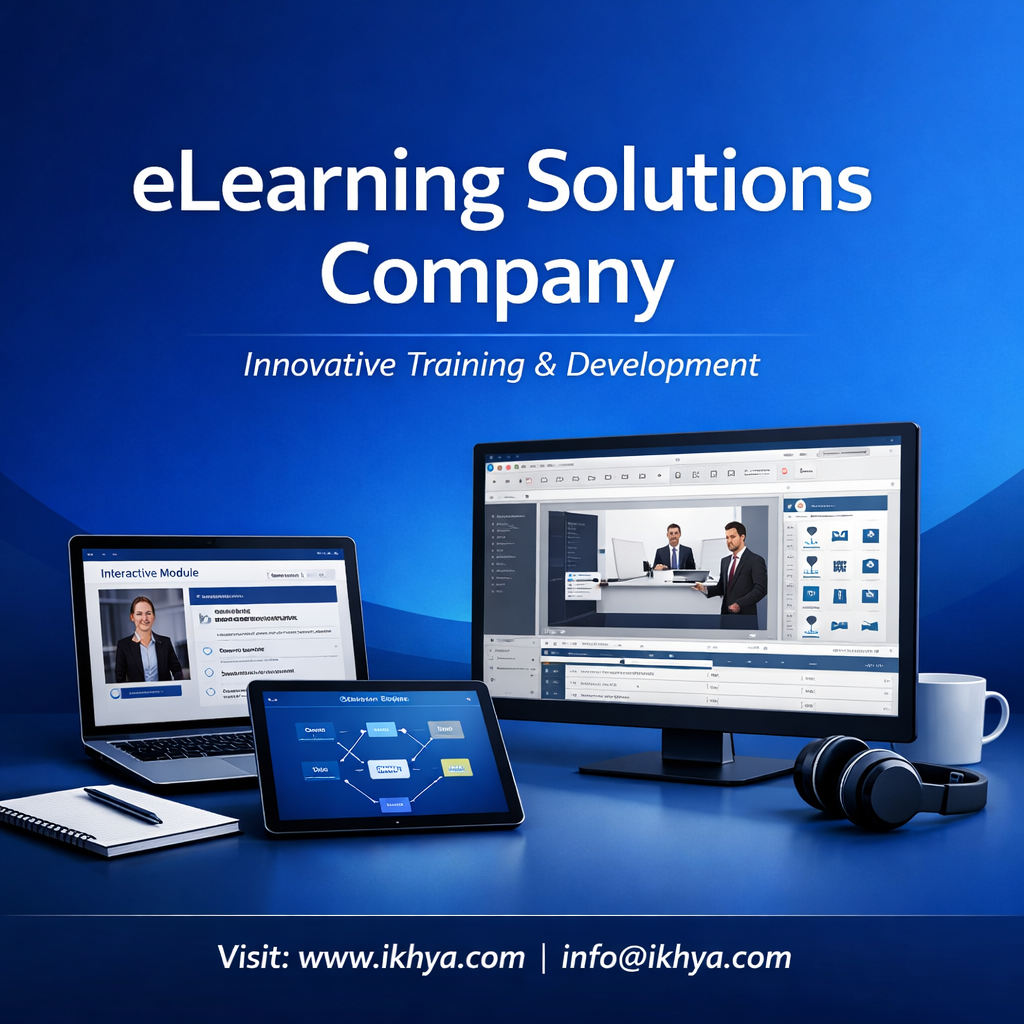


eLearning Solutions Company
Enterprises today need more than just training content.
They need scalable, measurable, and LMS-ready learning ecosystems that directly impact business performance.
An experienced eLearning solutions company helps organizations convert training into real business outcomes:
- Faster onboarding
- Stronger compliance
- Improved workforce productivity
IKHYA delivers enterprise-grade solutions that align with your systems, global teams, and performance goals. Learn more about Our approach on the About IKHYA eLearning solutions company.
If you’re planning a new training initiative, you can directly contact IKHYA to discuss your requirements with experts.
What Does an eLearning Solutions Company Actually Deliver?
An eLearning solutions company is not just a content creator. It is a strategic partner that designs, develops, deploys, and continuously optimizes corporate training programs.
For enterprises, the focus is not on courses—it is on business outcomes, scalability, and long-term learning impact.
Core Deliverables:
1. Custom eLearning Development
Tailored training aligned with aaayour business goals, audience, and systems. Explore how enterprises build role-specific programs with custom eLearning development services.
2. Instructional Design Expertise
Structured learning experiences based on adult learning principles. This ensures knowledge retention and measurable outcomes via instructional design services.
3. Rapid eLearning Development
Faster course creation for time-sensitive training needs. Ideal for compliance, onboarding, and product updates using rapid eLearning development services.
4. LMS-Compatible Course Development
Courses built for seamless deployment across platforms. Supports SCORM, xAPI, and enterprise LMS ecosystems via LMS-compatible eLearning course development services.
5. Legacy Content Conversion
Convert outdated formats like PPTs, PDFs, and ILT into interactive learning. See how organizations modernize training using ILT to eLearning course conversion services.
6. Microlearning & Mobile Learning
Short, focused modules optimized for mobile-first workforce training. Delivered through microlearning development services and mobile learning development solutions.
7. Localization & Global Deployment
Multi-language training for distributed teams. Handled through eLearning translation & localization services.
8. Simulation-Based Training
Interactive scenarios for high-risk or complex environments. Delivered using eLearning simulation-based training services.
What Enterprises Actually Buy (Beyond Services)
Most organizations are not buying “courses.”
They are investing in:
- Faster employee onboarding
- Reduced compliance risks
- Consistent global training delivery
- Measurable learning analytics
- Scalable workforce development
Where Most Vendors Fall Short
Many vendors focus only on content creation.
But enterprises need:
- LMS integration support
- Scalable delivery models
- Multi-region deployment
- Post-launch analytics and optimization
This is where a strategic partner like IKHYA becomes critical.
Types of eLearning Solutions Enterprises Need Today
Enterprises rarely need a single type of training. They need a mix of solutions aligned to business goals, workforce scale, and industry requirements.
This is where many vendors fall short—they offer generic solutions instead of modular, scalable learning ecosystems.
Below are the core eLearning solution types enterprises actively invest in.
Custom eLearning for Business-Critical Training
Custom eLearning is built from scratch based on your workflows, systems, and internal processes.
It is best suited for:
- Compliance training
- Product training
- Process training
- Leadership development
Unlike off-the-shelf content, custom programs align directly with KPIs.
Rapid eLearning for Speed and Scale
When timelines are tight, rapid eLearning helps convert existing content into structured courses quickly.
Best use cases:
- Policy updates
- System rollouts
- Refresher training
Modern tools like Articulate Storyline 360 and Articulate Rise 360 enable fast development cycles without compromising quality.
Many enterprises accelerate delivery using rapid eLearning development using Storyline and Rise 360.
LMS-Based eLearning for Enterprise Deployment
Large organizations need training that integrates seamlessly with their LMS.
Key requirements:
- SCORM/xAPI compliance
- Tracking and reporting
- User management integration
Courses developed through LMS-compatible eLearning course development services ensure smooth deployment across platforms like Moodle, Cornerstone, and SAP SuccessFactors.
Legacy Content Conversion (PPT, PDF, ILT)
Most enterprises already have training content—but in outdated formats.
Conversion solutions transform:
- PowerPoint presentations
- Instructor-led training (ILT)
- PDFs and manuals
Into:
- Interactive digital learning
- Mobile-friendly modules
- Trackable LMS courses
For example, organizations modernize content using PPT to eLearning conversion services or follow structured approaches outlined in convert PowerPoint to eLearning a complete guide.
Microlearning for Continuous Learning
Microlearning delivers short, focused modules that employees can consume quickly.
Ideal for:
- Sales training
- Product knowledge
- Just-in-time learning
This approach improves retention and fits into daily workflows.
Enterprises implement this at scale through microlearning development services.
Simulation-Based and Scenario Training
For high-risk industries, theoretical training is not enough.
Simulation-based learning provides:
- Real-world scenarios
- Decision-making practice
- Risk-free environments
Used heavily in:
- Healthcare
- Aviation
- Manufacturing
Built using eLearning simulation-based training services.
Mobile Learning for Distributed Workforces
Modern employees learn on the go.
Mobile-first training ensures:
- Accessibility across devices
- Higher engagement rates
- Flexible learning schedules
Organizations adopt this using mobile learning development solutions.
Localization for Global Enterprises
Global companies need consistent training across regions.
Localization includes:
- Multi-language translation
- Cultural adaptation
- Region-specific compliance
Handled efficiently via eLearning translation & localization services.
Key Insight for Decision Makers
The real value is not choosing one solution—it’s combining the right mix.
A strong eLearning partner helps you:
- Identify the right blend
- Scale across teams
- Optimize continuously
How Enterprise eLearning Development Works (Step-by-Step Process)
For enterprises, eLearning development is not a linear content creation task. It is a structured process involving multiple stakeholders, systems, and validation stages.
Understanding this process helps decision-makers evaluate vendor capability, timelines, and risks.
1. Business & Training Needs Analysis
Every successful project starts with clarity.
This phase identifies:
- Business goals (compliance, performance, onboarding)
- Target audience and skill gaps
- Existing content and systems
- LMS and technical constraints
Many organizations engage experts through eLearning consultancy services to define a scalable learning strategy before development begins.
2. Instructional Design Blueprint
Once requirements are clear, instructional designers create the learning architecture.
This includes:
- Learning objectives
- Content structuring
- Storyboarding
- Assessment strategy
Strong instructional design ensures training is not just informative, but effective.
Enterprises typically rely on instructional design services to align content with adult learning principles and business outcomes.
3. Content Development & Authoring
This is where learning content is transformed into interactive modules.
Key elements:
- Visual design
- Interactivity (quizzes, scenarios)
- Multimedia integration (audio, video)
Tools commonly used:
- Articulate Storyline 360
- Adobe Captivate
- Lectora Inspire
Organizations often choose Articulate Storyline development services for highly interactive and simulation-heavy training.
4. Quality Assurance & Iteration
Enterprise projects require rigorous QA before deployment.
This phase includes:
- Functional testing (navigation, interactions)
- LMS compatibility testing
- Content accuracy validation
- Stakeholder reviews
Multiple feedback cycles ensure alignment with expectations.
5. LMS Integration & Deployment
Courses are packaged and deployed into the organization’s LMS.
Key considerations:
- SCORM/xAPI compliance
- User roles and access
- Reporting setup
Courses developed via LMS-compatible eLearning course development services are optimized for seamless deployment across enterprise platforms.
6. Localization & Multi-Region Rollout
For global organizations, courses are adapted for different regions.
Includes:
- Language translation
- Cultural customization
- Regulatory alignment
Handled through eLearning translation & localization services to ensure consistency across geographies.
7. Analytics, Reporting & Optimization
Post-launch, performance tracking becomes critical.
Enterprises monitor:
- Course completion rates
- Assessment scores
- Learner engagement
- Skill improvement metrics
This data helps optimize training continuously.
8. Ongoing Support & Updates
Training is never static.
Vendors must support:
- Content updates
- System upgrades
- New module additions
This ensures long-term ROI from eLearning investments.
What Enterprises Should Evaluate in This Process
Before selecting a vendor, assess:
- Do they follow a structured process?
- Can they scale across multiple teams?
- Do they support LMS integration?
- Can they handle global rollout?
- Do they provide post-launch support?
Key Takeaway
A well-defined development process reduces risk, improves quality, and ensures faster deployment.
Vendors who skip structured workflows often lead to delays, rework, and poor learning outcomes.
Technology Stack & LMS Compatibility Explained
For enterprise buyers, technology compatibility is often the deciding factor—not content quality alone.
Even well-designed courses fail if they don’t integrate with your systems.
This is where many vendors lack depth. They build courses—but don’t ensure seamless deployment, tracking, and scalability.
What Does LMS Compatibility Actually Mean?
LMS compatibility ensures your eLearning courses can:
- Launch without errors
- Track learner progress
- Record assessment scores
- Generate reports for compliance and audits
This is typically enabled through standards like:
- SCORM (1.2 / 2004)
- xAPI (Tin Can API)
- AICC (legacy systems)
Courses developed through LMS-compatible eLearning course development services are built to meet these standards from the start.
Common Enterprise LMS Platforms
Most organizations already use an LMS. Your eLearning vendor must adapt to it—not the other way around.
Popular platforms include:
- SAP SuccessFactors
- Cornerstone OnDemand
- Moodle
- Docebo
- TalentLMS
A capable eLearning partner ensures:
- Smooth course upload
- Zero compatibility issues
- Accurate reporting
Authoring Tools That Support Enterprise LMS
Modern eLearning development relies on advanced authoring tools that are LMS-ready.
Widely used tools include:
- Articulate Storyline 360 → High interactivity and simulations
- Articulate Rise 360 → Responsive, mobile-first courses
- Adobe Captivate → Software simulations and complex workflows
- iSpring Suite → Fast PowerPoint-based development
Choosing the right tool depends on:
- Interactivity level required
- Device compatibility
- Development speed
Integration Beyond LMS (Often Overlooked)
Enterprise training ecosystems go beyond LMS.
Advanced organizations integrate eLearning with:
- HRMS (employee data sync)
- CRM systems (sales training tracking)
- Compliance platforms
- Analytics dashboards
This enables:
- Personalized learning paths
- Real-time performance tracking
- Business-aligned reporting
Scalability Considerations
As organizations grow, training must scale.
Your eLearning solution should support:
- Thousands of concurrent users
- Multi-region deployment
- Multi-language delivery
- Role-based learning paths
Without scalability planning, systems fail under load.
Security & Data Protection
Enterprise training often includes sensitive data.
Vendors must ensure:
- Secure content hosting
- Data encryption
- Access control mechanisms
- Compliance with data regulations
This is rarely highlighted by competitors—but critical for enterprise buyers.
Analytics & Reporting Capabilities
Training without measurement has no business value.
Modern eLearning systems provide:
- Completion tracking
- Skill gap analysis
- Learner engagement metrics
- ROI measurement
These insights help L&D teams make data-driven decisions.
Key Decision Insight
When evaluating an eLearning solutions company, ask:
- Can they integrate with our LMS without issues?
- Do they support SCORM/xAPI standards?
- Can they scale globally?
- Do they provide analytics and reporting support?
- Can they integrate with our existing systems?
Bottom Line
Technology is not just a backend requirement—it directly impacts:
- Learner experience
- Reporting accuracy
- Training effectiveness
- Long-term scalability
Choosing a vendor with strong LMS and integration expertise reduces risk significantly.
Enterprise Use Cases Across Industries
Enterprise buyers don’t invest in eLearning for the sake of training.
They invest to solve specific business problems—compliance risks, safety incidents, onboarding delays, or performance gaps.
A strong eLearning solutions company must demonstrate industry-specific capability, not just generic expertise.
Below are high-impact use cases across major industries.
Healthcare: Compliance & Clinical Training
Healthcare organizations require strict compliance training aligned with regulations.
Typical training needs:
- HIPAA compliance
- Patient safety protocols
- Clinical procedure training
eLearning solutions used:
- Scenario-based simulations
- Assessment-driven modules
- Certification tracking
Many healthcare providers implement structured programs using healthcare training eLearning solutions to reduce compliance risks and improve patient outcomes.
Manufacturing: Safety & Process Training
Manufacturing environments involve high-risk operations.
Training focus:
- Equipment handling
- Safety protocols
- Standard operating procedures (SOPs)
eLearning approach:
- Simulation-based training
- Visual walkthroughs
- Microlearning for shop-floor workers
Organizations deploy scalable programs using manufacturing training eLearning solutions to minimize workplace incidents.
Financial Services: Regulatory & Risk Training
Financial institutions operate under strict regulatory frameworks.
Key training areas:
- Anti-money laundering (AML)
- KYC compliance
- Risk management
Solution types:
- Scenario-based compliance training
- Interactive case studies
- Periodic certification modules
These are typically delivered through financial services training eLearning solutions to ensure audit readiness.
Retail: Customer Experience & Sales Training
Retail organizations need consistent customer experience across locations.
Training priorities:
- Customer interaction
- Product knowledge
- Upselling techniques
Best-fit solutions:
- Mobile learning modules
- Microlearning for quick access
- Scenario-based customer interactions
Companies improve frontline performance using retail training eLearning solutions.
Oil & Gas: Safety & Compliance Training
This sector involves hazardous environments and strict compliance.
Training needs:
- Hazard identification
- Emergency response
- Equipment safety
eLearning solutions:
- High-fidelity simulations
- Scenario-based risk training
- Certification tracking
Delivered at scale via oil & gas training eLearning solutions.
IT & Software: Product & Technical Training
Technology companies require fast, scalable training.
Focus areas:
- Product onboarding
- Software training
- Internal tools training
Solutions include:
- Interactive walkthroughs
- Video-based learning
- Modular training paths
Organizations scale technical enablement using IT & software training eLearning solutions.
Aviation: Safety-Critical Training
Aviation training demands precision and compliance.
Training areas:
- Safety procedures
- Emergency handling
- Regulatory compliance
Approach:
- Simulation-based learning
- Assessment-heavy modules
- Certification tracking
Organizations adopt these programs through aviation training eLearning solutions.
Key Insight for Enterprise Buyers
Industry context matters.
A vendor who understands your domain:
- Reduces development time
- Improves content accuracy
- Delivers better learner engagement
Generic vendors often fail here.
Real Enterprise Case Examples (Cost + Timeline)
Most vendors avoid sharing real numbers. That makes it hard for enterprise buyers to plan budgets or evaluate feasibility.
Here are realistic scenarios based on common enterprise engagements. These examples show scope, cost, and timelines—so you can benchmark your own projects.
Case 1: Manufacturing Safety Training Program
Industry: Manufacturing
Scope:
- 12 modules (equipment safety + SOPs)
- Simulation-based scenarios
- Multi-language (3 languages)
Solution Approach:
- Custom eLearning + simulations
- Mobile-friendly delivery
- LMS integration (SCORM 2004)
Timeline:
- 10–14 weeks
Cost Range:
- $22K – $36K
Outcome:
- Reduced safety incidents
- Standardized training across plants
For a deeper implementation example, see manufacturing safety training eLearning case study.
Case 2: Healthcare Compliance Training
Industry: Healthcare
Scope:
- 8 modules (compliance + patient safety)
- Scenario-based learning
- Certification assessments
Solution Approach:
- Instructional design + interactive modules
- LMS tracking for audits
- Periodic updates
Timeline:
- 8–10 weeks
Cost Range:
- $15K – $26K
Outcome:
- Improved compliance scores
- Faster audit readiness
Explore how similar programs are implemented via healthcare compliance training eLearning case study.
Case 3: Retail Onboarding & Sales Training
Industry: Retail
Scope:
- 20 microlearning modules
- Mobile-first design
- Product + customer interaction training
Solution Approach:
- Microlearning strategy
- Rapid development using Rise 360
- Multi-device compatibility
Timeline:
- 6–8 weeks
Cost Range:
- $12K – $22K
Outcome:
- Faster onboarding
- Improved sales performance
A similar implementation can be seen in customer service training for retail staff case study.
Case 4: Financial Compliance (AML Training)
Industry: Financial Services
Scope:
- 6 modules (AML + risk scenarios)
- Scenario-based learning
- Annual recertification
Solution Approach:
- Compliance-focused instructional design
- Assessment-driven modules
- LMS reporting
Timeline:
- 6–9 weeks
Cost Range:
- $11K – $19K
Outcome:
- Reduced compliance risk
- Improved regulatory adherence
See a real-world implementation example at anti-money laundering training eLearning case study.
Case 5: Custom Enterprise Training Program
Industry: Multi-industry enterprise
Scope:
- 25+ modules
- Mixed formats (simulation + microlearning)
- Multi-language rollout
Solution Approach:
- Full-scale custom development
- LMS integration + analytics
- Continuous updates
Timeline:
- 16–24 weeks
Cost Range:
- $42K – $95K
Outcome:
- Scalable global training system
- Centralized learning management
A broader example is available in custom eLearning development case study.
Cost Breakdown Insight (Important for Buyers)
Typical pricing depends on:
- Level of interactivity
- Number of modules
- Multimedia usage
- Localization requirements
- LMS complexity
Average Cost Benchmarks:
- Basic module:$860 – $1,610
- Interactive module: $1,610- $3,750
- Simulation-heavy module: $3,754+
Timeline Factors
Project duration varies based on:
- Content availability
- Feedback cycles
- Number of stakeholders
- Language versions
Delays usually happen due to internal review cycles—not development.
Key Takeaway
Transparent pricing and timelines help you:
- Plan budgets accurately
- Set realistic expectations
- Avoid vendor mismatch
Most competitors avoid this level of clarity—this is where informed buyers gain an advantage.
Pricing Models of eLearning Solutions Companies
Pricing is one of the biggest decision factors for enterprise buyers.
Yet most vendors keep it vague.
Understanding pricing models helps you:
- Estimate budgets accurately
- Compare vendors fairly
- Avoid hidden costs
Common Pricing Models Explained
1. Per Module Pricing
This is the most widely used model.
How it works:
- Fixed cost per module
- Based on complexity and duration
Typical Pricing:
- Basic module: $855 – $1,610
- Interactive module: $1,610 – $3,760
- Simulation-heavy module: $3,754+
Best for:
- Clearly defined scope
- Small to mid-sized projects
2. Hourly / Time & Material Model
Used when requirements are evolving.
How it works:
- Billing based on hours spent
- Flexible scope
Typical Rates:
- $16 – $43 per hour (based on expertise)
Best for:
- Continuous development
- Frequent changes
3. Dedicated Team Model
You hire a full or partial team.
Includes:
- Instructional designers
- Developers
- QA specialists
Typical Monthly Cost:
- $3,300-$13,000 depending on team size
Best for:
- Large-scale, ongoing programs
- Enterprises with continuous training needs
4. Project-Based Pricing
End-to-end fixed pricing for defined scope.
Includes:
- Design
- Development
- QA
- Deployment
Typical Range:
- $8,600-$86,000
Best for:
- Full training programs
- Multi-module projects
Organizations planning structured projects often use frameworks like eLearning RFP template guide to define scope clearly before vendor engagement.
What Impacts eLearning Costs?
Pricing is influenced by several factors:
- Level of interactivity
- Number of modules
- Custom vs rapid development
- Multimedia usage (video, animation)
- Localization (languages)
- LMS integration complexity
For example:
- Converting a PowerPoint is cheaper
- Building simulations is more expensive
Hidden Costs Enterprises Often Miss
Many vendors don’t highlight these upfront:
- Content updates after launch
- LMS troubleshooting
- Localization revisions
- Additional review cycles
Working with experienced providers offering eLearning consultancy services helps identify these early.
Cost Optimization Strategies
Enterprises can reduce costs by:
- Reusing existing content
- Choosing rapid eLearning for simple modules
- Prioritizing high-impact training areas
- Outsourcing instead of building in-house
A detailed comparison is available in in-house vs outsourced eLearning development cost comparison.
Budget Planning Tip for Enterprises
Instead of asking:
“What is the total cost?”
Ask:
“What is the cost per outcome?”
Example:
- Cost per trained employee
- Cost per compliance certification
- Cost per performance improvement
This aligns training with business ROI.
Key Takeaway
Transparent pricing is a sign of a mature vendor.
If pricing is unclear:
- Expect scope creep
- Budget overruns
- Delivery delays
Outsourcing vs In-House eLearning Development
One of the most important decisions enterprises face is whether to build training internally or outsource to an eLearning solutions company.
The wrong choice can lead to delays, higher costs, and poor learning outcomes.
In-House eLearning Development
Building an internal team gives you full control—but comes with significant overhead.
What it involves:
- Hiring instructional designers, developers, and QA
- Investing in authoring tools
- Managing project timelines internally
Advantages:
- Full control over content
- Immediate access to team
- Better alignment with internal processes
Challenges:
- High fixed costs
- Longer setup time
- Limited scalability
- Skill gaps in advanced development
Outsourced eLearning Development
Outsourcing gives access to specialized expertise and scalable resources.
What it involves:
- Partnering with an experienced vendor
- Defining scope and timelines
- Collaborative development process
Advantages:
- Faster delivery
- Access to expert teams
- Scalable resources
- Lower operational overhead
Many enterprises reduce costs and timelines by choosing to outsource eLearning development – benefits, costs, and best practices.
Cost Comparison (Realistic View)
| Factor | In-House | Outsourced |
|---|---|---|
| Initial Setup | High | Low |
| Monthly Cost | Fixed | Variable |
| Scalability | Limited | High |
| Time to Start | Slow | Fast |
| Expertise Level | Depends on hiring | Specialized |
For a deeper comparison, refer to in-house vs outsourced eLearning development cost comparison.
When In-House Makes Sense
Choose in-house if:
- You have continuous, large-scale training needs
- You can invest in a full team
- You need complete control over content
When Outsourcing is Better
Choose outsourcing if:
- You need faster delivery
- You lack internal expertise
- You want to scale training globally
- You want predictable costs
Hybrid Model (Best of Both)
Many enterprises adopt a hybrid approach:
- Strategy + governance → In-house
- Development + scaling → Outsourced
This provides flexibility without increasing overhead.
Key Decision Framework
Before choosing, ask:
- Do we have the internal expertise?
- How fast do we need delivery?
- What is our long-term training volume?
- Can we scale quickly if needed?
Common Mistake to Avoid
Trying to build everything in-house to “save cost” often leads to:
- Delays
- Poor quality
- Higher long-term expenses
Bottom Line
Outsourcing is not just a cost decision—it’s a speed, scale, and expertise decision.
For most enterprises, outsourcing delivers faster ROI.
How to Choose the Right eLearning Vendor
Choosing the wrong vendor leads to delays, budget overruns, and ineffective training.
Enterprise buyers must evaluate vendors beyond portfolios and pricing. The focus should be on capability, scalability, and long-term partnership value.
1. Evaluate Enterprise Experience (Not Just Portfolio)
Many vendors showcase visually appealing courses.
But enterprise projects require:
- Multi-stakeholder coordination
- Large-scale deployment
- Compliance alignment
Ask:
- Have they handled enterprise-level rollouts?
- Do they understand your industry?
A structured evaluation approach is explained in how to choose the eLearning vendor.
2. Check LMS & Integration Capability
This is a non-negotiable factor.
Ensure the vendor can:
- Deliver SCORM/xAPI compliant courses
- Integrate with your LMS
- Support reporting and analytics
Without this, even good content becomes unusable.
3. Assess Instructional Design Strength
Content quality depends on instructional design—not visuals.
Look for:
- Scenario-based learning
- Assessment strategies
- Learner engagement techniques
Strong vendors combine design thinking with business outcomes.
4. Validate Scalability
Enterprise training evolves.
Your vendor must handle:
- Increasing course volumes
- Multi-language rollouts
- Global deployments
Ask:
- Can they scale from 5 modules to 100+?
5. Review Development Process
A structured process reduces risk.
Ensure they follow:
- Needs analysis
- Storyboarding
- Iterative reviews
- QA and testing
Vendors without process maturity often cause delays.
6. Analyze Pricing Transparency
Avoid vendors who:
- Give vague estimates
- Hide revision costs
- Don’t define scope clearly
Instead, work with vendors who provide:
- Clear cost breakdowns
- Defined deliverables
- Timeline commitments
7. Check Post-Launch Support
Training is not a one-time project.
You will need:
- Updates
- Enhancements
- Localization
- Technical support
Ensure long-term support is included.
8. Evaluate Communication & Collaboration
Enterprise projects require constant coordination.
Look for:
- Dedicated project managers
- Clear communication channels
- Defined feedback cycles
Poor communication is a major cause of project failure.
9. Request a Pilot or Demo
Before committing:
- Ask for a sample module
- Review quality and interactivity
- Evaluate turnaround time
You can directly book a free eLearning demo to assess capabilities before full engagement.
10. Use an RFP for Structured Evaluation
For large projects, always use an RFP.
It helps:
- Compare vendors objectively
- Define scope clearly
- Avoid misunderstandings
You can initiate this process by submitting your requirements through request RFP.
Key Decision Insight
The best vendor is not the cheapest.
It is the one who:
- Understands your business
- Scales with your needs
- Delivers consistent quality
Red Flags to Watch
Avoid vendors who:
- Skip discovery phase
- Cannot explain their process
- Lack LMS expertise
- Provide unrealistic timelines
Bottom Line
Vendor selection directly impacts training success.
Take time to evaluate properly—it reduces long-term risk and ensures better ROI.
Why IKHYA is a Strategic eLearning Partner for Enterprises
Choosing a vendor is one thing.
Choosing a long-term strategic partner is what drives real business impact.
IKHYA positions itself not just as a development provider—but as a partner that aligns learning with enterprise performance goals.
Built for Enterprise-Scale Learning
IKHYA is designed to support:
- Large-scale training programs
- Multi-location deployments
- Continuous learning ecosystems
Unlike smaller vendors, IKHYA focuses on scalable architecture and long-term engagement models.
Learn more about their enterprise approach on the About IKHYA eLearning solutions company.
End-to-End eLearning Capabilities
IKHYA covers the full lifecycle:
- Consulting and strategy
- Instructional design
- Development (custom + rapid)
- LMS integration
- Localization
- Post-launch support
Organizations looking for complete solutions often start with eLearning consultancy services to define their roadmap before execution.
Strong Focus on Business Outcomes
Most vendors focus on course delivery.
IKHYA focuses on business impact.
This includes:
- Faster onboarding
- Improved compliance rates
- Better employee performance
- Reduced training costs over time
Training is mapped to measurable outcomes—not just completion rates.
Expertise Across Tools & Technologies
IKHYA works across leading authoring tools:
- Articulate Storyline 360
- Articulate Rise 360
- Adobe Captivate
- Lectora Inspire
This ensures the right tool is selected based on:
- Interactivity requirements
- Timeline constraints
- LMS compatibility
Proven Industry Experience
IKHYA delivers solutions across:
- Healthcare
- Manufacturing
- Financial services
- Retail
- Aviation
- IT & software
This domain expertise reduces:
- Learning curve
- Development time
- Content errors
Flexible Engagement Models
Enterprises can choose:
- Project-based execution
- Dedicated development teams
- Long-term outsourcing partnerships
This flexibility helps organizations scale without increasing internal overhead.
Global Delivery & Localization Capability
IKHYA supports:
- Multi-language training
- Cultural adaptation
- Global rollout strategies
Delivered through eLearning translation & localization services for consistent learning across regions.
Post-Launch Support & Continuous Improvement
IKHYA provides ongoing support:
- Content updates
- LMS optimization
- Performance tracking
- Learning analytics
This ensures training stays relevant and effective.
What Makes IKHYA Different
Compared to competitors, IKHYA stands out in:
- Pricing transparency
- Structured development process
- Enterprise integration expertise
- Real-world implementation experience
Ready to Evaluate IKHYA?
If you are planning an enterprise training initiative:
- Validate capabilities
- Review sample modules
- Discuss your requirements
You can contact IKHYA directly or book a free eLearning demo to see how solutions are implemented.
Final Thought
The right eLearning partner doesn’t just deliver courses.
They help you build a scalable, measurable, and future-ready learning ecosystem.
IKHYA is built to deliver exactly that.
FAQs About eLearning Solutions Companies
An eLearning solutions company designs, develops, and deploys digital training programs for organizations, including content creation, LMS integration, and analytics.
Services include custom development, rapid eLearning, instructional design, LMS integration, localization, and simulation-based training.
Costs range from $80,000 to $3,50,000+ per module depending on complexity. Full projects can go up to $80,00,000+.
Interactivity level, number of modules, multimedia usage, localization, and LMS integration complexity.
Yes initially, but it delivers better ROI due to relevance and long-term usability.
Small projects take 4–8 weeks, while enterprise programs can take 3–6 months.
Delays usually come from internal review cycles, unclear requirements, and content gaps.
It ensures courses can run, track progress, and report results within your LMS using SCORM or xAPI standards.
Moodle, SAP SuccessFactors, Cornerstone, Docebo, and Talent LMS.
Popular tools include Articulate Storyline 360, Articulate Rise 360, and Adobe Captivate.
It is training built specifically for your organization’s processes, goals, and audience.
Yes, PPTs, PDFs, and classroom training can be converted into interactive digital courses.
Outsourcing is ideal for faster delivery, scalability, and access to expert teams.
Lower costs, faster turnaround, better quality, and access to specialized skills.
Yes, with proper LMS integration and architecture, it can support thousands of learners globally.
Yes, through localization and translation services.
Through LMS analytics, including completion rates, scores, and engagement metrics.
Evaluate experience, LMS expertise, scalability, pricing transparency, and support.
Project scope, timelines, audience details, technical requirements, and expected outcomes.
Because it offers end-to-end services, enterprise scalability, LMS expertise, and proven implementation experience.
Ready to Build Your Enterprise eLearning Strategy?
Choosing the right eLearning solutions company is a critical business decision.
The right partner will help you:
- Scale training globally
- Improve workforce performance
- Achieve measurable ROI
Next Steps
- Discuss your requirements with experts → contact us
- Submit your project scope → request RFP
- Evaluate capabilities with a live example → book a free eLearning demo
Final Takeaway
Enterprise learning is no longer optional—it is a strategic investment.
With the right partner like IKHYA, you can build a future-ready, scalable, and performance-driven learning ecosystem.
At IKHYA – eLearning Solutions Company, we design impactful, compliance-driven, and performance-focused digital learning solutions tailored to your business goals.
🎯 Custom eLearning Course Development
⚡ Rapid eLearning & PPT Conversion
📊 Workplace Compliance Training
🌍 Localization & LMS-Ready Modules