Lectora Inspire Authoring Tool Explained: Features, Use Cases, and Enterprise Benefits

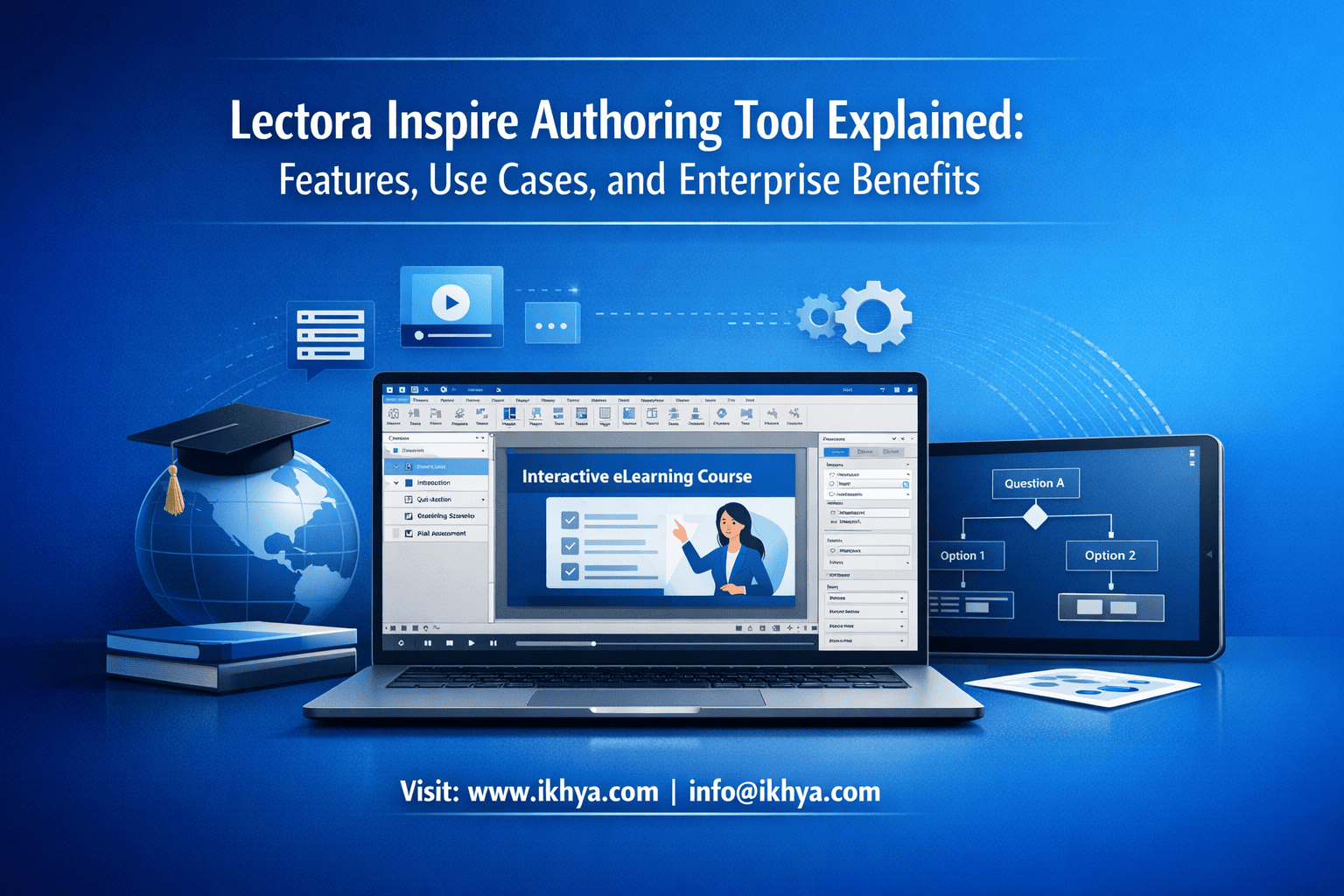
Organizations today need scalable, compliant, and highly interactive training solutions. The Lectora Inspire authoring tool is designed to meet these enterprise-level demands by enabling teams to create accessible, responsive, and LMS-ready eLearning courses efficiently.
If you’re evaluating authoring tools or planning large-scale training programs, understanding how Lectora works—and where it fits—can directly impact your training ROI, compliance success, and development speed.
If you’re exploring how to implement Lectora for your organization, you can book a free eLearning demo to see how enterprise-grade courses are built in real scenarios.
What Is Lectora Inspire Authoring Tool
Lectora Inspire is a powerful eLearning authoring software used by enterprises to create interactive, accessible, and scalable digital training content. It is widely known for its strong compliance capabilities, flexibility, and control over course design, making it ideal for regulated industries.
Unlike many drag-and-drop tools, Lectora offers a structured, HTML-based development environment, allowing deeper customization and better control over learning experiences.
Key Characteristics of Lectora Inspire
- Built for enterprise-level training development
- Supports SCORM, xAPI, and LMS integration
- Enables responsive design for multi-device learning
- Strong focus on accessibility (WCAG compliance)
- Allows advanced scripting and customization
How Lectora Inspire Works
Lectora uses a page-based development structure, where instructional designers can:
- Create structured learning modules
- Add multimedia elements (videos, simulations, quizzes)
- Apply logic using variables and conditions
- Publish courses compatible with LMS platforms
This makes it especially useful for organizations that need complex training workflows, such as compliance certifications or multi-step onboarding programs.
Why Enterprises Prefer Lectora Inspire
Many global organizations across the USA, UK, UAE, and Australia choose Lectora because it offers:
- High control over content design
- Robust compliance and reporting capabilities
- Seamless LMS integration
- Scalability for large training programs
For example:
- A healthcare organization can build HIPAA compliance training with strict tracking
- A manufacturing company can develop safety simulations with conditional logic
- A financial institution can deploy audit-ready certification programs
If you’re evaluating whether Lectora aligns with your training goals, exploring custom eLearning development services can help you understand implementation strategies tailored to your industry.
Key Features of Lectora Inspire for eLearning Development
Lectora Inspire stands out among eLearning authoring tools because of its enterprise-grade capabilities, especially in accessibility, customization, and compliance. These features make it suitable for organizations that need more than just basic course creation.
Core Features That Define Lectora Inspire
- Accessibility-first design (WCAG compliant)
- Responsive course development across devices
- Advanced scripting and variables for complex logic
- Seamless LMS integration (SCORM, xAPI, AICC)
- Built-in assessment and tracking capabilities
- Localization and multi-language support
These features enable teams to build highly interactive, scalable, and regulation-ready training programs.
Accessibility and Compliance Capabilities
One of the strongest advantages of Lectora Inspire is its built-in accessibility support, which is critical for organizations operating in regulated environments.
It allows developers to:
- Create courses compliant with WCAG 2.1 standards
- Add screen reader compatibility
- Enable keyboard navigation
- Provide closed captions and transcripts
This is particularly important in industries like healthcare, finance, and government, where accessibility is not optional but mandatory.
Organizations focusing on inclusive training often rely on accessible eLearning solutions to ensure compliance and usability across diverse learners.
Responsive eLearning Development
Lectora enables true responsive design, meaning courses automatically adjust to different screen sizes without losing functionality.
Key capabilities include:
- Device-specific layout adjustments
- Flexible object positioning
- Mobile-friendly navigation
- Consistent learner experience across desktop, tablet, and mobile
This is essential for companies with distributed workforces or mobile-first training strategies.
If you’re planning mobile-ready training programs, exploring mobile learning development solutions can help align your content with modern learner behavior.
Advanced Interactivity and Customization
Unlike many tools that limit customization, Lectora allows developers to build complex, logic-driven learning experiences.
It supports:
- Conditional branching scenarios
- Variables and triggers
- Custom JavaScript integrations
- Scenario-based simulations
This makes it ideal for:
- Compliance decision-making scenarios
- Technical training simulations
- Role-based learning paths
For organizations needing simulation-heavy content, eLearning simulation-based training services can extend these capabilities further.
LMS Compatibility and Tracking
Lectora integrates seamlessly with most Learning Management Systems (LMS), ensuring smooth deployment and tracking.
Supported standards include:
- SCORM 1.2 / SCORM 2004
- xAPI (Tin Can API)
- AICC
This enables:
- Real-time learner tracking
- Completion reporting
- Performance analytics
- Certification management
For enterprises managing large-scale deployments, LMS-compatible eLearning course development services ensure smooth integration and reporting accuracy.
Localization and Multi-Language Support
Global organizations often require training in multiple languages. Lectora simplifies localization by allowing:
- Easy text extraction and translation
- Multi-language course versions
- Region-specific customization
- RTL (right-to-left) language support
This is especially useful for companies operating across regions like the USA, UK, UAE, and Australia.
To scale training globally, eLearning translation and localization services help ensure cultural and linguistic accuracy.
Built-in Assessment and Evaluation Tools
Lectora provides powerful assessment tools that support:
- Quizzes and knowledge checks
- Scenario-based evaluations
- Automated scoring
- Certification tracking
This ensures organizations can measure:
- Learning effectiveness
- Compliance completion rates
- Skill improvement
Lectora Inspire’s feature set makes it a strong choice for enterprise training environments, especially where compliance, scalability, and customization are critical.
How Lectora Inspire Supports Responsive eLearning Design
Lectora Inspire enables organizations to build fully responsive eLearning courses that adapt seamlessly across devices—desktop, tablet, and mobile—without compromising usability or learning experience.
This capability is critical in today’s environment, where learners access training anytime, anywhere, across multiple devices.
What Responsive eLearning Means in Lectora
Responsive eLearning in Lectora refers to creating courses that:
- Automatically adjust layout based on screen size
- Maintain content readability and interaction quality
- Deliver consistent learning experiences across devices
Instead of creating separate versions for each device, Lectora allows developers to design once and optimize for all screens.
Key Capabilities That Enable Responsive Design
1. Flexible Layout System
Lectora provides fluid layouts and scalable objects, allowing content elements to reposition dynamically.
- Content blocks resize automatically
- Images and media adjust proportionally
- Text remains readable across devices
This ensures a smooth experience whether learners are using a laptop or a smartphone.
2. Device-Specific Customization
Developers can fine-tune how content appears on different devices.
- Adjust layouts for mobile vs desktop
- Hide/show elements based on screen size
- Optimize navigation for touch interactions
This is especially useful for mobile-first training strategies.
Organizations aiming to enhance mobile accessibility often combine Lectora with mobile learning development solutions to ensure optimal learner engagement.
3. Touch-Friendly Interactions
Lectora supports modern interaction models that work well on touch devices:
- Tap-based navigation
- Swipe interactions
- Mobile-friendly buttons and menus
This improves usability for field employees, remote teams, and on-the-go learners.
4. Consistent User Experience Across Devices
A major challenge in eLearning is maintaining consistency. Lectora ensures:
- Same learning flow across all devices
- No loss of functionality on smaller screens
- Consistent branding and UI
This is crucial for enterprise training programs where standardization matters.
Real-World Example
A retail organization training store associates across multiple locations:
- Desktop version used for in-store training
- Mobile version used for quick refresher modules
With Lectora:
- Same course adapts to both environments
- No need for duplicate development
- Faster deployment across regions
Business Impact of Responsive Design
Implementing responsive eLearning using Lectora results in:
- Reduced development time and cost
- Higher learner engagement rates
- Improved course completion rates
- Better accessibility across global teams
For organizations planning scalable training programs, rapid eLearning development services can further accelerate responsive course delivery.
Responsive design is not just a feature—it is a strategic requirement for modern corporate training. Lectora Inspire ensures that organizations can meet this requirement efficiently while maintaining quality and consistency.
Lectora Inspire Features for Compliance Training
Lectora Inspire is widely used for compliance training because it provides strong control over content structure, tracking, and reporting—critical requirements in regulated industries like healthcare, finance, manufacturing, and aviation.
It enables organizations to deliver audit-ready, trackable, and legally compliant training programs at scale.
Why Lectora Is Ideal for Compliance Training
Compliance training requires more than just content delivery. It must ensure:
- Mandatory completion tracking
- Assessment validation and scoring
- Audit-ready reporting
- Consistent content delivery across regions
Lectora meets these requirements through its robust LMS integration and advanced logic capabilities.
Organizations building regulatory programs often combine it with compliance training eLearning solutions to ensure full alignment with industry standards.
Key Compliance-Focused Features
1. Advanced Tracking and Reporting
Lectora supports SCORM and xAPI, enabling detailed learner tracking.
This allows organizations to monitor:
- Course completion rates
- Time spent on modules
- Assessment scores
- Certification status
These reports are essential during audits and regulatory inspections.
2. Scenario-Based Assessments
Compliance training is not just about knowledge—it’s about decision-making in real situations.
Lectora enables:
- Branching scenarios
- Real-world simulations
- Role-based assessments
Example:
- A financial services employee navigating an anti-money laundering scenario
- A healthcare professional responding to patient data privacy situations
For deeper implementation, eLearning simulation-based training services can enhance realism and learner engagement.
3. Certification and Recertification Management
Many industries require periodic certification.
Lectora allows:
- Automated certification generation
- Expiry tracking
- Recertification workflows
This ensures employees remain compliant over time without manual tracking.
4. Version Control and Content Updates
Regulations change frequently. Lectora makes it easier to:
- Update content quickly
- Maintain version history
- Re-deploy updated courses without disruption
This is critical for industries like:
- Healthcare (HIPAA updates)
- Finance (AML/KYC regulations)
- Oil & Gas (safety protocols)
Industry-Specific Compliance Use Cases
Healthcare
- HIPAA compliance training
- Patient safety protocols
- Infection control modules
Organizations often use healthcare training eLearning solutions to meet strict regulatory requirements.
Manufacturing
- Workplace safety training
- Equipment handling procedures
- Hazard identification
These programs align well with manufacturing training eLearning solutions for large-scale workforce training.
Finance
- Anti-money laundering (AML) training
- Fraud prevention
- Regulatory compliance certifications
Aviation
- Safety compliance training
- Emergency response simulations
Programs like aviation training eLearning solutions rely heavily on structured, trackable learning systems.
Real-World Scenario
A global banking organization needed to train 5,000+ employees across regions:
- Requirement: AML compliance with audit tracking
- Solution: Lectora-based courses with scenario assessments
- Outcome:
- 98% completion rate
- Full audit compliance
- Reduced training time by 30%
Business Impact of Using Lectora for Compliance
- Reduced compliance risk
- Improved audit readiness
- Higher learner accountability
- Scalable global deployment
Lectora Inspire transforms compliance training from a checkbox activity into a measurable, trackable, and effective learning system.
Enterprise Use Cases of Lectora Inspire Across Industries
Lectora Inspire is widely adopted across industries because it supports complex training requirements, regulatory compliance, and scalable deployment. Its flexibility makes it suitable for both technical and non-technical training programs.
Below are real-world use cases across major industries to show how organizations apply Lectora in practical scenarios.
Healthcare Training Use Cases
Healthcare organizations require strict compliance, accuracy, and accessibility in training.
Lectora is used to develop:
- HIPAA compliance training
- Patient data privacy modules
- Clinical procedure simulations
- Infection control and safety training
Example Scenario:
A hospital network in the UK needed to train 2,000+ staff on updated patient safety protocols.
- Approach: Scenario-based Lectora modules
- Timeline: 4 weeks
- Outcome:
- 95% course completion rate
- Improved compliance audit scores
- Reduced onboarding time for new staff
For organizations implementing similar programs, Lectora Inspire for healthcare compliance training provides structured solutions.
Manufacturing Training Use Cases
Manufacturing environments demand hands-on, safety-focused, and process-driven training.
Lectora enables:
- Equipment handling simulations
- Safety and hazard training
- SOP (Standard Operating Procedure) modules
- Quality control training
Example Scenario:
A manufacturing company in the UAE deployed safety training for factory workers across 5 plants.
- Approach: Interactive simulations with conditional logic
- Timeline: 3–4 weeks
- Outcome:
- 40% reduction in safety incidents
- Faster onboarding for new employees
- Consistent training across locations
For large-scale programs, Lectora Inspire development for manufacturing training ensures consistency and compliance.
Financial Services Training Use Cases
Financial institutions require audit-ready, trackable, and regulation-driven training programs.
Lectora is commonly used for:
- Anti-money laundering (AML) training
- Fraud detection programs
- Risk management modules
- Regulatory certification training
Example Scenario:
A banking organization in the USA implemented AML training for 5,000+ employees.
- Approach: Scenario-based compliance modules
- Outcome:
- 98% completion rate
- Full audit compliance
- Reduced manual tracking effort
Retail Training Use Cases
Retail companies need fast, scalable, and mobile-friendly training for distributed teams.
Lectora supports:
- Employee onboarding programs
- Product training modules
- Customer service training
- Seasonal campaign training
Example Scenario:
A retail chain in Australia trained store employees on new product lines:
- Approach: Mobile-responsive Lectora modules
- Timeline: 2 weeks (rapid deployment)
- Outcome:
- Faster product knowledge adoption
- Improved customer satisfaction scores
Retail-focused organizations can enhance programs with retail training eLearning solutions.
IT and Software Training Use Cases
Tech companies require highly interactive and technical training environments.
Lectora is used for:
- Software onboarding training
- System simulations
- Product training for SaaS platforms
- Cybersecurity awareness
Example Scenario:
An IT company deployed training for a new enterprise software tool:
- Approach: Step-by-step simulation modules
- Outcome:
- Reduced support queries by 35%
- Faster user adoption
Organizations in this domain can explore IT and software training eLearning solutions for scalable deployment.
Oil & Gas Training Use Cases
This industry requires high-risk safety training and strict compliance adherence.
Lectora supports:
- Safety compliance modules
- Emergency response training
- Equipment handling simulations
- Environmental compliance training
For specialized programs, oil and gas training eLearning solutions help address industry-specific challenges.
Key Takeaways Across Industries
Across all sectors, Lectora Inspire delivers:
- Consistency in training delivery
- Scalability for large workforces
- Compliance-ready content
- Interactive and engaging learning experiences
If your organization operates in a regulated or complex training environment, Lectora is often the preferred choice over simpler tools.
To evaluate how it fits your specific use case, you can request an eLearning RFP and get a tailored solution approach based on your industry and training goals.
When to Use Lectora Inspire in Corporate Training
Lectora Inspire is best used when organizations need high control, compliance readiness, and scalable training delivery. It is not always the fastest tool for simple courses, but it becomes highly valuable in complex, enterprise-level scenarios.
Understanding when to choose Lectora helps avoid unnecessary costs and ensures the right tool is used for the right purpose.
Ideal Scenarios to Use Lectora Inspire
You should choose Lectora Inspire when your training requirements involve:
- Strict compliance and regulatory tracking
- Complex branching scenarios and simulations
- Multi-language and global deployment
- Accessibility requirements (WCAG compliance)
- Integration with LMS using SCORM or xAPI
- Large-scale enterprise training programs
These scenarios demand precision, flexibility, and scalability, which Lectora is designed to deliver.
Decision Framework: Is Lectora the Right Choice?
Use this quick evaluation framework:
| Requirement | Use Lectora Inspire? |
|---|---|
| Compliance-heavy training | Yes |
| Accessibility required | Yes |
| Complex simulations needed | Yes |
| Rapid, simple courses | No (consider faster tools) |
| Mobile-first microlearning | Depends on complexity |
| Global multi-language rollout | Yes |
When Lectora Outperforms Other Tools
Lectora becomes the preferred option when compared to other tools in the following situations:
1. Compliance-Driven Training Programs
- Healthcare, finance, aviation industries
- Requires tracking, reporting, and audit readiness
2. Accessibility-Focused Learning
- Government or regulated sectors
- Need for screen reader compatibility and WCAG standards
Organizations focusing on inclusivity often adopt accessible eLearning solutions alongside Lectora to meet global compliance standards.
3. Complex Learning Paths and Simulations
- Multi-step decision-making scenarios
- Role-based training journeys
- High interactivity requirements
For advanced learning experiences, instructional design services help structure these complex programs effectively.
4. Enterprise-Level Training Deployment
- Thousands of learners across regions
- Need for centralized control and reporting
- Integration with enterprise LMS platforms
When NOT to Use Lectora Inspire
Lectora may not be the best choice if your requirements are:
- Simple slide-based training
- Very tight timelines (1–2 days development)
- Basic content with minimal interactivity
- Small-scale internal training
In such cases, tools used in rapid eLearning development using Storyline and Rise 360 may be more efficient.
Real-World Decision Scenario
A global manufacturing company needed two types of training:
| Training Type | Tool Used | Reason |
|---|---|---|
| Safety compliance training | Lectora Inspire | Complex tracking + simulations |
| Product knowledge training | Storyline/Rise | Faster development |
This hybrid approach ensured:
- Efficiency in simple training
- Depth and compliance in critical training
Business Impact of Choosing the Right Tool
Selecting Lectora in the right scenarios leads to:
- Higher compliance accuracy
- Better learner engagement in complex topics
- Reduced long-term training risks
- Scalable global training delivery
If you’re unsure whether Lectora fits your training needs, exploring eLearning consultancy services can help you make a data-driven decision based on your goals, budget, and timelines.
Lectora Inspire vs Storyline vs Captivate
Choosing the right authoring tool depends on your training complexity, compliance needs, and development speed requirements. While Lectora Inspire is powerful, tools like Storyline and Captivate may be better suited for different scenarios.
Understanding these differences helps organizations make cost-effective and performance-driven decisions.
Quick Comparison Overview
| Feature / Capability | Lectora Inspire | Articulate Storyline | Adobe Captivate |
|---|---|---|---|
| Ease of Use | Moderate (learning curve) | Easy | Moderate |
| Customization | Very High | Medium | High |
| Accessibility (WCAG) | Strong | Limited | Moderate |
| Responsive Design | Strong | Limited | Strong |
| Compliance Training | Excellent | Moderate | Good |
| Simulations | Advanced | Good | Excellent |
| LMS Compatibility | Full (SCORM, xAPI) | Full | Full |
| Development Speed | Moderate | Fast | Moderate |
When to Choose Lectora Inspire
Lectora is the best choice when your training requires:
- Strict compliance and audit tracking
- Accessibility (WCAG) requirements
- Complex branching and logic-driven scenarios
- Large-scale enterprise deployment
For organizations evaluating implementation, Lectora Inspire development services provide structured support for enterprise projects.
When to Choose Articulate Storyline
Storyline is ideal for:
- Rapid eLearning development
- Slide-based interactive courses
- Quick deployment with minimal complexity
It works well for onboarding, product training, and general corporate learning.
If your focus is speed and simplicity, Articulate Storyline development services can accelerate course creation.
When to Choose Adobe Captivate
Captivate is suitable for:
- Software simulations
- Technical training
- Responsive learning projects
It offers strong simulation capabilities but may require more expertise.
Organizations building technical training programs often use Adobe Captivate development services for advanced use cases.
Decision Framework Based on Use Case
| Use Case | Recommended Tool |
|---|---|
| Compliance-heavy training | Lectora Inspire |
| Rapid onboarding | Storyline |
| Software simulations | Captivate |
| Accessibility-focused training | Lectora Inspire |
| Mobile learning | Lectora / Captivate |
| Simple corporate training | Storyline |
Real-World Example
A financial services company needed two training tracks:
- Compliance certification → Lectora Inspire (for tracking & audits)
- Sales onboarding → Storyline (for speed and simplicity)
Outcome:
- Reduced development time by 35%
- Improved compliance reporting accuracy
- Balanced cost and efficiency
Key Takeaway
- Lectora Inspire = Best for control, compliance, scalability
- Storyline = Best for speed and ease
- Captivate = Best for simulations and technical training
If you’re comparing tools for a large-scale training initiative, reviewing Lectora Inspire vs Articulate Storyline comparison can help you make a more informed decision based on your requirements.
Lectora Inspire Development Cost for Enterprises
The cost of developing courses using Lectora Inspire depends on complexity, interactivity level, content type, and scale of deployment. For enterprises, pricing is typically calculated per hour of content or based on project scope.
Understanding cost structure helps organizations plan budgets and avoid unexpected expenses.
Typical Cost Range for Lectora Development
Here is a realistic breakdown:
| Course Type | Cost per Hour of Content |
|---|---|
| Basic (text + images + simple quizzes) | $1,000 – $3,000 |
| Intermediate (interactions + branching) | $3,000 – $7,000 |
| Advanced (simulations + compliance-heavy) | $7,000 – $15,000+ |
Factors That Influence Cost
Several variables impact the final pricing:
1. Level of Interactivity
- Simple click-through courses → lower cost
- Scenario-based simulations → higher cost
2. Content Availability
- Ready content (PPT, documents) → lower cost
- Content creation from scratch → higher cost
Organizations converting legacy content often use PPT to eLearning conversion services to reduce development time and cost.
3. Compliance and Accessibility Requirements
- WCAG compliance increases effort
- Certification tracking adds complexity
4. Multimedia Elements
- Videos, animations, voiceovers increase cost
- Interactive simulations significantly increase cost
5. Localization and Multi-Language Support
- Each additional language increases cost by 20–40%
- Requires translation, voiceover, and testing
Global deployments often rely on eLearning translation and localization services for efficiency.
Cost Scenario Examples
Scenario 1: Compliance Training (Healthcare)
- Duration: 1 hour
- Features: Scenarios + assessments + tracking
- Cost: ~$8,000 – $12,000
- Timeline: 3–4 weeks
Scenario 2: Employee Onboarding (Retail)
- Duration: 45 minutes
- Features: Basic interactivity + mobile-friendly
- Cost: ~$2,500 – $5,000
- Timeline: 2–3 weeks
Cost Optimization Strategies
To reduce costs without compromising quality:
- Reuse existing content
- Use templates for consistency
- Limit unnecessary animations
- Choose the right level of interactivity
- Outsource to experienced vendors
Organizations looking to optimize budgets often explore outsource eLearning development benefits and cost strategies for better ROI.
Enterprise Budgeting Insight
For large organizations:
- Annual training budgets often range from $50,000 to $500,000+
- Lectora is typically used for high-value, compliance-critical training
- Simpler courses may use faster tools to balance cost
Business Impact of Cost Planning
Proper cost planning ensures:
- Predictable project execution
- Better ROI on training investment
- Efficient resource allocation
If you need a more accurate estimate based on your requirements, you can explore cost of Lectora Inspire course development to understand pricing models in detail.
Project Timelines for Lectora Inspire Development
The timeline for Lectora Inspire development depends on course complexity, content readiness, and level of interactivity. Enterprise projects typically follow structured timelines to ensure quality, compliance, and scalability.
Understanding realistic timelines helps organizations plan launches, compliance deadlines, and workforce training rollouts effectively.
Typical Development Timelines
Here’s a practical breakdown:
| Course Type | Development Timeline |
|---|---|
| Basic course | 1–2 weeks |
| Intermediate course | 2–4 weeks |
| Advanced compliance/simulation | 4–8+ weeks |
Key Factors That Affect Timelines
1. Content Availability
- Ready content → faster development
- Content creation required → longer timelines
Organizations converting existing materials often use ILT to eLearning course conversion services to accelerate development.
2. Level of Interactivity
- Static slides → quick turnaround
- Scenario-based simulations → extended timelines
3. Review and Feedback Cycles
- Multiple stakeholder reviews increase duration
- Faster approvals reduce delays
4. Compliance Requirements
- Additional validation, testing, and reporting setup
- Accessibility checks (WCAG compliance)
5. Localization Needs
- Multi-language courses require translation and QA
- Adds 1–3 weeks depending on scope
Example Timeline Models
2-Week Rapid Development Model
Best for:
- Product training
- Quick onboarding modules
Process:
- Content finalization (Day 1–2)
- Storyboarding (Day 3–4)
- Development (Day 5–10)
- Review & revisions (Day 11–14)
This model works well when using rapid eLearning development services for faster turnaround.
4-Week Standard Enterprise Model
Best for:
- Compliance training
- Simulation-based learning
Process:
- Analysis & planning (Week 1)
- Instructional design & storyboarding (Week 2)
- Development & integration (Week 3)
- Testing, QA, and deployment (Week 4)
Real-World Timeline Scenario
A manufacturing company needed safety training across multiple plants:
- Scope: 1-hour compliance training
- Complexity: High (simulations + tracking)
- Timeline: 4 weeks
Outcome:
- On-time deployment
- Standardized training across locations
- Reduced safety incidents
How to Reduce Development Time
To speed up timelines:
- Finalize content before development
- Limit unnecessary revisions
- Use templates and reusable components
- Choose experienced vendors
- Use rapid development approaches where possible
Business Impact of Proper Timeline Planning
- Faster training rollout
- Reduced delays in compliance programs
- Better coordination across teams
- Improved cost control
If you want a structured approach to enterprise training execution, reviewing the enterprise eLearning development process step-by-step guide can help streamline timelines and delivery.
Outsourcing Lectora Inspire Development vs In-House
Organizations often face a key decision: build Lectora courses in-house or outsource development to experts. The right choice depends on budget, expertise, timeline, and project complexity.
For most enterprise-level projects, outsourcing provides speed, scalability, and specialized expertise, while in-house teams offer control and internal alignment.
In-House Development: Pros and Limitations
Advantages:
- Full control over content and updates
- Better alignment with internal processes
- Immediate access to stakeholders
Limitations:
- Requires skilled instructional designers and developers
- Higher long-term resource costs (hiring, training, tools)
- Slower development for complex projects
- Limited scalability for large rollouts
Outsourced Development: Pros and Advantages
Advantages:
- Access to experienced Lectora specialists
- Faster turnaround times
- Scalable teams for large projects
- Cost efficiency for complex training programs
Organizations often rely on Lectora eLearning development services to handle end-to-end course creation efficiently.
Cost Comparison: In-House vs Outsourcing
| Factor | In-House | Outsourcing |
|---|---|---|
| Initial cost | High (team + tools) | Moderate |
| Long-term cost | High | Flexible |
| Expertise | Limited to team | High (specialized) |
| Scalability | Low | High |
| Speed | Moderate | Fast |
When to Choose In-House
- Small, ongoing training updates
- Internal content with minimal complexity
- Organizations with an established L&D team
When to Outsource Lectora Development
Outsourcing is the better option when:
- Training involves compliance or high complexity
- Tight timelines need to be met
- Large-scale rollout across regions
- Internal team lacks Lectora expertise
For enterprise-level decisions, reviewing an eLearning outsourcing guide for enterprises can help you choose the right approach.
Hybrid Model (Best of Both)
Many organizations adopt a hybrid strategy:
- In-house team handles content and strategy
- External vendor handles development and technical execution
This approach balances:
- Control
- Cost
- Speed
Real-World Scenario
A UAE-based oil & gas company needed safety training for multiple locations:
- Internal team: Provided SME inputs
- Vendor: Developed Lectora courses
Outcome:
- Reduced development time by 40%
- Improved course quality
- Faster deployment across sites
Business Impact of Choosing the Right Model
- Optimized cost vs quality balance
- Faster project delivery
- Access to specialized expertise
- Reduced operational burden
If you’re planning a large-scale training initiative and want clarity on execution, you can request an eLearning RFP to evaluate outsourcing options based on your requirements.
How to Choose a Lectora Inspire Development Company
Selecting the right Lectora Inspire development company is critical for ensuring quality, scalability, and long-term success of your training programs. A wrong choice can lead to delays, poor learner experience, and compliance risks.
A structured evaluation approach helps organizations make confident, low-risk decisions.
Key Criteria for Selecting the Right Vendor
When evaluating a Lectora development partner, focus on these factors:
1. Proven Experience in Lectora Development
- Check past projects using Lectora
- Look for industry-specific experience
- Ask for sample courses or demos
2. Instructional Design Capability
A good vendor should not just develop—but also design effective learning.
- Ability to create engaging learning flows
- Experience in scenario-based training
- Understanding of adult learning principles
Organizations seeking structured learning design often combine vendor selection with instructional design services.
3. Compliance and Accessibility Expertise
Ensure the vendor can handle:
- WCAG-compliant development
- Regulatory training standards
- Audit-ready reporting
This is especially important for industries like healthcare, finance, and aviation.
4. Technical Capability
The vendor should be proficient in:
- SCORM and xAPI integration
- LMS deployment
- Advanced interactivity and scripting
5. Scalability and Team Strength
Evaluate whether the vendor can:
- Handle large-scale projects
- Scale resources quickly
- Deliver across multiple geographies
Vendor Evaluation Framework
Use this simple scoring model:
| Criteria | Weight | Score (1–5) |
|---|---|---|
| Lectora expertise | High | |
| Instructional design | High | |
| Compliance experience | High | |
| Cost efficiency | Medium | |
| Delivery capability | High |
This helps in objective decision-making.
Questions to Ask Before Finalizing a Vendor
- Can you share Lectora-based case studies?
- How do you handle compliance training projects?
- What is your development process and timeline?
- How do you ensure quality and testing?
- What support do you provide post-deployment?
A detailed checklist can be found in questions to ask before hiring a Lectora Inspire vendor.
Red Flags to Watch Out For
Avoid vendors who:
- Lack Lectora-specific experience
- Cannot demonstrate past work
- Offer unrealistically low pricing
- Do not follow structured development processes
Real-World Selection Scenario
A financial services company in the UK evaluated three vendors:
- Vendor A: Low cost but no compliance experience
- Vendor B: Strong design but limited scalability
- Vendor C: Balanced expertise + scalability
They chose Vendor C.
Outcome:
- Successful rollout for 3,000+ employees
- High audit compliance
- Long-term partnership established
Why Vendor Selection Matters
Choosing the right partner leads to:
- Higher course quality
- Faster delivery timelines
- Better learner engagement
- Reduced project risks
If you want expert guidance in selecting the right partner, exploring how to choose a Lectora Inspire development company can help you make a well-informed decision.
Challenges and Limitations of Lectora Inspire
Lectora Inspire is a powerful enterprise authoring tool, but like any platform, it comes with certain limitations and challenges. Understanding these helps organizations make realistic decisions and plan effectively.
Key Limitations to Consider
1. Steeper Learning Curve
Lectora is not as beginner-friendly as some other tools.
- Requires understanding of structure and logic
- Advanced features need technical knowledge
- Initial onboarding time can be higher
This makes it less suitable for teams without prior experience or training.
2. Development Time for Simple Courses
For basic training needs:
- Lectora may feel slower compared to rapid tools
- Overkill for simple, slide-based content
Organizations focused on speed often consider alternatives covered in best eLearning authoring tools for corporate training.
3. Interface Complexity
Compared to modern tools:
- UI can feel less intuitive
- Requires structured workflow understanding
This may impact productivity initially, especially for new teams.
4. Higher Initial Setup Effort
Setting up Lectora for enterprise use may involve:
- LMS configuration
- Template setup
- Accessibility configurations
However, once set up, it becomes highly efficient for large-scale projects.
5. Dependency on Skilled Resources
To fully utilize Lectora:
- Skilled instructional designers are needed
- Developers may need scripting knowledge
Organizations without internal expertise often rely on outsourcing Lectora Inspire eLearning development to overcome this challenge.
How to Overcome These Challenges
Organizations can mitigate these limitations by:
- Investing in team training and onboarding
- Using pre-built templates and frameworks
- Partnering with experienced vendors
- Adopting a hybrid development model
When These Limitations Matter Most
These challenges are more relevant when:
- Projects are small or short-term
- Teams lack technical expertise
- Speed is the primary requirement
In such cases, alternative tools may be more efficient.
Strategic Perspective
Despite these limitations, Lectora remains a strong choice for:
- Compliance-heavy environments
- Accessibility-focused training
- Complex enterprise learning ecosystems
The key is to use Lectora where its strengths outweigh its limitations.
Future Trends in Lectora-Based eLearning
Lectora Inspire continues to evolve alongside modern eLearning trends, making it relevant for future-ready training strategies.
Key Trends Shaping Lectora Development
1. AI-Driven Learning Experiences
- AI-assisted content creation
- Adaptive learning paths
- Personalized learner journeys
2. Increased Focus on Accessibility
- Stricter global compliance standards
- Greater demand for inclusive learning
Lectora’s accessibility-first approach positions it well for this trend.
3. Data-Driven Learning Analytics
With xAPI integration:
- Deeper learner insights
- Behavioral tracking
- Performance analytics
4. Mobile-First and Microlearning
- Short, bite-sized modules
- Mobile-optimized learning paths
Organizations increasingly combine Lectora with microlearning development services for better engagement.
5. Global Training and Localization
- Multi-language content
- Region-specific customization
This aligns with the growing need for global workforce training.
Business Impact of These Trends
- Improved learner engagement
- Better performance tracking
- More personalized learning experiences
- Scalable global training programs
Final Perspective
Lectora Inspire is not just a current solution—it is a future-ready platform for organizations investing in long-term training strategies.
If you’re planning to modernize your training approach, connecting with experts can help you align with these trends. You can contact the eLearning team to explore how Lectora can be implemented effectively for your organization.
Conclusion
Lectora Inspire stands out as a powerful, enterprise-grade authoring tool designed for organizations that require compliance, scalability, accessibility, and deep customization in their training programs.
Throughout this guide, we’ve seen that Lectora is not just another eLearning tool—it is a strategic solution for building complex, high-impact training.
Key Insights to Remember
- Lectora is best suited for compliance-heavy and enterprise training
- It offers strong accessibility and LMS integration capabilities
- Ideal for complex simulations and scenario-based learning
- Works well for global, multi-language training programs
- Requires the right expertise and planning for maximum ROI
When Lectora Makes the Most Sense
Choose Lectora Inspire if your organization needs:
- Audit-ready compliance training
- Scalable enterprise learning systems
- Advanced interactivity and logic-based learning
- Global deployment with localization
- Accessibility-first course design
Final Decision Perspective
If your training needs are simple, faster tools may work.
But if your organization operates in a regulated, complex, or large-scale environment, Lectora Inspire becomes a high-value investment.
Moving Forward
The success of Lectora implementation depends on:
- Choosing the right development approach
- Working with experienced teams
- Aligning tool capabilities with business goals
If you want to explore how Lectora can fit into your training strategy, you can get in touch with eLearning experts or reach out directly:
IKHYA – eLearning Solutions Company
Email: info@ikhya.com
FAQs
1. What is Lectora Inspire used for?
It is used to create interactive, compliant, and scalable eLearning courses for corporate training.
2. Is Lectora Inspire suitable for beginners?
It has a learning curve and is better suited for experienced instructional designers or enterprises
3. Does Lectora support mobile learning?
Yes, it supports responsive design for mobile, tablet, and desktop devices.
4. Is Lectora good for compliance training?
Yes, it is one of the best tools for compliance due to its tracking and reporting capabilities.
5. What industries use Lectora Inspire?
Healthcare, finance, manufacturing, retail, IT, and aviation industries commonly use it.
6. Does Lectora support SCORM and xAPI?
Yes, it fully supports SCORM, xAPI, and other LMS standards.
7. How much does Lectora development cost?
It typically ranges from $1,000 to $15,000+ per hour of content depending on complexity.
8. Is Lectora better than Storyline?
It depends on use case—Lectora is better for compliance and complexity, Storyline for speed.
9. Can Lectora be used for simulations?
Yes, it supports advanced simulations and branching scenarios.
10. Is Lectora suitable for global training?
Yes, it supports multi-language and localization features.
11. Does Lectora support accessibility standards?
Yes, it supports WCAG-compliant course development.
12. What is the development timeline for Lectora courses?
Typically ranges from 2 to 8 weeks depending on complexity.
13. Can Lectora integrate with LMS platforms?
Yes, it integrates seamlessly with most LMS platforms.1
14. Is Lectora good for onboarding training?
Yes, especially when onboarding involves compliance or structured workflows.
15. Can Lectora convert PowerPoint to eLearning?
Yes, but enhancements are needed for interactivity.
16. Is Lectora suitable for microlearning?
Yes, it can be used to create short, modular learning content.
17. Does Lectora support multilingual courses?
Yes, it supports translation and localization.
18. Should companies outsource Lectora development?
Yes, especially for complex or large-scale projects.
19. What are the limitations of Lectora?
It has a learning curve and may be slower for simple courses.
20. How to choose a Lectora development company?
Evaluate experience, scalability, instructional design expertise, and compliance knowledge.
Related Resources
Explore these resources to deepen your understanding: