
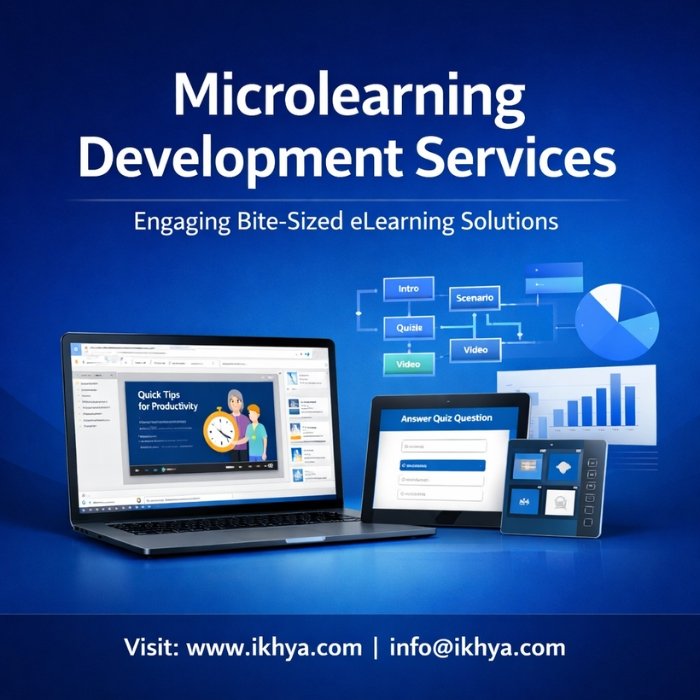



Microlearning Development Services
Modern organizations need faster and more effective ways to train employees without disrupting productivity. Microlearning development services help companies deliver short, focused learning modules that employees can access anytime, anywhere.
IKHYA – eLearning Solutions Company specializes in designing engaging microlearning solutions that improve knowledge retention and accelerate workforce performance. Our team works with global organizations to transform complex training into concise, interactive learning experiences.
Request a Proposal or Schedule a Consultation at info@ikhya.com
Get a Free eLearning Consultation / Proposal
Organizations today face increasing pressure to train employees quickly while maintaining high learning effectiveness.
Organizations planning new digital learning initiatives can schedule a free eLearning consultation to discuss training requirements and development strategies with our experts.
Microlearning allows companies to deliver targeted knowledge in short learning bursts, making training more engaging and easier to absorb.
IKHYA – eLearning Solutions Company works with enterprises to design microlearning programs that align with business objectives, workforce skill development, and digital learning strategies.
Our microlearning consultation helps organizations evaluate their training requirements and identify the most effective learning approach.
During the consultation, our experts help organizations:
- Analyze existing training programs and learning gaps
- Identify topics suitable for microlearning modules
- Develop a scalable microlearning strategy for employees
- Select the right learning technologies and authoring tools
- Plan LMS integration and deployment strategy
- Estimate project timelines and development scope
We support organizations at every stage of the learning transformation process—from strategy and instructional design to development and deployment.
Whether your organization needs microlearning for employee onboarding, compliance training, product knowledge, sales enablement, or leadership development, our team can design custom learning solutions that align with your workforce training goals.
Many organizations in the United States, United Kingdom, Australia, and the Middle East are increasingly adopting microlearning because employees prefer short learning sessions that fit into their daily workflows.
If your organization is exploring ways to modernize its training programs, our team can help design a scalable microlearning solution tailored to your needs.
Submit your training requirements or request a proposal.
IKHYA – eLearning Solutions Company
Email: info@ikhya.com
What is Microlearning Development?
Microlearning development is the process of designing short, focused digital learning modules that teach a single concept or skill in a few minutes. These bite-sized learning experiences help employees quickly understand and apply knowledge without long training sessions. Microlearning modules are commonly delivered through Learning Management Systems (LMS), mobile learning platforms, or digital learning portals and often include videos, scenarios, quizzes, and interactive content.
Why Organizations Need Microlearning Development Services
Organizations across industries are transforming their corporate training strategies to keep up with evolving workforce needs. Traditional long-form training programs often struggle to maintain employee engagement and knowledge retention. Microlearning addresses these challenges by delivering targeted learning experiences that fit naturally into employees’ daily workflows.
Modern Workforce Learning Challenges
The modern workforce faces constant information overload and limited time for training. Employees often struggle to complete long training courses while managing their daily responsibilities.
Common learning challenges organizations face include:
- Low engagement in traditional training programs
- Difficulty retaining information from lengthy courses
- Limited time available for employee training
- Rapid changes in industry knowledge and skills
- Distributed and remote workforces requiring flexible learning options
Microlearning helps address these challenges by breaking complex training topics into short modules that employees can complete in minutes.
For example, instead of completing a 60-minute compliance training course, employees can access 5-minute microlearning modules that cover specific topics such as data security practices, workplace safety procedures, or regulatory requirements.
This approach significantly improves learning completion rates and knowledge retention.
Demand for Mobile and Just-in-Time Learning
Today’s employees increasingly rely on mobile devices to access information quickly. Microlearning supports mobile-first learning experiences, allowing employees to access training whenever they need it.
Examples of just-in-time microlearning include:
- Sales teams reviewing product information before client meetings
- Customer service teams accessing troubleshooting guides
- Healthcare professionals reviewing medical protocols
- Manufacturing workers accessing safety procedures on the shop floor
Because microlearning modules are short and focused, employees can quickly find relevant information and apply it immediately in their work environment.
Organizations that implement microlearning solutions often see improvements in:
- employee productivity
- learning engagement
- knowledge retention
- real-time performance support
Global Corporate Training Trends
Large enterprises across the United States, United Kingdom, Australia, UAE, and Europe are adopting microlearning as a core component of their digital learning strategies.
Key drivers behind this shift include:
- Growth of remote and hybrid work environments
- Increased demand for continuous learning programs
- Rapid technology adoption in workplaces
- Need for scalable training across global teams
Microlearning also integrates well with modern learning technologies such as:
- Learning Management Systems (LMS)
- Learning Experience Platforms (LXP)
- mobile learning platforms
- AI-driven learning analytics
These technologies allow organizations to deliver personalized learning experiences while tracking learner progress and performance outcomes.
As organizations continue to invest in digital transformation and workforce development, microlearning development services have become an essential part of modern corporate training strategies.
Benefits of Microlearning Development
Microlearning has become one of the most effective approaches for modern corporate training because it aligns with how employees prefer to learn. Instead of long training sessions, learners receive short, focused learning experiences that improve engagement and retention.
Organizations that implement microlearning development services often experience significant improvements in training effectiveness and workforce productivity.
Key benefits of microlearning include:
Improved Knowledge Retention
Microlearning modules focus on a single concept or skill, making it easier for employees to understand and remember information.
Short learning sessions reduce cognitive overload and help learners absorb knowledge more effectively.
Benefits include:
- higher knowledge retention rates
- better recall of critical information
- improved application of learning in real work scenarios
Higher Employee Engagement
Traditional training courses often struggle to keep learners engaged for extended periods. Microlearning addresses this challenge by providing interactive and visually engaging content.
Microlearning modules may include:
- interactive scenarios
- short instructional videos
- quizzes and knowledge checks
- gamified learning activities
Because the modules are short and interactive, employees are more likely to complete the training.
Faster Training Delivery
Microlearning allows organizations to deliver training content quickly, especially when new knowledge or policies need to be communicated rapidly.
For example:
- product updates for sales teams
- new regulatory requirements for compliance training
- updated safety procedures for manufacturing employees
Short modules allow organizations to update and deploy training faster compared to traditional eLearning courses.
Supports Mobile and Remote Learning
Modern employees increasingly rely on smartphones and tablets to access learning resources. Microlearning modules are typically designed for mobile-first learning, making them accessible anytime and anywhere.
This flexibility is particularly beneficial for:
- remote workforces
- field employees
- distributed global teams
- frontline workers
Employees can access training exactly when they need it without interrupting their daily work.
Enables Continuous Learning Culture
Microlearning encourages ongoing skill development rather than one-time training programs. Organizations can deliver a continuous stream of small learning modules that support long-term employee development.
This approach supports:
- continuous professional development
- reinforcement learning strategies
- performance support tools
- skill-based workforce development
By delivering learning in small, manageable segments, organizations create a culture of continuous learning.
IKHYA Process for Microlearning Development
IKHYA – eLearning Solutions Company follows a structured development methodology to ensure that microlearning programs align with organizational training goals and deliver measurable learning outcomes.
Our development process combines proven instructional design frameworks with modern digital learning technologies.
Training Needs Analysis & Learning Strategy
The first step in microlearning development is understanding the organization’s training objectives and workforce learning needs.
Many enterprises begin by developing a structured learning strategy that aligns training initiatives with business objectives.
Our learning consultants work closely with stakeholders to:
- analyze existing training materials
- identify performance gaps
- define learning objectives
- determine which topics are suitable for microlearning
During this phase, we often apply instructional design frameworks such as ADDIE (Analysis, Design, Development, Implementation, Evaluation) to create a clear learning strategy.
This stage ensures that the microlearning program is aligned with business goals and employee skill development.
Instructional Design and Learning Architecture
Once the learning strategy is defined, our instructional design team structures the training into effective microlearning modules.
We design learning experiences that focus on:
- single learning objectives per module
- scenario-based learning activities
- interactive learning elements
- knowledge reinforcement techniques
Instructional designers apply learning science principles such as Bloom’s Taxonomy to ensure that training content progresses from knowledge acquisition to real-world application.
The learning architecture is also designed to support mobile learning and easy integration with Learning Management Systems.
Microlearning Module Development
During the development phase, our eLearning developers create interactive microlearning modules using industry-standard authoring tools.
Each module typically includes:
- concise instructional content
- visual learning elements such as graphics and animations
- interactive exercises
- quizzes or knowledge checks
Our developers ensure that all modules are compatible with SCORM and xAPI standards, allowing seamless deployment within most Learning Management Systems.
The development phase focuses on creating engaging learning experiences that employees can complete within 3–7 minutes.
Quality Assurance and Testing
Before deployment, all microlearning modules undergo a comprehensive quality assurance process.
Our QA team evaluates:
- instructional accuracy
- user interface and navigation
- multimedia functionality
- LMS compatibility
- mobile responsiveness
We also conduct user testing to ensure the modules deliver a smooth and intuitive learning experience across different devices and platforms.
Deployment and LMS Integration
After final approval, the microlearning modules are deployed within the organization’s learning ecosystem.
Our team supports integration with:
- Learning Management Systems (LMS)
- Learning Experience Platforms (LXP)
- mobile learning platforms
- enterprise training portals
We also assist organizations in tracking learning outcomes using analytics frameworks such as the Kirkpatrick Model, which measures training effectiveness across four levels:
- Learner reaction
- Learning outcomes
- Behavioral change
- Business impact
This structured approach ensures that microlearning programs deliver measurable improvements in workforce performance.
Technologies and Tools Used for Microlearning Development
Developing effective microlearning modules requires a combination of modern eLearning technologies, authoring tools, and learning standards. These technologies help create engaging, mobile-friendly, and scalable learning experiences that integrate seamlessly with corporate training ecosystems.
IKHYA – eLearning Solutions Company uses industry-leading tools and development standards to ensure compatibility with global enterprise learning platforms.
eLearning Authoring Tools
Our development team uses advanced authoring tools to design interactive microlearning modules that are visually engaging and responsive across devices.
Commonly used tools include:
- Articulate Storyline – widely used for interactive scenario-based learning modules
- Adobe Captivate – ideal for simulations, software training, and responsive learning experiences
- Lectora Inspire – suitable for enterprise-scale course development and accessibility compliance
- iSpring Suite – commonly used for rapid development and PowerPoint-based microlearning modules
- Rise 360 – responsive authoring tool designed for mobile-first microlearning experiences
These tools allow us to develop highly interactive training content with multimedia elements such as animations, videos, simulations, and knowledge assessments.
Learning Standards and Compatibility
Corporate training programs often rely on Learning Management Systems to distribute and track training content. To ensure seamless LMS integration, microlearning modules must comply with widely adopted learning standards.
IKHYA develops microlearning modules that support:
- SCORM (Sharable Content Object Reference Model)
- xAPI (Experience API / Tin Can API)
- AICC compatibility
- Learning Record Store (LRS) integration
These standards allow organizations to track learner progress, course completion, assessment scores, and engagement metrics.
Accessibility and Compliance Standards
Inclusive learning design is an essential part of modern corporate training. Our microlearning modules are developed following accessibility guidelines to ensure that training is usable by all employees.
We support accessibility standards such as:
- WCAG (Web Content Accessibility Guidelines)
- screen reader compatibility
- keyboard navigation support
- captioning and transcripts for multimedia content
Accessibility-focused development ensures compliance with international regulations and improves learning accessibility across global workforces.
Learning Platform Integration
Microlearning modules developed by IKHYA can be integrated with various enterprise learning technologies.
These include:
- Learning Management Systems (LMS)
- Learning Experience Platforms (LXP)
- mobile learning applications
- enterprise training portals
- HR and talent development platforms
This flexibility allows organizations to deliver training across multiple learning environments while maintaining consistent tracking and reporting capabilities.
Industries We Serve
Microlearning development services are used across many industries where organizations must train employees efficiently while maintaining operational productivity.
IKHYA – eLearning Solutions Company develops customized microlearning solutions for organizations in diverse sectors.
Healthcare
Healthcare professionals must stay updated with evolving medical practices, regulatory standards, and patient safety protocols.
Organizations in the healthcare sector increasingly use Healthcare eLearning solutions to deliver compliance training, patient safety education, and clinical knowledge updates.
Microlearning modules help healthcare organizations deliver short training sessions on topics such as:
- patient safety procedures
- clinical guidelines
- infection control protocols
- medical device usage
Short modules allow healthcare staff to quickly review critical information during their busy schedules.
Manufacturing
Manufacturing environments require continuous training for workplace safety, equipment operations, and compliance regulations.
You can also review a safety training case study demonstrating how digital learning improves safety compliance and workforce performance in industrial environments.
Many organizations implement manufacturing training eLearning solutions to ensure workers understand operational procedures, quality standards, and workplace safety practices.
Microlearning modules are particularly effective for:
- safety training programs
- machine operation procedures
- quality control processes
- workplace hazard awareness
These modules can be accessed on mobile devices by workers on the shop floor.
Financial Services
Financial institutions must regularly train employees on regulatory requirements, cybersecurity practices, and customer service standards.
Financial institutions increasingly use financial services eLearning solutions to deliver regulatory compliance training and cybersecurity awareness programs.
Microlearning programs help financial organizations deliver training on:
- regulatory compliance
- anti-money laundering (AML) procedures
- fraud prevention
- data security protocols
Short learning modules make it easier for employees to stay updated with changing regulations.
Construction
Construction companies use microlearning to reinforce safety standards and operational procedures.
Common training topics include:
- workplace safety guidelines
- equipment handling procedures
- hazard identification
- emergency response protocols
Short mobile-friendly modules allow workers to review safety procedures directly at job sites.
Oil and Gas
The oil and gas industry requires extensive training for safety compliance and operational standards.
Microlearning helps deliver focused training on:
- safety procedures
- environmental compliance
- operational risk management
- equipment maintenance guidelines
Because many workers operate in remote environments, mobile-accessible microlearning modules are particularly valuable.
Aviation
Aviation organizations must maintain strict training standards for safety and operational excellence.
Microlearning is used for:
- safety compliance training
- aircraft maintenance procedures
- regulatory training programs
- emergency response training
Short training modules allow aviation professionals to review critical procedures quickly and efficiently.
The Psychology Behind Effective Microlearning
The effectiveness of microlearning is strongly supported by research in cognitive science and learning psychology. By understanding how people process and retain information, organizations can design training experiences that significantly improve learning outcomes.
Cognitive Load Theory
Cognitive Load Theory explains that the human brain has a limited capacity for processing new information at one time.
Traditional long training sessions often overwhelm learners with excessive information, reducing retention and engagement.
Microlearning addresses this challenge by:
- presenting information in small segments
- focusing on one concept at a time
- reducing cognitive overload
This approach allows learners to process information more effectively and retain knowledge for longer periods.
Spaced Learning and Memory Retention
Spaced learning is a learning technique that distributes training over multiple sessions instead of delivering all information at once.
Microlearning naturally supports spaced learning by delivering training in short intervals.
Benefits of spaced learning include:
- improved long-term memory retention
- stronger recall of knowledge
- better reinforcement of learning concepts
Organizations often combine microlearning with reinforcement strategies such as follow-up quizzes or refresher modules.
Behavioral Learning Triggers
Microlearning can also incorporate behavioral learning principles that encourage learners to apply knowledge in real-world situations.
These techniques may include:
- scenario-based decision-making exercises
- real-world simulations
- performance support tools
- contextual learning prompts
By connecting learning content with real workplace scenarios, microlearning improves the likelihood that employees will apply their knowledge on the job.
Why Choose IKHYA – eLearning Solutions Company
Organizations investing in microlearning development need a partner that understands corporate training strategy, learning science, and enterprise technology ecosystems.
Organizations evaluating training partners should understand how to choose the right eLearning vendor to ensure successful learning program implementation.
Many enterprises evaluate outsourcing options to accelerate course development and reduce internal training production workload.
IKHYA – eLearning Solutions Company works with global organizations to design scalable digital learning solutions that align with business objectives and workforce development goals.
Our team combines instructional design expertise, modern learning technologies, and industry experience to deliver impactful microlearning programs.
Proven Experience in Corporate Learning
IKHYA has extensive experience working with organizations across multiple industries and global markets.
You can explore a real custom eLearning case study demonstrating how organizations successfully transform complex training programs into engaging digital learning experiences.
Our team understands the unique challenges enterprises face when designing training programs for distributed workforces.
Key experience highlights include:
- 300+ global clients served
- 1000+ digital learning courses developed
- 25+ years of combined industry experience
- 20+ industries supported worldwide
This experience allows us to design training solutions that address complex organizational learning needs.
Expertise in Instructional Design and Learning Science
Effective microlearning requires more than simply shortening existing training content. Our instructional design team applies proven learning frameworks to ensure each module delivers measurable learning outcomes.
Our development approach incorporates:
- ADDIE instructional design framework
- Bloom’s Taxonomy learning objectives
- scenario-based learning strategies
- spaced learning reinforcement techniques
- performance support learning models
These methodologies ensure that microlearning modules improve knowledge retention and support real workplace performance.
Enterprise-Grade Learning Technology
IKHYA develops microlearning modules that integrate seamlessly with enterprise learning ecosystems.
Our solutions support:
- Learning Management Systems (LMS)
- Learning Experience Platforms (LXP)
- SCORM and xAPI learning standards
- mobile learning platforms
- analytics and learning data tracking
This technology compatibility ensures that organizations can deploy and scale their training programs efficiently.
Global Training Expertise
Many of our clients operate across multiple countries and require training solutions that support diverse workforces.
Organizations delivering training to global teams often require multilingual eLearning content and localization support.
Our microlearning development services help organizations deliver training programs for teams across regions including:
- United States
- United Kingdom
- Australia
- Europe
- Middle East
We design training content that aligns with global business environments while supporting regional learning requirements.
Scalable Learning Solutions
Microlearning allows organizations to scale their training programs quickly as business needs evolve.
IKHYA helps enterprises:
- convert existing training programs into microlearning modules
- develop continuous learning libraries
- support ongoing workforce skill development
- create mobile-friendly training programs
This scalable approach enables organizations to maintain a dynamic and adaptable learning ecosystem.
Related eLearning Services
In addition to microlearning development services, IKHYA – eLearning Solutions Company provides a comprehensive range of corporate training solutions designed to support modern workforce development.
Our related services include:
Custom eLearning Development
Custom eLearning development focuses on designing fully tailored digital learning programs that align with an organization’s training goals, workforce skills, and business objectives.
These courses often include scenario-based learning, simulations, assessments, and interactive multimedia elements.
Rapid eLearning Development
Rapid eLearning development helps organizations convert existing training materials into digital learning courses quickly.
This approach is commonly used for:
- compliance training updates
- product training programs
- onboarding courses
- regulatory training requirements
Rapid development frameworks enable faster course deployment while maintaining instructional quality.
Instructional Design Services
Instructional design services focus on structuring training content using proven learning science principles.
Instructional designers analyze learning objectives, target audience needs, and performance outcomes to design effective learning experiences.
These services are often used for:
- corporate training strategy
- course structure development
- learning experience design
- curriculum planning
LMS Integration Services
Learning Management Systems play a critical role in delivering and tracking corporate training programs.
IKHYA provides LMS integration services that support:
- SCORM and xAPI course deployment
- LMS platform configuration
- learner tracking and reporting
- learning analytics integration
These services help organizations manage and monitor workforce training effectively.
PPT to eLearning Conversion
Many organizations still rely on PowerPoint presentations for internal training. PPT to eLearning conversion transforms these presentations into interactive digital learning modules.
This process may include:
- instructional design restructuring
- interactive multimedia integration
- quizzes and assessments
- LMS-compatible course development
Converted courses provide a more engaging and measurable learning experience.
ILT to eLearning Conversion
Instructor-led training programs can be transformed into scalable digital learning experiences through ILT to eLearning conversion.
This service helps organizations:
- convert classroom training into digital modules
- design blended learning programs
- create virtual instructor-led training (VILT) experiences
- develop self-paced eLearning courses
This approach allows organizations to deliver training to distributed teams efficiently.
Frequently Asked Questions
Microlearning development services involve designing and creating short, focused digital learning modules that teach a single concept or skill in a few minutes. These modules are typically 2–7 minutes long and are designed to improve knowledge retention, engagement, and accessibility.
A microlearning development company like IKHYA – eLearning Solutions Company works with organizations to:
- analyze training needs
- design instructional strategies
- create interactive learning modules
- integrate courses with Learning Management Systems (LMS)
Microlearning is commonly used for employee onboarding, compliance training, product training, safety training, and performance support.
A typical microlearning module lasts between 2 and 7 minutes, depending on the complexity of the topic. The goal is to focus on one learning objective per module so that employees can quickly understand and apply the information.
Examples include:
- a 3-minute product feature explanation
- a 5-minute compliance training scenario
- a 4-minute safety procedure walkthrough
Short modules reduce cognitive overload and make learning easier to absorb.
Microlearning works best for training topics that can be delivered in focused, bite-sized lessons.
Common examples include:
- product knowledge training
- compliance and regulatory training
- workplace safety training
- customer service skills
- software tutorials
- leadership tips and soft skills
- sales enablement training
Complex training topics can also be divided into multiple microlearning modules that form a structured learning pathway.
Microlearning can be delivered using a variety of digital learning formats depending on the learning objective and audience.
Common microlearning formats include:
- short instructional videos
- interactive scenarios
- animated explainer modules
- quick quizzes and knowledge checks
- interactive infographics
- gamified learning activities
- step-by-step tutorials
These formats help make training engaging and improve learner participation.
Yes, microlearning modules are typically designed to integrate seamlessly with Learning Management Systems (LMS).
Most modules are developed using industry standards such as:
- SCORM
- xAPI (Experience API)
- AICC compatibility
These standards allow organizations to track learner progress, completion rates, assessment scores, and engagement metrics through their LMS platform.
Traditional eLearning courses often include long training sessions that may take 30–60 minutes or more to complete. Microlearning focuses on delivering small pieces of information in short modules that take only a few minutes.
Key differences include:
Traditional eLearning | Microlearning |
Long courses | Short modules |
Multiple topics | Single learning objective |
Higher cognitive load | Reduced cognitive load |
Longer development time | Faster development |
Microlearning is designed to fit into employees’ daily workflows.
Yes, microlearning is highly effective because it aligns with how people naturally process and retain information.
Research in learning science shows that microlearning:
- improves knowledge retention
- increases learner engagement
- reduces cognitive overload
- supports real-time performance support
Employees are more likely to complete short modules compared to lengthy training programs.
Microlearning is widely used for compliance training because it allows organizations to deliver important regulatory updates in short, easy-to-understand modules.
Examples include:
- workplace safety regulations
- cybersecurity awareness training
- anti-harassment policies
- data protection regulations
Short modules help employees understand critical compliance information without lengthy training sessions.
The number of modules depends on the scope of the training program and the complexity of the subject.
For example:
- a product training program may include 10–15 modules
- a compliance training program may include 5–8 modules
- a leadership development program may include 20+ microlearning lessons
Instructional designers break larger topics into manageable learning segments.
Professional microlearning development companies use industry-standard authoring tools to build interactive learning modules.
Common tools include:
- Articulate Storyline
- Adobe Captivate
- Lectora Inspire
- iSpring Suite
- Rise 360
These tools allow developers to create multimedia content, interactive exercises, and responsive learning experiences.
The development timeline depends on the level of interactivity, design complexity, and number of modules required.
Typical timelines include:
- simple modules: 1–2 weeks
- interactive modules: 2–4 weeks
- larger microlearning programs: 4–8 weeks
Working with an experienced development team helps ensure faster and more efficient course production.
Yes, existing training materials such as PowerPoint presentations, PDFs, instructor-led training content, and traditional eLearning courses can be converted into microlearning modules.
The process usually involves:
- restructuring content into smaller learning segments
- redesigning instructional flow
- adding interactive elements
- integrating assessments and reinforcement activities
This approach allows organizations to modernize legacy training programs.
Microlearning is particularly effective for mobile learning environments.
Because modules are short and focused, they can easily be accessed on smartphones and tablets. This makes microlearning ideal for:
- field employees
- remote teams
- frontline workers
- sales professionals
Mobile accessibility allows employees to access training anytime and anywhere.
Microlearning improves retention by presenting information in smaller chunks that are easier for the brain to process.
Learning strategies used in microlearning include:
- spaced repetition
- reinforcement quizzes
- scenario-based learning
- real-world simulations
These techniques strengthen long-term memory and improve knowledge application.
Yes. Microlearning is ideal for just-in-time learning, where employees access training exactly when they need it.
Examples include:
- reviewing product features before a sales meeting
- checking safety procedures before operating equipment
- accessing troubleshooting guides while working
This approach turns training modules into practical performance support tools.
The cost of microlearning development varies depending on several factors:
- number of modules required
- level of interactivity
- multimedia elements such as animations or videos
- instructional design requirements
- LMS integration needs
Organizations typically request a project proposal to receive an accurate cost estimate based on their training requirements.
Organizations measure training effectiveness using learning analytics and evaluation models such as the Kirkpatrick Model.
Key performance indicators may include:
- course completion rates
- learner engagement metrics
- assessment scores
- employee performance improvements
- business impact indicators
Tracking these metrics helps organizations evaluate the effectiveness of their training programs.
Yes, microlearning is ideal for continuous learning strategies because it allows organizations to deliver training in small, ongoing learning experiences.
Examples include:
- weekly skill-building modules
- leadership development tips
- product knowledge updates
- reinforcement training modules
This approach supports long-term employee development.
Microlearning is widely used across many industries where employees need quick access to knowledge and training.
Industries that frequently use microlearning include:
- healthcare
- manufacturing
- financial services
- construction
- aviation
- oil and gas
- technology companies
These industries often require frequent training updates and quick knowledge reinforcement.
Working with a professional microlearning development company ensures that training programs are designed using proven instructional design principles and modern learning technologies.
A specialized development partner helps organizations:
- design effective learning strategies
- create engaging interactive modules
- integrate training with LMS platforms
- scale learning programs for global teams
Companies like IKHYA – eLearning Solutions Company help organizations transform traditional training into modern digital learning experiences that improve workforce performance.
Request Your Microlearning Development Proposal
Organizations across industries are adopting microlearning to deliver faster, more engaging, and performance-driven training experiences. Short, focused learning modules help employees learn efficiently while supporting continuous skill development across global teams.
If your organization is planning to implement microlearning for employee onboarding, compliance training, product training, or performance support, partnering with an experienced development company can ensure your training programs deliver measurable results.
IKHYA – eLearning Solutions Company works with enterprises to design scalable microlearning solutions that align with modern workforce training needs. Our team supports the entire development lifecycle, including learning strategy, instructional design, interactive module development, and LMS integration.
Whether you are starting a new microlearning initiative or converting existing training programs into bite-sized learning modules, our experts can help you create effective digital learning experiences.
Request your microlearning development proposal today.
Organizations planning large-scale corporate training initiatives can request a proposal to receive a customized microlearning development strategy and project estimate.
IKHYA – eLearning Solutions Company
Email: info@ikhya.com
Our team will review your training requirements and provide recommendations tailored to your organization’s learning objectives.
At IKHYA – eLearning Solutions Company, we design impactful, compliance-driven, and performance-focused digital learning solutions tailored to your business goals.
🎯 Custom eLearning Course Development
⚡ Rapid eLearning & PPT Conversion
📊 Workplace Compliance Training
🌍 Localization & LMS-Ready Modules



Reviews
There are no reviews yet.