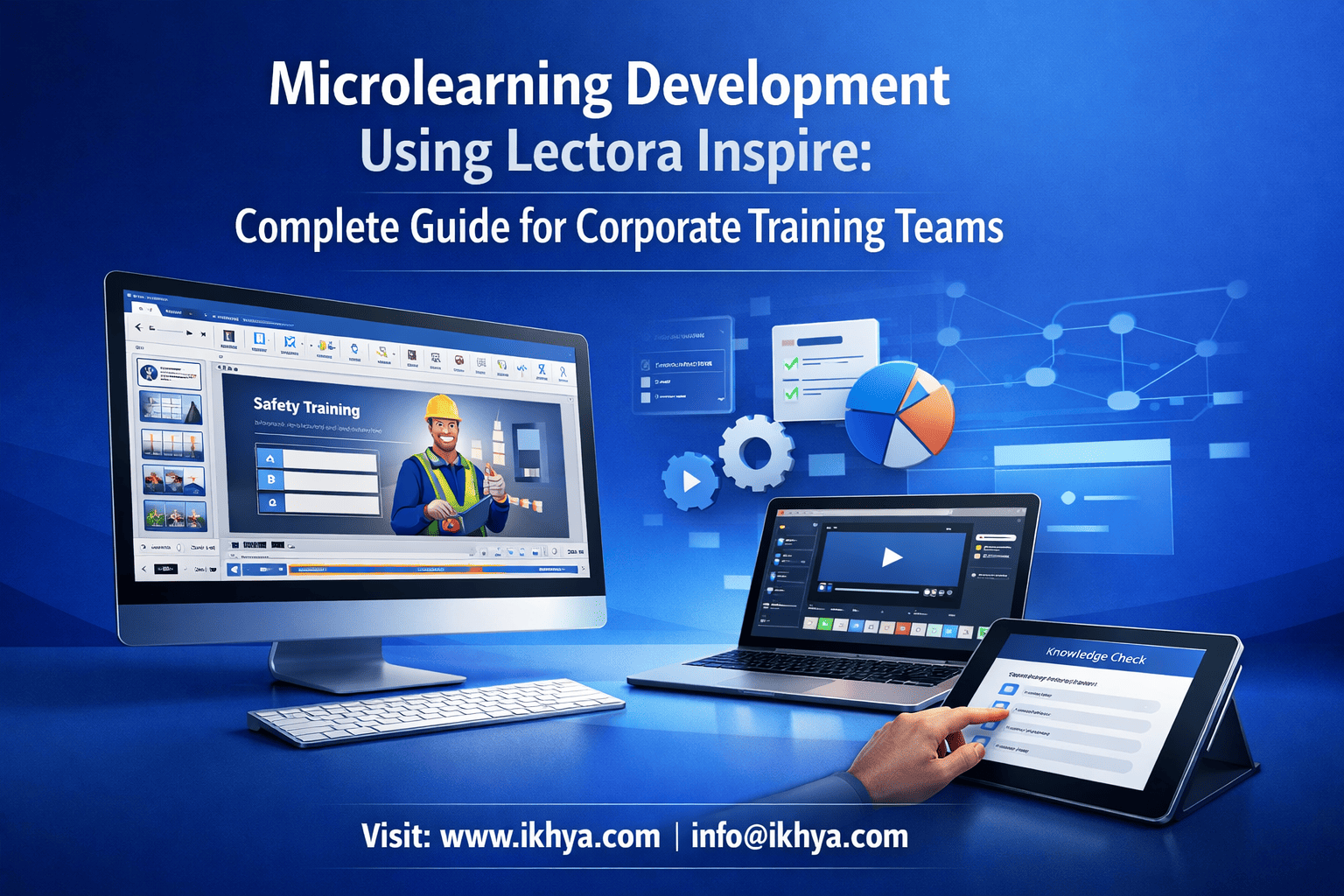
Microlearning Development Using Lectora Inspire: Complete Guide for Corporate Training Teams

Modern employees don’t have time for long training sessions. They need quick, focused learning that fits into their daily workflow. That’s where microlearning development using Lectora Inspire becomes a powerful solution for organizations aiming to improve engagement, retention, and performance.
Whether you’re modernizing legacy training or building new programs, microlearning helps deliver short, impactful learning experiences that actually work. book a free eLearning demo
What is Microlearning Development and Why It Matters
Microlearning development is the process of creating short, focused learning modules designed to deliver a single learning objective in a few minutes. These modules are typically mobile-friendly, interactive, and easy to consume.
In simple terms:
- Learning is broken into small, digestible units
- Each module focuses on one clear outcome
- Content is designed for quick access and retention
Why Microlearning is Critical for Corporate Training
Traditional training methods often fail because they:
- Overload learners with information
- Require long attention spans
- Are not accessible on-demand
Microlearning solves these problems by offering:
- Just-in-time learning for immediate application
- Higher engagement due to short duration
- Better retention through focused content
- Mobile accessibility for global teams
For organizations planning structured digital learning, aligning microlearning with a strong instructional design strategy through instructional design services ensures that each module delivers measurable outcomes.
Key Characteristics of Effective Microlearning
High-performing microlearning modules typically include:
- 2–7 minute duration
- Single learning objective
- Scenario-based or interactive format
- Mobile-first design
- LMS compatibility (SCORM/xAPI)
When implemented correctly, microlearning becomes a performance support tool, not just a training format.
Where Microlearning Fits in Modern Learning Ecosystems
Microlearning is not a replacement for full courses—it complements them.
It works best for:
- Reinforcement training
- Compliance refreshers
- Product updates
- Onboarding support
- Skill-based learning
Organizations often combine microlearning with broader programs like custom eLearning development services to build a complete learning ecosystem that scales globally.
Real-World Example
A healthcare organization reduced training time by 40% by converting long compliance modules into microlearning units. Instead of 60-minute sessions, employees completed 5-minute scenario-based modules, improving both completion rates and retention.
Why Use Lectora Inspire for Microlearning Development
Lectora Inspire is one of the most powerful authoring tools for building scalable, responsive, and highly interactive microlearning modules. It is especially suited for enterprises that require compliance-ready, LMS-compatible, and customizable learning experiences.
Key Reasons Lectora Inspire is Ideal for Microlearning
- Responsive design capabilities for mobile-first learning
- Advanced interactivity for scenario-based modules
- SCORM, xAPI, and AICC compliance for LMS tracking
- Reusable templates for rapid microlearning development
- Strong accessibility support (WCAG compliant)
For organizations planning structured learning ecosystems, lectora inspire development services help accelerate deployment while maintaining high quality.
Microlearning + Lectora = Scalable Training
Lectora enables organizations to build microlearning at scale because:
- Content can be reused across modules
- Templates reduce development time
- Updates can be deployed quickly
- Localization is easier for global teams
When combined with rapid elearning development using lectora inspire, organizations can roll out training programs in weeks instead of months.
Built for Enterprise-Level Training Needs
Unlike basic authoring tools, Lectora is designed for:
- Complex compliance training
- Multi-language deployment
- Advanced assessments and branching scenarios
- Integration with enterprise LMS platforms
This makes it highly suitable for industries like healthcare, finance, and manufacturing where accuracy, tracking, and scalability are critical.
Real-World Example
A financial services company in the UK converted its annual compliance training into microlearning using Lectora Inspire. The result:
- 60% reduction in training time
- 35% increase in completion rates
- Improved audit readiness through xAPI tracking
When Lectora Outperforms Other Tools
Lectora Inspire is particularly effective when:
- You need custom UI/UX flexibility
- Training requires complex branching logic
- Courses must meet strict compliance standards
- You want full control over content structure
For organizations comparing tools, reviewing lectora inspire vs articulate storyline can help determine the right fit.
Key Features of Lectora Inspire for Microlearning Courses
Lectora Inspire offers a robust set of features that make it highly effective for building interactive, scalable, and mobile-friendly microlearning modules. These features directly support rapid development while maintaining enterprise-level quality.
1. Responsive Course Design for Mobile Learning
Microlearning is most effective when accessible on mobile devices. Lectora supports responsive design that adapts content across:
- Smartphones
- Tablets
- Desktops
This ensures learners can access training anytime, anywhere—especially critical for distributed teams.
For organizations focusing on mobile-first strategies, mobile learning development solutions complement Lectora-based microlearning effectively.
2. Built-In Interactivity for Engaging Learning
Lectora enables creation of highly interactive microlearning modules such as:
- Click-based scenarios
- Drag-and-drop activities
- Decision-making simulations
- Knowledge checks and quizzes
These interactions improve engagement and retention compared to passive content.
For advanced use cases, combining microlearning with elearning simulation-based training services creates realistic learning environments.
3. Reusable Templates for Rapid Development
One of the biggest advantages of Lectora is the ability to:
- Create reusable layouts
- Standardize course structure
- Reduce development time
This is essential for organizations producing large volumes of microlearning modules.
4. Advanced Tracking with SCORM and xAPI
Lectora supports:
- SCORM 1.2 / 2004
- xAPI (Tin Can API)
- Detailed learner analytics
This allows organizations to track:
- Completion rates
- Learner performance
- Engagement metrics
Such tracking is crucial for compliance-heavy industries.
5. Accessibility and Compliance Support
Lectora is known for strong accessibility features, including:
- WCAG compliance
- Screen reader compatibility
- Keyboard navigation support
For organizations with inclusive training goals, accessible elearning solutions can further enhance compliance and usability.
6. Multi-Language and Localization Capabilities
Global organizations can easily scale training with:
- Language switching
- Translation workflows
- Region-specific content adaptation
This makes Lectora ideal for global workforce training programs.
To support localization at scale, elearning translation localization services are often integrated into development workflows.
Feature Summary Table
| Feature | Benefit for Microlearning |
|---|---|
| Responsive Design | Mobile-friendly learning |
| Interactivity | Higher engagement |
| Templates | Faster development |
| SCORM/xAPI | Advanced tracking |
| Accessibility | Inclusive learning |
| Localization | Global scalability |
Real-World Insight
A manufacturing company in the UAE used Lectora templates to develop 120 microlearning modules in under 6 weeks, reducing development time by nearly 50% compared to traditional methods.
Microlearning Development Process Using Lectora Inspire
Microlearning development using Lectora Inspire follows a structured approach focused on speed, clarity, and measurable outcomes. The goal is to convert complex content into short, high-impact learning modules.
Step-by-Step Microlearning Development Workflow
1. Content Analysis and Chunking
- Define clear learning objectives
- Break content into small modules
- Focus on one outcome per module
For legacy content transformation, ppt to elearning conversion services support efficient restructuring.
2. Instructional Design and Storyboarding
- Create short learning flows
- Use scenarios and quick assessments
- Align with real-world application
3. Development in Lectora Inspire
- Use templates for faster production
- Add interactions and branching
- Integrate visuals and media
To accelerate development, lectora elearning development services are commonly used.
4. Testing and Deployment
- Ensure LMS compatibility
- Validate mobile responsiveness
- Publish in SCORM/xAPI formats
For seamless deployment, lms compatible elearning course development services ensure integration readiness.
Typical Development Timeline
- 1–2 weeks → basic microlearning
- 3–4 weeks → interactive modules
- 4–6 weeks → advanced scenarios
Key Success Factors
- Keep modules short and focused
- Prioritize mobile-first design
- Use real-world scenarios
- Continuously improve based on data
This version removes:
- Redundant explanations
- Extra tables
- Overextended examples
Word count reduced significantly while keeping SEO + intent intact.
Types of Microlearning You Can Build in Lectora Inspire
Lectora Inspire supports multiple microlearning formats, allowing organizations to deliver training based on specific business goals and learner needs.
1. Scenario-Based Microlearning
- Real-life decision-making situations
- Branching paths based on learner choices
- Immediate feedback
Widely used in compliance and customer-facing roles.
2. Video-Based Microlearning
- Short explainer videos (2–5 minutes)
- Demonstrations and walkthroughs
- Pausable, on-demand learning
Best for product training and onboarding.
3. Interactive Quiz-Based Modules
- Quick assessments
- Knowledge checks
- Reinforcement learning
Helps improve retention and track performance.
4. Simulation-Based Microlearning
- Practice-based learning environments
- Software or process simulations
- Hands-on skill development
Often combined with elearning simulation-based training services for advanced training needs.
5. Mobile-First Microlearning Modules
- Designed specifically for smartphones
- Swipe-based navigation
- Minimal text, high visuals
Supported through mobile learning development solutions for better accessibility.
6. Infographic and Visual Microlearning
- Data-driven visuals
- Step-by-step process graphics
- Quick reference guides
Ideal for performance support and refreshers.
When to Use Each Type
| Type | Best Use Case |
|---|---|
| Scenario-Based | Compliance, customer service |
| Video-Based | Product, onboarding |
| Quiz-Based | Reinforcement |
| Simulation | Technical skills |
| Mobile Modules | Field workforce |
| Infographic | Quick reference |
Industry Use Cases of Microlearning Using Lectora Inspire
Microlearning using Lectora Inspire is widely adopted across industries to deliver targeted, scalable, and high-impact training.
Healthcare
- Compliance and regulatory training
- Patient safety protocols
- Short refresher modules
Often supported by lectora inspire for healthcare compliance training for accuracy and audit readiness.
Manufacturing
- Safety training modules
- Equipment handling guides
- Process-based learning
Used to reduce errors and improve on-floor performance.
Finance
- Regulatory compliance updates
- Risk and fraud awareness
- Policy training
Microlearning helps keep teams updated without long sessions.
Retail
- Customer service training
- Product knowledge
- Sales techniques
Short modules improve frontline employee performance.
IT / Software
- Product training
- System onboarding
- Tool-based learning
Often integrated into onboarding programs for faster ramp-up.
Why It Works Across Industries
- Quick deployment
- Easy updates
- Mobile accessibility
- Better engagement
Microlearning vs Traditional eLearning: Key Differences
Microlearning and traditional eLearning serve different purposes. The choice depends on training goals, learner behavior, and content complexity.
Key Differences
| Factor | Microlearning | Traditional eLearning |
|---|---|---|
| Duration | 2–7 minutes | 30–60+ minutes |
| Structure | Single objective | Multiple topics |
| Engagement | High | Moderate |
| Accessibility | Mobile-first | Often desktop-focused |
| Use Case | Reinforcement, quick learning | Deep training programs |
When to Choose Microlearning
- Need quick knowledge transfer
- Training must be accessible on mobile
- Learners have limited time
- Frequent updates are required
When Traditional eLearning Works Better
- Complex subjects requiring depth
- Certification programs
- Detailed compliance training
- Multi-topic learning journeys
Blended Approach Works Best
Most organizations combine both:
- Use microlearning for reinforcement and updates
- Use full courses for core training
To build a balanced learning strategy, corporate elearning development the complete enterprise guide provides a structured approach.
Cost of Microlearning Development Using Lectora Inspire
The cost of microlearning development using Lectora Inspire depends on complexity, interactivity, and volume.
Typical Cost Range (Per Module)
- Basic → $300 – $800
- Interactive → $800 – $2000
- Advanced → $2000 – $5000+
What Impacts Cost
- Level of interactivity (quiz vs simulation)
- Custom design vs template-based
- Multimedia usage (video, animation)
- Localization requirements
For detailed estimation, cost of lectora inspire course development helps define realistic budgets.
Cost Optimization Tips
- Use templates for repeat modules
- Prioritize high-impact content
- Develop in batches
- Outsource for faster scaling
If you’re estimating budget for your project, request rfp to get a detailed cost breakdown aligned to your requirements.
Development Timelines: How Long Does It Take?
Microlearning development using Lectora Inspire is relatively fast compared to full-length courses. Timelines depend on complexity and volume.
Typical Timelines
- 1–2 weeks → Basic modules
- 3–4 weeks → Interactive modules
- 4–6 weeks → Advanced scenarios
What Affects Timelines
- Content readiness
- Number of modules
- Interactivity level
- Review cycles
How to Speed Up Development
- Use pre-built templates
- Finalize content early
- Run parallel development
- Work with experts via rapid elearning development services
Challenges in Microlearning Development and How to Solve Them
Microlearning is effective, but poor execution can reduce its impact. Identifying common challenges helps ensure better outcomes.
Common Challenges
- Over-fragmentation of content
→ Too many small modules without clear flow - Lack of clear objectives
→ Modules become informational instead of actionable - Low engagement
→ Static content reduces effectiveness - Inconsistent design
→ Different modules feel disconnected
How to Solve Them
- Define one clear objective per module
- Use scenarios and interactivity instead of static slides
- Maintain consistent templates and structure
- Align modules with business outcomes
For structured execution, elearning consultancy services help identify gaps and optimize strategy.
Key Insight
Microlearning works best when it is:
- Focused
- Consistent
- Outcome-driven
When to Choose Lectora Inspire for Microlearning
Lectora Inspire is not always the default choice—but it becomes the right choice when training requires control, scalability, and compliance.
Choose Lectora Inspire When
- You need highly customized microlearning modules
- Training involves complex decision-making scenarios
- Compliance tracking (SCORM/xAPI) is critical
- You require multi-language deployment
- Accessibility (WCAG) is mandatory
For deeper understanding, why organizations choose lectora inspire for elearning development explains its enterprise advantages.
When It May Not Be Necessary
- Simple content with minimal interactivity
- Quick internal training with limited scope
- No requirement for advanced tracking
Decision Tip
If your training needs involve scale + compliance + customization, Lectora Inspire is a strong fit.
Outsourcing Microlearning Development: Strategy & Benefits
Outsourcing microlearning development using Lectora Inspire helps organizations achieve faster delivery, better quality, and lower internal effort.
Why Organizations Outsource
- Lack of in-house expertise
- Tight timelines
- Need for scalable production
- Requirement for high-quality design
For structured outsourcing, outsourcing lectora inspire elearning development provides a clear execution approach.
Key Benefits
- Faster turnaround through experienced teams
- Cost efficiency with optimized workflows
- Access to specialists (ID, UI/UX, developers)
- Scalable production for large projects
When Outsourcing Makes Sense
- Large volume of modules
- Multi-language rollout
- Complex interactivity requirements
- Strict deadlines
Quick Strategy
- Start with a pilot module
- Define clear scope and timelines
- Use standardized templates
- Track progress with milestones
How to Choose the Right Lectora Inspire Vendor
Selecting the right vendor ensures your microlearning program is scalable, high-quality, and aligned with business goals.
Key Evaluation Criteria
- Experience in Lectora-based development
- Strong instructional design capability
- Portfolio across industries
- Ability to handle scale and timelines
To simplify evaluation, how to choose a lectora inspire development company provides a structured checklist.
Questions to Ask
- Can you share relevant case studies?
- What is your development timeline?
- How do you handle revisions?
- Do you support LMS integration and analytics?
Red Flags to Avoid
- No clear process
- Limited Lectora expertise
- Unrealistic timelines
- Poor communication
Final Thoughts: Building Scalable Microlearning with Lectora Inspire
Microlearning development using Lectora Inspire enables organizations to deliver focused, engaging, and scalable training that aligns with modern learning behavior.
- Improves engagement and retention
- Reduces training time
- Supports global and mobile learning
- Enables measurable outcomes
For organizations planning implementation or scaling, contact us to discuss requirements or get clarity on next steps.
FAQs
1. What is microlearning in Lectora Inspire?
Short, focused learning modules created using Lectora for quick knowledge delivery.
2. How long does microlearning development take?
Typically 1–4 weeks depending on complexity.
3. What is the cost of microlearning development?
Ranges from $300 to $5000+ per module.
4. Is Lectora good for microlearning?
Yes, especially for interactive and compliance-focused training.
5. Can microlearning be mobile-friendly?
Yes, Lectora supports responsive design for mobile devices.
6. What industries use microlearning?
Healthcare, manufacturing, finance, retail, and IT.
7. Does Lectora support SCORM and xAPI?
Yes, both standards are supported.
8. Can existing training be converted into microlearning?
Yes, using structured content conversion.
9. Is microlearning suitable for compliance training?
Yes, especially for refreshers and updates.
10. Do I need an LMS for microlearning?
Recommended for tracking and reporting.
11. How many modules should a course have?
Depends on content, usually 5–20 micro modules.
12. What is the ideal length of a module?
2–7 minutes.
13. Can microlearning include simulations?
Yes, Lectora supports interactive simulations.
14. Is outsourcing microlearning development beneficial?
Yes, for speed, quality, and scalability.
15. Can microlearning be updated easily?
Yes, modules can be edited individually.
16. What tools are used besides Lectora?
Storyline, Rise, Captivate depending on needs.
17. Is microlearning effective for onboarding?
Yes, it speeds up learning and retention.
18. How is learner performance tracked?
Through LMS using SCORM/xAPI.
19. Can microlearning support global teams?
Yes, with localization and mobile access.
20. Is microlearning better than traditional eLearning?
It depends—best used alongside traditional methods.
Related Resources
Explore these resources to understand microlearning strategy, Lectora implementation, and how to plan, scale, and execute enterprise training effectively.