SCORM-Compliant eLearning Development: Why It Matters for LMS Integration

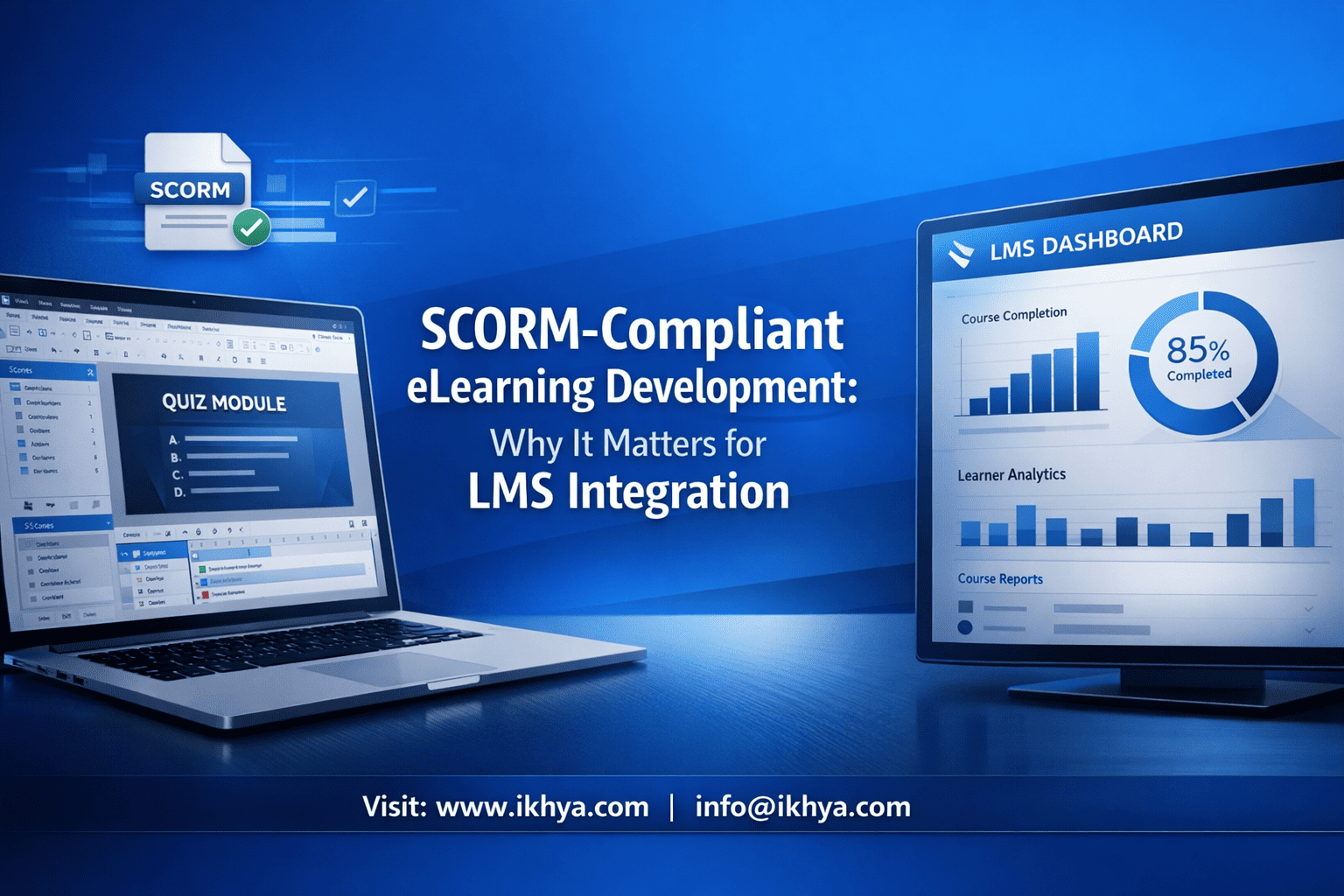
Most eLearning failures happen after development—when courses don’t track progress, scores don’t report correctly, or LMS integration breaks. These issues often arise when SCORM compliant eLearning development is not implemented correctly, leading to inaccurate reporting, compliance risks, and unreliable training outcomes.
Without a structured approach, even well-designed courses fail to deliver measurable results inside an LMS. Implementing standards like SCORM ensures seamless integration, accurate tracking, and consistent reporting. Working with experts in LMS-compatible eLearning course development services helps eliminate integration failures and ensures your training is scalable and LMS-ready.
If you want your courses to work flawlessly across platforms and avoid costly redevelopment, you can book a free eLearning demo to evaluate the right approach for your training needs.
What Is SCORM and Why Is It Critical for LMS Integration?
SCORM is a technical standard that allows eLearning courses and Learning Management Systems (LMS) to communicate using a common language. It ensures courses can report learner progress, scores, completion status, and time spent through reliable SCORM tracking and reporting mechanisms. Without SCORM, LMS platforms cannot reliably track learning activity, leading to compliance failures, inaccurate reporting, and unusable training data.
Understanding SCORM for LMS Compatible eLearning Development
SCORM stands for Sharable Content Object Reference Model. It was developed by the Advanced Distributed Learning (ADL) Initiative, a program of the U.S. Department of Defense, to standardize how digital learning content interacts with LMS platforms.
Before SCORM compliant eLearning development, every LMS required custom integration, making LMS compatible eLearning difficult to scale.
- How content launches
- How content communicates with the LMS
- How learner progress is tracked
- How completion and scores are recorded
This made eLearning portable, scalable, and measurable.
How SCORM Works in SCORM LMS Integration and Tracking
In SCORM compliant eLearning development, when a learner opens a SCORM course, the LMS and course communicate using a defined API and data model, enabling seamless SCORM LMS integration.
Step-by-step communication flow:
- Learner launches course from LMS
- LMS opens the SCORM package in a browser
- Course connects to LMS using SCORM API
- Course sends learner activity data
- LMS stores progress, score, and completion
Example data sent to LMS:
| Data Element | Description | Example |
|---|---|---|
| Lesson Status | Completion state | completed |
| Score | Learner score | 85% |
| Time Spent | Duration in course | 25 minutes |
| Bookmark | Last location | Slide 14 |
| Interaction Data | Quiz responses | Question 3 correct |
This communication ensures accurate tracking and reporting.
Real-World Example: SCORM in Corporate Compliance Training
Consider a global company operating in the USA, UK, UAE, and Australia that must track safety compliance training.
Without SCORM:
- LMS cannot verify completion
- No reliable compliance reporting
- Audit failures possible
With SCORM:
- LMS tracks completion automatically
- Reports show completion by employee, department, and country
- Compliance evidence is audit-ready
This is why SCORM is mandatory in industries like:
- Healthcare
- Aviation
- Oil and Gas
- Banking and Finance
- Manufacturing
Why SCORM compliant eLearning development is essential for LMS
Most major LMS platforms rely on SCORM, including:
- Moodle
- Cornerstone
- Docebo
- SAP SuccessFactors
- TalentLMS
- Blackboard
- LearnWorlds
SCORM ensures a course built once can work across all these systems, enabling LMS compatible eLearning at scale.
Without SCORM compliance, LMS platforms cannot:
- Track completion reliably
- Record quiz scores correctly
- Resume courses from last position
- Generate accurate reports
SCORM Enables LMS Features That Organizations Need
SCORM compliant eLearning development powers critical LMS functionality through advanced SCORM tracking and reporting:
SCORM tracking and reporting features:
- Completion tracking
- Score reporting
- Time tracking
- Progress tracking
- Interaction tracking
Administrative Features:
- Compliance reporting
- Certification tracking
- Audit readiness
- Performance analytics
Learner Experience Features:
- Resume from last location
- Save progress automatically
- Track assessment results
SCORM Solves the Biggest LMS Integration Problem: Compatibility
Without SCORM, courses must be custom-built for each LMS.
With SCORM:
- One course works across multiple LMS platforms
- No redevelopment required
- Lower development cost
- Faster deployment globally
For multinational organizations, this is essential.
How SCORM compliant eLearning development tracks learner progress
SCORM tracks learner progress by sending real-time data from the course to the LMS using a defined data model and API. It records completion status, scores, time spent, quiz responses, and bookmarks. This allows LMS platforms to generate reports, resume courses, verify compliance, and measure training effectiveness accurately across global organizations.
The SCORM Data Model: What Information Gets Tracked
SCORM course development defines exactly what data a course can send to the LMS, ensuring consistency with LMS tracking standards
Core SCORM tracking variables include:
| SCORM Data Element | Technical Name | Purpose |
|---|---|---|
| Completion Status | cmi.core.lesson_status | Tracks completed, incomplete, passed, failed |
| Score (Raw) | cmi.core.score.raw | Stores learner score |
| Score (Min/Max) | cmi.core.score.min / max | Defines score range |
| Time Spent | cmi.core.session_time | Measures training duration |
| Total Time | cmi.core.total_time | Cumulative learning time |
| Bookmark | cmi.core.lesson_location | Resume from last position |
| Suspend Data | cmi.suspend_data | Stores detailed progress state |
| Interaction Data | cmi.interactions | Records quiz responses |
These variables enable precise tracking required by compliance-driven industries.
Completion tracking in SCORM compliant eLearning development
Completion tracking is the most important function in SCORM compliance for LMS environments, especially for certification programs.
SCORM uses standardized status values:
Completion status types:
- completed
- incomplete
- passed
- failed
- not attempted
- browsed
Example workflow:
- Learner starts course → LMS records “incomplete”
- Learner finishes all required slides
- Course sends “completed” status
- LMS records completion with timestamp
This allows administrators to verify training completion instantly.
How SCORM Tracks Quiz Scores and Assessment Results
SCORM course development allows quizzes to send detailed assessment data to the LMS.
Tracked assessment data includes:
- Final score
- Pass/fail result
- Individual question responses
- Correct and incorrect answers
- Attempts count
Example: Compliance Certification Course
| Learner | Score | Pass Mark | Result |
|---|---|---|---|
| Employee A | 92% | 80% | Pass |
| Employee B | 65% | 80% | Fail |
The LMS automatically records and reports these results.
This is essential for:
- OSHA training in the USA
- Workplace safety in Australia
- Financial compliance in the UK
- Corporate regulatory training in UAE
How SCORM Enables Resume Functionality (Bookmarking)
SCORM allows learners to resume exactly where they left off using bookmarking.
The course saves the learner’s position using:
Technical variable:
cmi.core.lesson_location
Example scenario:
- Learner exits at slide 27
- LMS stores location
- Learner returns later
- Course resumes at slide 27
This improves learner experience and completion rates.
How SCORM Tracks Time Spent in Training
Time tracking is critical for regulated industries where minimum training hours are required.
SCORM tracks:
- Session time
- Total time
- Time per attempt
Example compliance requirement:
| Country | Compliance Requirement | Tracking Need |
|---|---|---|
| USA | OSHA safety training hours | Exact time tracking |
| UK | Health and safety certification | Verifiable duration |
| UAE | Oil & gas compliance training | Audit-ready records |
| Australia | Workplace training compliance | Mandatory time logs |
SCORM ensures LMS records this automatically.
How SCORM Tracks Detailed Learner Interactions
SCORM can store detailed interaction data such as:
- Question responses
- Answer choices
- Response time
- Attempt number
This allows advanced analytics.
Example interaction record:
| Question | Learner Answer | Correct | Time |
|---|---|---|---|
| Q1 | B | Yes | 12 sec |
| Q2 | C | No | 18 sec |
This helps organizations identify knowledge gaps.
SCORM Versions Explained: SCORM 1.2 vs SCORM 2004 vs xAPI
SCORM versions define how courses communicate with LMS platforms. SCORM 1.2 is the most widely supported version globally. SCORM 2004 adds sequencing and advanced tracking. xAPI is a newer standard that tracks learning beyond LMS platforms. Choosing the correct version ensures compatibility, reporting accuracy, and future scalability.
SCORM 1.2: The Global Industry Standard
SCORM 1.2 is the most commonly used version worldwide because of its universal compatibility.
Key features:
- Completion tracking
- Score tracking
- Bookmarking
- Basic reporting
Limitations:
- No advanced sequencing
- Limited reporting detail
- Cannot define complex learning paths
Where SCORM 1.2 is used most:
- Corporate training worldwide
- Compliance training in USA and UK
- Healthcare LMS systems
- Banking and finance training
Why companies still use SCORM 1.2:
- Supported by nearly all LMS platforms
- Reliable and stable
- Easy to implement
SCORM 2004: Advanced Tracking and Sequencing
SCORM 2004 introduced more powerful learning control.
Key advantages over SCORM 1.2:
- Learning path sequencing
- Improved completion tracking
- Better reporting
- Standardized success vs completion status
Example sequencing rule:
- Module 2 unlocks only after Module 1 completion
- Assessment unlocks only after all modules complete
This is critical in regulated training programs requiring strict SCORM compliance for LMS systems.
xAPI (Tin Can API): The Modern Successor to SCORM
xAPI expands tracking beyond traditional LMS environments.
It can track:
- Mobile learning
- Offline learning
- Simulation training
- VR and AR training
- Learning outside LMS
Example tracked activities:
- Watched training video
- Completed VR simulation
- Attended workshop
- Viewed PDF guide
This enables complete learning analytics.
Global Comparison: SCORM 1.2 vs SCORM 2004 vs xAPI
| Feature | SCORM 1.2 | SCORM 2004 | xAPI |
|---|---|---|---|
| LMS compatibility | Excellent | Good | Requires LRS |
| Completion tracking | Yes | Yes | Yes |
| Score tracking | Yes | Yes | Yes |
| Bookmarking | Yes | Yes | Yes |
| Sequencing | No | Yes | Yes |
| Offline tracking | No | No | Yes |
| Mobile tracking | Limited | Limited | Excellent |
| Industry adoption | Highest | Moderate | Growing |
How SCORM Packages Are Built: The Technical Development Process
SCORM packages are built by exporting eLearning courses from authoring tools into a standardized ZIP file containing HTML, JavaScript, media, and a manifest file. This package enables LMS platforms to launch the course, track learner activity, and store completion data consistently across different LMS environments worldwide.
What Is a SCORM Package?
A SCORM package is a compressed ZIP file containing all course assets and configuration files required for LMS delivery.
SCORM package contents include:
| File Type | Purpose |
|---|---|
| HTML files | Course structure and content |
| JavaScript files | LMS communication logic |
| Media files | Images, audio, video |
| CSS files | Course styling |
| XML manifest (imsmanifest.xml) | Defines course structure and tracking |
| Assessment files | Quiz logic and scoring |
The most critical file is imsmanifest.xml, which tells the LMS how the course works.
The imsmanifest.xml File: The Core of SCORM Functionality
The imsmanifest.xml file defines:
- Course structure
- Launch file location
- Course identifiers
- Tracking settings
- Sequencing rules (SCORM 2004)
Example simplified manifest structure:
<manifest identifier="course_001">
  <organizations>
    <organization identifier="org_001">
      <item identifier="item_001" identifierref="resource_001">
        <title>Safety Training Module</title>
      </item>
    </organization>
  </organizations>
  <resources>
    <resource identifier="resource_001" href="index.html"/>
  </resources>
</manifest>
This file ensures LMS platforms know how to launch and track the course.
SCORM Development Workflow Using Authoring Tools
Modern authoring tools automatically generate SCORM-compliant packages.
Most commonly used tools globally:
| Authoring Tool | SCORM Support | Common Regions |
|---|---|---|
| Articulate Storyline | SCORM 1.2, 2004, xAPI | USA, UK, Australia |
| Articulate Rise | SCORM 1.2, 2004 | Global |
| Adobe Captivate | SCORM 1.2, 2004, xAPI | UAE, Europe, USA |
| iSpring Suite | SCORM 1.2, 2004, xAPI | Corporate training worldwide |
| Lectora | SCORM 1.2, 2004, xAPI | Government and enterprise |
Development process:
- Design course content
- Add interactions and assessments
- Configure SCORM reporting settings
- Export as SCORM package
- Upload to LMS
- Test tracking and reporting
SCORM API: How the Course Communicates with the LMS
SCORM uses a JavaScript API to exchange data.
Core SCORM API functions:
| Function | Purpose |
|---|---|
| LMSInitialize() | Starts communication |
| LMSSetValue() | Sends data to LMS |
| LMSGetValue() | Retrieves data from LMS |
| LMSCommit() | Saves data |
| LMSFinish() | Ends communication |
Example communication flow:
LMSInitialize("");
LMSSetValue("cmi.core.lesson_status", "completed");
LMSSetValue("cmi.core.score.raw", "90");
LMSCommit("");
LMSFinish("");
This ensures learner progress is saved through SCORM tracking in LMS environments.
Example: SCORM Deployment in a Global Corporate LMS
A multinational oil and gas company deploying safety training across UAE, USA, and Australia would:
Step 1: Development
- Create course in Articulate Storyline
- Export as SCORM 1.2
Step 2: LMS Upload
- Upload ZIP package to LMS
- Configure completion criteria
Step 3: Learner Access
- Employees launch course
- LMS tracks progress
Step 4: Reporting
- LMS generates compliance reports
This ensures audit-ready training records.
SCORM Compliance Requirements and Validation Methods
SCORM compliance means the course correctly communicates with LMS platforms using SCORM standards. This requires proper manifest configuration, API communication, completion triggers, and data reporting. Validation tools test whether the course sends and receives data correctly, ensuring compatibility with LMS platforms globally.
Core Technical Requirements for SCORM Compliance
A course must meet these requirements:
1. Valid manifest file
- Proper imsmanifest.xml structure
- Correct resource references
2. Functional SCORM API communication
- Initialize communication
- Send progress and score
- Commit and close properly
3. Proper completion triggers
- Completion status defined
- Pass/fail criteria configured
4. LMS compatibility
- Works across multiple LMS platforms
SCORM Testing Tools Used Worldwide
Before deployment, SCORM packages must be tested using validation tools.
Most trusted testing tools:
| Tool | Organization | Purpose |
|---|---|---|
| SCORM Cloud | Rustici Software (USA) | Industry standard testing |
| ADL Test Suite | US Government | Official compliance testing |
| Moodle LMS | Open-source global | LMS compatibility testing |
| SCORM Driver | Rustici Software | SCORM integration testing |
SCORM Cloud is considered the global benchmark.
What SCORM Testing Verifies
Testing confirms:
- Course launches correctly
- Completion tracking works
- Score reporting functions
- Bookmarking works
- No communication errors
Example test results:
| Test | Result |
|---|---|
| Course launch | Pass |
| Completion tracking | Pass |
| Score tracking | Pass |
| Resume functionality | Pass |
Common SCORM Compliance Errors and How to Fix Them
Common issues:
| Problem | Cause | Solution |
|---|---|---|
| Completion not tracked | Missing completion trigger | Configure completion criteria |
| Scores not reporting | Incorrect quiz settings | Enable score reporting |
| Resume not working | Suspend data not configured | Enable bookmarking |
| LMS not detecting course | Manifest errors | Fix imsmanifest.xml |
These issues can cause compliance failures.
Global LMS Compatibility: USA, UK, Australia, UAE, and Enterprise Systems
SCORM ensures eLearning courses work consistently across LMS platforms used in different countries and industries. It standardizes communication between content and LMS, allowing multinational organizations to deploy training globally without rebuilding courses. This ensures compliance tracking, performance reporting, and consistent learner experience across enterprise systems worldwide.
Why Global Organizations Require SCORM Compatibility
Multinational companies operate across multiple regulatory environments. Training must be tracked accurately in every region.
Without SCORM, organizations face:
- Inconsistent reporting across regions
- LMS integration failures
- Compliance audit risks
- Duplicate development costs
With SCORM, organizations can deploy a single course globally.
Example: Global compliance training deployment
| Country | LMS Used | SCORM Requirement |
|---|---|---|
| USA | Cornerstone | OSHA compliance tracking |
| UK | Moodle | Health & Safety reporting |
| UAE | SAP SuccessFactors | Oil & Gas compliance |
| Australia | Docebo | Workplace safety tracking |
SCORM ensures compatibility across all these systems.
LMS Platforms That Depend on SCORM Globally
Most enterprise LMS platforms are built around SCORM standards.
Major LMS platforms supporting SCORM:
| LMS Platform | Region | Industry Usage |
|---|---|---|
| Cornerstone OnDemand | USA, UK | Enterprise and government |
| SAP SuccessFactors | Global | Fortune 500 companies |
| Moodle | Global | Universities and corporate |
| Docebo | USA, Europe, UAE | Corporate training |
| Blackboard | USA, UK | Education and enterprise |
| Totara Learn | UK, Australia | Government and healthcare |
| TalentLMS | Global | SMB and enterprise |
These platforms rely on SCORM for tracking and reporting.
Government and Regulatory Compliance Requirements
Many regulatory bodies require verifiable training records.
SCORM provides audit-ready reporting for compliance.
Examples of compliance requirements globally:
| Country | Regulation | Training Requirement |
|---|---|---|
| USA | OSHA | Safety training tracking |
| UK | HSE | Workplace safety certification |
| UAE | ADNOC | Oil and gas safety compliance |
| Australia | Safe Work Australia | Employee safety training |
SCORM enables LMS systems to store verifiable completion records required during audits.
Example: Multinational Deployment Scenario
A UK-based financial institution deploys compliance training to employees in:
- London
- Dubai
- Sydney
- New York
Without SCORM:
- Each LMS requires custom course version
- Reporting inconsistent
With SCORM:
- Single course deployed globally
- All LMS platforms track completion
- Unified compliance reporting
This reduces cost and improves reliability.
SCORM vs Non-SCORM Courses: Risks and Business Impact
SCORM courses enable LMS tracking, reporting, and compliance verification, while non-SCORM courses function like static web content without reliable tracking. Non-SCORM courses cannot report completion, scores, or learner activity accurately, making them unsuitable for compliance, certification, or enterprise training programs requiring verifiable learning records.
What Happens When Courses Are Not SCORM-Compliant
Non-SCORM courses cannot communicate properly with LMS platforms.
This results in:
- No completion tracking
- No score reporting
- No progress saving
- No compliance verification
Example comparison:
| Feature | SCORM Course | Non-SCORM Course |
|---|---|---|
| Completion tracking | Yes | No |
| Score reporting | Yes | No |
| Resume functionality | Yes | No |
| Compliance reporting | Yes | No |
| LMS integration | Full | Limited |
Financial Risks of Non-SCORM Courses
Organizations can face significant financial and compliance risks.
Major risks include:
- Compliance audit failures
- Legal liability
- Retraining costs
- Redevelopment costs
- Loss of training records
Example: Compliance audit failure
A company cannot prove employees completed safety training.
Result:
- Regulatory penalties
- Mandatory retraining
- Operational disruption
SCORM prevents these risks.
Operational Risks of Poor LMS Integration
Without proper SCORM integration:
- Learner progress may be lost
- Courses may not load correctly
- Reports may be inaccurate
- LMS performance may degrade
This reduces training effectiveness.
Long-Term Scalability Benefits of SCORM
SCORM enables scalable training infrastructure.
Benefits include:
- Reusable course content
- LMS independence
- Easy global deployment
- Long-term compatibility
This protects training investment.
Frequently Asked Questions (FAQ)
What is SCORM compliance in eLearning?
SCORM compliance means the course follows SCORM technical standards so it can communicate with LMS platforms. This allows tracking of learner progress, completion status, scores, and time spent. Without SCORM compliance, LMS systems cannot reliably monitor or report training activity.
Which SCORM version should organizations use?
SCORM 1.2 is the safest choice because it works with nearly all LMS platforms globally. SCORM 2004 is better for advanced sequencing and learning paths. xAPI is best for advanced analytics and modern learning environments but requires additional infrastructure.
Can an LMS work without SCORM?
Yes, but tracking and reporting will be limited or unreliable. SCORM ensures accurate completion tracking, score reporting, and compliance verification, which are essential for corporate and regulated training environments.
How do you test if a course is SCORM compliant?
Upload the course to SCORM Cloud or a test LMS and verify completion tracking, score reporting, bookmarking, and communication. These tools simulate real LMS environments and confirm proper SCORM functionality.
What happens if SCORM is implemented incorrectly?
Incorrect implementation can cause completion tracking failures, missing scores, and reporting errors. This can lead to compliance failures, retraining costs, and loss of training data.
Ensure Your eLearning Works Seamlessly Across Any LMS
SCORM compliance is not optional—it is essential for reliable LMS integration, accurate tracking, and compliance reporting. Poor implementation can lead to failed tracking, compliance risks, and costly redevelopment.
IKHYA – eLearning Solutions Company specializes in SCORM-compliant eLearning development compatible with Moodle, Cornerstone, SAP SuccessFactors, Docebo, and all major LMS platforms worldwide.
Contact IKHYA at info@ikhya.com to ensure your courses are fully SCORM-compliant, LMS-ready, and built for global deployment.
Frequently Asked Questions (FAQs)
1. What is SCORM compliant eLearning development?
SCORM compliant eLearning development ensures courses follow standardized protocols to communicate with LMS platforms, enabling accurate tracking, reporting, and seamless LMS integration.
2. Why is SCORM compliance important for LMS integration?
SCORM compliance ensures reliable data exchange between courses and LMS platforms, allowing accurate tracking of learner progress, scores, and completion.
3. How does SCORM tracking in LMS work?
SCORM tracking in LMS works by sending real-time learner data such as progress, scores, and time spent from the course to the LMS using a standardized API.
4. What is included in SCORM tracking and reporting?
SCORM tracking and reporting include completion status, quiz scores, time spent, learner interactions, and bookmarking for resume functionality.
5. What is SCORM course development?
SCORM course development involves creating eLearning content that is packaged and structured to work seamlessly across different LMS platforms.
6. What is the difference between SCORM and xAPI?
SCORM vs xAPI differs in scope—SCORM focuses on LMS-based tracking, while xAPI tracks learning beyond LMS, including offline and experiential learning.
7. What are LMS tracking standards?
LMS tracking standards define how learning data is captured, stored, and reported. SCORM is one of the most widely used LMS tracking standards globally.
8. What are eLearning SCORM standards?
eLearning SCORM standards define how courses are packaged, launched, and how they communicate with LMS platforms for tracking and reporting.
9. Which SCORM version should I use?
SCORM 1.2 is widely supported and reliable, while SCORM 2004 offers advanced sequencing. The choice depends on LMS compatibility and training requirements.
10. Can SCORM courses work on any LMS?
Yes, SCORM compliant eLearning development ensures compatibility across most LMS platforms, making courses reusable and scalable.
11. What happens if a course is not SCORM compliant?
Non-SCORM courses cannot track learner progress, scores, or completion accurately, leading to reporting issues and compliance risks.
12. How do you test SCORM compliance?
SCORM compliance is tested using tools like SCORM Cloud to verify tracking, reporting, bookmarking, and LMS communication.
13. What industries require SCORM compliance for LMS?
Industries like healthcare, aviation, oil & gas, finance, and manufacturing require SCORM compliance for LMS to meet regulatory standards.
14. How does SCORM improve compliance training?
SCORM enables audit-ready reporting, ensuring organizations can prove training completion and meet regulatory requirements.
15. What is a SCORM package?
A SCORM package is a ZIP file containing course files, media, and a manifest file that enables LMS integration and tracking.
16. How does SCORM enable LMS compatibility?
SCORM standardizes communication between courses and LMS platforms, ensuring LMS compatible eLearning across systems.
17. Can SCORM track learner interactions?
Yes, SCORM tracking and reporting can capture detailed learner interactions, including quiz responses and time spent.
18. Is SCORM still relevant today?
Yes, SCORM remains a widely adopted LMS tracking standard due to its reliability and compatibility across platforms.
19. What are the benefits of SCORM compliant eLearning development?
It ensures accurate tracking, seamless LMS integration, scalability, compliance readiness, and cost-effective deployment.
20. How can organizations implement SCORM effectively?
Organizations can implement SCORM by working with experts in SCORM compliant eLearning development and using compatible authoring tools.
Related Resources
Strengthen your eLearning strategy with these carefully selected resources designed to support LMS integration, scalability, and SCORM compliance.