
Lectora Inspire eLearning Development for Manufacturing Training

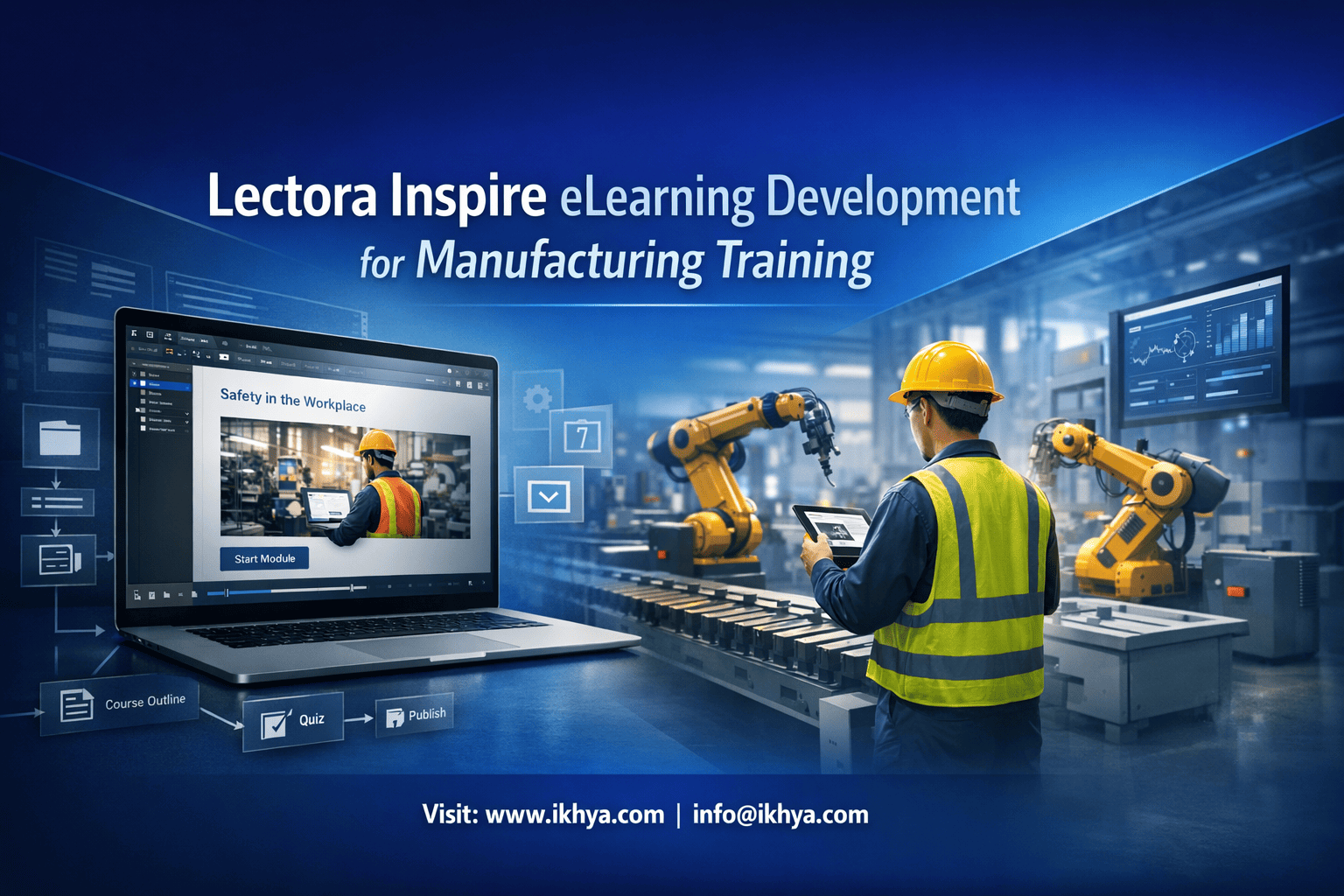
Manufacturing companies today face increasing pressure to train large workforces quickly, maintain strict safety compliance, and support global operations. Traditional classroom training often fails to scale across multiple plants, languages, and regulatory requirements. This is where modern eLearning technologies such as Lectora Inspire help organizations build structured, interactive, and scalable training programs.
Modern enterprises are increasingly adopting digital learning solutions to standardize workforce training, reduce operational risks, and ensure compliance with international manufacturing standards. Platforms like Lectora Inspire allow training teams to develop highly interactive courses that integrate with enterprise Learning Management Systems (LMS), enabling efficient training delivery and measurable learning outcomes.
Organizations looking to modernize their manufacturing training programs often begin by evaluating trusted eLearning partners. Companies such as IKHYA provide enterprise-grade solutions that help manufacturers design, develop, and deploy scalable learning ecosystems across global operations. If your organization is exploring digital training transformation, you can Book a Free eLearning Demo to understand how enterprise learning solutions can support your workforce development strategy.
In this guide, we will explore how Lectora Inspire supports manufacturing training, how enterprises implement these solutions, and how organizations can successfully evaluate and outsource eLearning development.
Why Manufacturing Companies Are Adopting Lectora Inspire for eLearning Development
Manufacturing organizations adopt Lectora Inspire because it enables scalable, compliance-ready, and highly interactive training for technical workforces. The platform supports complex simulations, multilingual deployment, and enterprise LMS integration, making it suitable for global manufacturing training programs that require consistent learning delivery across multiple locations.
Manufacturing environments are complex. Employees must understand machinery operations, safety procedures, regulatory requirements, and operational workflows. Traditional instructor-led training alone cannot efficiently support these needs at scale.
Digital learning platforms such as Lectora Inspire provide a solution by enabling organizations to build structured training programs that can be delivered consistently across global manufacturing facilities.
Growing Training Complexity in Manufacturing
Modern manufacturing operations require workers to understand multiple systems, machines, and processes. Training must cover areas such as:
- Machine operation procedures
- Quality control protocols
- Equipment maintenance practices
- Digital manufacturing technologies
- Workplace safety regulations
As factories adopt Industry 4.0 technologies, training programs must also evolve. Workers now interact with automated systems, robotics, and digital monitoring tools, which increases the complexity of training requirements.
Interactive eLearning built with Lectora Inspire allows organizations to create simulations and guided learning experiences that replicate real operational environments.
Compliance and Safety Training Requirements
Manufacturing companies operate under strict regulatory frameworks across different countries. Safety and compliance training is mandatory and must be documented.
Examples include:
- OSHA safety standards in the United States
- Workplace safety regulations in the UK
- Australian vocational training standards
- Industrial workforce training initiatives in the UAE
Lectora Inspire helps organizations build structured compliance training programs that include:
- Interactive safety scenarios
- Knowledge assessments
- certification tracking
- SCORM or xAPI compliant reporting
These features allow training teams to track learner progress and demonstrate compliance during audits.
Organizations implementing compliance-focused training programs often work with specialized partners that understand both instructional design and enterprise learning technologies. Providers such as IKHYA support large-scale compliance training through services like Compliance Training eLearning Solutions that integrate with enterprise LMS systems.
Need for Scalable Global Workforce Training
Large manufacturing companies often operate across multiple regions. Training programs must support:
- multiple languages
- regional compliance standards
- different workforce skill levels
- standardized operating procedures
Lectora Inspire allows course developers to design modular learning experiences that can be localized and deployed across global facilities.
Key advantages include:
- multi-language course development
- centralized training updates
- cloud-based LMS deployment
- mobile-friendly learning experiences
This ensures that employees across different plants receive consistent training aligned with company policies and operational standards.
Global enterprises that plan to scale digital learning initiatives often benefit from consulting services that help design enterprise learning architectures. Teams evaluating their training strategy can also Contact IKHYA Experts to discuss how scalable eLearning solutions can support manufacturing workforce development.
What Is Lectora Inspire and Why It Works for Manufacturing Training
Lectora Inspire is a powerful enterprise eLearning authoring tool used to create interactive, compliance-ready training programs. It supports SCORM and xAPI standards, integrates easily with enterprise LMS platforms, and enables organizations to build responsive courses for global workforces. These capabilities make it particularly effective for manufacturing training environments.
Manufacturing training often requires complex learning experiences. Workers must understand equipment operations, follow precise procedures, and comply with safety standards. Unlike basic training tools, Lectora Inspire allows developers to create detailed simulations, step-by-step operational guides, and scenario-based learning experiences.
For enterprises managing large training ecosystems, this flexibility makes Lectora a strong choice for developing technical training programs.
Organizations that require advanced Lectora course development frequently partner with specialized providers such as Lectora eLearning Development Services to build enterprise-grade learning solutions.
Key Features of Lectora Inspire
Lectora Inspire includes several capabilities that support enterprise manufacturing training.
Key features include:
Advanced Interactivity
Manufacturing training often requires hands-on learning simulations. Lectora allows developers to create interactive elements such as:
- equipment operation simulations
- branching learning scenarios
- troubleshooting exercises
- step-by-step SOP walkthroughs
These features help employees understand real operational workflows before working with actual equipment.
Responsive Course Design
Modern manufacturing teams include mobile and field workers. Lectora courses can be designed for:
- desktop learning environments
- tablets used on factory floors
- mobile devices for quick reference learning
This flexibility helps organizations deliver training wherever employees work.
Reusable Learning Templates
Large manufacturing organizations frequently deploy training across multiple plants. Lectora enables teams to create reusable templates for consistent training delivery.
This reduces development time and ensures training standardization across global operations.
SCORM and xAPI Compatibility
Enterprise learning systems require standardized tracking of training activities. Lectora Inspire supports both SCORM and xAPI, which are widely used eLearning standards.
These standards allow training programs to:
- track learner progress
- record assessment results
- monitor compliance completion
- integrate with corporate LMS systems
Manufacturing companies often rely on LMS platforms to monitor workforce certifications and safety training completion. SCORM and xAPI compatibility ensures seamless communication between training content and LMS reporting systems.
LMS Integration Capabilities
Most large enterprises already operate enterprise Learning Management Systems. Lectora Inspire integrates with many LMS platforms used by global organizations.
Typical LMS integrations include:
- Cornerstone
- Moodle
- SAP SuccessFactors
- Docebo
- TalentLMS
Through these integrations, training managers can:
- assign courses to employees
- track completion rates
- monitor compliance training
- generate audit-ready reports
Organizations building LMS-compatible training often work with providers offering LMS Compatible eLearning Course Development Services to ensure smooth deployment and integration.
Accessibility and Compliance Support
Manufacturing companies must ensure training accessibility for diverse workforces. Lectora Inspire supports accessibility standards such as WCAG compliance, allowing organizations to create inclusive training programs.
Accessibility features include:
- screen reader compatibility
- keyboard navigation support
- accessible multimedia content
- ADA-compliant learning design
These capabilities are particularly important for enterprises operating across multiple regions where accessibility standards are mandated by law.
Companies modernizing training for global workforces frequently combine accessibility features with scalable learning architectures. Consulting partners such as IKHYA help organizations design inclusive digital learning ecosystems that support both compliance and operational training.
Types of Manufacturing Training That Can Be Built Using Lectora Inspire
Lectora Inspire supports a wide range of manufacturing training programs, from safety compliance to equipment operation. Its interactive capabilities allow organizations to create realistic simulations, step-by-step procedural training, and assessment-driven learning experiences tailored to industrial environments.
Manufacturing companies must train employees across multiple operational areas. These programs must ensure safety, productivity, and regulatory compliance.
Interactive eLearning developed using Lectora Inspire helps organizations standardize these training programs while reducing dependency on instructor-led sessions.
Safety and Compliance Training
Safety training is one of the most critical training categories in manufacturing environments.
Common safety training topics include:
- workplace hazard identification
- machine safety protocols
- chemical handling procedures
- emergency response training
- PPE usage guidelines
Interactive scenarios built in Lectora allow employees to practice decision-making in simulated safety situations.
Many enterprises implement digital compliance programs using specialized solutions such as Compliance Training eLearning Solutions to ensure consistent training delivery across facilities.
Equipment Operation Training
Manufacturing employees must understand how to operate machinery safely and efficiently.
Lectora courses can simulate equipment workflows such as:
- machine startup procedures
- production line operations
- equipment calibration processes
- maintenance and troubleshooting tasks
These simulations help workers build confidence before interacting with real machines.
Interactive learning significantly reduces the risk of operational errors and equipment damage.
Standard Operating Procedures (SOP) Training
Standard Operating Procedures (SOPs) are essential in manufacturing environments. However, traditional SOP documentation is often difficult for workers to understand.
Lectora Inspire enables organizations to transform SOPs into:
- step-by-step visual training modules
- interactive learning walkthroughs
- video-based process demonstrations
- assessment-driven SOP validation
This ensures employees fully understand procedures before performing tasks.
Quality Control Training
Quality assurance is critical in industries such as automotive, electronics, pharmaceuticals, and aerospace manufacturing.
Training programs often include:
- inspection procedures
- defect identification
- quality assurance standards
- product testing protocols
Interactive learning modules help workers recognize quality issues and follow proper inspection workflows.
Organizations implementing structured quality training programs often integrate learning solutions with specialized platforms such as Manufacturing Training eLearning Solutions to standardize training across production facilities.
Onboarding for Factory Workers
Employee onboarding is another important training area in manufacturing organizations.
New workers must quickly understand:
- workplace safety policies
- equipment basics
- operational workflows
- company compliance standards
Digital onboarding programs built with Lectora Inspire allow organizations to deliver consistent onboarding across multiple manufacturing sites.
These programs often combine:
- microlearning modules
- video demonstrations
- scenario-based learning
- knowledge assessments
For companies hiring at scale, digital onboarding significantly improves training efficiency and reduces time-to-productivity.
Benefits of Using Lectora Inspire for Enterprise Manufacturing Training
Lectora Inspire offers several advantages for enterprise manufacturing training programs. Its flexibility, accessibility support, and LMS compatibility make it well suited for complex industrial training environments where organizations must train thousands of employees across multiple locations while maintaining strict safety and compliance standards.
Manufacturing organizations require training solutions that are scalable, measurable, and capable of delivering consistent learning experiences across global operations. Lectora Inspire helps enterprises build these training ecosystems through advanced instructional design and technology integration.
High Interactivity for Technical Training
Manufacturing training is highly procedural. Employees must learn step-by-step operational processes and make correct decisions in high-risk environments.
Lectora Inspire supports advanced interactive elements such as:
- machine operation simulations
- interactive process diagrams
- decision-based safety scenarios
- troubleshooting exercises
- guided equipment walkthroughs
These elements help learners understand complex technical processes in a controlled digital environment.
Interactive learning also improves knowledge retention. Workers are more likely to remember procedures when they practice them in simulations rather than simply reading manuals.
Organizations implementing interactive digital training often combine these approaches with Instructional Design Services to ensure courses follow proven learning frameworks.
Multi-Language Global Training Deployment
Large manufacturing companies often operate across multiple countries. Training programs must therefore support multilingual learning environments.
Lectora Inspire enables efficient course localization, allowing organizations to deliver training in multiple languages while maintaining consistent instructional design.
Key localization benefits include:
- translation-ready course structures
- multi-language interface support
- localized compliance training
- region-specific regulatory modules
Global enterprises frequently combine localization with structured development frameworks. This approach ensures training programs meet both global operational standards and regional regulatory requirements.
Mobile-Friendly Manufacturing Learning
Manufacturing workers are rarely seated at desks. Many employees work directly on factory floors or in operational environments.
Lectora Inspire supports responsive design, allowing training content to be accessed through:
- mobile devices
- tablets used in production facilities
- desktop training portals
Mobile learning allows employees to review training modules when needed, creating a powerful performance support system.
Many organizations now integrate mobile learning with microlearning strategies. Short training modules can reinforce procedures, safety guidelines, or operational checklists directly on the factory floor.
Companies exploring scalable mobile training solutions often leverage Mobile Learning Development Solutions to deliver accessible workforce training.
Analytics and Training Performance Tracking
Modern enterprise learning strategies depend on data. Manufacturing organizations must track whether employees have completed training and whether learning programs improve operational performance.
Lectora Inspire integrates with enterprise LMS platforms to provide detailed training analytics such as:
- course completion rates
- assessment scores
- certification tracking
- training compliance reporting
- learner engagement metrics
These insights allow training leaders to measure the effectiveness of their programs and identify areas where employees need additional support.
Organizations planning large-scale digital training initiatives often begin with structured vendor evaluation and training design processes. If your team is preparing a new manufacturing training initiative, you can Request an eLearning RFP to evaluate development options and implementation strategies.
Lectora Inspire vs Other Authoring Tools for Manufacturing Training
Lectora Inspire is one of several enterprise eLearning authoring tools used for corporate training. Organizations often compare it with platforms such as Articulate Storyline and Adobe Captivate when selecting a development technology for manufacturing training.
Each tool has strengths depending on the type of learning content required.
| Feature | Lectora Inspire | Articulate Storyline | Adobe Captivate |
|---|---|---|---|
| Best For | Complex enterprise training | Interactive scenario-based learning | Software simulations |
| LMS Compatibility | SCORM, xAPI | SCORM, xAPI | SCORM, xAPI |
| Accessibility Support | Strong WCAG support | Moderate accessibility tools | Moderate accessibility tools |
| Localization | Strong multi-language capabilities | Requires additional workflows | Limited localization tools |
| Responsive Design | Flexible responsive design | Responsive through player | Strong responsive design |
| Ideal Use Cases | Compliance, manufacturing, enterprise training | Corporate soft skills training | Technical software training |
When Lectora Inspire Is the Best Choice
Lectora Inspire is often preferred when organizations require:
- enterprise-level accessibility compliance
- large-scale multilingual training programs
- complex technical training simulations
- integration with corporate LMS ecosystems
- detailed instructional design control
Manufacturing organizations benefit from Lectora’s ability to handle complex compliance training and structured technical learning environments.
When Other Tools May Be Preferred
While Lectora is powerful, other authoring tools may be suitable for specific training needs.
For example:
- Articulate Storyline is often used for interactive corporate training modules. Organizations seeking specialized Storyline development support may consider Articulate Storyline Development Services.
- Adobe Captivate is widely used for software training simulations and system training. Enterprises implementing system training solutions often evaluate Adobe Captivate Development Services.
In many enterprise learning ecosystems, organizations use multiple authoring tools depending on the training program.
Choosing the Right Authoring Tool for Manufacturing Training
When evaluating authoring tools, corporate training leaders typically consider several factors:
Training complexity
- equipment simulations
- operational procedures
- compliance scenarios
Integration requirements
- LMS compatibility
- SCORM / xAPI tracking
- learning analytics
Global deployment
- multilingual course delivery
- localization workflows
- regulatory compliance
Development scalability
- in-house development capacity
- outsourcing models
- vendor expertise
Because these decisions affect long-term training strategies, many enterprises partner with experienced eLearning development companies such as IKHYA that can recommend the most suitable authoring tools based on organizational training goals.
If your organization is evaluating digital learning solutions for manufacturing training, the next step is often defining a clear development strategy and vendor engagement model.
Enterprise Lectora eLearning Development Process for Manufacturing Training
Developing effective manufacturing training using Lectora Inspire requires a structured enterprise learning process. Organizations typically follow a multi-stage approach that includes training analysis, instructional design, development, LMS integration, and performance evaluation to ensure training programs meet operational and compliance requirements.
Enterprise training programs must align with business goals such as productivity improvement, safety compliance, and workforce upskilling. A structured development process ensures training initiatives deliver measurable impact.
Training Needs Analysis
Every enterprise eLearning project begins with a training needs assessment. Manufacturing organizations must identify the exact skills employees need to perform their roles effectively.
Typical analysis activities include:
- reviewing operational workflows
- identifying safety training gaps
- analyzing production performance data
- consulting plant managers and subject matter experts
This step ensures that training programs address real operational challenges rather than theoretical knowledge gaps.
Instructional Design Frameworks
After defining training objectives, instructional designers create a structured learning strategy.
Common frameworks used in enterprise learning include:
- ADDIE Model (Analysis, Design, Development, Implementation, Evaluation)
- SAM Model for rapid development cycles
- Scenario-Based Learning for safety and operational training
- Microlearning for quick reinforcement modules
These frameworks help transform complex manufacturing procedures into engaging learning experiences.
Organizations seeking structured training development often partner with specialists providing Instructional Design Services to ensure learning programs follow proven educational methodologies.
Rapid eLearning Development
Manufacturing companies frequently need to develop training programs quickly, especially when introducing new equipment or regulatory changes.
Rapid development strategies include:
- converting existing PowerPoint training materials
- transforming instructor-led training into digital courses
- creating reusable course templates
- building modular learning units
Rapid development approaches reduce production timelines while maintaining training quality.
Many enterprises accelerate course creation through solutions such as Rapid eLearning Development Services that help convert legacy content into interactive digital learning.
LMS Integration and Deployment
Once courses are developed, they must be deployed through the organization’s Learning Management System.
LMS deployment includes:
- SCORM or xAPI course packaging
- learner enrollment workflows
- certification tracking
- training compliance reporting
Enterprise LMS systems allow training managers to monitor workforce development across global manufacturing facilities.
Continuous Learning Analytics
Modern corporate training programs rely on learning analytics to evaluate effectiveness.
Key performance indicators include:
- course completion rates
- learner engagement metrics
- knowledge assessment results
- operational performance improvements
These insights allow L&D leaders to refine training programs continuously and ensure learning investments deliver measurable business value.
Outsourcing Lectora Inspire Development for Manufacturing Training
Many enterprises outsource Lectora Inspire development to specialized eLearning companies to accelerate development timelines, access expert instructional designers, and reduce operational costs. Outsourcing allows organizations to scale training programs while maintaining high-quality course design and technical implementation.
Manufacturing companies often manage multiple training initiatives simultaneously. Building all courses internally may not always be practical.
Outsourcing provides access to specialized expertise in:
- instructional design
- multimedia development
- LMS integration
- localization services
When Enterprises Should Outsource
Organizations typically outsource eLearning development in situations such as:
- large-scale training transformation projects
- rapid deployment of compliance training
- global workforce training initiatives
- modernization of legacy training content
External development partners bring specialized knowledge and proven development frameworks that accelerate project delivery.
Companies evaluating outsourcing strategies often consult resources like Outsource eLearning Development – Benefits, Costs and Best Practices to understand the advantages and potential engagement models.
Cost Structure of Lectora Course Development
The cost of developing Lectora Inspire training depends on several factors.
Common cost drivers include:
- course length and complexity
- level of interactivity required
- multimedia production
- localization requirements
- instructional design effort
For example:
| Course Type | Estimated Development Effort |
|---|---|
| Basic compliance module | Low |
| Interactive safety training | Medium |
| Equipment simulation training | High |
| Multi-language enterprise training | Very High |
Organizations evaluating digital training investments often compare internal development costs with external development options.
Engagement Models for eLearning Vendors
When outsourcing eLearning development, enterprises typically choose from several engagement models.
Project-Based Model
- vendor delivers a defined training course
- suitable for small projects
Dedicated Development Team
- ongoing collaboration with external experts
- suitable for large enterprise training programs
Staff Augmentation
- external specialists join internal teams
- useful for rapid scaling
Each model offers different advantages depending on the organization’s training roadmap.
In-House vs Outsourced Development
Many organizations debate whether to build internal development teams or partner with external vendors.
| Factor | In-House Development | Outsourced Development |
|---|---|---|
| Initial Cost | High | Moderate |
| Development Speed | Slower | Faster |
| Expertise Access | Limited | Specialized |
| Scalability | Difficult | Flexible |
Enterprises comparing these models often review insights from In-House vs Outsourced eLearning Development Cost Comparison to determine the best strategy.
Organizations planning large training programs can also Contact IKHYA Experts to explore outsourcing models that align with enterprise training goals.
How to Choose the Right Lectora Inspire eLearning Development Company
Selecting the right eLearning development partner is critical for enterprise training success. Manufacturing organizations must evaluate vendors based on technical expertise, instructional design capabilities, and experience delivering complex training programs.
A structured vendor evaluation process helps procurement teams reduce project risks.
Vendor Evaluation Framework
Corporate training leaders typically evaluate vendors using criteria such as:
- experience with enterprise training projects
- knowledge of manufacturing workflows
- expertise with Lectora Inspire development
- ability to deliver scalable LMS integrations
- global localization capabilities
A well-defined evaluation framework ensures organizations select partners capable of supporting long-term training initiatives.
Companies preparing vendor evaluations often review guidance from How to Choose the eLearning Vendor before making procurement decisions.
Manufacturing Domain Expertise
Manufacturing training differs significantly from corporate soft-skills training.
Vendors should demonstrate expertise in areas such as:
- safety and compliance training
- machine operation simulations
- SOP training development
- industrial workforce learning strategies
Industry-specific knowledge ensures training content accurately reflects operational environments.
LMS Integration Capability
Enterprise training programs rely heavily on LMS platforms for learner management and reporting.
A reliable development partner should support:
- SCORM and xAPI integration
- enterprise LMS deployment
- training analytics dashboards
- automated certification tracking
This ensures seamless integration between training content and corporate learning infrastructure.
Global Localization Support
Global manufacturing companies require training programs that support multiple languages and regional regulations.
Vendors must be able to provide:
- course translation services
- cultural localization of training scenarios
- multilingual LMS deployment
- region-specific compliance modules
Organizations operating internationally often rely on experienced partners like IKHYA that specialize in scalable global eLearning deployment.
Global Use Cases of Lectora Inspire in Manufacturing Training
Lectora Inspire is widely used by global manufacturing companies to support workforce training initiatives across different regulatory and operational environments.
Enterprises across regions use digital learning platforms to standardize training and improve operational performance.
USA Corporate Manufacturing Training Programs
In the United States, manufacturing organizations often use eLearning for:
- OSHA compliance training
- workplace safety programs
- technical equipment operation training
Interactive digital training helps companies maintain compliance while reducing safety incidents.
UK Compliance and Safety Training
Manufacturing companies in the UK must comply with strict workplace safety regulations.
Digital learning programs are commonly used for:
- safety awareness training
- machinery operation certification
- health and safety compliance programs
Australian Vocational Manufacturing Training
Australia’s vocational training framework emphasizes workforce skill development.
Manufacturing organizations use digital learning to deliver:
- skill certification programs
- equipment operation training
- apprenticeship learning modules
UAE Industrial Workforce Training Initiatives
The UAE has invested heavily in industrial workforce development as part of its economic diversification strategies.
Manufacturing companies use digital learning to train:
- plant technicians
- engineering teams
- production supervisors
These initiatives often involve large-scale digital learning deployments across multiple industrial facilities.
Future of Manufacturing Training with Lectora Inspire and Digital Learning
The future of manufacturing training is increasingly digital. Organizations are integrating advanced technologies with eLearning platforms to create immersive and data-driven learning experiences.
Several emerging trends are shaping the next generation of manufacturing training.
Microlearning for Industrial Workforces
Short learning modules allow workers to review procedures quickly while working in operational environments.
AI-Driven Learning Analytics
Artificial intelligence can analyze training performance data to identify skill gaps and recommend personalized learning paths.
Simulation-Based Learning
Advanced simulations allow employees to practice complex procedures without risking equipment damage or safety incidents.
Organizations implementing simulation-driven learning often explore solutions like eLearning Simulation Based Training Services to create immersive training experiences.
Continuous Workforce Upskilling
As manufacturing technologies evolve, organizations must continuously train employees to keep up with automation, robotics, and digital production systems.
Digital learning platforms enable ongoing workforce development at scale.
Conclusion — Why Enterprises Partner with IKHYA for Lectora Inspire Development
Manufacturing organizations must train large workforces while maintaining strict safety and compliance standards. Traditional training approaches often struggle to scale across global operations.
Lectora Inspire provides a powerful platform for building interactive, LMS-compatible training programs that support complex industrial learning requirements.
However, successful implementation requires expertise in instructional design, enterprise learning technologies, and manufacturing training strategies.
IKHYA helps organizations design scalable training ecosystems that support workforce development, compliance management, and operational performance.
By combining instructional design expertise with advanced authoring tools, IKHYA enables enterprises to deploy high-impact digital learning solutions across global manufacturing operations.
Organizations planning to modernize their training programs can begin by exploring About IKHYA eLearning Solutions to understand how enterprise learning solutions can support long-term workforce development strategies.
Frequently Asked Questions
1. What is Lectora Inspire used for in manufacturing training?
Lectora Inspire is used to develop interactive digital training programs including safety training, equipment operation simulations, and compliance learning modules.
2. Is Lectora Inspire compatible with LMS platforms?
Yes. Lectora supports SCORM and xAPI standards, allowing integration with most enterprise Learning Management Systems.
3. Can Lectora courses support multilingual manufacturing training?
Yes. Lectora allows course localization, enabling organizations to deploy training programs across multiple languages.
4. What industries commonly use Lectora Inspire?
Industries such as manufacturing, healthcare, aviation, finance, and compliance training frequently use Lectora.
5. How long does it take to develop a Lectora course?
Development timelines vary depending on course complexity but typically range from 2 to 8 weeks.
6. Can Lectora courses include simulations?
Yes. Lectora supports interactive simulations, branching scenarios, and technical training exercises.
7. Is Lectora suitable for compliance training?
Yes. Many organizations use Lectora for safety and regulatory compliance training programs.
8. What LMS platforms work with Lectora courses?
Common platforms include Moodle, Cornerstone, SAP SuccessFactors, Docebo, and TalentLMS.
9. Can existing PowerPoint training be converted to Lectora courses?
Yes. Legacy training materials such as PowerPoint presentations can be converted into interactive eLearning modules.
10. Does Lectora support accessibility standards?
Yes. Lectora supports WCAG accessibility guidelines for inclusive training design.
11. Why do enterprises outsource Lectora development?
Outsourcing allows companies to access specialized expertise, accelerate development, and reduce internal resource requirements.
12. What is SCORM in eLearning?
SCORM is a standard that enables communication between eLearning courses and LMS platforms.
13. What is xAPI used for?
xAPI tracks learner interactions across multiple learning environments.
14. Can Lectora support mobile learning?
Yes. Lectora courses can be designed for mobile, tablet, and desktop devices.
15. What role does instructional design play in eLearning?
Instructional design ensures training programs follow structured learning methodologies that improve knowledge retention.
16. What factors influence Lectora course development cost?
Course length, interactivity level, multimedia usage, and localization requirements all affect development costs.
17. Can Lectora support simulation-based manufacturing training?
Yes. It is commonly used for equipment training and operational workflow simulations.
18. Is Lectora suitable for global training programs?
Yes. Its localization and LMS integration capabilities make it ideal for global workforce training.
19. How do companies evaluate eLearning vendors?
Organizations assess vendor expertise, technology capabilities, domain knowledge, and scalability.
20. What are the benefits of digital manufacturing training?
Digital training improves scalability, knowledge retention, compliance tracking, and workforce productivity.
Related Resources
If you want to explore enterprise eLearning strategies further, the following resources provide deeper insights into corporate training development and outsourcing strategies.




