Convert PowerPoint Training into Lectora Inspire eLearning: Complete Process, Cost & Strategy Guide

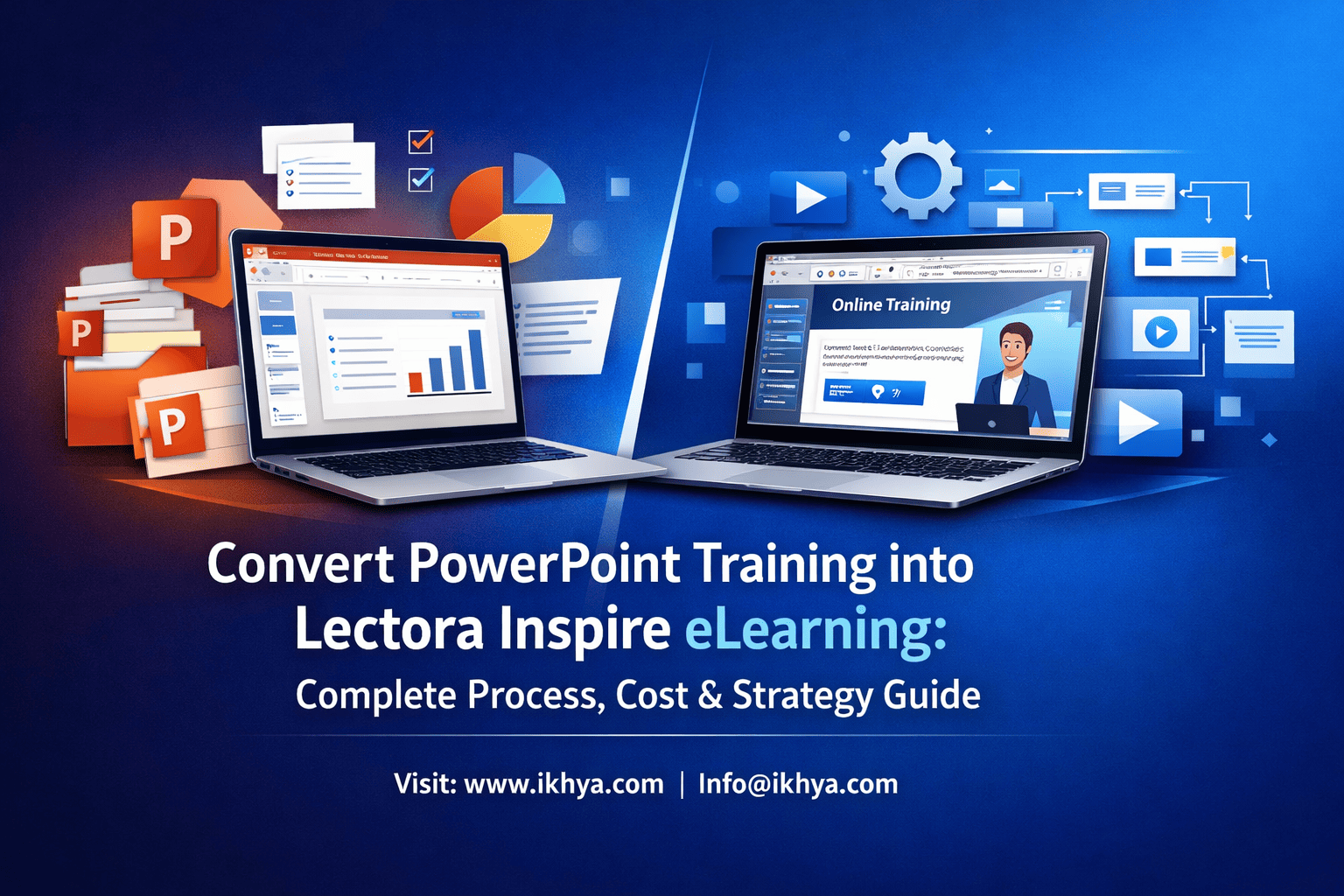
Converting PowerPoint training into Lectora Inspire eLearning is one of the most effective ways to transform static content into engaging, trackable, and scalable digital learning. Traditional PPT-based training often fails to deliver measurable results because it lacks interactivity, analytics, and learner engagement.
Modern organizations across the USA, UK, UAE, and Australia are rapidly shifting toward LMS-driven eLearning that supports SCORM, xAPI, mobile learning, and compliance tracking. If your training still relies on slides, you are likely missing performance insights and learner engagement opportunities.
To understand how structured transformation works, explore PPT to eLearning conversion services.
If you want to see how interactive learning actually looks, you can book a free eLearning demo.
What is PowerPoint to Lectora Inspire eLearning Conversion
PowerPoint to Lectora Inspire eLearning conversion is the process of transforming slide-based training into interactive, multimedia-rich, LMS-compatible courses using Lectora Inspire.
This is not just a format change—it is a complete learning experience redesign that improves engagement, retention, and tracking.
What happens during conversion
- Slides are restructured into modular learning units
- Static text is converted into interactive elements
- Assessments and quizzes are integrated
- Audio, video, and animations are added
- Courses are published in SCORM/xAPI formats
- Content is optimized for mobile and multi-device delivery
PowerPoint vs Lectora eLearning
| Feature | PowerPoint Training | Lectora eLearning |
|---|---|---|
| Interactivity | Minimal | High |
| Tracking | None | SCORM/xAPI enabled |
| Engagement | Low | High |
| Accessibility | Limited | WCAG compliant |
| Device Compatibility | Desktop-focused | Fully responsive |
Why organizations use Lectora Inspire
Lectora Inspire is widely adopted for enterprise training because it supports:
- Advanced branching and scenario-based learning
- Strong compliance and regulatory training
- Built-in accessibility features
- Seamless LMS integration
Organizations aiming for scalable and structured development often choose Lectora Inspire development services.
When conversion becomes necessary
You should convert PowerPoint training into eLearning when:
- Learner engagement is low
- There is no tracking or reporting
- Training needs to be deployed globally
- Compliance training requires audit trails
- Mobile learning is essential
For a broader strategic perspective, refer to convert PowerPoint to eLearning complete guide.
Why PowerPoint Training Fails in Modern Learning Environments
PowerPoint training fails today because it is passive, non-trackable, and not designed for digital learning behavior. Modern learners expect interaction, personalization, and measurable outcomes—none of which PPT can deliver effectively.
Key limitations of PowerPoint training
- No learner engagement
Slides are linear and passive, leading to low retention rates. - No tracking or analytics
You cannot measure completion, performance, or progress without LMS integration. - Not mobile-friendly
PPTs are not optimized for smartphones or tablets. - No interactivity or assessments
Learners cannot actively participate or test knowledge. - No compliance reporting
Critical for industries like healthcare, finance, and manufacturing.
Real-world impact
Organizations that rely only on PPT training often face:
- Low course completion rates (below 40%)
- Poor knowledge retention
- Lack of audit-ready compliance data
- Ineffective onboarding and product training
This is why companies are shifting toward interactive digital learning ecosystems supported by custom eLearning development services.
Benefits of Converting PPT into Lectora eLearning
Converting PowerPoint into Lectora eLearning transforms static content into engaging, measurable, and scalable training solutions.
Key benefits
- High engagement through interactivity
Add quizzes, branching scenarios, and simulations. - Full LMS compatibility
Track learner progress using SCORM or xAPI. - Improved knowledge retention
Interactive learning improves retention by up to 60%. - Mobile learning support
Courses work seamlessly across devices. - Scalable global deployment
Deliver training across multiple locations and languages.
Organizations looking to scale fast often rely on rapid eLearning development services to accelerate conversion timelines.
Business-level advantages
| Area | Impact After Conversion |
|---|---|
| Training Efficiency | Faster onboarding and upskilling |
| Compliance | Audit-ready reporting |
| Cost | Reduced instructor-led training costs |
| Scalability | Train global teams simultaneously |
| Analytics | Data-driven decision making |
Example scenario
A manufacturing company converted 120 PPT-based safety modules into Lectora eLearning:
- Completion rates increased from 45% to 92%
- Training time reduced by 35%
- Compliance audit success improved significantly
For organizations with blended learning programs, combining approaches like ILT to eLearning course conversion services further enhances training effectiveness.
Step-by-Step PPT to Lectora Inspire Conversion Process
Converting PowerPoint into Lectora eLearning follows a structured, multi-stage process to ensure quality, engagement, and scalability.
Step 1: Content Audit and Analysis
- Identify outdated or redundant slides
- Define learning objectives
- Segment content into modules
Step 2: Instructional Design Planning
- Create storyboards
- Define interaction strategy
- Align with learning outcomes
Organizations often use instructional design services to ensure content is pedagogically strong.
Step 3: Visual and Interaction Design
- Convert slides into engaging layouts
- Add animations and transitions
- Design user-friendly navigation
Step 4: Development in Lectora Inspire
- Build interactive screens
- Add quizzes, branching, and simulations
- Integrate multimedia
Step 5: LMS Integration and Testing
- Publish SCORM/xAPI packages
- Test across LMS platforms
- Ensure compatibility and performance
For seamless deployment across platforms, refer to LMS-compatible eLearning course development services.
Step 6: Review and Optimization
- Stakeholder feedback
- Bug fixes and improvements
- Final deployment
Instructional Design Strategy for Effective PPT to Lectora Conversion
A successful PowerPoint to Lectora Inspire conversion is not about design alone—it depends on a strong instructional strategy that transforms content into a meaningful learning experience.
What makes instructional design critical
Without proper instructional design:
- Content remains slide-heavy and ineffective
- Learners lose interest quickly
- Knowledge retention remains low
With the right approach, training becomes engaging, outcome-driven, and measurable.
Core instructional design principles used
- Chunking content
Break large PPT decks into smaller, digestible modules - Scenario-based learning
Use real-world situations to improve decision-making - Active learning
Include quizzes, drag-and-drop, and simulations - Visual storytelling
Replace text-heavy slides with visuals and interactions - Feedback-driven learning
Immediate responses improve retention
Organizations aiming for structured learning outcomes often rely on expert instructional design to ensure high-quality course development.
Cost of Converting PowerPoint to Lectora eLearning
The cost of converting PowerPoint into Lectora eLearning varies based on complexity, interactivity, and scale. There is no one-size-fits-all pricing.
Typical cost ranges
| Level | Description | Cost (Per Module) |
|---|---|---|
| Basic | Slide-based with minimal interactivity | $500 – $1500 |
| Intermediate | Moderate interactivity, quizzes | $1500 – $4000 |
| Advanced | Simulations, branching, custom UI | $4000 – $8000+ |
Factors affecting cost
- Number of slides
- Level of interactivity
- Multimedia integration
- Instructional design complexity
- Localization requirements
- LMS integration
For organizations evaluating budgets, reviewing cost of Lectora Inspire course development provides deeper financial insights.
Cost-saving strategy
- Use rapid development models
- Reuse existing assets
- Focus on high-impact modules first
Many companies reduce cost and timeline by outsourcing to rapid eLearning development providers.
Timeline for PPT to eLearning Conversion Projects
The timeline depends on project complexity, content volume, and review cycles.
Typical timelines
| Project Type | Duration |
|---|---|
| Small (5–10 modules) | 2–3 weeks |
| Medium (10–25 modules) | 4–6 weeks |
| Large (25+ modules) | 8–12 weeks |
Example timeline breakdown
2–3 Week Rapid Conversion Model
- Week 1: Content analysis + storyboard
- Week 2: Development
- Week 3: Testing and deployment
6-Week Standard Model
- Week 1–2: Instructional design
- Week 3–4: Development
- Week 5: QA and revisions
- Week 6: LMS deployment
Delays usually happen due to
- Multiple stakeholder reviews
- Unclear requirements
- Frequent content changes
For faster execution, organizations often consider outsource eLearning development benefits costs and best practices.
Lectora Inspire vs Storyline vs Captivate
Choosing the right tool is critical for effective conversion. While Lectora Inspire is powerful, it’s important to compare it with other tools.
Tool comparison
| Feature | Lectora Inspire | Storyline | Captivate |
|---|---|---|---|
| Accessibility | Excellent | Moderate | Good |
| Responsive Design | Strong | Limited | Strong |
| Interactivity | High | Very High | High |
| Ease of Use | Moderate | Easy | Moderate |
| Best Use Case | Compliance, enterprise training | Interactive storytelling | Software simulations |
When Lectora is better
- Compliance-heavy industries
- Accessibility requirements (WCAG)
- Large-scale enterprise training
For deeper comparisons, refer to Lectora Inspire vs Articulate Storyline and Lectora Inspire vs Adobe Captivate.
When to Use Lectora for PPT Conversion
Lectora Inspire is not always the default choice—but it excels in specific scenarios.
Best-fit situations
- Compliance and regulatory training
- Multi-language global deployment
- Accessibility-focused training
- Large enterprise rollouts
When not to use Lectora
- Simple microlearning modules
- Highly animation-heavy storytelling
- Small-scale projects with tight budgets
Organizations evaluating tools should also explore best eLearning authoring tools for corporate training.
Industry Use Cases of PPT to Lectora Inspire eLearning
PowerPoint to Lectora conversion is widely used across industries where training needs to be scalable, compliant, and measurable. Each industry has unique challenges that Lectora helps address effectively.
Healthcare Training
Healthcare organizations require strict compliance and audit-ready training.
Use cases:
- Patient safety training
- HIPAA compliance
- Clinical procedure training
Challenge: Regulatory requirements and frequent updates
Solution: Interactive modules with assessments and tracking
Organizations in this sector often adopt healthcare training eLearning solutions for compliance-driven learning.
Manufacturing Training
Manufacturing focuses on safety and operational efficiency.
Use cases:
- Safety training
- Equipment handling
- SOP-based training
Challenge: High-risk environments and multilingual workforce
Solution: Scenario-based learning with visual simulations
Many companies implement manufacturing training eLearning solutions to improve safety outcomes.
Finance and Compliance Training
Financial institutions need precise tracking and regulatory adherence.
Use cases:
- Anti-money laundering (AML)
- Risk management training
- Regulatory compliance
Challenge: Audit requirements and global standards
Solution: SCORM/xAPI-based tracking and reporting
These organizations benefit from financial services training eLearning solutions.
Retail Training
Retail requires fast and scalable training for large teams.
Use cases:
- Customer service training
- Product training
- Sales enablement
Challenge: High employee turnover
Solution: Mobile-friendly microlearning
Retail businesses often deploy retail training eLearning solutions for rapid onboarding.
IT and Software Training
IT training focuses on technical skills and product knowledge.
Use cases:
- Software onboarding
- Product feature training
- Cybersecurity awareness
Challenge: Frequent updates and complex concepts
Solution: Interactive simulations and modular learning
Companies adopt IT software training eLearning solutions for scalable delivery.
LMS, SCORM, and xAPI Compatibility Explained
For eLearning to be effective, it must integrate seamlessly with Learning Management Systems (LMS). Lectora enables this through standardized formats.
What is SCORM
- Tracks course completion
- Records quiz scores
- Integrates with most LMS platforms
What is xAPI
- Tracks detailed learner behavior
- Works beyond LMS (mobile, offline)
- Provides deeper analytics
Why compatibility matters
- Enables data-driven learning decisions
- Ensures compliance tracking
- Supports global deployment
Organizations deploying training at scale rely on LMS-compatible solutions to ensure smooth integration.
Common Challenges in PPT to eLearning Conversion
While conversion offers significant benefits, organizations often face challenges during execution.
Major challenges
- Content overload
PPT slides are often too text-heavy - Lack of instructional design
Poor learning structure reduces effectiveness - Limited interactivity planning
Courses remain static even after conversion - Technical compatibility issues
LMS integration failures - Stakeholder misalignment
Delays due to multiple approvals
How to overcome these challenges
- Start with content audit and simplification
- Use instructional design frameworks
- Define clear learning objectives
- Test LMS compatibility early
For organizations struggling with outdated courses, eLearning course redesigning services can help modernize existing content effectively.
Outsourcing vs In-House Development
One of the biggest decisions organizations face is whether to build courses internally or outsource development.
In-house development
Pros:
- Full control over content
- Internal expertise development
Cons:
- High setup cost
- Longer timelines
- Limited scalability
Outsourced development
Pros:
- Faster delivery
- Access to experts
- Scalable resources
Cons:
- Requires vendor coordination
- Dependency on external teams
Organizations often compare both approaches using in-house vs outsourced eLearning development cost comparison.
For large-scale or time-sensitive projects, outsourcing is usually the preferred approach.
How to Choose the Right Lectora Development Vendor
Choosing the right vendor directly impacts the success of your eLearning project.
Key evaluation criteria
- Experience in Lectora development
- Portfolio and case studies
- Instructional design capability
- LMS integration expertise
- Global delivery capability
Questions to ask vendors
- What is your development process?
- How do you ensure quality and timelines?
- Can you support multi-language deployment?
- What industries have you worked with?
To make an informed decision, refer to how to choose a Lectora Inspire development company and questions to ask before hiring a Lectora Inspire vendor.
If you are planning a structured project discussion, you can request an RFP to get detailed proposals.
Future Trends in PowerPoint to Lectora eLearning Conversion
The shift from PowerPoint to eLearning is no longer just about interactivity—it is evolving with new technologies that improve personalization, speed, and learning effectiveness.
Key trends shaping modern eLearning
- AI-driven content transformation
AI tools help convert PPT content into structured learning faster - Adaptive learning experiences
Courses adjust based on learner performance - Microlearning modules
Short, focused lessons improve retention and engagement - Mobile-first learning design
Training is optimized primarily for smartphones - Advanced analytics and xAPI
Deep insights into learner behavior and performance
Organizations aiming to stay competitive are increasingly investing in modern learning ecosystems supported by mobile learning development solutions and microlearning development services.
Final Decision Framework: Should You Convert PPT to Lectora?
If you’re still unsure, this framework helps you make a clear decision.
Convert immediately if:
- Your training is static and non-interactive
- You need LMS tracking and reporting
- Compliance training requires audit trails
- You are scaling training globally
- Learner engagement is low
Consider phased conversion if:
- You have a large volume of content
- Budget constraints exist
- Some content is still relevant as-is
Avoid conversion (for now) if:
- Training is rarely used
- Content is outdated and needs full redesign
- No LMS or digital strategy exists
Real-World Scenario-Based Decision Example
Scenario 1: Manufacturing Company
- 150 PPT modules
- Safety compliance requirement
- Multi-location workforce
Decision: Full conversion to Lectora
Outcome: Improved compliance and reduced incidents
Scenario 2: IT Company
- Product training PPTs updated frequently
- Global teams
Decision: Modular conversion with rapid updates
Outcome: Faster onboarding and product adoption
Scenario 3: Financial Institution
- Regulatory training
- Audit-heavy requirements
Decision: High-interactivity Lectora courses
Outcome: 100% audit compliance readiness
Bringing It All Together
Converting PowerPoint training into Lectora Inspire eLearning is not just a technical upgrade—it is a strategic move that improves engagement, compliance, scalability, and measurable learning outcomes.
Organizations that take a structured approach—combining instructional design, the right tools, and expert development—consistently see better training ROI and learner performance.
If you are planning to modernize your training, working with an experienced partner like IKHYA – eLearning Solutions Company can help you avoid common pitfalls and accelerate results.
Email: info@ikhya.com
To get clarity on your specific requirement, you can contact our team.
If you’re ready to evaluate your project scope and cost, you can request a detailed proposal.
FAQs
1. Can PowerPoint be directly converted into Lectora Inspire?
No, it requires redesign into interactive eLearning with instructional design and development.
2. How long does PPT to Lectora conversion take?
Typically 2–6 weeks depending on complexity and number of modules.
3. What is the cost of PPT to eLearning conversion?
It ranges from $500 to $8000+ per module based on interactivity and complexity.
4. Is Lectora better than Storyline for conversion?
Lectora is better for compliance and accessibility, while Storyline suits interactive storytelling.
5. Can converted courses work on mobile devices?
Yes, Lectora supports fully responsive and mobile-friendly learning.
6. What formats are used for LMS compatibility?
SCORM and xAPI are the most commonly used standards.
7. Do I need instructional design for conversion?
Yes, it is essential for creating effective and engaging learning experiences.
8. Can old PPT content be reused?
Yes, but it often needs restructuring and optimization.
9. Is outsourcing better than in-house development?
For large-scale or fast delivery, outsourcing is usually more efficient.
10. Can courses be translated into multiple languages?
Yes, Lectora supports multi-language course development.
11. What industries benefit most from conversion?
Healthcare, manufacturing, finance, retail, and IT benefit significantly.
12. Can I track learner progress after conversion?
Yes, through LMS using SCORM or xAPI.
13. What is the biggest challenge in conversion?
Transforming static content into engaging learning experiences.
14. Do I need an LMS for eLearning?
Yes, to track performance, completion, and analytics.
15. How can I reduce development time?
Use rapid eLearning strategies and experienced vendors.
16. What is rapid eLearning conversion?
A fast development approach using templates and reusable assets.
17. Is Lectora suitable for compliance training?
Yes, it is one of the best tools for compliance-focused learning.
18. Can simulations be added during conversion?
Yes, advanced Lectora courses can include simulations.
19. How do I choose the right vendor?
Evaluate experience, portfolio, process, and scalability.
20. What is the first step to start conversion?
Conduct a content audit and define learning objectives.
Related Resources
Explore these resources to deepen your understanding of PowerPoint to eLearning conversion and make informed decisions about tools, processes, and vendor selection. These guides are structured to help you move from strategy to execution with clarity.