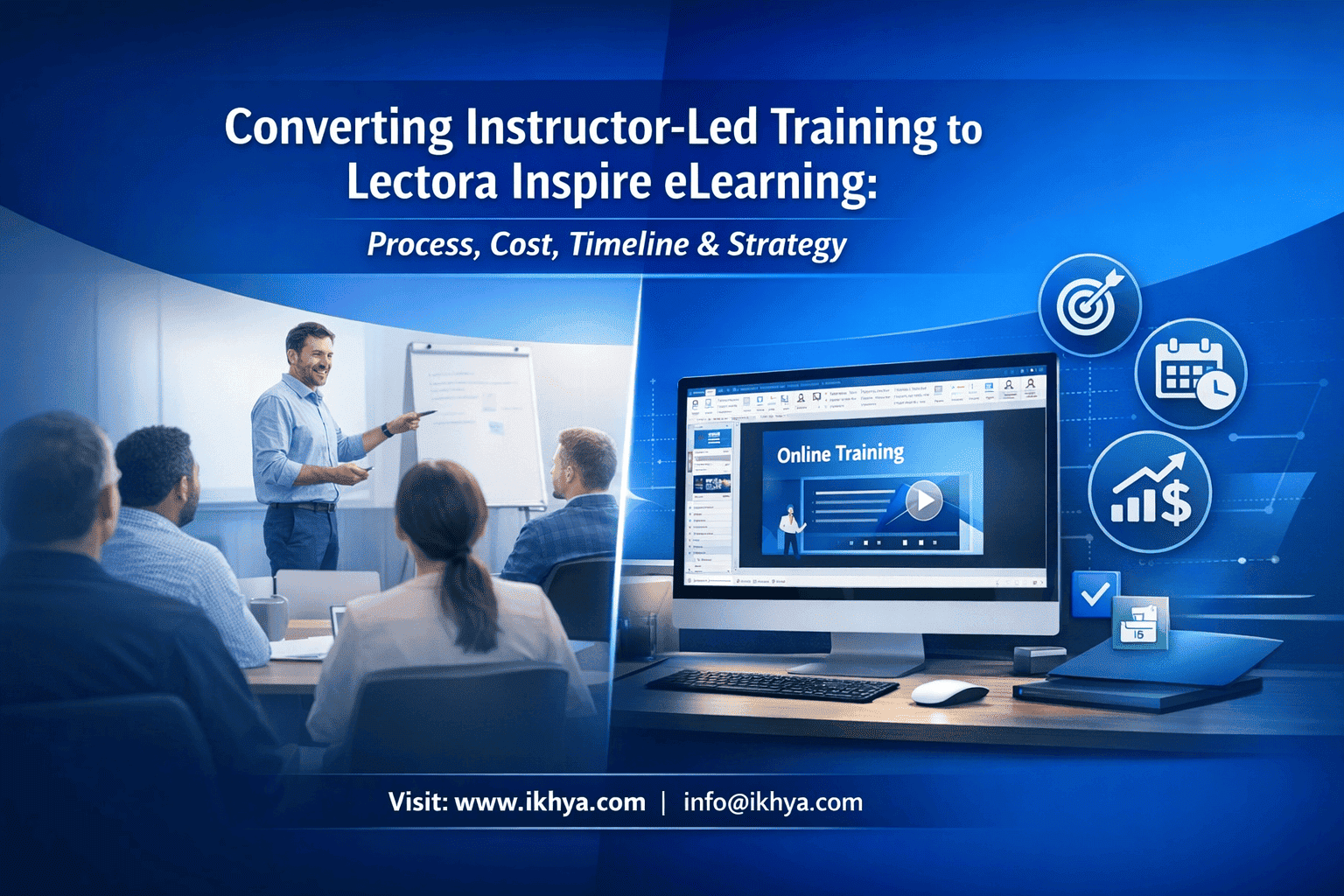
Converting Instructor-Led Training to Lectora Inspire eLearning: Process, Cost, Timeline & Strategy

Modern organizations are rapidly converting instructor-led training to Lectora Inspire eLearning to scale learning, reduce delivery costs, and improve consistency across global teams. Classroom training alone can no longer meet the demands of distributed workforces and compliance-driven industries.
If you’re exploring how to transition from ILT to digital learning, this guide will help you understand the process, cost, timelines, and strategy—so you can make informed decisions and avoid costly mistakes. If you’re evaluating your next step, you can also explore a tailored approach through a book a free demo to see how this transformation works in practice.
What Is ILT to Lectora Inspire eLearning Conversion
ILT to Lectora Inspire eLearning conversion is the process of transforming classroom-based training into interactive, digital courses using Lectora Inspire, enabling scalable, trackable, and flexible learning delivery through LMS platforms.
Instead of simply converting slides, this process involves redesigning learning experiences for digital environments.
Key Elements of ILT Conversion
- Converting instructor-led sessions into self-paced modules
- Transforming static content into interactive learning
- Embedding assessments, quizzes, and simulations
- Ensuring SCORM/xAPI compliance for LMS tracking
- Making courses mobile-responsive and accessible
What Changes During Conversion
| ILT Component | eLearning Equivalent |
|---|---|
| Instructor explanation | Interactive content + narration |
| Classroom discussion | Scenario-based learning |
| Printed manuals | Digital modules |
| Live Q&A | Knowledge checks |
| Physical assessments | LMS-based quizzes |
Why Lectora Inspire Is Used
Organizations choose Lectora Inspire because it offers:
- Advanced customization and scripting
- Strong accessibility compliance (WCAG)
- Seamless LMS integration (SCORM, xAPI)
- Flexibility for complex enterprise training needs
For organizations evaluating tools, understanding the complete capabilities of Lectora Inspire is a critical first step before conversion.
Why Organizations Are Converting ILT to eLearning
Organizations are converting instructor-led training into eLearning to improve scalability, reduce costs, and deliver consistent learning experiences across global teams while enabling tracking, analytics, and flexible access through LMS platforms.
Traditional classroom training is no longer sustainable for modern enterprises operating across multiple geographies like the USA, UK, UAE, and Australia.
Key Drivers Behind ILT to eLearning Conversion
- Scalability: Train thousands of employees without scheduling constraints
- Cost Reduction: Eliminate travel, venue, and instructor costs
- Consistency: Deliver the same training quality across all locations
- Tracking & Compliance: Monitor learner progress using LMS (SCORM/xAPI)
- Flexibility: Enable anytime, anywhere learning
Organizations exploring scalable solutions often start by evaluating ilt to elearning course conversion services to understand how structured transformation works.
Business Impact Comparison: ILT vs eLearning
| Factor | Instructor-Led Training | eLearning (Lectora Inspire) |
|---|---|---|
| Cost per learner | High | Low |
| Scalability | Limited | High |
| Tracking | Manual | Automated (LMS) |
| Consistency | Instructor-dependent | Standardized |
| Accessibility | Location-bound | Global access |
Real-World Scenario
A manufacturing company in the UAE conducting safety training for 500 employees:
- ILT Cost: ~$25,000 annually
- eLearning Cost: ~$6,000 one-time development
- ROI Achieved: Within 3–6 months
Similarly, healthcare organizations in the UK use eLearning for compliance training to ensure audit readiness and regulatory alignment, something difficult to achieve with classroom-only formats.
When ILT Starts Failing
ILT becomes inefficient when:
- Workforce is geographically distributed
- Training needs frequent updates
- Compliance tracking is required
- Training volume increases rapidly
In such cases, companies often transition using custom elearning development services to ensure content is not just converted—but optimized for digital learning.
Strategic Shift: From Teaching to Learning Experience
ILT focuses on instructor delivery, while eLearning focuses on learner engagement.
This shift includes:
- Passive listening → Interactive learning
- Instructor dependency → Self-paced autonomy
- One-size-fits-all → Personalized learning paths
To achieve this transformation effectively, organizations rely on instructional design services that restructure content into engaging digital formats.
ILT to Lectora Inspire Conversion Process (Step-by-Step)
Converting ILT to Lectora Inspire eLearning is a structured, multi-stage process involving content analysis, instructional redesign, development, testing, and LMS deployment to ensure effective and scalable learning outcomes.
This is not a simple file conversion—it is a learning transformation process.
Step 1: Content Audit & Analysis
The first step is evaluating all existing ILT materials:
- PowerPoint slides
- Instructor guides
- PDFs and manuals
- Videos and case studies
Goal: Identify what can be reused, redesigned, or removed.
Organizations transitioning from legacy formats often combine this step with ppt to elearning conversion services for faster transformation.
Step 2: Instructional Design Redesign
Content is restructured into:
- Learning objectives
- Modules and microlearning units
- Interactive elements (scenarios, quizzes)
This ensures the course is engaging, not just informative.
Step 3: Storyboarding
A detailed blueprint is created:
- Screen-by-screen flow
- Visual design
- Interactions and navigation
- Assessment strategy
This acts as the foundation of development.
Step 4: Lectora Inspire Development
The course is built using Lectora:
- Interactive screens
- Branching scenarios
- Simulations
- Multimedia integration
For advanced use cases like simulations, organizations often integrate elearning simulation based training services to enhance engagement.
Step 5: Quality Assurance & Testing
Courses are tested for:
- Functionality
- LMS compatibility
- Mobile responsiveness
- Accessibility (WCAG compliance)
Step 6: LMS Deployment
Final courses are deployed to LMS:
- SCORM/xAPI packaging
- User tracking setup
- Reporting dashboards
For organizations requiring cross-device learning, integrating mobile learning development solutions ensures accessibility across devices.
Step 7: Continuous Improvement
Post-launch:
- Analyze learner data
- Identify drop-off points
- Optimize content
Example Timeline (Realistic)
| Project Type | Timeline |
|---|---|
| Basic ILT conversion (1 hour content) | 2–3 weeks |
| Interactive course with scenarios | 4–6 weeks |
| Enterprise-level training program | 6–10 weeks |
Key Insight
The success of ILT conversion depends not on the tool—but on the strategy, instructional design, and execution quality.
Organizations that rush this process often end up with:
- Low engagement
- Poor completion rates
- Ineffective training outcomes
Instructional Design Strategy for ILT Conversion
A successful ILT to Lectora Inspire conversion depends on instructional design that transforms passive content into engaging, outcome-driven learning experiences aligned with business goals and learner needs.
Simply digitizing slides leads to low engagement. The real impact comes from how content is redesigned.
Core Instructional Design Framework
Effective ILT conversion follows this structured approach:
- Define Learning Objectives
- What should learners know or do after the course?
- Align with business KPIs (compliance, productivity, safety)
- Chunk Content into Modules
- Break long sessions into microlearning units (5–10 minutes)
- Improve retention and completion rates
- Design Engagement Layers
- Scenario-based learning
- Decision-making simulations
- Real-world problem solving
- Embed Assessments Strategically
- Knowledge checks after each module
- Final assessments for certification
- Enable Adaptive Learning Paths
- Beginner vs advanced learner tracks
- Role-based personalization
Organizations aiming for high-impact outcomes often integrate microlearning development services to improve retention and engagement.
Before vs After Instructional Transformation
| Element | ILT Format | eLearning Format |
|---|---|---|
| Content delivery | Lecture-based | Interactive modules |
| Engagement | Instructor-driven | Learner-driven |
| Practice | Group discussion | Simulations & branching |
| Assessment | End-of-session | Continuous evaluation |
Real-World Example
Finance Industry (USA): Compliance Training
- ILT Duration: 6-hour classroom session
- Converted to: 8 microlearning modules
- Result:
- 40% faster completion
- 60% improvement in assessment scores
To support compliance-heavy industries, companies often combine conversion with accessible elearning solutions to meet regulatory standards.
Common Instructional Design Mistakes
- Converting slides without redesign
- Overloading screens with text
- Ignoring learner interaction
- Skipping real-world scenarios
Cost of Converting ILT to Lectora eLearning
The cost of converting instructor-led training to Lectora Inspire eLearning typically ranges from $500 to $8,000+ per hour of content, depending on complexity, interactivity, and customization requirements.
Understanding cost drivers helps avoid underestimating budgets.
Key Cost Factors
- Content Complexity
- Basic slides → Low cost
- Technical training → High cost
- Level of Interactivity
- Static modules → $500–$1,500
- Scenario-based → $2,000–$5,000
- Simulation-heavy → $5,000+
- Multimedia Requirements
- Voiceovers
- Animations
- Video production
- Compliance & Accessibility
- WCAG standards increase effort
- Required in healthcare, finance
- Localization
- Multi-language courses increase cost
- Often required for global teams
For companies planning large-scale deployment, exploring elearning translation localization services becomes essential.
Cost Breakdown Table
| Type of Course | Cost Range (Per Hour) |
|---|---|
| Basic conversion | $500 – $1,500 |
| Interactive course | $2,000 – $5,000 |
| Advanced simulation-based | $5,000 – $8,000+ |
Example Cost Scenarios
Scenario 1: Manufacturing Safety Training (India/UAE)
- Duration: 1 hour
- Interactivity: Medium
- Cost: ~$3,000
- Timeline: 4 weeks
Scenario 2: Healthcare Compliance (UK/USA)
- Duration: 2 hours
- Interactivity: High
- Cost: ~$10,000
- Timeline: 6–8 weeks
Organizations often optimize budgets by leveraging rapid elearning development services for faster turnaround.
Cost Optimization Tips
- Reuse existing assets (videos, PPTs)
- Prioritize high-impact modules first
- Use templates for consistency
- Outsource to specialized vendors
Timeline for ILT to eLearning Development
The timeline for converting ILT to Lectora Inspire eLearning typically ranges from 2 weeks to 10 weeks, depending on content volume, complexity, and review cycles.
Standard Development Timeline Breakdown
| Phase | Duration |
|---|---|
| Content analysis | 2–5 days |
| Instructional design | 5–10 days |
| Development | 2–4 weeks |
| QA & revisions | 1–2 weeks |
Two Common Delivery Models
Rapid Development Model (2–3 Weeks)
Best for:
- Basic conversions
- Low interactivity
- Tight deadlines
Often supported by rapid development approaches using Lectora Inspire.
Standard Development Model (4–8 Weeks)
Best for:
- Interactive courses
- Compliance training
- Scenario-based learning
Timeline Risks to Watch
- Delayed SME feedback
- Frequent content changes
- Undefined learning objectives
How to Accelerate Development
- Finalize content before development
- Use standardized templates
- Work with experienced vendors
Organizations needing structured execution often consult elearning consultancy services to streamline timelines and reduce delays.
When to Choose Lectora Inspire Over Other Tools
Lectora Inspire is best suited for organizations that require high customization, accessibility compliance, and complex interactive learning, especially in enterprise and compliance-driven environments.
Choose Lectora Inspire When:
- You need WCAG-compliant courses
- Training involves complex branching scenarios
- You require deep LMS integration
- Courses must support global deployment
- You need full control over design and logic
Organizations building large-scale programs often rely on lectora inspire development services to leverage its full capabilities.
When Lectora May NOT Be Ideal
- Rapid, template-based development needed
- Minimal interactivity required
- Budget constraints are very tight
Lectora is not just a tool—it is a platform for enterprise-grade learning solutions.
Companies that choose it typically prioritize:
- Compliance
- Scalability
- Customization
Lectora Inspire vs Storyline vs Rise vs Captivate
Choosing the right authoring tool is critical because it directly impacts development speed, interactivity, scalability, and long-term maintenance of your eLearning programs.
Each tool serves a different purpose—Lectora Inspire stands out for enterprise-level customization and compliance-heavy training.
Quick Comparison of Authoring Tools
| Feature | Lectora Inspire | Articulate Storyline | Articulate Rise | Adobe Captivate |
|---|---|---|---|---|
| Customization | Very High | High | Low | High |
| Ease of Use | Moderate | Easy | Very Easy | Moderate |
| Interactivity | Advanced | Advanced | Limited | Advanced |
| Responsiveness | Strong | Medium | Excellent | Strong |
| Accessibility (WCAG) | Excellent | Good | Basic | Good |
| Best For | Compliance, enterprise | General corporate training | Rapid learning | Software simulations |
When Lectora Clearly Wins
- Complex compliance training (healthcare, finance)
- Multi-language global deployment
- Accessibility-focused training (WCAG standards)
- Advanced branching and logic
For a deeper understanding of differences, reviewing lectora inspire vs articulate storyline helps clarify tool-level decisions.
When Other Tools Are Better
- Rise: Fast deployment, simple modules
- Storyline: Balanced interactivity and speed
- Captivate: Software simulations
Organizations evaluating multiple tools often explore best elearning authoring tools for corporate training before making a final decision.
There is no “one-size-fits-all” tool. The right choice depends on:
- Training complexity
- Budget
- Timeline
- Compliance requirements
Industry Use Cases of ILT to Lectora Conversion
ILT to eLearning conversion using Lectora Inspire is widely adopted across industries where compliance, safety, and scalability are critical.
Healthcare Industry
Use Case: Compliance & regulatory training
- HIPAA, patient safety, clinical procedures
- High need for audit tracking and certification
Organizations often implement lectora inspire for healthcare compliance training to meet strict regulatory standards.
Manufacturing Industry
Use Case: Safety and equipment training
- Machine handling
- Hazard prevention
- SOP training
A typical case involves converting classroom safety sessions into interactive modules, supported by lectora inspire elearning development for manufacturing training.
Financial Services
Use Case: Regulatory & compliance training
- Anti-money laundering (AML)
- Risk management
- Audit readiness
Courses require detailed tracking and reporting, making Lectora a strong fit.
Retail Industry
Use Case: Employee onboarding and customer service
- Sales training
- Product knowledge
- Customer interaction scenarios
Retail organizations often adopt retail training elearning solutions to scale onboarding across locations.
IT & Software Industry
Use Case: Product and technical training
- Software onboarding
- System workflows
- Technical certifications
These require interactive simulations and guided learning paths.
Key Insight
Across industries, the goal is the same:
- Improve learning outcomes
- Reduce training costs
- Enable scalable delivery
Common Challenges in ILT to eLearning Conversion
ILT to eLearning conversion often fails when organizations underestimate the complexity of instructional redesign and over-rely on simple content conversion.
Major Challenges
- Content Overload
- ILT sessions are too long for digital format
- Lack of Engagement
- Static slides lead to poor retention
- SME Dependency
- Delays due to expert availability
- Technology Misalignment
- Wrong tool selection
- Poor Instructional Design
- No learner-centric approach
How to Overcome These Challenges
- Break content into microlearning
- Use interactive scenarios
- Align with learning objectives
- Choose the right authoring tool
- Partner with experienced vendors
Organizations struggling with legacy content often turn to elearning course redesigning services to improve engagement and effectiveness.
Risk Mitigation Framework
| Risk | Solution |
|---|---|
| Low engagement | Add simulations & scenarios |
| Delays | Pre-define timelines |
| Budget overruns | Fixed-scope projects |
| Poor outcomes | Instructional design focus |
Outsourcing ILT to Lectora Development
Outsourcing ILT to Lectora Inspire development allows organizations to leverage expert instructional design, faster delivery timelines, and cost efficiency without building in-house teams.
When to Outsource
- Large-scale training programs
- Tight deadlines
- Lack of internal expertise
- Need for advanced interactivity
Companies evaluating outsourcing often compare options using elearning outsourcing guide for enterprises to make informed decisions.
In-House vs Outsourcing Comparison
| Factor | In-House | Outsourced |
|---|---|---|
| Cost | High | Moderate |
| Speed | Slow | Fast |
| Expertise | Limited | Specialized |
| Scalability | Low | High |
Benefits of Outsourcing
- Access to experienced instructional designers
- Faster turnaround
- Scalable production
- Reduced operational overhead
Organizations aiming to reduce cost and timelines often choose to outsource elearning development benefits costs and best practices.
Vendor Engagement Models
- Fixed-cost projects
- Dedicated development teams
- Hourly engagement
Key Decision Insight
Outsourcing is not just about cost—it is about:
- Speed
- Quality
- Scalability
How to Choose the Right eLearning Vendor
Choosing the right vendor for ILT to Lectora Inspire eLearning conversion directly impacts project success, cost efficiency, and long-term scalability. The right partner brings not just development capability, but instructional design expertise and strategic alignment.
Key Criteria for Vendor Selection
- Instructional Design Capability
- Do they redesign content or just convert it?
- Look for structured learning frameworks
- Lectora Expertise
- Experience with complex interactions
- Knowledge of accessibility standards (WCAG)
- Portfolio & Case Studies
- Industry-specific examples
- Proven results (completion rates, ROI)
- Process & Communication
- Defined workflow
- Clear timelines and milestones
- Technology & Compliance
- SCORM/xAPI expertise
- LMS integration capability
Organizations evaluating vendors often start with a structured approach using how to choose the elearning vendor to avoid costly mistakes.
Vendor Evaluation Framework
| Criteria | What to Check |
|---|---|
| Experience | Years + industry exposure |
| Capability | Tools, interactivity, design |
| Scalability | Ability to handle large projects |
| Cost Model | Transparent pricing |
| Support | Post-launch maintenance |
Questions to Ask Before Hiring
- Have you handled ILT to Lectora conversions before?
- Can you share similar project examples?
- What is your development process?
- How do you ensure quality and engagement?
Before finalizing a vendor, reviewing questions to ask before hiring a Lectora Inspire vendor can help eliminate risk and improve decision confidence.
When to Request an RFP
An RFP is recommended when:
- Project scope is large
- Multiple vendors are being evaluated
- Budget needs to be justified
You can streamline this process using a structured request rfp to get accurate proposals aligned with your requirements.
Future Trends in ILT to eLearning Conversion
ILT to eLearning conversion is evolving rapidly with the integration of AI, automation, and data-driven learning strategies, making training more personalized, scalable, and efficient.
Key Trends Shaping the Future
1. AI-Powered Learning
- Adaptive learning paths
- Personalized recommendations
- Automated content generation
2. Microlearning Dominance
- Short, focused modules
- Mobile-first delivery
- Higher retention rates
3. Data-Driven Learning Analytics
- Real-time learner tracking
- Performance insights
- Predictive learning outcomes
4. Automation in Development
- Faster content conversion
- Template-driven design
- Reduced development time
5. Multi-Device Learning
- Mobile-first design
- Responsive learning experiences
Organizations embracing modern strategies often combine conversion with mobile-first learning strategies to ensure accessibility across devices.
The future is not just about converting ILT—it is about creating intelligent, adaptive learning ecosystems.
Final Decision Framework: Should You Convert ILT to Lectora Inspire?
If you’re evaluating whether to convert your instructor-led training into Lectora Inspire eLearning, this framework will help you make a confident, business-aligned decision.
When You Should Convert
- Training is delivered repeatedly across locations
- Costs of classroom training are high
- Compliance tracking is required
- Workforce is remote or distributed
- Training needs frequent updates
When You Should Reconsider
- Training is highly discussion-based
- Audience size is very small
- Budget is extremely limited
Decision Matrix
| Scenario | Recommended Action |
|---|---|
| Large workforce + compliance needs | Convert to Lectora |
| Rapid deployment required | Consider Rise/Storyline |
| High customization needed | Use Lectora |
| Low complexity training | Use rapid tools |
Converting ILT to Lectora Inspire is not just a content shift—it is a business transformation strategy that impacts:
- Learning effectiveness
- Operational efficiency
- Compliance readiness
If you’re planning your next step, you can explore your requirements with experts at contact us to get clarity on cost, timelines, and execution strategy.
IKHYA – eLearning Solutions Company
Email: info@ikhya.com
FAQs
1. What is ILT to eLearning conversion?
It is the process of transforming classroom training into digital, interactive learning modules.
2. Why should organizations convert ILT to eLearning?
To reduce costs, improve scalability, and enable tracking through LMS platforms.
3. How long does ILT to eLearning conversion take?
Typically 2 to 10 weeks depending on complexity and interactivity.
4. What is the cost of ILT conversion?
It ranges from $500 to $8,000+ per hour of content.
5. Why use Lectora Inspire for eLearning?
It offers high customization, accessibility compliance, and strong LMS integration.
6. Can all ILT content be converted to eLearning?
Most content can be converted, but it requires instructional redesign.
7. What industries benefit from ILT conversion?
Healthcare, manufacturing, finance, retail, and IT sectors.
8. Is Lectora better than Storyline?
Lectora is better for complex, compliance-heavy training, while Storyline is easier to use.
9. What are common mistakes in ILT conversion?
Simply converting slides without redesign and ignoring interactivity.
10. Do I need an LMS for eLearning?
Yes, for tracking, reporting, and learner management.
11. What is SCORM in eLearning?
A standard that allows courses to communicate with LMS systems.
12. What is xAPI?
An advanced tracking standard that captures detailed learner data.
13. Can ILT be converted into microlearning?
Yes, content can be broken into short, focused modules.
14. Should I outsource eLearning development?
Yes, if you need expertise, speed, and scalability.
15. What tools are used for eLearning development?
Lectora, Storyline, Rise, and Adobe Captivate are common tools.
16. How do I choose the right vendor?
Evaluate experience, portfolio, process, and technical expertise.
17. What is the biggest benefit of eLearning?
Scalability and consistency across global teams.
18. Can eLearning be updated easily?
Yes, digital courses can be modified faster than ILT materials.
19. What is mobile learning?
Training accessible on smartphones and tablets.
20. How do I get started with ILT conversion?
Start with a consultation or demo to assess your training needs.
Related Resources
Explore these resources to deepen your understanding of ILT to eLearning conversion, Lectora development, and enterprise training strategies. These links guide you from foundational knowledge to decision-making and implementation.